



Abstract
Objective
This study aimed to evaluate the quality and reliability of information presented in short videos related to anterior cruciate ligament (ACL) injuries on two major Chinese social media platforms, TikTok and Bilibili.
Methods
A systematic search using the keyword “ACL injuries” was conducted to identify the top 100 Chinese videos on TikTok and Bilibili, respectively. The Global Quality Score (GQS) and the modified DISCERN evaluation scale were employed to assess video content reliability and quality. Videos characteristics—including engagement metrics, uploader identity, video length, and content type—were also gathered. Statistical analyses were conducted to examine differences and correlations between platforms, uploader categories, and video quality.
Results
Out of 200 videos reviewed, 175 met inclusion criteria. The most common content theme was treatment, found in 59 videos (33.71%). TikTok videos attracted higher user engagement than Bilibili. However, the overall video quality on both platforms was moderate. TikTok videos scored higher on GQS and modified DISCERN than on Bilibili. Engagement on TikTok showed no positive correlation with content quality, while that on Bilibili demonstrated a moderate positive correlation. Videos uploaded by healthcare professionals were more popular but often tended to be shorter in duration. Notably, videos uploaded by individual users often achieved quality scores comparable to, or even exceeding, those of medical professionals and science communicators.
Conclusion
TikTok demonstrated higher engagement than Bilibili, but both platforms showed limited quality and reliability in ACL injury-related video content. No strong correlation was observed between video content quality and engagement. These findings highlight the need for improved oversight of ACL injury-related information disseminated through short video platforms in China.
Introduction
Anterior cruciate ligament (ACL) injuries are a major clinical and public health concern, particularly amid the global rise in sports participation. 1 ACL injuries are among the most frequent and debilitating knee injuries, commonly resulting from non-contact mechanisms such as sudden deceleration, pivoting, or landing from a jump.2,3 Their incidence has been steadily increasing, especially among adolescents and young adults.4,5 The typical clinical presentation of ACL injuries includes symptoms such as immediate knee instability, extensive swelling within 6 h, and inability to continue physical activity. 6 Despite these hallmark symptoms, ACL injuries are often underdiagnosed at initial presentation, leading to delayed treatment and worse outcomes. A retrospective analysis involving 160 study participants with an average age of 28.6 years revealed that only 14.4% of ACL injury patients were correctly diagnosed during their initial medical visit. 7 Such delays increase the risk of secondary injuries, such as meniscal tears and post-traumatic osteoarthritis, prolong rehabilitation, and reduce the likelihood of returning to pre-injury activity levels. 8 Beyond physical injuries, ACL injuries impose significant psychological and socioeconomic burdens on patients, particularly adolescents, manifesting as feelings of disappointment, sports avoidance, and diminished social interactions post-injury. 9
Public awareness of ACL injuries has long remained insufficient, particularly regarding prevention, symptoms, and treatment. For instance, a regional survey of 576 participants revealed that although more than half of the population acknowledged the severity of ACL injuries, major knowledge gaps persisted regarding risk factors and characteristic symptoms. 10 It is imperative to educate patients about the advantages and disadvantages of different management options and to encourage their participation in shared decision-making. Accordingly, a patient decision aid has recently been developed for children and adolescents with ACL rupture to promote active involvement in shared decision making and treatment decisions. 11 While high-profile injuries in elite athletes may raise general awareness of the condition, this visibility often fails to convey the comprehensive knowledge necessary for effective injury prevention and management. For instance, a study of German professional football reveals significant sex-specific risks and long-term career impacts—such as a 3.0% ACL prevalence in women's football and one-third of players sustaining a second injury within 6 years—details rarely captured in mainstream media coverage. 12
In this digital era, short videos have become a powerful and essential tool for health education. 13 The China Online Audiovisual Development Research Report (2025) indicates that short videos have become a foundational application for Chinese internet users, with over 30% of users being under the age of 24. Social media enables individuals, particularly adolescents, not only to passively receive information but also to actively seek knowledge about ACL injuries. However, the educational value of these videos depends largely on the accuracy and quality of their content. Efforts to maximize click-through rates and engagement may sometimes undermine scientific rigor, leading to potential misinformation that could negatively affect patient decision-making and management. 14 Therefore, assessing the quality of ACL injury-related content on social media platforms is essential for improving the effectiveness of public health education. An analysis of 127 videos related to ACL injuries on Instagram found that their GQS and DISCERN scores were predominantly between 2 and 3, reflecting low to moderate overall quality and limited reliability. These videos primarily focused on surgical procedures and evaluation while largely neglecting prevention and potential complications, indicating substantial gaps in the completeness and educational value of the content. 15 The videos primarily focused on surgical techniques and evaluations, while complications and prevention were the least mentioned topics. This indicates that Instagram can serve as a tool for obtaining information about ACL reconstruction surgery, but other aspects still need improvement. Currently, no studies have analyzed the content and quality of videos related to ACL injuries on Chinese short-video platforms. This study addresses this gap by evaluating the reliability and quality of ACL injury-related videos on two prominent short video platforms, TikTok, and Bilibili.
Materials and methods
Ethical considerations
This study has been reviewed and approved by the Ethics Committee of Limin Hospital of Weihai High District (LMLL-2025-003). Written informed consent was not required for either participation in the study or for the publication of potentially/indirectly identifying information, in accordance with the local legislation and institutional requirements. The social media data was accessed and analyzed in accordance with the platform's terms of use and all relevant institutional/national regulations.
Search strategy and data processing
We conducted a cross-sectional study and performed a systematic search using newly registered, standardized accounts to minimize user-specific bias. The Chinese phrase “ACL injuries” was used as the keyword to search TikTok (https://www.douyin.com/) and Bilibili (https://www.bilibili.com/), respectively, based on each platform's comprehensive ranking system. A total of 200 short videos—100 from each platform—were selected for inclusion in this study. The default comprehensive ranking algorithm integrates multiple metrics, encompassing user engagement data, video recency, and content creator authority. The comprehensive search was conducted on June 20, 2025. We omitted videos that fell under the following categories: (1) duplicate content; (2) videos not pertaining to the topic; (3) videos lacking audio; (4) videos not in the Chinese language. The basic information and content quality of these videos were reviewed and assessed by two independent reviewers (T.M. and X.L.), and any discrepancies were resolved through consensus by a third investigator (W.X.).
We retrieved and recorded the basic information of each video, including the uploader's name, uploader type, release date, video duration (in seconds), number of likes, number of comments, number of shares, and number of collections. Patients or the public were not involved in the design, conduct, reporting, or dissemination plans of our research.
Evaluation methodologies and procedure
To assess the reliability and quality of the short videos that were collected, this study utilized the Global Quality Score (GQS) alongside a modified version of the DISCERN score. The GQS, which ranges from 1 (very poor quality) to 5 (excellent quality), provides a holistic evaluation of video quality, incorporating aspects such as flow and logical organization, accuracy of information, clarity of narration, visual presentation, and the educational value to the general public. 16 For reliability assessment, a modified DISCERN tool was employed. Reviewers assessed whether each video met five binary (Yes = 1/No = 0) criteria: (1) Clarity—Is the information presented in an understandable and straightforward way? (2) Relevance—Is the content relevant to ACL injuries and appropriate for public education? (3) Traceability—Are sources or references (e.g., medical guidelines or literature) provided or implied? (4) Robustness—Is the information evidence-based, comprehensive, and not overly simplified? (5) Fairness—Is the information presented objectively without bias or commercial intent? The total modified DISCERN score thus ranged from 0 to 5.17,18
In addition, the content of the video was categorized into the following: (1) Prevention, (2) Diagnosis, (3) Symptoms, (4) Disease Overview (including two or more of etiology, diagnosis, symptoms, prevention, treatment, lifestyle, prognosis), (5) Lifestyle (prevention or treatment through lifestyle), (6) Treatment (including medication, rehabilitation, surgery), and (7) Prognosis. Each video was assigned to a single, mutually exclusive category. The types of uploaders were classified as follows: (1) Healthcare professionals (Verified doctors, nurses, rehabilitation therapists, or technicians employed by medical institutions, as well as official accounts representing hospitals or clinics. Verification was confirmed via platform identity tags, professional titles, or disclosed affiliations), (2) Science communicators (Individuals or groups dedicated to disseminating scientific or medical knowledge but not affiliated with clinical institutions; typically content creators with a focus on health education), (3) News media (Such as online media, television stations, newspapers), and (4) Individual users (Unaffiliated individuals without clear medical or journalistic background; identified by lack of professional credentials, institutional affiliation, or verified tags). Evaluations were performed by a trio of assessors possessing pertinent medical expertise, all of whom had undergone standardized training before scoring in order to maintain consistency in the evaluation standards and reduce bias.
Statistical analysis
This research employed descriptive statistics alongside nonparametric testing to evaluate the characteristics of videos and their quality metrics. Categorical variables were represented as counts and percentages, whereas continuous variables were summarized with medians and interquartile ranges. Differences in platform distributions were assessed with chi-square tests or Fisher's exact tests, and Mann–Whitney U tests were employed to compare interaction data and quality scores between TikTok and Bilibili. For comparisons involving multiple groups, such as medical personnel, news outlets, science communicators, and individual video users, Kruskal–Wallis tests were conducted. The overall agreement in ratings was evaluated using Cohen's coefficient (κ), based on methodologies from previous research. 19 The Cohen's κ value determined for this research was > 0.8, indicating a robust level of interrater reliability. To explore the connection between GQS and modified DISCERN scores, a Spearman's correlation analysis was performed. The statistical analyses were conducted using SPSS version 26.0, whereas visual representations were generated through the Hiplot platform (https://hiplot.cn/). 20 Results were considered to be statistically significant with p < .05.
Results
Video characteristics
A total of 175 short videos related to ACL injuries were included. The selection process is depicted in Figure 1, and video characteristics are summarized in Table 1. TikTok contributed 98 videos (56.0%), while 77 (44.0%) were from Bilibili. The majority were uploaded by healthcare professionals (68.0%), followed by individual users (16.6%) and science communicators (15.4%) (Figure 2). Treatment (33.7%) and overview (22.9%) were the most common content types. The overall quality was moderate, with both GQS and modified DISCERN scores showing a median of 3 (IQR: 2–3), indicating that most videos provided only basic or partially adequate information with limited reliability. Inter-rater reliability was high (Cohen's kappa: 0.884 for GQS, 0.849 for DISCERN).

The flow chart of this study.

Distribution of videos by source type on TikTok and Bilibili platforms.
Video characteristics.

Comparison of characteristics between different short-video platforms.

Comparison of different video source.

Comparison of features across platforms
TikTok videos showed significantly higher engagement (likes, comments, shares, and collections) than Bilibili (p < .001 for all). They were also significantly shorter in duration (p < .001) but received higher quality ratings, with higher median GQS scores (3 vs. 2, p = .025) and higher median modified DISCERN scores (3 vs. 2, p < .001). These findings suggest that TikTok videos were generally of moderate quality and reliability, while Bilibili videos tended to be lower in both aspects (Table 2, Figure 3). TikTok also had a higher proportion of videos from healthcare professionals (86.7% vs. 44.2%), while Bilibili featured a more diverse mix of uploader types and content categories.

Comparison of video quality scores between Bilibili and TikTok platforms.
Comparison of features across different video sources
Healthcare professionals generated the majority of content and attracted more engagement in likes, comments, and shares (p < .05). However, their videos were shorter than those from other uploader types (p < .001). Individual users achieved the highest GQS scores, while DISCERN scores remained consistent across all uploader categories (Table 3, Figure 4).
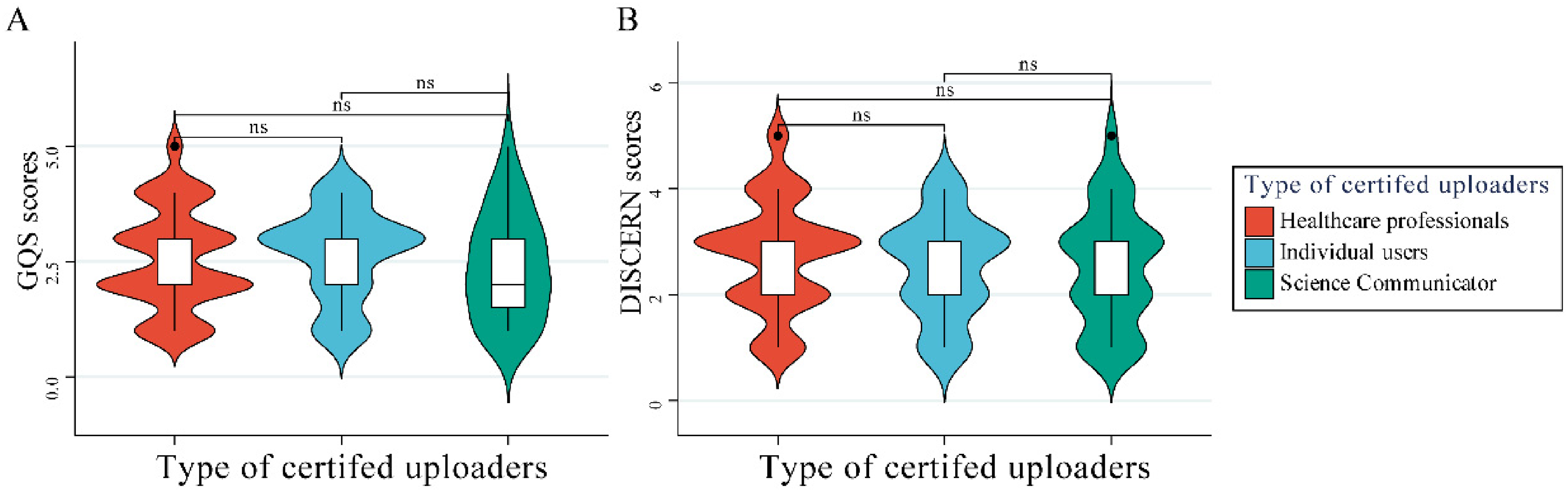
Comparison of video quality scores by video source.
Correlation analysis
On Bilibili, video duration showed a positive correlation with both engagement and quality scores. TikTok showed no such pattern. Across both platforms, a moderate positive correlation was observed between GQS and DISCERN scores, while engagement metrics did not correlate with video quality, especially on TikTok (Figure 5).

Correlation matrix of video engagement metrics and quality scores on TikTok and Bilibili.
Discussion
Summary of findings
This cross-sectional study evaluated the content of 175 short videos from two major Chinese short-video platforms (TikTok and Bilibili) to examine the quality and reliability of health information related to ACL injuries. The video content primarily focuses on the therapeutic aspects, including surgical techniques and postoperative rehabilitation guidance. It also provides a comprehensive overview of risk factors, diagnosis, symptoms, and other pertinent information related to ACL injuries. The study utilized the GQS and modified DISCERN scores as evaluation tools to quantitatively assess the completeness and reliability of short videos. Overall, the health information presented in these short videos demonstrated moderate reliability.
Our study revealed marked disparities in content quality and user engagement between TikTok and Bilibili. TikTok videos were generally much shorter but achieved substantially higher levels of user interaction than Bilibili videos. This may reflect differences in platform algorithms, content styles, and user behaviors. TikTok's algorithm prioritizes highly engaging, short-form videos, which fosters rapid dissemination and broad reach. 21 Moreover, most ACL injury-related TikTok videos were uploaded by healthcare professionals, likely contributing to higher levels of audience trust and engagement. By contrast, Bilibili tends to host longer, more detailed videos from diverse content creators, catering to users seeking detailed tutorials. This may explain its lower, but more deliberate, engagement patterns.
Although the overall quality scores of short videos on both platforms were moderate (median scores of 3 out of 5 on both GQS and modified DISCERN scales), TikTok videos demonstrated statistically significant improvements in quality and reliability compared with Bilibili. This rating advantage of TikTok videos may be explained by the high proportion of medical professionals contributing to TikTok, producing content that is generally more accurate and structured. Moreover, TikTok's recommendation algorithm favors high-quality professional creators and promotes content tailored to users’ interests, thereby raising the platform's average quality. Interestingly, however, individual users achieved higher GQS ratings than medical professionals and science communicators. This may reflect their ability to share authentic personal experiences as patients, resulting in narratives with stronger coherence and emotional resonance. Additionally, individual users generally display advanced social media skills, employing refined editing techniques, subtitles, background music, and visual effects that enhance both aesthetic appeal and engagement. Such techniques make complex or technical medical knowledge more accessible and digestible. Their content also tends to be more focused and simplified, further improving clarity and ease of understanding. Consequently, within the framework of GQS evaluation, which emphasizes holistic presentation, comprehensibility, and audience resonance; these factors provide individual users with a relative advantage.
Comparison with previous studies
A study analyzing 127 ACL injury-related videos on Instagram reported GQS and DISCERN scores predominantly in the range of 2–3, indicating low to moderate overall quality and limited reliability, with most videos providing only basic or partially adequate information. 15 Similar to our findings, the content primarily focused on surgical techniques and clinical evaluation, while preventive measures, complications, and long-term management were rarely addressed. This trend was also observed on Twitter, where content posted by physicians primarily emphasized surgical interventions, while patients focused more on prognosis-related topics. 22 On YouTube, the quality of videos demonstrating ACL reconstruction surgery was found to be unsatisfactory, with low educational value and reliability. 23 Furthermore, videos related to postoperative rehabilitation and return to sports after ACL reconstruction on YouTube also demonstrated poor accuracy and trustworthiness. Notably, videos produced by healthcare professionals exhibited significantly higher quality compared to those created by commercial entities or individual users. 24 These findings align with the quality issues observed on Chinese short-form video platforms. However, from the perspective of content creators, individual users actually received higher GQS scores than healthcare professionals—a result that diverges markedly from trends observed on Instagram or YouTube. This suggests that on Chinese short-form video platforms, content generated by individual users can still serve as a considerable educational resource.
The gap between patient needs and content
Ramkumar et al. through the analysis of 3145 posts about ACL surgery published by Instagram users found that patients are more concerned about practical aspects such as wound appearance, the recovery process, and the return to sports. 22 However, there is a gap between these needs and the available video content. On platforms like TikTok and Bilibili, videos categorized as “treatment” and “overview” account for more than half of the content. This reflects, to some extent, that platform content is serving a role in public disease education, which may stem from the fact that public awareness of ACL injuries in China is still in its early stages. 25 Nevertheless, the nature of short videos makes it difficult to provide the personalized advice that patients seek. Additionally, the insufficient proportion of “prognosis”-related content may make it challenging for patients to establish reasonable recovery expectations, potentially leading to unnecessary anxiety. Therefore, narrative videos uploaded by individual users can provide patients with valuable experiential references and emotional resonance, serving as an indispensable supplement to the educational efforts of healthcare professionals.
Addressing challenges and opportunities in health information governance on Chinese short video platforms
Short video platforms such as TikTok and Bilibili have recently emerged as influential tools for health information dissemination, offering engaging and accessible content to wide audiences. 26 Given the rapid growth of internet use in China, these platforms can potentially play a pivotal role in health education. However, the accuracy and reliability of health-related content on these platforms vary considerably, underscoring the need for systematic evaluation. 27
The dissemination and impact of health-related short videos are shaped by several interacting factors, including uploader identity—where medical professionals garner significantly higher engagement due to their perceived credibility. Platform-specific algorithms also play a role, often favoring brevity and immediacy over depth, while content that aligns with immediate user concerns, such as treatment options, tends to gain the most traction. 28 Platforms should strengthen oversight by implementing stricter verification systems and recalibrating recommendation algorithms to prioritize evidence-based content. Simultaneously, healthcare professionals should adopt more effective digital communication strategies to engage audiences. Regulatory bodies and academic institutions must establish clear guidelines and promote critical health literacy to foster a more reliable and beneficial digital health information ecosystem.
Limitations and future directions
First, video data were restricted to Chinese short video platforms, potentially restricting the generalizability of the findings. Second, because short video platforms frequently update their algorithms, the findings are time-sensitive and may not reflect future trends. Third, the quality assessment tools used carry some degree of subjectivity and may not fully capture the actual informational needs of patients, potentially impacting the accuracy of the survey results. To overcome these constraints, future research should expand to include multiple platforms and diverse languages, adopt newer and more objective assessment metrics, and effectively leverage artificial intelligence to improve analytical efficiency. Such improvements would strengthen the robustness and impact of future investigations.
Conclusion
This study evaluated ACL injury–related short videos on TikTok and Bilibili and found that the overall quality and reliability were moderate, with a median score of 3 out of 5 on both GQS and modified DISCERN scales. TikTok videos demonstrated higher quality and engagement levels than those on Bilibili, potentially due to a higher proportion of content from healthcare professionals. However, video popularity did not consistently reflect content quality. Notably, some individual users produced videos with quality comparable to or exceeding those by professionals, likely due to stronger narrative clarity and audiovisual appeal. These results highlight the need for improved oversight and collaboration between platforms, healthcare professionals, and regulators to ensure that short video content supports accurate and accessible health education.
Supplemental Material
sj-xlsx-1-dhj-10.1177_20552076261418829 - Supplemental material for Quality and reliability of anterior cruciate ligament injury-related short Chinese videos on Bilibili and TikTok: Cross-sectional study
Supplemental material, sj-xlsx-1-dhj-10.1177_20552076261418829 for Quality and reliability of anterior cruciate ligament injury-related short Chinese videos on Bilibili and TikTok: Cross-sectional study by Teng Ma, Xin Li, Zhiping Yu, Wenjing Qu, Wenpeng Xie and Haibo Cong in DIGITAL HEALTH
Footnotes
Ethical considerations
This study has been reviewed and approved by the Ethics Committee of Limin Hospital of Weihai High District (LMLL-2025-003). Written informed consent was not required for either participation in the study or for the publication of potentially/indirectly identifying information, in accordance with the local legislation and institutional requirements. The social media data was accessed and analyzed in accordance with the platform's terms of use and all relevant institutional/national regulations.
Author contributions
Teng Ma, Xin Li, Wenpeng Xie, and Haibo Cong co-designed the study. Teng Ma, Xin Li, Zhiping Yu, and Wenjing Qu collected and analyzed the data and drafted the manuscript. Wenpeng Xie and Haibo Cong revised the manuscript. All authors contributed to the article and approved the submitted version.
Funding
The authors disclosed receipt of the following financial support for the research, authorship, and/or publication of this article: This work was supported by Shandong Province Medical and Health Technology Project (grant number: 202304071516), Joint project between the Science and Technology Department of the National Administration of Traditional Chinese Medicine and the Health Commission of Shandong Province (grant number GZY-KJS-SD-2024-087), and Traditional Chinese Medicine Technology Project of Weihai (2024N-36).
Declaration of conflicting interests
The authors declared no potential conflicts of interest with respect to the research, authorship, and/or publication of this article.
Data availability
The original data used in this study were obtained from TikTok (https://www.douyin.com/) and Bilibili ( ) and are publicly available on the platform. The analyzed datasets generated during the study are available from the corresponding author upon reasonable request.
Supplemental material
Supplemental material for this article is available online.
References
Supplementary Material
Please find the following supplemental material available below.
For Open Access articles published under a Creative Commons License, all supplemental material carries the same license as the article it is associated with.
For non-Open Access articles published, all supplemental material carries a non-exclusive license, and permission requests for re-use of supplemental material or any part of supplemental material shall be sent directly to the copyright owner as specified in the copyright notice associated with the article.
