



Abstract
Introduction
Hospitals play a potentially crucial role in public health, and social media can be powerful tools to reach their target audiences but are hospitals exploiting them to their full potential?
Methods
We retrieved the institutional webpages and the social media profiles (Facebook, Instagram, X (Twitter), YouTube, LinkedIn, WhatsApp and Telegram) of all Italian public hospitals located in regional capitals (N = 194). From 1 March to 30 April 2022, we analysed these profiles, noting the number of followers and of posts published, the date of the last post, and the availability of a social media policy. We selected the most active 53 social media profiles (belonging to 33 hospital facilities) for a closer content analysis. Engagement was measured through numbers of reactions, comments and shares to posts published from 1 to 30 April 2022.
Results
About 36.6% of hospitals had a social media profile, and 18.3% had a social media policy. Most (87%) used Facebook as their main platform. They posted most frequently about hospital events and activities (48.3% of the socially active set). Overall, engagement was modest, as on average 0.62% of potential users reacted to a post. The same post often appeared without modifications across different platforms (82.3% of cases for Instagram, 37.8% for X (Twitter) compared to Facebook).
Conclusions
Italian public hospitals did not seem to have a clear social media policy nor strategy, and social media remained underused. Italian hospitals, therefore, appeared to be missing valuable opportunities to reach out to their patients and communities.
Introduction
There is little doubt that effective communication is a central tenet for any public health intervention, in that it improves prevention, short-term and long-term care. Public health communication may involve healthcare providers, individuals, communities, policy makers and organisations at the local, national or international level, with the ultimate goal of providing citizens with the necessary knowledge and skills to understand, choose and interact with the healthcare system, improving their own lifestyle and well-being. While communication carried out via social media may be perceived as falling short of the standards for credibility and relevance required by the World Health Organisation, 1 it is also arguably very easily accessible, understandable and extremely timely – three further key characteristics of effective public health communication. Moreover, evidence shows that nowadays, social media such as Facebook, Instagram, X (Twitter) 1 or Tik Tok are the preferred means through which people, and especially the younger generations, produce and retrieve information of any kind, alongside the world wide web and offline media such as newspapers, television and the radio, and that this tendency has increased during the Covid-19 pandemic. 2
Studies and commentaries have also discussed the impact of social media on the medical profession and on clinical practice. For example, Gholami-Kordkheili's 2013 review 3 already explored social media's challenges and opportunities for medical professionalism, citing the guidelines which had just been published by the American Medical Association. These encouraged the single doctor or practitioner to reflect on how to best use social media so as to enhance, rather than hinder, their medical professionalism, highlighting the risks involved. Similarly, the systematic review carried out in 2014 in Italy by Vanzetta et al. 4 listed the following possible risks of using social media in health care: violation of patients’ or colleagues’ privacy, inappropriate sharing and dissemination of sensitive information, violation of professional boundaries, breach of confidentiality of health information and the risk of compromising the professional image of the practitioner, their organisation or even the health care system. To date, the situation appears to have changed little: the potentials and risks remain largely unchanged, and as a result, updates to the guidelines (such as the one presented by the AMA in 2019 2 ), while taking into account changes dictated by technological advancement and the increasing digitisation of the population, do not appear to propose significant differences from what was already identified in 2013. However, these documents focus primarily on how individual health professionals should use social media, while in fact the creation and management of institutional profiles, referring to organisations such as hospitals, would require specific consideration. Indeed, when individual health professionals communicate with their patients through social media on behalf of the organisation they work for, they transfer (even if partially) all of the above-mentioned risks (e.g. compromise of professional image, violation of boundaries and patient confidentiality) from themselves to the entire facility. At the same time, an organisation that violates one or more of the above-mentioned points will create problems for both patients and employees. On the other hand, hospitals also play a potentially crucial role as a source of credible and actionable information, because they are authoritative institutions, often firmly anchored in and well-known at the local and regional, if not national and international, level. They may also organise initiatives to offer prevention and treatment services, and to disseminate research. 5
Citing the Texas Methodist Health System, Richter et al.
6
contend that hospitals tend to exaggerate risks and consequently do not exploit social media to their full potential: Many of the reservations hospitals have about social media stem from misperceptions. The idea that mistakes in the social media content posted by hospital staff leads to far-reaching and disastrous consequences is not necessarily accurate. […] In the 2 years after the [Methodist Health] system initiated a social media policy for its 12,000 employees, only a few violations occurred. Also, mistakes or inaccurate information are corrected more quickly on social media sites than through traditional avenues. (p. 448)
Once again, the Covid-19 pandemic can be said to have highlighted both these opportunities and challenges: it arguably pointed out that the lack of presence of hospitals, and health care organisations more generally, on social media in a society where these are increasingly at the centre of public and private life would pose great risks, including ruling out the possibility of counteracting the phenomenon of infodemics and the circulation of false information.
Rationale for the present study and research questions
Despite official guidelines and commentaries, little is still known about the way hospitals communicate with their public, and especially about the way they use social media, mainly because to date, most studies published on the topic focus primarily on the use of social media by single health care professionals. Few studies have been carried out on hospitals’ social media profiles; these focused on countries such as the United States,6–8 Spain
9
and Portugal.
10
Generally, they have found that hospitals tend to use social media reluctantly, infrequently or unsuccessfully, either because they do not have a social media profile, because they do not update it regularly, or do not create a successful message and consequently do not reach a high level of engagement. It is not entirely clear whether this is due to a lack of interest and/or resources, or due to fears connected with the novel, and sometimes unreliable, nature of the medium itself. Moreover, to our knowledge, a comprehensive study of the Italian hospitals’ social media presence is still missing. Therefore, we sought to investigate if and how Italian public hospitals use social media, and the level of engagement with their audience, carrying out a quali-quantitative analysis from an interdisciplinary (public health and discursive) perspective. Our main research questions were the following: RQ1: Do Italian public hospitals have one or more social media profile? RQ2: Are Italian public hospitals active on social media? RQ3: Which kind of content do they publish on social media? RQ4: Do they obtain a high level of engagement?
Materials and methods
This is a mixed-methods study where we gathered quantitative and qualitative data about Italian hospitals’ use of social media pages. We first retrieved the complete list of Italian hospitals from the Italian Ministry of Health's website (updated to 2019 3 ). This list includes all public and private Italian hospitals alongside information on their location (region and county), size (big hospitals accommodate 750–1000 patients; medium-sized hospitals accommodate 500–750 patients; small hospitals accommodate 200–500 patients) and type of facility. From this list, we selected all public hospitals (including hospitals, directly operated hospitals, research institutions, hospitals integrated with university, hospitals integrated with the national health service, scientific institutes of hospitalisation and care as well as state-funded scientific institutions of hospitalisation and care) located in regional capitals 4 in line with. 10 We thus obtained a dataset of N = 194 hospitals.
We used Google to retrieve each hospital's website, and we used contact information available on the website to retrieve their official social media profile(s), which were then manually checked. Only institutional profiles were included in the study: personal, departmental, service or unofficial profiles were excluded. Additionally, we searched the hospitals’ websites to look for a publicly available social media policy document.
As a second step, we determined which social media profile was indeed actively used and regularly updated, by collecting for each hospital and for each social media page the number of followers, the number of posts published in the last month and the date of the last published post, the only exceptions being LinkedIn (where we considered the number of followers only) and Telegram (where we considered the number of subscribers only). The reference time frame was 1 March to 30 April 2022 (UTC + 01:00). For each social media platform, a list was drawn up in descending order, from the hospital that published the most to the one that published the least. Among these, we selected the first quartile (dividing by excess) to carry out a closer quantitative and qualitative analysis.
For each of the selected hospitals and social media pages, each post published from 1 April to 30 April 2022 (UTC + 01:00) was then analysed, taking into account the ensuing aspects (again following
10
):
- Profile picture; presence or absence of contact information, presence or absence of a description of the hospital's mission/vision, presence or absence of pinned posts (used to retrieve essential information about the facility more easily) and presence or absence of answers to users’ comments. - Engagement, measured by calculating the average number of reactions, comments, views and shares obtained by each post in relation to the number of followers. - The content of each post, including text and image.
We also noted the similarities and differences among the posts published by the same hospital across different platforms, in order to assess the extent to which communication is planned taking into account the different affordances of each social media platform. Finally, we carried out a corpus-assisted content analysis of the texts of the Facebook posts
11
using the SketchEngine software
12
and MaxQDA 2022.
13
Facebook was chosen for this closer qualitative analysis because it was the single most used social media platform in our sample. The methodology described in this section is summarised visually in the flow chart in Figure 1.

Flow chart visually showing the methodology used to carry out the research.
Results
Quantitative analysis of social media usage
From the first step of the analysis, we discovered that 71 out of 194 hospitals (36.6%) had at least one social media profile. Among these, Facebook was the most widely used (62 out of 71 hospitals, corresponding to 87.3%, had a Facebook profile), followed by YouTube (51 hospitals, 71.8%), X (Twitter) (39 hospitals, 54.9%) and Instagram (25 hospitals, 35.2%). Noticeably, however, only 13 out of the 71 facilities that had one or more social media profiles also had a publicly accessible social media policy (18.3%).
The final sample for the closer qualitative analysis, made up of hospitals belonging to the first quartile of the most active social media users, comprises 16 Facebook pages, 13 YouTube channels, 10 X (Twitter) profiles, 6 Instagram Pages and 4 LinkedIn pages; as for Telegram, we decided to include all four channels in our analysis. This list thus consists of 53 social media pages and profiles, referring to 33 different facilities. The full list of the hospitals included in this part of the study, together with their characteristics (location, size and type of facility), number of followers and number of posts published in the month under scrutiny, is available as Supplementary Material. Table 1 shows the median/range of number of followers and number of posts published by hospitals according to location, size and type of facility.
Final sample of 53 social media profiles referring to 33 different hospitals belonging to the first quartile of the most active social media users, grouped according to location, size, type, number of followers and number of posts published in the last month (expressed as median/range).
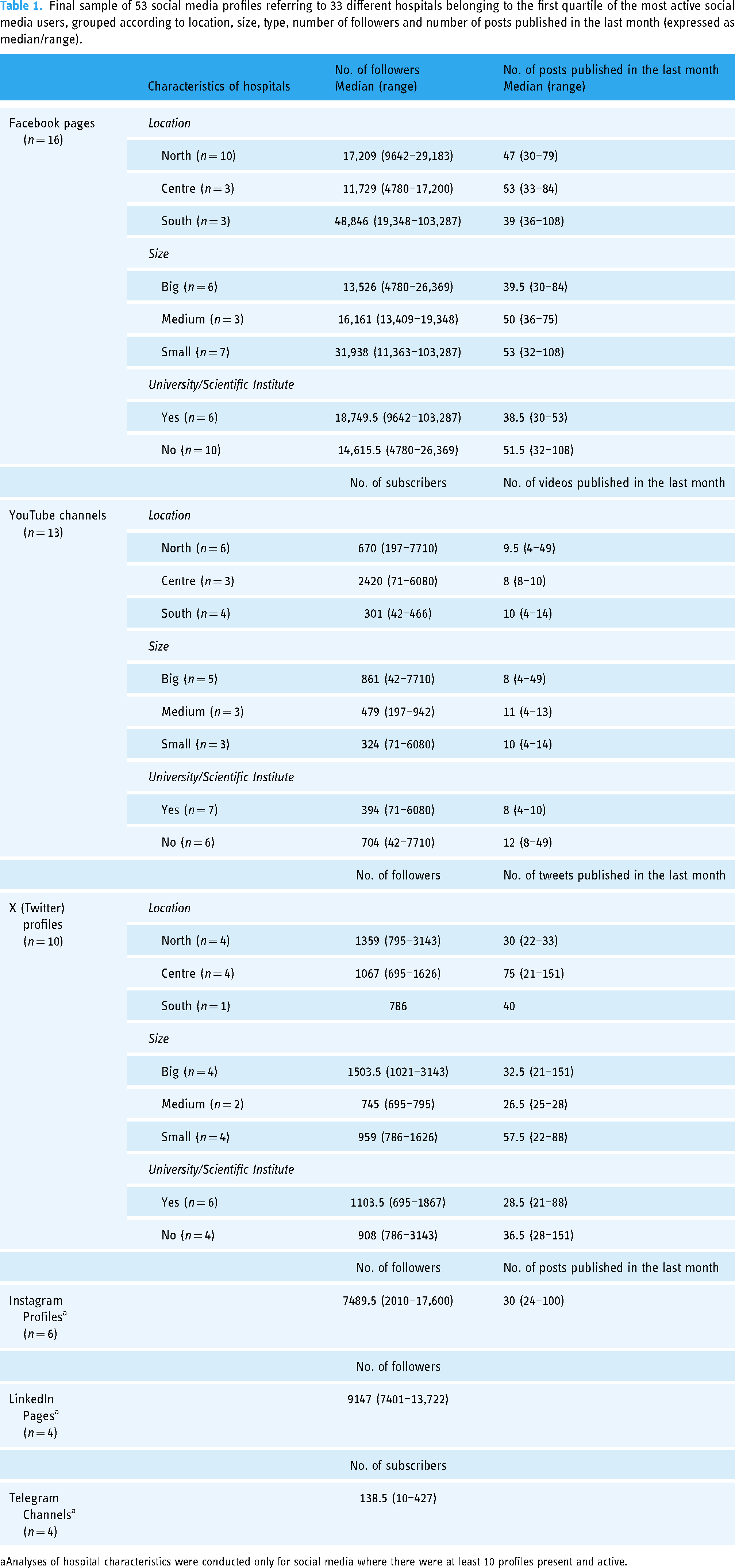
Analyses of hospital characteristics were conducted only for social media where there were at least 10 profiles present and active.
Analysis of the most active social media profiles
Sample description
Most of the Italian hospitals which tended to be most active on social media were located in Northern Italy (17 hospitals, 51.5%); 8 hospitals (24.2%) were located in the centre of Italy and 7 (21.2%) in the South (see Supplementary Materials). Most of the hospitals in our sample (9, 27.3%) were medium-sized, but these were closely followed by smaller (7 hospitals, 21.2%) or bigger (7 hospitals) facilities; 5 (15.2%) hospitals in our sample were very big, accommodating more than 1000 patients and 4 (12.1%) were very small, accommodating 200 or fewer patients. Nine hospitals (27.3%) were affiliated with universities; 10 (30.3%) are hospitals where the provision of medical care is combined with scientific research activities; combined, hospitals where scientific research is carried out account for 57.7% of the sample. Interestingly, only five facilities had a publicly available social media policy document. Moreover, there was a discrepancy between existing and actively used social media profiles, as most of the facilities in the selected sample had two (nine hospitals), three (nine hospitals) or four (eight hospitals) social media profiles, but the majority of them (23, 69.7%) actively used only one platform.
When looking more closely at the tendencies shown in Table 1, which groups the hospitals in the sample according to location, size and type, we can see that the hospitals with the highest number of Facebook followers were located in the South, although hospitals in the North and in the Centre tended to post more frequently; moreover, smaller hospitals tended to have a higher number of Facebook followers and to post more frequently, as well. The opposite seems to hold true for X (Twitter), where the highest number of followers was obtained by hospitals located in Northern Italy and by bigger hospitals, although hospitals located in the Centre and smaller hospitals tended to post more frequently. As far as YouTube is concerned, hospitals located in the Centre of Italy and bigger hospitals had a higher number of subscribers. Hospitals that were not affiliated with a university or research centre tended to be more successful in terms of number of Facebook followers and YouTube subscribers, and to post more frequently on Facebook, YouTube and X (Twitter).
Analysis of the social media pages
Profile pictures, contact information, mission and vision and answers to users’ comments
As can be seen in Figure 2, most hospitals displayed their own logo or a picture of their own façade as their social media profile picture; moreover, they always included contact information such as phone number and email address, so as to connect with their present or prospective patients and their families outside social media. However, only a minority of them clearly described their mission and/or vision. Similarly, only 2 pages exploited the possibility of adding pinned posts to their Facebook profile, that is, posts considered by the authors and editors of the page as foundational and descriptive of their identity or reporting content that must always and quickly remain available to users. The use of Instagram featured stories, which are similar to Facebook's pinned posts, was more widespread.
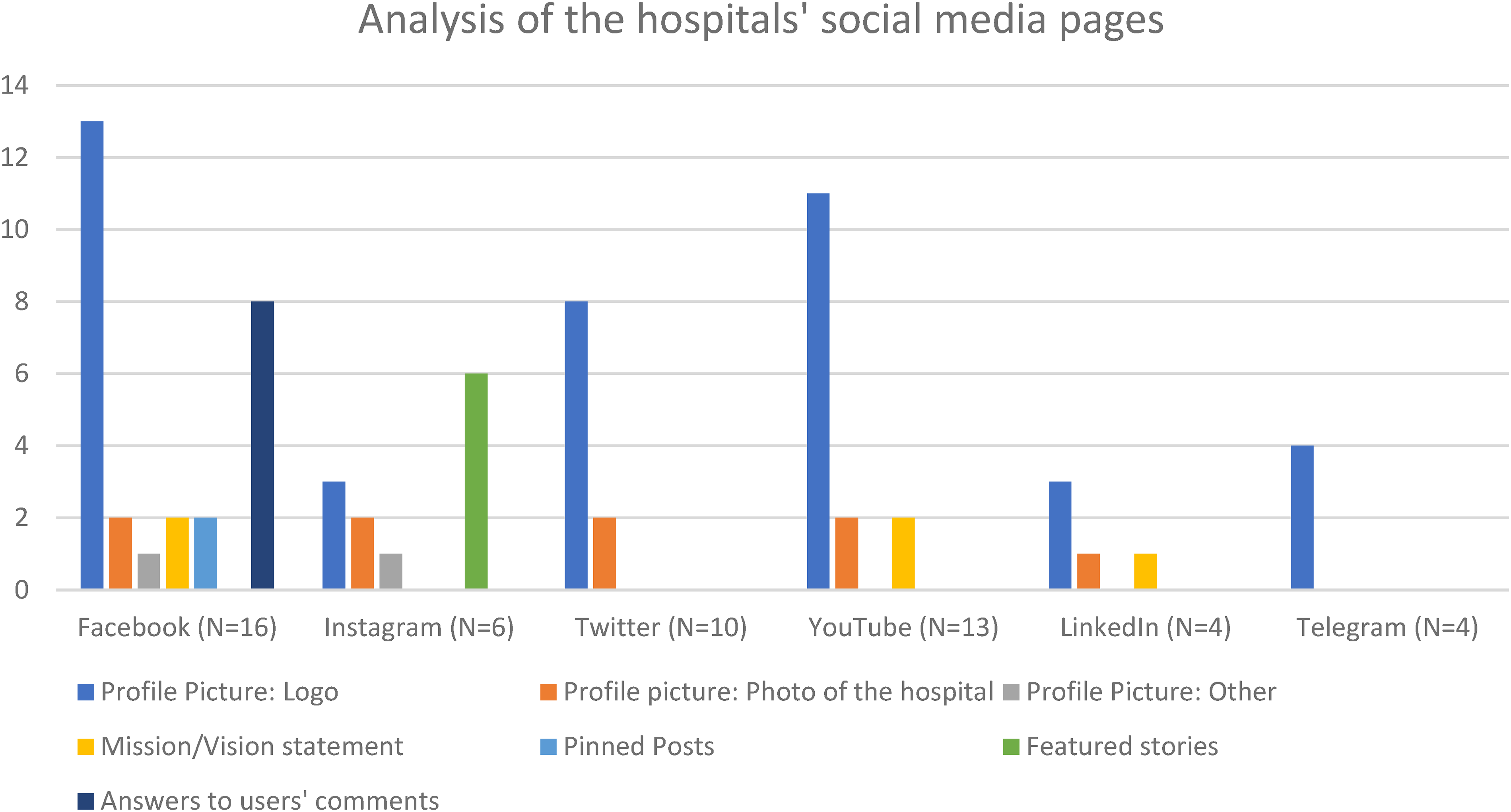
Analysis of the social media pages’ profile pictures, presence of mission/vision statements, pinned posts (on Facebook), featured stories (on Instagram) and answers to users’ comments (on Facebook). Denominators for each set are shown in parentheses.
We also noted whether Facebook editors publicly responded to comments left by users, because this datum can be used to assess whether, and to what extent, the social media page serves to establish a two-way dialogue between its editors and its users, namely between the hospital and its public. We found that most of the hospitals analysed never responded to comments posted by users; only one hospital publicly replied to comments which signalled technical problems such as broken hyperlinks. It should be emphasised, however, that given the nature of our survey (where we chose to adopt a passive approach to the social media pages investigated, without interacting directly with them) it was not possible to assess whether the page answered private messages written by individual users.
Page activity
As previously stated, the initial sample selection identified the hospitals with the highest number of posts published in April 2022. However, we recognised a high variability in the frequency with which hospitals posted new content: more specifically, 32.3% of hospitals in our sample posted daily on Facebook (at least one post in each of the 30 days under study, averaging three posts per day); most hospitals (54.7%) posted frequently (at least one post in 20 out of 30 days); 6.5% posted infrequently (at least one post in 10 out of 30 days) and another 6.5% of hospitals in our sample rarely posted anything (one post in five days out of 30). These patterns appeared very similar across all the platforms in our sample, because hospitals tended to share the same content simultaneously on different social media with minimum adjustments, as will be further argued in ‘Quantitative content analysis of the posts’ section.
Engagement
We measured engagement by noting the number of reactions, views and comments elicited by each post. However, given that each profile had a different number of followers, and therefore a different number of potential users/viewers, we calculated the average number of reactions per post in relation to the number of followers, reporting the percentage value, as shown in Table 2.
Engagement level, measured by noting the number of reactions, views and comments elicited by each post and calculating the percentage in relation to the number of followers, as of 30 April 2022.

It appears that, despite the apparent variability in the number of reactions elicited, all pages failed to engage their public significatively; the only exception was Telegram, which, however, is an instant messaging app, where subscribers to different channels are more likely to see each message that they receive.
Quantitative content analysis of the posts
While analysing the content of the posts we noticed that most hospitals tended to publish the same post across different platforms, with only very little or no modifications. In most cases, posts first appeared on Facebook and were then shared or re-posted on Instagram (where 82.3% of the published content was similar or identical to Facebook) and on Telegram (where 94.4% of the published content was similar or identical to Facebook). In 94.3% of our sample, the recording of a live event first posted on Facebook was then uploaded on YouTube. The only exception was X (Twitter), where 37.8% of the published posts were similar or identical to Facebook. However, the remaining 62.2% of tweets were not original content, instead were re-tweets from other profiles, (such as the Italian Ministry of Health), and therefore do not constitute original material produced by the hospital itself. Therefore, the analysis and the percentages presented in the ensuing paragraphs refer to Facebook only, but the results apply to all the social media platforms in the sample.
Exploring the content of all posts, it emerged that they were mostly used to publicise news, events or activities within the hospital; 19% displayed information on diseases and/or preventive behaviours; 16% were about Covid-19 (general information, swab tests, restrictions); 9.6% were posts about commemorative dates; 6.1% shared information on awards received by the hospital and/or staff and in rare cases (0.9%) text was absent. The same tendency held true when analysing each hospital in more detail, as shown in Figure 3: 77.3% of the facilities in the sample posted more content concerning hospital news, events and activities (in red in the graph), while fewer hospitals used their Facebook page mainly to provide information on diseases and/or preventive behaviours (in orange in the graph) or on Covid-19 (in blue in the graph).
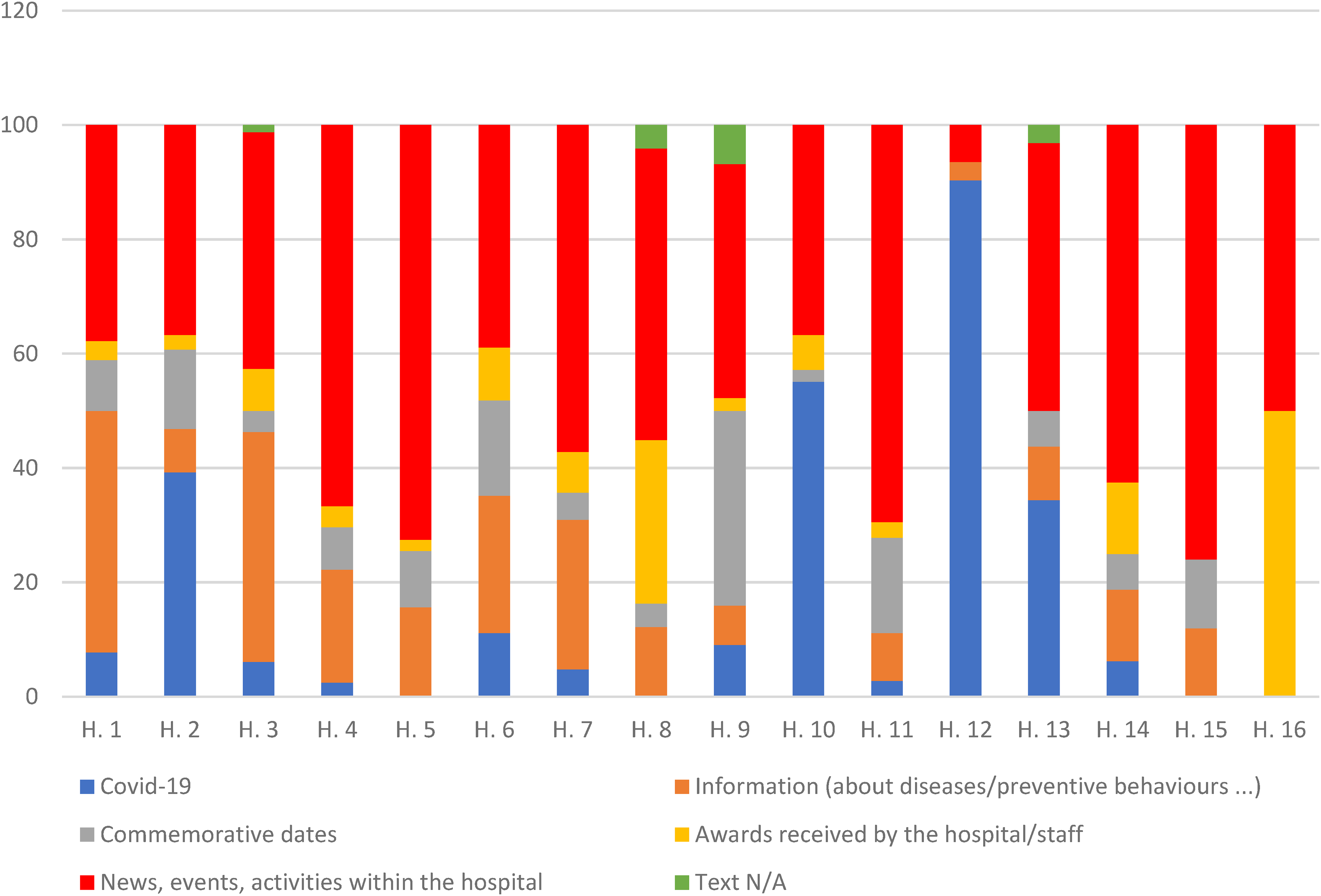
Content of the posts published on Facebook.
Furthermore, in 43.8% of the cases, the post with the highest number of reactions per page belonged to the category ‘posts about news, events and activities within the hospital’, while in 37.5% of the cases it fell into the category ‘posts about awards received by the hospital/staff’. On the other hand, the category ‘posts providing information on diseases/preventive behaviours’ only accounted for 6.3% of the posts that generated the highest number of reactions.
The same tendency was reflected in their use of pictures complementing the written text, because, once again, these tended to display photographs of the hospital premises, patients or staff (28.7% of the whole set). The other predominant trend was infographics, used in 21.1% of cases, followed by posters of events (13.8%), stills from videos (11.6%) and photos of events (9.1%). To a much lesser extent were stock images of environments and/or people used (2.6%), as well as images of hospital procedures and/or technology (2.6%). Images that did not fall into any of these categories were labelled as ‘other’ (3.9% of the cases). Only in 0.4% of the cases, the text was not accompanied by any image.
The analysis of the most frequent words and phrases in the corpus further highlighted this emphasis on the hospital itself, its activities and its patients, as shown by the word-cloud 5 in Figure 4. The words which appear most prominently in the cloud, that is, the most frequently used lemmas, are ‘paziente’ (‘patient’), salute (‘health’), ‘anno’ (‘year’) ‘aprile’ (‘April’), ‘donna’ (‘woman’), ‘ospedale’ (‘hospital’), ‘nuovo’ (‘new’), ‘dose’, ‘cura’ (‘cure’), ‘sanitario’ (‘health’), ‘medico’ (‘physician’) and ‘ricerca’ (‘research’).
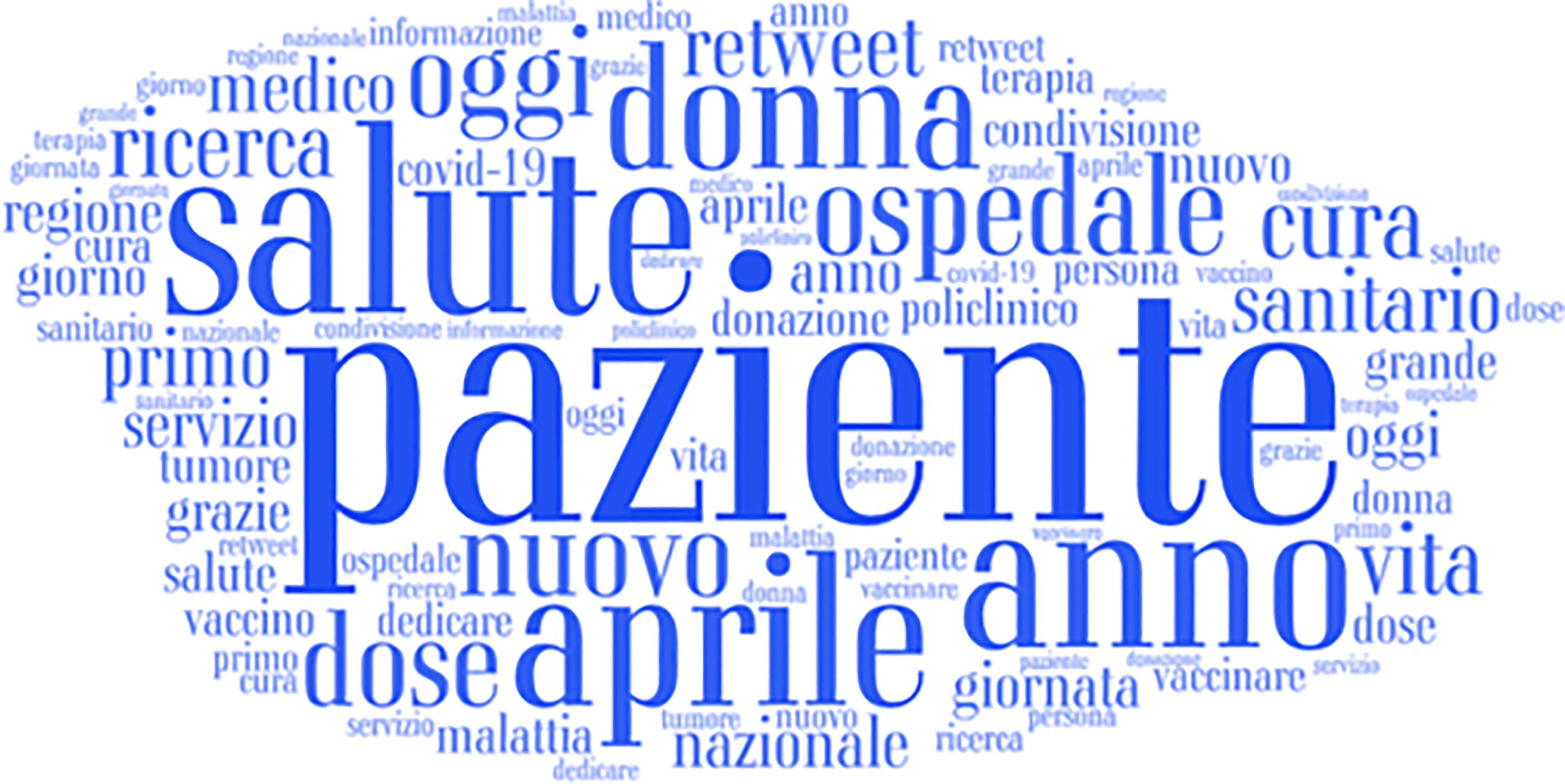
Word-cloud showing the most frequent words in the overall corpus of posts published in hospitals’ social media profile pages.
In the ensuing section, a closer qualitative content analysis of three posts from the Facebook corpus is briefly presented.
Qualitative content analysis of three Facebook posts
The first example is a Facebook post which was published on 4 April 2022, with the aim of providing people with health information. It received very modest engagement, with only 14 people ‘liking’ the content, three comments and two shares. As is typical of Facebook posts, it displays a picture and an accompanying text. The picture portrays a man, whose face is not recognisable because his back is partially turned; however, his gestures – he is touching his right ear with his hand – clearly suggest that he is in pain and probably suffering from tinnitus. His pain is also visually represented through colour, as pink is used to focus on his right ear and hand while the rest of the picture is in black and white. The image is accompanied by a long text starting with a direct question to capture the reader's attention (‘Are you hearing annoying buzzes and hisses in your ears?’), followed by a possible diagnosis (‘It could be tinnitus’). The text then explains the characteristics and incidence of tinnitus in some detail; at the end, a link is provided to an external, authoritative source (the website of the National Institute of Health) to provide further information on this ailment. There might be different reasons why the social media accounts in our sample make the choice to link to an external source for further information, including not only the desire to drive traffic but also the strive to build trust by including the hospital in a solid healthcare system led by an authoritative research institution. However, it must be noted that this could also have a possibly negative effect on some of the readership, as this choice might be also perceived as failing to promote the hospital itself as a source of creditable information. Moreover, the post fails to inform readers about who they should turn to if they experience tinnitus; this is a potential problem, especially if the post is seen by users who are not scrolling the hospital's Facebook profile but merely come across it because someone else has shared it. These shortcomings could help explain why the hospitals in our sample were struggling to produce successful informative posts.
Conversely, as mentioned earlier, posts showing life inside the hospital, its workers and its patients seemed to be particularly successful in terms of engagement. An example of this type of post was published on 9 April 2022. Five pictures show one doctor who works for the hospital while she was attending a public event hosted by a local association; the text explains that the doctor was the recipient of a prize awarded by the association, and thanks all the people who voted for the hospital by directly addressing them (‘A heartfelt thanks to all of you who voted for the hospital’). This type of posts, which appeal directly to users, is generally successful on Facebook because it creates a sense of community, builds trust and at the same time promotes success stories; and indeed, this post prompted 174 reactions, 5 comments and 3 shares. However, it should be noted that the kind of exposure workers and patients are subjected to by agreeing to have their pictures taken and shared on social media may not be accepted or appreciated by all and may raise concerns about compliance with privacy regulations, as recalled by Richter and colleagues. 6 Moreover, the effectiveness of this kind of post is based on the attempt to create a relationship of familiarity and trust between patients and facility staff, but without providing any medical nor organisational information.
A more effective type of Facebook post seems to be devoted to informing people of initiatives taking place within the hospital. For example, one post published on 13 April 2022 informed users of an initiative dedicated to women's health, and received 169 reactions, 48 comments and 148 shares. The image showed the poster for the event, while the accompanying text described the details of the initiative, including: the days it took place, the different types of examinations women could undergo and a link to an external newspaper article that provided additional information. Details on how to contact the hospital to participate in the initiative were not provided in the post, but were given in the linked article. This seems one of the most effective ways to exploit the potentials offered by social media communication to improve the connection between hospitals and their patients which can have direct effects on the population's participation in public health initiatives.
Discussion
Our first RQ asked whether Italian public hospitals had one (or more) social media profile. Our results show that Italian public hospitals tended to not use social media extensively in the period under study, as only 36.6% of the public facilities located in regional capitals had a social media profile. Although this percentage was slightly higher than that reported by Martinez-Millana et al., 9 who discovered that only 34.2% of Spanish hospitals had a social media page, it still falls short of the requirements set by the WHO and is much lower than that of US hospitals, where 94% had an active Facebook profile, as reported by Medina et al. 8
Our second RQ aimed to discover whether Italian public hospitals were active social media users, consistently producing new content. In the selected sample, most hospitals had two, three or four social media profiles; however, most actively used only one platform, thus missing the opportunity to engage an audience as wide and varied as possible.
The preferred social media was Facebook, used by 87.3% of the socially active hospitals in our sample; as for the other platforms, YouTube and X (Twitter) were used by 71.8% and 54.9% of the analysed hospitals. In both cases, the percentages were higher than those found in Spain, 7 where it was discovered that 44% out of 269 socially active public hospitals used Twitter, 31% used Facebook and 24% used YouTube. Moreover, no clear tendency seemed to emerge in terms of location, size and type of facility analysed.
The lack of a clear communication and social media strategy was evident also from the analysis of mission/vision statements and social media policy documents. This result is in line with what was discovered in the US, 8 where only 18.8% of the analysed hospitals displayed a mission and 6.02% a vision statement, but is much lower than the percentage reported in Portugal (76%). 10
Furthermore, social media were often not exploited to their full potential: for instance, only 12.5% of the analysed sample took the opportunity to create pinned posts on Facebook, although these are useful to highlight some of the best content on the page (note that this percentage is lower than the 21% reported for Portuguese hospitals 10 ). Moreover, social media profiles did not seem to be used to construct a two-way dialogue with their public, as most did not answer to the comments left by the users on their homepage (although, as stated, it was not possible to assess whether they answered to direct messages). Again, this result is in line with Gonçalves's, 10 who found that only 18% of Portuguese public hospitals replied to comments. This inability to take advantage of the specific affordances of each social media platform, as well as the lack of planning and communication strategy, was also suggested by the fact that the same post was often shared without substantial variations across the different platforms, failing to tailor a different message based on the social media's various affordances.
As for the content of the published posts, which was the topic of our third RQ, most of the hospitals in our sample used social media to promote news, events and activities within the hospital itself rather than trying to disseminate information on diseases and preventive behaviours. This tendency could also be seen in Gonçalves 10 (showing that 18% of Portuguese public hospitals posted about diseases, whereas 100% posted about hospitals news and events), but was more prominent than the trend reported for US hospitals, 8 57% of which advertised their awards and recognitions on Facebook. Most importantly, this seems at odds with the increase in the use of social media as a source of information on health and illness and with the evidence reported by the recent Data Science Task Force study, 14 according to which health institutions are increasingly being taken up by citizens as reference points on which to base their opinions. These sources highlight a growing need for accurate, accessible and comprehensible information, but arguably, Italian hospitals still fail to be a reference source on the subject. This seems closely linked to the seeming lack of in-depth reflection on the reasons why a hospital should open a social media profile, hinted at by the absence of a clear mission/vision statement and of clear upstream planning. Finally, when answering RQ4 about engagement of such posts we found that overall engagement was modest, and that posts about news, events and activities within the hospital obtained the highest number of reactions.
We also looked more closely at the actual discursive realisation of these posts, providing three examples which were representatives of (a) posts providing health information, (b) posts promoting awards received by hospitals and hospital staff and (c) posts sharing information on hospitals’ public health initiatives. We were thus able to more clearly identify the strengths and weaknesses of each category; the analysis showed that social media tended to work best to inform the population about public health initiatives taking place within the hospitals, providing information on how to participate and whom to contact.
The study has several limitations: firstly, we lacked access to information visible only to the editors of the pages, such as the number of people reached by one single post. Thus, we measured engagement using the number of reactions left by users to one post and creating a percentage based on the number of followers. However, this datum is necessarily imprecise due to the social media's internal mechanisms, whereby not every follower of a given social media profile sees the content it produces, which can nonetheless be visible to some users who do not follow the same page. Similarly, the information we gathered about social media policy and the content of the posts were based uniquely on the publicly available material. Hence, future developments of this analysis could involve surveys exploring the hospital staff's and the public's opinion about the use of social media by institutional health organisations. Third, our analysis covered a very limited time span of two months. Fourth, the aim of the study was limited to uncovering main hospitals’ social media pages and did not include departmental pages, which may have more direct engagement and communicate differently with patients, as they are closer to their immediate needs.
Nevertheless, our initial sample consisted of all Italian public hospitals located in regional capitals, and the close quantitative and qualitative analysis of the most active social media profiles in this sample encompassed a number of aspects and characteristics of the social media page. Therefore, we believe our analysis to have accurately portrayed the use and willingness to use social media by Italian healthcare facilities in a given period.
Conclusion
Our study explored Italian public hospitals’ use of social media (Facebook, Instagram, X (Twitter), LinkedIn and Telegram) in March and April 2022, from an interdisciplinary perspective. Our quali-quantitative analysis took into account several aspects, including brand image, engagement levels and content of the published posts. We discovered that Italian public hospitals tended to use social media infrequently and inconsistently (RQ1 and RQ2), despite the unquestionable centrality of good and effective communication in today's healthcare and the potentials of the Internet and of social media in reaching wide audiences. Moreover, we discovered that they do not tend to use social media to promote health information and initiatives, but rather to publicise news, events or activities within the hospital (RQ3). However, their posts received very modest engagement (RQ4). These results are in line with current literature and suggest that hospitals should implement their communication strategies, possibly involving teams of professionals to reach higher levels of engagement. Although our analysis covered a limited time span, this exploration is arguably worth continuing, given the increasingly central role that communication plays in (institutional) healthcare.
Supplemental Material
sj-docx-1-dhj-10.1177_20552076241245921 - Supplemental material for Institutional health communication and social media: Exploring Italian hospitals’ use of social media pages
Supplemental material, sj-docx-1-dhj-10.1177_20552076241245921 for Institutional health communication and social media: Exploring Italian hospitals’ use of social media pages by Carlotta Fiammenghi, Loredana Covolo, Anna Vanoncini, Umberto Gelatti and Elisabetta Ceretti in DIGITAL HEALTH
Footnotes
Contributorship
UG, CF and AV researched the literature and conceived the study. CF and AV were involved in data gathering; CF, AV, EC and UG were involved in data analysis. LC, UG and EC supervised the study. CF wrote the first draft of the paper, CF and LC worked on the second draft of the paper. All authors reviewed and edited the manuscript and approved the final version of the manuscript.
Declaration of conflicting interests
The authors declared no potential conflicts of interest with respect to the research, authorship, and/or publication of this article.
Ethical approval
Not applicable; no human subjects involvement.
Funding
The authors received no financial support for the research, authorship, and/or publication of this article.
Guarantor
UG

Supplemental material
Supplemental material for this article is available online.
Notes
References
Supplementary Material
Please find the following supplemental material available below.
For Open Access articles published under a Creative Commons License, all supplemental material carries the same license as the article it is associated with.
For non-Open Access articles published, all supplemental material carries a non-exclusive license, and permission requests for re-use of supplemental material or any part of supplemental material shall be sent directly to the copyright owner as specified in the copyright notice associated with the article.
