




Abstract
Objectives
Our research aims to assess the quality and reliability of videos related to prostate cancer on TikTok and Bilibili, and to compare content characteristics and information accuracy between the two platforms.
Methods
On May 1, 2025, we searched for the top 100 videos using the terms “prostate cancer” on TikTok and “前列腺癌” on Bilibili, resulting in 200 videos. Two independent reviewers evaluated the content of each video using the Global Quality Scale (GQS) score and modified DISCERN (mDISCERN). Both reviewers independently assessed each video's scope, reliability, and overall quality.
Results
Significant differences were observed in GQS and mDISCERN scores between TikTok and Bilibili videos (P < 0.0001 for both). Videos on Bilibili demonstrated superior quality and reliability compared to those on TikTok, as indicated by median GQS scores of 4.00 versus 2.00 and mDISCERN scores of 4.00 versus 2.00, respectively. Videos uploaded by urologists were significantly more reliable and of higher quality than those uploaded by patients (P < 0.001). Similarly, videos focused on disease knowledge and treatment were of higher quality and reliability than those sharing personal experiences (P < 0.01).
Conclusion
Prostate cancer-related videos on Bilibili are generally of higher quality and reliability than those on TikTok. However, videos produced by urologists consistently demonstrated higher quality and reliability compared to those by patients across both platforms. Social media platforms should enhance the review and regulation of medical content to ensure its authenticity and accuracy, while content creators should aim to improve video quality to better meet the needs of a wider audience.
Keywords
Introduction
Prostate cancer is one of the most prevalent malignancies among men worldwide, particularly affecting older adults. 1 Advances in medical science have introduced various treatment options, including active surveillance, chemotherapy, radiation therapy, hormonal therapy, surgery, and cryotherapy. 2 Studies have indicated that following a prostate cancer diagnosis, men actively seek information about their disease and available treatment. 3 This search for information is crucial, as it supports informed decision-making and helps patients cope with the psychological impact of the diagnosis.
With the rise of digital health information, social media platforms have become an increasingly popular source of medical knowledge for the general public, a trend supported by various studies. The shift in the use of the internet, particularly social media, has facilitated the dissemination of health-related information, allowing individuals to engage with content that aligns with their beliefs and interests. For instance, a study examining social media engagement around vaccinations found that scientific publications can influence public discourse on platforms like Twitter, with provaccine tweets increasing significantly following major scientific publications. 4 This suggests that social media can serve as a conduit for scientific information, potentially shaping public perceptions and behaviors regarding health topics. This trend is particularly evident in the growing popularity of video content as a medium for disseminating health information. Short-form video-sharing platforms such as TikTok and Bilibili are widely used platforms where health-related content, including information on prostate cancer, is frequently shared.
However, concerns have been raised regarding the accuracy, quality, and reliability of medical content on these platforms. The open nature of short-form video-sharing sites allows anyone to upload content, which results in a wide range of video quality. Many videos on these platforms lack reliable information and may even contain deceptive and misleading content. Exposure to inaccurate health information in short videos poses a significant risk to patients, especially those who may base medical decisions on such content. 5 In contrast, high-quality videos can deliver accurate, authoritative medical knowledge, helping viewers understand complex medical issues and treatment options. Conversely, low-quality videos, on the other hand, can spread misinformation, mislead audiences, and ultimately compromise health outcomes.6–8 Consequently, maintaining the quality of medical videos on online platforms is essential.
Over the past decade, social media platforms have emerged as significant sources of health information.9,10 Researchers have assessed the quality of videos on TikTok and Bilibili over 30 dermatology conditions, 11 20 COVID-19-related topics, 9 10 psychiatric disorders, 12 weight management, 13 internal medicine diseases such as chronic obstructive pulmonary disease 14 and diabetes, 15 as well as surgically treated conditions including gallstones, 16 lung nodules, 17 and gastric cancer. 18
With the increasing use of social media as a source of health information, evaluating the quality of cancer-related videos has become essential. While several studies have examined TikTok videos related to urological malignancies,19–21 few have included Chinese-language platforms such as Bilibili, which hosts a large volume of user-generated medical content in China.
Therefore, this study aims to evaluate the quality and reliability of short videos related to prostate cancer on TikTok and Bilibili. Specifically, we seek to (1) analyze the content characteristics and sources of these videos; (2) assess their quality using the Global Quality Scale (GQS) and reliability using the modified DISCERN (mDISCERN) tool; and (3) compare video performance and information quality between the two platforms. The goal is to identify strengths and shortcomings in online prostate cancer education to inform future content creation and public health communication.
Methods
Ethical considerations
This study did not involve clinical data, human specimens, or laboratory animals. All data were obtained from publicly available videos on TikTok and Bilibili, ensuring that no personal privacy issues were involved. Since the study did not include any user interaction, an ethics review was not required.
Methodology for search and data acquisition
This cross-sectional study involved searching for the top 100 videos using the keyword “prostate cancer” on TikTok and “前列腺癌” (prostate cancer in Chinese) on Bilibili as of May 1, 2025 (Figure 1). The analysis was limited to the top 100 videos on each platform, as previous studies16,22,23 have demonstrated that videos beyond this threshold do not significantly impact the results. Before searching, we logged out of all accounts and cleared the search history to avoid bias from personalized recommendations. The search results were presented in the default order.
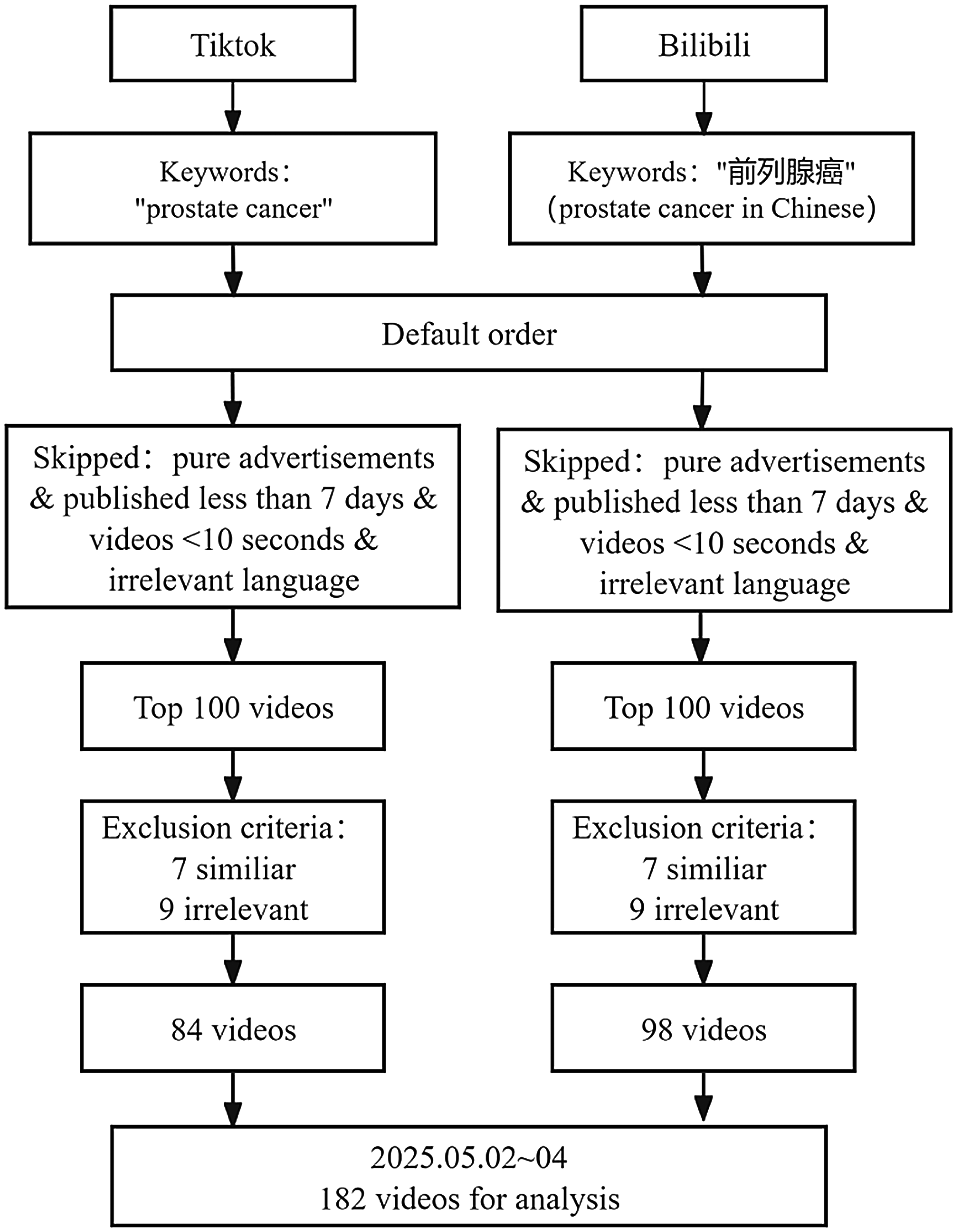
Search strategy for short videos on prostate cancer.
Videos were included if they (1) focused on prostate cancer-related information (e.g. symptoms, diagnosis, treatment, prevention); (2) were publicly accessible; and (3) were published over 7 days. Exclusion criteria included (1) duplicate content across or within platforms, (2) non-health-related content, (3) pure advertisements, (4) published less than 7 days, (5) videos <10 s, and (6) irrelevant language (e.g. non-Mandarin/English).
For each eligible video, the following parameters were documented and analyzed: video source, title, web address, upload date, days since publication, content type, duration, number of views, likes, comments, saves, and shares.
Classification of videos
The videos were categorized into four groups based on their source and into four groups based on their content. Video sources were classified into the following categories: (1) urologists, (2) doctors from other disease areas, (3) patients, and (4) science communicators. Video content was categorized as follows: (1) disease knowledge, (2) treatment, (3) personal experience sharing, and (4) other information.
Video quality and reliability assessments
Two widely used standardized scales, including the GQS and the mDISCERN scale, were used to assess the quality and reliability of the video content.24,25 The GQS rates overall quality on a scale from 1 to 5, with scores of 1–2 suggesting subpar quality, 3 indicating moderate quality, and 4–5 representing high quality. Conversely, the mDISCERN system consisted of 5 questions, assigning a score of 1 for each “yes” response and 0 for each “no” response. Ultimately, higher scores indicated better quality and reliability. Mengmeng Liang and Fan Yang independently reviewed and assessed the videos. A third arbitrator (Chen Zhu) assigned the final score if the two raters’ scores were inconsistent. We quantified the interrater agreement using Cohen's kappa (κ).
Statistical analyses
Since the data were non-parametrically distributed, descriptive statistics are reported as median and the interquartile range. The Kruskal–Wallis test was used to assess the differences between groups, and the Dunn's multiple comparison test was applied for two-way intergroup comparisons. Cohen's κ was used to measure interrater agreement between the two raters. Spearman correlation analysis was conducted to evaluate the relationship between quantitative variables. Poisson regression models were employed to assess the influence of video-related variables on video quality. The P-value for the significance of the statistical analysis was <0.05. GraphPad Prism software (version 9.0.0) for Windows was used for data analysis.
Results
Video characteristics
A total of 182 videos were collected for data extraction and analysis, with 87 sourced from TikTok and 98 from Bilibili. Table 1 highlights that TikTok videos received significantly more likes, comments, saves, shares, and views than Bilibili videos (P < 0.05), whereas Bilibili videos were notably longer in duration than TikTok videos (P < 0.0001). In summary, Bilibili focused on longer videos, whereas TikTok emphasized interactive content.
Characteristics of the videos on Bilibili and TikTok.

GQS: Global Quality Scale; mDISCERN: modified DISCERN; IQR: interquartile range.
Wilcoxon rank-sum test.
Video classifications
Tables 2 and 3 and Figure 2 present the sources, content types, and characteristics of prostate cancer-related videos on Bilibili and TikTok.

Percentage of videos on prostate cancer from different sources and with different contents on Bilibili and TikTok: (a) sources of Bilibili videos, (b) sources of TikTok videos, (c) content types of Bilibili videos and (d) content types of TikTok videos.
Characteristics of the videos across sources and content in Bilibili.

IQR: interquartile range.
Characteristics of the videos across sources and content in TikTok.

IQR: interquartile range.
On the Bilibili platform, videos uploaded by urologists accounted for the largest proportion at 55%, followed by those from doctors in other medical fields (22%), science communicators (19%), and patients (4%). Regarding content, videos focused on disease knowledge were the most common, comprising approximately 60% of the total, followed by treatment-related videos (30%) and experience-sharing videos (10%).
On TikTok, among the four identified sources of videos, patients uploaded videos represented the largest proportion (54%), followed by those from science communicators (32%), urologists (7%), and doctors in other disease areas (7%). Regarding content types, experience-sharing videos were the most prevalent, comprising approximately 34% of the total, followed by disease knowledge (30%), other information (20%), and treatment (16%).
Video quality and reliability under different classifications
GQS and mDISCERN scores demonstrated strong interrater consistency, with kappa values of 0.793 and 0.853, respectively. Figure 3 displays GQS, mDISCERN scores, and the quality/reliability distributions for prostate cancer-related videos on Bilibili and TikTok. Significant differences were observed in GQS and mDISCERN scores between TikTok and Bilibili videos (P < 0.0001 for both). Regarding Bilibili videos, the GQS median score was 4, and the mDISCERN score was 4, indicating that the Bilibili videos were of good quality and reliability. TikTok videos had a median GQS score of 2 and an mDISCERN score of 2, reflecting their poor quality and low reliability.

GQS, mDISCERN scores, and the quality/reliability distributions of videos related to prostate cancer on Bilibili and TikTok: (a) comparison of GQS between Bilibili and TikTok videos, (b) proportions of different levels of video quality, (c) comparison of mDISCERN scores between Bilibili and TikTok videos, and (d) proportions of varying levels of video reliability. ns: not significant at P < 0.05. GQS: Global Quality Scale; mDISCERN: modified DISCERN.
We compared GQS and mDISCERN scores across various video sources and content types (Figures 4 and 5). On the Bilibili platform, videos created by urologists and doctors from other disease areas received higher GQS scores compared to those by patients and science communicators (P < 0.05, P < 0.0001, and P < 0.0001, respectively). Additionally, videos created by urologists received significantly higher mDISCERN scores than those produced by doctors from other disease areas, patients, and science communicators (P < 0.05, P < 0.0001, and P < 0.0001, respectively). Videos by doctors in various disease areas received higher mDISCERN scores than those of patients (P < 0.05). No notable differences were observed among the other source groups. On the TikTok video platform, videos by urologists and science communicators and exhibited higher GQS scores than those of patients (P < 0.0001 and P < 0.01, respectively). Videos created by urologists, doctors from other disease areas, and science communicators received significantly higher mDISCERN scores compared to those by patients (P < 0.001, P < 0.05, and P < 0.01, respectively). No notable differences were observed among the other source groups.

GQS and mDISCERN scores of videos on prostate cancer from different sources on Bilibili and TikTok: (a) GQS of Bilibili videos from different sources, (b) mDISCERN scores of Bilibili videos from different sources, (c) GQS of TikTok videos from different sources, and (d) mDISCERN scores of TikTok videos from different sources. GQS: Global Quality Scale; mDISCERN: modified DISCERN. *P < 0.05, **P < 0.01, ***P < 0.001, ****P < 0.0001.

GQS and mDISCERN scores of videos on prostate cancer from different content types on Bilibili and TikTok: (a) GQS of Bilibili videos from different content types, (b) mDISCERN scores of Bilibili videos from different content types, (c) GQS of TikTok videos from different content types, and (d) mDISCERN scores of TikTok videos from different content types. GQS: Global Quality Scale; mDISCERN: modified DISCERN. *P < 0.05, **P < 0.01, ***P < 0.001, ****P < 0.0001.
On the Bilibili platform, experience-sharing videos had lower GQS scores compared to those focused on disease knowledge and treatment (P < 0.001 and P < 0.0001, respectively). The mDISCERN scores for experience-sharing videos were significantly lower than those for disease knowledge and treatment, with P < 0.001 and P < 0.0001, respectively. On TikTok, videos about experience sharing and other information had lower GQS scores than those focused on disease knowledge and treatment (P < 0.01 and P < 0.0001). The mDISCERN scores for experience sharing and other informational videos were significantly lower than those for disease knowledge and treatment (P < 0.01, P < 0.001, P < 0.001, and P < 0.0001). No notable differences were observed among the other source groups.
Analysis of correlation and Poisson regression
The data were not normally distributed; thus, we used Spearman correlation analysis to reveal the relationships between different video variables (Table 4). Figure 5 illustrates that on the Bilibili platform, both GQS scores (r = 0.2629, P = 0.0082) and mDISCERN scores (r = 0.3352, P = 0.0007) positively correlate with video duration. On TikTok, both GQS and mDISCERN scores indicated positive correlations with video shares (GQS: r = 0.2823, P = 0.0163; mDISCERN: r = 0.2798, P = 0.0173), saves (GQS: r = 0.2507, P = 0.0337; mDISCERN: r = 0.2758, P = 0.0190), and views (GQS: r = 0.3247, P = 0.0054; mDISCERN: r = 0.3562, P = 0.0021).
Spearman correlation analysis between video variables and the GQS and mDISCERN scores.
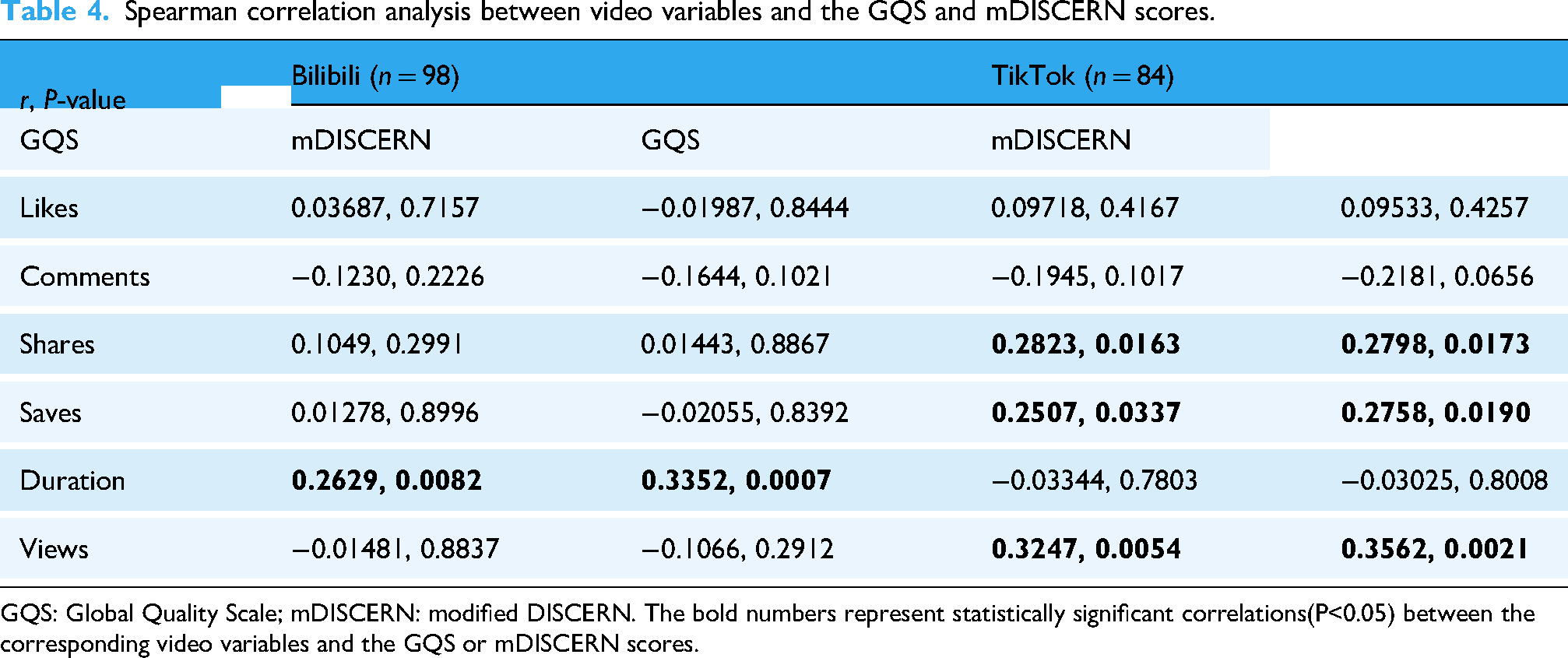
GQS: Global Quality Scale; mDISCERN: modified DISCERN. The bold numbers represent statistically significant correlations(P<0.05) between the corresponding video variables and the GQS or mDISCERN scores.
Discussion
The increasing use of social media in public health education is a phenomenon that has been gaining momentum over the past few years. This trend is driven by the widespread adoption of social media platforms, which have become integral to the dissemination of health information and education. Health organizations and professionals have leveraged social media platforms like TikTok and Bilibili to reach a broader audience with health-related content. With the rapid growth of social media platforms, the findings may have varied recently.
Principal findings
Although previous studies have analyzed content related to prostate cancer or urogenital cancers,26–28 these studies were limited to English-language content. They did not compare platform-specific characteristics or regional user behaviors. Moreover, this study is the first to comprehensively evaluate prostate cancer-related videos on both TikTok and Bilibili platforms.
This cross-sectional content analysis identified significant disparities in the quality and reliability of prostate cancer-related videos between TikTok and Bilibili. TikTok's video quality and reliability were significantly lower than those of Bilibili. Furthermore, compared with earlier TikTok-based studies, our analysis suggests that prostate cancer-related videos’ overall quality and reliability on TikTok have not improved significantly over time. 27 The overall low quality may be mainly due to the predominance of content created by non-professionals, such as patients or science communicators, who possess limited medical expertise. This may also be attributed to the shorter duration of TikTok videos and the fact that most content was focused on sharing personal experiences. Notably, the quality and reliability of TikTok videos were positively correlated with engagement metrics (shares, saves, and views), suggesting that lower-quality content can attract significant attention within the platform's entertainment-driven ecosystem. These studies highlight a critical gap between video quality and viewer engagement, suggesting that high-quality content does not always translate to higher viewership, a challenge that needs addressing to improve public health literacy.
In contrast, videos on Bilibili were generally longer and scored significantly higher in both quality and reliability assessments. This can be attributed to most videos produced by medical professionals, particularly urologists and other specialists, emphasizing delivering accurate information about disease knowledge and treatment. Furthermore, the positive correlation between video duration and both quality and reliability on Bilibili suggests that longer videos facilitate more thorough explanations, citation of authoritative sources, and clearer organization of medical content.
Video characteristics
There is a significant difference between Bilibili and TikTok regarding video length and popularity. Specifically, videos on TikTok are generally shorter in duration, with higher popularity and engagement, measured by shares, saves, and views. This is consistent with previous research indicating that shorter videos tend to be more addictive and spread rapidly, as they are well-suited for quick consumption within a short period of time.29,30 This suggests that TikTok may possess a more substantial capacity to attract viewer attention and stimulate user engagement. However, despite the high traffic of TikTok videos, the prostate cancer-related videos on TikTok have lower GQS and mDISCERN scores than those on Bilibili. These studies highlight a critical gap between video quality and viewer engagement, suggesting that high-quality content does not always translate to higher viewership. Consequently, viewers should apply critical thinking and caution when selecting TikTok as a health information source to ensure the accuracy and reliability of the content.
Video classifications
Videos uploaded by medical professionals on the Bilibili platform predominantly focused on disease knowledge and treatment, consistent with findings from other studies. For instance, a study on gastric cancer-related videos found that 53% were uploaded by health professionals, covering topics such as early signs, late symptoms, causes, and treatment methods. 31 These findings suggest that medical professionals constitute the primary source of video uploads on Bilibili and primarily aim to share disease-related knowledge and treatment guidance, reflecting a high level of professionalism. This trend may be attributed to the unique features and user demographics of the Bilibili platform. Specifically, Bilibili supports long-form video content, enabling medical professionals to comprehensively explain diseases and treatment protocols.
On the TikTok platform, most prostate cancer-related videos are uploaded by patients and science communicators. These videos typically focus on sharing personal experiences and disseminating disease-related knowledge, often presented in an entertaining and engaging manner. The goal is to capture viewers’ attention and increase interaction through short, appealing content. These observations align with the findings of Carter et al., 32 who, in their study of videos related to concussions and head injuries, found that most videos were primarily focused on entertainment, with only a small number providing scientific facts about concussions. This suggests that TikTok often prioritizes emotional appeal over informational depth. TikTok, as a social platform primarily based on short videos, has a low barrier to entry, allowing virtually anyone to upload content. This accessibility encourages creators, including ordinary patients and science communicators, to share their health experiences and knowledge. While such content can be valuable for raising awareness, it may lack clinical accuracy or depth, potentially leading to a lower level of professionalism and depth in health-related information. 33
Quality of videos
The study identified significant differences in GQS and mDISCERN scores between TikTok and Bilibili videos (P < 0.0001 for both). Bilibili videos showed higher quality and reliability, while TikTok videos scored lower. This result reflects differences in video length, content, uploader type, and platform algorithms and user characteristics. Bilibili, initially designed for long-form, knowledge-based content, prioritizes educational and in-depth videos through its recommendation system, particularly in science and health. In contrast, TikTok promotes fast-paced, short videos driven by engagement metrics such as likes and watch time, favoring eye-catching content over informative material. This often leads to a trade-off in depth and accuracy.
Moreover, Bilibili tends to attract a younger, more education-oriented audience—such as students and professionals—who actively seek reliable information. In contrast, TikTok's broader user base includes more casual viewers who may favor entertainment, prompting creators to prioritize engagement over accuracy.
In terms of video duration, Bilibili supports longer video durations, which allows medical professionals ample time to thoroughly explain disease knowledge, treatment methods, and precautions, improving the content's completeness, quality, and reliability. The short duration and single-format presentation of videos on the TikTok platform limit the breadth and depth of content, which may contribute to the lower quality and reliability.
Regarding video sources and content, videos uploaded by urologists exhibited superior quality and reliability compared to those by patients on both platforms, aligning with other studies indicating that content from medical professionals is generally regarded as more credible and high quality.8,34–36 This underscores the critical role of healthcare providers’ professional backgrounds in ensuring the accuracy and reliability of medical videos. Videos from professionals draw on clinical expertise and offer more timely updates. 37 Given the high level of professionalism required for medical-related videos, we suggest that short video platforms implement stricter entry thresholds for such uploaders. All doctors were officially certified in the videos we collected from TikTok and Bilibili, with identities verifiable via hospital websites. However, these platforms have not yet implemented comprehensive restrictions on uploaders, and non-professionals, such as science communicators, are still uploading a large number of medical-related videos. Our study showed that science communicators accounted for 19% of the videos on Bilibili and 32% on TikTok, which may contribute to the generally lower video quality observed on both platforms.
Meanwhile, although our study found that patient-uploaded videos generally had lower quality and reliability scores than those by healthcare professionals, it is essential to acknowledge their unique role in the online health information ecosystem. These videos often focus on personal experiences, treatment journeys, and emotional coping, offering psychological support, peer connection, and reassurance for individuals facing similar challenges. For newly diagnosed patients and their families, such content can complement professional information by addressing practical concerns and emotional responses often absent from clinician-led videos. Therefore, while typically rated as low quality from an informational perspective, patient-generated content should not be dismissed. Instead, platforms and health communicators should consider appropriately labeling this content as experiential rather than instructional, helping users access its emotional and social value while being guided toward credible medical information for clinical decisions.
Relationship between video quality and its characteristics
Our analysis revealed a positive correlation between GQS and mDISCERN scores and video duration on the Bilibili platform, aligning with findings from previous studies reported by Liu et al.5,38,39 This phenomenon can be explained from various aspects. Initially, longer videos can cover more comprehensive topics—such as disease definitions, symptoms, risk factors, diagnostic methods, treatments, and prognosis—helping viewers better understand complex medical information and thereby improving video quality and reliability. 38 Additionally, long-form videos are often created by medical professionals who reference clinical guidelines and research, enhancing accuracy and trustworthiness. 40
Meanwhile, we found that the GQS and mDISCERN scores of prostate cancer videos on the TikTok platform showed weak positive correlations with video shares, saves, and views, which contrasts with previous studies.16,38 Previous studies have shown that a negative correlation exists between video popularity metrics and DISCERN scores, indicating that TikTok viewers are unable to distinguish between high-quality and low-quality videos. 16 Those researchers attributed these circumstances to TikTok's recommendation mechanism, which dictates that videos with more likes are more likely to be recommended 23 ; thus, lower-quality popular videos become more popular, further exacerbating the gap between video quality and popularity. However, during our video search process, videos appearing at the top of the page included not only those with high numbers of likes but also newly uploaded videos and those posted by doctors. This indicates that TikTok's content recommendation algorithm is gradually evolving to emphasize informative and credible content. Meanwhile, the positive correlation between video shares and video quality suggests that as public health awareness and knowledge improve, users are more inclined to engage with high-quality content. This indicates that people's ability to recognize quality videos is gradually increasing.
Comparative analysis and research prospects
Beyond TikTok and Bilibili, platforms such as YouTube and Reddit also contribute to disseminating prostate cancer-related information. YouTube provides longer, more detailed educational videos, while Reddit facilitates peer discussions and experience sharing. In contrast, TikTok and Bilibili prioritize short-form, visually engaging content driven by algorithmic recommendations. In a study by Abramson et al. evaluating the content quality and racial/ethnic representation of prostate cancer screening videos on YouTube and TikTok, 28 it was found that although these videos were widely viewed, they did not provide high-quality consumer health information. Similarly, in a study by Xue et al. assessing the functional quality and reliability of genitourinary cancer-related videos on TikTok, 27 most videos were found to be of poor to moderate quality and reliability. These differences affect the content format, accuracy, and depth of health information.
In addition, variations in language, health literacy, and cultural attitudes influence how information is presented and received across communities using English, Mandarin, Urdu, Turkish, Arabic, and other languages. Future research should adopt a cross-platform, multilingual perspective to understand these dynamics better and support the development of effective health communication strategies.
Practical significance
Prostate cancer ranks among the most prevalent cancers in men, with its incidence rising worldwide. 41 Despite this, public awareness of prostate cancer remains insufficient, which can lead to many cases being detected at an advanced stage, thereby affecting treatment outcomes and patient survival rates. 42 Consequently, identifying and treating prostate cancer early is vital for enhancing patient outcomes. The internet's widespread use has facilitated easy access to medical information through various social media platforms. The absence of robust regulatory frameworks results in inconsistent quality of online information, particularly health education videos, making it challenging for patients to assess their reliability.14,43,44 Effective health education videos enhance awareness and understanding of prostate cancer. Misleading videos can lead to incorrect health decisions.45,46 Evaluating prostate cancer-related videos with standardized scientific assessment tools is crucial. Such evaluations can offer valuable guidance for video-sharing platforms and content creators on effectively communicating reliable health information to the public. This approach discourages the prioritization of audience appeal and engagement metrics at the expense of informational depth, quality, and reliability. Evaluating the quality of medical videos on social media is essential to guarantee that the public accesses reliable, evidence-based information. Future research should provide recommendations on how to develop and regulate these platforms, as well as how to evaluate video content systematically. Medical professionals should maintain a rigorous approach and produce comprehensive, high-quality videos to support and guide patients effectively.
Advantages and limitations
Our study's strengths include the following: this study is the inaugural evaluation of the quality and reliability of prostate cancer-related videos on both Bilibili and TikTok platforms. In terms of platform selection, our study focused on the two most commonly used short video platforms. TikTok has a large and diverse user base, covering various age groups and regions, while Bilibili attracts a user group primarily composed of university students and young professionals. This dual-platform study design enhances the applicability and relevance of the findings across different social media environments. For video assessment, we employed GQS and mDISCERN, which are more suitable tools for assessing video-based health information. Two raters independently assessed each video, with any discrepancies resolved through discussion with an arbitrator, who made the final decision. This process significantly reduced interrater variability caused by subjective bias.
However, our study has several limitations. First, we only analyzed the top 100 videos from each platform, resulting in a relatively small sample size. Second, we focused solely on videos from TikTok and Bilibili and analyzed differences within Chinese- and English-language contexts; future studies could broaden the scope by including additional domestic and international video platforms and exploring differences across a wider range of language environments. Third, in the Methods section, we only searched for the term “prostate cancer,” which may have excluded other relevant terms such as “prostate tumor” or “prostate carcinoma,” potentially resulting in an incomplete video sample. Finally, as this is a cross-sectional study, the video platform's content is subject to change over time.
Conclusions
A total of 182 videos were collected for data extraction and analysis, with 84 sourced from TikTok and 98 from Bilibili. Our study found that prostate cancer-related videos on Bilibili were of good quality and reliability, whereas those on TikTok were of poor quality and low reliability. Bilibili focused on longer videos, whereas TikTok emphasized interactive content. Overall, videos uploaded by urologists exhibited superior quality and reliability compared to those by patients. In addition, disease knowledge and treatment videos had higher quality and reliability compared to those focused on experience-sharing. Therefore, medical professionals must recognize the importance of the quality and reliability of medical information shared on public platforms. Additionally, social media platforms must enhance the review and regulation of medical content to ensure its authenticity and accuracy, while content creators should focus on improving video quality to better meet the audience's needs.
Footnotes

Ethical approval
No clinical data, human specimens, or laboratory animals were used in this study. All information was obtained from publicly released TikTok and Bilibili videos, and none of the data involved personal privacy concerns. In addition, this study did not involve any interaction with users; therefore, no ethics review was needed.
Author contributions
Mengmeng Liang did conceptualization, data curation, formal analysis, writing the original draft, and validation. Fan Yang did conceptualization, data curation, formal analysis, investigation, writing the original draft, and validation. Chen Zhu performed data curation, formal analysis, and writing the original draft. Shasha Lu did data curation, and writing the original draft. Weigang Yan participated in writing, reviewing, and editing. Juan Wang did writing, reviewing, and editing. All authors contributed to the article and approved the submitted version.
Funding
The authors received no financial support for the research, authorship, and/or publication of this article.
Declaration of conflicting interests
The authors declared no potential conflicts of interest with respect to the research, authorship, and/or publication of this article.