



Abstract
Objective
This study aimed to evaluate the quality, reliability, and readability of online patient-centered information related to the management of gummy smile.
Methods
A systematic search was conducted using Google, Yahoo, and Bing to identify websites providing patient-oriented information on gummy smile treatments. A total of 257 websites met the inclusion criteria and were analyzed. Content quality was assessed using the DISCERN instrument, Journal of the American Medical Association (JAMA) benchmarks, and the Health on the Net (HON) code certification. Readability was evaluated using the Flesch Reading Ease Score (FRES), Flesch -Kincaid Grade Level (FKGL), Simplified Measure of Gobbledygook (SMOG) index, and Coleman -Liau index.
Results
The overall quality of online information was low to moderate, with a mean DISCERN score of 40 ± 9.9. Only 11 websites were certified by the HON code, indicating limited adherence to established standards for trustworthy health information. According to JAMA benchmarks, only two websites fulfilled all four criteria. Readability analysis demonstrated that the content was relatively complex, with a mean FRES of 60.1 ± 9.2 and a mean FKGL of 8.9 ± 1.8, exceeding the recommended reading level for the general public.
Conclusions
Online patient-centered information regarding gummy smile is generally of suboptimal quality and readability. The limited number of reliable and easily understandable resources underscores the need for improved quality control, standardization, and patient-focused content development. Enhancing the accessibility and reliability of online information may support better patient understanding and informed decision-making in dental aesthetics.
Introduction
The act of smiling is a facial expression that holds one of the greatest recognitions and plays a crucial role in a person's social abilities, self-confidence, and capacity to engage with others. 1 The social lives of individuals can be significantly impacted if their smiles are affected. 2 One of the concerns that prompts visits to dental clinics is a gummy smile—a common esthetic issue. A gummy smile can be defined as a non-pathological condition leading to an esthetic disharmony, characterized by the gingival display of 3–4 mm during smiling. 3 An excessive show of gingiva in a smile can arise due to an imbalance between specific anatomic structures: the maxilla, gingiva, teeth, and lips. 3 It necessitates a customized approach to treatment that accounts for its underlying etiology, which can stem from dental, skeletal, or muscular abnormalities. The prevalence of gummy smile was almost similar in some literature, ranging from 10% to 12%,3–5 with affected individuals being perceived to have unattractive smiles, a judgment endorsed by both dentists and laypersons. 6
Due to the social impairment caused by the excessive show of gingiva, people are likely to search for different ways to better understand their condition; one of the possible methods is the utilization of the internet. As it has revolutionized the way individuals access information, an increasing number of patients have turned to the Internet to gain insights into the potential treatments for their medical conditions.7,8 The COVID-19 pandemic has further amplified this trend, with the majority of individuals now acquiring information primarily from online sources. This trend encompasses a broad range of resources, spanning governmental organizations to individual-authored content for various purposes. 9 A survey from 2020 revealed that health-related online information was sought by 55% of Europeans, showing a growth of 21% from 2010. 10 Specifically, countries like Finland, the Netherlands, Denmark, and Germany have witnessed an increase in online health information-seeking behavior, exceeding 70%. 10 Similar trends are observed in the United States, where a recent investigation uncovered that the population seeking health information online rose from 61% in 2008 to 74% in 2017. 11 Several Asian countries display even higher percentages of this behavior, with mainland China, the Philippines, Hong Kong, Indonesia, and Vietnam recording rates of 79%, 80%, 85%, 85%, and 86%, respectively.12,13 Although easier and more cost-effective information access helps patients with different needs answer their questions, it can also, without a doubt, provide misleading information. 14 Despite the limited disadvantages of such recent developments in the field of knowledge, internet health information can improve the patient–dentist relationship by better understanding dentist's advice and recommendations. 15
Different studies collectively highlight that the quality of online information related to various dental topics is often inadequate or scientifically imperfect. The information is frequently of low quality, with many important aspects, such as long-term outcomes and complications, overlooked. Even though some information may be readable and comprehensible, it often does not meet the required quality standards. These findings underscore a critical need for improvements in the quality of online dental information to support patients in making reasonable decisions.16–19 Currently, there appears to be a lack of research focusing on the information available online concerning gummy smiles, which points to an unexplored area in the field.
While the potential benefits of online health information are substantial, it is crucial to address the challenges posed by varying content quality and accuracy. Against this drawback, this study aims to assess the quality, comprehensiveness, and accessibility of online information specifically related to gummy smiles. And to evaluate the information that individuals navigate when seeking insights into gummy smile conditions and treatments. This investigation will determine the challenges that internet-based health information presents in the context of this condition. The aim of this study is to evaluate the quality and readability of online patient-centered knowledge about gummy smiles.
Methods
Search strategy
To evaluate the quality and comprehensibility of online information aimed at patients seeking insights about “gummy smile,” an extensive internet search was initiated. Before starting the search, all stored cookies were deleted, and private browsing mode was engaged to ensure fair search outcomes. Search approach: the investigation involved the utilization of three search engines—Google, Yahoo, and Bing. The methodology was expanded to encompass the first 200 website results from each search engine using the keywords “gummy smile” and its variants. Previous studies have typically restricted search results to 50 websites per query to balance feasibility and comprehensiveness.20–22 Our search protocol increased the screening of websites by a factor of four to ensure that all available content was thoroughly captured and analyzed, thereby minimizing the risk of omitting relevant information, even though a typical layperson might not extend their search to this extent.
Inclusion criteria: websites that were freely accessible and using English as the primary language and provided thorough information about “gummy smile.” Exclusion criteria: scholarly articles, evaluations of books, websites featuring irrelevant content, non-working links, and links in languages other than English, websites requiring membership for access, platforms intended for product promotion, forums for discussions, video content streams, and digital repositories of medical terminology were all included in the exclusion criteria.
The search terms employed included the original term “gummy smile,” its variants, common misspellings, and related problem-focused phrases that a layperson might utilize in their search (Table 1).
Terms and variants used in the search strategy.

The search was conducted from January 1, 2025 to January 2, 2025, using Google Chrome browser (Version 141.0.7390.123) on a Windows 10 (64-bit) platform. The country setting was configured to Saudi Arabia, and the regional format was set to English (World).
Two independent investigators (MSA and ATH) performed the primary search and initial screening of the results. Potential websites were identified and systematically logged into a synchronized cloud-based spreadsheet (Google Sheets, Google LLC) for collaborative data management.
After the initial data was logged, extra care was taken to remove any duplicate entries. This was done by checking the Uniform Resource Locators for every result across the three search engines. If the same website had multiple entries in the spreadsheet—because it was listed on multiple platforms—all duplicates were removed and was counted once in final analysis. Discrepancies between the two reviewers regarding website eligibility were resolved through consensus or, where necessary, by consultation with a third senior author (MAAS).
Quality assessment
The quality of the online material was assessed independently by two reviewers (ATH, KA) using the DISCERN instrument 23 ; the Journal of the American Medical Association (JAMA) benchmarks for website analysis 24 ; and the Health on the Net (HON) seal. 25
The DISCERN tool was developed and validated to assess the dependability of online content, its specific treatment-related information, and the overall quality of scoring. This instrument is originated at the University of Oxford and comprises a total of 16 components. The first eight questions are aimed at evaluating reliability, while questions 9 to 15 pertain to precise treatment details. Each question is assigned a numerical value on a scale from 1 to 5, where 1 signifies very poor, 2 indicates poor, 3 denotes moderate, 4 represents good, and 5 stands for excellent. An extra last question is included to allow for an overarching assessment of the material's quality (to be rated as low, moderate, or high). A composite score derived from the initial 15 DISCERN items is utilized to categorize the overall quality of the publication. Specifically, if the majority of responses fall below a score of 2, the material is classified as low quality; scores predominantly in the mid-range indicate moderate quality; whereas scores frequently rated 4 or higher denote high-quality content. 26
The assessment of website quality was conducted using the JAMA criteria. These standards encompass the clear identification of medical content's authors, contributors, affiliations, and pertinent qualifications, along with the incorporation of attributions such as references and sources. Additionally, the criteria involve declarations of ownership, conflicts of interest, and the provision of information about the current status through content posting dates and updates.
Founded in 1995, the HON is a non-profit entity designed to offer guidance in assessing the credibility of online medical information and sources. Websites adhering to eight criteria, which span from highlighting authors’ credentials to distinctly separating advertising and editorial content, can display the HON seal as a mark of compliance.
Readability assessment
It is the process of gauging the level of reading comprehension required to understand written texts using systematic formulas. 27 The assessment of readability was conducted using six distinct measures: Flesch Reading Ease Score (FRES), Flesch–Kincaid Grade Level (FKGL), the Simplified Measure of Gobbledygook (SMOG) index, and the Coleman–Liau index (CLI), Automated Readability Index (ARI), and Gunning Fog (GF) scale.
The FRES is determined through a formula involving average sentence length and average syllables per word, resulting in a score ranging from 0 to 100. Higher scores indicate easier readability. Scores above 90 are easily understood by an average 5th-grade student, while scores between 60 and 70 are meant to be comprehensible for 8th and 9th-graders, that is, in plain English language. Scores below 50 represent an academic difficulty level. The FKGL builds upon this foundation by recalibrating these linguistic variables to output a US school grade level.
The SMOG index focuses on the density of polysyllabic words containing three or more syllables to estimate the years of education required for complete comprehension. SMOG score ranges from 9 or less to 19 or greater which corresponds to the level of education of high school freshman to a professional/doctoral level, respectively.
Conversely, the CLI and the ARI utilize character counts per word instead of syllables to provide a more consistent assessment for computerized analysis. The GF index also yields a grade-level score by combining sentence length with the percentage of “complex” words within the sample.
The FKGL, SMOG, CLI, ARI, and GF index are all standardized to provide a US academic grade level, signifying the minimum education level required for an average student to comprehend the material. For example, a score of 6 implies that the text is suitable for a student through the 6th grade, a score of 11 corresponds to an 11th grade, and a score of 19 or above for doctoral levels. To ensure broad accessibility in healthcare or public settings, it is often recommended that materials achieve a score of 6.0 or lower. Following established methodological standards, all text was prepared by removing non-discursive elements such as tables and citations before being independently analyzed by two reviewers to determine the average final score.
Statistical tests
Data were processed and analyzed using SPSS (version 22, IBM, Armonk, NY, USA). Descriptive statistics were used for categorization of websites (Table 2) and distribution of DISCERN and JAMA scores (Tables 3 and 4). Shapiro–Wilk test for normality revealed data was normally distributed. One-way analysis of variance was used for comparison of quality (JAMA, DISCERN, and HON Seal) and readability (FRES, FKGL, SMOG, CLI, ARI, and GF) between groups based on affiliation.
Categorization of websites based on affiliation, specialization, content type, and content presentation (n = 257).

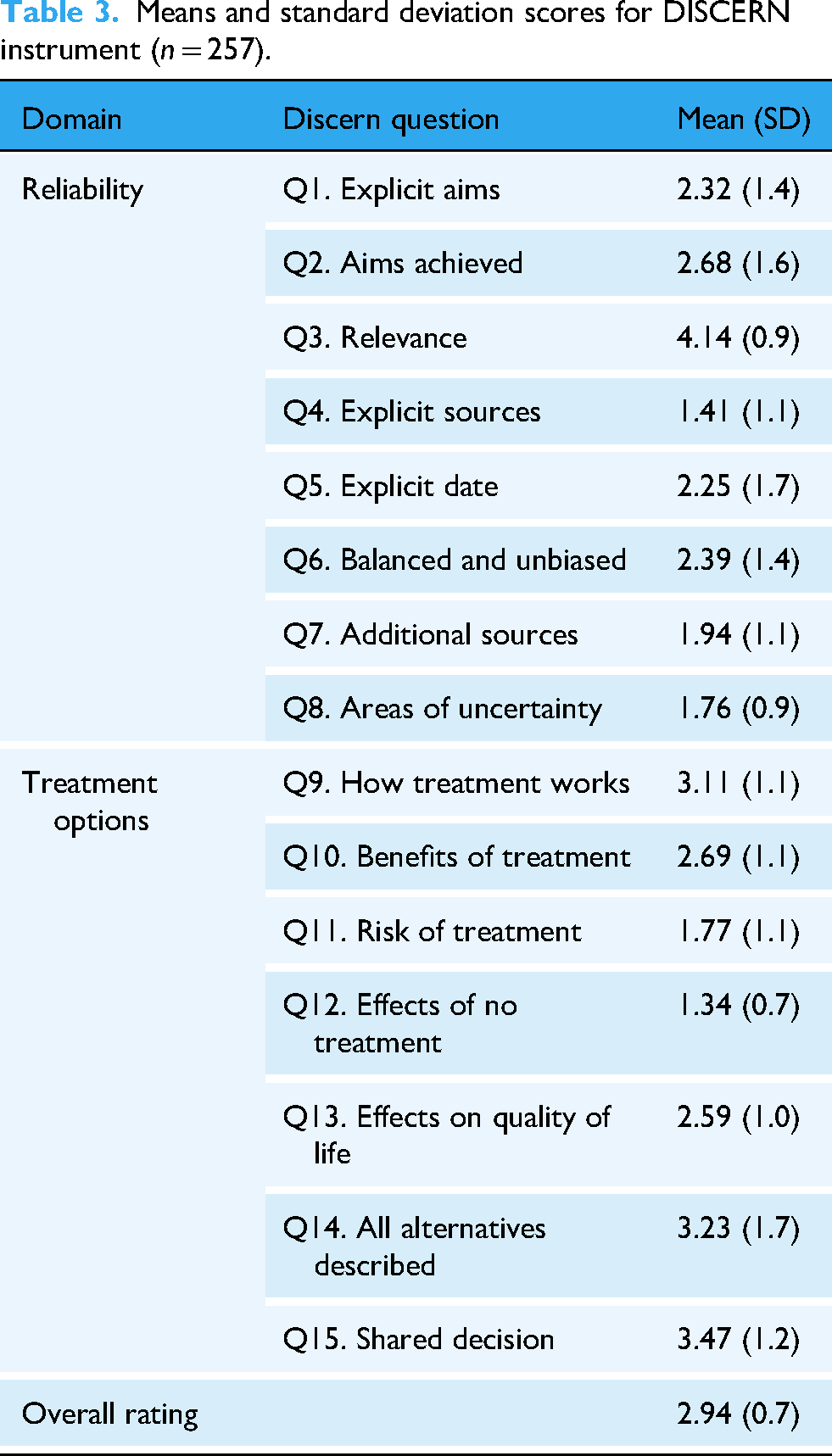
Means and standard deviation scores for DISCERN instrument (n = 257).
Quality and readability of the included websites based on their affiliation reported as frequency and percentage (n = 257).

HON: Health on the Net.
*Statistically significant difference p-value is less than 0.001.
Inter-examiner reliability was assessed by intraclass correlation coefficient (ICC). A random sample of 20 websites was chosen by a third author (AAA) and was allocated to two reviewers (ATH, KA) who did blinded assessment. The ICC scores for quality and readability assessment tools ranged between were 0.991 and 0.825, demonstrating excellent intraclass correlation.
Results
Available websites
Google found 20,900,000 websites, Bing found 250,000, and Yahoo also found 250,000 when searching the term “gummy smile.” Investigators evaluated the first 200 results from each engine for eligibility criteria and found 257 websites that fit the criteria. The remaining 343 websites were excluded. See Figure 1 for the selection strategy. See supplementary list for the included links.

Flowchart of the searching strategy.
The checked websites were categorized, and found that most of them, 121 websites (47.1%), belonged to universities or medical centers, followed by commercial websites and non-profit organizations, 90 websites (35%) and 46 websites (17.9%), respectively. None of the websites was affiliated as governmental. All websites were partly related to gummy smiles, with 248 (96.5%) containing medical facts, 48 (18.7%) included clinical trials, 32 websites included questions and answers (12.5%), and only 8 (3.1%) presenting human interest stories. In total, 190 (73.9%) websites included embedded images, 22 (8.6%) included embedded videos along with the main text, and none included audio. For a summary of the website's affiliation, content type, and presentation, see Table 2.
Quality assessment
The quality of websites was evaluated by three tools: the DISCERN instrument, JAMA benchmarks, and the HON code.
For the HON code, only 11 websites were sealed with the HON code; 10 of them belonged to non-profit organizations.
The DISCERN assessment reported a mean of the total score (sum of questions 1 to 15) as 40 (±9.9), a reliability score (questions 1 to 8) with a mean of 18.9 (±6.1). Lastly, a treatment score (questions 9 to 15) mean of 18.8 (±4.5) was found. The mean score of each question is reported in Table 3. Questions 4 and 12 had the lowest mean scores, while the highest score was reported in the third and fifteenth questions. The mean and standard deviation of the total, reliability, and treatment scores of the websites according to their affiliation are summarized in Table 4.
The JAMA benchmarks had four items: authorship, attribution, disclosure, and currency. The currency was the most commonly achieved on 91 websites, followed by authorship on 57 websites. The disclosure was the least reported on 10 websites. The distribution of the achieved JAMA items according to website affiliation showed statistically significant differences in authorship, attribution, and currency, as shown in Table 4. For the number of achieved JAMA items per website, only two websites achieved the four items in the same websites; in addition, none of the items was achieved in 152 websites. The number of achieved items per website is shown in Table 4. The distribution of the number of achieved items per website according to websites’ affiliation showed statistically significant differences (p-value <0.001).
Readability assessment
The FRES scored 88 as the maximum and 26 as the minimum score, with a mean of 60.1 (±9.2). FRESs showed statistical differences based on website affiliation (p-value <0.001). Figure 2 shows the FRES difficulty categories. For the FKGL test, the maximum and minimum scores were 14.6 and 3.7, respectively. The mean score for FKGL was 8.9 (±1.8), with statistical differences among different affiliations (p-value <0.001). The SMOG test showed a mean of 8.5 (±1.4), and maximum and minimum scores of 13.3 and 5.2, respectively. The CLI test showed a maximum score of 16 and a minimum of 6.2 with a mean of 10.8 (±1.3) with no statistically significant difference across affiliations (p-value 0.635). The GF scale had maximum and minimum scores of 46.5 and 7, respectively, with a mean of 12.1 (±3.5). The ARI had a mean of 9 (±2) with a maximum score of 15.4 and a minimum of 3.2. A statistical difference was found across different affiliations (p-value <0.001); more details are shown in Table 5.

The FRES difficulty categories of the evaluated websites (n = 257). FRES: Flesch Reading Ease Score.
Comparison between means according to websites’ affiliation (n = 257).

FRES: Flesch Reading Ease Score; GF: Gunning Fog; FKGL: Flesch–Kincaid Grade Level; CLI: Coleman–Liau index; SMOG: Simplified Measure of Gobbledygook; ARI: Automated Readability Index.
*Statistically significant difference p-value is less than 0.001.
The maximum count of words on a website was 3371, while the minimum was 84, with a mean of 919 (±606). In accordance, the sentence count had a maximum of 248 and a minimum of 8 sentences, with a median of 59.1 (±39.3). In comparison based on affiliations, no significance was found in words or sentence count.
Discussion
The impact of aesthetic concerns such as gummy smile can significantly affect a person's self-esteem and confidence, leading them to explore potential treatments to improve their smile's appearance. 28 Patients are increasingly interested in understanding available procedures and their outcomes. Patients seeking solutions for cosmetic concerns, such as gummy smiles, often turn to the Internet to gather health-related information. 29 A gummy smile is a common aesthetic issue characterized by excessive gum exposure when smiling; as it is an aesthetic concern, patients frequently search for online resources regarding treatment options. 29
As the demand for gummy smile treatment information grows, it becomes essential to provide high-quality online resources tailored to patients seeking solutions for this cosmetic concern. 30 Evaluating the quality of these online materials using standardized criteria is crucial. The study examined the content of 257 websites related to gummy smile treatment. It was found that none of the reviewed websites was exclusively focused on gummy smile treatment. Furthermore, a significant portion (96.5%) of the content consisted of medical facts, potentially making it challenging for patients to understand the information. Patients may encounter barriers when searching for online health information, including difficulty finding specific information and challenges in interpreting complex medical content. These barriers are common among individuals seeking cosmetic solutions. 31
To make information more accessible and patient-friendly, the use of human-interest stories or patient-based vignettes is proposed. These approaches present medical content in lay terminology and through the patient's perspective, potentially offering social and emotional support. 32 However, the study found that only a small percentage (3.1%) of the examined websites included such human-interest studies.
The overall mean DISCERN score of the assessed websites indicated that the quality of available information ranged from low to moderate, with only a few high-quality websites; this is similar to a few other studies.16,19,33 This underscores the importance of evaluating online health information for reliability and credibility, especially for patients considering cosmetic treatments.
An important observation is the potential presence of a commercial bias among online sources, with a significant number of websites categorized as commercial sites (35%). This raises questions about the objectivity and reliability of information provided, particularly in the context of cosmetic procedures.
The HON code empowers internet users to assess the reliability of the information they come across online. It was originally established as an effort to guarantee the availability of trustworthy health-related content. Depending on how well the website aligns with these recommendations, it may receive the HON code seal of approval, which remains valid for a period of 1 year. Of the examined websites, 11 were sealed with the HON code, and 10 of them belonged to non-profit organizations. This number of sealed websites is higher than in similar studies16,19,30; this may be due to the larger number of included websites.
Beyond the JAMA tool addressing various aspects of websites, including authorship, attribution, disclosure, and currency, which consumers may not be fully aware of, it is crucial from a scientific perspective. A scenario may arise where a website copies high-quality information from a trusted professional source, but the absence of accurate details regarding copyrights and other pertinent issues raises questions about the site's reliability and content. The JAMA benchmark serves as an efficient tool for evaluating quality, enabling evaluators to promptly identify websites lacking fundamental components of information transparency and trustworthiness. Notably, our study's most significant shortcoming based on the JAMA criteria was in the “disclosure” category, with only 10 (3.9%) websites acknowledging the sources they referenced. The second most notable shortcoming was associated with “attribution,” as merely 30 sites (11.7%) indicated when the information was last posted or updated. It was quite astonishing that a mere two (0.8%) websites managed to meet all four JAMA criteria.
The analysis of readability, which assesses the reading skills required for understanding a written text, reveals that gummy smile-related content is challenging to read. The FRESs for these materials are mostly below acceptable for patients. This difficulty in comprehension may be attributed to the technical nature of the information presented. It's worth noting that this comprehension challenge is lower than what has been described for websites about other dental-related topics.19,34 This situation is particularly concerning given the significant number of individuals with low health literacy levels, which refers to their ability to access, understand, evaluate, and communicate health information. 35
Addressing this issue may involve simplifying the language used in implant-related content, including using fewer syllables per word and reducing the complexity of phrases. 36 Additionally, involving potential users, patient associations, and other relevant stakeholders in the development of health-related websites and enhancing their health literacy skills can be valuable approaches to alleviate this challenge. 37
This study has limitations, including restriction to English-language websites and exclusion of social media platforms such as YouTube, which may cause selection bias. Search engine algorithms and ranking variability could also affect results. The study assessed proxies of quality (DISCERN, JAMA, HON, readability) rather than clinical accuracy, providing limited insight into factual reliability. Additionally, the analysis methods may oversimplify complex relationships. Future studies should include non-English and multi-media sources and apply more advanced analytical models to better capture factors influencing online health information quality.
Conclusion
In conclusion, the findings highlight the critical need for high-quality, easily understandable online information tailored to patients seeking solutions for gummy smiles. It emphasizes the importance of healthcare professionals collaborating to provide patient-friendly information. Additionally, it underscores the significance of evaluating online health information for reliability and credibility, especially considering potential commercial influences. Ensuring the availability of trustworthy online resources is essential to enhance the decision-making process for individuals concerned about gummy smiles.
Supplemental Material
sj-xlsx-1-dhj-10.1177_20552076261416800 - Supplemental material for Assessment of quality and readability of web-based knowledge about gummy smile: An infodemiology study
Supplemental material, sj-xlsx-1-dhj-10.1177_20552076261416800 for Assessment of quality and readability of web-based knowledge about gummy smile: An infodemiology study by Ahmad Qazali, Muath Saad Alassaf, Abdulsamad Talaat Habeeb, Khalid Alblushi, Ahmad Othman, Asim Almarhoumi and Mahmoud Alsulaimani in DIGITAL HEALTH
Footnotes

Ethical approval
Ethical approval was not required for this study as it utilized publicly available online data and did not involve human participants.
Author contributions
Ahmad Qazali (AQ) and Muath Saad Alassaf (MSA) contributed to the conceptualization and methodology of the study. Data curation was performed by Abdulsamad Talaat Habeeb (ATH), Khalid Ahmed Albulushi (KAA), Ahmad Othman (AO), and Asim Abdulrahman Almarhoumi (AAA). Formal analysis was conducted by AQ, MSA, and Mahmoud A. Alsulaimani (MAAS). Investigation was carried out by ATH, KAA, AO, and AAA. AQ and MSA prepared the original draft, while all authors contributed to reviewing and editing of the manuscript. Visualization was handled by AQ and MSA. Supervision was provided by AQ, with project administration jointly undertaken by AQ and MSA.
Funding
The authors received no financial support for the research, authorship, and/or publication of this article.
Declaration of conflicting interests
The authors declared no potential conflicts of interest with respect to the research, authorship, and/or publication of this article.
Guarantor
Muath Saad Alassaf.
Supplemental material
Supplemental material for this article is available online.
References
Supplementary Material
Please find the following supplemental material available below.
For Open Access articles published under a Creative Commons License, all supplemental material carries the same license as the article it is associated with.
For non-Open Access articles published, all supplemental material carries a non-exclusive license, and permission requests for re-use of supplemental material or any part of supplemental material shall be sent directly to the copyright owner as specified in the copyright notice associated with the article.
