



Abstract
Background
The Hospital Information System (HIS) is a vital tool for enhancing operational efficiency and informed decision-making in hospitals. A systematic evaluation of the HIS helps identify its strengths and weaknesses, supports continuous improvement based on user needs, and ultimately enhances hospital performance.
Objective
This study aimed to assess the impact of HIS on staff performance in teaching hospitals affiliated with Kerman University of Medical Sciences, focusing on users’ perceptions of system usefulness, ease of use, and its effect on daily work efficiency.
Methods
A descriptive–analytical cross-sectional study was conducted between September 2023 and January 2024 in four teaching hospitals (Shafa, Afzalipour, Bahonar, and Beheshti). A total of 189 of 193 HIS users—including managers, permanent, contractual, and temporary staff—were recruited through census sampling. Data were collected using a validated researcher-developed questionnaire containing 33 items across three domains: staff performance, service delivery, and hospital revenue/cost management. Cronbach's alpha coefficient was .78. Data analysis was performed using the R software, employing descriptive statistics, Pearson correlation, and the Kruskal–Wallis test.
Results
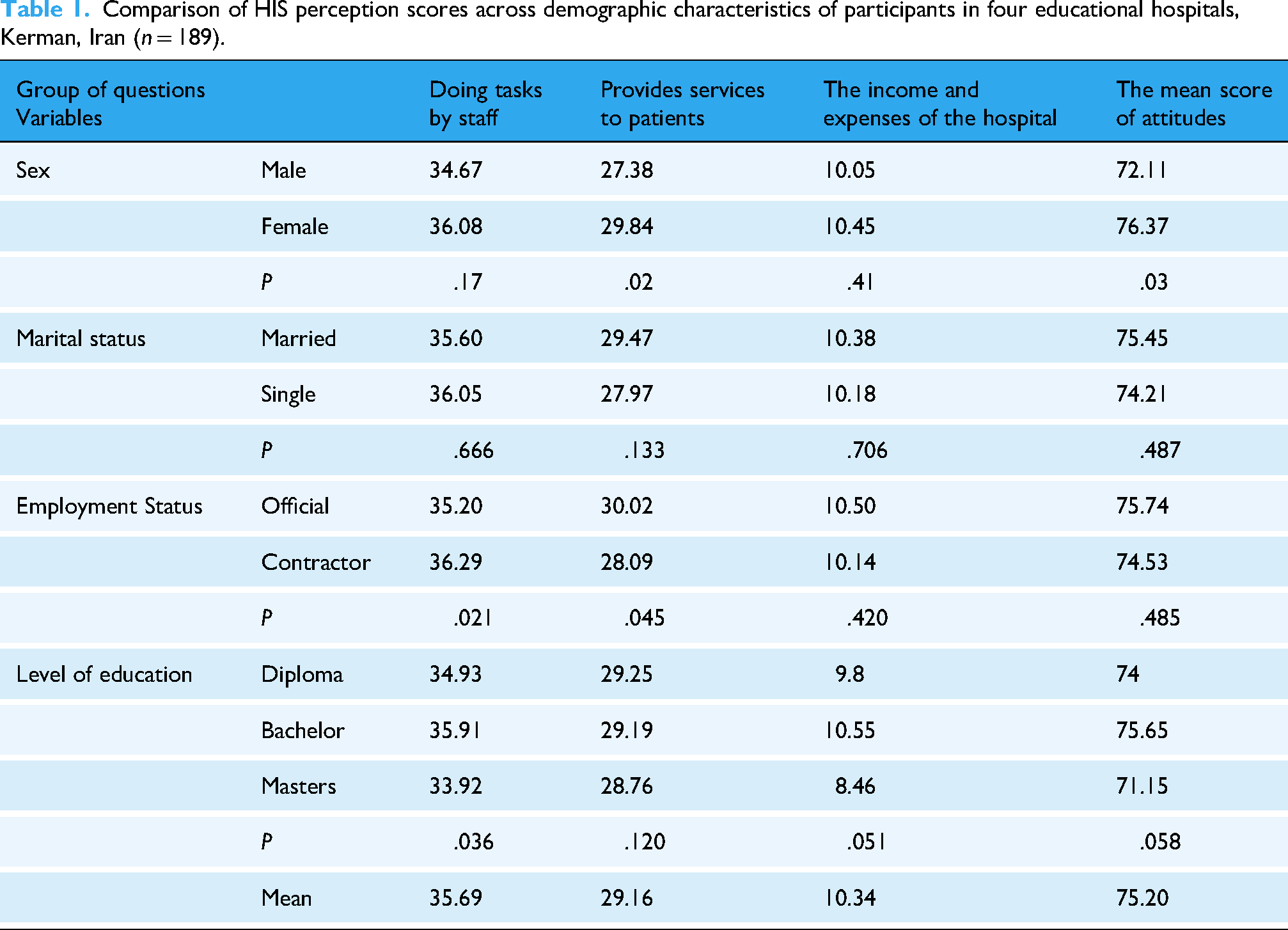
Female participants reported significantly more positive perceptions of HIS in the domains of service delivery (P = .02) and overall use (P = .03). Staff with bachelor's degrees and permanent employees perceived greater positive effects of HIS on task performance (P = .036 and P = .021, respectively). No significant differences were found in the perceived impact of HIS on hospital revenue and cost management among different groups.
Conclusion
HIS positive influence on staff performance and service delivery in hospital environments. To maximize its benefits, targeted user training and ongoing system evaluation are recommended. Although the findings are specific to four hospitals in Kerman, users’ perceptions provide valuable insights for optimizing the implementation of HIS in similar healthcare settings.
Background
Access to accurate, timely, and comprehensive information is fundamental to the effectiveness of modern healthcare organizations. Hospital Information Systems (HIS), as integrated digital platforms, play a critical role in supporting evidence-based decision-making, improving service quality, and optimizing hospital operations across clinical, administrative, and financial domains.1,2
The implementation of HIS enables real-time collection, storage, retrieval, and sharing of patient and operational data, thereby reducing human error, redundancy, and inefficiency.3–5 However, empirical studies have shown that the impact of HIS on healthcare staff performance, workflow efficiency, and user satisfaction varies greatly depending on system design, organizational context, and implementation quality.6,7
As both the advantages and challenges of HIS adoption have become more apparent, the early assumption that HIS universally enhances efficiency has evolved. While studies have demonstrated that certain modules—such as Computerized Physician Order Entry (CPOE) and electronic prescribing—reduce errors and improve accuracy,8,9 others have revealed increased documentation burdens and usability issues that may heighten staff workload.10,11
Systematic reviews have attributed these mixed outcomes to differences in information quality, interface design, and overall usability.12,13 In contrast, high usability scores and positive user experiences have consistently been correlated with higher job satisfaction, lower burnout, and stronger intentions to continue using the system.2,14,15
Organizational readiness and user training are also crucial to the success of HIS. Insufficient training, weak infrastructure, and limited stakeholder engagement can lead to user frustration and resistance.3,16 Conversely, participatory implementation approaches—where frontline users are actively engaged in customization and evaluation—enhance system acceptance and perceived usefulness.17,18 Moreover, the quality of technical support and ongoing feedback loops significantly shapes user attitudes and overall system performance. 19
Recent research has shifted its focus from system acceptance alone to measurable outcomes that affect both hospital operations and staff experiences. For example, Moore et al. (2020) demonstrated that HIS can either save or waste nurses’ time depending on workflow alignment. 10 Holmgren et al. (2024) reported strong associations between Electronic Health Record (EHR) usability and physician satisfaction, showing that interface optimization directly enhances physician performance. 12 Similarly, Alalayyan et al. (2020) emphasized information quality as a critical determinant of hospital performance and decision-making accuracy. 3
Comparative assessments in digital hospitals reveal that when HIS modules are well-integrated and aligned with clinical needs, both patient safety indicators and staff productivity improve.1,20
User perceptions of HIS are also useful predictors of its effectiveness. Perceived usefulness, ease of use, and trust in data accuracy directly influence satisfaction.13,17 Nurses and administrative staff often value HIS for facilitating access to records and team collaboration, but express concerns about its complexity and the increased administrative workload.4,18 High levels of “technostress” have been associated with lower satisfaction and suboptimal system use. 11 Targeted training programs and user interface redesigns have been shown to mitigate these challenges, increasing efficiency and reducing documentation fatigue.7,17
In developing and middle-income countries, HIS implementation faces barriers such as limited resources, weak technical infrastructure, and inconsistent policy support. Yet evidence from Iran, Lebanon, Turkey, and other regions indicates that localized HIS adaptation and ongoing evaluation can substantially enhance staff performance and patient care coordination.4,5,21 These findings underscore the need for context-specific evaluations to pinpoint HIS strengths and weaknesses in real-world operational settings.
Given the complex interplay among technical, human, and organizational factors, continuous assessment of the impact of HIS on hospital staff remains essential. This study, therefore, examines users’ perceptions of HIS effectiveness, ease of use, and its influence on daily work, providing empirical evidence to guide the optimization of HIS design, training, and management in teaching hospitals.
Objective
The primary objective of this study was to assess the impact of the Hospital Information System (HIS) on staff performance in teaching hospitals affiliated with Kerman University of Medical Sciences. Specifically, the study examined users’ perceptions of the system's effectiveness, ease of use, and its contribution to daily work efficiency.
By evaluating user satisfaction and system performance, the research aimed to identify the strengths and weaknesses of the HIS and provide evidence-based recommendations to optimize its use and enhance the quality of healthcare services.
Methods
Study design
A descriptive–analytical cross-sectional study was conducted from September 2023 to January 2024 in four teaching hospitals affiliated with Kerman University of Medical Sciences: Afzalipour, Shafa, Beheshti (psychiatric), and Bahonar hospitals.
All HIS users—including managers, permanent, contractual, and temporary staff—were included through census sampling to ensure comprehensive participation and minimize sampling bias.
Sampling
The study population comprised 189 of 193 HIS users. Power analysis using G*Power (α = .05, medium effect = 0.3, power = 0.8) indicated a minimum sample size of 143 for meaningful group comparisons; thus, the final sample of 189 participants provided sufficient statistical power.
Inclusion criteria were at least six months of continuous HIS use and active daily engagement. Exclusion criteria included long-term leave or non-involvement in HIS-related activities.
Data collection instruments
Data were collected via a validated, researcher-designed questionnaire based on prior HIS evaluation frameworks.22–24 The instrument contained 33 items in three domains:
Staff performance (15 items) Service delivery (13 items) Hospital revenue/cost management (5 items)
Responses were rated on a five-point Likert scale (0 = strongly disagree to 4 = strongly agree), yielding total scores from 0 to 132, with higher scores reflecting more positive perceptions.
Validity and reliability
Five experts in medical informatics and health information management assessed content validity using CVR and CVI methods.25,26 The mean CVI was 0.89, and items with CVR < 0.62 were revised or removed.
Exploratory factor analysis (EFA) on pilot data (n = 30) confirmed a three-factor structure explaining 71.3% of total variance.
Cronbach's alpha coefficients were .83, .81, and .76 for the respective domains, and 0.84 overall. Test–retest reliability (ICC = 0.87; 95% CI: 0.79–0.93) confirmed temporal stability.
Common method bias
Procedural controls (confidentiality assurances, randomized item order, negative phrasing) and Harman's single-factor test were used; the first unrotated factor explained 29.4% of variance, indicating minimal bias. 27
Data collection and analysis
After administrative approvals, participants completed the anonymous questionnaire voluntarily. Data were analyzed in R (v4.3) using descriptive statistics, Kruskal–Wallis tests, and Spearman's correlation due to non-normal data distributions verified by Shapiro–Wilk tests (P < .05).
A conceptual framework (Figure 1) based on the DeLone and McLean IS Success Model and the HOT-Fit model guided the analysis. 24

Conceptual model illustrating the relationships among HIS system quality, user satisfaction, and staff performance outcomes.
Results
A total of 189 of 193 HIS users participated (mean age 36.8 ± 7.4 years; 72.5% female). Most were permanent employees (55.6%) with bachelor's degrees (84.7%).
Table 1 shows the comparison of HIS perception scores across demographic variables. Only statistically significant differences are summarized here.
Comparison of HIS perception scores across demographic characteristics of participants in four educational hospitals, Kerman, Iran (n = 189).
No significant associations were found between age, work experience, or hospital affiliation and HIS evaluation domains (P > .05).
Table 2 presents the mean scores for all 33 questionnaire items evaluating users’ perceptions of Hospital Information System (HIS) performance across multiple domains.
Mean scores by questionnaire item among users and managers in educational and healthcare settings (n = 189, 2023–2024).

Participants expressed generally positive perceptions of HIS, with high ratings for operational accuracy, task completion speed, ease of daily tasks, teamwork enhancement, information exchange, and data security.
Lower ratings for workload, redundancy, and cost management functions indicated areas for improvement in workflow integration and interface optimization.
Overall, female and permanent staff perceived HIS as more effective in enhancing task and service performance. Greater HIS experience was also linked with more favorable perceptions, suggesting a cumulative learning effect.
Discussion
This study evaluated staff perceptions of the impact of HIS implementation on performance, service delivery, and hospital management in four teaching hospitals in Kerman, Iran.
Findings indicate that staff generally viewed HIS as beneficial for task accuracy, operational speed, and data reliability, though concerns about workload and system redundancy persisted.
The results align with previous evidence that HIS adoption enhances workflow efficiency, access to patient data, and clinical communication.28–30 Studies in Turkey, Indonesia, and Saudi Arabia have reported similar findings regarding improved coordination, reduced errors, and higher user satisfaction.28–30
However, as observed in the present study, data entry overload and navigation time remain concerns, emphasizing the importance of continuous, user-centered system design.12,31
Demographic patterns—specifically higher scores among women and permanent employees—mirror prior findings that employment stability and gender influence technology acceptance.32–34 Longer exposure to structured HIS training is likely to contribute to higher confidence and proficiency.
The positive relationship between HIS experience and perception supports the “learning curve” concept commonly observed in digital health adoption studies. 35
Although HIS was rated highly for data accuracy and security, users were less satisfied with the workload and redundancy. These concerns highlight the significance of usability, interoperability, and workflow redesign.12,35,36 Incorporating user feedback and improving interface design may mitigate these challenges.
Furthermore, the stronger impact of HIS on clinical performance compared to financial management likely reflects the relative maturity of clinical modules versus administrative ones in resource-limited settings. 37 Expanding decision-support and analytical tools could enhance HIS's role in financial and operational efficiency.
Overall, this study adds contemporary evidence from Iranian teaching hospitals, reinforcing global findings on the positive but nuanced effects of HIS. Future research should integrate mixed methods to capture richer insights into user experiences, post-implementation satisfaction, and long-term institutional outcomes.
Limitations
Several limitations should be acknowledged.
First, the cross-sectional design precludes causal inference regarding the relationship between HIS use and staff performance, as it reflects perceptions at a single point in time. Longitudinal or experimental designs are recommended to capture evolving user attitudes and changes in performance over time.
Second, the study was confined to four teaching hospitals, which limited its generalizability to other contexts. Broader national or multi-center studies comparing public and private hospitals could enhance external validity.
Third, although the instrument was validated and reliable, it relied on self-reported data, which may be subject to bias or social desirability effects. Future studies should combine subjective surveys with objective system data (e.g., task completion logs).
Finally, despite procedural and statistical efforts to minimize common method bias, data from the same respondents may still share variance.
Conclusion and implications
In summary, HIS was perceived to have a positive impact on staff performance and service delivery within teaching hospitals. To maximize its benefits, ongoing user training, participatory design, and continuous evaluation are essential.
Although limited in scope, this study provides evidence-based insights to support HIS optimization and inform national strategies for digital transformation in healthcare systems.
Footnotes

Funding
The authors received no financial support for the research, authorship, and/or publication of this article.
Declaration of conflicting interests
The authors declared no potential conflicts of interest with respect to the research, authorship, and/or publication of this article.