




Abstract
Objective
This cross-sectional study aimed to analyze the content and quality of migraine-related videos on Chinese video-sharing platforms.
Background
In recent years, the escalating incidence and prevalence of migraine have imposed an increasing burden on individuals. Short-video platforms, such as TikTok and BiliBili, have demonstrated immense potential for disseminating health-related information. While a substantial number of migraine-specific videos are available on TikTok and BiliBili, their quality and reliability remain largely uncharacterized.
Method
On 24 August 2025, short videos related to migraine were gathered from BiliBili and TikTok via a comprehensive Chinese language search. Following the extraction of fundamental information, each video was evaluated using the Global Quality Score (GQS), the modified DISCERN tool (mDISCERN) score, and the Patient Education Materials Assessment Tool (PEMAT). Furthermore, Spearman's correlation analysis was employed to investigate the relationships among video variables, GQS, DISCERN, and PEMAT scores.
Results
TikTok demonstrated greater popularity than BiliBili, evidenced by higher numbers of likes, collections, comments, and shares. Overall, short videos on TikTok generally received superior scores across all evaluation metrics compared to those on BiliBili. Furthermore, it was observed that videos shared by Neurology Professionals consistently scored higher in GQS, mDISCERN, PEMAT-U, and PEMAT-A than those from other contributors. Spearman's correlation analysis indicated no significant association between video variables and GQS or mDISCERN scores.
Conclusions
The quality and reliability of migraine-related videos on both BiliBili and TikTok were found to be suboptimal. Notably, videos shared by Neurology Professionals tended to exhibit superior quality and trustworthiness. Therefore, individuals should exercise caution when consuming short-form video content.
Keywords
Introduction
Migraine, a prevalent neurological disorder, is primarily characterized by episodes of intense, recurring head pain.1,2 This cephalalgia typically manifests as a unilateral, pulsating, or throbbing sensation. Patients frequently experience a range of accompanying symptoms, including nausea, emesis, shifts in mood, and profound fatigue. Furthermore, heightened sensitivity to light (photophobia), sound (phonophobia), and odors (osmophobia) is commonly reported. 1 For some individuals, a migraine attack may be heralded by an aura, which involves transient neurological manifestations that can be significantly debilitating. These auras encompass various symptoms such as visual disturbances (e.g. flashing lights or temporary vision loss), sensory abnormalities (paresthesias), one-sided motor weakness affecting the body or face, and speech impairments. 3 The global burden of migraine has significantly escalated over the past three decades. 4 According to studies from the Global Burden of Disease initiative, migraine ranks as the third leading cause of disability among neurological disorders. Furthermore, the impact of migraine varies across different age demographics: it is identified as the primary contributor to neurological disease burden in adolescents, and the second largest neurological disease burden in adults. 5 As public awareness of health issues continues to grow, there is an increasing level of concern and anxiety surrounding migraine. Consequently, individuals are not only seeking professional medical advice but are also increasingly turning to online platforms, including social media, for information, treatment recommendations, and preventive strategies related to migraine.
Social media's role in healthcare is expanding, with approximately 80% of internet users seeking health information online.6,7 Among various social media platforms, those centered on short-form video content have gained remarkable traction. TikTok serves as a prime example, boasting over 100 million users across more than 150 countries. 8 Furthermore, in December 2021, TikTok topped the charts for global mobile application downloads in China. 9 Similarly, BiliBili, another popular short-video platform, attracts millions of monthly active users. 10 Both TikTok and BiliBili have emerged as influential channels for the creation and dissemination of health-related videos. Evidence suggests TikTok exhibited immense potential for information dissemination during the COVID-19 pandemic.11,12 Additionally, both BiliBili and TikTok host a plethora of trending videos on conditions such as diabetes, inflammatory bowel disease, obstructive pulmonary disease, and liver cancer, garnering substantial likes, comments, and other forms of engagement10,13–15 While BiliBili and TikTok provide the public with extensive access to health-related short videos, concerns persist regarding the variability in their quality and trustworthiness. This inconsistency stems from the absence of rigorous content moderation and peer-review mechanisms on these platforms. Consequently, a substantial portion of the available videos exhibits low quality and questionable reliability, frequently containing inaccurate or misleading content, which presents considerable risks to patient well-being.16,17 Therefore, a critical evaluation of the quality and accuracy of short videos pertaining to health topics on BiliBili and TikTok is crucial. Prior investigations have examined the caliber of short-video content on TikTok or BiliBili concerning various medical conditions, including liver cancers, 10 thyroid cancers, 9 chronic obstructive pulmonary diseases, 13 inflammatory bowel diseases, 14 and gallstone diseases, 8 among others. Given the escalating public interest in migraine, there is a notable abundance of short videos on this subject whose quality and reliability remain largely unverified. Accordingly, this study sought to systematically assess the quality and credibility of short videos about migraine found on the BiliBili and TikTok platforms.
Methods
Search strategy and data extraction
This study is a descriptive cross-sectional study conducted in Shanghai, China, on 24 August 2025. To gather data, the search term “偏头痛” (translated as “migraine”) was utilized on 24 August 2025, to acquire the top 100 videos by comprehensive ranking from both BiliBili and TikTok. Video quality assessment was subsequently carried out between 25 August and 28 August 2025. Comprehensive ranking, which is a combination of the video completion rate (the proportion of people who watched more than 5 s), like rate (the proportion of people who liked the video), comment rate (the number of people who left comments on the video), follow rate (the number of people who followed the author), and upload time, recommended the recently uploaded videos and the most popular videos. 10 To mitigate any potential bias from personalized recommendation algorithms, a fresh account was established and used for logging into each short-video platform. From the initially retrieved top 100 videos, a subsequent screening process was applied based on a set of exclusion criteria. These criteria encompassed non-Chinese content, duplicate entries, videos lacking identifiable authors, and those deemed irrelevant to the topic. Furthermore, instructional videos and those entirely devoid of visual content were also systematically excluded. This rigorous filtering yielded a final collection of qualifying videos for analysis (Figure 1). The decision to confine our analysis to the initial 100 videos was predicated on two key rationales. Firstly, the search algorithms of both TikTok and BiliBili are designed to prioritize thematic relevance, thus ensuring that the most pertinent videos concerning migraine are displayed prominently. Beyond the initial 100 results, the topical association of videos tends to diminish significantly. Secondly, user behavior studies indicate that most viewers typically engage with the initial search outcomes, rarely navigating through extensive lists of results.13,18,19 For each video ultimately included, fundamental metadata were extracted. This encompassed the video's origin, thematic content, duration (in seconds), and engagement metrics (number of likes, comments, shares, and saves).

Search strategy and video filtering program.
Videos assessments
Two investigators meticulously examined and utilized the Global Quality Scale (GQS), the modified DISCERN tool (m DISCERN), and the Patient Education Materials Assessment Tool (PEMAT), developed by the U.S. Agency for Healthcare Research and Quality, 20 to evaluate the video content. The GQS serves as a widely adopted instrument for assessing the quality of health information conveyed in videos, employing a rating scale from 1 (very poor) to 5 (excellent).8,21 The mDISCERN tool was employed to gauge video reliability across five specific parameters: clarity, relevance, traceability, robustness, and fairness.14,22 Each video received scores from two investigators for these five parameters, with individual scores ranging from 0 to 5.13,23 To further ascertain the comprehensibility and practical utility (actionability) of these videos, PEMAT was incorporated into our assessment. Based on their content, videos were further categorized into three distinct groups: Disease Knowledge, Treatment, and Comprehensive Disease Content. To delve deeper into treatment-related content, these videos were sub-categorized into Non-Pharmacological Interventions and Pharmacological Interventions. Video uploaders were classified into three primary categories: Neurology Professionals, Non-Neurology Professionals, and Non-Professionals. Prior to the scoring process, both raters meticulously reviewed the guidelines for the GQS, mDISCERN, and PEMAT scores, and resolved any ambiguous details to mitigate bias. The evaluation tasks were accomplished by two qualified physicians (SQ and JG) working in the division of neurology in a tertiary teaching hospital. Before scoring the videos, the two raters reviewed the mDISCERN, GQS scoring and PEMAT instructions and discussed the details to prevent cognitive biases. Each video underwent evaluation by both raters, followed by a discussion to reconcile any discrepancies. Furthermore, we used Cohen κ and intraclass correlation coefficient to quantify the agreement between the two raters. The specific scoring criteria for these assessment systems are detailed in Supplementary Tables S1 and S2.
Statistical analysis
Statistical analysis was conducted using SPSS (version 24.0), R software (version 4.3.0), and Origin 2021 for data processing and visualization. Categorical variables were summarized using frequencies and percentages. Numerical data, depending on their distribution, were expressed as mean (standard deviation, SD) for normally distributed sets or median with range for non-normally distributed sets. Comparisons between two groups were performed using either the Mann–Whitney U test or Student's t-test. For comparisons involving three or more groups, the Kruskal–Wallis test or one-way ANOVA was applied. We used Cohen κ and intraclass correlation coefficient to quantify the agreement between the two raters. The association between quantitative variables was investigated through Spearman's rank correlation analysis. A p-value threshold of <0.05 was established to denote statistical significance.
Results
Short-video characteristics
A total of 175 migraine-related short videos were included in this study for analysis (Table 1). The median video length was 102.00 s (Q1, Q3: 64.0, 241.0). Regarding engagement metrics, videos received a median of 678.00 likes (Q1, Q3: 161.0, 3871.5), 420.00 collections (Q1, Q3: 70.5, 2002.0), 68.00 comments (Q1, Q3: 11.5, 302.0), and 260.0 shares (Q1, Q3: 28.0, 1374.0). Further categorization by video content revealed that treatment-related videos constituted the largest proportion, with 88 videos (50.3%), followed by comprehensive disease content videos at 60 (34.3%), and disease knowledge videos being the fewest at 27 (15.4%). Pertaining to video uploaders, Non-Neurology Professionals contributed the highest number of videos, totaling 71 (40.6%), followed by Non-Professionals with 58 videos (33.1%), while Neurology Professionals uploaded the fewest, at 46 (26.3%). The overall quality assessment of the videos showed a median GQS score of 3.00 (Q1, Q3: 2.0, 4.0). The mDISCERN score, reflecting video reliability, had a median of 2.0 (Q1, Q3: 2.0, 3.0). For the PEMAT, the median PEMAT-U (understandability) score was 71.0% (Q1, Q3: 56.0%, 84.5%), and the median PEMAT-A (actionability) score was 100.00% (Q1, Q3: 67.0%, 100.0%).
General characteristics, quality, and reliability of the videos.

GQS: Global Quality Score; mDISCERN: modified DISCERN tool; PEMAT: Patient Education Materials Assessment Tool.
Table 2 and Figure 2 present a detailed comparison of general characteristics, quality, and reliability scores for migraine-related short videos on Bilibili (n = 80) and TikTok (n = 95).

Comparison of video content, sources, and treatment modalities for migraine short videos on Bilibili and TikTok platforms. A. Distribution of video content categories on Bilibili and TikTok. B. Distribution of video uploader sources on Bilibili and TikTok. C. Distribution of treatment modalities within treatment-related videos on Bilibili and TikTok.
General information, quality, and reliability scores of migraine videos on TikTok and Bilibili.
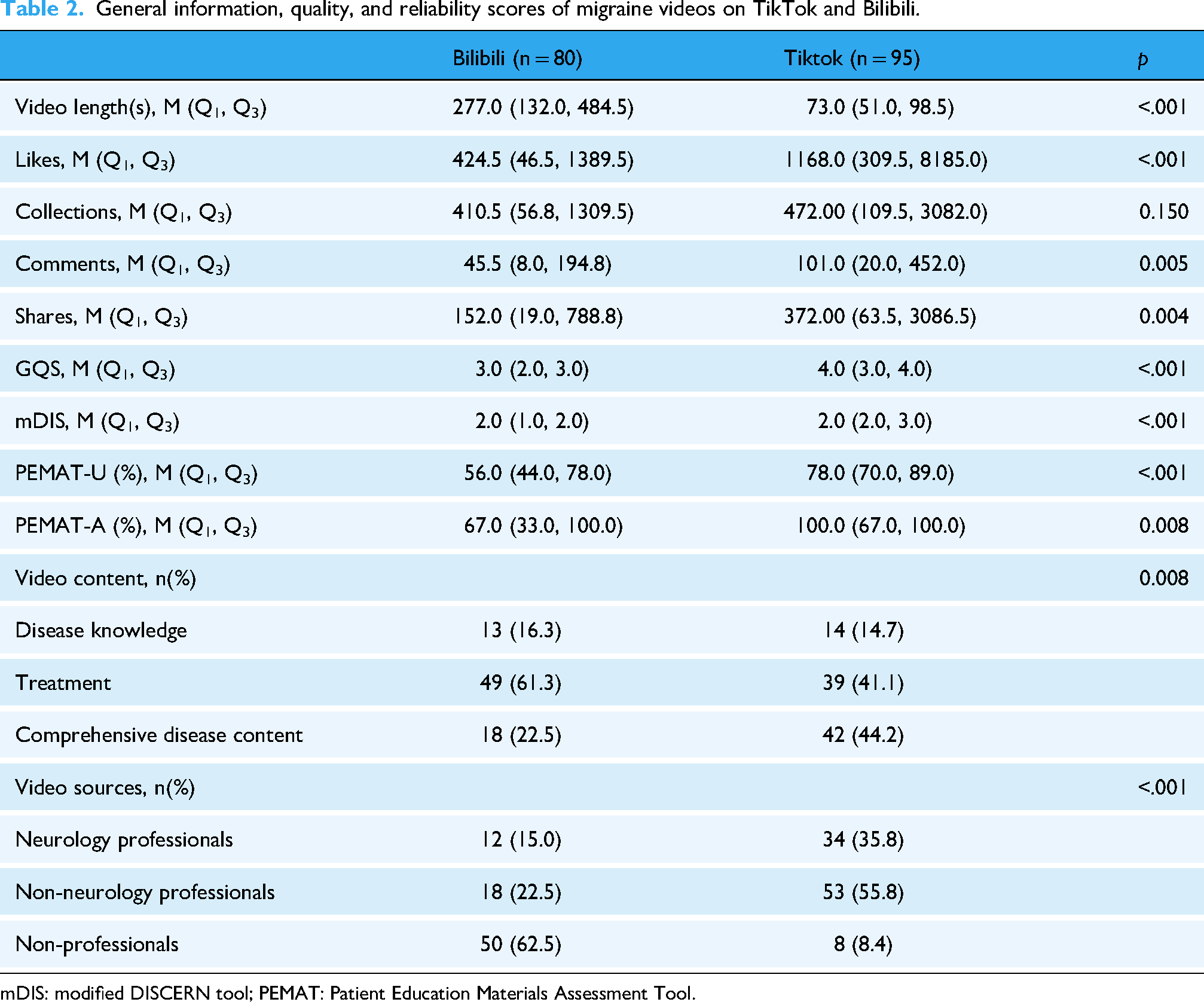
mDIS: modified DISCERN tool; PEMAT: Patient Education Materials Assessment Tool.
Regarding general video characteristics, Bilibili videos had a significantly longer median duration of 277.0 s (Q1, Q3: 132.0, 484.5) compared to TikTok's 73.0 s (Q1, Q3: 51.0, 98.5) (p < .001). Conversely, TikTok videos demonstrated significantly higher engagement metrics, including median likes [1168.0 (Q1, Q3: 309.5, 8185.0) vs. Bilibili's 424.5 (Q1, Q3: 46.5, 1389.5), p < .001], comments [101.0 (Q1, Q3: 20.0, 452.0) vs. 45.5 (Q1, Q3: 8.0, 194.8), p = 0.005], and shares [372.0 (Q1, Q3: 63.5, 3086.5) vs. 152.0 (Q1, Q3: 19.0, 788.8), p = 0.004]. No significant difference was observed in median collections between platforms.
Figure 2(A) illustrates the distribution of video content, which differed significantly between platforms. On Bilibili, “Treatment” videos were most prevalent (61%), followed by “Comprehensive Disease Content” (22%) and “Disease Knowledge” (16%). In contrast, TikTok featured a higher proportion of “Comprehensive Disease Content” (44%) and “Treatment” videos (41%), with “Disease Knowledge” making up 15%. Figure 2(B) details video sources, also showing a significant difference. Bilibili videos were predominantly uploaded by “Non-Professionals” (62%), with “Non-Neurology Professionals” contributing 22% and “Neurology Professionals” 15%. On TikTok, “Non-Neurology Professionals” were the primary source (56%), followed by “Neurology Professionals” (36%), while “Non-Professionals” accounted for only 8%. For treatment-specific videos (Figure 2(C)), a notable disparity was found in treatment modalities: 60% of Bilibili's treatment videos focused on “Pharmacological Interventions” versus 40% on “Non-Pharmacological Interventions,” whereas on TikTok, “Non-Pharmacological Interventions” dominated (98%), with only 2% covering “Pharmacological Interventions.”
Regarding video quality and reliability (Table 2), TikTok videos generally scored higher. The median GQS score [4.0 (Q1, Q3: 3.0, 4.0)], mDISCERN score [2.0 (Q1, Q3: 2.0, 3.0)], and PEMAT-U percentage [78.0% (Q1, Q3: 70.0%, 89.0%)] were all significantly higher for TikTok compared to Bilibili (GQS: 3.0 (Q1, Q3: 2.0, 3.0), p < .001; mDISCERN: 2.0 (Q1, Q3: 1.0, 2.0), p < .001; PEMAT-U: 56.0% (Q1, Q3: 44.0%, 78.0%), p < .001). PEMAT-A percentage was also significantly higher on TikTok [100.0% (Q1, Q3: 67.0%, 100.0%)] compared to Bilibili [67.0% (Q1, Q3: 33.0%, 100.0%)] (p = 0.008).
Video quality and reliability assessments
The cohen's κ of GQS and mDISCERN are 0.69(0.60–0.77), 0.79(0.71–0.86). The ICC(3,1) of PEMAT-U and PEMAT-A are 0.98(0.98–0.99),0.93(0.91–0.95). Table 3 and Figure 3 present the characteristics, quality, and reliability of migraine videos categorized by uploader type. Significant differences were observed in video length and likes across the three uploader groups. Non-Professionals uploaded significantly longer videos, with a median length of 227.5 s (Q1, Q3: 110.5, 471.8), compared to Neurology Professionals [82.5 s (Q1, Q3: 51.3, 110.8)] and Non-Neurology Professionals [89.0 s (Q1, Q3: 60.0, 126.0)]. Non-Neurology Professionals’ videos garnered the highest median likes [1241.0 (Q1, Q3: 230.5, 11765.5)], followed by Neurology Professionals [694.0 (Q1, Q3: 186.3, 1871.3)], with Non-Professionals receiving the fewest [470.0 (Q1, Q3: 54.5, 1751.0)]. No statistically significant differences were found for collections, comments, or shares across the uploader groups.
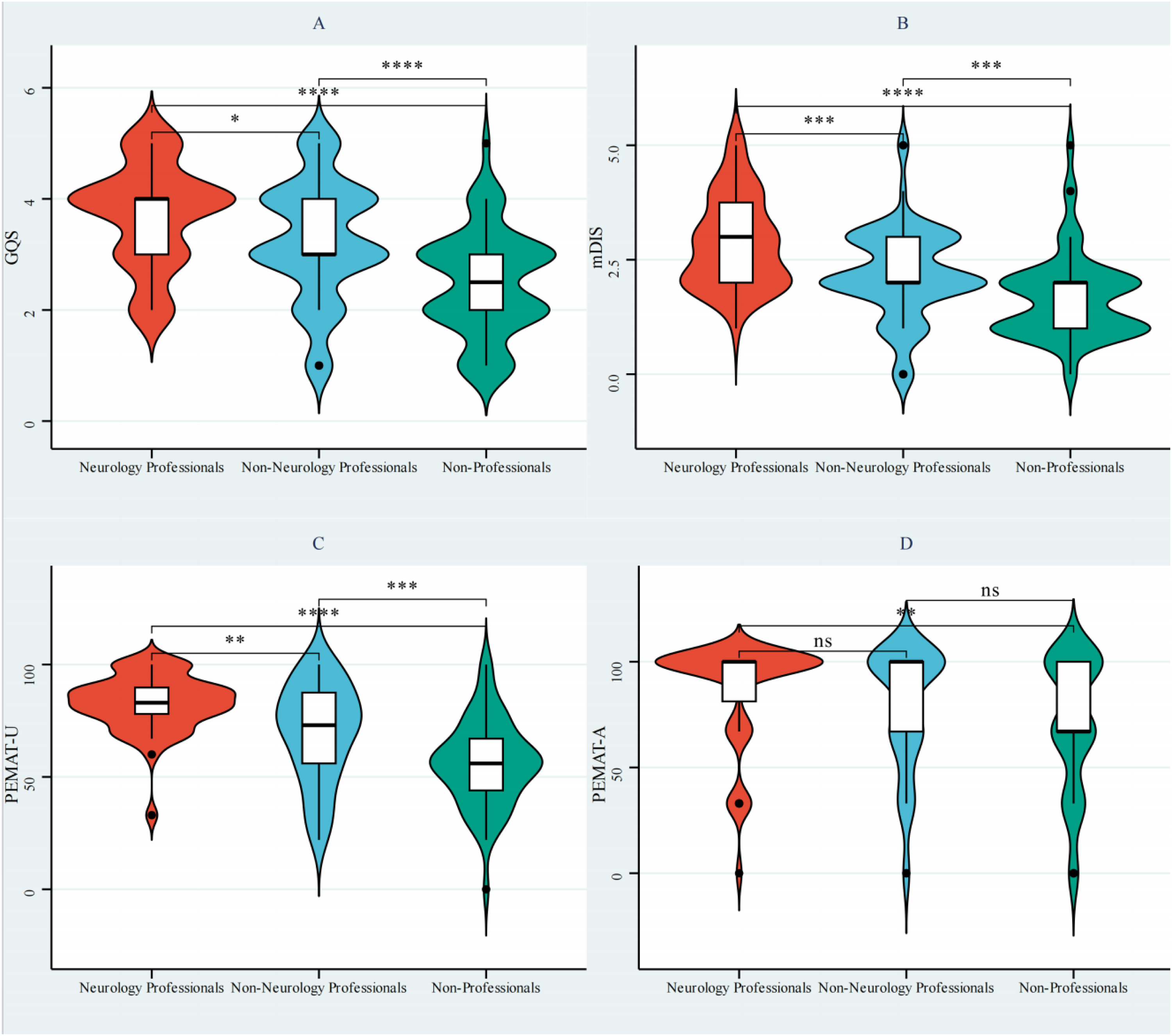
Quality and reliability scores of migraine videos by uploader professionalism. A. GQS distribution across neurology professionals, non-neurology professionals, and non-professionals. B. mDIS score distribution across uploader categories. C. PEMAT-U score distribution across uploader categories. D. PEMAT-A score distribution across uploader categories.*p < 0.05, **p < 0.01, ***p < 0.001, ****p < 0.0001; ns = not significant. mDIS: modified DISCERN tool; PEMAT: Patient Education Materials Assessment Tool.
Characteristics, quality, and reliability of migraine videos by different uploaders on TikTok and Bilibili.

mDIS: modified DISCERN tool; PEMAT: Patient Education Materials Assessment Tool.
Crucially, video quality and reliability scores demonstrated significant disparities among uploader types, as visually depicted in Figure 3. Neurology Professionals consistently produced videos with the highest median GQS [4.0 (Q1, Q3: 3.0, 4.0)], significantly surpassing Non-Neurology Professionals [3.0 (Q1, Q3: 3.0, 4.0)] and Non-Professionals [2.5 (Q1, Q3: 2.0, 3.0)]. Non-Neurology Professionals also scored significantly higher than Non-Professionals for GQS (Figure 3(A)). Similarly, for mDISCERN scores, Neurology Professionals achieved the highest median [3.0 (Q1, Q3: 2.0, 3.8)], significantly outperforming Non-Neurology Professionals [2.0 (Q1, Q3: 2.0, 3.0)] and Non-Professionals [2.0 (Q1, Q3: 1.0, 2.0)]. A significant difference was also noted between Non-Neurology Professionals and Non-Professionals for mDISCERN (Figure 3(B)). In terms of understandability, Neurology Professionals again led with a median PEMAT-U of 83.0% (Q1, Q3: 78.0%, 89.8%), significantly higher than Non-Neurology Professionals [73.0% (Q1, Q3: 56.0%, 87.5%)] and Non-Professionals [56.0% (Q1, Q3: 44.0%, 67.0%)]. Non-Neurology Professionals’ videos were also significantly more understandable than those from Non-Professionals (Figure 3(C)). For PEMAT-A, both Neurology Professionals [100.0% (Q1, Q3: 81.3%, 100.0%)] and Non-Neurology Professionals [100.0% (Q1, Q3: 67.0%, 100.0%)] achieved high median scores, with no significant difference between them. However, Non-Professionals’ videos had a significantly lower median PEMAT-A score [67.0% (Q1, Q3: 67.0%, 100.0%)] compared to Neurology Professionals and Non-Neurology Professionals (Figure 3(D)).
Table 4 and Figure 4 provide a comprehensive overview of the characteristics, quality, and reliability scores of treatment-related migraine videos, categorized by intervention modality (Non-Pharmacological vs. Pharmacological). This analysis included 148 migraine videos containing treatment-related content (comprising both “Treatment” and “Comprehensive Disease Content” categories), specifically comparing Non-Pharmacological Interventions (n = 42) and Pharmacological Interventions (n = 106).

Quality and reliability scores of migraine videos by treatment modality. A. GQS distribution for Pharmacological Interventions and Non-Pharmacological Interventions. B. mDIS score distribution for Pharmacological Interventions and Non-Pharmacological Interventions. C. PEMAT-U score distribution for Pharmacological Interventions and Non-Pharmacological Interventions. D. PEMAT-A score distribution for Pharmacological Interventions and Non-Pharmacological Interventions.****p < 0.0001; ns = not significant. mDIS: modified DISCERN tool; PEMAT: Patient Education Materials Assessment Tool.
Characteristics, quality, and reliability of migraine videos by treatment modality.
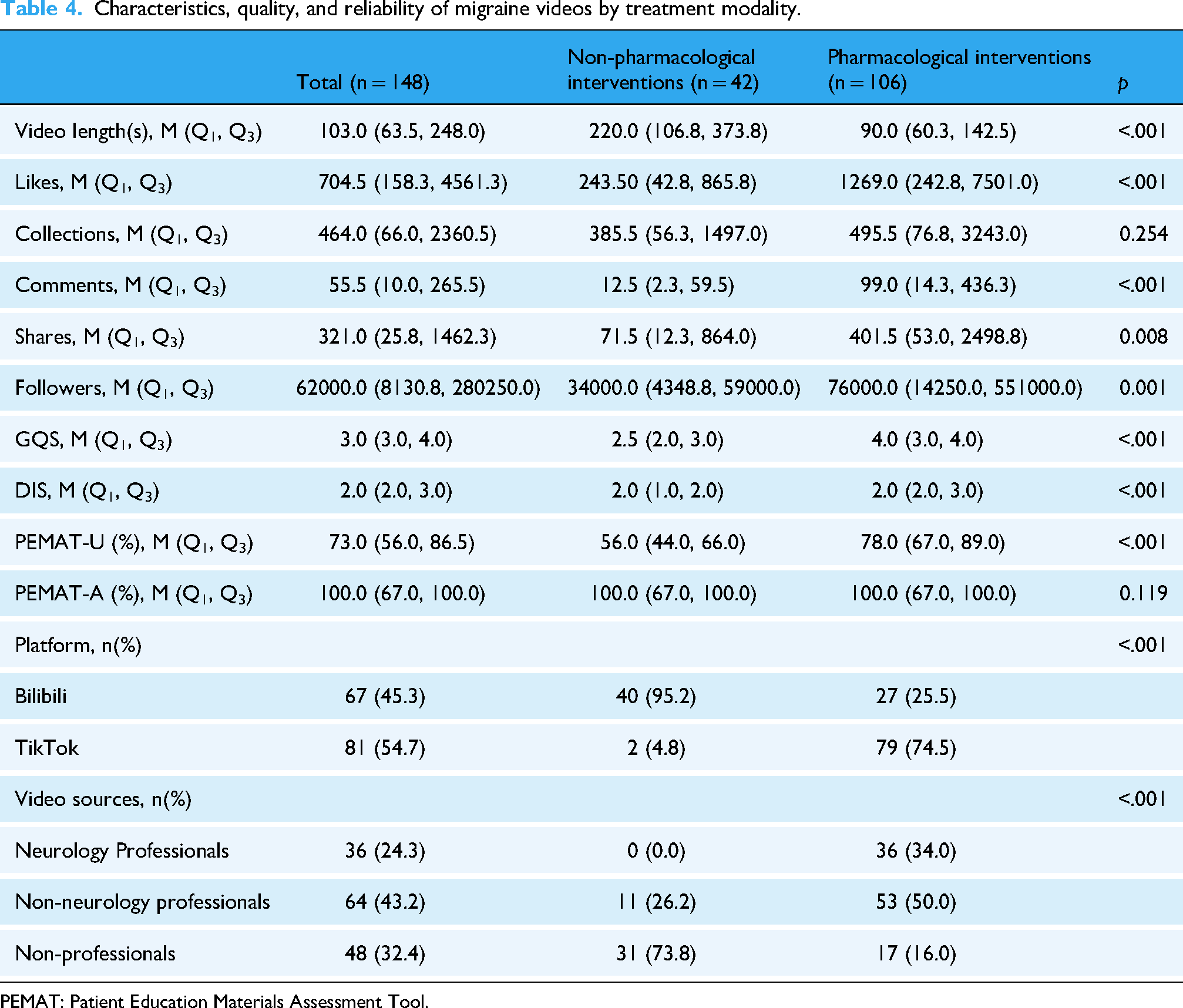
PEMAT: Patient Education Materials Assessment Tool.
Significant differences were observed in video length and several engagement metrics between the two intervention groups. Videos focusing on Non-Pharmacological Interventions were notably longer, with a median length of 220.0 s (Q1, Q3: 106.8, 373.8), compared to Pharmacological Interventions videos at 90.0 s (Q1, Q3: 60.3, 142.5). Conversely, videos discussing Pharmacological Interventions garnered significantly higher median likes [1269.0 (Q1, Q3: 242.8, 7501.0) vs. 243.5 (Q1, Q3: 42.8, 865.8) for Non-Pharmacological], comments [99.0 (Q1, Q3: 14.3, 436.3) vs. 12.5 (Q1, Q3: 2.3, 59.5)], and shares [401.5 (Q1, Q3: 53.0, 2498.8) vs. 71.5 (Q1, Q3: 12.3, 864.0)]. Videos on Pharmacological Interventions also had a significantly higher median number of followers [76000.0 (Q1, Q3: 14250.0, 551000.0) vs. 34000.0 (Q1, Q3: 4348.8, 59000.0)]. No significant difference was found for collections.
As illustrated in Figure 4 and detailed in Table 4, significant differences were evident in video quality and reliability scores between the two intervention types. Videos on Pharmacological Interventions consistently demonstrated higher quality and reliability. Specifically, they achieved a significantly higher median GQS of 4.0 (Q1, Q3: 3.0, 4.0) compared to Non-Pharmacological Interventions at 2.5 (Q1, Q3: 2.0, 3.0) (Figure 4(A)). Similarly, the median mDISCERN score was significantly higher for Pharmacological Interventions [2.0 (Q1, Q3: 2.0, 3.0)] than for Non-Pharmacological Interventions [2.0 (Q1, Q3: 1.0, 2.0)] (Figure 4(B)). For understandability, Pharmacological Interventions videos also had a significantly higher median PEMAT-U score of 78.0% (Q1, Q3: 67.0%, 89.0%) compared to Non-Pharmacological Interventions at 56.0% (Q1, Q3: 44.0%, 66.0%) (Figure 4(C)). However, no significant difference was observed in PEMAT-A scores, with both groups showing a median of 100.00% (Q1, Q3: 67.0%, 100.0%) (Figure 4(D)).
The distribution of videos across platforms and uploader sources also varied significantly by intervention type . For Non-Pharmacological Interventions, a vast majority of videos originated from Bilibili (95.2%), with only 4.8% from TikTok. Conversely, for Pharmacological Interventions, TikTok was the dominant platform (74.5%), while Bilibili accounted for 25.5%. Regarding uploader sources, Non-Professionals contributed the largest share of Non-Pharmacological Intervention videos (73.8%), followed by Non-Neurology Professionals (26.2%), with no Neurology Professionals. In contrast, Pharmacological Intervention videos were primarily uploaded by Non-Neurology Professionals (50.0%) and Neurology Professionals (34.0%), with Non-Professionals contributing 16.0%.
Spearman correlation analysis
Spearman correlation analysis was conducted to explore the relationships among various video characteristics, GQS, mDIS, PEMAT-U, and PEMAT-A in the included migraine-related videos. The results are presented in Figure 5.

Spearman correlation matrix among video variables, quality, and reliability scores.X:p ≥ 0.05.
A strong positive inter-correlation was observed among all engagement metrics: likes, collections, comments, and shares. Specifically, likes showed strong positive correlations with collections (r = 0.92), comments (r = 0.88), and shares (r = 0.93). Similar strong positive correlations were found between collections and comments (r = 0.81), collections and shares (r = 0.95), and comments and shares (r = 0.87). Video length, however, did not exhibit significant correlations with any of these engagement metrics.
Regarding the quality and reliability assessment tools, GQS, mDIS, PEMAT-U, and PEMAT-A demonstrated positive inter-correlations. GQS was strongly positively correlated with mDIS (r = 0.74) and moderately positively correlated with PEMAT-U (r = 0.64) and PEMAT-A (r = 0.42). mDIS also showed moderate positive correlations with PEMAT-U (r = 0.57) and PEMAT-A (r = 0.34). PEMAT-U and PEMAT-A were moderately positively correlated (r = 0.55).
Discussion
Migraine is a severely debilitating condition that places a substantial burden on affected individuals24–26 This burden is experienced not only during acute attacks (ictal phase) but also in the periods between them (interictal phase), leading to migraine being recognized as the costliest neurological disorder. 27 As the Global Campaign Against Headache continues to advance worldwide, educational programs targeting physicians and headache patients have been widely implemented.28,29 There is now growing scholarly attention toward public awareness campaigns for headache knowledge. Current forms of such knowledge dissemination mainly include national Medication-Overuse Headache (MOH) awareness campaigns, 30 university education programs, 31 public education initiatives, 32 leaflet distribution during mass vaccination drives, 33 e-learning through schools, 33 and e-learning conducted on social networking sites frequented by user groups with potentially high headache prevalence. 34 These measures have, to a certain extent, enhanced public understanding of headache disorders. Given the widespread influence and popularity of TikTok and Bilibili among populations in China, they present an ideal medium for disseminating accurate health education. Consequently, this study aims to evaluate the necessity and effectiveness of leveraging social media to convey health knowledge.
TikTok and BiliBili as health information sources
Social media's role in healthcare is expanding, with approximately 80% of internet users seeking health information online.6,7 Both TikTok and BiliBili have emerged as influential channels for the creation and dissemination of health-related videos. Evidence suggests TikTok exhibited immense potential for information dissemination during the COVID-19 pandemic.11,12 Additionally, both BiliBili and TikTok host a plethora of trending videos on conditions such as diabetes, inflammatory bowel disease, obstructive pulmonary disease, and liver cancer, garnering substantial likes, comments, and other forms of engagement10,13–15 In our investigation, we observed a similar pattern regarding migraine-related videos, which successfully captured audience interest. The 175 videos analyzed within our study garnered approximately 880,000 likes and 73,000 comments since their initial upload, signifying a high level of public engagement and popularity. Consequently, platforms like TikTok and BiliBili show considerable promise as conduits for disseminating health information, including details pertinent to migraine. However, while short-form video content offers significant opportunities for health education, it also introduces potential hazards to public health and carries various adverse effects. The diverse origins of content creators, coupled with the insufficient oversight and moderation mechanisms inherent to these platforms, frequently lead to the prevalence of substandard and untrustworthy videos. 35 This phenomenon can even extend to the circulation of deceptive and erroneous material among the general public.16,36 For example, a prior study examining heart failure videos on TikTok identified a lack of comprehensive content and raised concerns about their reliability and overall quality. 37 Comparable analyses have similarly highlighted the poor quality of information found in short videos pertaining to conditions such as anorexia nervosa and idiopathic pulmonary fibrosis.38,39 More critically, multiple studies have underscored the potential for short-video platforms to convey misleading health information16,17,38–40 Strikingly, Simon and colleagues’ assessment of atopic eczema videos revealed that a substantial 34.0% contained potentially detrimental advice. 16 Equally alarming, research evaluating the quality of psoriasis-related videos found that over half disseminated inaccurate information, with approximately 10% providing overtly dangerous recommendations. 41 Adding to this concern, misinformation tends to propagate more rapidly and extensively than verified facts. 9 Patients who rely on such inaccurate information from short-videos risk making detrimental health decisions, thereby compromising their well-being. To counteract this, it is paramount that video platforms enhance their content monitoring and review protocols. This measure is essential to guarantee the accuracy, quality, and reliability of disseminated videos, thereby protecting users from potentially harmful or misleading content.
Quality and reliability of the short videos about migraine
The quality and reliability of online information concerning migraine, particularly on short-video platforms, remain largely uncharacterized, to our current understanding. This investigation serves as the inaugural effort to bridge this specific knowledge gap. Prior studies have indicated a variable overall quality for health education videos,15,42 with content from professionals generally outperforming that from non-professionals. 10 Our findings corroborate this, demonstrating that videos produced by medical professionals, especially neurologists, offer comparatively superior instructional utility, marked by enhanced quality and trustworthiness. This superiority likely stems from their comprehensive grasp of migraine pathophysiology, adherence to clinical guidelines, and familiarity with cutting-edge research. In contrast, non-medical personnel often rely on anecdotal evidence and personal perspectives, potentially introducing bias into their shared content. 43 Such observations reinforce the paramount importance of accumulated expertise for credible healthcare information videos. 44 Disturbingly, our analysis revealed a limited involvement from Neurology Professionals, who contributed merely 26.29% (46/175) of the videos. The higher proportion of content shared by other sources consequently compromises the quality of migraine-related videos available on these platforms. Therefore, it is essential to incentivize Neurology Professionals to produce a greater volume of high-quality educational videos on migraine. This will not only elevate public understanding of the condition but also effectively harness social media's capacity to advance public health.
Correlation analysis
A relationship among likes, comments, and saves on social media has been established by previous investigations. 45 Our current study revealed a substantial positive association (above 0.8) among likes, comments, saves, and shares. This suggests that content that is highly liked tends to also attract more comments, be frequently saved by users, and achieve broader dissemination. This high degree of interconnectedness indicates that active user feedback is typically reflected across various engagement metrics. Within our research, we identified an inverse relationship between video duration and PEMAT-U (%), possibly because prolonged video content could reduce user willingness to engage. 10 Unexpectedly, we found that video quality exhibited either no significant or only a weak positive correlation with audience interaction (likes, comments, shares, and saves), a finding that stands in surprising opposition to the outcomes of certain prior studies.8,16 And it suggests that popular engagement metrics or video duration are not reliable indicators of the quality or reliability of migraine-related health information. Surprisingly, videos published by Neurology Professionals, despite their superior quality, received comparatively less attention in terms of user interaction. Conversely, our study also revealed that while Non-Neurology Professionals’ videos were not as high in quality as those from NPs, they remained relatively reliable and achieved higher video engagement.40,46 This phenomenon might stem from the rigorous language and complex professional terminology often employed in NP videos, which tends to be less appealing to a non-specialist audience.47,48 Furthermore, these trends could also be influenced by the recommendation algorithms of short-video platforms. 8 Specifically, videos with more likes and interactions are more likely to be promoted, thereby exacerbating the disparity between video quality and popularity. Consequently, it is advisable for Neurology Professionals to consider public needs and preferences, using simpler language when uploading videos. Additionally, platforms ought to establish robust video screening mechanisms, prioritizing professional and high-quality content in search results to ensure the dissemination of accurate knowledge.
Practical significance
The expanding reach of internet technology, coupled with a growing societal emphasis on health literacy, has fundamentally shifted the patient's role from a passive receiver to an engaged pursuer of health information. 15 This transformation is further amplified by the rapid progress in multimedia and the ubiquity of mobile devices, positioning visual social media as a primary conduit for patient knowledge. While these platforms offer unparalleled ease of access to medical content, the variable quality of uploaded videos poses considerable risks, with some content actively deceiving users or providing factually incorrect advice. Recognizing these perils, the medical community, alongside the Chinese government, has taken action; notably, China has released the world's inaugural guidelines for the responsible sharing of scientific health information across media channels. It is imperative that high-caliber videos be prioritized and gain more visibility. An ideal health promotion video should balance scientific rigor, public resonance, and ease of understanding, ensuring it is devoid of any false or misleading elements. Consequently, evaluating video quality becomes paramount to ensure audiences receive reliable information, and subsequent research must guide the strategic development and enhancement of these crucial digital platforms.
Limitations
It is important to acknowledge, however, that our study is not without its limitations. Primarily, the constantly evolving nature of video content on platforms like TikTok and BiliBili makes a real-time quality appraisal difficult. Our assessment was a snapshot in time, and potential subjective variations could still exist within the evaluations, suggesting that more extensive expert review is advisable for future studies. Secondly, our scope of evaluation was restricted to videos uploaded on Chinese short-video platforms. As a result, these findings might not be directly applicable to platforms catering to different linguistic communities, thereby highlighting the importance of conducting subsequent cross-cultural and cross-linguistic research.
Conclusion
This study assessed the quality of 175 migraine-related videos available on TikTok and BiliBili. Overall, the quality and reliability of the video content across these platforms were found to be suboptimal. Specifically, migraine videos on TikTok demonstrated a marginal superiority over those on BiliBili. Videos contributed by Neurology Professionals were identified as possessing higher quality and reliability, thus offering more valuable information to viewers. Consequently, it is imperative for healthcare professionals and institutions to acknowledge the burgeoning prominence of short-form videos and actively provide high-quality migraine content. Furthermore, short-video platforms ought to bolster their monitoring and review mechanisms, while patients should exercise discernment when consuming short videos on BiliBili and TikTok.
Supplemental Material
sj-docx-1-dhj-10.1177_20552076261415929 - Supplemental material for The quality and reliability of short videos about migraine on Chinese social Media platforms (BiliBili and TikTok): A cross-sectional study
Supplemental material, sj-docx-1-dhj-10.1177_20552076261415929 for The quality and reliability of short videos about migraine on Chinese social Media platforms (BiliBili and TikTok): A cross-sectional study by Siyu Qian, Jiachen Gu and Haonan Zhao in DIGITAL HEALTH
Supplemental Material
sj-xlsx-2-dhj-10.1177_20552076261415929 - Supplemental material for The quality and reliability of short videos about migraine on Chinese social Media platforms (BiliBili and TikTok): A cross-sectional study
Supplemental material, sj-xlsx-2-dhj-10.1177_20552076261415929 for The quality and reliability of short videos about migraine on Chinese social Media platforms (BiliBili and TikTok): A cross-sectional study by Siyu Qian, Jiachen Gu and Haonan Zhao in DIGITAL HEALTH
Footnotes
Acknowledgements
The authors would like to express their gratitude to the participants who participated in the study.

Ethical approval
The Medical Ethics Committee of QingPu Hospital Affiliated to Fudan University approved this research (QWJ2024-18).
Author contributors
HZ was responsible for conceptualization, writing the original draft, and editing. SQ and JG handled data curation, data analysis, and visualization. All authors contributed to the article and approved the submitted version.
Funding
The authors received no financial support for the research, authorship, and/or publication of this article.
Declaration of conflicting interests
The authors declared no potential conflicts of interest with respect to the research, authorship, and/or publication of this article.
Data availability
Raw data were generated at QingPu Hospital Affiliated to Fudan University. Derived data supporting the findings of this study are available from the corresponding authors on request.
Statement
The video content used in the study from TikTok and Bilibili was all public at the time of data collection and did not require individual consent for use. The data collection was conducted in full compliance with TikTok's and Bilbili's terms of service.
Guarantor
HZ
Supplemental material
Supplemental material for this article is available online.
References
Supplementary Material
Please find the following supplemental material available below.
For Open Access articles published under a Creative Commons License, all supplemental material carries the same license as the article it is associated with.
For non-Open Access articles published, all supplemental material carries a non-exclusive license, and permission requests for re-use of supplemental material or any part of supplemental material shall be sent directly to the copyright owner as specified in the copyright notice associated with the article.
