




Abstract
Background
Osteonecrosis of the femoral head is a disabling orthopedic condition often diagnosed late due to limited public awareness. Social media platforms such as Bilibili and TikTok have become key sources of health information, yet the quality of content varies widely.
Methods
We searched Bilibili and TikTok on February 12, 2025, using the Chinese term “股骨头坏死” (osteonecrosis of the femoral head), which serves as both the scientific and commonly used colloquial expression. A total of 162 videos were analyzed using the modified DISCERN (mDISCERN), Global Quality Score, Video Information and Quality Index (VIQI), and Patient Education Materials Assessment Tool evaluation tools. User engagement metrics and content quality scores were compared between platforms using the Mann–Whitney U test and the Chi-square test.
Results
TikTok videos demonstrated significantly higher user engagement, reflected by greater numbers of likes, favorites and comments. However, Bilibili hosted a wider range of creators and provided more in-depth examination and diagnosis-oriented content. TikTok achieved higher scores in overall video quality (mDISCERN-sum and VIQI-sum), particularly in information flow,information accuracy and understandability, whereas Bilibili performed better in actionability, offering more detailed procedural or instructional guidance. Professional creators produced videos with higher scores in information flow and information accuracy, whereas non-professionals achieved higher actionability scores.
Conclusion
TikTok and Bilibili serve complementary functions in osteonecrosis of the femoral head (ONFH) education: TikTok enhances awareness of early symptoms, while Bilibili supports deeper understanding of imaging, staging and treatment. Building on these strengths, future digital health efforts should integrate professional expertise, improve content governance and apply AI-assisted tools to deliver accurate, accessible and actionable ONFH information for earlier detection and better disease management.
Keywords
Introduction
Osteonecrosis of the femoral head (ONFH) is an orthopedic disease with high morbidity, with an annual prevalence ranging from 15,000 to 20,000 in the United States, and the cumulative number of cases of necrosis of the femoral head in China reached 8.12 million in 2013, with young and middle-aged people being mainly affected.1,2 Hip arthroplasty due to femoral head necrosis accounts for approximately 10% of all hip arthroplasties in the United States, and this percentage is greater in China. 3 ONFH may result from trauma, corticosteroid or alcohol use, and can also manifest secondary to systemic autoimmune disorders such as antiphospholipid syndrome.4,5 Nevertheless, because the early clinical manifestations are mostly atypical or even asymptomatic, most patients fail to receive timely treatment, which ultimately results in femoral head collapse, which affects joint function and threatens patients’ health. 6 This suggests the necessity of strengthening the popularization of the disease to improve the early recognition rate, optimize the treatment plan, and improve the prognosis of patients.
Currently, digital health communication profoundly changes the way information is accessed, and an increasing number of people choose to obtain medical information through online video platforms. 7 In an era where patients are increasingly involved in shared decision-making, the push of medical videos is conducive to patients’ early understanding of their condition, adjusting their expectations, actively cooperating with treatment, and promoting good doctor–patient interactions. 8 However, video content is of mixed quality, and misinformation may mislead patients, resulting in decreased cooperation and tension in the doctor‒patient relationship. 9 Therefore, it is necessary to standardize the science, accuracy, and reliability of such videos.
Bilibili and TikTok occupy most of the long and short video markets in China, respectively. TikTok relies on intelligent recommendation algorithms to realize the accurate delivery of medical information, and its daily users have a greater initiative to search for orthopedic disease content; Bilibili operates in the mode of an in-depth knowledge community, with a high rate of completion of relevant medical science videos.10,11 Despite the existence of a large amount of ONFH-related video content on the above video platforms, the quality of medical videos related to ONFH on these platforms has not yet been fully evaluated.
Therefore, this study systematically evaluated the content quality and reliability of ONFH-related popular science videos on Bilibili and TikTok. By identifying the advantages and deficiencies in the dissemination of ONFH-related information, this study aims to provide an evidence-based reference for optimizing online health communication, enhancing early disease awareness, and guiding preventive and therapeutic education. To the best of our knowledge, this is the first cross-platform analysis comparing ONFH-related medical videos on these two major Chinese short-video platforms.
Materials and methods
Ethical considerations
This study analyzed only publicly available short-video data and did not involve any human subjects or identifiable personal information. The research protocol received ethical approval from the Ethics Committee of Henan Provincial Hospital of Chinese Medicine (The Second Affiliated Hospital of Henan University of Chinese Medicine) (Approval No. 1665-01). This hospital serves as a key teaching and research base of the School of Orthopedics, Henan University of Chinese Medicine, integrating clinical practice, education, and scientific research, which provides a strong foundation for the implementation of this study. The study was conducted in accordance with the Declaration of Helsinki and the COPE ethical guidelines for research involving publicly available social-media data.
Study setting
This study is a cross-sectional content analysis. The initial data collection was carried out on February 12, 2025, at the Henan Provincial Hospital of Chinese Medicine (The Second Affiliated Hospital of Henan University of Chinese Medicine), by the research team. Following data acquisition, systematic screening, coding, and statistical processing were undertaken between February 12 and March 1, 2025 to ensure the accuracy, consistency, and completeness of the dataset, at the Henan University of Chinese Medicine and the Henan Provincial Hospital of Chinese Medicine.
Video collection
Searches were conducted on Bilibili and TikTok with the term “股骨头坏死” (osteonecrosis of the femoral head, in Chinese, is both a scientific name and a commonly used colloquial term). Although both platforms have overseas versions, their main user base and content environment in this study are primarily within China and English search terms yielded negligible or no relevant results. Before searching, the screener logged out of all accounts and cleared the search history to avoid personalized recommendation bias. The search results were displayed in the default order without any filtering criteria. In addition, the screener skipped videos posted within a week due to unstable viewing and liking data that did not accurately reflect viewer engagement. Following the methodology of previous social media content analysis studies and the above conditions, we collected the top 100 videos on the Bilibili and TikTok platforms. 12
Video review
Two researchers independently reviewed the videos and excluded duplicate, re-uploaded, or unrelated videos. Marketing or promotional videos primarily aimed at advertising products or medical services were excluded, as they did not provide substantive educational or informational content. Direct reprints, translations, and technically defective videos, including those with missing sound, incomplete playback, or corrupted visuals, were excluded because they could not be reliably assessed for quality or reliability.
Video characteristics
For each included video, interactive and engagement-related attributes were systematically recorded by the researchers. These included kudos (user appreciation reactions equivalent to “likes”), favorites (instances where users saved or bookmarked the video), comments (user feedback or messages posted below the video), shares (instances of content being reposted or forwarded to others), view count (total number of times the video was played), and bullet screens (real-time scrolling comments appearing across the video screen). These indicators were selected to comprehensively reflect audience engagement and platform-specific interaction behaviors.
Uploader characteristics
Details about the uploaders, including name, avatar, homepage, ID, number of followers, authentication status, and type, were collected by the researcher. Video uploaders were categorized as doctors, other medical professionals/students, hospitals/departments/associations, official media self-published media.
Video categorization
The subject of the videos were categorized as anatomical, epidemiological, etiology/prevention, examination/diagnosis, pathology, prognosis, symptoms and treatment. The subject of the videos were categorized as anatomical, etiology/prevention, pathology, epidemiological, symptoms, examination/diagnosis, treatment, and prognosis. The video shooting style of the videos was categorized as animation/motion (animated graphics or motion effects illustrating medical concepts), medical scenarios (dramatized clinical settings or demonstrations by healthcare professionals), PPT/Class (lecture-style presentations using slides or classroom explanations), Q&A (an interactive question-and-answer format addressing audience queries or explaining clinical topics), solo narrative (a single speaker presenting directly to the audience or camera) and television programs/documentaries (professionally produced segments from broadcast or long-form media). In addition, the researchers also examined whether the videos contained content related to Traditional Chinese Medicine (TCM) to capture the integration of TCM perspectives in ONFH-related health communication.
Quality assessment
The quality of all valid videos obtained after the above screening and categorization process was independently assessed by two researchers. The modified version of DISCERN (mDISCERN), 13 the Global Quality Score (GQS), 14 the Video Information and Quality Index (VIQI), 15 and Patient Education Materials Assessment Tool (PEMAT) 16 were used to assess video quality. The Supplemental Materials 1, 2, 3 and the Supplemental Material 4 provide detailed descriptions of these tools.
mDISCERN, adapted from the DISCERN tool, is better suited for assessing video material, and is widely used to assess the quality of health information on websites, social media, YouTube, and other multimedia platforms. 20 It has also been used to assess the content quality of medical education videos, surgical operation videos, and other healthcare-related videos. 21 mDISCERN consists of five questions related to video reliability. Each question is given a score of 1 for “yes” and 0 for “no.” The higher the score is, the better the reliability.
The GQS was originally designed as a tool for assessing the quality of websites, focusing on the flow and ease of use of information. The scale ranges from 1 to 5, where 1 or 2 indicates low quality, 3 indicates moderate quality, and 4 or 5 indicates high quality. 14 In addition, GQS has been used to assess the quality of video content, especially in the healthcare field. For example, the GQS is used to assess the quality of medical information provided in YouTube videos on a scale ranging from 1 (very poor) to 5 (excellent) and is combined with the DISCERN tool for a comprehensive assessment. 19
The VIQI tool is an analytics and search engine optimization optimization tool to help users improve the number of views and channel performance of their videos. It contains four dimensions: Information flow (VIQI-1), information accuracy (VIQI-2), quality (each image, animation, interview, video subtitle, and summary in the video contains a point) (VIQI-3), and precision (the level of coherence between the video's title and content) (VIQI-4). Each criterion is rated on a scale of 1 to 5, with higher scores indicating better quality. 15
The PEMAT, for use with auditioned materials, is an assessment tool for patient education materials developed to address the shortcomings of the readability formula itself. The domains of comprehensibility (when consumers from different backgrounds and with different levels of health literacy can process and interpret key information) and actionability (when consumers from different backgrounds and with different levels of health literacy can determine what they can do on the basis of the information provided) were assessed, with a maximum score of 100% for each domain.17,18 The survey consists of 25 questions, 21 of which represent the comprehensibility of the health information and 4 of which assess the actionability of the video recommendations. Each item was scored as “agree = 1, disagree = 0. The scores for the total (PEMAT-T), understandability (PEMAT-U), and actionability (PEMAT-A) sections were calculated as the “Total Score/Total Possible Score × 100.” Higher scores indicate better performance. 16
Previous studies have validated the above tools, especially in the context of social media platforms.13–21 Additional files and additional files provide detailed descriptions of these tools.
Statistical analysis
In this study, the data were checked and recorded by two people, and the data were statistically analyzed via SPSS 25.0 software. The Shapiro‒Wilk test for normality of continuous variables was used, with normally distributed continuous variables expressed as the standard deviation (SD) ± mean, and continuous variables that did not fit the normal distribution expressed as the median, minimum-maximum, and percentile (M [P25, P75]).
The Mann‒Whitney U test was used to compare continuous variables that did not conform to a normal distribution and are reported with numbers and ratios. The chi-square test and continuity correction were used to compare categorical variables as a means of elucidating the differences between the two platforms, TikTok and Bilibili. Correlation analysis was performed via Spearman's method to assess the relationship between viewer interaction and video quality, where r > 0 indicates a positive correlation and r < 0 indicates a negative correlation. The strength of the correlation was categorized as follows: |r| ≤ 0.2 indicates no correlation; 0.2 < |r| ≤ 0.4 indicates a weak correlation; 0.4 < |r| ≤ 0.6 indicates a moderate correlation; and 0.6 < |r| ≤ 0.8 indicates a strong correlation, and a P value < 0.05 was considered statistically significant.
Results
Video characteristics
Among the 200 videos obtained, 162 (81%) valid videos were included in this study (Figure 1). These videos, including 74 from TikTok and 88 from Bilibili, were used to analyze the dissemination characteristics of ONFH (Table 1). The number of kudos, favorites and comments on TikTok was significantly greater than that on Bilibili (P < 0.001).

Search strategy for videos on osteonecrosis of the femoral head (ONFH).
Characteristics of videos about osteonecrosis of the femoral head (ONFH) on TikTok and Bilibili.

- indicates that no corresponding data were available on the platform.
Mann–Whitney U test.
Uploader characteristics
In this study, we statistically analyzed the characteristics of creators who uploaded videos related to ONFH on two platforms, TikTok and Bilibili. As shown in Table 2, TikTok had a higher rate of certified uploads and was dominated by the doctors, whereas Bilibili had a lower rate of certified uploads and a more diverse type of uploader, with a significant difference between the two platforms (P < 0.001).
Characteristics of the uploaders of videos about osteonecrosis of the femoral head (ONFH) on TikTok and Bilibili.

Chi-Square test.
Video categorization
The video categorization results of the ONFH-related videos in this study are shown in Table 3 (Figure 2). There were significant differences between the two platforms in the subject and the integration of TCM knowledge (P < 0.001), but there were no significant differences in video shooting style. In terms of subject, Bilibili had a significantly greater percentage of content in the examination/diagnosis category than TikTok (P < 0.001). Neither platform covered epidemiological videos. In terms of video shooting style, TikTok and Bilibili were dominated by solo narrative and medical scenarios. Notably, BiliBili excels in integrating TCM theories, as it contains far more TCM content than TikTok does (P < 0.001).

Classification of videos about osteonecrosis of the femoral head (ONFH) on TikTok and Bilibili.
Classification of videos about ONFH on TikTok and Bilibili.
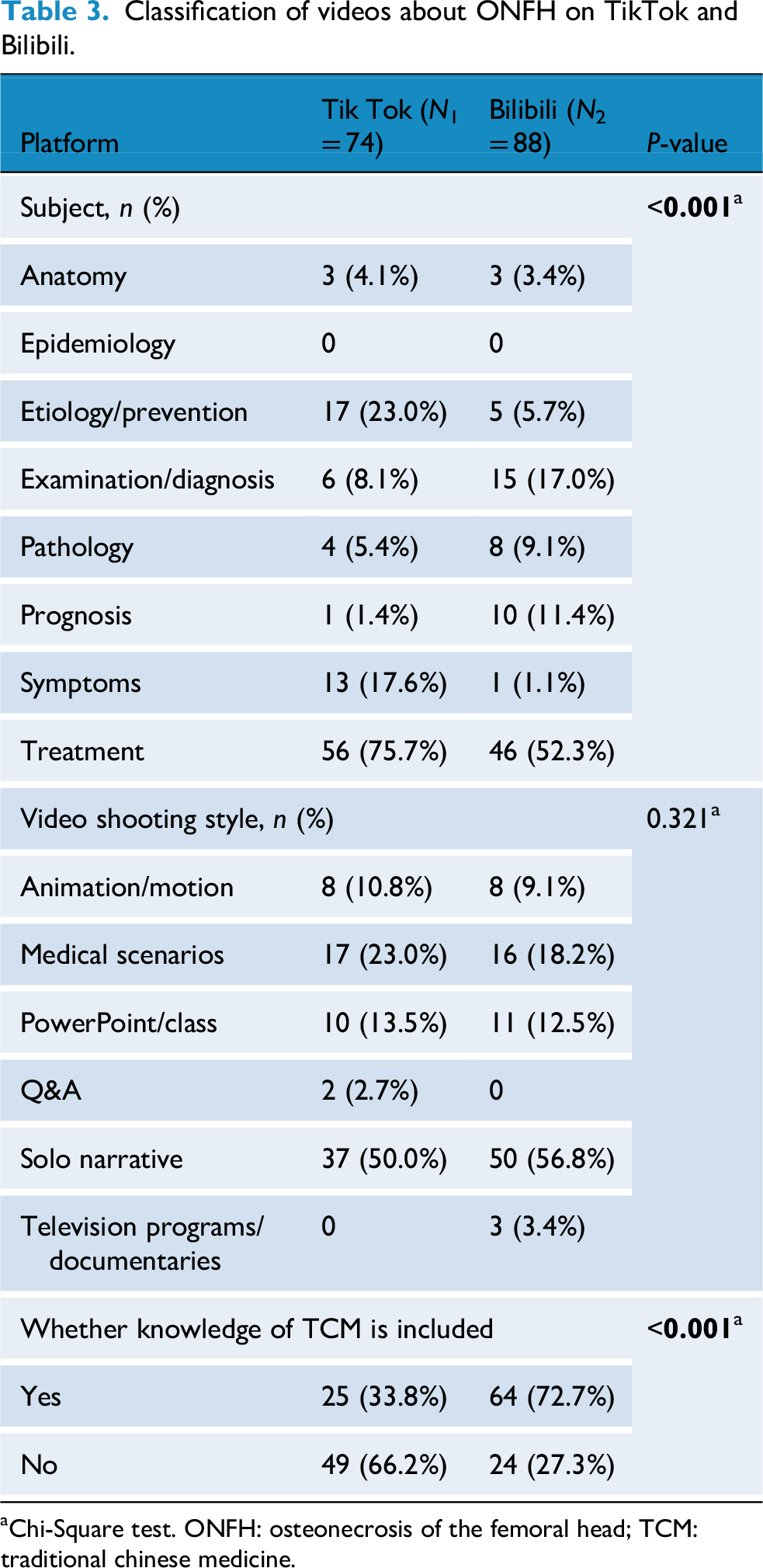
Chi-Square test. ONFH: osteonecrosis of the femoral head; TCM: traditional chinese medicine.
Video quality
In terms of video quality, as shown in the Table 4 (Figure 3), the mDISCERN score of Bilibili was lower than that of TikTok (P < 0.001). In the GQS, both platforms had a total score of 3 and an interquartile range of 3–4, with no statistically significant difference (P = 0.853). The VIQI-sum shows that TikTok is significantly better than Bilibili (P < 0.001). The specific difference is reflected in the fact that TikTok is significantly better than Bilibili in terms of the information flow (VIQI-1) (P < 0.001). TikTok and Bilibili also have some differences in the information accuracy (VIQI-2), with Bilibili's score distribution being more concentrated (P = 0.004). In terms of the PEMAT-T, there was no significant difference between TikTok and Bilibili (P = 0.822). However, in terms of understandability (PEMAT-U), TikTok scored significantly higher than Bilibili did (P = 0.004), indicating that TikTok videos focus more on concise and easy-to-understand expressions, whereas Bilibili's long videos have a greater density of information, which is harder to understand. For actionability (PEMAT-A), Bilibili significantly outperformed TikTok, a difference that highlights BiliBili's strength in providing specific action guidance (P < 0.001).

Quality assessment of videos about osteonecrosis of the femoral head (ONFH) on TikTok and Bilibili.
Quality assessment of videos about ONFH on TikTok and Bilibili.

mDISCERN: modified DISCERN; VIQI: Video Information and Quality Index; ONFH: osteonecrosis of the femoral head; PEMAT: Patient Education Materials Assessment Tool; GQS: Global Quality Score.
Mann–Whitney U test.
Chi-Square test.
Continuity correction.
This study also assessed the difference in the quality of videos related to ONFH uploaded by professionals and nonprofessionals, as shown in Table 5. The overall mDISCERN sum did not differ significantly between the two groups (P = 0.240). Regarding the GQS, the difference did not reach statistical significance (P = 0.057). In terms of the VIQI items, professionals demonstrated significantly better non-performance in information flow (VIQI-1) (P < 0.001), information accuracy (VIQI-2) (P = 0.005) and the VIQI-sum (P < 0.001). For the PEMAT evaluation, the actionability score (PEMAT-A) of non-professionals was significantly higher (P = 0.035).
Comparison of video quality uploaded by professionals and nonprofessionals.
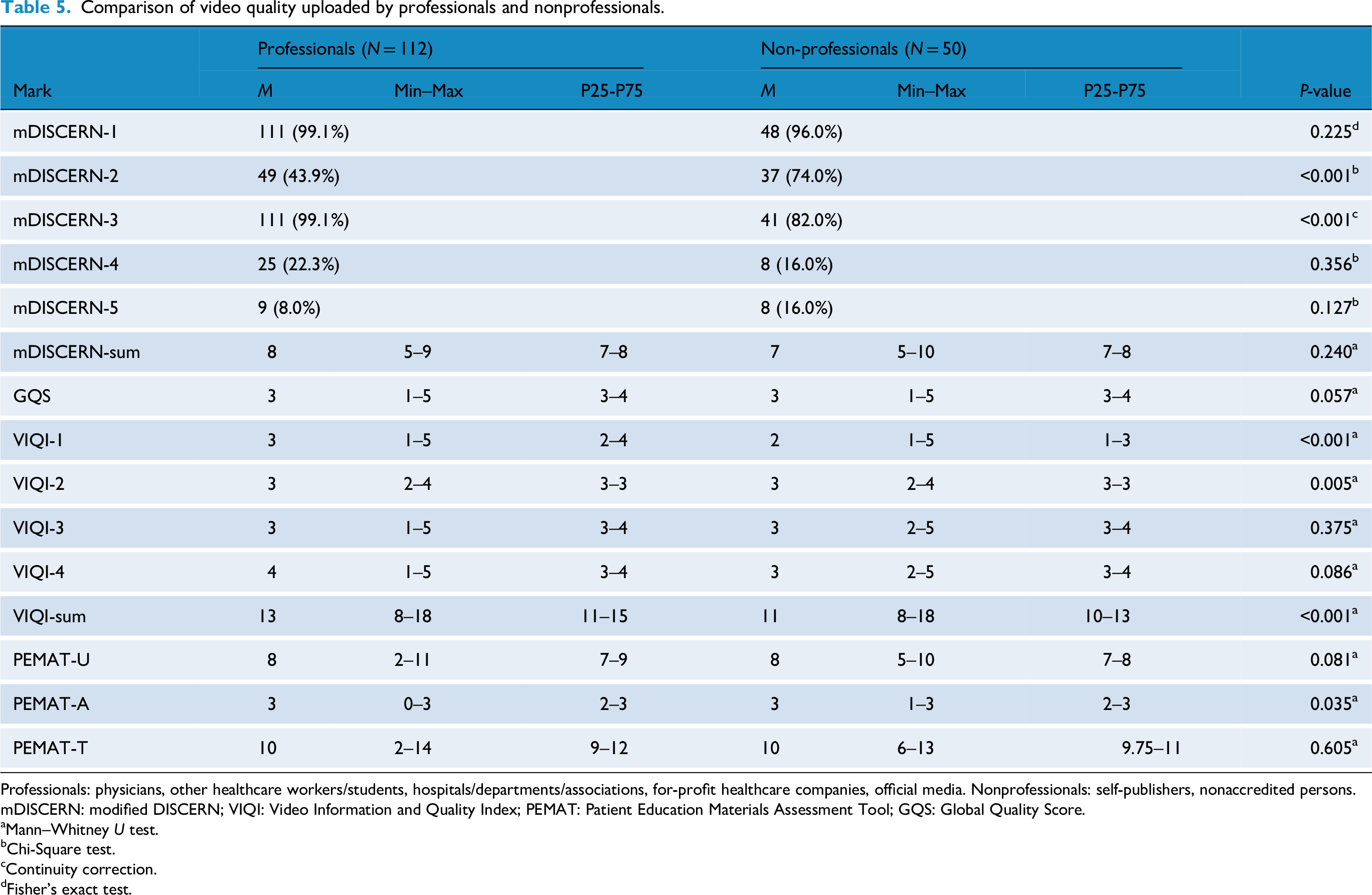
Professionals: physicians, other healthcare workers/students, hospitals/departments/associations, for-profit healthcare companies, official media. Nonprofessionals: self-publishers, nonaccredited persons. mDISCERN: modified DISCERN; VIQI: Video Information and Quality Index; PEMAT: Patient Education Materials Assessment Tool; GQS: Global Quality Score.
Mann–Whitney U test.
Chi-Square test.
Continuity correction.
Fisher's exact test.
Correlation analysis
As shown in Table 6, all video quality indicators on TikTok were significantly associated with audience engagement, indicating a uniformly link between video quality and user interactions. In contrast, the correlation patterns on Bilibili were more selective, with significant associations observed only for certain quality indicators. VIQI-sum demonstrated moderate correlations with kudos (r = 0.452, P < 0.001) and view count (r = 0.434, P < 0.001). In addition, favorites (r = 0.358, P < 0.001), comments (r = 0.395, P < 0.001), and bullet screen interactions (r = 0.327, P = 0.002) showed weak correlations with VIQI-sum. A significant weak correlation was observed between mDISCERN-sum and favorites (r = 0.215, P = 0.019).
Correlation analysis between video quality and viewer interaction on TikTok and Bilibili.

mDISCERN: modified DISCERN; VIQI: Video Information and Quality Index; PEMAT: Patient Education Materials Assessment Tool; GQS: Global Quality Score.
Discussion
The use of social media in public health education is increasing due to its ability to remove physical barriers that have traditionally hindered access to healthcare support and resources.22–24 Digital video in particular has become a central vehicle for patients to access health information, and its dynamic visualization properties help to popularize complex medical concepts. 25 Although numerous previous studies have compared these platforms in the context of other health topics, few have examined serious orthopedic conditions. Limited attention has been given to ONFH, a progressive orthopedic disease that primarily affects young and middle-aged adults. 26 Without timely detection and intervention, ONFH can lead to femoral head collapse and severe disability. 27 Therefore, evaluating the reliability and quality of educational content related to ONFH is of substantial clinical and public health importance.
The two platforms demonstrate distinct patterns in both user activity and content composition, and these structural differences directly influence how ONFH-related medical information is presented and disseminated within the digital health landscape. The substantially higher numbers of kudos, favorites and comments on TikTok indicate that its users engage with content in an immediate and spontaneous manner. TikTok's rapid, short-form browsing environment encourages immediate user engagement and facilitates wide dissemination of concise messages. 28 For ONFH, this communication style is advantageous for raising awareness about early symptoms, risk factors and indicators for prompt imaging evaluation. Such content is particularly valuable for younger individuals, who constitute a large portion of the at-risk population and often seek brief, visually clear explanations when first encountering hip discomfort.29,30
In contrast, Bilibili displays a much more diverse uploader structure. Although the platform hosts fewer certified medical professionals, it attracts a wider range of contributors, consistent with its long-standing community culture that encourages participation from users with varied backgrounds. 31 This ecosystem broadens the scope of ONFH-related content and supports videos with greater clinical detail. 32 Notably, Bilibili contains a substantially higher proportion of examination- and diagnosis-oriented videos, suggesting that creators on this platform prefer to provide systematic explanations of ONFH imaging features, staging criteria and differential diagnosis rather than brief overviews. Such detailed content can be particularly valuable for individuals who need to understand disease progression or interpret radiographic findings. However, the complete absence of epidemiological material on both platforms reveals a shared deficiency in presenting population-level ONFH information, including incidence patterns and risk distributions, which are essential components of digital public health education. 33 In addition, although individual narration and clinical scenario demonstrations are common across both platforms, Bilibili features a notably higher volume of TCM content. This tendency is enabled by the platform's longer video format, which allows creators to elaborate on TCM interpretations of ONFH, including theoretical frameworks and treatment approaches that require more extensive explanation. 34
Clear differences in video quality were observed between the two platforms, and these differences have important implications for how ONFH-related health information is interpreted within digital environments. TikTok obtained higher mDISCERN-sum and VIQI-sum scores, indicating higher evaluations of overall video quality, while GQS scores did not differ between the two platforms. Differences in understandability and actionability further highlight how each platform contributes to ONFH education in distinct ways. TikTok achieved higher understandability scores, reflecting communication styles that simplify essential ONFH concepts into visually direct formats. Because early symptoms of this condition are often subtle and easily overlooked, such clarity may help viewers identify initial patterns of hip discomfort or functional limitation that require medical attention.6,35 In contrast, Bilibili demonstrated a clear advantage in actionability, as its longer and more information-dense videos enable creators to provide systematic guidance on topics such as imaging interpretation, weight-bearing precautions, rehabilitation exercises and postoperative care. These aspects are especially valuable for individuals who already have an ONFH diagnosis and are making decisions about treatment options or managing their recovery process.
Uploader characteristics also shape how information about osteonecrosis of the femoral head is presented. Videos created by medical professionals consistently received higher evaluations in reliability and structural indicators, including information flow and information accuracy. This reflects the importance of expert input when explaining complex topics related to osteonecrosis of the femoral head, such as ARCO staging, MRI findings and the process of choosing between joint preserving procedures and arthroplasty. 36 In contrast, non-professional contributors achieved higher actionability scores, often by providing concrete instructions related to daily activities, symptom monitoring and lifestyle adjustments. Such practical guidance can help individuals with osteonecrosis of the femoral head manage everyday function or adhere to postoperative precautions. 37 The complementary strengths of these two contributor groups show that both professional and lay participation enrich the digital health environment, offering audiences accurate medical explanations as well as accessible self management advice. 38
The two platforms display markedly different patterns in the relationship between video quality and user engagement, and these differences have important implications for the dissemination of information about osteonecrosis of the femoral head. On TikTok, all major engagement indicators showed clear associations with quality measures, indicating that users respond more directly to ONFH videos that are clearly organized and visually coherent. This viewing pattern aligns with TikTok's rapid browsing environment, where concise explanations of early hip pain, risk factors and warning signs can quickly attract feedback from viewers. 39 Such immediate interaction amplifies the visibility of higher quality ONFH videos, which may help promote earlier recognition of symptoms and encourage timely clinical evaluation. 40
In contrast, the pattern observed on Bilibili was more selective. Only the VIQI and mDISCERN measures showed meaningful associations with engagement, while other quality indicators displayed no clear relationships. This suggests that user interaction on Bilibili is influenced by a broader set of contextual factors, including creator identity, the depth of clinical explanation, community expectations and viewers’ existing interest in orthopedic knowledge. For ONFH, a condition that requires understanding of imaging features, staging criteria and complex treatment choices, this pattern indicates that engagement may depend not only on video quality but also on whether the content provides the level of detail and academic orientation that Bilibili users typically seek. 41 Consequently, high quality ONFH videos do not automatically generate strong audience interaction unless they align with these viewer preferences and the platform's more academically oriented communication style. 42
Future efforts should focus on enhancing the digital health environment to better support individuals at risk of or living with osteonecrosis of the femoral head. First, because video selection in this study relied on platform-generated rankings, future research should establish sampling strategies independent of recommendation algorithms to reduce selection bias. Understanding how platforms promote or downrank ONFH-related videos is essential for ensuring that accurate and timely information reaches patients who urgently need early recognition and management guidance.
Second, digital health interventions should be optimized based on the distinct strengths of each platform to address the specific informational needs of ONFH patients. On TikTok, clear, concise and visually structured content can help users quickly grasp early warning signs, risk factors and treatment options, which is critical for a disease where diagnostic delay directly contributes to femoral head collapse. On Bilibili, longer and more in-depth formats can be used to deliver comprehensive explanations of imaging findings, surgical decision-making pathways and rehabilitation strategies, thereby supporting patients who seek deeper understanding of disease progression and long-term management.
Third, collaborative communication models involving both medical professionals and trained lay creators could significantly improve education related to osteonecrosis of the femoral head. Jointly produced videos, expert led live streams and interactive tutorials may help translate complex orthopedic concepts, including vascular compromise, mechanical stress distribution and the indications for core decompression, into formats that are easier for the public to understand while maintaining medical accuracy. Such collaboration can also expand digital support for younger individuals with osteonecrosis of the femoral head, who often face substantial challenges when making early treatment decisions.
Finally, artificial intelligence technologies offer new opportunities to strengthen dissemination of high-quality ONFH information. AI-assisted content review, automated quality labels and transparent verification of medical credentials can help platforms highlight authoritative orthopedic content while limiting the spread of misleading or outdated advice. Integrating these technologies into platform governance can support the creation of a more trustworthy digital ecosystem, enabling ONFH patients to access accurate, actionable and clinically meaningful guidance throughout their disease course.
Conclusions
This study demonstrates that TikTok and Bilibili differ markedly in how they disseminate information related to osteonecrosis of the femoral head. TikTok's short and rapid format supports quick spreading of key points such as early symptom recognition, risk factors and the need for timely imaging evaluation. This style is well suited for younger individuals who often seek brief and visually direct explanations. To enhance impact, TikTok creators should deliver clear messages early in the video and ensure the use of reliable medical information.
Bilibili, with its longer and more detailed videos, provides richer explanations of ONFH imaging features, staging systems, treatment decision pathways and rehabilitation practices. This format benefits users who require deeper understanding of disease mechanisms and long-term management. Improved structuring, segmented teaching and interactive elements may further enhance the educational value of this platform.
Both platforms should strengthen medical content verification and develop mechanisms to monitor accuracy and user feedback. Collaboration between medical professionals and trained lay creators can improve both reliability and practicality of ONFH educational materials. Artificial intelligence tools may support content summarization and quality screening but should not be used for individualized treatment guidance.
Overall, optimizing the strengths of each platform and improving content governance will contribute to a more effective digital ecosystem for ONFH education, helping individuals recognize symptoms earlier, make informed decisions and better manage their condition.
Supplemental Material
sj-docx-1-dhj-10.1177_20552076251411032 - Supplemental material for Bilibili and TikTok as sources of medical information on osteonecrosis of the femoral head: A cross-platform content analysis
Supplemental material, sj-docx-1-dhj-10.1177_20552076251411032 for Bilibili and TikTok as sources of medical information on osteonecrosis of the femoral head: A cross-platform content analysis by Bingqi Wei, Liu Chen, Xinyue Zhang, Yijing Li, Jiarong Li, Xingyue Ren, Hang Li, Luwei Zhang, Yunfang Fan, Jiani Meng, Feiyang Chen, Zimeng Xie, Yifan Qi, Yueyang Chen and Shangzeng Wang in DIGITAL HEALTH
Supplemental Material
sj-docx-2-dhj-10.1177_20552076251411032 - Supplemental material for Bilibili and TikTok as sources of medical information on osteonecrosis of the femoral head: A cross-platform content analysis
Supplemental material, sj-docx-2-dhj-10.1177_20552076251411032 for Bilibili and TikTok as sources of medical information on osteonecrosis of the femoral head: A cross-platform content analysis by Bingqi Wei, Liu Chen, Xinyue Zhang, Yijing Li, Jiarong Li, Xingyue Ren, Hang Li, Luwei Zhang, Yunfang Fan, Jiani Meng, Feiyang Chen, Zimeng Xie, Yifan Qi, Yueyang Chen and Shangzeng Wang in DIGITAL HEALTH
Supplemental Material
sj-docx-3-dhj-10.1177_20552076251411032 - Supplemental material for Bilibili and TikTok as sources of medical information on osteonecrosis of the femoral head: A cross-platform content analysis
Supplemental material, sj-docx-3-dhj-10.1177_20552076251411032 for Bilibili and TikTok as sources of medical information on osteonecrosis of the femoral head: A cross-platform content analysis by Bingqi Wei, Liu Chen, Xinyue Zhang, Yijing Li, Jiarong Li, Xingyue Ren, Hang Li, Luwei Zhang, Yunfang Fan, Jiani Meng, Feiyang Chen, Zimeng Xie, Yifan Qi, Yueyang Chen and Shangzeng Wang in DIGITAL HEALTH
Supplemental Material
sj-pdf-4-dhj-10.1177_20552076251411032 - Supplemental material for Bilibili and TikTok as sources of medical information on osteonecrosis of the femoral head: A cross-platform content analysis
Supplemental material, sj-pdf-4-dhj-10.1177_20552076251411032 for Bilibili and TikTok as sources of medical information on osteonecrosis of the femoral head: A cross-platform content analysis by Bingqi Wei, Liu Chen, Xinyue Zhang, Yijing Li, Jiarong Li, Xingyue Ren, Hang Li, Luwei Zhang, Yunfang Fan, Jiani Meng, Feiyang Chen, Zimeng Xie, Yifan Qi, Yueyang Chen and Shangzeng Wang in DIGITAL HEALTH
Footnotes
Acknowledgments
The authors would like to express their gratitude to the video uploaders for their contributions to public health.
ORCID iDs

Ethical considerations
This study analyzed only publicly available short-video data and did not involve any human subjects or identifiable personal information. The research protocol received ethical approval from the Ethics Committee of Henan Provincial Hospital of Chinese Medicine (The Second Affiliated Hospital of Henan University of Chinese Medicine) (Approval No. 1665-01). This hospital serves as a key teaching and research base of the School of Orthopedics, Henan University of Chinese Medicine, integrating clinical practice, education, and scientific research, which provides a strong foundation for the implementation of this study. The study was conducted in accordance with the Declaration of Helsinki and the COPE ethical guidelines for research involving publicly available social-media data.
Authors’ contributions
BQW conceived and designed the study. LC wrote the original draft. XYZ reviewed and edited the manuscript. YJL and JRL analyzed the data. XYR and HL collected the top 100 videos and the characteristics of the videos and authors. LWZ, YFF, JNM FYC, ZMX, YFQ, and YYC were responsible for reviewing, classifying, and scoring the videos. SZW critically revised the manuscript for intellectual content and offered the funding. All the authors contributed to manuscript writing and editing and approved the final draft for submission.
Funding
The authors disclosed receipt of the following financial support for the research, authorship, and/or publication of this article: This work was supported by the National Natural Science Foundation of China (82374490), the Natural Science Foundation of He'nan Province of China (222300420486), He'nan Province University Science and Technology Innovation Team (24IRTSTHN040), Scientific research project of Traditional Chinese Medicine in He'nan Province (2023ZYZD06ZD06), and Scientific research project of Traditional Chinese Medicine in He'nan Province (2025ZY1016, 2023ZYZD06, 2021ZY2010, 2019ZY2035), Zhengzhou Science and technology Benefit to the people plan project (2023KJHM0009), He'nan province key research and development special projects (241111311700), He'nan Province Young and Middle-aged Health Science and Technology Innovation Leading Talents (LJRC2024020), Henan Students’ innovation training program (202410471006, 202510471007, 202510471049).
Declaration of conflicting interests
The authors declared no potential conflicts of interest with respect to the research, authorship, and/or publication of this article.
Data availability
The datasets generated during and/or analyzed during this study are available from the corresponding author upon reasonable request.
Supplemental material
Supplemental material for this article is available online.
References
Supplementary Material
Please find the following supplemental material available below.
For Open Access articles published under a Creative Commons License, all supplemental material carries the same license as the article it is associated with.
For non-Open Access articles published, all supplemental material carries a non-exclusive license, and permission requests for re-use of supplemental material or any part of supplemental material shall be sent directly to the copyright owner as specified in the copyright notice associated with the article.
