



Abstract
Objectives
College students are facing a growing prevalence of mental health challenges, while they frequently face obstacles in seeking professional help. Drawing upon the agency model in the theory of interactive media effects (TIME) and the transportation-imagery model, this study presents an extended framework to investigate how interface features enhance the persuasive potential of health narratives, thereby improving intentions to seek professional help for depression among Chinese college students.
Method
The present study employs a 2 (customization: with versus without) × 2 (interactivity: high versus low) factorial experiment (N = 373). To validate the experimental stimuli, a mini-program was developed on WeChat, allowing participants to fully navigate the health narrative within the interface.
Results
SEM results indicated that both customization and high interactivity increased the sense of agency. Regarding the interaction effect, the further ANOVA results revealed that the effect of interactivity on enhancing the sense of agency is more pronounced for participants in the non-customization condition, compared to those in the customization conditions. Additionally, sense of agency was positively associated with transportation. As predicted, transportation motivated the emotional shifts, which then positively predicted the users’ intentions to seek professional help for depression. Furthermore, the mediation analysis indicated that the effect of customization on users’ intentions to seek professional help was mediated by sense of agency, transportation, and emotional shifts.
Conclusion
The interface features demonstrate potential in improving the persuasiveness of health narratives, thereby fostering greater willingness to seek professional help.
Introduction
College students worldwide face rising rates of depression, yet many hesitate to seek professional help due to stigma, time pressures, and limited access.1–3 Mobile, narrative-based interventions can lower these barriers by providing accessible, scalable, and cost-effective digital experiences that motivate users to seek professional help on devices students already use.4,5 The effectiveness, however, depends not only on content quality but also on how the interface enables engagement.6,7 Therefore, understanding how mobile interface design influences user engagement is critical for optimizing digital health interventions that promote college students’ help-seeking behavior for depression.
Guided by the theory of interactive media effects (TIME) and the transportation–imagery model, this study examines how interface design produces persuasive outcomes. 8 As one of the core models in TIME, the agency model of customization defines sense of agency as the extent to which individuals perceive themselves as key participants who can influence the mediated content; this perception shapes users’ attitudes and behaviors. 8 Allowing users to personalize the interface or interact with its functions increases perceived sense of control and personal relevance, thereby enhancing engagement with digital narratives.9–11 In digital narrative environments, customization lets users tailor interface options and aspects of story experience to their preferences, whereas interactivity enables real-time engagement with the unfolding narrative through active choices and system feedback. Together, these features foster narrative immersion and emotional resonance in digital health communication.
The transportation–imagery model suggests that mental and emotional absorption in a story, known as transportation, is associated with attitude and behavior change. 12 Mobile interactive design can heighten transportation by offering personalized choices and immediate feedback, deepening their engagement and empathy with the narrative. Moreover, narrative persuasion is a dynamic process in which emotional responses evolve as the story unfolds. 13 Capturing these emotional shifts, such as moving from distress to hope, helps to illuminate how users process digital health narratives and internalize persuasive messages. Therefore, integrating transportation and emotional shifts into the TIME framework clarifies how interface design contributes to the persuasiveness of digital health narratives.
Accordingly, a 2 (customization: with vs. without) × 2 (interactivity: high vs. low) factorial experiment was conducted using a WeChat mini-program that delivers a mobile-based depression prevention narrative. The study aims to examine (1) how interface features shape users’ sense of agency, transportation, and emotional shifts, thereby promoting greater user engagement in digital health narratives and (2) whether the two interface features (i.e., customization and interactivity) interact. This study proposes a design-oriented, testable model that links concrete interface features to persuasive processes in mobile-based digital interventions, thereby guiding the development of narratives that effectively encourage college students to seek professional help for depression.
Literature review
Theoretical basics: extending TIME with narrative perspectives
TIME describes how interface features (i.e., the interaction techniques afforded by interactive media) affect users’ attitudes and behaviors towards achieving optimal persuasive outcomes. 8 Notably, TIME articulates an underlying mechanism by which action affordance, facilitated by interface features, leads to attitudinal and behavioral outcomes at the user level, where user engagement serves as a crucial mediator. 8 Within the domain of interactive media effect studies, user engagement involves an initial response to these techniques and subsequent engagement with mediated information.14,15
Previous research has documented that when users engage consciously with the interactive interface, their attention is fully captured by the mediated environment, facilitating deeper involvement and processing of media content.16,17 Such immersion is beneficial to the narrative persuasion, as narratives require individuals to devote more attention and experience emotional shifts as the narrative unfolds.13,18,19 Taken together, as illustrated in Figure 1, this study extends the original TIME model to incorporate mechanisms of transportation and emotional shifts. This model offers a comprehensive understanding of the pathways from interface features to users’ psychological reactions and their narrative engagement with media content, which subsequently influences their intentions to seek professional help for depression. The next sections discuss the conceptualization of each pathway.

Conceptual model.
The relationship between features of interactive media and the sense of agency
Abundant evidence has demonstrated that interactive media fosters user engagement by enabling interaction between the user and the interface. 16 For example, various interactive media platforms, such as social media websites or applications, allow users to customize the interface appearance and tailor the information based on their preferences. According to the agency model of customization in TIME, 8 these interactive features afford users greater agency by enabling them to become active participants with the ability to exert influence over the nature and course of the communication process. Sense of agency refers to the users’ perception of self as both a source and a creator, as well as their sense of control over the interface.20,21 It has been shown to mediate the impact of customization on psychological consequences, such as enhanced engagement in health-related behavior 22 and increased information recall. 23 Hence, the key to improving the effectiveness of interface designs depends on their ability to foster a stronger sense of agency in users. 20 In this regard, this study proposes incorporating customization and interactivity to enhance users’ sense of agency and investigate their effects on narrative persuasion in the context of depression prevention.
Customization empowers users to modify the interface appearance and control the media content based on their preferences and interests.
24
Sundar
20
indicated that customization significantly influenced users’ psychology by fostering a feeling of being in charge and influential, which leads to a greater sense of agency. Oh et al.'s research
11
also confirmed that customization can foster greater agency, further cultivating positive attitudes toward the interface and offered content. Niu et al.
25
conducted an experiment exploring the effect of customization on reducing problematic drinking, revealing that customization increased participants’ affective and cognitive trust in health-related content by enhancing their sense of agency. Thus, we propose the following hypothesis: H1: Customization will elicit a higher sense of agency over the interface compared to non-customization.
Interactivity is the fundamental feature of modern interactive technology, empowering users to participate in a wide variety of interactive activities. From the functional perspectives, interactivity refers to a range of interactive behaviors that users consistently interact with the interface.
26
For instance, an interactive interface typically allows users to reveal additional information by clicking a button, or to adjust settings such as volume or brightness by manipulating a slider. These interactive actions, afforded by the interactivity feature, allow users to explore and manipulate the interface freely, making users more active.8,26,27 Specifically, users typically develop a sense of control and autonomy when they perceive the freedom to act at their own will.
28
This is supported by an experimental finding of immersive virtual reality-assisted learning, where learners in experiment scenarios with a high degree of interactivity scored higher on sense of agency.
29
In this regard, interactivity has the potential to enhance users’ sense of agency. Therefore, we present the following hypothesis: H2: A high level of interactivity will elicit a higher level of sense of agency over the interface compared to a low level of interactivity.
Furthermore, the diverse combinations of interface features have differing impacts on users’ sense of agency, as supported by numerous studies.11,30 Accordingly, this study seeks to investigate how the combined interactive design affects the users’ sense of agency. The first research question is proposed: RQ1: Will there be an interaction effect between customization and interactivity on the sense of agency over the interface?
The relationship between the sense of agency and transportation
From the perspective of human self-consciousness, sense of agency is understood as the subjective perception that individuals initiate and manage their own behaviors. 31 In interactive media literature, sense of agency refers to the extent to which users perceive themselves as influencing and being connected to the interface. 20 Sense of agency has been shown to positively influence cognitive processing by fostering deeper engagement with the media content. For example, Kim et al. 32 pointed out that users who customized video game settings experienced increased autonomy, which in turn strengthened their engagement with the game narrative. Similarly, Oh et al. 11 found that the interface functions offered by social media enable users to express likes and comments, which has been shown to effectively encourage users’ systematic processing of health-related information by enhancing their sense of agency. This can be understood through the lens of social cognitive theory, which posits that an increased sense of agency boosts an individual's motivation and performance. 33 Therefore, sense of agency has the potential to facilitate engagement and processing with narrative information.
Transportation is recognized as an effective narrative-based mental processing.34–36 The transportation-imagery model underscores transportation as a convergent process that involves the concentration of an individual's cognitive and emotional resources on the occurrences within the narrative.12,37 It is reasonable to hypothesize that a greater sense of agency might lead to a better experience of transportation when the individual is processing narrative information. That is, users who perceive themselves as active participants over a media interface are more likely to invest cognitive and emotional resources in narrative processing, thereby achieving a higher status of transportation. Thus, we propose the following hypothesis: H3: Sense of agency is positively associated with transportation.
The relationship between transportation, emotional shifts, and intentions to seek professional help for depression
The effectiveness of narrative persuasion lies in its capacity to evoke emotional responses in the audience.38,39 Scholars have suggested that the emotional experience of consuming narrative fluctuates, with narrative information triggering emotional peaks and lows in viewers. 13 This phenomenon is conceptualized as emotional shifts, which pertain to variations in the emotional experience during the consumption of media content.13,18 For example, when processing narratives, an individual's emotions may shift from positive to negative, and the intensity of a single emotion may vary, such as progressing from fear to fright. 18 These emotional shifts, unfolding over time, indicate changes in emotional states at different temporal points.
According to the transportation-imagery model, recipients are involved in the narrative experience through transportation and emotion.
37
When processing narrative information, transported recipients become immersed in the narrative world, experiencing strong emotional responses about its characters and events, making their beliefs more susceptible to the viewpoints implicitly conveyed in the narrative.
37
Supporting this, Winkler et al.
40
documented a positive association between transportation and both the frequency and intensity of emotional shifts. Thus, as individuals become more immersed in a dynamic storyline, their likelihood of experiencing emotional shifts increases. Narratives that provoke emotional shifts are often more persuasive than those that do not,19,41 offering benefits such as enhanced message processing,
13
increased identification,
42
and facilitation of persuasive outcomes that encourage adaptive changes in health behavior. Building upon the above discussion, it is hypothesized that transportation is related to emotional shifts, which subsequently impact users’ intentions to seek professional help for depression. The following research hypothesis is proposed: H4: Transportation is positively associated with emotional shifts. H5: Emotional shifts are positively associated with users’ intentions to seek professional help for depression.
The mediating effect of the sense of agency, transportation, and emotional shifts
Substantial research has examined the impact of interface features on the persuasiveness of health information.9,25,43 From the TIME perspective, this mechanism can be understood as a process that flows from interface features to user engagement, and subsequently to health outcomes.
8
As discussed above, it is essential to understand the effectiveness of this mechanism, particularly when applied to narrative information. Aligned with the theoretical arguments and empirical findings, we anticipate that interface features will influence the users’ sense of agency over the interface, which may subsequently affect their intentions to seek professional help for depression by evoking transportation and emotional shifts regarding narrative information. Accordingly, this study seeks to investigate the connection between interface features (customization, interactivity, and their interaction) and users’ intentions to seek professional help for depression through the serial mediation of sense of agency, transportation, and emotional shifts. RQ2: Are the effects of interface features (customization, interactivity, and their interaction) on users’ intention to seek professional help for depression sequentially mediated by sense of agency, transportation, and emotional shifts?
Method
Participants
Participants were recruited from students enrolled in undergraduate courses to take part in a web-based survey experiment about depression. In total, 373 participants completed the experiment, including 268 females (71.8%) and 105 males (28.2%), with ages ranging from 18 to 25 years (M = 20.25, SD = 1.24). Most participants (N = 296, 79.4%) reported a monthly living expense of 6000 RMB or less.
Experimental design and procedure
In this study, a 2 × 2 between-subjects factorial experiment was used to examine the impact of customization and interactivity on participant responses. Customization was defined as a binary variable, comprising customization and non-customization conditions, while interactivity was manipulated along a high-low continuum, resulting in four experimental conditions: customization with high interactivity, customization with low interactivity, non-customization with high interactivity, and non-customization with low interactivity.
To ensure consistency in the format of the interface, we required participants to use mobile devices to browse the stimulus. The experimental procedures were ethically approved by the authors’ affiliated university, and all participants provided written informed consent before their participation. Following this, they were randomly allocated to one of the four experimental groups using online randomizer programming. Subsequently, they were directed to explore the interface thoroughly before completing a post-questionnaire.
Stimuli
To validate the experimental stimuli, we developed a mini-program on WeChat, a widely used social media platform in China. The mini-programs presented a narrative about a college student's journey through depression diagnosis, treatment, and recovery. All participants, regardless of experimental group, were exposed to the same narrative.
Customization was manipulated by granting the user perceived control over both the interface and narrative trajectory through a series of customized settings. 9 In the customization condition, participants were given the ability to customize their interface and narrative in three steps. First, participants were prompted to select an avatar and a nickname, which were displayed on subsequent pages. They were then asked to respond to a series of questions, knowing that their answer would influence the content they encountered later. Lastly, while navigating the story, participants could influence the narrative trajectory by making medical decisions regarding the protagonist's medical treatment. Specifically, they were asked to choose which hospital the protagonist should visit. It is important to note that regardless of the participants’ decision, the narrative unfolded in the same manner as in the non-customization group. Participants in the non-customization condition were not offered the above customized options.
In the high interactivity condition, participants had more opportunities to interact with the interface and access supplemental information through clicks. For example, participants could help the protagonist gather more details regarding the medical examination. By clicking on the blood test icon, specific information about the test would be displayed on the interface. In contrast, in the low interactivity condition, all relevant information was directly presented on the interface, eliminating the need for clicks to access additional content. In addition, participants in the high interactivity conditions could observe the character's facial expressions in response to their clicks, while those in the low interactivity conditions could not. Examples of the experimental stimuli can be found in Supplementary Appendix I.
Measurement
Sense of agency. Six items were employed to evaluate the degree of perceived agency. 44 Participants were asked to rate their agreement with these statements, ranging from 1 (strongly disagree) to 7 (strongly agree), such as “I felt in control of my actions” (M = 5.42, SD = 1.33).
Transportation. Transportation was assessed using five items developed from the Appel, Gnambs 45 short version of the Transportation scale, with responses ranging from 1 (strongly disagree) to 7 (strongly agree). Participants reported statements such as, “I became mentally engaged in the narrative while reading” (M = 3.82, SD = 1.32).
Emotional shifts. To assess participants’ emotional experience, we evaluated the intensity of seven emotions–happy, hopeful, optimistic, sad, hopeless, worried, and fearful–at both the beginning and end of the narrative. 46 Participants rated each emotion on a scale from 1 (not at all) to 7 (totally). To calculate the emotional shift, we followed the method outlined by Winkler et al. 40 For each emotion, we computed the absolute difference in intensity ratings at both the beginning and the end of participants’ reading of the narrative. These differences were then summed to generate seven new variables, each representing a shift in one of the emotions: happy, hopeful, optimistic, sad, hopeless, worried, and fearful. Subsequently, the scores for these seven variables were combined to create a composite measure reflecting the overall change in emotional intensity after exposure to the narrative (M = 2.39, SD = 1.33).
Intentions to seek professional help. A single item was employed to assess participants’ willingness to pursue professional assistance for depressive symptoms. Responses were recorded on a 7-point Likert-type scale (M = 5.90, SD = 1.40).
Randomization and manipulation check
Demographic equivalence across the four experimental conditions was confirmed through chi-square tests and ANOVAs, with no significant differences in gender, age, or monthly disposable income, indicating successful randomization.
Subsequently, we assessed customization and interactivity levels of the stimuli. Participants in the customization condition (M = 5.96, SD = 1.09) perceived higher customization than those in the non-customization condition (M = 4.62, SD = 2.23, t = 7.41, p < .001). Similarly, participants in the high interactivity condition perceived a greater level of interactivity (M = 6.18, SD = 1.21) than those in the low interactivity condition (M = 4.26, SD = 2.00, t = 11.19, p < .001). These findings indicated that experimental manipulation was effective.
Analytical strategy
IBM SPSS Statistics version 29 was utilized to verify statistical assumptions, conduct descriptive data analysis. Structural equation modeling (SEM) was carried out using the lavaan package (version 0.6-19) within R Studio to examine the main hypotheses and research questions. Sense of agency, transportation, emotional shifts, and intentions to seek professional help were specified as continuous latent variables within the model, alongside the customization (1 = yes, 0 = no), interactivity (1 = high, 0 = low), and demographic variables.
Results
Descriptive statistics, encompassing means (M), standard deviations (SD), and Pearson correlation coefficients for the primary variables, are shown in Table 1. Additionally, CFA was conducted to validate the measurement model by assessing factor loadings, construct reliability, and convergent validity (see Table 2).
Correlation matrix of main variables.
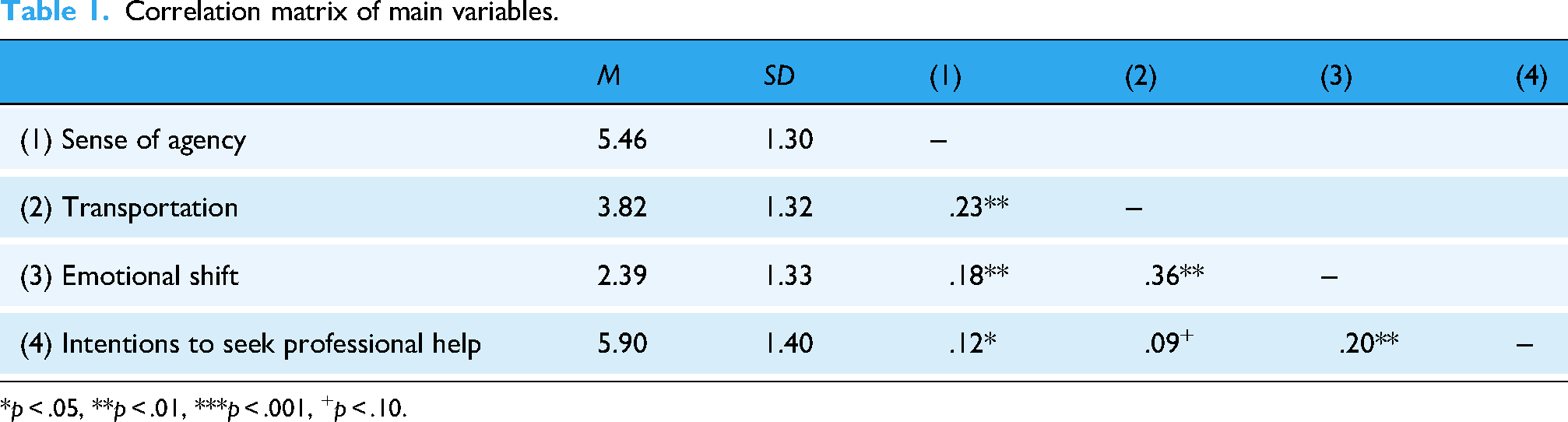
*p < .05, **p < .01, ***p < .001, +p < .10.
Constructs, items, and reliability and validity assessments.
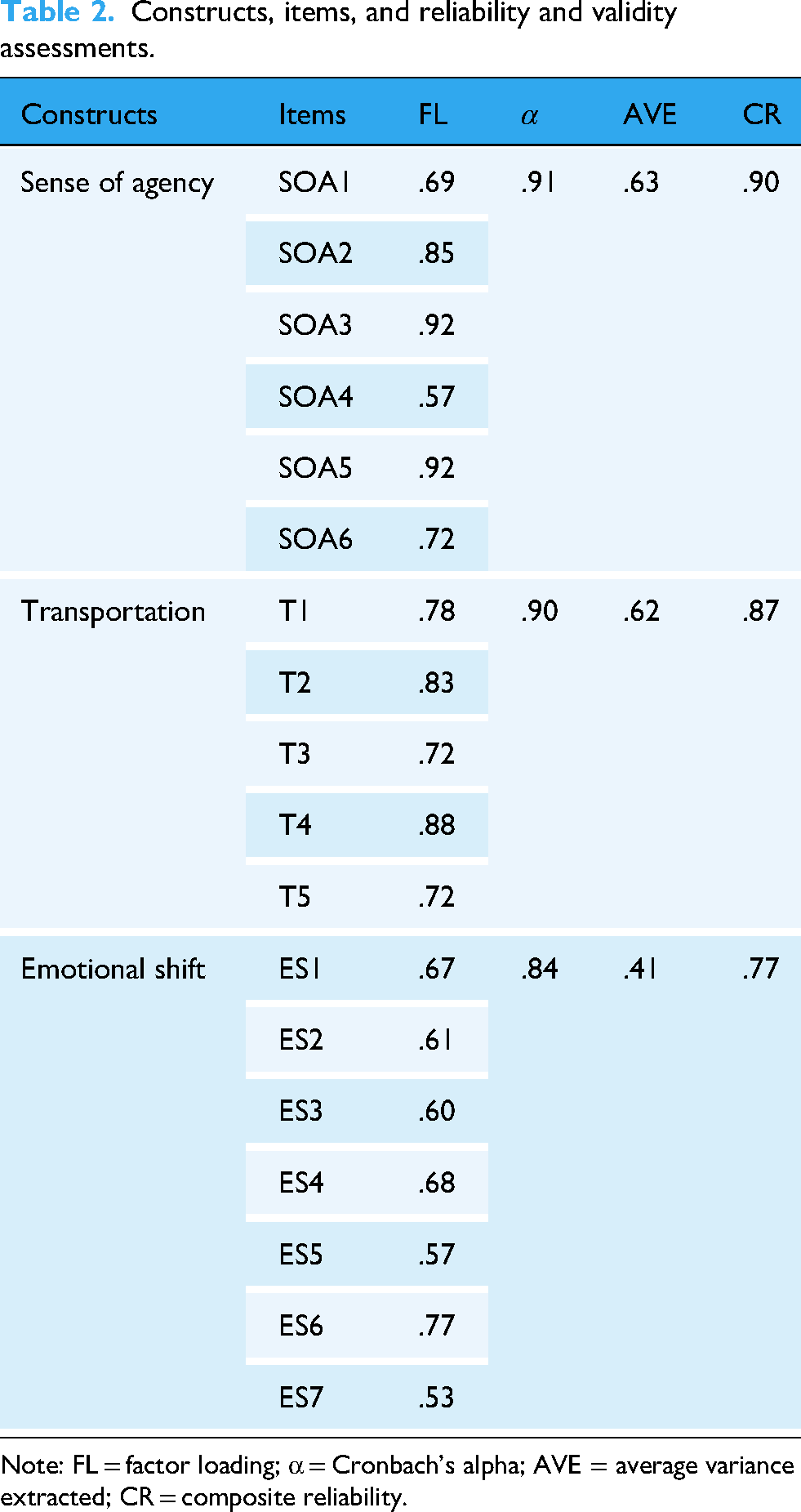
Note: FL = factor loading; α = Cronbach's alpha; AVE = average variance extracted; CR = composite reliability.
After controlling for gender, age, and monthly living expense, the SEM results showed that the proposed model had a good fit (χ2[254] = 416.68 p < .001, χ2/df = 1.64, RMSEA = .04, CFI = .96, TLI = .96, SRMR = .06). Visualized model paths and standardized parameter estimates are presented in Figure 2. We found positive associations between customization (β = .52, p < .001) and interactivity (β = .12, p = .01) with sense of agency. These findings support H1, H2.
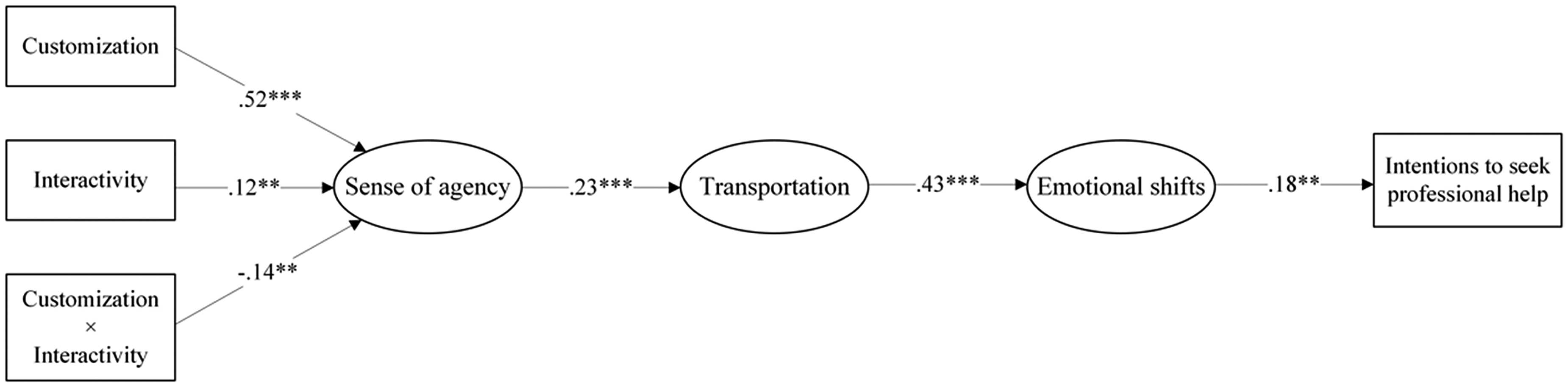
Model with standardized path coefficients. Note: Nonsignificant paths are denoted by dashed lines. Rectangles represent observed variables; ovals represent latent variables. *p < .05, **p < .01, ***p < .001.
To our surprise, the interaction effect of customization and interactivity negatively influenced sense of agency (β = –.14, p = .002). We conducted an ANOVA to investigate the interaction effect of customization and interactivity on sense of agency (F[1, 372] = 9.28, p = .002, partial η2 = .03). Figure 3 shows plots of the interaction effects. Results indicated that interactivity significantly increased the sense of agency in the non-customization condition (Mlow = 4.48, SD = 1.42; Mhigh = 5.19, SD = 1.39), but yielded no further improvement in the customization condition (Mlow = 6.09, SD = .75; Mhigh = 6.09, SD = .71). This reflects a redundancy effect, where users who already experience strong perceived control through the customization feature gain no additional sense of agency from further interactivity. Additionally, a post-hoc power analysis in G*Power (f = .16; α = .05; N = 373) showed adequate power to detect the interaction (1–β = .87). 47 These findings provide answers to RQ1.
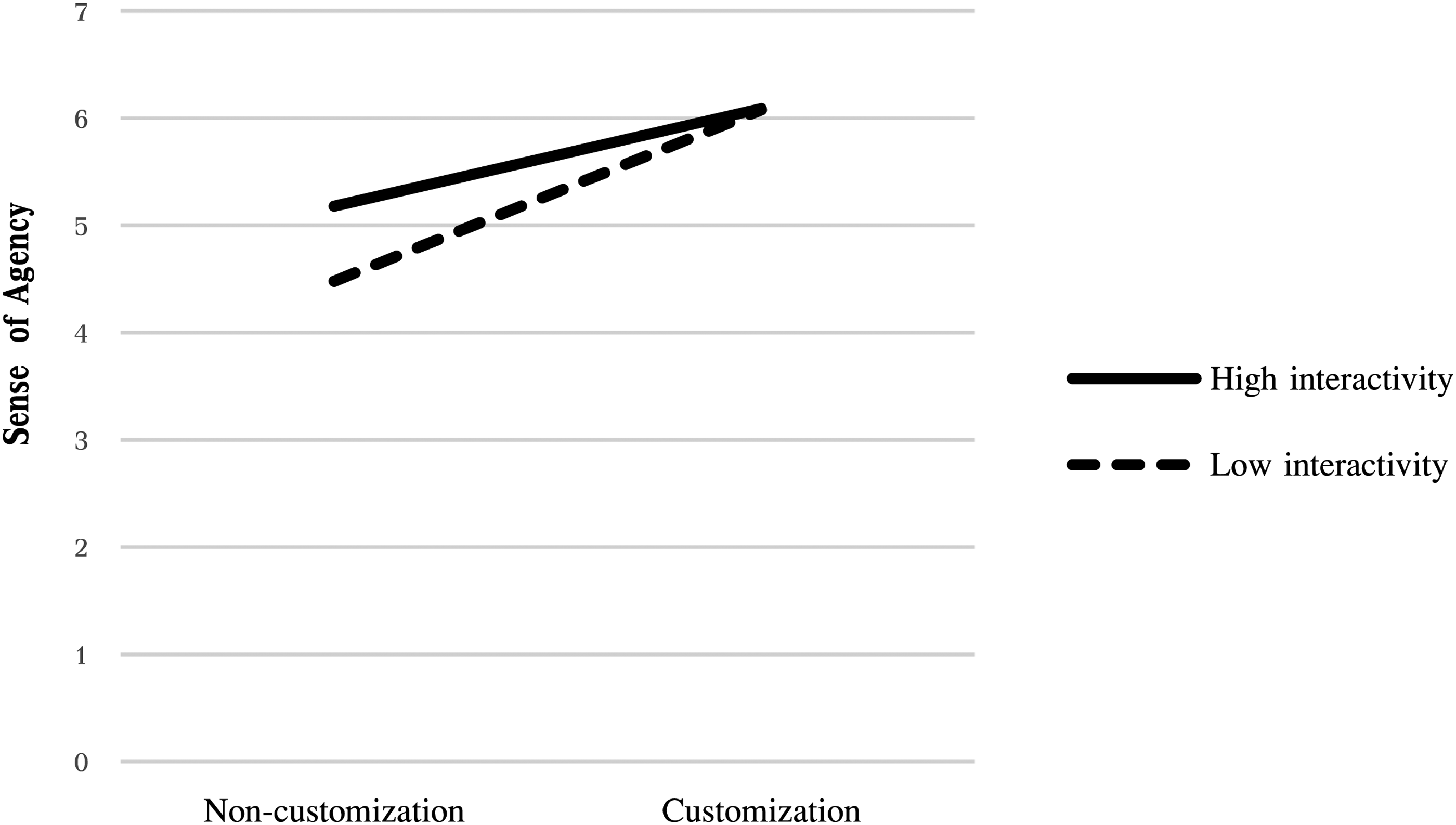
Interaction effects of customization and interactivity on sense of agency.
Moreover, sense of agency (β = .23, p < .001) emerged as a significant positive predictor of transportation. Transportation (β = .43, p < .001) also triggered users’ emotional shifts. Furthermore, it was found that emotional shifts positively influenced users’ intentions to seek professional help (β = .18, p = .003). Thus, H3, H4, and H5 were supported.
Regarding RQ2, the results indicated that the effectiveness of interface features in improving users’ intention to seek professional help works through the process of user engagement, specifically by enhancing sense of agency, transportation, and emotional shifts, rather than the interactive design itself. The mediating effects demonstrated that customization influences users’ intentions to seek professional help through a sequential mediation process involving sense of agency, transportation, and emotional shifts (Boot SE = 0.004, 95% CI [0.002, 0.019]). However, the sequential mediating effects of interactivity (Boot SE = 0.001, CI [0.000, 0.005]) and their interaction (Boot SE = 0.001, 95% CI [−0.006, 0.000]) were not significant. To validate the direct effect, we conducted an ANOVA analysis. However, there was no statistically significant direct effect of customization (F[1, 372] = 0.12, p = .73), interactivity (F[1, 372] = 0.25, p = .62), or their interaction effect (F[1, 372] = 3.53, p = .06) on intentions to seek professional help. These findings addressed RQ2, suggesting that interface features alone are insufficient to influence users’ intentions to seek professional help; rather, they enhance their intentions by fostering user engagement in narrative persuasion.
To further validate the hypothesized serial process, we estimated a competing model in which emotional shifts preceded transportation (see Supplementary Appendix II for details). Although the reversed competing model also demonstrated acceptable fit (χ²[254] = 429.04, p < .001, CFI = 0.96, TLI = 0.95, RMSEA = 0.04, SRMR = 0.06), its overall fit was slightly poorer than that of the hypothesized model (TLIhypothesized model = 0.96, TLIcompeting model = 0.95). However, all serial indirect effects in the competing model were nonsignificant, as all 95% bootstrap confidence intervals included zero, so the competing model was not retained. Therefore, we proceeded with the hypothetical model's proposed pathways from transportation to emotional shifts.
Discussion
As depression becomes a rising mental health challenge among college students, this study investigates how interface features such as customization and interactivity influence users’ intentions to seek professional help for depression, primarily by enhancing their sense of agency and its effects on transportation and emotional shifts. Our findings first indicated a positive effect of customization on sense of agency, supporting the original agency model 8 and aligning with previous studies.21,30 High interactivity was also found to enhance the users’ sense of agency over the interface. Specifically, under conditions of high interactivity, users continuously interact with the interface and receive immediate feedback, increasing their familiarity and control, thereby enhancing their sense of agency.
Regarding the interaction between customization and interactivity, a significant negative effect on sense of agency was observed. When both features are high, customization already provides users with a strong sense of control, so additional interactivity contributes little to their perceived agency. In turn, the overlap between these features may introduce redundant information that distracts users and increases their cognitive load, 48 which helps to explain why the added interactivity no longer enhances perceived agency. This finding aligns with Xu et al.'s research, 43 suggesting that a moderate level of interactivity is sufficient to enhance users’ psychological engagement. However, adding multiple features simultaneously generates redundant cues and cognitive load, ultimately diminishing the sense of agency.
Further, the present study indicated that an increased sense of agency over the interface facilitates the enhancement of transportation. Consistent with previous human-computer studies,32,49,50 people are more prone to engage with entertainment narratives or interactive narratives when they experience a heightened sense of agency. This can be understood through the lens of self-determination theory, positing that satisfaction with psychological needs enhances user engagement and intrinsic motivation.51,52 In a similar vein, a heightened sense of agency over the interface reveals that users feel in control of their behaviors, satisfying their need for autonomy and enhancing their motivation to be transported into the narrative world.
As predicted, we found that transportation could significantly affect emotional shifts. Specifically, individuals in a state of high transportation experienced more pronounced emotional shifts. Consistent with prior research in emotional shifts, 40 our results underscored the pivotal role of transportation in fostering emotional shifts. Furthermore, we discovered that emotional shifts are positively correlated with the users’ intentions to seek professional help for depression. These findings align with previous literature in narrative persuasion, 18 suggesting that transportation can lead to significant emotional shifts, thereby motivating individuals to make health-related decisions that align with the persuasive content.
Implications and limitations
This study offers new perspectives on TIME and narrative persuasion literature. It expands the TIME framework from a narrative perspective by integrating the transportation-imagery model and applying it to health promotions targeting depression. On the one hand, it pioneers new directions for future TIME studies by examining the impact of various interface features and design combinations on users’ narrative information processing and subsequent health-related behaviors. On the other hand, unlike previous research that primarily concentrated on user engagement, such as the elaboration, which typically deals with argument-based information, 10 our findings highlight the importance of distinguishing the information conveyed by interactive media between narrative and non-narrative information, as well as delving into the nuances of narrative information processing.
Moreover, this study advances the established narrative theoretical framework by incorporating emotional shifts, which sheds light on the micro-mechanism of the narrative persuasion process within an interactive interface. Namely, this model illustrates how transportation, facilitated by emotional shifts, strengthens individuals’ intentions to seek professional help for depression.
Our findings also provide practical implications for health-oriented interface design and depressive interventions. Initially, while we observed a significant enhancement in sense of agency results from customization and interactivity, the synergistic augmentation of these two features is limited. Such findings suggest that offering various interactive features simultaneously does not necessarily result in better outcomes in health initiatives. Overly complex interface designs may not be cost-efficient and could lead to undesirable outcomes due to the excessive occupation of cognitive resources. Furthermore, given the importance of sense of agency in facilitating narrative transportation, we recommend prioritizing interactive features that allow users to express their personality or preference. These features can increase the user's willingness to engage with health narratives by creating a media environment with a high level of autonomy. For narrative content, we suggest incorporating more emotional elements and plot twists to stimulate users’ emotional shifts and encourage health-related behavioral intentions in line with the narrative persuasion.
This study has several limitations. First, the measurement of emotional shifts could be improved in future studies. In this study, participants reported their emotional response at two points in the narrative, which may not fully capture real-time emotional dynamics or the overall extent of emotional shifts. Future studies might consider employing physiological measures (i.e., skin-conductance levels) to monitor the emotional shifts as they occur. In addition, as noted by Winkler et al., 40 emotional shifts and transportation may be mutually reinforcing. Some studies suggested that emotional response is an antecedent of transportation. 53 In the present study, a competing model testing the reversed sequence (emotional shifts preceding transportation) also showed acceptable fit. However, its performance was not superior to that of the hypothesized model, indicating that our proposed direction remains theoretically and empirically supported. Nonetheless, future research should explore this potential bidirectional relationship between emotional shifts and transportation to deepen the understanding of how individuals process narrative information.
Finally, the generalizability of these findings should be interpreted with caution. This study was conducted using a WeChat mini-program with Chinese undergraduate students, a group that tends to have higher education levels and digital literacy than the general population. As a result, the findings may not extend to other digital platforms or to populations with different cultural and demographic characteristics. Future research should consider applying the proposed mediating mechanism across different digital environments or more diverse groups to examine whether platform differences or user characteristics affect the observed effects.
Conclusion
This study proposed an integrative framework to examine how the design of interface features (e.g., the customization and interactivity) influences college students’ intentions to seek professional help for depression. Both customization and interactivity significantly enhanced users’ sense of agency. However, the significant negative interaction effect indicates that these features do not simply additively enhance agency. When customization was available, additional interactivity failed to provide further psychological benefit.
The results further highlight the critical role of sense of agency, showing that a stronger sense of agency significantly shapes users’ transportation and emotional shifts during interactions with digital health narratives, thereby indirectly influencing college students’ help-seeking intentions. The findings of this study extend the TIME framework by adding the narrative perspective and deepen the understanding of how individuals interact with narrative content in digital environments. These insights provide valuable references for future efforts to enhance the effectiveness of mental health promotion through more engaging mobile-based communication strategies.
Supplemental Material
sj-docx-1-dhj-10.1177_20552076251408875 - Supplemental material for Promoting mental health help-seeking through interactive mobile-based narratives: Effectiveness of a depression prevention program among college students
Supplemental material, sj-docx-1-dhj-10.1177_20552076251408875 for Promoting mental health help-seeking through interactive mobile-based narratives: Effectiveness of a depression prevention program among college students by Yijing Li, Xiao Zhang and Yu Guo in DIGITAL HEALTH
Footnotes
Acknowledgements
The authors acknowledge the support from the Macau University of Science and Technology Foundation (FRG-25-037-FA) and the Research Active Teaching Relief Scheme at Hong Kong Shue Yan University.

Consent to participate
All participants received information about the purpose, procedures, and voluntary nature of the study and provided written informed consent before taking part.
Author contributions
Yijing Li contributed to writing–review and editing, writing–original draft, formal analysis, methodology, and conceptualization. Xiao Zhang contributed to writing–review and editing, and conceptualization. Yu Guo contributed to writing–review and editing, methodology, and conceptualization.
Author information
Yijing Li (MA, Shandong University) is a PhD candidate majoring Communication Studies at Macau University of Science and Technology, Macau SAR, China. Her research focuses on health communication, human-computer interaction.
Xiao Zhang (PhD, The Chinese University of Hong Kong) is an Assistant Professor at the Department of Journalism and Communication, Hong Kong Shue Yan University. Her research interests include social media studies, media effects, marketing communication, and health communication. Her research has been published in New Media & Society, Asian Journal of Communication and International Journal of Communication.
Yu Guo (PhD, Hokkaido University) is a Professor in Faculty of Humanities and Arts at Macau University of Science and Technology, Macau SAR, China. His research focuses on environmental and health communication. His prior works have been published in Information, Communication and Society, Environmental Communication, New Media & Society, and Journal of Health Communication.
Funding
The authors disclosed receipt of the following financial support for the research, authorship, and/or publication of this article: This research is financially supported by the Macau University of Science and Technology Foundation (FRG-25-037-FA).
Ethics approval
The research was reviewed and approved by the faculty board member of the university with which the corresponding author was affiliated (MUST-FA-2025013).
Declaration of Conflicting Interests
The authors declared no potential conflicts of interest with respect to the research, authorship, and/or publication of this article.
Data availability statement
The data are available from the corresponding author on reasonable request.
Supplemental material
Supplemental material for this article is available online.
References
Supplementary Material
Please find the following supplemental material available below.
For Open Access articles published under a Creative Commons License, all supplemental material carries the same license as the article it is associated with.
For non-Open Access articles published, all supplemental material carries a non-exclusive license, and permission requests for re-use of supplemental material or any part of supplemental material shall be sent directly to the copyright owner as specified in the copyright notice associated with the article.
