




Abstract
Objective
To compare the adaptability of two large language models: ChatGPT and DeepSeek in responding to health education questions related to patients with palmar hyperhidrosis.
Methods
Based on clinical guidelines and expert experience, 17 health education questions relevant to palmar hyperhidrosis were developed and posed separately to ChatGPT and DeepSeek. Twelve experienced thoracic surgery experts independently evaluated the adaptability of the responses generated by both models. Each response was rated using a five-point Likert scale to quantitatively analyze the adaptability of the information provided.
Results
Both language models demonstrated good adaptability in addressing health education questions related to palmar hyperhidrosis. In the English context, 10 responses of ChatGPT received a full score (5 points) from more than 50% of experts, while DeepSeek did so for 8. In the Chinese context, both ChatGPT and DeepSeek receive 10 responses a full score (5 points) from more than 50% of experts. ChatGPT outperformed DeepSeek in the English-language setting, whereas DeepSeek showed superior overall performance in the Chinese context.
Conclusion
This preliminary study demonstrates that both ChatGPT and DeepSeek are capable of effectively addressing health education questions for patients with palmar hyperhidrosis. ChatGPT performs better in English-language setting, while DeepSeek shows greater adaptability in Chinese-language context. However, human review remains essential to ensure the accuracy and reliability of the provided information in practical applications.
Primary palmar hyperhidrosis (PPH) is a functional disorder characterized by excessive sweating of the palms. 1 It predominantly affects young individuals, with a global prevalence ranging from approximately 1% to 4.4%,2,3 while the prevalence in China is reported to be around 2.08%. 4 PPH not only disrupts patients’ daily activities but can also lead to psychological issues such as social anxiety and low self-esteem, significantly impairing their quality of life.5,6 Currently commonly used treatment methods include conservative treatment such as physical modalities, including direct current and iontophoresis, oral anticholinergic drugs, topical antiperspirants and other medical treatments, as well as Botox injection, thoracoscopic sympathectomy, etc. However, conservative treatment may have short-term and limited effects.7,8 While surgical intervention has demonstrated particularly effective outcomes.9,10 Although compensatory sweating and recurrence may occur, the effective rate can still exceed 95%. 1 However, the decision-making process regarding surgical intervention is often influenced by multiple factors, including the severity of the condition, the risk of compensatory hyperhidrosis, and individual patient preferences. 11 Patient education plays a critical role in perioperative management, as it enhances understanding of the disease, available treatment options, and the recovery process. This, in turn, can improve treatment adherence, increase patient satisfaction, and reduce preoperative anxiety. 12 Nevertheless, due to the complexity and specialized nature of medical knowledge, patients and their caregivers often struggle to fully comprehend information related to palmar hyperhidrosis. In addition to traditional –patient and nurse–patient communication, individuals typically seek medical information from various sources before making treatment decisions. An increasing number of patients actively search for information about their condition and treatment options on the internet before and after clinical visits. Younger patients, in particular, are more inclined to use digital platforms such as social media and short video apps to access health information. 13 However, the accuracy and reliability of information obtained online can vary significantly. Due to the complexity and professionalism of medical knowledge, patients lack a certain understanding of the cause, treatment, complications, etc. of the disease, and may have varying degrees of understanding of answers to relevant questions.
In recent years, artificial intelligence (AI) technologies have entered a phase of rapid iteration and accelerated development worldwide. Among these, large language models (LLMs) have emerged as a pivotal component in the advancement of artificial general intelligence, fundamentally reshaping the way knowledge is produced and disseminated, and driving transformative innovation in the field of knowledge services. 14 Exemplified by models such as ChatGPT, developed by OpenAI (San Francisco, USA), and DeepSeek, created by the company DeepSeek, LLMs have shown considerable promise in the delivery of medical information, paving new avenues for accessing health education in the healthcare domain.15,16 With their powerful natural language understanding and generation capabilities, these models can produce coherent, contextually relevant responses across an extensive range of medical topics. Recent studies have demonstrated that such tools can support clinical decision-making, automate medical documentation, and provide reliable answers to patient inquiries, highlighting their potential as valuable assets in modern healthcare systems17–19.Several studies have confirmed that ChatGPT demonstrates significant potential for application in the healthcare field. Agbavor et al. 20 leveraged ChatGPT to predict early speech and writing patterns in Alzheimer's disease patients, aiming to facilitate early diagnosis of the condition. Perlis et al. 21 investigated the role of ChatGPT in the treatment of bipolar disorder, highlighting its potential to improve treatment decision making, thereby providing a foundation for its application in other medical fields. However, most research on ChatGPT in healthcare has been conducted in English, with relatively limited exploration in languages such as Chinese. Chinese is one of the most widely spoken languages worldwide, and DeepSeek, a model developed with a focus on Chinese, is continually optimized with open-source data, making it potentially more suited to local needs. Despite this, there has been little research on its capabilities in medical consultation. This study aims to compare the performance of ChatGPT and DeepSeek in delivering health education on palmar hyperhidrosis, with the goal of determining whether these models can serve as effective tools for providing high-quality treatment information and health education in the healthcare sector.
Materials and methods
Data collection method
Through literature review, based on guidelines and expert consensus, the research team initially formulated 20 health education questions related to palmar hyperhidrosis, and then invited 12 experts to conduct an expert group meeting to eliminate the problems of duplicate content (n = 2) or ambiguous semantic expressions, and the questions were unclear (n = 1), 17 questions were finally determined, covering aspects of treatment and nursing care. In April 2025, these questions were presented in both English and Chinese, prefaced with the prompt “Please answer the following questions about palmar hyperhidrosis.” Each set of questions was independently input into ChatGPT-4-turbo and DeepSeek-V3 using the “new chat” feature to ensure unbiased responses.
Data analysis method
An expert panel was assembled to evaluate the adaptability of the two language models, ChatGPT and DeepSeek, in responding to health education questions related to palmar hyperhidrosis. The panel consisted of 12 members, 10 of the 12 experts have master's degree or above, and all 12 experts can use English proficiently, all with extensive clinical experience in thoracic surgery. Each member independently assessed the responses generated by both models, evaluating their accuracy, comprehensiveness, and applicability for health education. A five-point Likert scale was used for overall scoring (Table 1). To minimize continuity bias, the questions in each questionnaire were presented in randomized order, and there was an interval of more than 1 week between each evaluation by the same expert.
Likert five-point rating criteria for evaluating ChatGPT and DeepSeek responses to health education questions on palmar hyperhidrosis.

Statistical analysis
Data were analyzed using SPSS version 26.0. Numerical variables were described using quartiles, and comparisons were made using the rank-sum test to assess differences in adaptability between ChatGPT and DeepSeek in answering health education questions on palmar hyperhidrosis. P<0.05 was considered statistically significant. If more than 50% of the expert panel assigned a full score to a response, it was considered to have good adaptability. As this study did not involve patient information, ethical committee approval was not required.
Results
Twelve experienced thoracic surgery experts participated in this study. This part of the content has been reflected in Table 2 in the text. Both language models demonstrated good adaptability in responding to health education questions related to palmar hyperhidrosis.
Clinical experience of thoracic surgery experts (n = 12).

In the English context, 10 responses generated by ChatGPT received full scores from more than 50% of the experts, while DeepSeek achieved this in 8 responses. In the Chinese context, both ChatGPT and DeepSeek had 10 responses each with a full score rate exceeding 50% (see Figure 1).
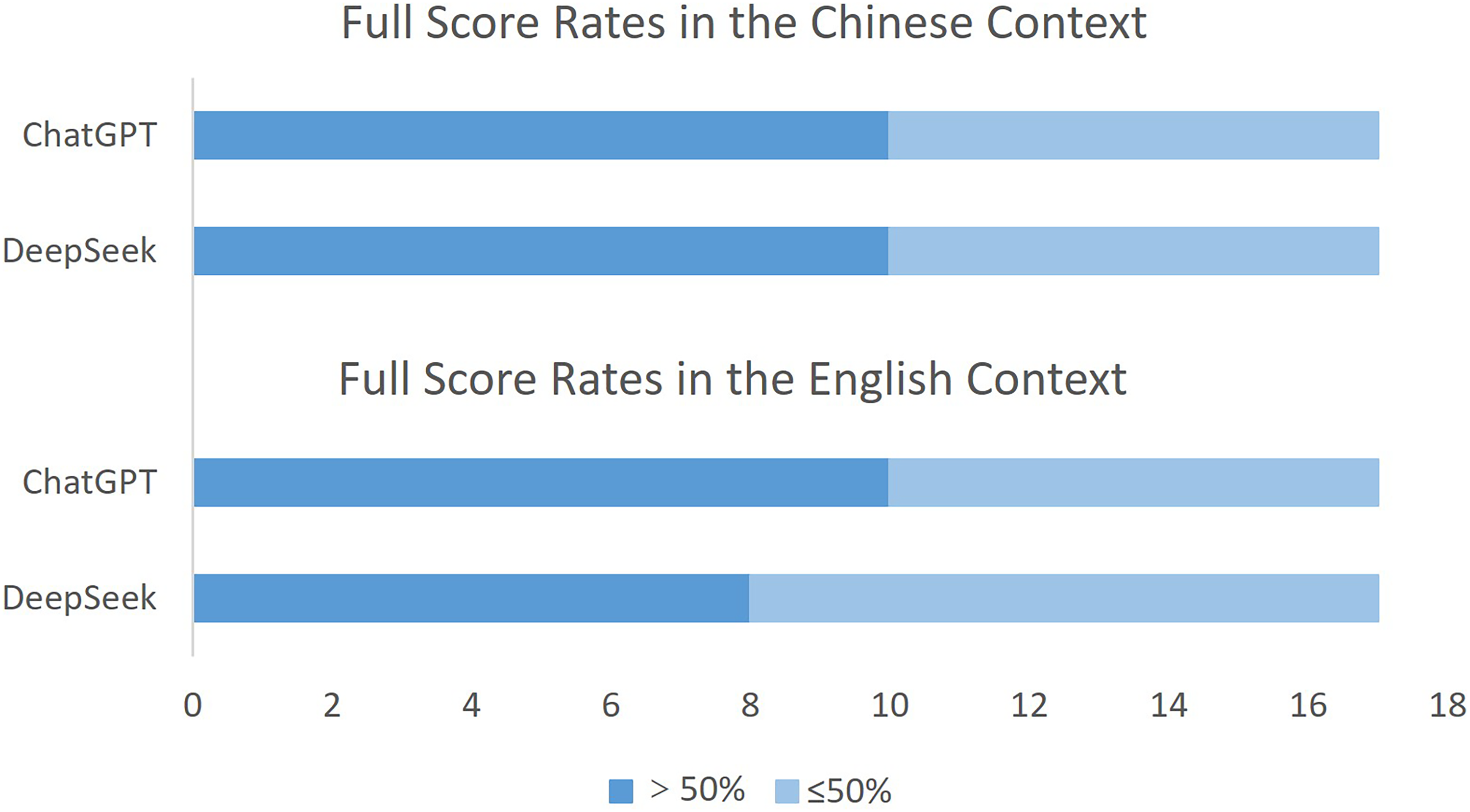
Comparison of full score rates between ChatGPT and DeepSeek in English and Chinese context.
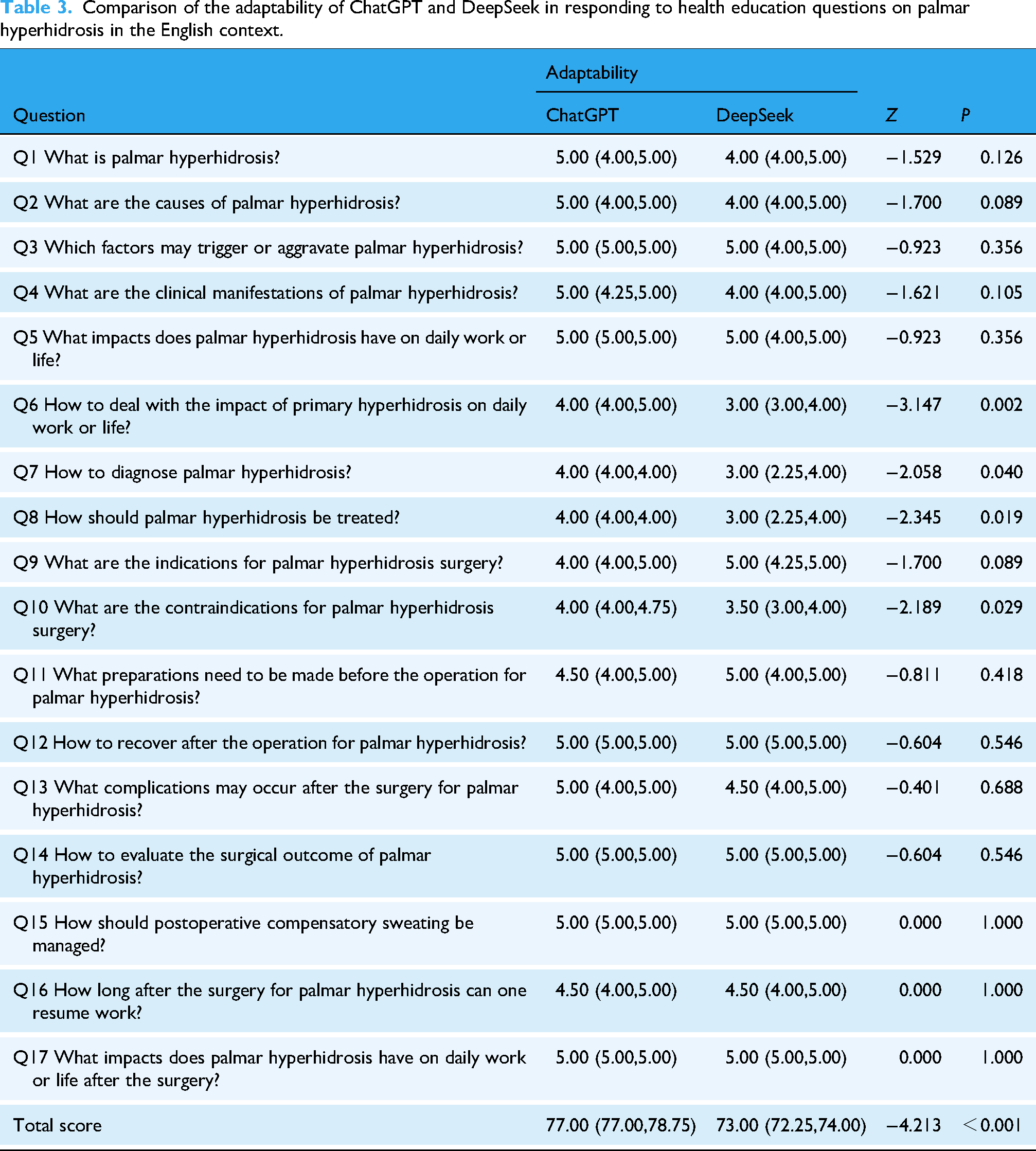
Overall, ChatGPT outperformed DeepSeek in the English context, whereas DeepSeek provided more favorable responses in the Chinese context (see Tables 3 and 4).
Comparison of the adaptability of ChatGPT and DeepSeek in responding to health education questions on palmar hyperhidrosis in the English context.
Comparison of the adaptability of ChatGPT and DeepSeek in responding to health education questions on palmar hyperhidrosis in the Chinese context.

Discussion
LLMs have attracted significant attention in the medical field due to their powerful natural language processing capabilities, which enable them to generate professional, coherent, and logically consistent responses. These models have strong potential for application in healthcare. 22 This study provides a thorough comparison and analysis of the adaptability of ChatGPT and DeepSeek in addressing health education questions related to palmar hyperhidrosis. The results show that both models can provide relatively accurate, comprehensive, and applicable responses. As auxiliary tools for patient education, LLMs can quickly generate high-quality answers, helping patients acquire knowledge about their conditions and treatment options more effectively, ultimately benefiting their healthcare journey. This finding aligns with previous research. For instance, Endo et al. 23 highlighted that ChatGPT's responses to liver transplant-related queries generally exhibit high quality, suggesting its potential as a patient education tool and an initial information source. Yan et al. 24 affirmed the completeness and adaptability of ChatGPT in providing health information for patients with inflammatory bowel disease. A comparison between the two language models reveals that, in an English-language context, ChatGPT outperforms DeepSeek overall, emphasizing its global applicability as a cross-lingual healthcare communication and education tool, consistent with the findings of Yuan et al. 25 However, it is worth noting that the performance of the model is relatively weaker in a Chinese context, highlighting the limitations of general-purpose AI models when facing multilingual and multicultural medical scenarios. In contrast, DeepSeek shows a distinct advantage in the Chinese context. This advantage stems from its development based on a Chinese-specific dataset, continually updated by a dynamic database, enabling it to provide more precise information. This makes DeepSeek a more effective tool in the Chinese medical environment, playing a crucial role in accurately understanding complex and specialized medical terminology.
A detailed analysis of specific issues reveals that, although both language models exhibit high overall adaptability, there are still some omissions and deficiencies in their responses when compared to guidelines and expert feedback. For example, in the English context, when answering the question “How to deal with the impact of primary hyperhidrosis on daily work or life?”—given that palmar hyperhidrosis affects quality of life and social interactions, many patients experience psychological stress, while DeepSeek overlooked the positive role of psychological interventions for patients. In response to “How to Diagnose palmar hyperhidrosis?” DeepSeek failed to mention the diagnostic criteria, such as the condition needing to persist for more than 6 months and meeting at least two of the following: bilateral sweating in specific areas, a positive family history, cessation of sweating during sleep, and daily work-life impairment. Regarding “How to evaluate the surgical outcome of palmar hyperhidrosis?” DeepSeek overlooked the probability of recurrence after surgery, which could lead patients to neglect recurrence concerns when making treatment decisions, thus influencing their choice of therapeutic options. In the Chinese context, when answering the question “What is palmar hyperhidrosis?” ChatGPT omitted secondary hyperhidrosis caused by local inflammation or injury affecting the autonomic nervous system. In response to “What are the clinical manifestations of palmar hyperhidrosis?” ChatGPT described excessive sweating in the palms, soles, and axillae, which often accompanies hyperhidrosis, as occurring only in a small minority of severe cases. When discussing the “clinical diagnosis of hyperhidrosis,” both ChatGPT and DeepSeek failed to mention the diagnostic standard of at least one episode per week. In addressing “What are the indications for palmar hyperhidrosis surgery?” ChatGPT did not mention the appropriate age for surgery, noting that symptoms in children under 14 years are still evolving and should be observed. When discussing “What are the contraindications for palmar hyperhidrosis surgery?” neither ChatGPT nor DeepSeek provided explanations of absolute contraindications, such as severe bradycardia (heart rate <55 beats/min) seen in electrocardiogram tests, positive atropine tests, or high-risk patients prone to severe postoperative compensatory sweating. In the responses to “How should hyperhidrosis be treated?” and “How should postoperative compensatory sweating be managed?” DeepSeek mentioned iontophoresis therapy. Although this method has been certified by guidelines and is often used in patients with palmar hyperhidrosis, it has not been widely practiced in clinical practice in China and may not be suitable for Chinese patients. Analyzing the reasons for these omissions and deficiencies, both LLMs have knowledge databases with last updates over 6 months ago, which may limit their ability to provide the most current medical information. Additionally, LLMs may face limitations related to data statistics, algorithms, computational resources, and the complexity and individuality of medical practices, as well as differing healthcare practices across regions globally. These factors can result in incomplete, inaccurate, or noncomprehensive answers on specific medical topics. Therefore, when using LLMs for patient education and auxiliary medical decision making in palmar hyperhidrosis, it is essential to consider the opinions of specialized healthcare professionals.
Even though AI holds immense potential, continuous optimization is necessary. Moreover, the role of human review in AI applications should not be overlooked. When patients face medical-related professional problems, relying solely on AI is obviously not enough, although they can provide education and comfort, it is crucial that all patients should seek guidance from medical professionals. A combination of both can facilitate the dissemination of medical knowledge and health advice, ultimately providing patients with more precise and comprehensive support. In the future, when asking questions, further details can be made according to different service recipients, such as geographical differentiation, population subdivision (age, occupation, education, etc.), etc., to better adapt to the needs of patients in the current situation. Future research can also further explore the adaptability of various LLMs in providing health education for thoracic surgery-related diseases in both English and Chinese contexts or other language settings.
Limitations
This study has certain limitations. The participants in this study were only thoracic surgery experts, and dermatologists who also diagnosed and treated palmar hyperhidrosis were not included. This may make the research results more biased toward the perspective of surgical treatment. And this study has not evaluated the acceptability of ChatGPT and DeepSeek in understanding to patients without a medical background. Such patients often require clear, concise and easy-to-understand explanations and medical advice. And, patients with palmar hyperhidrosis vary in terms of age, educational level, and severity of the condition, which may influence their needs and comprehension of health education content. Therefore, in the future, dermatologists can be invited to participate in the evaluation to form a more comprehensive educational material suitable for patients with palmar hyperhidrosis to meet the needs of patients in different clinical scenarios. Additionally, future research should more rigorously assess the comprehensibility and practical effectiveness of these tools for patients with diverse cultural and educational backgrounds. Furthermore, considering the individual differences among patients, in the future, patient surveys can be further included to make the questions for the two large language model tools more comprehensive and better meet the needs of more patients.
Conclusion
This study demonstrates that both ChatGPT and DeepSeek exhibit good adaptability in addressing health education issues related to palmar hyperhidrosis, highlighting the potential of AI in medical consultation. In the English context, ChatGPT shows a certain advantage in overall response quality compared to DeepSeek. However, in the Chinese context, DeepSeek may be the preferred choice. Depending on the usage context, selecting the appropriate model can provide more accurate, comprehensive, and applicable health education information for both English and Chinese users. In clinical practice, integrating traditional doctor–patient and nurse–patient communication with the application of large language models can help palmar hyperhidrosis patients better access relevant health education information and assist in making informed medical decisions.
Footnotes
Acknowledgements
The authors acknowledge all the reviewers.

Ethical approval
This study was determined to be exempt from ethical review and was granted approval by the Ethics Committee of the First Affiliated Hospital of Soochow University.
Contributorship
All listed authors made significant contributions to this study, whether in research design, data collection, organization and analysis, or in the writing and revision of the manuscript. All listed authors gave final approval of the version to be published, agreed on the journal to which the article has been submitted, and agree to be accountable for all aspects of the work.
Funding
The authors received no financial support for the research, authorship, and/or publication of this article.
Declaration of conflicting interests
The authors declared no potential conflicts of interest with respect to the research, authorship, and/or publication of this article.
Guarantor
The authors take responsibility for the manuscript. All authors take responsibility for any liabilities regarding this case.
Supplemental material
Supplemental material for this article is available from the corresponding author Jing Luo on reasonable request.