



Abstract
Introduction
Developing new tools utilizing a theoretical nursing framework is essential to bridge the theory–practice gap in nursing by facilitating the transfer of skills and knowledge between learning and clinical settings.
Purpose
This study aimed to examine the relationship between the usability of mobile learning applications in clinical nursing practice and students’ self-efficacy.
Method
A cross-sectional design was conducted, for 202 undergraduate nursing students of 2nd to 4th levels, who training in clinical nursing practice. System usability scale and mobile learning application self-efficacy scale were utilized.
Result
This study showed that 90.6% of students use mobile apps during their learning process. There was a positive correlation between students’ self-efficacy and the usability of using mobile learning applications (r = .741). In addition, there were significant differences between the students’ usability of utilizing mobile applications and their self-efficacy (p < 0.05).
Conclusions
Mobile learning applications can be helpful educational tools that help Z-generation students feel more at ease, accessible, and enjoying their education. Furthermore, students are satisfied with using these apps and learning about their practical nursing. Also, these apps can promote their self-efficacy if they achieve their educational purposes.
Keywords
Introduction
Recently, information and communication technology (ICT) has transformed traditional education models that were once dominated by teacher-centered approaches, textbook-based instruction, and mass classroom teaching. 1 ICT has facilitated more interactive, adaptable, and learner-centered approaches, offering learners possibilities for active participation along with personalized learning experiences. 2 Among the many advances in ICT, mobile learning has gained particular attention for its ability to support learning anytime and anywhere, making it especially valuable in professional disciplines that require continuous knowledge development and skill reinforcement. 3
In the field of nursing education, where both theoretical understanding and clinical skill development are essential, the integration of ICT and mobile applications offers innovative approaches to bridging the gap between theory and practice. 4 Nursing educators are increasingly utilizing these tools to enhance students’ cognitive, psychomotor, and affective domains, thereby equipping them to provide safe, effective, and value-based patient care in a variety of clinical settings. 5
According to Tang et al. (2019), clinical nursing practice is the key element of nursing education that enables students to engage effectively, develop professional values and clinical skills, and consolidate the theoretical knowledge necessary for nursing practice. 6 Building on this, learner-centered education supports students in becoming independent, self-directed learners.7,8 The learner-centered education is the foundation for teaching, while mobile learning serves as a useful tool that connects classroom instruction to practical clinical practice. 9 In clinical nursing settings, learner-centered education can be implemented with the use of mobile learning platforms by enabling students to practice skills at their own pace, get real-time feedback, and run on challenging topics again as needed by providing flexible, accessible, and engaging applications.10,11 This approach encourages self-directed learning and builds self-assurance in using theoretical knowledge in clinical settings. In addition, it enhances active participation and accommodates diverse learning preferences.12,13
Clinical nursing education faces several challenges, including gaps between theoretical knowledge and practical application, limited clinical teaching practices, and variations in training sites and instructor expertise. 14 The theory–practice gap, or students’ difficulty in applying classroom learning to real clinical situations, can reduce competence and confidence in patient care. 15 Mobile learning (m-learning) offers a promising strategy to bridge this gap by providing flexible, interactive, and learner-centered resources that support skill transfer across classroom and clinical settings. 16
Background
This study relies on Bandura's Social Cognitive Theory, which indicates the crucial importance of self-efficacy in influencing human learning and performance. Self-efficacy reflects individuals’ beliefs regarding their ability to successfully perform particular responsibilities. 17 In clinical nursing education, developed self-efficacy enhances students’ confidence, commitment, and competence in applying clinical skills. 18 Usability and self-efficacy in mobile learning apps work together to reduce cognitive load, improve efficiency, and promote useful user experiences. 19 As a result, students are more inclined to actively engage with it. Self-efficacy also improves students’ effective engagement with practical applications. 20 Thus, this approach addresses the interaction between technical design features (usability) and the psychological factors (self-efficacy) in determining the success of mobile learning in clinical nursing education.
Evidence suggests that the usability of mobile applications can enhance knowledge, psychomotor skills, and learning attitudes. This, in turn, directly influences students’ self-efficacy, motivation, and engagement, which subsequently affect their learning outcomes and confidence in clinical practice21–23
Despite these findings, few studies critically examine how mobile applications explicitly designed with high usability and aligned with learner-centered pedagogy can enhance self-efficacy and bridge the theory–practice gap.24–27 So, this study aimed to explore the relationship between the usability of mobile learning applications in clinical nursing practice and students’ self-efficacy, using interactive clinical nursing skills. The usability of these applications was assessed with the System Usability Scale (SUS), while students’ self-efficacy was measured with the Mobile Learning Application Self-Efficacy Scale.
Research questions
What are the students’ perceptions of utilizing mobile applications?
Is there a significant correlation between usability and students’ self-efficacy in using mobile learning applications?
Is there a significant relationship between students’ demographics and the usability of mobile learning applications and their self-efficacy?
Methodology
Design of study
Cross-sectional study design was utilized.
Setting
The study was conducted during nursing students practical training from March to April 2024, in several clinical sites/hospitals on West Bank in Palestine
Sample and participants
The whole population (N = 400) consists of 2nd, 3rd, and 4th undergraduate nursing students who enrolled in clinical courses (adult, child, and women nursing care, and advanced critical care) in the first rotation in the clinical site in the nursing program of nursing department in health professions faculty at Al-Quds university, in the spring semester 2023–2024 academic year. The sample size was calculated via G*power 3.1 by considering alpha = 0.05, a medium effect size, a margin of error of 5%, and inserting the whole population of 400 with a 95 confidence interval (reference). This provided a sample size of 197 undergraduate nurse students. However, our sample was 202, which was greater than the required sample size.
Inclusion criteria
In this study, the inclusion group was all students who enrolled in these clinical courses in the first rotation (adult, child, and women nursing care, and advanced critical care), in the second, third, and fourth levels of the spring semester of the 2023–2024 academic year, and who uploaded mobile applications (MSD Manual Professional App; EN Merch Sharp & Dohme LLC; and Drugs.com Medication Guide).
Exclusion criteria
The exclusion group was students who enrolled in the second rotation and first-year students who did not register for clinical courses. Also, students who didn’t did not have prior experience with application.
Instruments
Socio-demographic data
The researchers developed socio-demographic data including gender, age, place of residency, level of study, economic status, clinical practice course, internet access, perceived level of internet skills, and grade point average (GPA).
Students’ perceptions toward using mobile applications
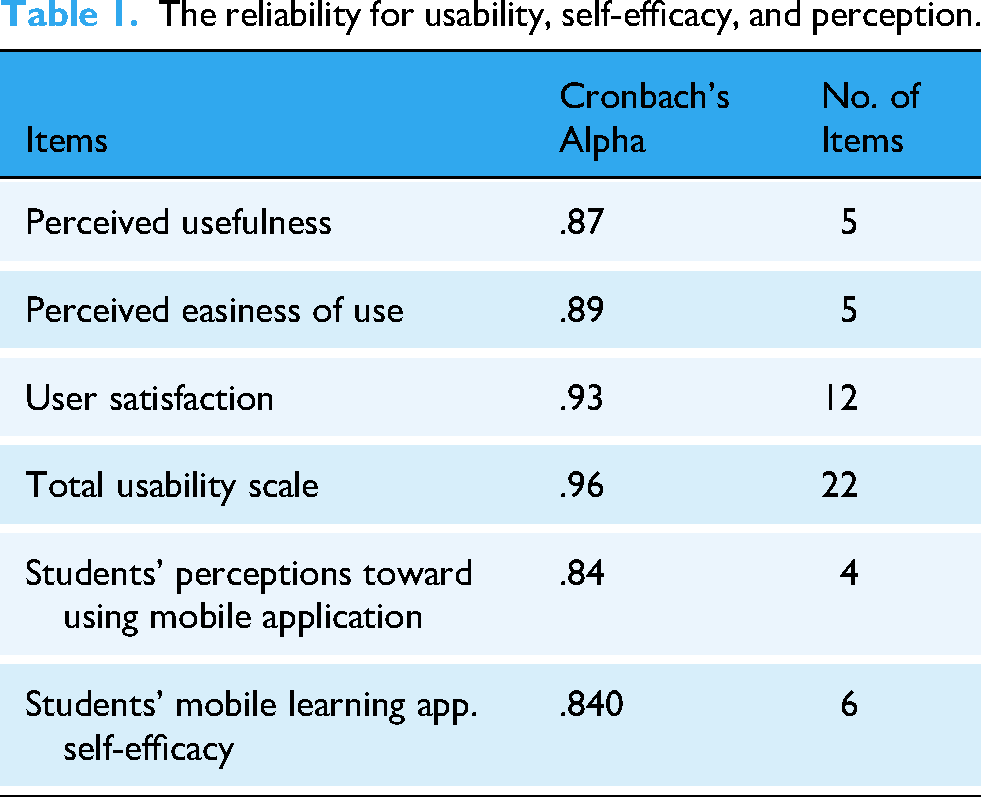
The researchers developed these questions to assess students’ perceptions: Did you learn by using mobile applications; Are you satisfied with your mobile-based learning experience; Do you think utilizing mobile applications helps to obtain knowledge in clinical practice; Do you think utilizing mobile applications would be beneficial in clinical practice. The reliability of this questionnaire was Cronbach's Alpha = .84 (see Table 1).
The reliability for usability, self-efficacy, and perception.
System Usability Scale
SUS is a general questionnaire used for evaluating the usability of electronic systems such as mobile devices. It is a quicker tool for judging the perceived usability of systems because it has fewer items with less scale pointing and includes a question regarding the satisfaction of the user with the digital solution that evaluates the usability outcome. Also, it has reproducibility, reliability, and validity. So, researchers and evaluators of m-learning applications have frequently used them. 28
The usability scale developed by Davis (1989) consists of 22 items, divided into three subscales (perceived ease of use (5 items), perceived usefulness (PU) (5 items), and satisfaction (12 items)) according to the 5-point Likert scale (1 = strongly disagree, 2 = disagree, 3 = neutral, 4 = agree, 5 = strongly agree), and the reliability was 0.85. 29 In this study, Cronbach's alpha for all items was (.962), and for each subscale, it was (.891,.876,.939, respectively).
Mobile learning app. Self-efficacy scale
Mobile learning app. The self-efficacy scale developed by Compeau and Higgins (1995) consists of six items according to the 5-point Likert scale (1 = strongly disagree, 2 = disagree, 3 = neutral, 4 = agree, 5 = strongly agree), and the original reliability was (.638), and in this study it was (.840).
Validity of instruments
All of the study instruments were validated by three experts, including the coordinator of the clinical practice unit, an educator of the pharmacology course, and the coordinator and instructor of the adult practical nursing course. The validity involved content that checks whether the application covered all relevant aspects of the theoretical and practical training course, such as patient cases, medication guidelines, and skills, and procedures of several nursing training courses that align with the curriculum. Also, construct validity determines if the instrument truly measures the student's self-efficacy and their perception of using the mobile applications. Additionally, experts evaluated the internal validity of the instruments to confirm their consistency across items and their ability to measure concepts without bias. There was editing that took place in the usability tool that was associated with mobile application tools to achieve the aim of the study.
Reliability
The internal consistency of the study variables was assessed using Cronbach's alpha. All measures have acceptable to excellent reliability. The reliability statistics are shown in Table 1.
Study process
Prior to initiating data collection, ethical approval was obtained from the Institutional Review Board of Al-Quds University. Data involving second- to fourth-year students enrolled for the spring semester of the 2023–2024 academic year was collected. Upon obtaining all requisite permissions, students were notified through the clinical unit in the Nursing Department at the Faculty of Health Professions and directed to install and utilize the mobile applications MSD Manual Professional App (EN Merch Sharp & Dohme LLC) and Drugs.com Medication Guide to assist with their clinical assignments. These apps were chosen for their reliability, comprehensiveness, and consistency with the nursing curriculum, offering evidence-based drug information and guidance appropriate for clinical practice.
Instructors requested that students consistently utilize the applications during clinical rotations, including looking into medications, examining interactive case scenarios, and referencing patient care guidelines. Although usage was independent, the instructions highlighted the necessity of regular involvement (e.g. a minimum of 2–3 times weekly) and advised the utilization of particular features, including search options, interactive training, and clinical decision support tools. To standardize the procedure, all students were provided with identical instructions about installation and usage, and the apps were made available on personal mobile devices to ensure equal access.
Data collection was conducted via an electronic questionnaire regarding the usability and self-efficacy distributed through Google Forms, shared on WhatsApp, and open for responses from March to April 2024. Participation was voluntary and unbiased, and students were asked to reflect on their actual experiences using the applications during their clinical practice.
Ethical consideration
Approval for this research was obtained from the Institution Review Board of Al-Quds University (RESC/2024-23). Consent was obtained from all participants before conducting the research. To ensure the privacy of participants, we used participants’ student numbers rather than their names.
Data analysis
All statistical procedures were analyzed using SPSS, version 27 (George & Mallery, 2021). Descriptive statistics were conducted to calculate the means, standard deviation (SD), and frequencies of the study variables. Furthermore, independent sample t-tests were conducted to compare students’ perception and satisfaction toward utilizing mobile applications in clinical sites, while one-way analysis of variance was used to test mean differences for variables with two or more categories and the person correlation between the self-efficacy of students and usability toward utilizing mobile applications. Additionally, normality was assessed using the Shapiro–Wilk test, and homogeneity of variance was evaluated using Levene's test.
Results
Student socio-demographic characteristics
Of the 202 participants in the 2nd to 4th levels of undergraduate nursing students who participated in this study, 76.7% were female and 68.8% were 20–24 years old. Half of them had a GPA average of 80–89%. Also, they had available daily and good internet access (71.8% and 60.4%, respectively). 90.5% of them live in cities and villages and have moderate economic status (87.1%; see Table 2).
Socio-demographic data (N = 202).
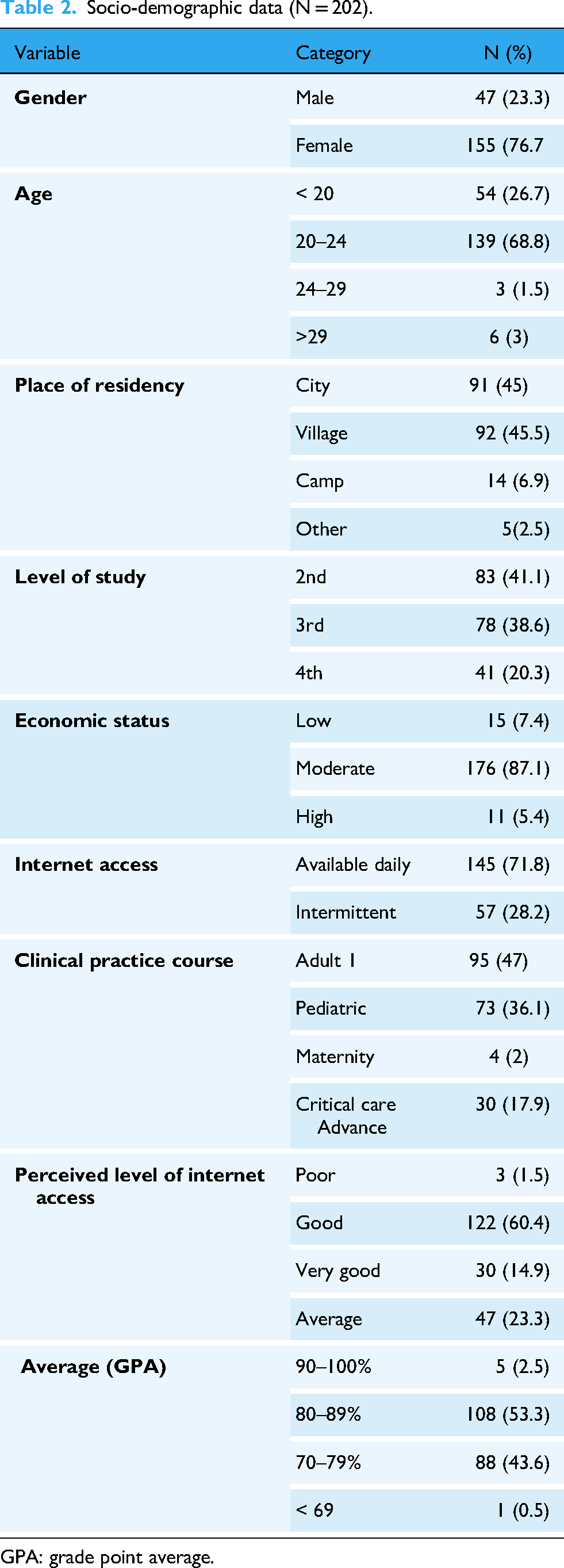
GPA: grade point average.
Students’ perceptions toward utilizing the mobile application
The result of this study showed positive perceptions of students toward utilizing mobile application-based learning; 90.6% of students reported that they use mobile apps during their learning process, and 85.1% of them indicated that mobile learning applications are beneficial in nursing education, whether theory or practice. On the other hand, 78.2% of participants have displayed their satisfaction with using mobile learning applications and could obtain and improve their knowledge through utilizing them (74.3%; see Table 3).
Students’ perceptions toward utilizing mobile application.

The usability and self-efficacy of students toward Mobile applications
The results of this study showed the usability of students toward mobile applications in clinical practice education (3.39 ± 0.74); they indicated the PU mean of using mobile applications was (3.47 ± 0.87) for improving learning outcomes, completing assignments faster, and enhancing overall practice. Additionally, they reported the applications were easy to learn and navigate, and the ease of use mean was (3.42 ± 0.81). Consequently, their satisfaction mean was (3.34 ± 0.75) about using these applications.
On the other hand, this study showed that the overall mean of students’ self-efficacy was 3.26 ± 0.74, indicating that the highest mean was (3.42 ± 1.005) for students to feel more comfortable when they have access to support or initial guidance. In the statement “I would be able to use the M-learning app. if I could refer to someone for help if I face difficulties,” and the lowest mean was (3.13 ± .989) of student confidence in using the app. In the statement, “I would be able to use the M-Learning app. only if I had seen someone else experience it before I tried it myself” (see Table 4).
Usability and students self-efficacy of using mobile learning applications.

SD: standard deviation.
Socio-demographic characteristics and usability of mobile applications and students’ self-efficacy
In Table 5, the results indicated there were significant differences between the students’ usability of utilizing mobile applications and gender, age, level of study, clinical practice course, average (GPA), and perceived level of internet skills (p < 0.05). In addition, there were significant differences in students’ self-efficacy toward using mobile applications in clinical nursing practice regarding age and gender (p = 0.003, p = 0.035, respectively). There was also a positive correlation between students’ self-efficacy toward mobile learning applications and the usability of these applications during the learning process (r = .741; see Table 6).
Differences between demographic students and usability, and self-efficacy toward using mobile applications.
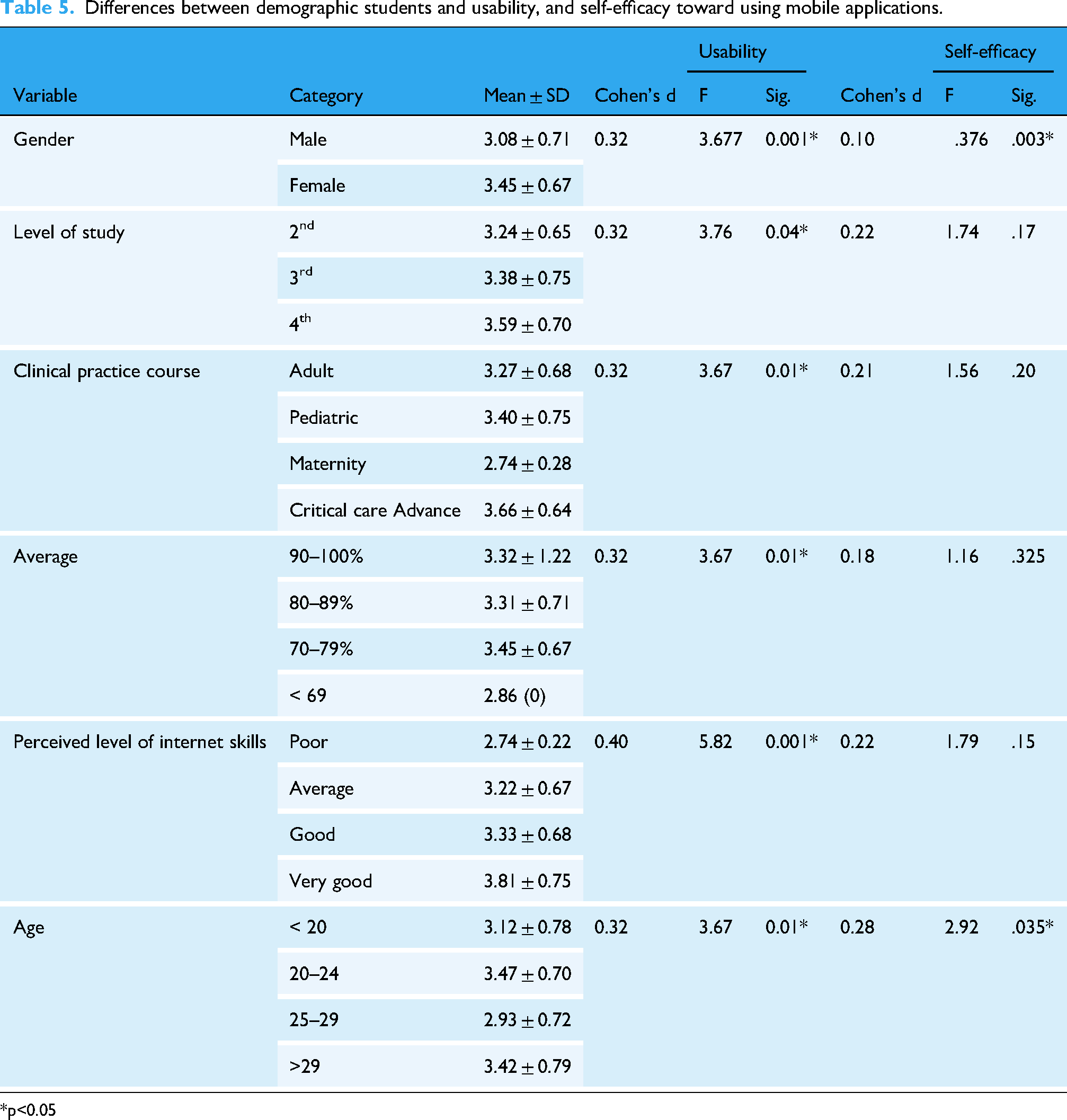
*p<0.05
Correlation students self-efficacy and usability of mobile learning application.

Correlation is significant at the 0.01 level (two-tailed).
Discussion
Students’ perceptions toward utilizing the mobile application
The students’ positive perspectives toward using the mobile learning application in clinical nursing practice are in line with the studies by Babazade et al. (2016) and Mergany et al. (2021) that demonstrated the beneficial effects of the m-learning intervention by pointing to Mayer's cognitive theory of multimedia learning. This theory indicates that learning outcomes are significant when people combine images and words in an e-learning environment.30–32 Additionally, consistent with studies by Butarbutar (2022) and Oxyandi et al. (2023), mobile learning applications play a critical role in clinical learning data recording, implementation activities and materials, documentation, and evaluation processes of nursing students’ clinical competency achievements effectively and efficiently, as well as clinical and academic preceptor supervision.33,34 One potential benefit of mobile apps shown in this study is their constant accessibility, which is crucial for knowledge retention. Additionally, several clinical apps are free of charge, and these features enhance the inter-activeness and responsiveness of mobile-based applications, leading to enhanced learning outcomes. These findings align with studies conducted by.35–38 In addition, mobile learning applications promote student satisfaction, foster self-directed learning, and reduce barriers to communication between learners and educators by providing a variety of intriguing possibilities for engagement. 39 Consequently, the integration of applications in the nursing curriculum promotes pupil involvement and the utilization of updated, evidence-based content in nursing care practice. 40
Usability and self-efficacy students toward using mobile applications
In line with the findings of van Wingerden et al. (2019), which showed the highest perceived ease—meaning that the m-learning was easily accessible and the instructions were clear for all participants 41 —this study found positive perceptions toward usefulness, ease of use, and satisfaction (3.39 ± 0.74) that mobile learning applications in clinical nursing practice matched their interests and abilities. Furthermore, it was in line with the study conducted by Al-Bashayreh et al. (2022), which demonstrated that self-efficacy has a significant effect on PU and ease of use.42,43
The average PU value in this study was 3.47 ± 0.87, indicating that students thought mobile learning applications were beneficial learning media. This is in line with studies by Mekic and Ozlen (2014) and Fralick et al. (2017), which found that most respondents thought the mobile applications were useful. Smartphones can be used for a variety of purposes, including enhancing productivity, facilitating communication and information services, and providing greater opportunities to access material about transcultural nursing, practical nursing learning, and nursing context.44,45 Al-Bashayreh et al. (2022) suggest that consumers would find mobile learning applications comfortable if they believed them to be beneficial. 42
On the other hand, the average perceived ease of use (PEOUU) value was 3.42 ± 0.81, suggesting that students enjoyed using mobile learning applications through designing content and applications. This finding is in line with studies conducted by Hossain (2023), Sari et al. (2020), and Fralick et al. (2017), which found that students are more likely to use mobile learning applications if they perceive them to be pleasant, enjoyable, and fun, with clear interactions between respondents and smartphones and that they are understandable, adaptable, and applicable.1,44,46 Furthermore, the ease of use and portability of mobile learning applications make them easily accessible at any time and place. 47
The average score for students’ satisfaction with using mobile learning applications was 3.34 ± 0.75, which is consistent with the study by Li et al. (2019), who found that students were satisfied with the apps’ functionality, design, and ease of use. This suggests that students were able to concentrate on their learning rather than get interrupted by the apps’ defects. 48
According to this study's findings, students’ self-efficacy regarding the usability and use of mobile learning applications was positive. This is consistent with studies by Naveed et al. (2023) and Fatima et al. (2017), which found that SE increases learning capacity and provides people the confidence they need to embrace new technology. Additionally, students’ self-cognition is enhanced by self-efficacy, which also has an association with the usefulness indication of the effectiveness of mobile learning applications.49,50 Because of this, students with higher levels of self-efficacy will get more advantages and improve their IT abilities.51,52 Furthermore, active learning—which improves student results and willingness to learn—is the source of self-efficacy.53,54
Furthermore, the mean (3.13 ± .989) of students’ confidence in utilizing the app was the lowest in this study. In the statement “I would be able to use the M-learning app. only if I had seen someone else experience it before I tried it myself,” students may not feel as comfortable utilizing the application on their own, particularly if they are not familiar with the concepts of mobile learning. Additionally, information from individuals they know is trusted by students more than information from the Internet and TV media. According to studies by Al-Emran et al. (2018), Hao et al. (2017) “external influence” presupposes “self-efficacy,” which indicates that when students believe they are confident in their capacity to embrace M-learning, they control the resources needed to do so.55,56
The correlation between students’ socio-demographic factors, the usability of mobile applications, and their self-efficacy
According to the study's findings, there was a significant correlation between student self-efficacy and usability when utilizing mobile learning apps based on their gender and age, which in this study showed most of the students in the 20–24 age range are technologically skilled; this is expected given their generational development since they often identify game-based learning with Generation Z, and the majority of them included in this study were female. These results align with studies conducted by Siwale & Mwalemba (2023) and Ahmed et al. (2024), who observed that females might be more willing to utilize technology in learning settings due to social norms or expectations focusing on digital proficiency in fields that have traditionally been dominated by males. 57 In technology-mediated learning environments, females often exhibit greater capabilities for cooperation, communication, and flexibility; these skills are critical for effectively utilizing emerging technologies in educational settings. 58 Additionally, these findings are consistent with those reported by Buchanan et al. (2021) and Al-Bashayreh et al. (2022), which demonstrated that Generation Z, often referred to as the mobile generation, is prepared to utilize technological advancements in education due to their upbringing with easy access to the internet.42,59
Furthermore, the findings of this study showed that there is a significant correlation between the level of study, clinical practice course, GPA, students’ internet skills, and the usability of mobile applications.
In this study, second-year students constituted the largest group of participants. This may be explained by the structure of the nursing curriculum, where second-year students are often first exposed to foundational clinical courses that require frequent use of mobile learning applications. These students may also have higher motivation to engage with new learning technologies as they transition from theoretical to practical components of their education. This aligns with the studies by McGee et al. (2023) and Ryan et al. (2024), which highlighted that early clinical exposure encourages students to engage more actively with digital tools and applications as they seek to bridge the gap between theory and practice. 60 Additionally, students in the earlier clinical years often report higher interaction with mobile learning apps due to structured assignments and guided clinical tasks. 61 That emphasizes the curriculum's focus on foundational clinical skills, supporting the use of mobile applications to facilitate early experiential learning. In addition, advanced students, particularly those in clinical practice courses, tend to have more experience and exposure to mobile applications, which enhances their usability skills. This increased familiarity often leads to higher satisfaction and more effective use of mobile applications.60,61
Moreover, students with elevated GPAs usually show more effective time management and study skills, potentially resulting in a more efficient utilization of mobile applications for educational objectives. The study by Alkhazali et al. (2024) supports the claim that mobile applications significantly enhance the knowledge and skills of nursing students, indicating that academically successful students are more likely to benefit from these technological tools. 62 This study observed that students enrolled in various clinical practice courses favor the use of smartphones for academic purposes. The findings are consistent with the studies of Buabeng-Andoh (2018) and Alfalah (2023), which indicate that students demonstrate adaptability to the employed technology. The main activity performed on smartphones is web browsing, as it offers constant and convenient access to information.63,64 Furthermore, proficiency in internet skills allows students to navigate and utilize mobile applications more effectively, resulting in enhanced usability experiences. This finding aligns with a study conducted by Durmuş et al. (2024), which indicated that individuals with higher levels of digital literacy exhibit greater competence in navigating the features and functionalities of mobile health applications. 65
This study indicates a strong and statistically significant correlation (r = 0.741, p < 0.001) between nursing students’ self-efficacy and the usability of mobile applications in clinical settings, demonstrating an important relationship in nursing education. This finding suggests that students with greater confidence in their abilities are more likely to engage effectively with mobile applications, which are increasingly incorporated into clinical practice. A number of studies confirm this relationship. Choi (2021) identified a positive correlation between nursing students’ self-efficacy and their intention to utilize medical-related mobile applications, indicating that increased self-efficacy correlates with a more positive attitude towards mobile health technologies. 66 Badiyepeymaiejahromi et al. (2023) demonstrated that interventions aimed at enhancing students’ self-concept, such as the Nurse Self-Concept Mobile Application, significantly improved self-efficacy, subsequently increasing engagement with educational technologies. 67 Zarei et al. (2025) found that smartphone applications aimed at patient education improved self-efficacy in health management, indicating that mobile applications can effectively enhance self-efficacy, a concept applicable to nursing students in clinical environments. 68
Limitation
This study provides valuable insights into nursing students’ self-efficacy and the usability of mobile learning applications; nonetheless, several limitations ought to be recognized. The study was conducted over a brief duration of one month, which restricts the evaluation of long-term knowledge retention. The cross-sectional design identifies associations; however, it does not establish causal relationships. The sample was obtained from a single institution, potentially limiting generalizability. Furthermore, there were no direct assessments of clinical competence, and self-reported questionnaires may be subject to response or social desirability bias. Students’ engagement may be affected by distractions from non-educational applications, and the varying quality of content in these applications restricts interactivity and the replication of practical skills.
Future research should employ longitudinal designs to assess sustained learning outcomes, recruit larger and multi-institutional samples, and incorporate educators to investigate differences among groups. The integration of objective assessments for clinical skills and the enhancement of measurement tools, including app analytics, would yield more precise insights into students’ actual usage. It is advisable to create interactive, evidence-based mobile applications specifically designed for students and to incorporate them into the clinical curriculum to improve learning outcomes and usability.
Conclusion
This study concluded that mobile learning applications serve as beneficial educational tools, facilitating an improved and accessible learning experience for Generation Z students while enhancing their enjoyment of education. Students exhibiting higher self-efficacy demonstrate increased confidence and engagement in the exploration and utilization of mobile applications, recognizing these tools as more usable and useful for clinical learning. Consequently, educational programs designed to incorporate mobile technologies need to emphasize strategies that enhance students’ self-efficacy, as these approaches can markedly improve the adoption and effective use of digital learning tools in clinical education.
Implication in nursing education
This study supports the use of mobile learning apps in clinical nursing practice in nursing education in a variety of ways, emphasizing the need for these tools to be creative, user-friendly, and enjoyable to increase effectiveness. The way M-learning interventions take place is also essential to instructors and faculties since university students are directly impacted by them. The results also light on the opinions of the students and their future intentions to integrate various kinds of mobile learning apps in difference nursing courses. Conversely, the findings guided developers and academic institutions on how to better understand the multimodal technical aspects that need to be taken into account while developing mobile apps in various fields. This decreases frustration and helps students use mobile devices with attention.
Footnotes

Funding
The authors received no financial support for the research, authorship, and/or publication of this article.
Declaration of conflicting interests
The authors declared no potential conflicts of interest with respect to the research, authorship, and/or publication of this article.