



Abstract
Background
The widespread use of mobile fitness apps (MFAs) provided new opportunities to promote regular physical activity and adopt a healthy lifestyle. However, many MFAs have encountered underutilization issues and declining in user stickiness. Promoting the continued use of MFAs is an urgent goal.
Objective
This study examined how MFAs’ affordances (tracking, visualizing, reminding, gaming, and sharing) influence users’ continuance intention from a health empowerment perspective.
Methods
This cross-sectional study surveyed 279 users using MFAs and analyzed the data using structural equation modeling.
Results
The results showed that tracking, visualizing, gaming, and sharing affordances positively impact health empowerment, while reminding affordance had no impact. Health empowerment can positively impact users’ continuance intention. Furthermore, health empowerment mediated the relationships between the MFA's affordances and continuance intention.
Conclusion
This study examines the differential effect of MFA's affordances on users’ continuance intention, specifically identifying the affordances that are impactful in driving sustained engagement. Furthermore, this study establishes health empowerment as a fundamental mediating mechanism through which these affordances exert their positive influence on continuance intention. These findings significantly advance the understanding of the nuanced relationship between technology affordance and user behavior in the MFA context. The results provide targeted and actionable design recommendations for mobile fitness app developers to enhance user long-term engagement.
Introduction
Regular exercise, fitness, and other physical activities have many physical and mental benefits, such as developing healthy lifestyle habits, relieving emotional exhaustion, and improving life satisfaction. 1 Although physical activity can help improve health and well-being, about 27.5% of adults and 81% of adolescents globally fail to meet WHO-recommended physical activity guidelines. 2 The emergence of smart devices and the development of mobile fitness apps (MFAs) provided new opportunities to promote regular physical activity and adopt a healthy lifestyle.3–5 MFAs are smartphone programs that data from a smartphone's built-in tools to measure health and fitness parameters, 6 such as Keep (http://www.gotokeep.com), Yodo Run (https://www.51yund.com/zh-cn), BooHee Health (https://www.boohee.com), and Nike Run Club (http://www.nike.com/nrc). In China, there are 1.116 billion mobile Internet users, 7 while Keep -the most popular app- has 840 million downloads in the app market. MFAs are mainly used to track and record the process of physical activities, provide feedback on these physical activities, create an environment with dynamic storylines or game-like experiences (e.g., milestone missions, medals, points, and leaderboards), and share these achievements in social networks.8–10 Using the various features of MFAs can help users lead more healthy lives and subjective wellbeing.11,12 While users get beneficial health outcomes from using MFAs, there are still challenges in encouraging users to continued use these technologies.13,14 Many MFAs have encountered underutilization issues and declining user stickiness.15,16 Evidence shows that a substantial 45.7% of health-related mobile apps (e.g., MFAs) users had stopped using these apps due to negative experiences. 3 The discontinued usage behavior severely hinders users’ health benefits from MFAs.17,18 This lack of sustained engagement negatively impacts user health. 19 Furthermore, cessation of MFAs usage hinders developers’ opportunities to gather essential user feedback, thereby restricting continuous optimization of physical activity services. Lowering the quality of services provided by MFAs can also harm users’ engagement and physical activities.1,20
Health empowerment is defined as a person's belief that they have a significant influence over health outcomes, including the ability to address personal health issues and feel in control over factors that can impact health outcomes.21,22 Health empowerment is a critical determinant of the continued use of health-related technologies. Empirical evidence consistently demonstrates this link: health empowerment actively promotes continuance intention for chronic disease management apps, 23 and positively impacts older adults’ continued use of wearable health technologies. 24 Consequently, the key question arises: how can users be effectively empowered? Previous research indicates that using information and communications technology can make users feel empowered, 25 and functional attributes play a key positive role.22,23 In the context of MFAs, MFAs have some operable attributes embedded in the device to help users achieve their fitness goals, such as tracking, reminding, visualizing, gaming, and sharing. Previous studies have analyzed users’ perceptions of these MFAs’ affordance. For instance, Wang and Collins 9 found that tracking is a core feature, and when combined with gamification and social features, it will gain further user preference. Higgins 6 found that MFAs help users monitor their physical condition, provide quick and reliable responses, and allow them to share and compete with friends on social media, which can help users change behavior and improve well-being. However, a critical research gap remains. While affordances like tracking, gamification, and sharing are recognized for their general role in user engagement and well-being, there is a distinct lack of direct evidence identifying which specific affordances within MFAs actually generate health empowerment and, consequently, drive long-term technology usage. Precisely how these functional attributes translate into the psychological state of empowerment that underpins continued use remains unclear and underexplored.
To sum up, to solve the above research problems, we draw on health empowerment to explore the relationship between the affordance of MFAs and users’ continuance intention. This study focuses on two research questions:
RQ1: Which affordances of MFAs significantly influence users’ health empowerment and continuance intention?
RQ2: What is the mechanism through which these affordances affect continuance intention?
Theoretical foundation and literature review
Health empowerment
Health empowerment is the application and development of empowerment theory in the medical and healthcare field.26,27 Unlike the traditional approach in health management, health empowerment emphasizes that the individual is the first person responsible for health. 28 Empowerment occurs when individuals can make autonomous, informed health decisions and when an individual's ability to address health issues increases. 29 Therefore, health empowerment can be described best in terms of meaning, competence, self-determination, and impact.22,26 In other words, when individuals feel empowered, they not only actively focus on the value of health goals and develop the capability to achieve them but also make autonomous decisions regarding their behaviors, with a clear understanding of the anticipated outcomes of those behaviors. 27
Health empowerment contributes to individuals develop healthy behaviors and enhance the subject's well-being. When people feel being empowered, they continue to sustain healthy behaviors.25,30 Evidence suggests that individuals who participate in health empowerment programs perform better at healthy eating and physical activity. 31 Furthermore, health empowerment can improve users’ well-being. 32 Li et al. 33 have found that when people use psychological self-help systems, empowerment can relieve their occupational stress and increase their perceived happiness. Considering the potential benefits of health-related technologies, many scholars have begun to pay attention to the impact of health empowerment on usage behavior. 34
The next question is how to improve people's health empowerment? Health-related technologies have become essential tools.25,35 People can access health information on online medical websites for health empowerment 36 because people gain information, benefits, and health decision-making benefits. 21 Participating in online health communities is also an effective way to enhance health empowerment, where people can access valuable information and social support from community members.37,38 Health empowerment is enabled by information and communications technology through technology characteristics. Specifically, Zhou et al. 32 found that mobile health technology characteristics positively affect health empowerment, including perceived response efficacy, ease of use, and mHealth quality. Nelson et al. 22 demonstrated that systemic elements are determinants of health empowerment, including attractiveness, feedback, privacy protection, readability, and gamification.
Affordances of mobile fitness apps
Initially proposed in the ecological psychology field, affordance refers to the possibilities for action provided by objects and spaces in the environment to organisms. 39 With the development of information technology, the concept of affordability is used to explore the interaction between people and information technology. Markus and Silver 40 defined IT affordance as “the possibilities for goal-oriented actions afforded to specified user groups by the technical functionalities of technical objects. These possibilities are influenced by the inherent characteristics of the technology itself, such as its features. For example, electronic health records have two features (structured data entry forms and a common database for storing patient information), which give rise to an affordance: capturing and archiving digital data about patients. 41 Previous studies have explored IT affordance in different scenarios, focusing on the features of different IT. Zhang et al. 42 identified mobile health consultation affordance (visibility, searching, and guidance shopping), highlighting their impact on psychological outcomes. Suh 43 analyzed the impact of quantified-self technology's affordances (tracking, visualizing, and sharing) on individual motivation and use behavior.
In this study, affordance refers to the possibilities for goal-oriented actions afforded to specified user groups (such as fitness enthusiasts, people with special physiological conditions, etc.) by the technical functionalities of MFAs. To achieve affordance, MFAs offer several features. James et al. 44 grouped the fitness technology features into three feature sets: data management features, exercise control features, and social interaction features. Data management features allow users to collect personal physical activity data and analyze and display it in combination with data from other sources. Exercise control features provide rewards and reminders to motivate users to follow an exercise plan and achieve their goals. Social interaction features allow users to interact with others and share their exercise achievements. We identify the affordances that can be achieved by these feature sets. Affordances related to data management features are tracking and visualizing affordance, affordances related to exercise control features are reminding and gaming affordance, and social interaction features provides sharing affordance.
The current study analyzes the impact of some MFAs’ affordances on user behaviors. The affordance of MFAs can significantly improve user exercise adherence and well-being. 1 Specifically, MFAs can provide credible feedback to encourage users to achieve their health goals and remind them when they are not reaching their health goals. MFAs also allow users to share their exercise information with friends, which can promote behavior change and improve well-being. 45 In a field study, Ghose et al. 46 found that reminders were able to promote physical activity in people with diabetes. Oc and Plangger 47 also found that wearable devices’ affordance (gaming, instructing, sharing, and tracking) can increase the habitual use of these devices. These studies provide evidence that affordance affects user technology use behavior.
Furthermore, many studies focus on the mechanisms by which affordance affects user behavior. Suh 43 demonstrates that tracking affordance promotes continuance intention via utilitarian motivation, shared affordance through hedonic affirmation, and visualizing affordance via both motivational pathways. In addition, gaming affordance influences mobile fitness app usage behavior via the improvement of users’ IT identity. 15 However, the mechanisms through which varied affordances influence user behavior – especially how specific affordance types trigger use behavior – remain underexplored in existing literature. While existing research predominantly explains user behavior through the lens of tool utility, healthy behaviors inherently emphasize domains such as initiative, autonomy, and control, 48 highlighting the impact of intrinsic motivation on usage rather than reliance on perceived external values. Therefore, this study explores how the above five affordances (tracking, visualizing, reminding, gaming, and sharing) empower users and promote continuance intention.
Research models and hypotheses
“A-P-B” framework
This study explores how MFAs’ affordance affects users’ continuance intention, combining MFAs’ affordance and health empowerment. The framework of “affordance-psychological outcomes-behavior (A-P-B)” provides a reasonable framework for explaining the effect of technology affordance on users’ psychological and behavioral outcomes.42,49–51 From the perspective of user perception, affordances shape the overall evaluation of MFAs’ designs, which can subsequently affect users’ psychological outcome. For instance, Zhou et al. 48 found that fitness's affordance can significantly increased individuals’ sense of autonomy, competence, and relatedness. Zhang et al. 42 also shown that IT affordances exerted a significant positive influence on IT identity in the mobile health consultation content. Furthermore, users’ psychological outcomes influence individual behavior change. Zhang et al. 49 regard perceived value as the psychological result of watching live broadcasts, which can positively influence users’ repurchase intention. Based on this farmwork, we selected five affordances (tracking, visualizing, reminding, gaming, and sharing), regarding health empowerment as a psychological outcome and continuance intention as behavior. The research model constructed is shown in Figure 1.
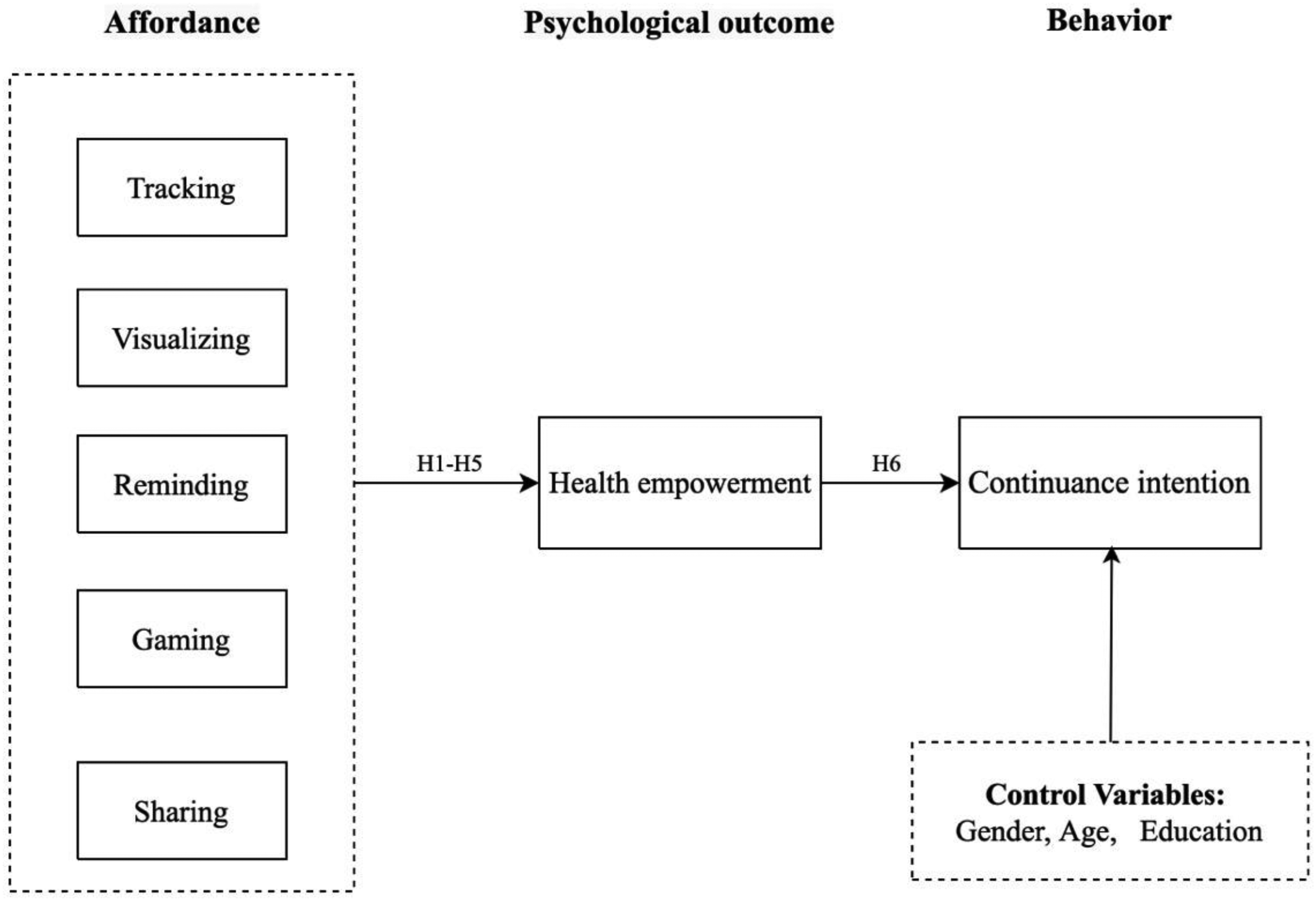
Research model.
The influence of MFAs’ affordances on health empowerment
By gratifying user needs, affordances in health-related apps can achieve health empowerment. 23 Grounding in established evidence that technological affordances constitute primary drivers of health empowerment,22,23 this study extends prior work by dissecting how distinct affordances in MFAs—particularly tracking, visualizing, reminding, gaming, and sharing—activate health empowerment.
Tracking affordance is the property of MFAs that allows users to collect data, including, for example, their location, body movements, heart rate, pace, speed, dive depth, sleep quality, or swim strokes. 47 As the foundational affordance in MFAs, tracking satisfies users’ primary need for behavioral self-awareness by enabling continuous access to quantified activity metrics (e.g., step counts, calorie expenditure). This real-time data accessibility establishes the baseline for all subsequent health self-regulation processes.9,52 Individuals can gain access to data that reflects their workout progress and adjust their health goals and plans based on that data to achieve self-management. Faizah, Hardian 53 have affirmed the potential value of tracking, as the user can document the exercise data, allowing users to feel the specific help and value of the MFAs to achieve their fitness goals. Therefore, this study proposes the following hypothesis:
H1: Tracking affordance has a positive impact on health empowerment.
Visualizing affordance is the property of MFAs that transforms raw user data into interactive, multi-faceted visual representations to make historical trends, current performance, and future projections intuitively understandable. 43 Visualizing affordance can convey information about personal status and progress through graphic elements, which can help users analyze factual data about themselves more intuitively. 54 This means that users can visualize their exercise process and physical condition. Various forms of visualization, including charts, tables, and animations, allow users to analyze movements more quickly and directly, enhancing the user's sense of control over the physical activity process. Users can gain valuable insights from the data and apply them to their next physical activity to improve their health management ability. 53 Evidence shown that applying visualization to health technology can help promote patient empowerment. 54 Therefore, this study proposes the following hypothesis:
H2: Visualizing affordance has a positive impact on health empowerment.
Reminding affordance is the property of MFAs that proactively delivers timely and contextually relevant prompts to users, designed to cue the initiation of a target behavior. 44 Reminders have been widely used in mobile health management applications and have positive value for users achieving their health goals.46,55 Reminders can help improve user exercise adherence. 56 This is because timely reminders can make users aware of the value of exercise and change users’ health beliefs. 57 There is evidence that users feel empowered when they receive information that aligns with achieving their personal health goals. 25 Therefore, this study proposes the following hypothesis:
H3: Reminding affordance has a positive impact on health empowerment.
Gaming affordance is the property of MFAs that integrates game design elements into non-game contexts to elicit users’ emotional responses and goal-oriented behaviors. 47 Gaming affordance makes it possible to create an environment with dynamic storylines or game-like experiences, which can increase the perceived fun of users and thus help users more easily achieve their exercise goals. The game feature increases perceived enjoyment and distracts from otherwise boring and difficult exercise goals, helping to motivate users to stay on track with their physical activity. 47 This experiential rewarding content contributes to users feeling empowered. 25 There is evidence that gamification positively fluences health empowerment. 22 Therefore, this study proposes the following hypothesis:
H4: Gaming affordance has a positive impact on health empowerment.
Sharing affordance is the property of MFAs that allows users to disclose their data on their achievements with other users or even external individuals (e.g., coaches, doctors). 47 Specifically, users can share their activity data with others, keep track of social connections’ activities and accomplishments, communicate with others, create chat groups, and set up joint activities with friends. Socially oriented features provide users with the opportunity for social comparison, which helps to improve exercise adherence and engagement behavior. 1 In social interaction, users can obtain health information and social support, which will enhance health empowerment. 37 There is evidence that social connection can make users feel empowered. 25 Therefore, this study proposes the following hypothesis:
H5: Sharing affordance has a positive impact on health empowerment.
The influence of health empowerment on continuance intention
Continuance Intention is defined as a willingness to continue using MFAs after their initial adoption its. 58 Empowerment is necessary for persons to sustain healthy behavior. 25 There is evidence that health empowerment promotes self-health management behaviors. 59 When individuals are empowered, they are adequately equipped to cope with their health issues and feel a sense of control over their health situation. Health empowerment includes competence, meaning, impact, and self-determination. 22 Self-determination theory points out that competence, autonomy, and relatedness can influence people's internal motivations and behaviors. 60 People take action when they are capable of completing a task and are able to obtain valuable benefits. 61 In the context of this study, more and more people are integrating MFAs into their daily health management process. When people are empowered to use MFAs, they are more likely to continue using them for personal health management in their daily lives. Because they feel they have greater ability and autonomy to manage their health through MFAs and believe in positive health outcomes. 24 Previous research has shown that health users’ cognition of health empowerment positively affects their continued use of chronic disease management apps. 23 Studies have also shown that the stronger the sense of empowerment, the stronger the individual's willingness to continue to use digital technology. 62 Therefore, this study proposes the following hypothesis:
H6: Health empowerment has a positive impact on continuance intention.
Methods
Questionnaire development
All principal constructs were operationalized using established measurement scales adapted from prior literature. Adapting existing scales not only helps to maintain reliability and validity from previous studies but also allows for better comparability across different studies and reduces the potential for measurement errors by ensuring relevance to the specific context being studied. The tracking and gaming scale were adapted from the research of Oc and Plangger, 47 which was validated among 500 individuals practicing various types of fitness or sports activities via wearable technologies (Cronbach's alphatracking = .781, Cronbach's alphagaming = .813). The visualizing scale was adapted from Suh, 43 which was validated among 180 quantified-self technology users (Cronbach's alpha = .820). Tracking and visualizing both contain three items, and gaming includes four items. The reminding and sharing scale were adapted from James, Wallace, 44 originally tested with 880 individuals who currently use or have used a fitness technology (Cronbach's alphareminding = .927, Cronbach's alphasharing = .923). Among them, sharing contains four items, and reminding includes three items. According to the scale developed by Nelson, Verhagen, 22 four items were used to measure health empowerment. The health empowerment scale was validated among 210 smart wristband users (Cronbach's alpha = .830). Finally, the scale of continuance intention was derived from Bhattacherjee, 58 which maintains proven reliability and validity through replications in many technology domains.
We first conducted a pilot survey to ensure the questionnaire was suitable. The pilot study involved a convenience sample of 30 participants who were active users of MFAs. These participants were recruited through the researchers’ social networks (e.g., WeChat Moments) to foster open communication and detailed feedback. Each participant participated in either one-on-one or small-group discussions after completing the draft questionnaire. The primary aim was to identify any items that were ambiguous, difficult to understand, or contextually unsuitable. Based on this qualitative feedback, several modifications were made to the instrument. For example, some items were rephrased to specifically mention “MFAs” instead of the more generic “system” or “technology” used in the original scales. To enhance contextual relevance and clarity, several measurement items were revised to more accurately reflect the target constructs within the mobile fitness app context. For example, the original item measuring visualizing affordance, ‘This mobile fitness app is able to give me a comprehensive view of my performance,’ was amended to ‘…in an easy-to-understand chart format’ to clearly emphasise the graphical data representations central to this affordance. While this pilot phase focused on qualitative feedback to refine item wording and structure, formal reliability and validity tests were conducted on the main study sample, as reported below. The final measurement instruments are shown in Appendix 1.
Data collection
This study adopted a cross-sectional questionnaire design to investigate the impact of MFAs’ affordance on health empowerment and continuance intention. Data were collected exclusively through anonymous online surveys. This study was approved by the Academic Committee of Business School at Central South University (ID: CSUBS20240520). We commissioned an online survey platform (Credamo) to recruit respondents randomly to answer the questionnaire. This platform's total number of registered samples exceeds 3 million, covering all provincial-level administrative regions in China. To achieve a random sample, we utilized the platform's ‘random push’ function to distribute the questionnaire to its user base. This function is designed by Credamo to randomly invite active users who fit our pre-specified demographic quotas (Report on China's Fitness Industry by STYD 63 ) from its large panel pool, minimizing selection bias and ensuring that every eligible participant has an equal probability of being invited.
Participants were presented with a detailed informed consent form at the beginning of the survey. The form outlined the study's purpose, estimated completion time, potential risks and benefits, data confidentiality assurances, and their right to withdraw at any time. Only after providing their digital consent by selecting ‘Agree’ were they allowed to proceed to the survey questions. All the participants have signed an informed consent in this study.
After voluntarily accepting the survey and providing their informed consent, participants were presented with a questionnaire and answered a series of questions. Two categories of data were systematically collected through an online platform: demographic profile (such as age, gender, education level, monthly income, and use experience) and core constructs (including tracking, visualizing, reminding, gaming, sharing, health empowerment, and continuance intention).
Participant screening and data cleaning
The survey was accessible for one month, starting in June 2024, yielding 398 responses. Prior to data analysis, a two-step data preparation procedure was implemented to ensure the quality and relevance of the sample. First, as our study focuses on users’ continuous usage behavior toward MFAs, we embedded a screening question (“Have you ever used a mobile fitness app, like Fitness in iPhone, Keep, Yodo Run, or BooHee Health?”) within the survey questionnaire. Six respondents were screened out because they did not respond “yes” to the screening question. After meeting the screening questions, we performed a data cleanup. To identify and exclude inattentive respondents, we embedded instructed-response items (e.g., “Please choose the number 4 for this question”) within the survey questionnaire. Participants who failed this attention check question were removed from the dataset. This step led to the exclusion of 113 participants. No participants were excluded for incomplete responses or for unusually fast completion times. Based on the three data cleaning criteria—failed attention checks, incomplete responses, and unusually fast completion times—a total of 113 participants were excluded.
Following these steps, a final sample of 279 valid and complete responses was retained for statistical analysis, yielding a response rate of 70%. A flowchart summarizing this process is provided in Figure 2. There are seven latent variables and 24 indicator variables. According to the method by Christopher Westland, 64 the lower bound of sample size of this study is 145. Considering the outcomes of the structural equation modeling for this study, a sample size of 279 appeared to be adequate to detect the effects of interest.

Data preparation procedure.
Data analysis
This study adopted the partial least square (PLS) structural equation model (SEM) for data analysis, and SmartPLS4.0 was used to test the model. Compared to CB-SEM, PLS-SEM is more suitable for this study, as it performs better when the structural model is complex, when the structural model includes one or more formative constructs, when the sample size is smaller due to a small population, when distribution lacks normality, and when research requires latent variable scores for consequent analyses.65–70
Result
General statistical description
The demographic profile of our final sample (n = 279) indicates a predominance of younger adults and a slightly higher proportion of female participants. This distribution, however, is not a limitation but rather an accurate reflection of the core user base of mobile fitness technology in China. Our sample characteristics are strongly aligned with the demographic trends reported in the Report on China's Fitness Industry (STYD 63 ). The report indicates that nearly 62% of fitness consumers in China are between the ages of 19 and 35, and female users slightly outnumber males. Furthermore, younger demographics are identified as the most active adopters of smart wearable devices (e.g., fitness trackers, smartwatches), with over 60% regularly monitoring metrics such as step count and heart rate. 71 Therefore, while our sample is not representative of the general Chinese population, it is highly representative of the technologically-engaged fitness consumer segment that is the primary focus of this study. Table 1 shows the detailed demographic information.
Demographic information of respondents.

Measurement model
First, this study assessed the reliability and validity of each construct. Composite reliability (CR) and Cronbach's alpha were used to verify the reliability of the survey instrument. Following the suggestions of Fornell and Larcker, 72 the CR and Cronbach's alpha values should be greater than 0.7. Factor loading and average variance extracted (AVE) were used to verify the convergent validity. Factor loading should be greater than 0.7, and AVE should be greater than 0.5. 73 As shown in Table 2, CR in this study ranges from 0.838 to 0.889, Cronbach's alpha in this study ranges from 0.710 to 0.834, AVE in this study ranges from 0.620 to 0.704, and factor loading ranges from 0.755 to 0.851. The value of the standardized CR, Cronbach's alpha, AVE, and factor loadings were acceptable; reliability and convergent validity were thus satisfied.
The results of convergence validity and reliability.

We used the traditional Fornell–Larcker criterion to assess discriminant validity. Fornell–Larcker criterion assesses discriminant validity by comparing the square root of each AVE in the diagonal with the off-diagonal correlation coefficients for each construct in the relevant rows and columns. When the square root of AVE is greater than other constructs’ correlation coefficients, discrimination validity is satisfied.72,74 The analysis results in Table 3 showed that the discrimination validity passes the test. In summary, the reliability and validity of the measurement model met the requirements.
Discriminant validity.

Secondly, a common method bias test was carried out. This study used a multicollinearity test to assess common method bias. When the multicollinearity test produced VIF values below 5 for all factors, the model was considered to have no common method bias. 75 The results show that VIF values (1.021–3.359) were all less than 5, so common method bias was not a serious problem in this study.
Structural model
This study used the bootstrap method in SmartPLS 4.0 to evaluate the significance of the structural model path. Figure 3 shows the results. Overall, the model explained 70.5% of the variation in health empowerment (M = 5.820; SD = 0.803) and 55.6% of the variation in continuance intention (M= 5.900; SD = 0.872), with good explanatory power.

Structural model.
To assess the mediating effects, we used the bootstrapping approach suggested by Hayes. 76 Table 4 shows the results of the mediation test. If the 95% confidence interval of indirect path does not contain 0, the mediating effect is significant. Therefore, health empowerment plays a mediating role in the influence of tracking, visualizing, gaming, and sharing affordances on continuance intention.
Results of the mediation effect test.

Notes: TRA: tracking; VIS: visualizing; REM: reminding; GAM: gaming; SHA: sharing; HE: health empowerment; CI: continuance intention.
Hypothesis test
As summarized in Table 5, five of the six proposed hypotheses (H1, H2, H4, H5, H6) received empirical support, while H3 was not substantiated. Detailed interpretations for each hypothesis are presented in subsequent sections.
Results of hypothesis test.
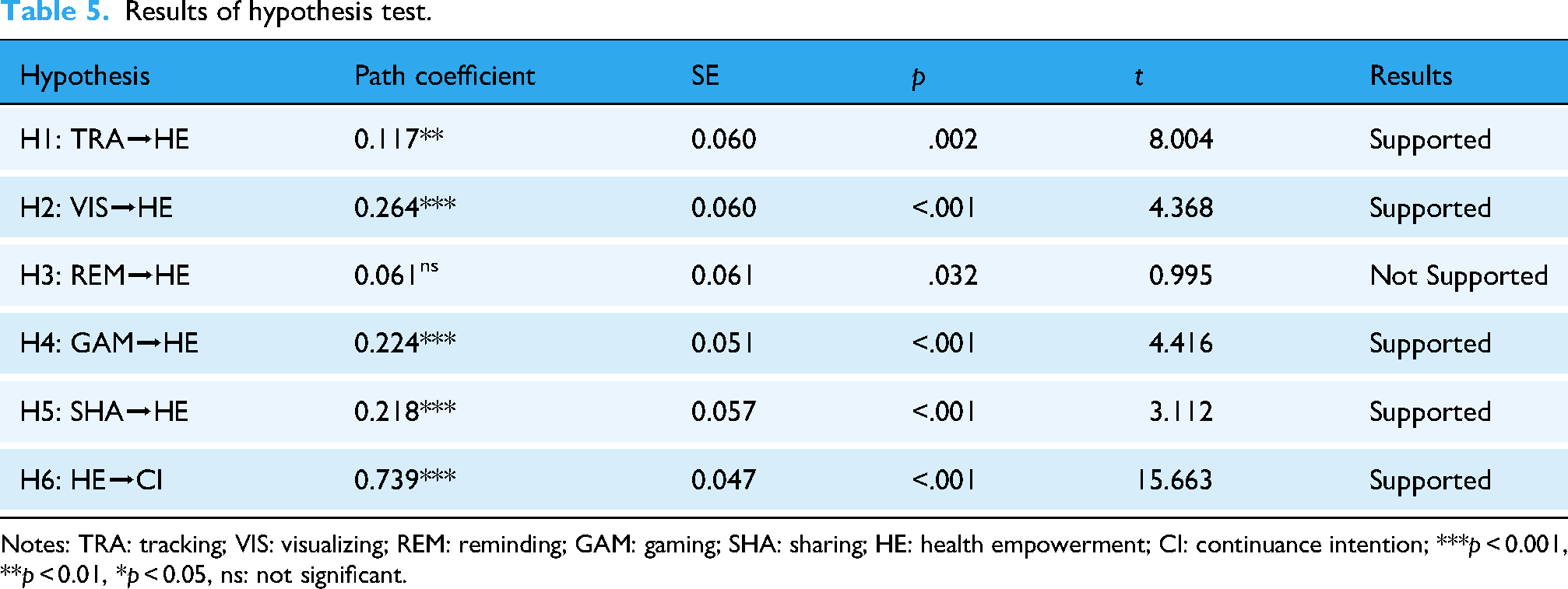
Notes: TRA: tracking; VIS: visualizing; REM: reminding; GAM: gaming; SHA: sharing; HE: health empowerment; CI: continuance intention; ***p < 0.001, **p < 0.01, *p < 0.05, ns: not significant.
Tracking affordance and health empowerment
Tracking affordance has a positive impact on health empowerment (β = 0.177, p = .002), which supports hypothesis 1. The accurate tracking of real-time health data transforms abstract health states into quantifiable metrics, establishing an objective foundation for self-regulation. By continuously contrasting current status with predefined goals, this process activates behavioral adaptation mechanisms: individuals increase workout duration and intensity when targets are unmet, while goal attainment reinforces exercise habit formation. Crucially, this granular capture of physical engagement enhances perceived control, ultimately empowering users through demonstrated recognition of exercise efficacy and health outcome significance.
Visualizing affordance and health empowerment
Supporting H2, visualizing affordance has a positive impact on health empowerment (β = 0.264, p < .001). Exercise data visualization translates raw tracking metrics into intuitive visual patterns, significantly mitigating cognitive load during information processing. By transforming exercise data into summary charts, users gain clearer insights into their health patterns, making it easier to track progress and adjust behaviors. This dual mechanism of cognitive efficiency amplification and behavioral pattern recognition ultimately cultivates health empowerment through strengthened perceived control.
Reminding affordance and health empowerment
Reminding affordance (β = 0.061, p = .320) had no impact on health empowerment, hypothesis 3 is not supported. One possible reason is that the content and manner of the reminder have a different impact on the user. Evidence suggests that outcome-oriented reminders are more effective than process-oriented reminders increasing the perceived value of exercise and perceived risks to health. 57 In order to achieve health goals, personalized reminders make users more aware of the meaning and impact of healthy exercise and thus achieve health empowerment.
Gaming affordance and health empowerment
Supporting H4, gaming affordance significantly enhances health empowerment (β = 0.224, p < .001). First, achievement systems objectively validate users’ capability to complete fitness tasks—exemplified by Apple's Activity Rings, where closing rings through movement generates tangible proof of goal attainment, thereby strengthening perceived competence. Second, motivational architectures activate both intrinsic and extrinsic drivers: leaderboards leverage social comparison to foster self-improvement drives, while badges and points employ operant conditioning to reinforce behavioral persistence. Collectively, these elements transform exercise from a discretionary activity into a purpose-laden pursuit by anchoring physical efforts in demonstrable capability and self-defined meaning.
Sharing affordance and health empowerment
Sharing affordance has a positive impact on health empowerment (β = 0.218, p < .001), hypothesis 5 is supported. Sharing affordance uniquely enhances health empowerment through social relationships in two interconnected ways. First, disclosing personal fitness achievements generates social validation—such as praise and recognition from peers—which directly reinforces the user's sense of efficacy and control. Second, integrating individuals into communities transforms solitary exercise into collective wellness pursuits, embedding personal efforts within a meaningful group narrative.
Health empowerment and continuance intention
The result shows that health empowerment positively influences users’ continuance intention (β = 0.739, p < .001), which is consistent with Liu, Jiang. 23 Hypothesis 6 is supported. When users feel empowered in health content, they are more likely to continue using MFAs in their daily lives. This is because using the app can meet the user's needs for autonomy, competence, and relevance.
Discussion
Principal findings
This study comprehensively examines how MFAs’ affordances foster health empowerment and continuance engagement. Our findings provide a clear answer to the first research question (RQ1) regarding which affordances significantly influence health empowerment and, consequently, continuance intention. The results demonstrate that tracking, visualizing, gaming, and sharing affordances all exert a significant positive impact on users perceived health empowerment, thereby promoting continuance intention. Specifically, tracking and visualizing affordances demonstrate significant positive effects on health empowerment, differing from Nelson et.al's 22 observations in smart wristband survey study where similar monitoring features showed no pronounced effects. The way the information is presented, the amount and frequency of information provided cannot empower users. MFAs can record and display a user's fitness data, which can help users better understand how their physical condition changes and how well they work. Self-monitoring contributes to increasing the perceived usefulness of using MFAs, 77 and this benefit promotes health empowerment.21,37 Therefore, tracking and visualizing affordances has a positive impact on health empowerment. Concurrently, gaming and sharing affordance positively impact health empowerment, which is in line with previous research.22,23 Gaming and sharing affordances increase the habitual use of MFAs in the health management process, 47 and this habit and healthy behavior will further strengthen the user's health empowerment. 78 However, reminding affordance shows no effect on health empowerment, echoing Nelson, Verhagen 22 emphasis that only actionable, credible feedback—not generic alerts—promotes empowerment. This suggests efficacy hinges on content relevance, such as personalized form-correction tips versus simplistic exercise prompts.
This study confirmed health empowerment as a key predictor of long-term user engagement in the mobile fitness context. Our findings show that health empowerment positively influences continuance intention of MFAs, a relationship corroborated in chronic disease management contexts by Liu, Jiang. 23 While prior research has emphasized perceived usefulness and satisfaction as drivers of MFA persistence,53,79–81 this study further identifies health empowerment as an independent and crucial predictor. In self-health management, the realization of user empowerment is conducive to the long-term adoption of health information technology by users. Regarding the second research question (RQ2) about the underlying mechanism, our analysis confirms that health empowerment serves as a key mediating variable that fully explains the relationship between the main MFA affordances and users’ continuance intention. Building on previous research that has established direct links between affordances and usage behaviour, 47 this study explores the underlying mediating mechanism in greater depth. While existing literature has primarily emphasised general motivational constructs—such as hedonic motivation, utilitarian motivation, and eudaimonic motivation—as main mediators, 43 our findings indicate that health empowerment is a more specific, relevant, and influential mediating variable within the context of mobile fitness applications. Unlike broad motivation-based explanations, health empowerment involves a sense of competence, self-determination, impact, and meaning that users gain through health technology use, providing a mechanism that is both theoretically nuanced and practically aligned with health behaviour change. Consequently, this study advances the field by identifying a more precise and domain-specific psychological pathway through which affordances influence continuance intention.
The generalisability of our findings should be considered in light of the study's context. Our empirical data were drawn from a sample of technologically adept health consumers within China. While this sample is highly representative of the core user base of Chinese mobile fitness applications (MFAs), and enhances the internal validity of our model, certain cultural and demographic factors (e.g., specific health beliefs, social sharing norms, or technology adoption rates) may influence the generalisability of the results to other populations. Notwithstanding this contextual boundary, we posit that the theoretical mechanisms identified—namely, that specific app affordances promote continued use through the mediation of health empowerment—are likely to be robust across contexts. The psychological needs for competence, self-determination, impact, and meaning (as captured by health empowerment) are fundamental drivers of human behaviour.
Implications of practical
Based on the empirical findings of this study, several concrete and actionable implications can be offered for mobile fitness app (MFA) developers seeking to enhance user retention and encourage long-term engagement. It is recommended that developers prioritize the enhancement of four core affordances—tracking, visualization, gamification, and sharing—as these collectively create empowerment perceptions that drive continuance intention. Regarding tracking affordance, developers need to enhance data recording capabilities and broaden data dimensions (such as count of steps, calorie consumption, heart rate, sleep quality, dietary intake, and other metrics), preferably through integration with wearable devices to offer users a comprehensive and accurate overview of their health behaviors. In terms of visualizing affordance, developers need to systematically refine data presentation methods. They could design clear, intuitive dashboards displaying key information at a glance, and provide diversified chart formats (e.g., line charts for trend observation, bar charts for data comparison, pie charts for proportional analysis). For gaming affordance, developers can introduce a range of challenges, quests, and achievement systems. Completing tasks or achieving specific goals allows users to earn badges and rewards, thus stimulating their competitive spirit and desire for accomplishment. Gamification elements should also be designed with adaptive challenge tiers and reward mechanisms that align with varying user levels, thereby triggering a sense of achievement and maintaining motivation. Furthermore, to enhance the sharing affordance, MFAs should deliver multi-channel sharing options for users. For example, they should allow the user to share across multiple social media platforms (such as WeChat, Weibo, Facebook, and Instagram), enabling users to showcase their workout achievements. Notably, the study found that basic reminder features had no significant impact on health empowerment. Therefore, developers should rethink simple notification systems and instead focus on intelligent, personalised prompts driven by user behaviour analysis—for example, context-aware messages that encourage users at the most effective times or when a decline in activity is detected.
Ultimately, these design strategies should be incorporated into a comprehensive framework of health empowerment, where each functional feature is intentionally developed to build competence through actionable insights, enable self-determination through personalisation and control, create meaning by connecting to personal values, and demonstrate impact through clear progress feedback. By transforming digital health tools from passive trackers into active platforms that support these four pillars, developers can effectively bridge the gap between short-term use and long-term adherence, thereby delivering sustainable value by truly empowering users to achieve lasting health behaviour change.
Strengths and limitations
This study advances mobile health research by empirically validating how specific affordances enhance continuance intention in MFAs, while establishing health empowerment as the critical psychological mechanism mediating this relationship. By bridging affordance theory with health empowerment, we reveal that affordances foster continuance intention through achieving health empowerment. These insights not only enrich literature about MFAs usage but also provide actionable design recommendations for developers. However, this study still has some limitations. First, the data were obtained from a cross-sectional survey, which could only capture users’ behavior intention rather than measure actual long-term usage patterns. This method leaves the intent-behavior gap unquantified, making it hard to ascertain whether health empowerment truly translates into sustained engagement with MFAs. Second, this study uses a structural equation model approach to examine correlations and mediating pathways among the constructs, the analysis remains inherently correlational. Thus, it cannot establish whether specific affordance causally enhance health empowerment and promote behavior change. Similarly, the presumed role of health empowerment in facilitating sustained use behavior requires further causal validation. As a result, the identified associations do not suffice to confirm that changing affordance directly leads to changes in health empowerment or user behavior. Finally, this study treated mobile fitness applications as a homogeneous category and did not account for potential variations between different types of professional health apps (e.g., fitness trackers vs. behavioral interventions). This oversight masks potential heterogeneity in how affordance promotes empowerment and behavioral outcomes across app subtypes. Consequently, the findings offer limited granular and practical insights for developers seeking to tailor designs to specification contexts.
Future research
Future research should aim to address the limitations identified in this study by using more diverse and rigorous study designs. Specifically, the following directions are recommended:
First, to address the limitation of cross-sectional data and better capture actual behaviour—rather than just behavioural intentions—longitudinal studies should be conducted. Monitoring users’ real engagement over a prolonged period would help confirm the long-term effects of health empowerment and measure the intention-behaviour gap.
Second, to move beyond correlational evidence and establish causality, intervention-based experiments are necessary. By actively modifying specific affordances within MFAs, researchers can test whether design changes lead to improvements in health empowerment and, consequently, in sustained usage behaviour. This approach would provide direct evidence of the causal pathways proposed by our model.
Finally, to explore the heterogeneity across app types, comparative studies should be designed to examine how different categories of professional health applications (e.g., fitness trackers versus behavioural intervention apps) influence the effect of affordances on empowerment and behaviour. Such research would provide nuanced, actionable insights for developing targeted solutions within specific subdomains of mobile health.
Conclusion
This study contributes to the literature on MFAs’ continuance by illustrating the pathway through which technological affordances—tracking, visualizing, gaming, and sharing—promote sustained engagement. They build a user's sense of health empowerment, strengthening the intention to continue use. We consider health empowerment a domain-specific mediating variable demonstrating greater specificity than general motivational factors in explaining sustained engagement. Take a runner using the app as an example: The tracking affordance translates subjective fatigue into objective data, providing a starting point for control. This data is then synthesized by visualization tools into a monthly progress chart, generating a clear sense of achievement. Gamification injects challenge and fun, turning routine into a goal-driven activity, while sharing achievements fosters social recognition. By combining these affordances, the app enhances the user's sense of empowerment, transforming the app from a tool-dependent activity into a spontaneous and sustainable lifestyle. Accordingly, for technology developers, this study offers actionable insights. To empower users and foster sustained engagement, developers should prioritize features such as tracking, visualizing, gaming, and sharing, focusing not merely on their presence but on the dedicated refinement of their design.
Supplemental Material
sj-doc-1-dhj-10.1177_20552076251389058 - Supplemental material for Leveraging mobile fitness apps for healthier lifestyles: How affordances drive sustained engagement
Supplemental material, sj-doc-1-dhj-10.1177_20552076251389058 for Leveraging mobile fitness apps for healthier lifestyles: How affordances drive sustained engagement by Yongmei Liu, Yunze Zhang and Zian Fang in DIGITAL HEALTH
Supplemental Material
sj-doc-2-dhj-10.1177_20552076251389058 - Supplemental material for Leveraging mobile fitness apps for healthier lifestyles: How affordances drive sustained engagement
Supplemental material, sj-doc-2-dhj-10.1177_20552076251389058 for Leveraging mobile fitness apps for healthier lifestyles: How affordances drive sustained engagement by Yongmei Liu, Yunze Zhang and Zian Fang in DIGITAL HEALTH
Footnotes
Acknowledgments
This work was supported by the National Natural Science Foundation of China [grant numbers 72071213, 72101088].

Ethical approval
This study has been performed in accordance with the Declaration of Helsinki. Approval was granted by the Academic Committee of Business School at Central South University, and the study complied with ethical standards (ID: CSUBS20240520). All the participants have signed an informed consent.
Author contributions
Yongmei Liu contributed to supervision, funding acquisition, and writing–review and editing. Yunze Zhang contributed to investigation, conceptualization, data curation, and writing–original draft preparation. Zian Fang contributed to conceptualization, methodology, formal analysis, writing–original draft preparation, and writing review and editing.
Funding
The authors disclosed receipt of the following financial support for the research, authorship, and/or publication of this article: This work was supported by the National Natural Science Foundation of China [grant numbers 72071213, 72101088].
Declaration of interest statement
The authors declare that they have no competing financial interests or personal relationships that could have appeared to influence the work reported in this paper.
Data availability statement
The survey respondents were assured raw data would remain confidential and would not be shared. But data will be made available on reasonable request.
Guarantor
Zian Fang.
Supplemental material
Supplemental material for this article is available online.
Appendix 1. Measurement instruments.
References
Supplementary Material
Please find the following supplemental material available below.
For Open Access articles published under a Creative Commons License, all supplemental material carries the same license as the article it is associated with.
For non-Open Access articles published, all supplemental material carries a non-exclusive license, and permission requests for re-use of supplemental material or any part of supplemental material shall be sent directly to the copyright owner as specified in the copyright notice associated with the article.
