




Abstract
Objective
Irritable Bowel Syndrome (IBS) is a prevalent functional gastrointestinal disorder that significantly impairs quality of life. Social media has become a primary source of health information, with TikTok and Bilibili emerging as popular video-sharing platforms in China. The present study aims to assess the content, quality, and user engagement of IBS-related videos on Bilibili and TikTok in China, identifying strengths and weaknesses in online health information and offering insights for improving patient education.
Methods
Hundred qualified videos from each platform were analyzed. Videos were categorized by platforms, sources, contents, and quality (using Global Quality Score and modified DISCERN scoring systems). Statistical analyses included correlation analysis and linear regression to assess relationships between video quality and engagement metrics.
Results
Videos showed an increasing trend from 2020 to 2024. TikTok videos were shorter (median 61.0 s vs. 220.0 s) with higher engagement. Healthcare professionals (77.0%) and science communicators (15.5%) were primary content creators. Linear regression revealed significant platform differences: on TikTok, higher quality videos had negative associations with likes and comments; on Bilibili, higher quality showed positive associations with all engagement metrics (likes, favorites, shares, and comments).
Conclusions
Platform-specific differences exist in how users engage with IBS-related content on Chinese social media platforms. The divergent relationship between video quality and engagement metrics on TikTok versus Bilibili suggests that content creators may need platform-specific strategies to effectively deliver high-quality health information.
Introduction
Irritable Bowel Syndrome (IBS) is a prevalent functional gastrointestinal disorder (FGID) characterized by chronic abdominal pain, bloating, and altered bowel habits, including diarrhea or constipation. 1 The global prevalence of IBS stands at 9.2%, 2 while in China, the prevalence is reported to be 1.4%, as determined by a household survey. 3 Despite its nonorganic nature, IBS significantly impairs patients’ quality of life, leading to physical discomfort, psychological distress, and social limitations. 4 As a chronic condition, IBS necessitates long-term self-management, encompassing dietary modifications, psychological interventions, and medication intervention.5–7
In recent years, social media platform has become a primary source of health information, influencing patients’ understanding and even decision-making regarding their conditions.8,9 Among the myriad of online platforms, Bilibili and TikTok have become widely recognized video-sharing platforms in China. Bilibili, originally a hub for animation, comics and games, has expanded to include a wide range of educational and informational videos, while TikTok, known for its short, engaging video format, has garnered a massive user base. Together, these platforms represent a significant shift in how individuals access and engage with health-related content.
The growing reliance on video platforms for health information is not without its challenges. While these platforms offer a convenient and accessible means of disseminating information, the quality and accuracy of the content can vary widely. 10 This is particularly concerning in the context of IBS, where misinformation may lead to inappropriate self-management strategies and potentially exacerbate symptoms. 11 Given the complex nature of IBS with its heterogeneous symptom presentation, patients might adopt unvalidated dietary restrictions or inappropriate therapies based on misleading content. Additionally, the difficulty in distinguishing IBS from other gastrointestinal disorders with similar presentations further compounds this risk.
The current study aims to provide a comprehensive assessment of the content, quality, and user engagement of IBS-related videos on Bilibili and TikTok within the Chinese population. By doing so, we seek to identify strengths and weaknesses in the current landscape of online health information and offer insights into how these platforms can be leveraged to improve patient education and outcomes in the management of IBS. We hypothesized that IBS-related health information content, quality, and engagement patterns would differ significantly between TikTok and Bilibili due to their distinct platform characteristics and user demographics, and that the relationship between content quality and user engagement would vary across these two platforms.
Methods
Search strategy and fundamental variables of videos
The videos involved in this study were sourced from Bilibili (https://www.bilibili.com/) and TikTok (Chinese version, https://www.douyin.com/). We conducted a search using the Chinese term for IBS as the query. To mitigate the influence of personalized recommendation algorithms, we cleared our search history prior to conducting the search and accessed the platforms in guest mode. Following the search, the videos were displayed in comprehensive ranking order, which is the default setting. Inclusion and exclusion are conducted concurrently until each platform independently accumulates 100 qualified videos, at which point the process is terminated.12,13 Videos were excluded if they met any of the following criteria: (1) complete absence of Chinese-language elements (specifically, videos simultaneously featuring non-Chinese text, non-Chinese audio, and lacking Chinese subtitles); (2) duplicates; (3) irrelevant content; or (4) advertisements. Irrelevant videos refer to videos that did not provide sufficient information about IBS, regardless of their presentation style. This included some videos that primarily featured artistic text with background music but lacked meaningful IBS-related content. Our focus was on the informational value rather than the format. The specific inclusion and exclusion process for videos can be seen in Figure 1. We collected basic variables related to the videos, defined as those directly accessible variables associated with the videos, including likes, favorites, shares, comments, duration (recorded in seconds), and days since the video was uploaded until its inclusion.

Flowchart for video inclusion.
The source and content of videos
Video sources were categorized based on content providers’ identities into two main groups: individual users and institutional users. The individual users comprised general users, healthcare professionals, and science communicators, while institutional users included news organizations, for-profit organizations, and nonprofit organizations. The content of the videos primarily centers on knowledge related to IBS, including its definition and overview, causes and risk factors, symptoms, diagnosis, and interventions (lifestyle adjustments and medication therapy). A single video may encompass multiple aspects of the aforementioned five dimensions.
The quality assessment of videos
The present study evaluated the videos using two scoring systems: GQS (Global Quality Score, Table S1) 14 and modified DISCERN (Quality Criteria for Consumer Health Information, Table S2). 15 Global Quality Score is a general quality assessment tool designed to evaluate the overall quality of medical information and videos, encompassing aspects such as the flow of the content and the usefulness to patients. Modified DISCERN scoring is an adaptation of the traditional DISCERN, 16 concentrating on the quality assessment of consumer health information, including factors such as the source of information, content completeness, and potential biases. The scoring process involved three senior gastroenterologists. Two gastroenterologists (XB and JL) participated in the scoring, while QJ (a senior gastroenterologist) served as the third reviewer. Prior to scoring, the three gastroenterologists convened to establish consensus on the theoretical framework of these three scoring systems. Video quality scores were determined through collaborative assessment by the two aforementioned gastroenterologists, with any scoring discrepancies resolved by the third reviewer.
Statistical analyses
Continuous variables were expressed as median (minimum–maximum) and compared across groups using the Kruskal–Wallis test. Categorical variables were presented as number (percentage) and compared using the chi-square test. Spearman's correlation analysis was performed to evaluate the relationships among video likes, favorites, shares, comments, duration, and days since upload. Linear regression analysis was conducted to assess the associations between video quality and the metrics of likes, favorites, shares, and comments. Statistical significance was defined as p < 0.05.
Results
Trends in video quantity over time
A total of 200 videos about IBS were included from TikTok and Bilibili platforms, with upload dates ranging from December 3, 2016, to February 17, 2025. Only one video was uploaded in 2016, while the remaining videos were posted between March 2020 and February 2025. As shown in Figure 2, the number of IBS-related videos demonstrated an increasing trend from 2020 to 2024, with TikTok exhibiting a more rapid growth rate compared to Bilibili.
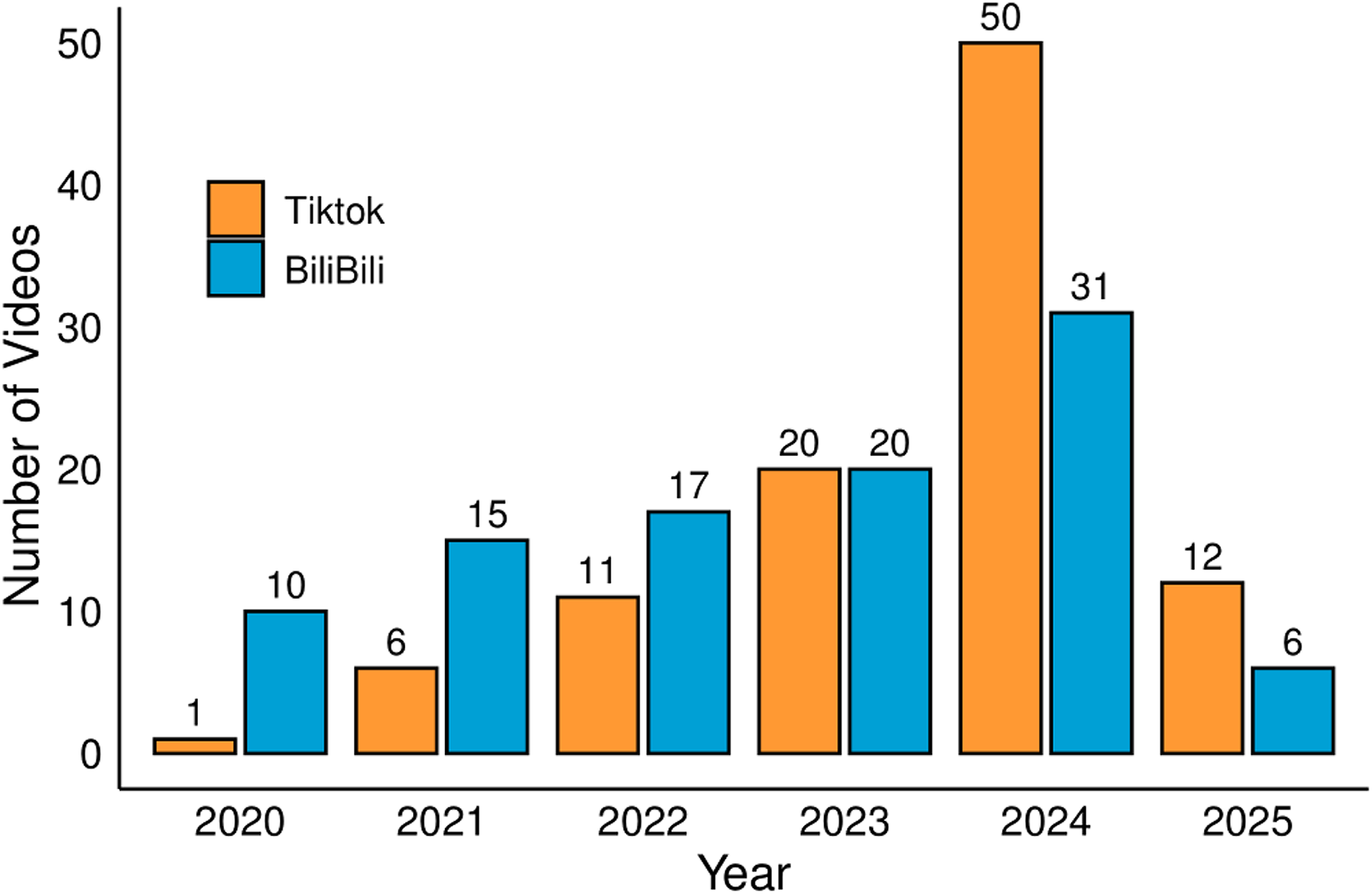
Trend of video quantity changes over the years.
Characteristics of included videos grouped by platforms
The duration of IBS-related videos on TikTok (median, 61.0 s) was shorter than those on Bilibili (median, 220.0 s). TikTok videos received higher engagement metrics compared to Bilibili videos in terms of likes (746.0 vs. 18.5), favorites (336.0 vs. 16.0), shares (268.0 vs. 6.0), and comments (81.0 vs. 2.0). The median scores for both GQS and modified DISCERN were equivalent between the two platforms (GQS = 3, modified DISCERN = 2). When combining videos from both platforms, 72.5% of videos achieved a GQS score ≥3, while 42.0% achieved a modified DISCERN score ≥3. The videos were predominantly created by professional individuals (77.0%) and science communicators (15.5%), with content primarily focusing on IBS symptoms (91.5%) and intervention (76.5%). Significant differences were observed between the two platforms regarding basic video characteristics and the presence of content of definition and overview (p < 0.05). For more information, please refer to Table 1. Additionally, high-quality videos tend to have longer durations regardless of the platform (Table S3).
Characteristics of included videos overall and categorized by platforms.

DISCERN, Quality Criteria for Consumer Health Information; GQS, Global Quality Score.
Characteristics of included videos grouped by sources
Professional individuals and science communicators were the top two sources of videos on both TikTok and Bilibili. On TikTok, videos created by professional individuals received lower engagement metrics in terms of likes, favorites, shares, and comments compared to those by science communicators. However, the opposite pattern was observed on Bilibili. Notably, on both platforms, videos from professional individuals demonstrated higher proportions of high scores (≥3) in both GQS and Modified DISCERN scoring compared to those from science communicators. Irritable Bowel Syndrome symptoms emerged as the most prevalent content topic in videos produced by both professional individuals and science communicators. More detailed information is presented in Table 2.
Characteristics of included videos categorized by sources.

DISCERN, Quality Criteria for Consumer Health Information; GQS, Global Quality Score.
Correlation analysis
Correlation analysis was performed among video metrics including likes, favorites, shares, comments, duration, and days since upload. The results revealed strong positive correlations among likes, favorites, shares, and comments (all correlation coefficients > 0.9, all p < 0.001). However, video duration showed negative correlations with likes, favorites, shares, and comments (correlation coefficients ranging from −0.2 to −0.5, all p < 0.001). The detailed correlation matrix is visualized in the heatmap presented in Figure 3.

Correlation heatmap.
The association between video quality and engagement metrics
Linear regression analysis exploring the associations between video quality and engagement metrics revealed substantial platform-specific differences (Table 3). On TikTok, higher video quality was negatively associated with likes and comments (both β < 0) but positively associated with favorites (β > 0). The relationship between video quality and shares showed opposing directions across the two quality assessment systems: negative for GQS ≥3 (β < 0) and positive for modified DISCERN ≥3 (β > 0). The negative association between GQS ≥3 and comments approached statistical significance (p = 0.062). On Bilibili, higher video quality demonstrated positive associations with all engagement metrics including likes, favorites, shares, and comments (all β > 0). The association between modified DISCERN ≥3 and shares reached statistical significance (p = 0.034), while its association with comments approached significance (p = 0.050). Additionally, the association between modified DISCERN ≥3 and favorites showed marginal significance (p = 0.098).
The association between video quality and engagement metrics as assessed by linear regression.

DISCERN, Quality Criteria for Consumer Health Information; GQS, Global Quality Score.
Discussion
The present study offers a comprehensive analysis of IBS-related videos on two major Chinese social media platforms, TikTok and Bilibili. To the best of our knowledge, this is the first study to systematically evaluate and compare the content quality, source distribution, and platform-specific engagement patterns of IBS-related videos in China.
Our findings reveal substantial disparities in engagement metrics and content consumption patterns between TikTok and Bilibili platforms. TikTok videos demonstrated significantly higher engagement metrics across all parameters (likes, favorites, shares, comments) despite considerably shorter durations (median 61.0 s vs. 220.0 s). This engagement disparity reflects fundamental differences in platform architecture and user interaction design. TikTok's algorithm-driven, rapid-scrolling interface optimizes for immediate engagement with condensed content, allowing users to quickly consume and respond to multiple videos in succession. 17 The inverse relationship between video quality and certain engagement metrics on TikTok represents a particularly noteworthy finding. The regression analysis revealed that higher-quality videos on TikTok demonstrated negative associations with likes and comments (both β < 0). Conversely, Bilibili exhibited positive associations between quality and all engagement metrics (all β > 0). This platform-specific divergence likely stems from several factors. First, the user bases of these platforms differ substantially in content consumption priorities. TikTok's algorithm prioritizes immediate engagement (likes, comments) through emotionally resonant or entertainment-focused content,18,19 which may disadvantage nuanced, scientifically rigorous health information. Bilibili's community, with its reputation for educational content, appears to consistently reward high-quality information across all engagement dimensions. Second, the correlation analysis revealed significant negative associations between video duration and engagement metrics (correlation coefficients < 0, all p < 0.001). This creates an inherent tension for health content creators, as higher-quality IBS videos generally required longer durations to convey comprehensive information. TikTok's short-form paradigm structurally disadvantages such content, while Bilibili's tolerance for extended viewing sessions accommodates more detailed explanations without sacrificing engagement.
While a previous study 20 evaluated IBS content on American TikTok, our research offers several distinctive contributions through cross-platform comparison and cultural contextualization. A primary difference lies in our comparative approach between traditional (Bilibili) and short-form (TikTok) video platforms, revealing platform-specific engagement patterns absent in single-platform studies. Most notably, we identified an inverse relationship between content quality and engagement on Chinese TikTok (negative associations with likes/comments), contrasting with Bilibili's positive quality-engagement relationship. Methodologically, our study employed linear regression analysis to quantify the relationship between video quality and engagement metrics, whereas previous research primarily utilized descriptive statistics and group comparisons. Content creator demographics also differed significantly between studies. While Waidyaratne et al. found that only 33% of American TikTok videos came from contributors with medical backgrounds, our research revealed that professional individuals dominated Chinese platforms (77.0%), suggesting cultural differences in health information sourcing.
The relationship between social media health information and gastrointestinal disorders presents a complex dynamic with both beneficial and detrimental effects. Zhao et al. 21 demonstrated that social media provides significant informational, emotional, and peer support for Crohn's disease patients, which positively mediates treatment understanding and symptom management. Their research found that when symptoms worsened, patients obtained more support from social media groups, leading to improved treatment understanding. Importantly, health information on social media functioned as a complementary medical intervention, enhancing clinical outcomes. However, they also noted that using social media groups not monitored by physicians and reduced patients’ trust in doctors. Contrastingly, Cinquetti et al. 22 highlighted potential negative impacts of social media on FGIDs in children. Their work identified social media as a psychosocial stressor that can exacerbate symptoms through the brain–gut axis. Excessive social media use was linked to increased anxiety, depression, and loneliness—psychological factors known to worsen FGIDs. A high prevalence of social media use was reported in adolescents with FGIDs, with usage levels correlating with symptom severity. However, another study shows that the daily amount of screen time and the number of social media platforms utilized do not have a relationship with the intensity of abdominal pain and other gastrointestinal symptoms in adolescents with FGID. 23 While social media can provide valuable support for gastrointestinal disease management, excessive or unmonitored use might function as a stressor potentially aggravating symptoms.
Our analysis revealed several notable strengths and weaknesses in IBS-related online health information across both platforms. Key strengths included the high prevalence of symptom-focused content (present in 91.5% of videos), significant coverage of causes and risk factors (74.5%), and intervention strategies (76.5%). Additionally, the predominance of healthcare professionals as content creators (77.0%) lends credibility to the information presented. However, substantial weaknesses were also identified. Only 45.5% of videos provided basic definition and overview information about IBS, and merely 30.0% discussed diagnosis, creating significant knowledge gaps for viewers seeking comprehensive understanding. The limited presence of high-quality videos (only 42.0% achieved a modified DISCERN score ≥ 3) indicates room for improvement in content accuracy and reliability.
The dissemination of health-related videos on social media platforms such as TikTok and Bilibili presents several significant ethical and moral challenges. First, misinformation or low-quality health content may mislead viewers, potentially resulting in delayed medical consultation, harmful self-management, or unnecessary anxiety. 24 The predominance of user-generated content, often produced by nonexperts, increases the risk of widespread misunderstanding or adoption of unproven solutions. Second, there is the potential for privacy violations, 25 as some videos may disclose sensitive patient information without proper consent or anonymization, contravening ethical standards. Moreover, commercial exploitation is a growing concern. Certain videos may include covert advertising or promote health-related products and services with questionable efficacy, raising issues of conflict of interest and consumer protection. Additionally, algorithm-driven content dissemination may prioritize sensational or emotionally provocative videos over accurate and reliable information, 26 further distorting public health knowledge. To address these risks, social media platforms should implement stricter content moderation policies, foster collaborations with healthcare professionals, and encourage the use of evidence-based references in health-related videos. Further research is also needed to evaluate the long-term effects of social media health information on public health behaviors and outcomes.
This study has several limitations and strengths. First, the cross-sectional design captures the content landscape at a specific time point, which may not reflect dynamic changes in content trends and quality over extended periods. Second, despite using standardized assessment tools (GQS and modified DISCERN), quality evaluation inherently involves some degree of subjectivity that could influence scoring outcomes. Third, this study focused exclusively on Chinese-language content from the two platforms in China. The user bases, platform algorithms, and content moderation policies of these websites are very likely different from those of similar international platforms. Furthermore, cultural factors—including health-seeking behaviors, doctor–patient relationships, and media consumption patterns—may influence the way medical information is presented and received. As such, the findings may not be generalizable to other languages, cultures, or social media environments outside of China. Despite these limitations, this study provides a comprehensive assessment of both content characteristics and quality metrics using multiple standardized evaluation tools. The inclusion of both traditional (Bilibili) and short-form (TikTok) video platforms offers valuable comparative insights. Additionally, the linear regression analysis revealing platform-specific differences in how quality relates to engagement metrics represents a novel contribution to understanding health information dissemination in the digital age.
Conclusions
In conclusion, TikTok and Bilibili have made significant contributions to IBS knowledge dissemination in China, providing accessible health information to a broad audience. Platform-specific differences exist in how users engage with IBS-related content. The most notable finding is the distinctive relationship between video quality and user engagement metrics: on TikTok, higher-quality videos showed negative associations with likes and comments but positive with favorites, while on Bilibili, quality content positively associated with all engagement metrics. Content creators and healthcare professionals should adopt tailored approaches for each platform, balancing scientific accuracy with platform-specific engagement strategies to effectively deliver health information.
Supplemental Material
sj-docx-1-dhj-10.1177_20552076251382029 - Supplemental material for Evaluating the content and quality of irritable bowel syndrome videos on social media platforms in China: Focus on TikTok and Bilibili
Supplemental material, sj-docx-1-dhj-10.1177_20552076251382029 for Evaluating the content and quality of irritable bowel syndrome videos on social media platforms in China: Focus on TikTok and Bilibili by Wenfeng Xi, Ruojian Feng, Jianing Li, Xiaoyin Bai, Yueyi Zhang, Qingwei Jiang and Aiming Yang in DIGITAL HEALTH
Footnotes

Ethical considerations
The present study involves the collection and analysis of publicly available data from Bilibili and TikTok such as likes, favorites, shares, comments, and duration. The research focuses on evaluating the source, content, and quality of these videos without involving any direct interaction with human subjects or collecting personally identifiable information. Since the data are derived from publicly accessible platforms and no private or sensitive information is used, the present study qualifies for exemption from ethical review.
Contributorship
WX contributed to writing—original draft, writing—review & editing, data curation, and formal analysis. RF contributed to data curation, methodology, and writing—review & editing. JL contributed to data curation and writing—review & editing. XB contributed to data curation and writing—review & editing. YZ contributed to methodology and visualization. QJ contributed to conceptualization, methodology, and supervision. AY contributed to conceptualization, funding acquisition, and writing—review & editing. All authors have reviewed and approved the final draft.
Funding
The authors disclosed receipt of the following financial support for the research, authorship, and/or publication of this article: National Key Research and Development Program of China, (grant number 2022YFC3602103, 2022YFC3602105).
Declaration of conflicting interests
The authors declared no potential conflicts of interest with respect to the research, authorship, and/or publication of this article.
Data availability
Research data can be obtained by emailing the corresponding author, subject to reasonable conditions.
Guarantor
AY.
Supplemental material
Supplemental material for this article is available online.