



Abstract
Background
NFC (near-field communication) technology for labeling of dental ceramic crowns through tagging may offer a versatile, contactless, and digital solution for prosthesis and patient identification.
Objectives
To evaluate the technological feasibility of labeling dental ceramic crowns with NFC tagging using surface marking, and to evaluate the durability and readability of the tagged crowns during dental laboratory disinfection.
Methods
This in-vitro pilot study consisted of two phases. In the technological phase, surface marking was done using the NTAG213 NFC tag (JAKCOM N3 Smart nail chip) to fabricate NFC-tagged ceramic crowns. An NFC-compatible smartphone was used as the NFC reader to evaluate the tag readability. In the experimental phase, the durability and readability of the tagged crowns were evaluated after dental laboratory disinfection. The data were expressed in frequencies and percentages. McNemar's test was used for statistical analysis.
Results
NFC-tagged ceramic crowns (n = 20), comprising 10 all ceramic and 10 metal ceramic crowns, were fabricated using surface marking. The NFC tags remained fully readable post-application. The absence of visible damages, discoloration of the crowns, or delamination of the tag indicated that disinfection did not affect the durability of the tagged ceramic crowns. The NFC tags maintained 100% readability with no statistically significant difference before and after disinfection (t-statistic = 0 and p-value = 1.0).
Conclusions
An innovative and simple labeling of dental ceramic crowns was developed using surface marking to fabricate NFC-tagged ceramic crowns. Their demonstrated durability and readability during dental laboratory disinfection highlights the potential of this technology for clinical and forensic applications. However, this study evaluates resistance to specific disinfection protocols rather than long-term durability under extended clinical use.
Keywords
Introduction
Labeling refers to the process of marking a patient's dental crowns with a unique identifier, usually their name or code, to enable identification in case of misplacement or for forensic purposes. 1 It has been legalized in Iceland, Sweden, and 21 states of the United States.2,3 However, there are no specific guidelines in the United Kingdom, India, and Saudi Arabia.4–6 Various methods of labeling, such as surface marking and inclusion, can be applied to both removable and fixed dental prostheses. 7 While these methods offer distinct advantages, no single approach is universally reliable. Previous studies have explored labeling for dental ceramic crowns.8,9 Kamath and Kamath 8 introduced a method of engraving initials on a metal ceramic crown. But it was often impractical due to limited space on the crown and lack of readability by non-clinical personnel. Similarly, Aguloglu et al. 9 proposed barcoding for dental ceramic crowns, which, although capable of withstanding high temperatures, was deemed too complicated for routine clinical use.
Near-field communication (NFC) technology, widely used in payments, access control, and ticketing, is increasingly being implemented in various healthcare applications. 10 A key implementation is in patient identification, where NFC-enabled wristbands or cards interface with electronic health records to provide accurate, real-time access to patient data. 11 NFC also supports knowledge-based decision support systems, streamlining clinical reasoning processes. 12 NFC-enabled wearable devices with biosensors monitor physiological parameters, such as temperature, pressure, electrophysiological signals, blood flow, and sweat, allowing seamless synchronization with healthcare infrastructure. 13 These tools support both remote and personal healthcare monitoring, contributing to professional oversight and self-care.14,15 In radiation oncology, batteryless NFC dosimeters like DosiTag enable in vivo measurement of ionizing radiation doses, improving precision in treatment delivery. 16 Additionally, NFC is being utilized to deliver patient information leaflets after dental treatments, enhancing patient education and post-operative care. 17 It can also store emergency data through wearable tags or stickers, facilitating rapid response in critical situations. 18
Parallel advancements in subdermal NFC microchipping offer novel healthcare potential. These chips, typically implanted in the hand, are already used for patient identification. 19 In healthcare, they can store emergency medical data, particularly valuable in disaster zones or for managing chronic illnesses like diabetes. Emerging biosensing chips monitor glucose, lactate, and hydration levels, with applications in chronic disease and performance management. 20 Further innovations include injectable chips that track vital signs such as heart rate and body temperature in real-time, contributing to chronic care, post-operative monitoring, and preventive health strategies. 21
NFC technology is emerging as a versatile tool in dentistry, offering innovative solutions for personalized care, diagnostics, treatment delivery, and clinical management. Anisov et al. 22 used NFC tags to deliver home oral care instructions. Lantada et al. 23 developed a bite-force sensing system using magnetic NFC. Shi et al. 24 created a battery-free dental patch for wireless intraoral sensing and drug delivery for dental caries treatment. Other applications include digitizing dental models, tracking research samples, managing digital outpatient department cards, implant systems documentation, and inventory management. 25 NFC technology has also been employed in the identification of geriatric individuals, patients with cognitive or physical impairments, and those who are unconscious or otherwise incapacitated due to injury.26,27 In these scenarios, dental records, often retrievable through NFC-enabled devices, serve as a vital resource for accurate personal identification, especially during emergencies or mass disaster situations. 27
Digital technologies in dentistry significantly improve treatment outcomes, streamline workflows, and support innovations like NFC, biotechnology, and telemedicine to optimize patient care.28–30 Integrating NFC technology into dental ceramic crowns can transform labeling practices by leveraging digital advancements that simplify clinical dentistry. This technology uses NFC tags to facilitate short-range wireless communication between devices, powered by radiofrequency signals emitted by the NFC reader during operation (Figure 1). Most modern smartphones, released after September 2011, whether operating on iPhone Operating System or Android system, are integrated with NFC technology. This enables them to act as NFC readers to allow wireless retrieval of data from the NFC tags by tagging, without the need for pairing. In most cases, the phone case should be removed, and NFC settings must be activated. The NFC antenna, usually located at the top of the smartphone, is the NFC induction area, which reads the tag. 10

Contactless near-field communication (NFC) system (Source: NXP Semiconductors. NTAG213 product datasheet. DataSheet4U. https://www.datasheet4u.com/datasheet-pdf/NXP/NTAG213/pdf.php?id=1443588 (accessed 12 Jan 2025). 31 .
The synergy of NFC technology with the IoT (Internet of Things) and IoDT (Internet of Dental Things) enables seamless communication between dental prostheses and external devices, simplifying patient identification. 32 The application of NFC tags in labeling removable dental prosthesis was first described by Narang et al. 33 Krishna Teja et al. 34 incorporated NFC tags containing patient and treatment details in a complete denture. Wadhwa et al. 35 used smartphone-enabled NFC tags for custom ocular prosthesis identification in pediatric patients. Vaibhav Puvvada et al. 36 described the integration of NFC tags in dental implants to improve implant detection, enhance patient care, and streamline clinical processes.
Despite its potential, NFC technology for labeling of dental ceramic crowns through tagging may offer a versatile, contactless, and digital solution for prosthesis and patient identification by leveraging smartphone-readable technology. Strict adherence to dental laboratory disinfection is essential to ensure infection control and prevent cross-contamination during the fabrication of dental prostheses. When integrating such digital technologies into ceramic crowns, it is critical to evaluate the durability and readability of the tagged crowns during disinfection, ensuring that these crowns withstand such rigorous conditions. The objective of this research was to evaluate the technological feasibility of labeling dental ceramic crowns with NFC tagging using surface marking, and to evaluate the durability and readability of the tagged crowns during dental laboratory disinfection. To the best of our knowledge, this research is pioneering and represents a significant innovation in digital dentistry.
Methods
This research was reviewed and approved by the Institutional Review Board of Majmaah University for ethical exemption as it did not involve any human, plant, or animal. No specific waiver number was assigned for exempt research. It has been described in accordance with the CRIS (Checklist for Reporting In-vitro Studies) guidelines. This study consisted of two phases: a technological phase and an experimental phase (Figure 2). In the technological phase, surface marking was done on dental ceramic crowns to fabricate NFC-tagged ceramic crowns. In the experimental phase, the durability and readability of the tagged crowns were evaluated after dental laboratory disinfection. To evaluate the NFC tag readability before and after dental laboratory disinfection, we formulated the following hypotheses: H0 (null hypothesis): There is no difference in the NFC tag readability before and after dental laboratory disinfection. Ha (alternative hypothesis): There is a difference in the NFC tag readability before and after dental laboratory disinfection.
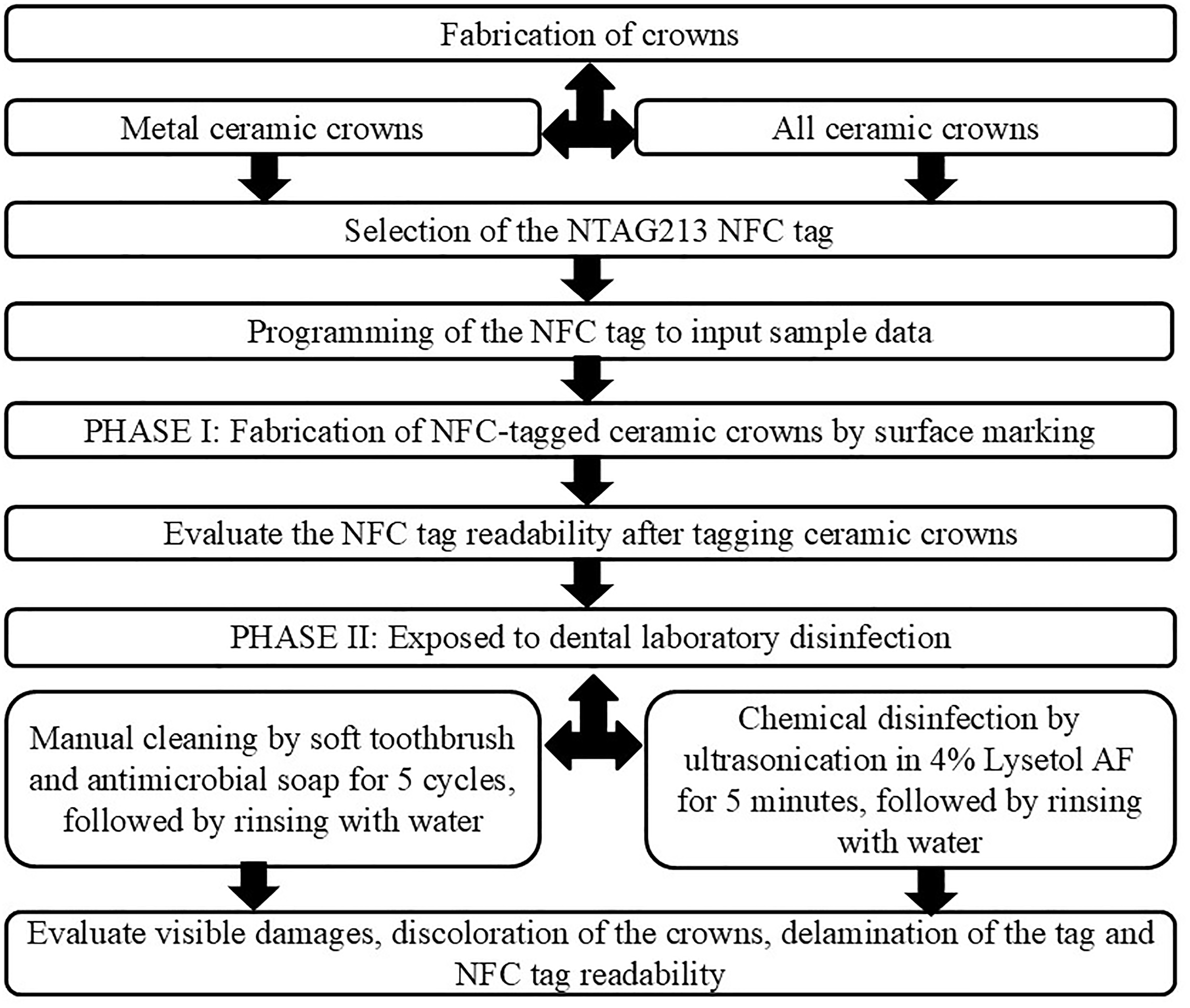
Study methodology.
Sample size calculation
To determine the sample size The primary outcome variable was the NFC tag readability after dental laboratory disinfection. Assuming a 100% success rate, effect size (p) = 1.0. Significance level (α) = 0.05 (5%). Power (1–β) = 0.80 (80%), which is a common standard for pilot studies. Proportion difference: Assume a meaningful difference in readability rates before and after disinfection is 5% ( Using a two-sided test for proportions and applying standard sample size formulas for pilot studies:

Phase I—Technological phase
Fabrication of dental ceramic crowns
Tooth preparations for all ceramic and metal ceramic crowns were done on a typhodont model (Nissin Dental Products Inc., Kyoto, Japan) on teeth 21 and 26, respectively. All ceramic crowns were made with zirconia (IPS e.max ZirCAD, Ivoclar Vivadent, Switzerland) using CAD-CAM (Computer-Aided Design-Computer-Aided Manufacturing). 37 Metal copings for metal ceramic crowns were fabricated using the lost wax process, after which ceramic (Ivoclar Vivadent, Switzerland) was baked using the traditional water-slurry method to fabricate the metal ceramic crowns. 38
Selection of the NFC tag 31
A commercially available NTAG213 NFC tag (JAKCOM N3 Smart nail chip, China) (Figure 3) was used to integrate it into the all ceramic and metal ceramic crowns to form NFC-tagged ceramic crowns. This tag is radio-inductive, characterized by its translucent and gold color. It is square-shaped with dimensions of 5 × 5 × 0.1 mm (length × width × thickness) and weighs 0.01 g. The tag is flexible, thin film, and wearable. It has a readable range of 1–3 cm and operates at a radio frequency of 13.56 MHz. The user memory is 144 bytes, and the maximum URL (uniform resource locator) size is 500 characters. Data transmission occurs at a rate of 106 kb/second, and the chip ensures data retention for up to 10 years. It can function within a temperature range of −50 °C and +80 °C.
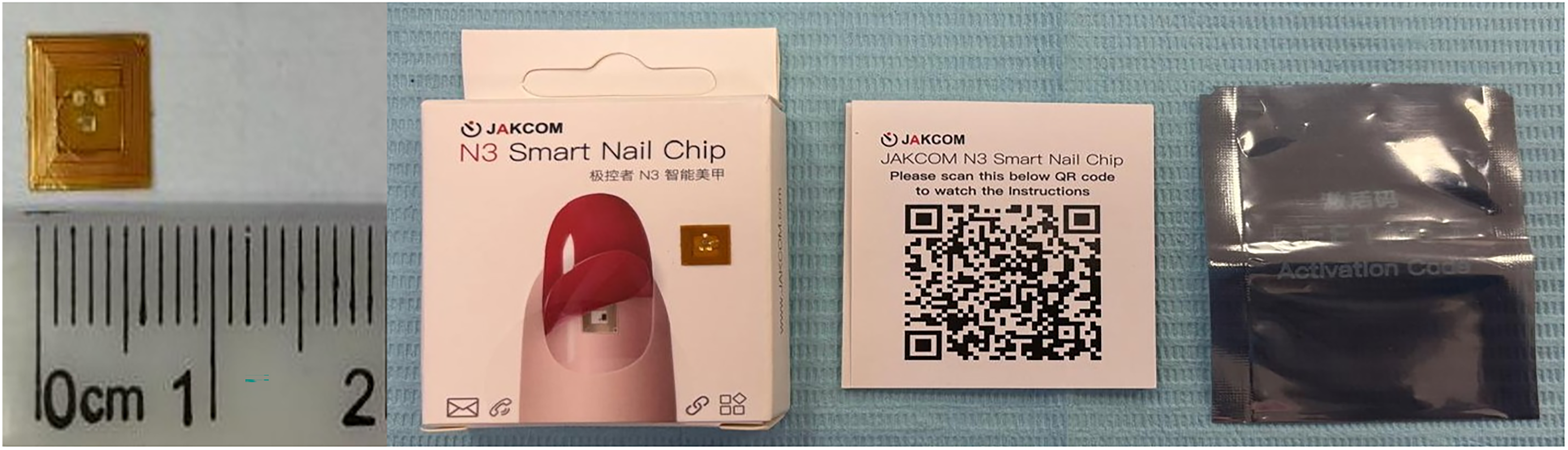
The NTAG213 near-field communication (NFC) tag and its contents.
The tag adheres to several standardizations, including NFC Forum Type 2 Tag, ISO/IEC (International Organization for Standardization/International Electrotechnical Commission) 14443 Type A, CE RED (Conformite Europeenne Radio Equipment Directive), and RoHS (Restriction of Hazardous Substances). For enhanced security, it features 32-bit password protection and supports both read-write programming and read-only locking mechanisms. In addition, the tag is made from skin-friendly material, is eco-friendly, self-adhesive, inexpensive, and robust. It is useful for applications related to data storage and object identification, which are of interest in this study.
The internal components of the tag are illustrated in the block diagram (Figure 4), 31 which highlights key functions essential for its operation. At the core of the system is the antenna, responsible for enabling electromagnetic communication, facilitating both the reception and transmission of NFC signals to interact with NFC readers over short distances. The power supply is a passive system that derives power through inductive coupling between the antenna of the tag and the reader, ensuring operation without an external power source. The RF (Radio Frequency) interface manages the radio frequency communication, ensuring seamless data exchange between the tag and reader over the NFC link. The digital control unit coordinates the internal operations of the tag, directing the flow of digital data between the components. To handle multiple tags in proximity, the anticollision feature is employed to prevent interference during simultaneous reads, ensuring that each tag is read individually or in order. The command interpreter processes the commands received from the NFC reader, ensuring their proper execution. The EEPROM (Electrically Erasable Programmable Read-Only Memory) stores important user-specific data, such as URLs, authentication keys, and application data, with the flexibility of being electrically erasable and reprogrammable for updates and modifications. The EEPROM interface enables efficient read and write operations.

Block diagram of NTAG213 NFC tag (Source: NXP Semiconductors. NTAG213 product datasheet. DataSheet4U. https://www.datasheet4u.com/datasheet-pdf/NXP/NTAG213/pdf.php?id=1443588. Accessed 12 Jan 2025) 31 ; NFC: near-field communication; RF: radiofrequency; EEPROM: electrically erasable programmable read-only memory.
Programming the NFC tag to input sample data
The NFC tags were inspected for visible manufacturing defects before being programmed using a smartphone (iPhone 15, Apple Inc., United States of America) as per the product instruction leaflet. The setup process began by scanning the leaflet's QR (quick response) code to initiate the NFC tag configuration (Figure 5). An account can be created after entering an email address and password. To configure a new device, the “sign up” and “add device” options were selected. An activation code printed on the tag's plastic pouch was entered, followed by selecting the device type as “Nail_EFTN5.” The device was renamed with the sample number, and the drop-down menu was selected to “set.” Using the app's social sharing feature, the “page” option was selected to input and submit the sample data. The data included the sample number, details of the prosthesis such as type and tooth number in FDI (Federation Dentaire Internationale) notation, material composition and manufacturing technique, date and place of manufacture, labeling method, and type of disinfection.

Screenshots of programming the near-field communication (NFC) tag to input sample data using the smartphone.
Method of application of NFC tag on the ceramic crowns by surface marking
The process for attaching NFC tags to the ceramic crowns began with cleaning the crowns by spraying surface cleaning solution (Quatidal Plus, Saudi Arabia), followed by rubbing the solution with clean gauze and allowing it to dry. The site preferred for tag placement was roughened with a tungsten carbide bur and dental laboratory micromotor. The lingual surface of the anterior crown was preferred for aesthetic reasons. Although it was non-aesthetic, the buccal surface of the posterior crown was selected because it could better accommodate the dimensions of the tag than the lingual surface (Figure 6). The incisal edges of the anterior crown and the occlusal surface of the posterior crown were avoided due to the possibility of occlusal adjustments. Additionally, the mesial and distal aspects of crowns were excluded due to limited space and potential interference with oral hygiene measures. Next, the backing from the smart nail chip was removed and peeled away, after which cyanoacrylate adhesive was applied to the back of the chip. The NFC tag, available in sticker form, was then carefully placed on the crown. After applying the tag, dental varnish (Copal-F, Prevest DenPro Limited, India) was brushed over it and allowed to dry for 40 seconds, protecting the tag as it was a surface marking method.

Near-field communication (NFC)-tagged ceramic crowns on 21 and 26.
Evaluation of the NFC tag readability after tagging ceramic crowns
The NFC tag readability was assessed using the NFC induction area on the smartphone. The process began by unlocking the phone, followed by positioning the NFC induction area of the smartphone over the tag to detect it. Once the tag was detected, the “web browser” option was selected to access the data stored on the tag (Figure 7).
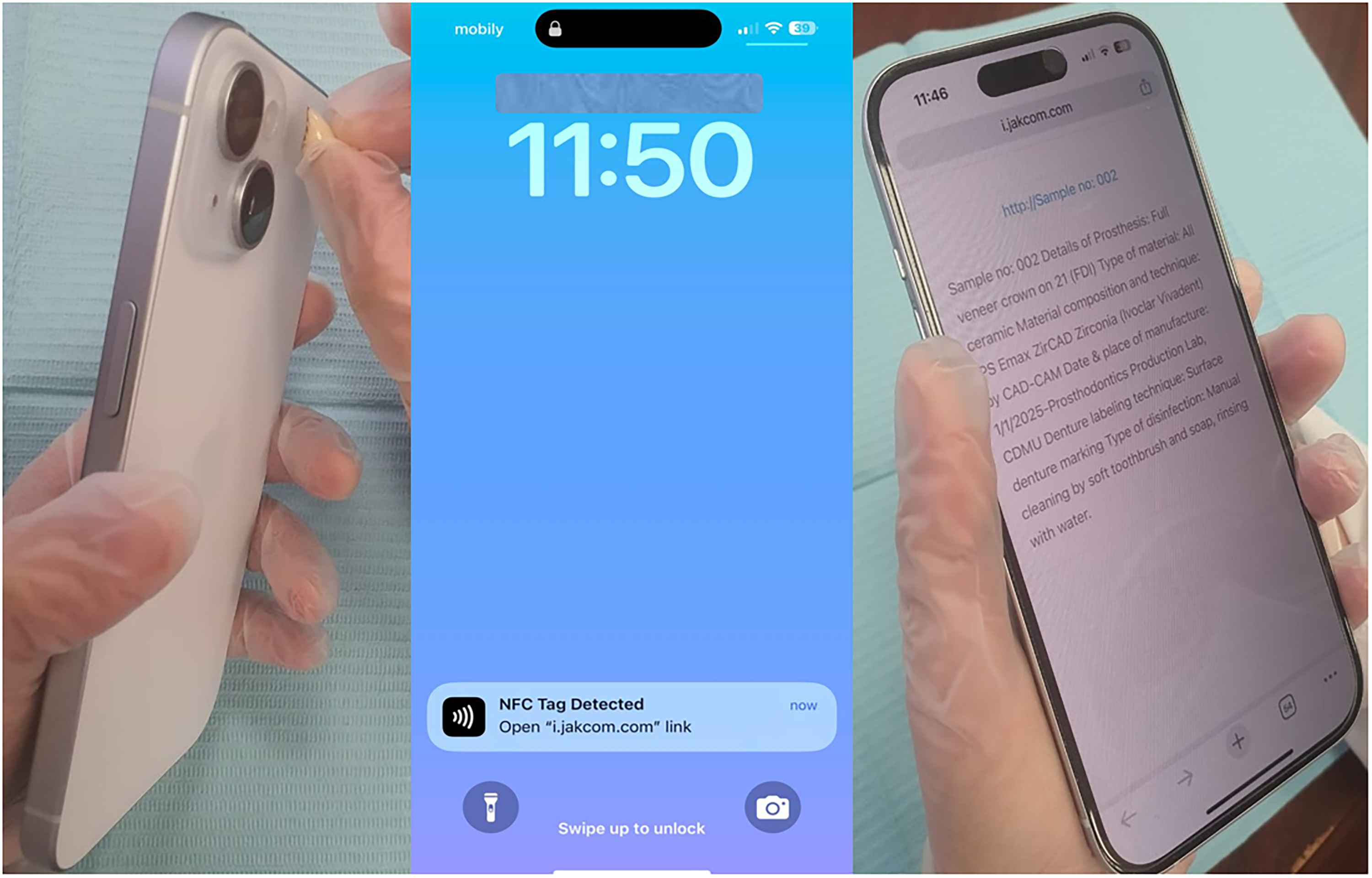
Evaluating the near-field communication (NFC) tag readability using a smartphone.
Phase II—Experimental phase
Exposure of NFC-tagged ceramic crowns to dental laboratory disinfection
Manual cleaning of the crowns was performed using a soft toothbrush and antimicrobial soap for five cycles, followed by rinsing with water (Figure 8(a)). 39 Chemical disinfection was done using ultrasonication in a bath containing 4% Lysetol AF (Gigasept® Instru AF, Schulke & Mayr GmbH, Germany). This aldehyde-free disinfectant concentrate contains 100 g of solution, which includes 15.6 g of cocospropylene diamineguanidine diacetate, 35 g of phenoxypropanols, and 2.5 g of benzalkonium chloride. One liter of the solution was prepared by mixing 30 mL of lysetol AF with 970 mL of distilled water. The prepared solution was placed in the ultrasonic cleaner, and the crowns were immersed and sonicated for 5 minutes (Figure 8(b)). The crowns were then removed from the solution, rinsed with water, and allowed to dry. The dental laboratory disinfection protocols employed have been validated in previous studies.40–42

Exposure of near-field communication (NFC)-tagged ceramic crowns to dental laboratory disinfection: (a) manual cleaning and (b) chemical disinfection.
Evaluation of the NFC-tagged ceramic crowns after disinfection
All samples were evaluated by the authors (AMJ, MZM, AAT, and AJ) for visible damage, crown discoloration, tag delamination, and NFC tag readability after disinfection. Each crown was examined under appropriate illumination and 10 × magnification using a stereomicroscope to identify surface defects such as microcracks, chipping, marginal degradation, or ceramic deformation. Macroscopic assessment was conducted to detect discoloration, including yellowing, loss of translucency, or surface staining. The tag-crown interface was inspected for delamination, defined as partial or complete separation of the NFC tag from the crown. The NFC tag readability was assessed using the method described previously to confirm tag detection, data integrity, access reliability, and response consistency. Any failure or inconsistency in tag detection or any instance of data loss was recorded as a loss of readability.
Statistical analysis
The data were expressed in frequencies and percentages. Inter-rater reliability was assessed using Cohen's kappa for each evaluation category in the experimental phase (visible damage, discoloration, delamination, and NFC readability). McNemar's test for paired categorical data was used to analyze the NFC tag readability before and after dental laboratory disinfection.
Results
Technological phase
NFC-tagged ceramic crowns (n = 20), comprising 10 all ceramic and 10 metal ceramic crowns, were fabricated using surface marking. The NFC tags remained fully readable post-application. The tags were easily detectable within the specified range of 1–3 cm, and the stored data was displayed correctly on the web browser of the smartphone.
Experimental phase
Substantial agreement was observed between raters for visible damage (κ = 0.75), discoloration (κ = 0.72), delamination (κ = 0.80), and NFC readability (κ = 0.85), indicating consistent evaluations across all categories. The absence of visible damages, discoloration of the crowns, or delamination of the tag indicated that disinfection did not affect the durability of the tagged ceramic crowns. The NFC tags maintained 100% readability with no statistically significant difference before and after disinfection (t-statistic = 0 and p-value = 1.0).
Discussion
Technological phase
The technological phase demonstrated the successful fabrication of NFC-tagged ceramic crowns. There are several advantages of integrating NFC tags into dental ceramic crowns rather than other body parts. Crowns provide a non-invasive, biocompatible, and clinically routine site for tag placement, avoiding the ethical, cultural, and medical concerns associated with subdermal or injectable devices. 43 As fixed dental prostheses, crowns offer a stable and durable environment that protects the tag and ensures long-term data retention. Their intraoral location also preserves patient aesthetics and comfort due to the tag's concealed placement. Unlike implanted devices, NFC tags in crowns are passive, battery-free, and accessible via smartphones, making them practical for storing patient identification, treatment data, or forensic information. 43
This tag was selected because it was wearable, skin-friendly, and the smallest size available commercially. 31 Its compact size, extensive data storage capacity, flexibility, and thin-film nature make it an ideal choice for seamless integration into ceramic crowns for labeling. 31 Furthermore, the tag was capable of functioning within the temperature and environmental conditions encountered during dental laboratory procedures. 31 The economical affordability of the tag (16 USD) and the non-requirement of any specialized NFC reader make this labeling method scalable for widespread use in dental technology.
The labelling method described in this research is highly advantageous due to its simplicity and straightforwardness. The surface marking was non-invasive, preserving the structural integrity and mechanical properties of the prostheses, unlike previous methods of ceramic crown labeling.8,9 The data retrieval process was quick, user-friendly, and ensured readability even by non-clinical personnel. 10 An inclusion labeling method was deemed impractical, as the manufacturer claimed that the tag could only tolerate heat up to 80 °C. To test its maximum heat resistance, the tag was placed in a porcelain crucible within a muffle furnace, gradually increasing the temperature from 100 °C to 400 °C in 100 °C increments every 5 minutes. 44 The temperature at which the tag became unreadable, recorded as 400 °C, was insufficient to endure the ceramic processing methods used in dental laboratories.
Experimental phase
The sustained durability and readability of the tagged ceramic crowns during disinfection underscore their robustness and reliability as a potential crown labeling method. Although the NFC tag was self-adhesive, roughening the ceramic crown and cyanoacrylate adhesive provided additional retention and prevented delamination during disinfection. The application of dental varnish over the tag offered an extra layer of protection, preventing direct contact with harsh chemicals and thereby safeguarding the durability and readability of the tag.
The results of the experimental phase are consistent with previous studies that have explored the use of NFC tags in removable dental prosthesis.33,44,45 Narang et al. 33 incorporated NTAG216 NFC tags into acrylic denture bases post-polymerization, ensuring resistance to chemical and thermal damage for durable labeling. Neculai-Candea et al. 44 marked complete dentures with NFC tags that withstood temperatures up to 200 °C. Stefanescu et al. 45 embedded acrylic dentures with two types of NFC tags, and the stored data remained intact after exposure to various liquids.
Clinical and forensic applications
The ADA (American Dental Association) specifications should be considered when introducing a new labeling method.6,46 These specifications require that the identification be simple, specific, cosmetically acceptable, fire and solvent resistant, and not weaken the prosthesis.6,46 The method reported in this research may not satisfy all the specifications. Based on the results, this method is simple, specific, and does not weaken the crowns. The gold color and dimensional constraints of the tag on the lingual surface compromised the aesthetics of posterior crowns. This would persist if applied to other maxillary or mandibular posterior teeth, as only the buccal surface of the crowns could accommodate the tag dimensions used in our study. However, the aesthetic specification was fulfilled by the anterior crown. The tags demonstrated heat resistance up to 400 °C and resistance to the fluids exposed to in this study. However, further research is required to investigate the fire and solvent resistance of the tag.
The clinical applicability of this research extends beyond tooth-supported ceramic crowns to include tooth-supported ceramic fixed partial dentures, implant-supported ceramic crowns, and fixed partial dentures. When translated to clinical practice, the tags could store patient data, national ID (identity document), or unique ID number, the treating professional's details, treatment and prosthesis details, clinical and laboratory information, or any other relevant information. The security features of the tag offer protection from the risk of leaking patient or professional data due to NFC vulnerabilities and other kinds of cybersecurity attacks. 47
Labeling dental ceramic crowns is an important tool for identifying deceased individuals in forensic investigations, and the integration of NFC technology could further enhance the accuracy and efficiency of this process. The ability of the NFC tags to store a wealth of data could be accessed in forensic investigations when traditional methods of identification are not available. 46
Limitations and future research
While this research demonstrated promising results, several limitations should be considered. One of the most significant limitations of this labeling method lies in the difficulty of accessing, modifying, or retrieving the chip once it has been affixed to the crown.
The NFC tag used in this study is not compatible with metal crowns due to interference caused by electromagnetic induction. While special “on-metal” tags like the on-metal NTAG213 exist, they are too large (19–29 mm) to be applied on metal crowns. 48 Research focusing on the development of smaller “on-metal” tags for metal crowns could be beneficial.
Although the tag used in this study was the smallest commercially available and unobtrusive, limited crown dimensions in smaller crowns, partial veneer crowns, or minimally invasive prostheses may limit its clinical use. Future research could focus on developing aesthetic, smaller NFC tags with larger memory capacities to meet the growing demands of digital healthcare systems.
CAD/CAM-fabricated lithium disilicate ceramics may allow pre-designing of chip housings, eliminating the need for surface roughening with tungsten carbide burs. Future research in this area could lead to more efficient and precise integration of NFC technology into such crowns.
The integration of NFC technology via pre-designed chip housings in zirconia crowns warrants further investigation to assess their integration efficiency and functional performance. The inclusion of zirconia crowns in this research offers valuable preliminary insight into the feasibility of integrating NFC technology into high-strength ceramics—an area largely unexplored in existing literature.
The study was conducted in an in-vitro setting, so the results may not fully reflect in-vivo clinical conditions. Clinical trials are needed to assess the feasibility and effectiveness of NFC-tagged ceramic crowns in the oral environment. Factors like saliva, temperature changes, chewing stresses, and exposure to food and drinks could affect the readability of the tag. The durability of the NFC-tagged ceramic crowns in the context of oral hygiene and various (physical, chemical, thermal, and radiation) assaults should be investigated. Long-term studies are also required to evaluate the aesthetic, mechanical, and functional impact of NFC-tagged ceramic crowns.
Conclusions
An innovative and simple labeling of dental ceramic crowns was developed using surface marking to fabricate NFC-tagged ceramic crowns. Their demonstrated durability and readability during dental laboratory disinfection highlights the potential of this technology for clinical and forensic applications. However, this study evaluates resistance to specific disinfection protocols rather than long-term durability under extended clinical use. With further research and clinical testing, NFC technology could transform patient care, dental prosthesis management, patient identification, and forensic investigations, offering significant benefits to both patients and dental professionals.
Footnotes
Acknowledgements
The authors would like to sincerely thank Mr Ahmed M. Kher Hlwani, Dental Technician in Prosthodontics, College of Dentistry, Majmaah University, Saudi Arabia, for his valuable support during the preparation of the samples for this research.

Ethical approval
This research was reviewed and approved by the Institutional Review Board of Majmaah University for ethical exemption as it did not involve any human, plant, or animal. No specific waiver number was assigned for exempt research. It has been described in accordance with the CRIS (Checklist for Reporting In-vitro Studies) guidelines.
Consent to participate
Not applicable.
Consent for publication
Not applicable.
Authors’ contributions
AMJ researched literature and conceived the study. AMJ, YA, SA, RA, AA, MZM, AAT, SJ, and AJ were involved in protocol development, conducting the research, and data analysis. AMJ wrote the first draft of the manuscript. MZM, AAT, SJ, and AJ reviewed and edited the manuscript and approved the final version of the manuscript.
Funding
The author(s) disclosed receipt of the following financial support for the research, authorship, and/or publication of this article: This work was supported by the Deanship of Scientific Research, Majmaah University, Al-Majmaah 11952, Saudi Arabia (grant number: R-2025-1887).
Declaration of conflicting interests
The authors declared no potential conflicts of interest with respect to the research, authorship, and/or publication of this article.
Data availability statement
All data generated or analyzed during this study are included in this published article.
Guarantor
AMJ