



Abstract
Objective
The psychological health of older adults is becoming an urgent issue. This study aims to investigate the role of eHealth in enhancing psychological health among Chinese older adults by examining how eHealth stimulates social support from family and friends, which in turn improves self-esteem and psychological health. The research is guided by the Stimulus-Organism-Response (SOR) framework and Social Cognitive Theory (SCT).
Methods
Data were collected from a national survey conducted in China between January and September 2023. The survey involved 898 adults 60 years and older. A sequential mediation analysis was performed to explore the indirect effects of eHealth use on psychological health through family and friend support and self-esteem.
Results
The study identified two parallel sequential mediating paths: (1) eHealth use → family support → self-esteem → psychological health (B = 0.01, 95% CI [0.01, 0.02]; bp = 0.01) and (2) eHealth use → friends support → self-esteem → psychological health (B = 0.01, 95% CI [0.01, 0.02]; bp = 0.01). Both paths demonstrate the significant roles of social support and self-esteem in enhancing psychological health.
Conclusion
The findings suggest that eHealth plays a crucial role in enhancing the psychological health of older adults by facilitating both external (family and friends) and internal (self-esteem) factors. These results highlight the importance of integrating social support and self-esteem into eHealth interventions to improve the psychological health of older adults.
Introduction
According to statistics released by the Ministry of Civil Affairs of China and the China National Working Commission on Aging, up to 2023, the number of older individuals 60 years and above in China had reached nearly 297 million, accounting for 21.1% of the total population. 1 This demographic shift raises concerns about the psychological health and quality of life of older adults, evidenced by increasing rates of depression and suicide among them.2–4 There is a pressing need for developing interventions to maintain and improve older adults’ psychological health.
In recent years, internet usage among Chinese older adults has notably increased, 5 allowing for a greater likelihood of accessing eHealth services. eHealth use, defined as the use of information and communication technology (ICT), particularly the internet, to enhance health and healthcare services, encompasses various activities such as telemedicine consultations, accessing health information online, participating in health communities, and using mobile health applications. 6 The literature on the impacts and efficacy of eHealth for older adults is growing,7–9 and it is increasingly recognized as a potentially effective strategy for enhancing their psychological health.10,11 Research shows that eHealth tools, such as electronic health records and patient portals, are particularly effective for older adults, especially those living independently. 7 These tools facilitate essential health monitoring and access to medical information, that can improve their quality of life and are crucial for maintaining psychological health. 12 However, despite a growing body of research linking eHealth use with improved psychological outcomes,13–15 a significant gap remains in understanding the underlying mechanisms through which eHealth impacts psychological health in older adults, especially in the Chinese context. Investigating these underlying mechanisms is becoming increasingly essential for improving the effectiveness of eHealth. Factors related to intimate relationships, such as social support, play a crucial role in the psychological health of older adults.16,17 Previous studies have also shown that for older adults, social support acts as a significant enabler for their eHealth learning and use, as without such support, they may lack the digital competence needed to adopt eHealth tools.18–20 Given the unique challenges faced by older adults, such as increased social isolation and limited mobility,21,22 factors about intimate relationships, such as social support, and those related to self-perceptions, such as self-esteem, are playing increasingly important roles in their psychological health.23,24
Employing the Stimulus-Organism-Response (SOR) framework and Social Cognitive theory (SCT) as the framework, this study investigates how eHealth use can influence psychological health outcomes through sequentially affecting perceived social support and self-esteem. By clarifying these pathways, this study aims to fill research gaps regarding the mechanisms through which eHealth can influence older adults’ psychological health, while addressing the significance of support from intimate relationships in explaining this relationship within the Chinese context.
Perceived social support is defined as the perceived psychological support and practical assistance that help individuals feel loved and cared for, bolstering their sense of self-worth and aiding in problem-solving through information or tangible help.25,26 It has been identified as an important indicator of both physical and mental health in older adults,27,28 since a large number of them are suffered from loneliness and declining health.29,30
Mehrabian and James 31 introduced the SOR framework as a theoretical lens to examine the effects of external stimuli on an individual's internal processes. This framework has been widely adopted in public health research, highlighting the critical roles of psychological factors in understanding effects of eHealth services.32–34 In the context of this study, eHealth use acts as the stimulus that can influence older adults’ perceptions of social support (the organism).
eHealth has substantial potential to enhance older adults’ perceived social support from family and friends, positively impacting their psychological health. In the Chinese context, the growing number of older adults living alone highlights an increasing need for effective communication of health concerns with family and friends.
35
eHealth equips people with personal health knowledge,
36
enabling them to discuss specific health issues or medical results online and offline. This increased dialogue not only facilitates better decision-making regarding health but also enhances the practical support received from family and friends.7,37 Thus, older adults may feel that their family and friends can actively engage in their health, fostering feelings of love, care, and emotional support. Specifically, eHealth tools can facilitate older adults’ family involvement in care by enabling health data sharing and family participation in consultations.38–40 As for friends, they provide emotional support more readily, as their encouragement typically comes without the sense of obligation that family might experience.
41
Moreover, friends can share similar health experiences through eHealth, helping to alleviate health anxiety among older adults, reduce loneliness, and foster a sense of companionship.41–43 Therefore, based on these reasons, the following hypotheses were proposed: H1a H1b
Social support has the potential to impact older adults’ health,44–46 particularly their psychological health.
47
Research emphasizes the link between social networks and cognitive factors, such as self-esteem,48–50 to explain this effect. Self-esteem, defined as an individual's positive self-regard, is associated with happiness and perceived self-worth, which can be influenced by various social factors.51,52 SCT explains how social connections affect self-perceptions and health outcomes.
53
According to SCT, individuals can learn and develop their self-esteem through observational learning, reinforcement, and social interactions. When older adults receive social support from family and friends, whether online or offline, it can increase their health knowledge, and ability to manage health and enhance feelings of self-value and acceptance.23,50,54 Besides, older adults’ family and friends can provide them with emotional support, share their experiences, and assist them in decision-making,55,56 such social reinforcement may lead to a better inner state, thereby improving self-esteem. As Shahid et al. demonstrated, family and friend support can positively impact self-esteem in older individuals by influencing their inner state.
57
Based on these reasons, the following hypotheses were proposed: H2a: For older adults, perceived family support is positively associated with self-esteem. H2b: For older adults, perceived friend support is positively associated with self-esteem.
SCT elucidates the role of self-cognitive factors (e.g., self-esteem) in the relationship between social support and psychological health.
53
Self-esteem is important for older adults navigating life transitions, such as retirement, declining health, and reduced social roles.58–60 These transitions may impact their sense of identity and purpose. As low self-esteem can lead to increased negative psychological outcomes such as depression, anxiety, and diminished self-acceptance,61–63 while a higher level of self-esteem correlates positively with positive psychological states like life satisfaction and happiness.64,65 A healthy level of self-esteem enables older adults to navigate transitions with resilience and adaptability, maintaining a positive self-image and healthy psychological state.66,67 A strong sense of self-esteem also empowers older adults to gain confidence and a sense of control over their lives.68,69 All of these factors contribute positively to their psychological state.70–72 Therefore, it is plausible that higher levels of self-esteem are positively associated with improved psychological health. Building on previous discussions, we further argue that there is a serial mediation relationship between eHealth use and psychological health, mediated by social support and self-esteem. Accordingly, we propose the following (see Figure 1 for the conceptual framework): H3 H4a H4b

Conceptual model.
Methods
Data source
This quantitative research utilized an online survey conducted through Kantar (www.kantar.com) between January and September 2023. Respondents received an email invitation informing them to log into the Kantar platform to participate in the survey. Approximately 15% of those randomly invited from the platform actually completed the survey. The survey sampled a random selection of 4979 Chinese adults from 31 provinces (or their equivalents), drawn from Kantar's panel. Quota sampling was applied to ensure the sample reflected the age and gender distribution reported in the seventh national census of 2020 by the National Bureau of Statistics. Ethical approval for this research was granted by the authors’ institution prior to the study's commencement. As missing data accounted for less than 1.0%, listwise deletion was used for handling it.
Variables and Measurements
eHealth use. To evaluate engagement in eHealth use, we referred to the measurement adapted from the previous study by Kontos et al. (2014) and the HINTS survey (HINTS5-Cycle1), which includes nine items to measure eHealth use, and has been validated by the National Cancer Institute.73,74 Participants reported their use of digital devices for the following purposes: (1) searching for health or medical information for oneself, (2) searching for health or medical information for someone else, (3) making online purchases of medications or vitamins, (4) locating doctors or other healthcare providers, (5) digital communication with doctors (e.g., email, online platforms), (6) arranging medical appointments, (7) monitoring medical expenses, (8) completing and submitting medical forms, and (9) accessing medical test results. Dichotomized responses (0 = no, 1 = yes) were summed up to create the index of eHealth activities (M = 6.56, SD = 2.11).
Perceived social support. This study measures perceived social support through the dimensions of family and friends, adapted from the Multidimensional Scale of Perceived Social Support (MSPSS), which was developed and validated by Zimet et al through assessments of its internal and test-retest reliability, as well as construct validity.75,76 Perceived family support and perceived friends support were measured separately using a four-item scale, and respondents were asked to indicate how they feel about certain statements. Examples of items for perceived family support include “I receive emotional help and support from my family” and “I can discuss my problems with my family.” For perceived friends support, examples include “My friends try to help me” and “When things get worse, I can rely on my friends.” Responses were recorded on a five-point Likert scale, ranging from 1 (strongly disagree) to 5 (strongly agree). The mean score of these items yielded the family social support score (M = 3.62, SD = 0.56, Cronbach's α = 0.78) and the friends’ social support score (M = 2.89, SD = 0.55, Cronbach's α = 0.77).
Self-esteem. The measurement of self-esteem was adapted from Rosenberg's Self-Esteem Scale (1965), which provides a widely validated and used framework for assessing self-esteem in various contexts. 77 It includes four items: (1) “I believe that I possess many good qualities” (2) “I am capable of doing things as well as most other people,” (3) “Like other people, I feel that I am a person of worth,” and (4) “I have a positive attitude towards myself.” Responses for these four items were collected on a five-point Likert scale, ranging from 1 (completely inconsistent) to 5 (completely consistent). An average score was computed for these items to represent the overall self-esteem measure (M = 2.96, SD = .61, Cronbach's α = 0.74).
Psychological health. Psychological health was measured using the “Patient Health Questionnaire-4” (PHQ-4), a brief and validated screening tool for depression and anxiety, which includes four questions. 78 Participants were asked to report their experiences over the past two months, responding to the frequency of (1) a lack of interest or pleasure in activities, (2) feelings of depression or hopelessness, (3) symptoms of anxiety or nervousness, and (4) challenges in controlling worrying thoughts. These items were rated on a four-point frequency scale, from 1 (nearly every day) to 4 (never), and the resulting scores were averaged to yield a composite index of psychological health (M = 3.07, SD = 0.83, Cronbach's α = 0.80). A higher composite score indicates better psychological health.
More information on core variable measurements can be found in the supplementary materials: Tables S1 to S4.
Control variables. We included the following sociodemographic variables as control variables: gender (1 = “male,” 0 = “female”), education level (ranging from 1 = “primary school or below” to 5 = “Bachelor's degree or higher”), and personal monthly income (ranging from 1 = “less than CNY 5000” to 5 = “CNY 20,000 or more”). These variables were chosen because they are commonly associated with differences in health behavior and technology adoption. Additionally, to provide a more comprehensive assessment of the impact of social support on the mental health of older adults, we included social network size as a control variable. Participants were asked: “How many close contacts do you have?” The response options were as follows: 1 = “none”; 2 = “1 person”; 3 = “2‒3 people”; 4 = “4‒5 people”; 5 = “6‒7 people”; 6 = “8‒9 people”; 7 = “10‒11 people”; 8 = “12 or more people.”
Statistical methods
The analysis of the collected data was conducted utilizing Model 80 in the SPSS macro PROCESS. Min-max normalization was employed as an auxiliary approach to facilitate comparisons across all pathways within the mediation model. 79 This procedure involved rescaling all variables to a unified range from 0 to 1. Within this context, the regression coefficients obtained post-normalization were interpreted as percentage coefficients (bp).80,81 For the current analyses, the 95% confidence interval (CI) for all effects used 10,000 bootstrapped samples.
Results
Demographics
Participants in this study were all older adults age 60 years and above. Among the 898 respondents, 489 (54.50%) were men, and 409 (45.50%) were women. The education level of most participants included some high school education (280/898, 31.20%). Furthermore, a substantial segment of the cohort reported an annual household income ranging from CNY 5001 to CNY 8000 (317/626, 35.30%). Detailed demographic characteristics are listed in Table 1. As shown in Table 2, most of the variables of interest were correlated.
Sample characteristics (N = 898).

Zero-order correlation (N = 898).

Note: *p < .05, **p < .01
Hypothesis testing
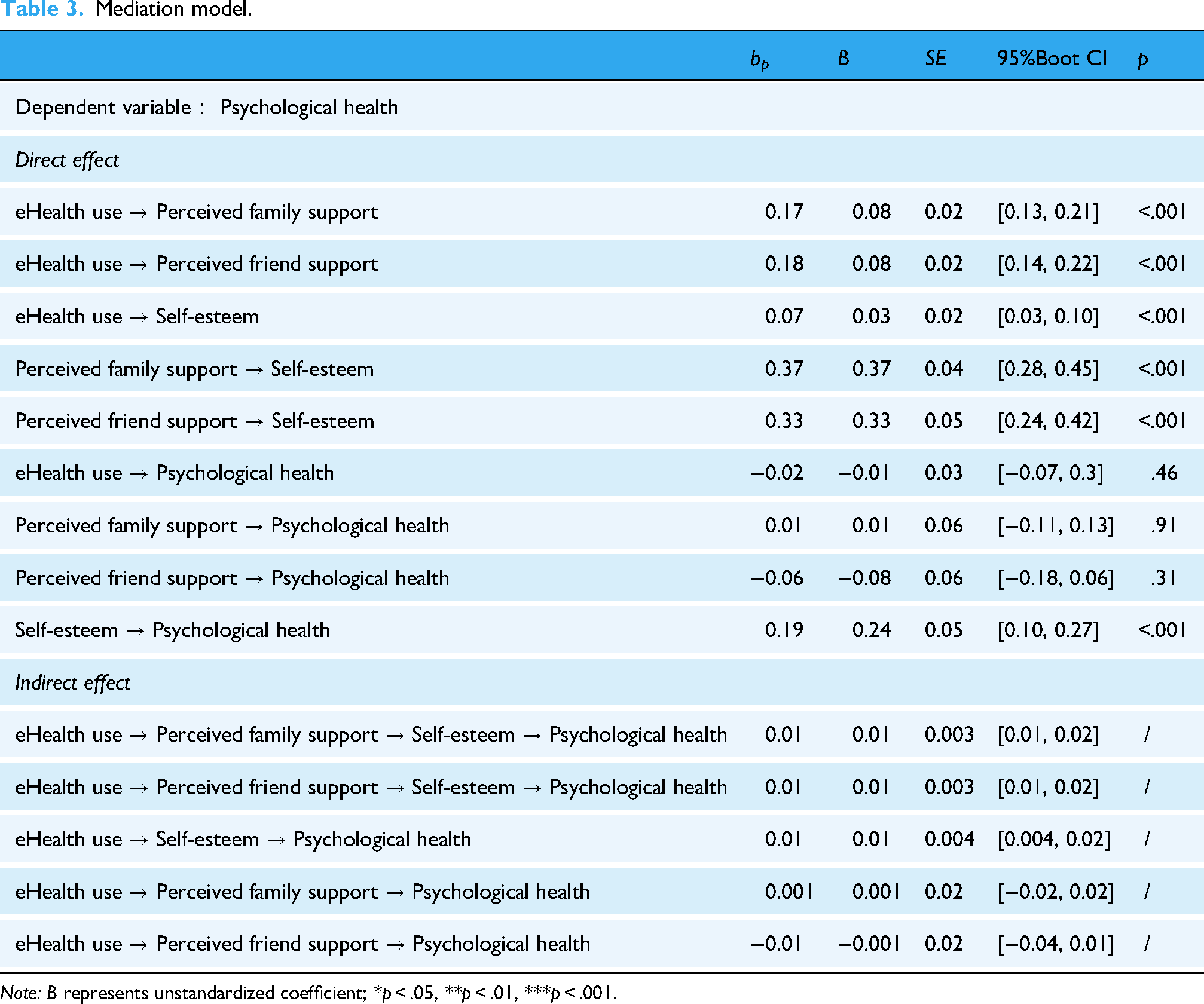
The mediation testing results are shown in Figure 2 and Table 3.

Effects of the mediation model.
Mediation model.
Note: B represents unstandardized coefficient; *p < .05, **p < .01, ***p < .001.
H1 proposed that eHealth use would be positively associated with both perceived family support and perceived friend support. The results supported H1, showing significant positive associations between eHealth use and perceived family support (B = 0.08, 95% CI (0.13, 0.21); bp = 0.02; p < .001) and between eHealth use and perceived friend support (B = 0.08, 95% CI [0.14, 0.22]; bp = 0.02; p < .001).
H2 suggested that perceived family support and friend support were positively associated with self-esteem. The results supported H2, indicating that both perceived family support (B = 0.37, 95% CI (.28, .45); bp = 0.37; p < .001) and perceived friend support (B = 0.33, 95% CI (.24, .42); bp = 0.33; p < .001) were significantly and positively associated with self-esteem.
H3 proposed a positive relationship between self-esteem and psychological health. The results supported H3, showing that self-esteem was positively associated with psychological health among older adults (B = 0.24, 95% CI (0.09, 0.27); bp = 0.18; p < .001).
H4 posited that perceived social support and self-esteem sequentially mediate the relationship between eHealth and psychological health
Discussion
This research investigated the impact of eHealth use on older adults’ psychological health, examining the mediating roles of two types of social support (family and friends) and self-esteem. Our study revealed that older adults’ engagement in eHealth activities could bolster their perceived social support from family and friends, which then fosters self-esteem and ultimately enhances their psychological health outcomes.
eHealth for addressing psychological issues in the elderly
The findings of this study empirically align with previous research, indicating that eHealth is beneficial for Chinese older adults, providing healthcare through psychological aspects.5,82 Currently, despite the well-documented health-related benefits of eHealth for older adults, its use and adoption remain limited among Chinese older adults. According to the 2023 Statistical Reports on Internet Development in China, as of June 2023, the number of internet users in China reached 1.079 billion, with the number of users of age 60 and above reaching 140 million, accounting for 13% of the total population of internet users. 83 However, a study reveals that less than 30% of them use the internet for health-related activities, such as seeking health information, using health apps, or engaging in online health communities. 1 The limited use of eHealth among older adults can be attributed to several factors: a lack of digital skills and literacy of older adults, which hinders effective use of digital platforms for health information seeking 36 ; unfamiliarity with eHealth platforms, leading to mistrust or reluctance to change established health-related behaviors 84 ; and some poorly designed eHealth apps with issues like small fonts and complex menus. 85 Moreover, substantial proportion of Chinese older adults experience psychological issues. The depression rate among older adults in China is notably high, standing at 25.55%, and is expected to continue to increase over time. 86 However, many feel shame or embarrassment about seeking help from consultants and doctors for these issues.87,88 eHealth offers a channel for these individuals to gain knowledge, seek help online without needing to visit a hospital, receive support from family and friends, and ultimately engage in healthcare processes to overcome their psychological challenges.
Roles of family and friends’ social support
Corresponding with findings of previous studies, this study emphasizes the important role of social support in explaining how eHealth positively influences the psychological health of older adults.89,90 To be specific, when considering how social support can contribute to older adults’ psychological health, some previous studies have generally paid more attention to family support over friend support. They found that while both family and friend support are important, family support tends to have a more substantial impact on the overall well-being and life satisfaction of older adults.91–93 This study specifically examined the effects of family support and friend support on older adults, indicating that they can both positively influence self-esteem, thereby contributing to improved psychological health. This finding aligns with the perspective raised by previous studies that emphasize the equal importance of friend support and family support for older adults.93,94 Friend support can effectively complement family support, particularly when family support is less accessible to some older individuals.95,96 This is especially important in the Chinese context, where more than half of older adults live in empty-nest households, with the proportion exceeding 70% in some rural areas. 97 In such cases, the absence of immediate family support often leaves older adults vulnerable to feelings of loneliness and isolation. 98 Previous studies have shown that the psychological well-being of empty-nest elders is at risk due to a lack of support from social networks. 99 In such situations, friend support can provide essential companionship, emotional comfort, and social engagement, helping to mitigate the negative effects of isolation and improve overall mental health for older adults.
The findings resonate with the SOR model and previous research,31,89 suggesting that the use of eHealth can positively affect individuals’ perceived social support and self-esteem (organism), then further improving their psychological health (response). That may be because eHealth, as a stimulus, simplifies the caregiving process, making it more accessible for such networks to participate in older adults’ healthcare processes. 100 It enables older adults to interact more easily with their loved ones, facilitating the sharing and discussion of health data and information, that may enhance their health status and self-efficacy.101,102 Through such processes, older adults can perceive greater support from their family and friends. Moreover, previous studies on eHealth's enhancement of social support have primarily focused on support from online health communities.89,103,104 This study indicates that, in addition to communicating directly in online health communities, eHealth can also enhance communication, connection, and support from individuals with intimate ties, such as family and friends. These factors are particularly important for the psychological health of older adults, especially in the context that a significant number of them live alone. 35
The mechanism of how self-esteem explains the impact of social support
Based on Social Cognitive Theory, this study further explains the dynamics between social support triggered by eHealth use and older adults’ psychological states. The findings indicate that perceived social support can increase older adults’ self-esteem and subsequently enhance their psychological health. For older adults, a wealth of perceived social support from family and friends may provide a richer repository of health-related knowledge and guidance, augmenting their ability to address health issues and provide emotional support effectively.40,105 This, in turn, fosters positive self-esteem.50,106
Two intriguing findings are related to the insignificant total effect of eHealth use on psychological health and the insignificant direct effect from both family and friends’ support on the psychological health of older adults. The insignificant total effect suggests that this model represents a competitive mediation, where indirect and direct effects can counteract each other, potentially reducing the total effect to insignificance.107,108 In the context of this study, it implies that besides the path from eHealth use influencing psychological health through social support and self-esteem, there might be other mediators explaining the effect of eHealth on psychological health, but through a negative indirect path. Such negative influencing mechanisms can be explained as follows: eHealth use may inadvertently heighten people's health-related anxieties by exposing them to information about various diseases, potentially leading to increased worries about the likelihood of developing these conditions and, consequently, a decline in psychological health.33,109 Particularly for older adults, who often experience heightened health-related worries, the increased awareness of elevated health risks and their potential consequences can lead to a heightened exposure to a large volume of disease-related information during eHealth use. This exposure may further exacerbate their psychological distress.110–112 Future studies are encouraged to explore the specific mechanisms by which eHealth use may negatively impact the psychological health of older adults and to develop interventions that can mitigate these adverse effects.
This study also found that the direct effect of social support on psychological health is insignificant, aligning with the concept of indirect-only mediation, which suggests that the relationships between both types of social support and psychological health are fully mediated by self-esteem.107,108 This highlights the significance of self-esteem in explaining the relationship between social support and the psychological health of older adults, which aligns with previous studies.113–117 It indicates that social support should be provided in a manner that respects and enhances older adults’ self-worth. The potential reason may be that high self-esteem fosters a positive self-view and resilience, that can help older adults to cope with a decline in social roles and life challenges, leading to higher level of psychological well-being.118–120 When aging, older adults—particularly those from Chinese cultures—place great importance on their self-worth and are highly sensitive to how it is perceived. 121 Even if they receive social support, they may still experience distress if they feel their self-worth is not respected. In such cases, self-esteem plays an important role in internalizing the value of social support. 122 This finding emphasizes the need to consider the quality and impact of social support on older adults’ self-esteem, as this is crucial for the effectiveness of social support in enhancing their psychological health.123,124
Although our study was conducted in China, a context that emphasizes family, community, and social ties, the findings are generalizable, as research from countries like Japan, India, and the United States similarly confirms the importance of social support and self-esteem in enhancing the well-being of elderly individuals. For instance, a study in Japan links social support and smartphone use to improved health, 18 while research from India highlights how digital platforms foster online social ties that benefit elders.125,126 This suggests that even in more individualistic cultures, the psychological health of older adults might still rely on support from family and friends. Additionally, in contexts with individualistic cultures, older adults might seek more autonomy and prefer using eHealth technologies to manage their health independently.127,128 This implies the need to explore other mediators, such as self-efficacy or health literacy, to explain the impacts of eHealth on psychological health.19,129 Furthermore, in regions with limited internet access, although social support remains important, the proliferation and quality of eHealth services may be inadequate. Therefore, there might be a pressing need to develop offline interventions to strengthen social support, utilizing channels such as phone calls and radio broadcasts.
Implications
The present study makes several contributions to public health research. First, it offers empirical evidence for the integrated application of the SOR framework and SCT to explain the underlying mechanisms of influences of eHealth on the psychological health of older adults in the Chinese context. By incorporating SCT, the study separately examines the roles of family and friend support, demonstrating their distinct pathways in influencing self-esteem and psychological health. Second, this research emphasizes the importance of social support for older adults, confirming that eHealth can provide not only online support but also support from family and friends in their daily lives, which is even more significant for older adults. This finding also highlights the critical role of social support in promoting psychological health. Lastly, this study addresses the importance of self-esteem in interventions aimed at improving the psychological health of older adults. Interventions should particularly value older adults’ self-worth and incorporate their families and friends to maximize effectiveness.
This study also has practical implications. First, recognizing the central role of eHealth, and its limited use among Chinese older adults, management necessitates the development of comprehensive strategies that foster eHealth adoption on both organizational and personal fronts. To facilitate this, educational initiatives and support systems must be established to enlighten older adults about the benefits of eHealth and encourage its integration into their healthcare routines. The government and healthcare providers are encouraged to develop community-based training programs that use hands-on instruction and pair older adults with young volunteers to equip them with the necessary digital skills and literacy for eHealth. Additionally, family members and friends are encouraged to assist older adults in this educational process. Furthermore, eHealth app and platform developers are suggested to design an older adult-friendly mode, featuring larger fonts, simplified interfaces, and menus, along with clear instructions to facilitate ease of use. Second, given the significant impact of social support on the psychological health of older adults, there is a clear need to promote their active engagement in health communications with social networks. Besides, given that both family and friend support are important for older adults’ psychological health, it is essential to suggest family members and friends to provide empathetic, attentive, and patient-centered support when interacting with older adults. Third, the practical significance can be extended beyond China to other contexts. Interventions focusing on enhancing social support, whether through family engagement or friend-related activities, may be beneficial for older adults globally. Moreover, considering the significance of social support in different contexts, tailored interventions that incorporate other culture-specific elements, such as self-efficacy and autonomy, may optimize the effectiveness of eHealth use. Future research is encouraged to consider cross-cultural interventions to enhance the psychological health of aging populations worldwide. Finally, the findings of this study underscore the critical importance of self-esteem in promoting the psychological health of older adults. Healthcare providers should focus on developing targeted interventions that integrate self-esteem enhancement into eHealth programs, ensuring that older adults receive comprehensive support that addresses both their emotional and psychological needs.
Limitations
This study has some limitations that point to areas for further research. First, due to its cross-sectional nature, causal relationships between the variables of interest could not be established. Longitudinal studies are expected to test the causality of the proposed model in this study. Second, the variables were self-reported by participants, which may affect the accuracy of the results. Future studies could benefit from incorporating objective measures to complement self-reported data, providing a more comprehensive understanding of these variables. Third, this study only tested if people used various eHealth services or not, without looking at the frequency or use patterns. These details are important to understand how eHealth affects mental health. Future research should measure effects of more detailed aspects of eHealth use. Fourth, the measurement of the dependent variable, psychological health, only includes items related to general psychological states. Future research is encouraged to focus on psychological issues that are particularly salient among older adults to investigate how these problems can be addressed through eHealth interventions. Fifth, when measuring the effects of social support, it would be beneficial to include participants’ satisfaction with their available support as a control variable in future studies. Finally, this study utilized an online format for sampling in the survey. It is important to acknowledge that this may introduce selection bias. Participants were invited to the survey via email, which may imply that they have greater access to and familiarity with online applications, potentially suggesting a higher socioeconomic status. Future studies are encouraged to test the model using a survey with offline random sampling, such as face-to-face interviews, which might be more representative.
Conclusions
This research provides concrete evidence that social support and self-esteem play important roles in explaining the effect of eHealth use on older adults’ psychological health. Specifically, this effect is partly channeled through the perceived support from family and friends and through self-esteem improvements. The insights from this study underscore the value of eHealth services in promoting psychological health, particularly among older adults. It also suggests that eHealth can be utilized to facilitate support from the intimate families and friends of older adults, emphasizing that such support should respect older adults’ self-esteem to improve their psychological health.
Supplemental Material
sj-docx-1-dhj-10.1177_20552076251346659 - Supplemental material for ehealth use and psychological health improvement among older adults: The sequential mediating roles of social support and self-esteem
Supplemental material, sj-docx-1-dhj-10.1177_20552076251346659 for ehealth use and psychological health improvement among older adults: The sequential mediating roles of social support and self-esteem by Song Harris Ao, Yingxia Zhu, Jiazheng Wang and Xinshu Zhao in DIGITAL HEALTH
Footnotes
Acknowledgments
All authors read and approved the final manuscript.

Ethical Considerations
Research ethics approval for this study was obtained from the first author's institution (project number is SSHRE23-APP013-FSS).
Informed Consent
This study was conducted in China, targeting participants from all 31 provinces. The data were collected and analyzed by established ethical standards and have obtained ethics approval. Written informed consent was also secured from participants.
Author Contributions
Yingxia Zhu conceived the original idea for the study. Song Harris Ao optimized the idea, provided guidance on the framework construction, and wrote the manuscript with Yingxia Zhu. Xinshu Zhao provided methodological guidance and funding. Jiazheng Wang was responsible for the final proofreading and checking of the manuscript.
Funding
This work was supported by the Macau Higher Education Fund [HSS-UMAC-2020-02] and; University of Macau [CRG2021-00002-ICI, ICI-RTO-0010-2021, CPG2022-00004- FSS and SRG2018-00143-FSS].
Declaration of Conflicting Interests
The authors declared no potential conflicts of interest with respect to the research, authorship, and/or publication of this article.
Supplemental material
Supplemental material for this article is available online.
References
Supplementary Material
Please find the following supplemental material available below.
For Open Access articles published under a Creative Commons License, all supplemental material carries the same license as the article it is associated with.
For non-Open Access articles published, all supplemental material carries a non-exclusive license, and permission requests for re-use of supplemental material or any part of supplemental material shall be sent directly to the copyright owner as specified in the copyright notice associated with the article.
