




Abstract
Background
Sleep monitoring devices present potential improvements to address the challenges of sleep disorders. However, systematic evaluations are lacking. This study investigates the functional characteristics of existing sleep monitoring devices in the Chinese market and delves into population preferences.
Objective
We aim to summarize the characteristics of mobile health devices with sleep monitoring function in China, analyzing product features and market prices, and collect population preferences for mobile health devices, providing a concrete basis for the ongoing development of mobile health technologies.
Methods
Data on 203 sleep devices were gathered from four major mobile shopping platforms (Tmall, JD.com, Pinduoduo, and Suning) using relevant keywords. A two-level variance model was employed to analyzed the link between device features and sales. Additionally, a structured questionnaire assessed public usage and attitudes towards these devices, with 167 responses collected via social networks.
Results
Our study found that smart bracelets, which make up 82.6% of sleep monitoring devices, effectively track heart rate, physical activity blood oxygen saturation, sleep duration, and assess sleep quality. Most devices cost under 500 RMB, influencing sales (β = −1.111 to −3.490, p < 0.001–.002). Features such as sleep quality assessment (β=0.520, p = 0.03), measuring physical activity (β=0.464, p = 0.03) and blood oxygen saturation (β=0.465, p = 0.02) are significantly associated with higher sales volumes. Usage peaks during and after exercise (41.0%) and during sleep (21.3%), with 60.4% preferring to spend under 500 RMB.
Conclusions
The study confirms a strong preference for smart bracelets with health tracking features, particularly for sleep monitoring, at a price point below 500 RMB. These findings highlight the potential of affordable, multifunctional devices to shape the future of smart healthcare, especially through cloud-based enhancements that improve doctor-patient communication.
Introduction
Background
Sleep disorders are characterized by insufficient sleep due to various factors and abnormal behaviors during sleep, which can increase the risk of multiple diseases.1,2 The prevalence of sleep disorders increases from 9% to 49% with age, indicating a negative impact on global public health that requires attention.3–5 Mobile health devices are a collection of wearable and environmental sensing devices that can be connected to mobile electronic device cloud to provide real-time, continuous, and personalized body data monitoring and medical care to users. 6 These devices enable users to access their health status via cloud-based services using portable electronic devices, while clinicians can view real-time health data in the cloud with user authorization. 7 This model facilitates the prevention and rehabilitation of multiple diseases. 8 Among these devices, consumer-targeted fitness devices, which are becoming increasingly popular, are equipped with sleep monitoring features. 9
The sleep monitoring device, primarily a consumer wearable, is utilized across various wearable platforms through Consumer Sleep Technologies (CSTs).10,11 Its purpose is to assess human sleep patterns and enhance sleep quality. 12 Additionally, it can be synchronized with sleep detection applications on mobile device platforms such as smartphones.11,13 Polysomnography (PSG) monitoring is currently regarded as the gold standard for the clinical diagnosis of sleep disturbance. 14 However, this test has limitations, as conducting sleep monitoring under hospital supervision can increase patient anxiety and make it difficult to measure normal physiological sleep states. Moreover, PSG is both time-consuming and expensive, and its capacity is limited, leading to longer wait lists. 15 In contrast, sleep monitoring using mobile health devices is not only less expensive than PSG but also allows for sleep monitoring at any time and place, resulting in more consistent physiological sleep data. To address the mismatch between supply and demand, there is an urgent need for a low-cost, convenient, and accurate means of sleep monitoring, leading to the development of market-oriented sleep monitoring equipment.
With increasing awareness of sleep health and a new peak in wearable device market sales, 16 important topics of discussion have surfaced, such as developing devices that are practically integrated with medical care and loved by the public and helping people select high-quality devices from the wide variety of sleep monitoring devices on the market. Numerous studies have explored the feasibility of several types of sleep monitoring devices for scientific research and in-home monitoring. By connecting to mobile terminals, these devices can make reasonable sleep assessments based on the metrics they measure.17–19 Several studies have discussed the inability of these devices to make the monitored data as precise as PSG due to the limitations of the sensors and algorithms.20–22 While these studies have guided the technical development of sleep monitoring devices in terms of principle feasibility and measurement accuracy, they have rarely analyzed the sales characteristics of devices and feedback from the public. Although some studies have assessed product usability and user preferences through interviews 23 and five-point Likert scales, 24 the small sample sizes have not provided an adequate population basis for device development. The analysis of user preferences and satisfaction serves as an effective measure of the real-world application of sleep monitoring devices. Among the various factors, poor usability is one of the most common reasons for users to discontinue use. 25 Therefore, existing sleep monitoring devices and applications should place greater emphasis on their sleep enhancement effects and sleep suggestion features as a means to improve user satisfaction, overall usability, reliability, and value for money.26,27 While recent research has provided insights into consumer preferences for sleep monitoring devices through behavioral economics approaches, 28 there remains a gap in understanding actual sales trends and functional characteristics through analysis of large-scale market data. 27 This information is significant for device development, medical integration, and population selection. 29
Objectives
To fill this gap, the present study collects information on sleep monitoring devices for sale in China, describes the characteristics of devices, conducts unsupervised learning-based functional classification to explore the factors that affect sales, and analyzes the public's willingness to use devices through real-world data such as purchases and evaluations. Additionally, the study collects insights and preferences from individuals regarding the utilization of mobile health devices to summarize the functional characteristics of mobile devices and the attention of people about sleep health. The study aims to provide a credible scientific basis for the development and sale of mobile devices and the selection of quality devices for the population, as well as to promote doctor-patient information interaction using mobile devices.
Methods
Data acquisition
We searched in the Baidu search engine on February 1, 2021, using three keywords that broadly represented the main purpose of mobile health devices in Chinese: “智能健康” (smart health), “智慧医疗” (smart healthcare), and “智慧养老” (smart elderly care). The inclusion of “smart elderly care” was particularly relevant in the Chinese market context, where many mobile health devices are specifically designed for elderly care needs given China's aging demographics. 30 We included the names of every mentioned device type from all links on pages 1–20 of the above three keywords as the search terms for the next step. We excluded device types in ad links or ad windows and device types that were not on the Chinese market. For type names that were difficult to understand, we further clicked the secondary link to determine the meaning of the name. Ultimately, 54 search terms were included in the study. Supplement 1 provides detailed search terms.
Next, we focused on the four largest Business to Customer (B2C) malls in China by annual sales, namely, Tmall, JDcom, Pinduoduo, and Suning. 31 At a single cross-sectional point from February 5 to 10, 2021, we conducted searches for 54 search terms within each of the four mobile shopping malls and collected the top 20 selling specific devices for each search term (or as many as possible, if fewer than 20 were available). Equipment data collection included (a) objective market data such as sales volume and reviews; (b) basic characteristics of equipment such as model and price; and (c) measurement and functional indicators of equipment such as heart rate monitoring, body fat measurement, and risk alarm. Supplement 2 provides detailed explanations of device categorization, equipment measurement, and function indicators. In total, we included 564 devices in our search, with the primary research subject being devices equipped with sleep monitoring capabilities. After excluding duplicate models, devices without cloud connectivity, and those that could not be connected to mobile phones or computers, 203 devices met our study definition. We present the specific screening and inclusion procedures in Figure 1.
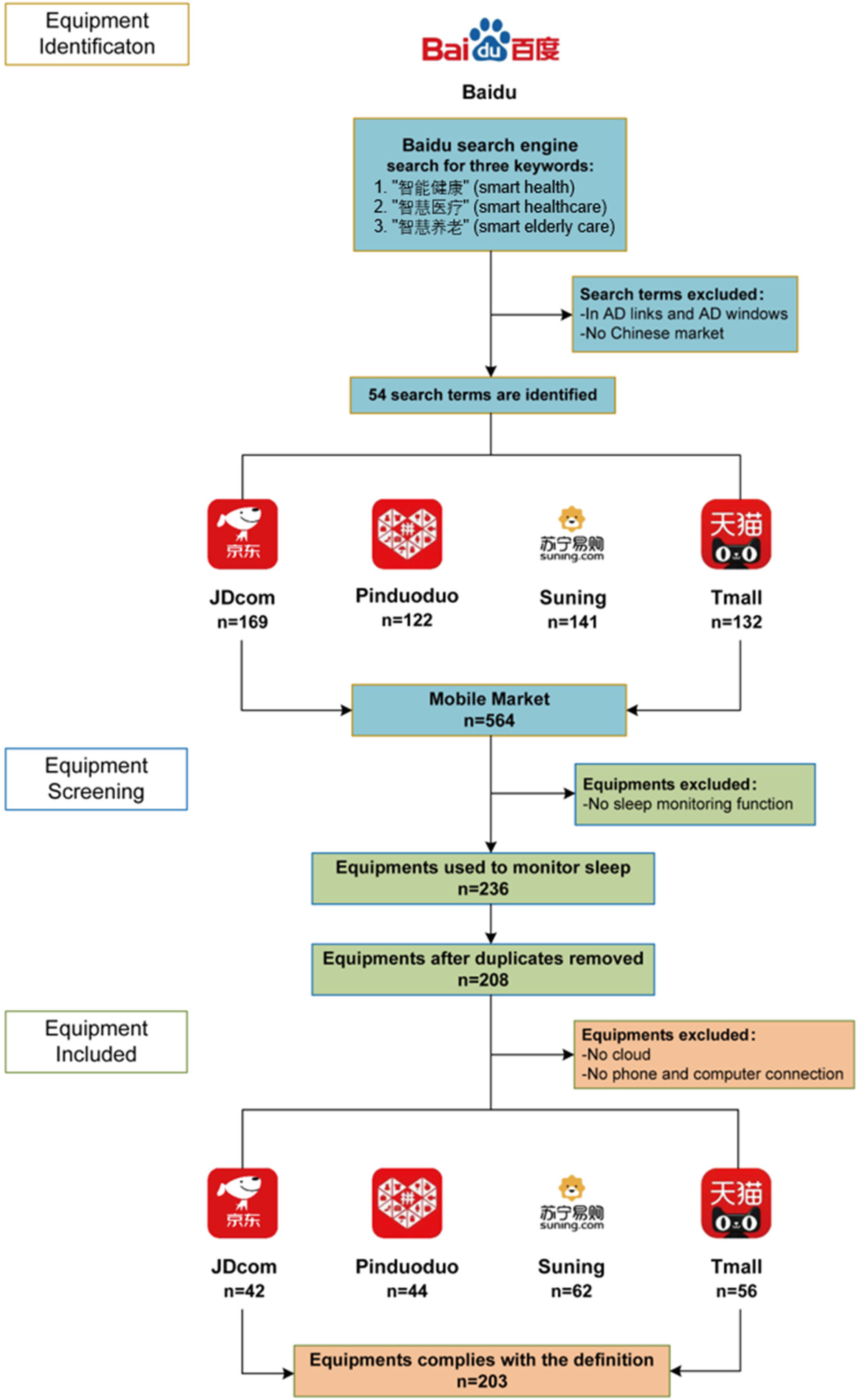
Flowchart of inclusion and exclusion of sleep monitoring devices.
User experience survey
To investigate the population's usage and attitude toward mobile health devices, a structured questionnaire was created, and an anonymous internet-based cross-sectional survey was conducted. The questionnaire comprised 34 questions that were designed based on important literature, covering the following five dimensions: (1) general demographic characteristics; (2) individual understanding of smart health monitoring equipment (hereafter referred to as “equipment”); (3) individual willingness to use the equipment; (4) individual use of the equipment and its satisfaction; and (5) individual expectations and value recognition of the equipment.
The questionnaire was created, distributed, and completed using Wenjuan.com, one of the largest free survey platforms in China. Convenience sampling was utilized to recruit participants, and recruitment was performed through WeChat, the social media platform with the largest user population in China. 32 From October 1, 2021, to October 5, 2021, the research team posted the questionnaire link on WeChat Moments and privately sent it to their friends and WeChat groups, intending to reach comprehensive recipient coverage. The research team's WeChat friends were also invited to forward the survey links. The primary target participants comprised residents of Fuzhou City in China. Participants were able to complete the questionnaire using personal computers or mobile devices. All respondents were informed that their participation was voluntary. No incentives were provided to study participants.
Initially, 172 questionnaires were obtained. After implementing post-quality control measures, questionnaires with logical and subjective completion errors were eliminated, resulting in a final sample size of 167. Power analysis was conducted using PASS 15.0 software, with a significance level of α=0.05, yielding a statistical power of 0.8564, which exceeds the recommended threshold of 0.80. 33 The content of the questionnaire related to this article can be found in Supplement 3.
Ethical considerations
Before participating in the survey, written informed consent was obtained from each participant. This study was approved by the Biomedical Research Ethics Committee of Fujian Medical University ([2021] No. 84). All procedures adhered to the relevant guidelines and regulations.
Data analysis and visualization
Data management and analysis were performed using Microsoft Excel 2017. Data are presented using frequencies and percentages, bar charts, pie charts, bubble diagrams, and heatmaps. Quantitative variables are presented as the mean and standard deviation or the median with interquartile range, while qualitative variables are presented as the frequency and percentage.
To investigate the relationship between device characteristics and device sales, we used a two-level variance components model that included a random term to account for market-level variance at the second level. The random effects model was estimated in two stages. We only considered individual-level predictors in Model 1, with market-specific random effects capturing market-level variations in sales that go beyond the impact of individual characteristics. If the variance for market-specific effects was significant, we proceeded to Model 2. This model included both market-level and individual-level predictors. We analyzed the effects of these predictors on device sales.
Results
Mobile devices characteristics
A total of 203 sleep monitoring devices were obtained from four mobile markets - Tmall, JDcom, Pinduoduo, and Suning. Descriptive information on device categories, measurement metrics, functions, sales, and prices of sleep monitoring devices is presented in Figure 2 and Supplement 4, which directly reflects the market sales situation and population selection tendency. Among the eight categories, smart bracelets, anti-wandering bracelets, and smart sleep mattresses accounted for 82.6%, 7.7%, and 3.9% of the sample, respectively. Among them, the type of smart bracelet occupies a large proportion (82.6%) in the eight categories of devices, and the most widely sold sleep devices on the market are bracelet devices. Figure 2(b, d) illustrates that there are 15 main measurement indicators and 19 main functions of sleep monitoring devices available on the market. The five measurement indicators with the largest number of devices available were sleep monitoring (n = 203), heart rate measurement (n = 171), physical activity (n = 166), blood oxygen saturation (n = 121), and sleep duration (n = 120). The smallest number of devices measured body temperature (n = 31), body movement rollover (n = 11), and blood glucose (n = 2). The five functions with the highest number of devices were analyzing data (n = 139), sleep quality assessment (n = 134), exercise monitoring and guidance (n = 111), global positioning system (n = 109), and data recording (n = 107). The lowest number of devices provided arterial prognosis (n = 37), SOS alarm (n = 27), and physician consultation (n = 7). Figure 2(c) provides a visual representation of sales and prices for each device based on data from the four mobile markets. The majority of devices in the four mobile markets were priced below 500 RMB, while the sales volume of the devices with a price above 1000 RMB is very low.

Characteristics of the 203 sleep monitoring devices. (a) Proportional distribution of sleep monitoring device categories; (b) frequency of measurement indicators in sleep monitoring devices; (c) sales and prices of sleep monitoring devices from four mobile markets - Tmall, JDcom, Pinduoduo, and Suning; (d) frequency of functions in sleep monitoring devices.
Factors associated with sales
We used a multilevel mixed linear regression model, controlling for market clustering, to analyze the functional indicators and prices of sleep monitoring devices (n = 203) and their impact on sales. Based on Figure 2(c), we divided the price variable into five groups, with the lowest price cluster as the reference (see Table 1). We found a negative correlation between price and monthly sales, indicating that the higher the price of a sleep monitoring device was, the lower its monthly sales (compared to the price below 100 RMB, the price at 101–500: β = −1.111, p = 0.002; at 501–1000: β = −1.697, p < 0.001; at 1001–5000: β = −1.789, p < 0.001, above 5000: β = −3.490, p < 0.001). Additionally, we found that the presence of certain functions in a device, such as physical activity (β=0.464, p = 0.03), blood oxygen saturation (β=0.465, p = 0.02), sleep quality assessment (β=0.520, p = 0.03), and near field communication (NFC) (β=0.516, p = 0.004), was positively correlated with its monthly sales, indicating that the inclusion of these functions has a positive impact on device sales.
Multilevel analysis of the relationship between functional indicators, prices, and sales of 203 sleep monitoring devices.

Abbreviations: AHI: apnea hypopnea index; AIC: Akaike's information criterion; CI: confidence interval; GPS: global positioning system; NFC: near field communication; RMB; Chinese Renminbi; REM: rapid eye movement; SE: standard error.
Bold values indicate statistical significance (P < 0.05).
Correlation clustering of measurement indicators and functions
A heatmap visualization of the correlation clustering similarity matrix for measurement indicators and functions of sleep monitoring devices is presented in Figure 3 to provide an overview of the relationships between variables, which explores the measurements on which sleep device functions depend in order to improve the accuracy of functional assessments. The color intensity represents the strength of association between each variable pair. Noteworthy positive correlations were observed between payment function and near-field communication (r = 0.820), sleep-related apnea-hypopnea index and sleep apnea risk assessment (r = 0.918), sleep apnea risk assessment and risk prediction (r = 0.862), and deep sleep duration and sleep quality (r = 0.657). Significant negative correlations were found between analyzing data and risk prediction (r = −0.638), analyzing data and arterial prediction (r = −0.668), analyzing data and sleep-related apnea-hypopnea index (r = −0.622), and analyzing data and sleep apnea risk assessment (r = −0.546). The correlation coefficients are provided in Supplement 5.

Correlation between measurement indicators and functionality in 203 sleep monitoring devices.
Population preferences
In order to understand public perceptions of smart health devices and the attention given to sleep functions when using health monitoring devices, we conducted an internet survey using convenience sampling to gather population preferences. After ensuring the quality of the responses, we received 167 complete responses, providing valuable insights into population views on mobile health devices and their usage feedback. Of these respondents, 36.5% (n = 61) were male and 63.5% (n = 106) were female, with a mean age of 23.98 and a standard deviation of 10.08. Most of the participants had a high school education (secondary school) or more (n = 162, 96.8%). The population preferences for the use of mobile devices are shown in Figure 4. As shown in Figure 4(a), less than half of all participants had used mobile health devices (n = 61, 36.6%), with most of them using the device several times a day (n = 22, 13.2%). Figure 4(b) shows the period of device use, with most participants using the device in specific situations (n = 68, 72.1%) and a minority using it throughout the day (n = 17, 27.9%). The most frequent periods of device use were during and after exercise (n = 25, 41.0%), followed by sleep (n = 13, 21.3%). The fewest participants used devices during the disease state (n = 7, 11.5%). Figure 4(c) shows the sleep device functions that participants used in a nightingale rose diagram, with heart rate measurement (n = 33, 55.9%), blood pressure measurement (n = 24, 40.7%), physical activity monitoring (n = 23, 30.9%), and sleep monitoring (n = 23, 30.9%) being the most commonly used functions. The least commonly used functions were cardiovascular biochemical indicators (n = 2, 3.4%), urinalysis (n = 2, 3.4%), and consultation recommendation (n = 2, 3.4%). Figure 4(d) also shows the acceptable price range of devices for all volunteers, with more than half of the volunteers indicating that they could accept devices priced below 500 RMB (n = 101, 60.4%). A very small number of participants also indicated that they would not use devices (n = 7, 4.2%).
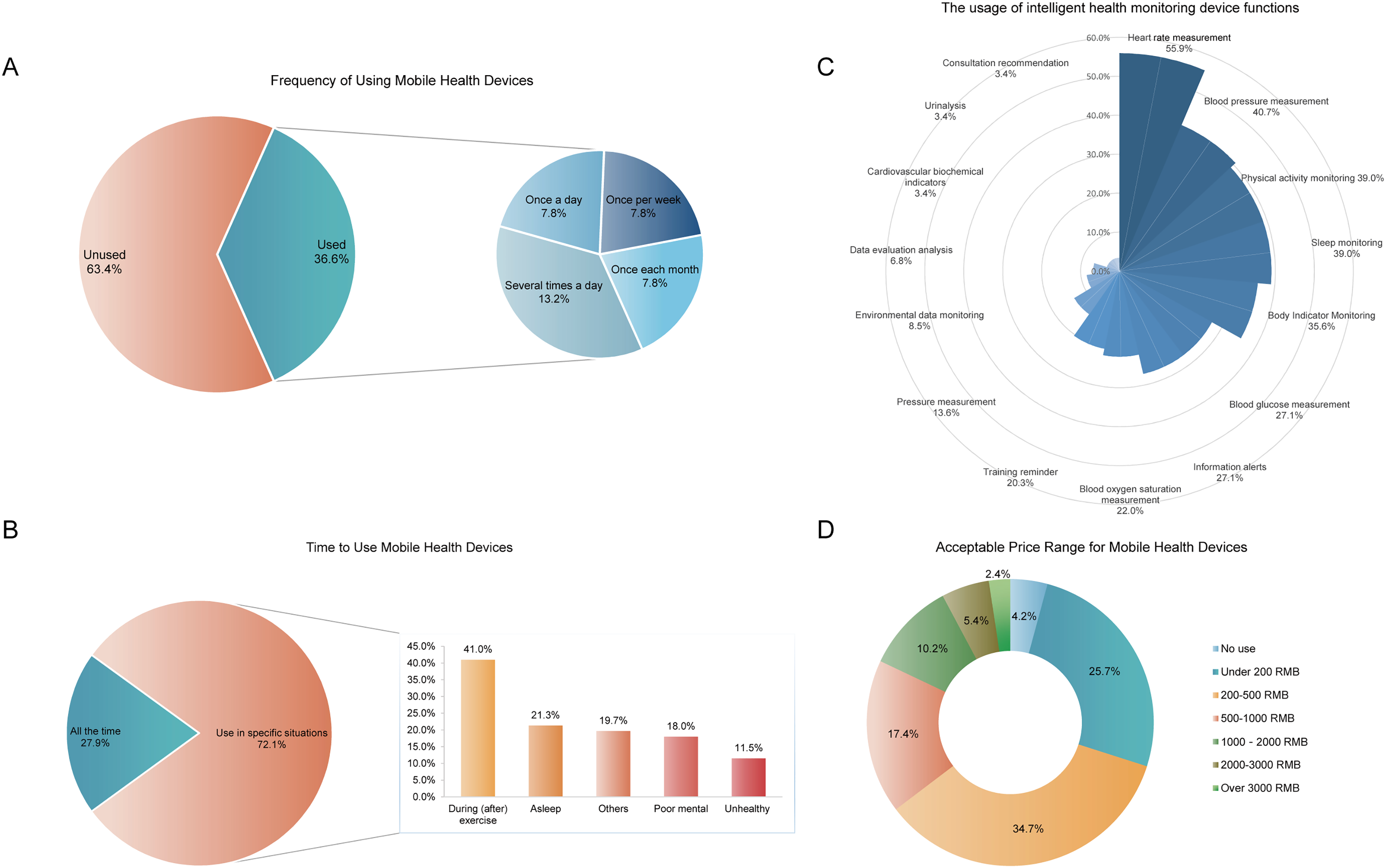
Population preferences on mobile device usage. (a) Frequency of participants using mobile health devices; (b) frequency and timing of device usage; (c) most commonly used functions of devices; (d) acceptable price range for devices among participants.
Discussion
Principal findings
This study aimed to gather characteristic data on sleep monitoring devices from the four largest mobile e-commerce platforms in China and conducted online questionnaires to explore the real-world and subjective perspectives of the population. Our findings indicate that smart bracelets are the most common type of sleep monitoring device and that they mainly measure physical activity, sleep time, sleep quality assessment, and risk prediction. The sales of devices were found to be negatively correlated with their selling price but positively correlated with their functions, including sleep quality assessment, measuring physical activity, and blood oxygen saturation. Moreover, we observed that people tend to purchase convenient and affordable devices, with an acceptable price of less than 500 RMB.
There is a wide variety of smart health devices available on the market, many of which are capable of home sleep monitoring and have gained popularity among consumers. The measurement indices of these sleep monitoring devices have been developed with reference to PSG, which is considered the gold standard for clinical diagnosis of sleep disorders. A substantial number of laboratory and cohort studies have been conducted to demonstrate their feasibility.9,34,35 Building on existing research in mobile health devices, this study contributes to our understanding of sleep monitoring devices through a comprehensive market analysis and evaluation of their functional characteristics and population preferences in China. We provide a comprehensive overview of these devices in terms of market sales, device functionality, and user preferences (feedback). Our aim is to offer valuable insights that could guide the future improvement and development of sleep monitoring devices. 27 In this study, we used real-world data to summarize the fundamental characteristics of commercially available sleep monitoring devices and found that smart bracelets are the most popular category of sleep monitoring devices. The accuracy of sleep monitoring based on smart bracelets has been well validated, 36 making them a suitable choice for sleep health management. Our findings also suggest that most devices can measure not only sleep-related indicators but also general health indicators, such as heart rate and physical activity. Kwasnicki et al. demonstrated the high accuracy of motion sensors on the body used to detect various sleep positions and assess sleep quality. 37 Analyzing sleep quality by measuring body movements is popular due to its simplicity, low cost, and unobtrusive application in assessing sleep-wake patterns despite its inherent limitations. 38 The questionnaire results of this study reveal that people use the devices not only during sleep but also during or after exercise and frequently utilize heart rate, blood pressure, and physical activity monitoring functions, which reflects people's preference for general health measurement functions. Therefore, we recommend that the development of general health measurement functions for sleep monitoring devices, in addition to sleep-related measurement functions, is worthy of consideration.
This study highlights the negative correlation between the selling price of sleep monitoring devices and their sales, as demonstrated by both real-world data and subjective feedback from the population, suggesting that a price of less than 500 RMB is acceptable for consumers. The study also shows that mobile devices with the ability to monitor physical activity, blood oxygen saturation, and NFC are preferred by users. The clustering results reveal that NFC and payment functions fall under the same category and offer fast and convenient services to users. The popularity of mobile payments has been well established, and the feasibility of heart rate and skin temperature monitoring through NFC has been demonstrated.39,40 Additionally, studies have introduced GPS functions that can be applied to mobile measurements. 41 Monitoring body movement is also a popular quantitative standard for daily exercise health. 42 In summary, the development of general health monitoring functions, particularly those that measure physical activity and blood oxygen saturation, as well as convenience functions such as NFC and mobile payment, is reasonable and recommended. These features not only enhance sales but also promote long-term use by users.
It is worth noting that sleep monitoring devices use deep sleep duration and the sleep-related apnea-hypopnea index to assess the risk of sleep apnea, which can predict the likelihood of developing sleep disorders and related diseases. As discussed in the introduction, respiratory and pulse oximetry monitoring has become more important for the detection and diagnosis of apnea due to the increasing prevalence and side effects of sleep apnea. 43 This study found a strong correlation between these metrics and suggests that they should be classified as core functional groups for sleep health monitoring devices. In addition, consumers prefer devices that not only measure sleep but also provide sleep quality assessments. Moreover, the mobile application that connects to the device plays an essential role in the overall functionality of sleep monitoring devices. Real-time health data obtained from the device can be sent to a mobile device, such as a smartphone or portable computer, via Bluetooth and wireless networks. This allows for the display of current or long-term measurements in the form of graphs, reports, and other visual aids, which enhances the usefulness of the device. Users can easily view individual data such as measurement results, long-term summary charts, health reports, and guidance on an electronic screen, making it easier for them to understand their current sleep health status and long-term effects. 44 This makes sleep monitoring devices an ideal tool for managing sleep health at home.
Limitations
This study has several limitations. First, the cross-sectional nature of the device data collected on the e-commerce platform limits the ability to infer causality between device characteristics and sales outcomes. Second, our data collection time was from February 5 to 10, 2021, which means that our research results can only represent the situation of a specific period. As time goes by, device sales data may change. At the same time, mobile health technology is developing rapidly and new devices are constantly being launched. Our data may not be able to reflect the latest device situation. However, there may not be a large difference in functionality between new products launched by the same brand and old products. Therefore, although devices have been updated, their core functions may not have changed significantly. Third, due to the confidential nature of the demographic information of individuals purchasing sleep devices in the online marketplace, it is not feasible to directly distribute questionnaires. Consequently, we have opted for an online recruitment approach to gather volunteers for this survey, aiming to explore public perceptions of mobile health devices. While this convenient sampling method may lean towards attracting younger participants who are more inclined to use mobile devices, it nonetheless establishes a foundation for the development and enhancement of mobile health devices, including sleep monitoring devices. Fourth, although our questionnaire was systematically constructed based on a literature review of mobile health device usage, it has not undergone formal validation processes. Despite this limitation, our questionnaire design provides a framework for future studies to develop standardized assessment tools. Fifth, the questionnaire responses were self-reported, which may be subject to recall bias and self-reporting bias. Nevertheless, this study provided a valuable overview of the sleep device market and consumers’ device selection tendencies in China.
Strengths
This study has several strengths. First, while sleep monitoring devices based on mobile devices have become increasingly popular for sleep health management among the general public, most studies on these devices focus on their technical aspects, without much research on their functional characteristics or user feedback. This study uniquely addresses these gaps in research, providing valuable insight into people's demands for sleep health management. Second, the study included a large sample of 203 sleep monitoring devices from the four largest mobile shopping malls in China in terms of sales, which is unprecedented in scale compared to previous studies that typically included only a few to a dozen devices. 45 The large real-world dataset provides a comprehensive view of the functional characteristics of sleep monitoring devices and the selection tendencies of the population. Finally, the study also explored the audience for sleep monitoring devices in terms of their feedback and willingness to use them, providing insight into user perspectives. The combination of the population survey and the functional characteristics of the devices complement each other and provide guidance for device development and population preferences.
Perspective
While most current consumer sleep monitoring devices are designed for general health tracking, there is a growing need for devices specifically tailored to sleep-disordered populations. To bridge this gap between market needs and device design, collaboration among device manufacturers, researchers, and healthcare professionals is essential. Such partnerships can facilitate the development and validation of specialized devices that better address the specific needs of sleep-disordered populations, ensuring that future devices not only track sleep metrics but also provide clinically relevant data for diagnosis and treatment. Furthermore, while many devices claim high accuracy supported by extensive R&D and medical device certifications, the actual measurement accuracy of these devices might not be fully validated or accessible to researchers. This uncertainty in measurement accuracy can significantly impact both user trust and market demand. Therefore, appropriate sleep assessment methods are crucial for evaluating these specialized devices and ensuring their clinical utility.
To address these challenges and enhance device reliability, we propose two preferred ways to analyze the measured metrics of sleep monitoring devices and make an assessment. One way is to use a particular algorithm built inside a mobile application that utilizes machine learning to analyze data collected by a smart health device and derive more precise and comprehensive health judgments. 44 Another strategy is to use real-time health data monitoring by external devices for consultation and diagnosis by internet doctors, enabling a new medical model through the use of a mobile health (mHealth) application platform on mobile devices. 46 With the guidance of qualified internet doctors and evidence-based health information available on the application platform, users can modify their behavior to maintain their health or facilitate recovery from disease. 47
By utilizing the sleep health data monitored by the devices, doctor-patient interaction can be realized, providing continuous long-term sleep-related data from the user to the medical professional for convenient and quick long-term follow-up. The medical professional can then provide risk assessment and clinical guidance on sleep disorders to the user. Compared to the conventional medical model, this not only enables users to obtain more expert clinical conclusions and recommendations but also makes it easier to allocate medical resources appropriately. 48 Additionally, the involvement of healthcare professionals in data interpretation can help mitigate concerns about device accuracy and enhance the overall reliability of sleep assessments. Delivering relevant health information about the user's actual sleep health can further increase the application's utility.
Conclusions
As the prevalence of sleep disorders continues to rise, sleep monitoring devices, such as smart bracelets, will become increasingly popular for managing sleep health. These devices can effectively measure indicators such as heart rate, physical activity, and sleep duration and assess sleep quality. A well-developed device should include sleep monitoring and assessment functions as well as general health monitoring and assessment features and convenient functions while remaining priced below 500 RMB to be more accessible to the public. Cloud-based data from sleep monitoring devices can facilitate patient-doctor interactions and greatly advance the development of intelligent healthcare.
Supplemental Material
sj-docx-1-dhj-10.1177_20552076251320752 - Supplemental material for Functional characteristics of sleep monitoring devices in China: A real-world cross-sectional study
Supplemental material, sj-docx-1-dhj-10.1177_20552076251320752 for Functional characteristics of sleep monitoring devices in China: A real-world cross-sectional study by Le Yang, Bingtao Weng, Xingyan Xu, Zhi Huang, Run Ding, Miaomiao Si, Yingxin Fu, Yurui Zhu, Yu Jiang, Beibei Rao, Xinyi Zhang, Qingwei Zhou, Shenglan Lin, Yansong Guo and XiaoXu Xie in DIGITAL HEALTH
Supplemental Material
sj-docx-2-dhj-10.1177_20552076251320752 - Supplemental material for Functional characteristics of sleep monitoring devices in China: A real-world cross-sectional study
Supplemental material, sj-docx-2-dhj-10.1177_20552076251320752 for Functional characteristics of sleep monitoring devices in China: A real-world cross-sectional study by Le Yang, Bingtao Weng, Xingyan Xu, Zhi Huang, Run Ding, Miaomiao Si, Yingxin Fu, Yurui Zhu, Yu Jiang, Beibei Rao, Xinyi Zhang, Qingwei Zhou, Shenglan Lin, Yansong Guo and XiaoXu Xie in DIGITAL HEALTH
Supplemental Material
sj-docx-3-dhj-10.1177_20552076251320752 - Supplemental material for Functional characteristics of sleep monitoring devices in China: A real-world cross-sectional study
Supplemental material, sj-docx-3-dhj-10.1177_20552076251320752 for Functional characteristics of sleep monitoring devices in China: A real-world cross-sectional study by Le Yang, Bingtao Weng, Xingyan Xu, Zhi Huang, Run Ding, Miaomiao Si, Yingxin Fu, Yurui Zhu, Yu Jiang, Beibei Rao, Xinyi Zhang, Qingwei Zhou, Shenglan Lin, Yansong Guo and XiaoXu Xie in DIGITAL HEALTH
Supplemental Material
sj-docx-4-dhj-10.1177_20552076251320752 - Supplemental material for Functional characteristics of sleep monitoring devices in China: A real-world cross-sectional study
Supplemental material, sj-docx-4-dhj-10.1177_20552076251320752 for Functional characteristics of sleep monitoring devices in China: A real-world cross-sectional study by Le Yang, Bingtao Weng, Xingyan Xu, Zhi Huang, Run Ding, Miaomiao Si, Yingxin Fu, Yurui Zhu, Yu Jiang, Beibei Rao, Xinyi Zhang, Qingwei Zhou, Shenglan Lin, Yansong Guo and XiaoXu Xie in DIGITAL HEALTH
Supplemental Material
sj-pdf-5-dhj-10.1177_20552076251320752 - Supplemental material for Functional characteristics of sleep monitoring devices in China: A real-world cross-sectional study
Supplemental material, sj-pdf-5-dhj-10.1177_20552076251320752 for Functional characteristics of sleep monitoring devices in China: A real-world cross-sectional study by Le Yang, Bingtao Weng, Xingyan Xu, Zhi Huang, Run Ding, Miaomiao Si, Yingxin Fu, Yurui Zhu, Yu Jiang, Beibei Rao, Xinyi Zhang, Qingwei Zhou, Shenglan Lin, Yansong Guo and XiaoXu Xie in DIGITAL HEALTH
Footnotes
Acknowledgments
We are thankful to the study participants.
Authors’ contribution
Le Yang had full access to all of the data in the study and took responsibility for the integrity of the data and the accuracy of the data analysis. Study concept and design: Le Yang, XiaoXu Xie. Acquisition, analysis, or interpretation of data: Le Yang, Bingtao Weng, Xingyan Xu. Drafting of the manuscript: Le Yang, Bingtao Weng, Xingyan Xu, Zhi Huang, Run Ding, Miaomiao Si, Yingxin Fu, Yurui Zhu, Yu Jiang, Beibei Rao, Xinyi Zhang, Qingwei Zhou, Shenglan Lin, Yansong Guo. Critical revision of the manuscript for important intellectual content: XiaoXu Xie. Statistical analysis: Le Yang, Bingtao Weng. Obtained funding: XiaoXu Xie. Administrative, technical, or material support: XiaoXu Xie. Study supervision: XiaoXu Xie.
Data availability
Scientists wishing to use mobile health study data for noncommercial purposes can obtain the dataset by contacting the corresponding author.
Declaration of Conflicting Interests
The author(s) declared no potential conflicts of interest with respect to the research, authorship, and/or publication of this article.
Funding
This research was supported by Fujian Medical University College Students’ Innovative Entrepreneurial Training Plan Program (C21118, C22024), Fujian Medical University Public Health School College Students’ Innovative Entrepreneurial Training Plan Program (xy202010015, xy202010018, xy202110005), Fujian Medical University Talent Research Funding (XRCZX2019031), National Natural Science Foundation of China Youth Program (82203989), Natural Science Foundation of Fujian (2021J01729), and Fujian Province Students’ Innovative Entrepreneurial Training Plan Program (S202010392017; S202010392019).
ORCID iDs

Supplemental material
Supplemental material for this article is available online.
References
Supplementary Material
Please find the following supplemental material available below.
For Open Access articles published under a Creative Commons License, all supplemental material carries the same license as the article it is associated with.
For non-Open Access articles published, all supplemental material carries a non-exclusive license, and permission requests for re-use of supplemental material or any part of supplemental material shall be sent directly to the copyright owner as specified in the copyright notice associated with the article.
