



Abstract
Background
Improving cognitive function in healthy older adults is a global concern. Cognitive training delays mental deterioration. The utilization of robots and board games for aiding older adults in cognitive training represents a prominent technological trend and is a subject of meriting investigation.
Objective
This study evaluates the acceptability and factors influencing the continuous usage intention of a robot-assisted board game (RABG) for cognitive training in community-dwelling older adults based on the decomposed theory of planned behavior (DTPB).
Methods
In this explanatory study, we developed an RABG with six educational modules. The experiences of 126 older adults recruited from northern Taiwan who completed the program were assessed using a DTPB-based questionnaire. Partial least-squares structural equation modeling was used to examine the correlations.
Results
The results demonstrate the DTPB's sufficient fitness and 79.9% explanatory power for the continuous usage intention of the RABG, confirming the effectiveness of the proposed structural model. Perceived usefulness positively affected attitude and continuous usage intention, indicating that perceived usefulness is critical in promoting older adults’ continuous usage intention. The interpersonal influence was a major antecedent of subjective norms. Self-efficacy affects perceived behavioral control. Attitudes and perceived behavioral control affected users’ intentions to use the RABG.
Conclusions
Our findings support the applicability of the DTPB in evaluating RABGs for cognitive training in older adults, suggesting its potential integration in future interventions.
Keywords
Introduction
The World Health Organization estimates that by 2050, the number of people over 65 will exceed 1.5 billion, accounting for 16% of the global population. 1 Aging problems include a decline in body tissue and function, deterioration of cognitive function, and changes in brain executive abilities.2,3 Enhancing cognitive reserves contributes to the regulation or amelioration of brain changes and damage. 4 Recently, cognitive function and age-related dementia have gradually become crucial practical and academic problems. Approximately 50 million individuals worldwide have been affected by degenerative brain diseases, and this number is expected to increase dramatically to more than 150 million by 2050. 5 The Lancet Committee suggests that a series of policy initiatives can be implemented to reduce considerably or delay brain degeneration, among which increasing social and cognitive activities for high-risk groups is an effective option. 6
Increased cognitive activity may stimulate the cognitive reserve and act as a buffer against rapid cognitive decline. 7 Cognitive training involves a series of activities designed to stimulate older adults’ memories, enhance their understanding of people and things, and improve their sense of orientation through guided exercise. 8 Previous research has demonstrated the benefits of cognitive-based interventions even for older adults with mild cognitive impairment stages. 9 Chiu et al. conducted a meta-analysis and found that for healthy older adults, cognitive training moderately influenced overall cognitive and executive functions but had minor effects on memory, attention, and visual–spatial abilities. 10 According to Butler et al., cognitive stimulation or training improves older adults’ cognitive abilities before their cognitive function degenerates. However, no significant changes were observed in the patients who had already experienced cognitive deterioration. 11 Additionally, research has shown that the prevalence of dementia and the rate of functional dependence are higher among older adults residing in long-term care facilities, with cognitive decline worsening the longer they remain institutionalized. 12 Therefore, older adults should initiate cognitive activities as early as possible to delay cognitive decline.
Technology-based interventions for cognitive training
Following the evolution of technology and the development of artificial intelligence (AI), applying new technology products to prevent cognitive decline is an innovative strategy. Numerous studies have demonstrated the positive effects and potential of technology-based cognitive training interventions for older adults. Interventions such as computerized cognitive training, virtual reality interventions, and robot-assisted interventions have been employed to improve cognitive functioning. 13 Recent technological advances have increased the interest in interactive robots to provide healthcare for older adults, 14 highlighting the need for exploratory studies to understand the feasibility and acceptance of such robot-assisted care among older populations.
Acceptability is a critical factor in the successful adoption of technology among older adults; a previous study confirmed that older adults consider information and communication technology platforms acceptable, engaging, and valuable; however, the digital gap should first be bridged for effective implementation. 15 Moreover, a systematic review indicated that past studies have shown that robotic-assisted technologies positively affect the health problems of older adults 16 and encourage social engagement among them. 17
Owing to the increase in the older adult population, there has been a growing emphasis on the design of applied technologies for the prevention and treatment of cognitive impairment in older adults. 18 The Robot-assisted Board Game (RABG), developed in this study, incorporated cognitive training into an interactive, gamified format. Board games facilitate interpersonal interactions and socialization, enabling older adults to maintain brain function and enhance social participation. 19 A meta-analysis indicated that board games can improve cognitive impairment and depression in older adults. 20 Other studies have pointed out that games can improve cognitive function and provide collaborative opportunities for individuals with dementia to interact with others by talking, assisting, encouraging, and inspiring each other and generating a sense of achievement during the game.21,22 By integrating robotics into these activities, the RABG program offers older adults an innovative tool for cognitive training, tailored to their needs and preferences.
To assess the overall acceptability of the RABG, we utilized the System Usability Scale (SUS), a well-established instrument recognized for its reliability, simplicity, and cost-effectiveness. 23 The SUS provides a standardized measure that can be easily applied across different systems and contexts, making it a popular choice for usability testing. It is known for its strong reliability (α = 0.70–0.91) and validity, with a threshold score of 70 indicating acceptable usability. 24 This usability foundation aligns with the theoretical constructs of the decomposed theory of planned behavior (DTPB), which provides a robust framework for examining technology adoption.
Theoretical framework: DTPB
The theory of planned behavior (TPB) proposes that behavior is predicted by behavioral intention that is influenced by attitude, subjective norms, and perceived behavioral control. 25 Ajzen (1991) indicated that constructs such as attitude, subjective norms, and perceived behavioral control are one-sided. Therefore, they may cause positive and negative beliefs on the same side to cancel each other out and affect the final results. 26 Taylor and Todd (1995) developed the DTPB by incorporating the TPB and the technology acceptance model (TAM). 27 Key definitions related to these theoretical constructs are provided in the glossary table in Appendix 1. The DTPB enables flexibility in discussing antecedents in diverse research scenarios, such as predicting students’ acceptance and continued intention to use immersive virtual reality to learn about illicit drug prevention 28 and predicting the continuous usage intention of information technology (IT) products. 29 Continuous usage intention refers to an individual's tendency to keep using a tool or system in the future. 28
Subjective norms refer to the social pressure to perform or not perform a target behavior, such as the influence of significant others. 30 These norms are critical during the early stages of innovation implementation 27 and relate to intention because people habitually act based on what others think they should do. Davis showed that attitudes can effectively predict behavioral intention in TAM. 31 Attitude can directly or indirectly influence the performance of a particular behavior. In addition, attitude refers to the degree to which a person actively or passively values technology. Therefore, DTPB is useful for investigating the influencing pathway of continuous usage intention related to technology-assisted learning. This study is the first to investigate the user experience of an RABG program for the cognitive training of older adults and examine the constructs associated with continuous usage intention in terms of the DTPB model. Perceived usefulness refers to the degree to which a person believes using a specific system improves their performance. 32 Regarding the use of emerging technologies, studies have found that perceived ease of use is not significant, 33 although some studies have shown that perceived usefulness and ease of use impact attitudes considerably. 34 Self-efficacy refers to an individual's confidence in their ability to use a given skill to accomplish an assigned task. Based on the framework of the DTPB, we propose hypotheses to explain older adults’ intention to use continuously robot-assisted board games.
Materials and methods
Design of the RABG program
We designed an RABG program for cognitive training of older adults. The RABG program included six aspects based on the Mini-Mental State Examination (MMSE), 35 namely, (1) orientation ability, (2) attention and calculation ability, (3) short-term memory (recall), (4) language skills (naming, repeating a phrase or sentence, and verbal and written commands), (5) comprehension skills (ability to understand and follow instructions), and (6) visuospatial abilities (visual and spatial relationships between objects), as the basis for developing board game contents, as shown in Table 1. This six-unit board game program lasts approximately 1 h per unit, with participants engaging in three 1-h sessions per week over 2 weeks.
Designated robot-assisted board game (RABG) program.
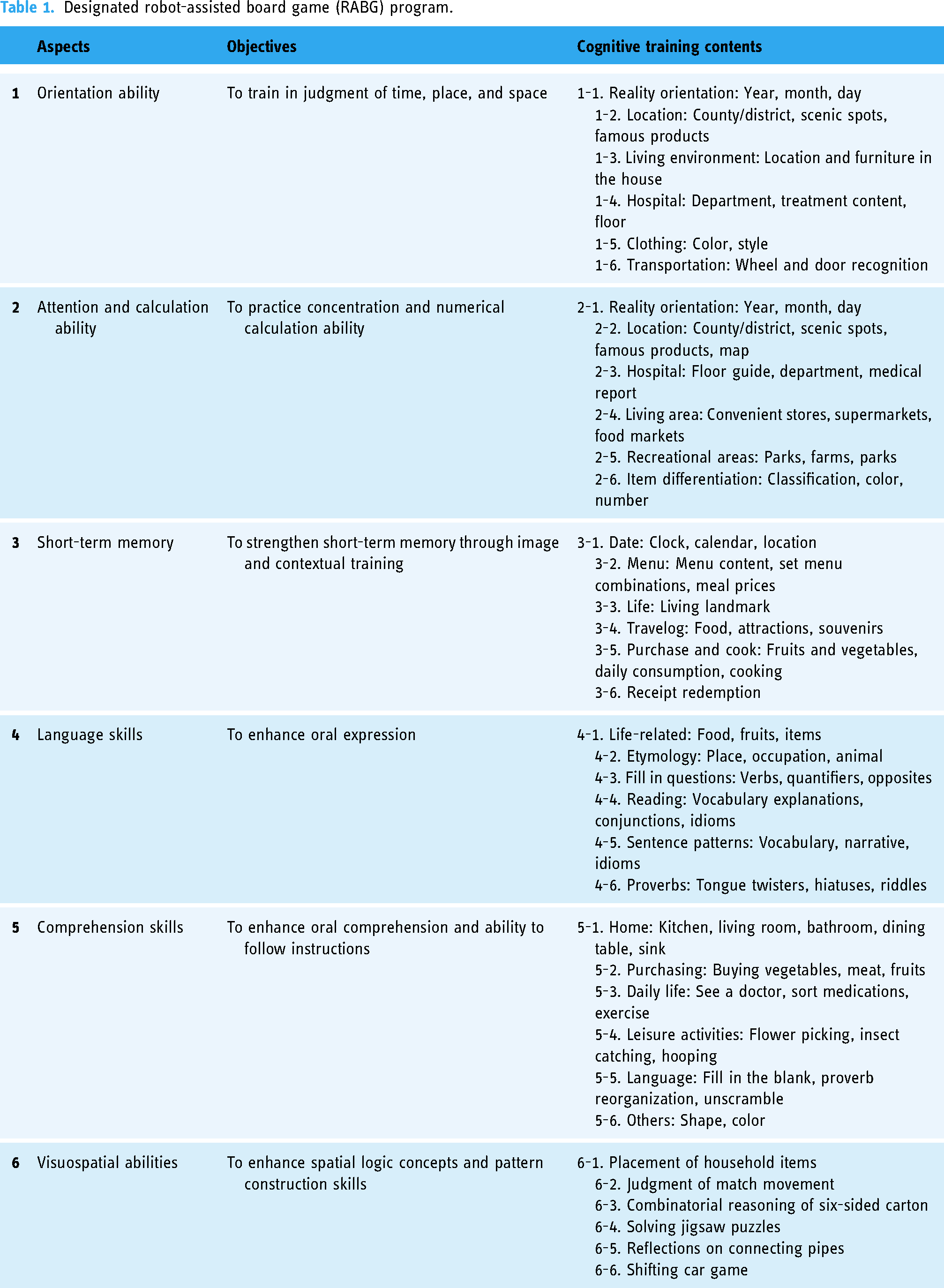
The program integrates robotic technology to complement the traditional board game format. The robot hosts a question bank of 320 cognitive training questions, categorized to train the six targeted abilities progressively. During gameplay, participants roll dice to navigate the board, and the robot interacts by reading questions aloud, providing real-time feedback, and recording responses. Correct answers are praised, while incorrect responses receive encouragement, fostering a supportive and engaging environment. Each group was supported by a research team member who acted as a facilitator, primarily responsible for explaining the game rules and ensuring smooth progress and order. The research team's specific duties included setting up equipment, providing training on game operations, guiding participants through quick response code scanning, adjusting the robot's angle for optimal interaction, and assisting participants in engaging effectively with the robot. The participants play board games with simultaneous cognitive training. The robot enhances participant engagement through human-like interactions, such as celebratory gestures or expressions of disappointment. This interactive dynamic complements the board game's physical, strategic elements, such as chance/fate cards, introducing variability and excitement. The robot's question-based interactions synchronize with board progression, creating a seamless link between digital and physical components.
This board game is designed for both single and group players. The game activities consider the age of the participants, integrate Taiwan's distinctive culture and characteristics, and leverage robot-assisted artificial intelligence to provide instantaneous feedback, entertainment, and an enhanced sense of presence through sound and screen images. This approach aims to motivate users to continue advancing and facing challenges. Figure 1 shows participants using the RABG system, highlighting how the robot facilitates questions and complements board navigation during training, with a sample of the program interface provided in Appendix 2.

The example photos of older adults interacting with the robot-assisted board game.
Participants and recruitment
This study used purposive sampling. One hundred and thirty adults aged 65 years or older were enrolled in this program at six community sites in northern Taiwan. The inclusion criteria were for older adults: (1) aged 65 years or older, (2) no visual or hearing impairments, (3) willing to participate in the study, (4) able to perform the RABG as instructed, and (5) willing to cooperate with the RABG content and complete the questionnaire. Due to incomplete responses from four participants, the final effective sample included 126 completed questionnaires. There were no specific exclusion criteria. The research team contacted northern Taiwan community centers in a medium-sized city (population of 362 874 as of March 2024) and explained the purpose of the study. After obtaining consent from the director of the community site, we posted a recruitment poster and arranged an orientation to explain the program's content. Older adults willing to participate in the RABG program were invited to complete an informed consent form to enable participation.
Measurements
Applicability evaluation of DTPB
The questionnaire contained demographic variables and 12 variables based on the DTPB, as shown in Appendix 3. The demographic variables included sex, age, education level, previous experience, and satisfaction with technological products and interactive robots. The 12 variables included attitudes, subjective norms, perceived behavioral control, continuous usage intention, perceived ease of use, usefulness, enjoyment, compatibility, interpersonal influence, self-efficacy, resource-facilitating, and technology-facilitating conditions. There were 1–6 items for each of the 12 variables (36 items in total). Furthermore, these items were modified from the DTPB questionnaire used in a previous study. 28 Content validity, reviewed by six professionals, was used to justify the validity of the questionnaire.
A sample item for continuous usage intention was, “I am willing to use the RABG in the future to stimulate cognition.” The DTPB questionnaire used a five-point Likert scale (strongly disagree to strongly agree) to assess the correlates that influenced continuous usage intentions, including attitudes, subjective norms, and perceived behavioral control. The higher the score, the more positive the older adults’ attitudes, subjective norms, and perceived control toward playing board games to prevent dementia. Moreover, the antecedents of attitudes, subjective norms, and perceived behavioral control were assessed. Higher scores for these antecedents indicate more positive beliefs related to attitudes, social norms, and perceived behavioral control.
Acceptability evaluation of RABG
This study utilized the SUS to assess the usability and acceptability of the RABG system. Developed by Brooke (1986), the SUS is a validated tool known for its reliability, simplicity, and adaptability across diverse systems. 23 It comprises 10 items, eight addressing usability and two evaluating learnability, rated on a five-point Likert scale (strongly disagree to strongly agree). For example, a sample item for usability was, “I think that I would like to use this RABG system frequently,” while a sample item for learnability was, “I needed to learn a lot of things before I could get going with this RABG system.” The SUS has increased reliability (α = 0.70–0.91) and validity, with a threshold score of 70 denoting acceptable usability. 24
Statistical analysis
The participants’ demographic data were analyzed using SPSS (version 23.0) and presented as counts and percentages. Partial least-squares structural equation modeling (PLS-SEM) was used in conjunction with SmartPLS (version 3.0) to examine the proposed hypotheses. PLS-SEM is more suitable than covariance-based structural equation modeling for studies with small sample sizes. 36 In addition, PLS-SEM is appropriate for testing a theoretical framework from a prediction perspective. The minimum sample size recommended for the PLS-SEM analyses was 10 times the maximum number of structural paths in the model for a specific latent variable. 37 The sample size in this study was sufficiently large to meet these conditions.
The hypothesis paths (as illustrated in Figure 2) examined in this study include:
Hypothesis 1 (H1): Attitudes influence continuous usage intention. Hypothesis 2 (H2): Subjective norms influence continuous usage intention. Hypothesis 3 (H3): Perceived behavioral control influences continuous usage intention. Hypothesis 4 (H4): Perceived ease of use influences attitudes. Hypothesis 5 (H5): Perceived usefulness influences attitudes. Hypothesis 6 (H6): Perceived enjoyment influences attitudes. Hypothesis 7 (H7): Perceived compatibility influences attitudes. Hypothesis 8 (H8): Interpersonal influence influences subjective norms. Hypothesis 9 (H9): Self-efficacy influences perceived behavioral control. Hypothesis 10 (H10): Resource-facilitating conditions influence perceived behavioral control. Hypothesis 11 (H11): Technology-facilitating conditions influence perceived behavioral control.

The hypotheses of the proposed model.
PLS-SEM analyses were conducted in two stages. 38 The first stage examined the reliability and validity of all the constructs of the proposed model. It is critical to confirm that the convergent and discriminative validities of the latent variables met the standards. The convergent validity can be justified by the item's loading, Cronbach's α, composite reliability (CR), and average variance extracted (AVE). The threshold of each item's loading and Cronbach's α of a measurement scale equal to or greater than 0.70 is considered reliable. 39 CR refers to the internal consistency of variables; the CR values must be higher than 0.70. 39 AVE represents the explained variation between the latent and measured variables. Therefore, the higher the AVE value, the higher the variance explained by the measured variable. The AVE values were recommended to be greater than 0.50. 36
To establish discriminant validity, we examined the Fornell–Larcker criteria and heterotrait-monotrait (HTMT) ratios. The Fornell–Larcker criterion indicates that the square root of the AVE for each variable should exceed the correlation of the latent variables. 36 HTMT values less than 0.90 verify discriminant validity. 40
In the second stage, the structural model was assessed. Path coefficients were calculated using estimates to represent the hypothesized relationships between the constructs. 37 The standardized root-mean-square residual (SRMR) was used to examine the fit of the model. A smaller SRMR indicates a better model fit, and an SRMR value < 0.08 is considered an acceptable indicator of model fit. 41 R2 (determination square) was used to examine the explained proportion of variance. An R2 value of 0.75, 0.50, and 0.25 indicates substantial, moderate, and weak levels of predictive accuracy, respectively. 36
Ethical considerations
This study was approved by the Research Ethics Review Committee of the National Taiwan University Hospital, Taiwan, No. 202111022RINA (4 January 2022). All participants were fully informed and provided their written informed consent before the interviews began.
Results
Participants’ characteristics and responses
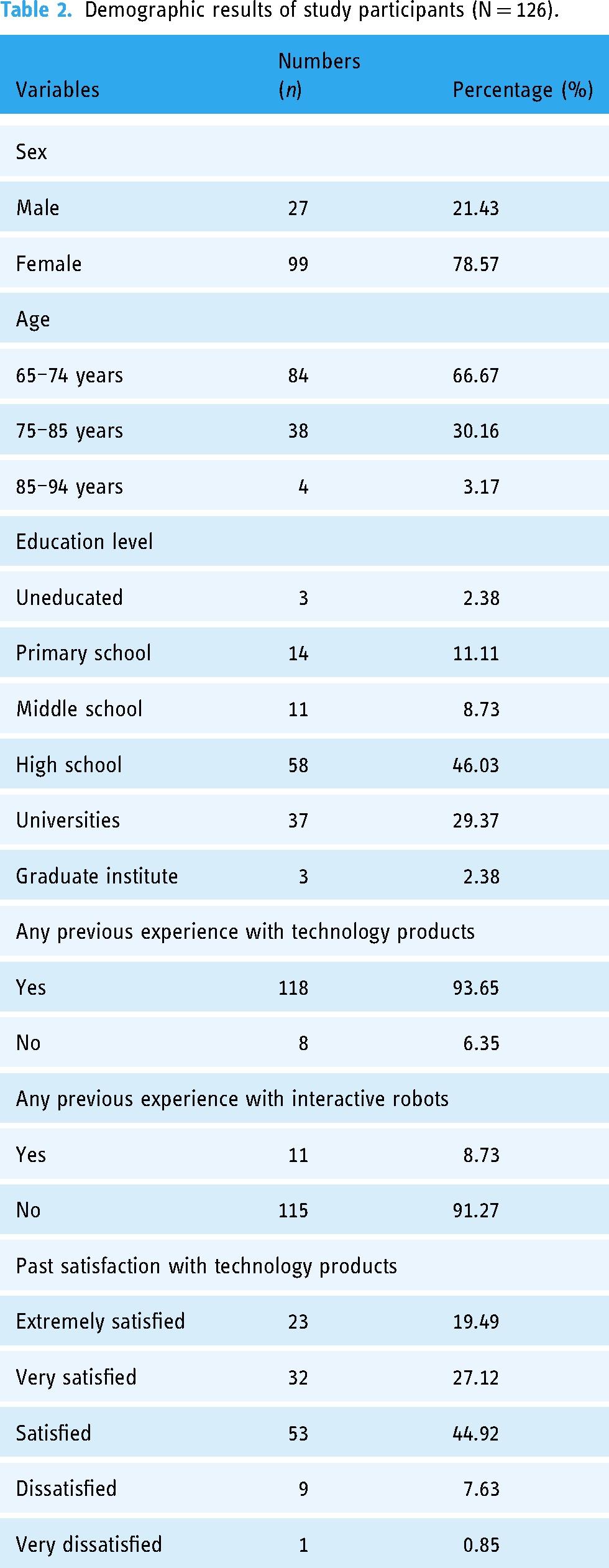
One hundred twenty-six older adults completed the survey. The mean age of the participants was 73.2 years (ages ranged from 65 to 94 years). Among these, 78.57% were female; the proportion of participants with high school education was the highest (46.03%). As shown in Table 2, 93.65% of the participants had prior experience using technological products. However, only 8.73% of the participants had prior experience using interactive robots; 91.53% were satisfied with the use of technology products.
Demographic results of study participants (N = 126).
Acceptability of RABG assessment
The SUS score for the RABG system was 87.50, exceeding the standard threshold for usability and placing the system in the “excellent” range compared with other systems evaluated in similar contexts. 24 This result demonstrates the system's ease of use and practical design, which align with older adults’ cognitive abilities and interaction preferences.
Measurement model assessment
As shown in Table 3, there were no significant differences in the 12 variables when grouped by sex, age, education level, or experience with interactive robots. The descriptive results of the 12 variables of the DTPB are presented in Table 4. The mean scores of the 12 variables were based on a five-point Likert-type scale and were in the range of 4.16–4.43, indicating that participants’ evaluation of the RABG was generally favorable. While playing the RABG, the participants reported that their experience was interesting, the game was easy to execute, and they indicated that the robot was cute and increased the entertainment value of the game.
Effects of sociodemographic groups on 12 variables: independent t-test and ANOVA results.
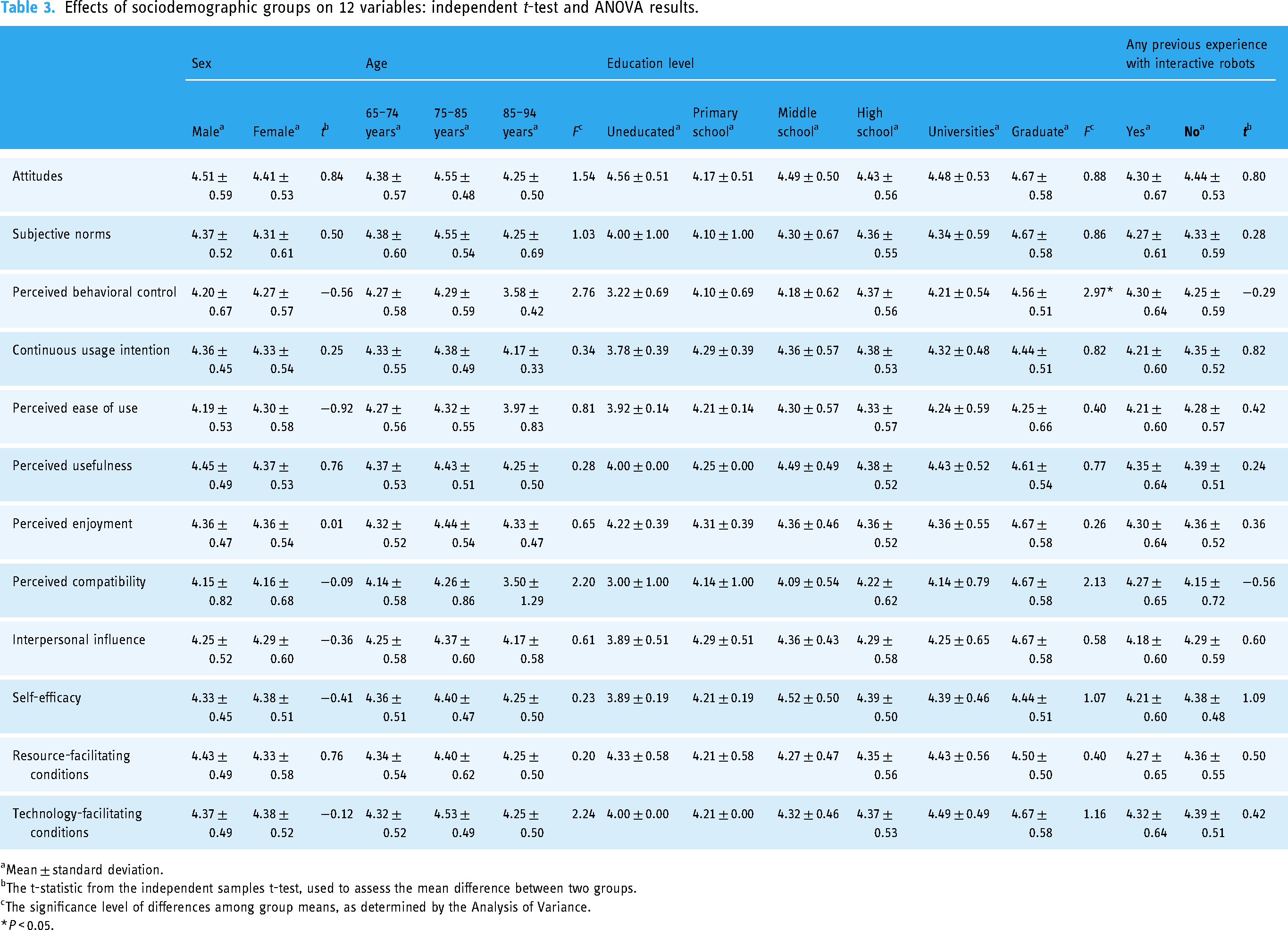
Mean ± standard deviation.
The t-statistic from the independent samples t-test, used to assess the mean difference between two groups.
The significance level of differences among group means, as determined by the Analysis of Variance.
*P < 0.05.
Descriptive results of the 12 variables of the DTPB.

Table 5 shows that the results of the factor loadings (in the range 0.865–1.000), Cronbach's α (ranging from 0.898 to 1.000), CR (ranging from 0.937 to 1.000), and AVE (ranging from 0.832 to 1.000) satisfied the recommended criteria, indicating the adequacy of the proposed measurement model. As shown in Table 6, the aforementioned criteria were met, suggesting that discriminant validity was established.
Convergent validity of the proposed measurement model.

Results of the Fornell–Larcker criterion and HTMT ratio of correlations.

According to this criterion, the square root of the AVE by a construct must be greater than the correlation between the construct and any other construct.
The acceptable level of discriminant validity is suggested to be less than 0.90.
Structural model assessment
Figure 3 presents the PLS-SEM results for the proposed model. The SRMR value was 0.077, which is less than 0.08, indicating that the model fit was satisfactory. The SEM software suggested the addition of two additional paths—from perceived usefulness to continuous usage intention (H12), and from interpersonal influence to continuous usage intention (H13)—to improve the model's fit.

The overall structure of the proposed model.
Perceived ease of use, usefulness, enjoyment, and compatibility explained 49.5% of the variance in the attitudes of older adults participating in the RABG, highlighting that positive attitudes are shaped by how useful, engaging, and easy to use the RABG is perceived to be. Attitudes mediate between perceived usefulness and continuous usage intention, suggesting that if participants perceive the program as beneficial, they are more likely to form positive attitudes, reinforcing their intention to continue using the RABG. Additionally, self-efficacy indirectly affects continuous usage intention through perceived behavioral control, indicating that the confidence of participants in their ability to use the program influences their sense of control, impacting their intent to engage with the RABG over time.
Interpersonal influence explained 46.0% of the variance in subjective norms. This result underscores the importance of interpersonal support, as encouragement from significant others can strengthen continuous usage intention by establishing a supportive social environment. Self-efficacy, resource- and technology-facilitating conditions explained 52.0% of the variance in perceived behavioral control, meaning that access to adequate resources and ease of interaction with the technology help older adults feel capable and in control of using the RABG.
Attitudes, subjective norms, and perceived behavioral control had the most significant explanatory power, with 79.9% of the variance in continuous usage intention. A value of 79.9% was more significant than 75%, indicating a substantial level of predictive accuracy. 36
Table 7 reveals each hypothesis's path coefficient and the corresponsive t- and P values regarding path analyses. More than half of the hypotheses are supported. The supported hypotheses (H1: path coefficient = 0.159, t = 2.038, P = 0.042, H3: path coefficient = 0.309, t = 3.515, P < 0.001, H12: path coefficient = 0.275, t = 2.492, P = 0.013, and H13: path coefficient = 0.253, t = 2.675, P = 0.007) proposed that attitudes, perceived behavioral control, perceived usefulness, and interpersonal influence were major antecedents of continuous usage intention. Perceived usefulness was a significant antecedent of attitude (H5: path coefficient = 0.469, t = 2.608, P = 0.009). Interpersonal influence significantly influenced subjective norms (H8: path coefficient = 0.682, t = 11.694, P < 0.001). Self-efficacy significantly influenced perceived behavioral control (H9: path coefficient = 0.532, t = 4.582, P < 0.001).
Results for the 13 hypotheses tests.

Note: *P < 0.05; **P < 0.005; ***P < 0.001; the statistical significance level was <0.05 for the bold values. The significant path coefficients supported the seven hypotheses.
Discussion
Acceptance and influencing factors of RABG in older adults
This study aimed to determine the constructs that influenced the acceptance of RABG among older adults. The participants reported high scores for the measured constructs of the DTPB associated with RABG, validating the program's acceptance. According to the results of the PLS-SEM structural model, our findings support the suitability of the DTPB as a framework for evaluating the RABG program for older adults based on the SRMR (0.077 < 0.08) and R2 values (79.9% > 75%). In the future, the development of robot-assisted digital cognitive training could incorporate enhancements to key DTPB variables, such as attitudes, perceived behavioral control, interpersonal influence, and perceived usefulness. By designing specific content and activities that target these factors, the acceptance of the technology among older adults can be improved considerably.
Our program's continuous usage intention was directly influenced by three measures: attitudes, perceived behavioral control, and perceived usefulness. Attitudes and perceived behavioral control influenced considerably older adults’ continuous usage intentions, a finding that is consistent with the theoretical assumptions. This aligns with a survey by Sundar and Kanimozhi, who applied the DTPB model to examine the intention to use 4G mobile services. 42 The RABG interface was based on the classic Monopoly board game, a familiar format for this generation of older adults, which enhances its appeal and creates a sense of familiarity. This design choice positively impacts attitudes by resonating with the participants’ experiences and cultural context, making the game more approachable. In terms of perceived behavioral control, the robot's cute appearance and simple, touch-based interactions allow older adults to feel more in control of the technology, helping to bridge the digital gap. However, subjective norms did not significantly influence continuous usage intentions. This may be because older participants already had positive subjective norms toward RABG. Thus, a consistent positive subjective norm and lack of variance do not significantly influence continuous usage intention. 43 The results indicate that attitudes significantly influenced the continuous usage intention of older adults to participate in RABG, which is consistent with the findings of a previous study. 28 Additionally, we found that participants’ attitudes and perceived behavioral control significantly influenced their continuous usage intention. 44 We also found that perceived usefulness directly affected behavioral intention, indicating that RABG is helpful for older adults. The significant constructs do not necessarily need to be influenced by attitude variables to influence continuous usage intentions. The participant's acceptance of unfamiliar technologies and devices was influenced by perceived usefulness, as supported by a previous study. 45
Consistent with a previous study, perceived usefulness was significantly associated with attitudes. 46 The underlying reason indicates that IT products can assist older adults in determining whether they are useful to their lives or individuals, thereby influencing users’ attitudes. For example, a meta-analysis revealed that older adults are the most willing to use familiar technologies. In contrast, older adults may be late adopters of novel technology products and hesitate to adopt them if their benefits are unclear. 47 The RABG program, designed with a sufficient number of reusable questions, supports the need for consistent cognitive training, which enhances its value, especially for institutionalized older adults who may lack cognitive training. This design feature makes the RABG a promising tool that could encourage broader adoption by care institutions. In a previous study, participants perceived usefulness as influential in forming an attitude, and continuous usage intention was significantly influenced by attitude and perceived usefulness. 48 Thus, perceived usefulness emerges as a critical construct that directly and indirectly influences participants’ continuous usage intentions.
However, consistent with a previous study, 28 perceived ease of use and enjoyment did not significantly influence attitudes. A possible explanation is that the RABG still requires staff to assist older adults during the playing process. It is not an easy game for older adults to operate and use. The primary purpose of our RABG program was to train older adults’ cognitive abilities in preventing dementia. Compared with other entertainment games, it is highly likely that they will be less attractive. Since 90% of the participants did not have prior experience with interactive robots, it is reasonable to conclude that the RABG is incompatible with participants’ usage experience. Thus, our structural model does not support H4, H6, or H7. Chen and Janicki found that older adults have a pleasant user experience when playing cognitive augmented reality board games with reminiscence elements. 49 Applying technology and reminiscence elements in AI board games can increase older adults’ game participation. Our RABG may add reminiscence elements to increase the entertainment value of the game for the participants as a reference for the next revision.
Role of subjective norms and interpersonal influence
Our findings also showed that interpersonal influence was significantly associated with subjective norms. However, subjective norms did not significantly influence older adults’ continuous usage intentions, which differs from the results of a previous study. 28 Interpersonal influences significantly influenced continuous usage intentions rather than subjective norms, indicating that the significant others of older adults influenced their continuous usage intentions without subjective norms. This may be because the characteristic of the RABG allows family members and friends to play together simultaneously; hence, interpersonal influences can directly influence continuous usage intention. In a previous study that applied single-player antidrug three-dimensional virtual reality, users were significantly influenced by significant others. Significant others’ antidrug expectations from parents and teachers increased the participants’ willingness to use the VR. 28 Because of the diverse nature of serious games and single- and multiplayer gameplay, it is reasonable to assume that the predictive ability of subjective norms varied across studies. Although significant others influenced older adults’ subjective norms, subjective norms did not influence their continuous usage intentions. Additionally, although sessions were conducted in a group format, the RABG program was designed to support both individual and group play, catering to the diverse learning preferences of older adults in institutional settings. This flexible design enhances the program's adaptability and potential for broader application.
Self-efficacy and perceived behavioral control
The findings suggest that self-efficacy significantly influences perceived behavioral control, indicating that the confidence level of older adults significantly influences their ability to execute digital tasks in the RABG. This result is consistent with a study that used DTPB to examine teachers’ intentions (kindergarten to 12th grade) to implement science, technology, engineering, and mathematics (STEM) education. 50 However, resource- and technology-facilitating conditions do not significantly influence perceived behavioral control. As mentioned earlier, this RABG provides ready-made game tools and resources, and the research staff plays the role of game instructors. It can guide participants to engage in a board game without assistance from the robots. Therefore, it is not surprising that the two constructs were insignificant. Furthermore, the results revealed that perceived behavioral control significantly influenced continuous usage intention, indicating that the greater the mastery and operational ability of the participants, the greater their continuous usage intention, consistent with the findings of a previous study. 51
Implications
This study demonstrated unique innovations that are in line with the trends of the AI era. Our findings extend the DTPB by investigating the acceptability of RABG programs among older, community-dwelling adults. DTPB could be a critical element for dementia prevention in older adults, contributing to the decrease in the disease burden on the healthcare system and caregivers. Our study indicates that integrating board games with interactive robots is feasible for older adults, a finding supported by previous studies.52,53 We suggest the program could be a critical element of cognitive training adopted by older adults. The advantage of the RABG program is that it was designed based on the concepts of gamification and the MMSE. Health games use design elements and mechanics to assist participants in solving personal health problems. This approach can enable people to improve their health while enjoying the fun of playing games and achieving health promotion and disease prevention goals.
Limitations
This study is associated with limitations that should be considered when interpreting the findings. First, the research staff had to assist most participants in using the RABG program, as they were first-time users. Although prior experience with IT products, especially interactive robots, could have been a confounding factor, only a small proportion of participants had previously interacted with robots. This limited exposure enhanced the credibility of our results by minimizing the influence of robot familiarity on participants’ acceptance of the RABG program. However, we cannot entirely rule out that general IT experience may have contributed to the positive acceptability results. Second, we only recruited participants from a medium-sized city, which limits the generalizability of the findings. Third, not all paths are significant, thus limiting the generalizability of the causal explanations of the structural model across different contexts. Nevertheless, the PLS-SEM approach provides valuable insights into the significance of the hypothesized relationships derived from the underlying theory. As suggested by professionals, data usability, which refers to the capacity of data to fulfill the requirements for a specific use situation, should receive adequate attention. Although our findings may not yield perfect causal explanations, they provide valuable insights into programs that use interactive robots for dementia prevention.
Conclusions
This study demonstrates that the DTPB provides a suitable framework for acceptance of an RABG among community-dwelling older adults. Our findings indicate that attitudes, perceived behavioral control, interpersonal influence, and perceived usefulness significantly influence older adults’ intention to continue using the program. The findings also provide insights into programs designed for older adults, including the designs of games and efforts expended to enable older adults to perceive the usefulness of the game. Interpersonal influence affected subjective norms and continued usage intentions, suggesting that involving significant others in gameplay could further enhance engagement and intention to use. This study also highlights the value of cognitive training and interpersonal interaction, as demonstrated through the program's structure and user responses. Few studies have examined user experiences and continuous usage intention for robot-assisted programs by applying the DTPB among older adults. Associations between the 12 DTPB variables hypothesized at the beginning of the study were established. Future research should expand on these findings by implementing the program across varied institutional settings and evaluating cognitive function changes to assess long-term preventive benefits.
Supplemental Material
sj-docx-1-dhj-10.1177_20552076241312576 - Supplemental material for Applicability of the decomposed theory of planned behavior for the evaluation of community-dwelling older adults’ acceptance in continuous usage of robot-assisted board games for cognitive training
Supplemental material, sj-docx-1-dhj-10.1177_20552076241312576 for Applicability of the decomposed theory of planned behavior for the evaluation of community-dwelling older adults’ acceptance in continuous usage of robot-assisted board games for cognitive training by Chiu-Mieh Huang, Su-Fei Huang, Yu-Ting Chen, Ching-Hao Chang, Hsiu-Chun Chien, Ying-Jie Chang, Kuei-Yu Huang and Jong-Long Guo in DIGITAL HEALTH
Supplemental Material
sj-docx-2-dhj-10.1177_20552076241312576 - Supplemental material for Applicability of the decomposed theory of planned behavior for the evaluation of community-dwelling older adults’ acceptance in continuous usage of robot-assisted board games for cognitive training
Supplemental material, sj-docx-2-dhj-10.1177_20552076241312576 for Applicability of the decomposed theory of planned behavior for the evaluation of community-dwelling older adults’ acceptance in continuous usage of robot-assisted board games for cognitive training by Chiu-Mieh Huang, Su-Fei Huang, Yu-Ting Chen, Ching-Hao Chang, Hsiu-Chun Chien, Ying-Jie Chang, Kuei-Yu Huang and Jong-Long Guo in DIGITAL HEALTH
Supplemental Material
sj-docx-3-dhj-10.1177_20552076241312576 - Supplemental material for Applicability of the decomposed theory of planned behavior for the evaluation of community-dwelling older adults’ acceptance in continuous usage of robot-assisted board games for cognitive training
Supplemental material, sj-docx-3-dhj-10.1177_20552076241312576 for Applicability of the decomposed theory of planned behavior for the evaluation of community-dwelling older adults’ acceptance in continuous usage of robot-assisted board games for cognitive training by Chiu-Mieh Huang, Su-Fei Huang, Yu-Ting Chen, Ching-Hao Chang, Hsiu-Chun Chien, Ying-Jie Chang, Kuei-Yu Huang and Jong-Long Guo in DIGITAL HEALTH
Footnotes
Acknowledgements
We thank all the participants for their time and commitment. This article was subsidized by the National Taiwan Normal University, Taiwan, ROC.
Contributorship
Conceptualization: JLG, CMH, and YTC; methodology: JLG and YTC; software: YTC and YJC; validation: JLG, CMH, SFH, and YTC; formal analysis: YTC; investigation: YTC; resources: SFH; data curation: YTC and YJC; writing—original draft preparation: JLG, CMH, YTC, and CHC; writing—review & editing: JLG, CMH, SFH, KYH, and CHC; visualization: YTC, HCC, and CHC; supervision: JLG, CMH, and SFH; project administration: CMH, SFH and YTC; funding acquisition: JLG. All the authors were responsible for drafting the manuscript. All the authors have read and approved the final version of the manuscript.
Data availability
The datasets generated or analyzed in this study are available from the corresponding author upon reasonable request.
Declaration of conflicting interests
The authors declared no potential conflicts of interest with respect to the research, authorship, and/or publication of this article.
Ethical approval
The study was conducted according to the guidelines of the Declaration of Helsinki and approved by the Research Ethics Review Committee of the National Taiwan University Hospital, Taiwan (No. 202111022RINA/4 January 2022).
Funding
The authors disclosed receipt of the following financial support for the research, authorship, and/or publication of this article: This work was supported by the National Science and Technology Council (grant number 111-2622-H-003-005).
Informed consent
Informed consent was obtained from all participants involved in the study.

Supplemental material
Supplemental material for this article is available online.
References
Supplementary Material
Please find the following supplemental material available below.
For Open Access articles published under a Creative Commons License, all supplemental material carries the same license as the article it is associated with.
For non-Open Access articles published, all supplemental material carries a non-exclusive license, and permission requests for re-use of supplemental material or any part of supplemental material shall be sent directly to the copyright owner as specified in the copyright notice associated with the article.
