



Abstract
Objective
This study aimed to identify predictive factors for engagement with dental caries-related posts on Instagram.
Methods
Using CrowdTangle, 10,000 English-language posts were retrieved based on total interactions. From these, 2063 posts were evaluated using predetermined inclusion criteria, and a final sample of 500 posts was selected. Two independent investigators classified the posts according to dichotomized criteria: author profile (regular or commercial users), sentiment (positive or neutral/negative), motivation (financial or nonfinancial), format (link or photo), aim of content (prevention or treatment), and facticity (information or misinformation). Predictive factors for total interaction and overperforming scores were determined using multiple logistic regression models.
Results
Misinformation accounted for 44% of posts. Most posts were shared by regular users (67.8%), used a photo format (61%), and expressed a positive sentiment (73.8%). Prevention-related posts were significantly related to financial motivation, while treatment-related posts were linked to time of publication, neutral/negative sentiment, and photo format. Older posts were positively associated with misinformation (odds ratio (OR) = 1.45). Positive sentiment (OR = 1.71) and regular user profiles (OR = 1.93) were associated with higher total interactions. In contrast, business profiles (OR = 2.39) and posts with neutral/negative sentiment (OR = 1.79) were associated with overperforming scores.
Conclusion
Despite a significant amount of misinformation, only sentiment and author profiles were predictive factors for total interaction and overperforming scores in Instagram posts about dental caries.
Introduction
The increasing availability of digital health information poses challenges for public health professionals, particularly due to the rise in health information-seeking behavior. In this context, social media platforms like Instagram have become prominent channels for disseminating content, allowing users to share health-related information privately and publicly. 1 This shift can empower individuals to take greater control of their healthcare decisions, reducing reliance on traditional healthcare professionals. 2 Cultural traditions and popular values further shape individual and collective health beliefs, influencing how oral health is managed and what information is produced and shared with this intent.3,4
However, the widespread consumption of misleading content about oral health underscores the urgent need for healthcare professionals and organizations to combat misinformation.5–9 Poor-quality online health information can hinder individuals’ ability to manage their oral health issues.10,11 In particular, dental caries—a disease that negatively affects the quality of life by causing functional loss, esthetic issues, painful symptoms, and leading to costly treatments—requires close attention. Hence, providing evidence-based information and promoting an accurate understanding of dental caries prevention and treatment are essential for improving health outcomes.
Thus, this study aims to identify predictive factors for engagement with English-language dental caries-related posts on Instagram, focusing on the author's profile, sentiment, motivation, type of content, and the facticity of the messages.
Methods
The authors adhered to the recommendations of the STROBE Statement for reporting the outcomes of observational studies. 12
Study design
The study design is presented in Figure 1. In this study, Instagram posts in English addressing information on dental caries were gathered through CrowdTangleTM, focusing on posts with the highest total interactions. A total of 500 posts, spanning from August 2018 to August 2022, were included in the sample after screening them by exclusion criteria. Following, two independent investigators (TSM and AMJ) conducted an in-depth qualitative analysis to characterize the messages, examining their author's profile, sentiment, motivation, format, aim of content, and facticity. These characteristics were checked by their possible association with quantitative metrics of user's engagement and time of publication, according to subsequent statistical analyses described in detail below.

Schematic representation of the study design.
Ethics
This study did not require approval from the Council of Ethics in Human Research of the Bauru School of Dentistry, University of Sao Paulo, as federal regulations do not apply to research using publicly available data and not directly involving human subjects. 13 A procedure for concealing personal information, including names and post profiles, was implemented to safeguard user privacy. The anonymized raw data is available in the Figshare repository. These measures ensure participant privacy and align with ethical research practices.
Search strategy, data collection, and preprocessing dataset
The collection of posts related to dental caries on Instagram was conducted through the CrowdTangleTM, a web scraping platform owned by Meta. Access to the platform is granted to qualified organizations, including researchers and university academics. Our research group has specific authorization to use this tool to study misinformation in Dentistry.
A search strategy was developed by the association of representative terms and hashtags using Boolean operators, as follows: “dental decay” OR “tooth decay” OR “toothdecay” OR “cavities” OR “cavities” OR “carious lesion” OR “cariouslesion” OR “caries” OR “cavity”. The data collection focused on posts with the highest total interaction published between August 2018 and August 2022, filtered by photos and albums.
A dataset in .csv format containing 10,000 posts was retrieved using CrowdTangleTM. This dataset included detailed information for each post, such as the name, category, description, country, and number of followers of the profiles from which the posts originated. The posts in the .csv file were ranked from highest to lowest based on interaction metrics. Additionally, it provided details about the posts themselves, including content, date, time, web page URLs, number of reactions, comments, shares, views, total interactions, and overperforming scores. Each post was accompanied by a direct link, allowing researchers to access information about the user who created it, including their name and photo. The overperforming score is a metric that assesses the engagement potential of a post, comparing it to the average total interactions of the last 100 posts from the same profile over different time frames, excluding the top and bottom 25% of posts.14,15
Following, an independent researcher systematically reviewed the first 2063 posts to achieve a predefined sample of 500 posts, as described by previous studies.9,14,16 Specifically, posts were excluded for not being related to the issue of dental caries (n = 128), for not being produced in English (n = 25), for inaccessible links (n = 29), and duplication (n = 1381) (Figure 2). To ensure uniformity and prevent inconsistencies, the independent researcher assigned numbers to the posts and arranged them sequentially on Google Slides (Google, Mountain View, CA, USA). This systematic approach facilitated an ethical analysis of anonymized messages by different researchers at different times. Following this, two independent investigators (TSM and AMJ) manually assessed the raw data. All this information has been compiled and stored in an open-access Figshare repository for further analysis.

Flowchart of post selection process.
Data analysis
Qualitative analysis
The qualitative analysis was performed with a deductive content analysis approach, using a predefined analytical framework and categories. 17 To reduce the subjectivity inherent in this type of analysis, the content was analyzed by two trained investigators (TSM and AMJ) who underwent intra-examiner calibration. They independently evaluated 10% of the total posts (n = 50) and discussed discrepancies with a third experienced researcher (TC) until the Intraclass Correlation Coefficient (ICC) values exceeded 0.7 for all categories. TSM and AMJ are clinical dentists with experience in digital studies, holding research fellowships, and are active on social media. TC is a researcher and clinical dental professor, also experienced in digital studies and active on social media.
After calibration, the two trained investigators classified the posts independently, using the following codes: (i) author's profile (regular users, companies, dental offices, or health professionals), (ii) sentiment (positive, neutral, or negative), (iii) motivation (financial or nonfinancial), (iv) format (photo or link), (v) aim of content (prevention or treatment), and (vi) facticity (information or misinformation). Following the qualitative analysis, the investigators collaboratively reviewed the posts. Disagreement prompted discussions until reaching a final consensus, thereby ensuring the quality and reliability of the analysis.9,14
The assessment of authors’ profiles involved scrutinizing Instagram profiles, classifying them as regular users (including digital influencers or blogs), companies (commercial entities, stores, or profiles associated with media or news agencies), and dental offices (dentists, healthcare professionals, clinics, or hospitals). Determination of the aim of content relied on perceived intentions, encompassing risk factors associated with dental caries prevention and information related to oral rehabilitation and dental materials for restorative treatment procedures.
The term “misinformation” was used in this study to broadly describe false or incorrect information, 18 encompassing “misinformation” (unintentional errors) and “disinformation” (deliberate deception intended to harm). 19 In this sense, posts were classified as misinformation when they disseminated false or misleading content, following scientific guidelines, consensus statements, and systematic reviews to evaluate information on dental caries.20,21 For instance, since the evidence supports fluoridated toothpaste for preventing dental caries, posts contradicting this information must be classified as misinformation. Additionally, no evidence supports the association of antibiotics with the development of dental caries as claimed by posts containing misinformation.
The motivation underlying digital content considered the categories described by Wardle and Derakhshan, 19 including social (related to groups), financial (intending profit), political (attempting to influence opinions due to political positions), and psychological (seeking recognition or reinforcement of an idea).
For sentiment analysis, a predefined protocol was established to minimize the subjectivity of this classification. Content was classified based on visible indicators, such as smiles, words related to disease prevention, motivational messages, and happy emojis, indicating positive feelings. Similarly, the detection of negative feelings relied on identifying expressions of sadness, texts with negative connotations, mentions of illnesses, pain, suffering, tooth loss, or negative emojis. Objective content, such as journalistic news and scientific research results or clinical cases, was categorized as expressing neutral feelings.
Finally, the type of content was automatically informed by the data collected from CrowdTangleTM.
Statistical analysis
SPSS version 28.0 (IBM Inc, Armonk, NY, USA) was used for statistical analysis. Initially, variables were transformed into dichotomized categories, as follows: author's profile (regular user or business/health), sentiment (negative/neutral or positive), motivation (nonfinancial or financial), format (photo or link), aim of content (prevention or treatment), and facticity (information or misinformation). The ICC values indicating the calibration of investigators varied from 0.76 to 0.87.
Continuous variables, including time of publication, total interaction, and overperforming score, were dichotomized using their median values. Given similarities in financial backgrounds, companies, dental offices, news agencies, and business profiles were grouped together. The positive feeling was dichotomized independently due to its theoretical association with higher levels of user engagement on social media. 22
The normality and homogeneity of the data were assessed using the Kolmogorov–Smirnov and Levene tests, respectively. Due to the non-normal distribution, the Mann–Whitney U test was employed to compare total interaction and overperforming scores between dichotomized variables. Furthermore, the differences in the distribution of frequencies of dichotomized variables in relation to categories of aim of content were analyzed using Pearson's Chi-square test.
Multiple logistic regression models were developed to assess the association between misinformation, total interaction, and overperforming scores with the aforementioned variables. The multiple logistic regression models included only factors that demonstrated a Wald test with P value < 0.20 in the simple analyses. A significance level of P < 0.05 was considered significant for all analyses.
Results
A total of 220 posts (44.0%) classified misinformation, with the most being shared by regular users (n = 339, 67.8%), in photo format (n = 305, 61%), focusing on the treatment of dental caries (n = 261, 52.2%), and expressing a positive sentiment (n = 369, 73.8%).
Posts shared by regular users and expressing negative/neutral sentiment showed higher overperforming scores (P < 0.001), while the highest total interaction numbers were found in posts shared by regular users (P < 0.001), and expressing positive sentiment (P = 0.006) (Table 1).
Comparison of medians (IQR) of total interaction and overperforming score regarding time of publication, author's profile, sentiment, motivation, format, aim of content, and facticity (Mann–Whitney U test, P < 0.05).
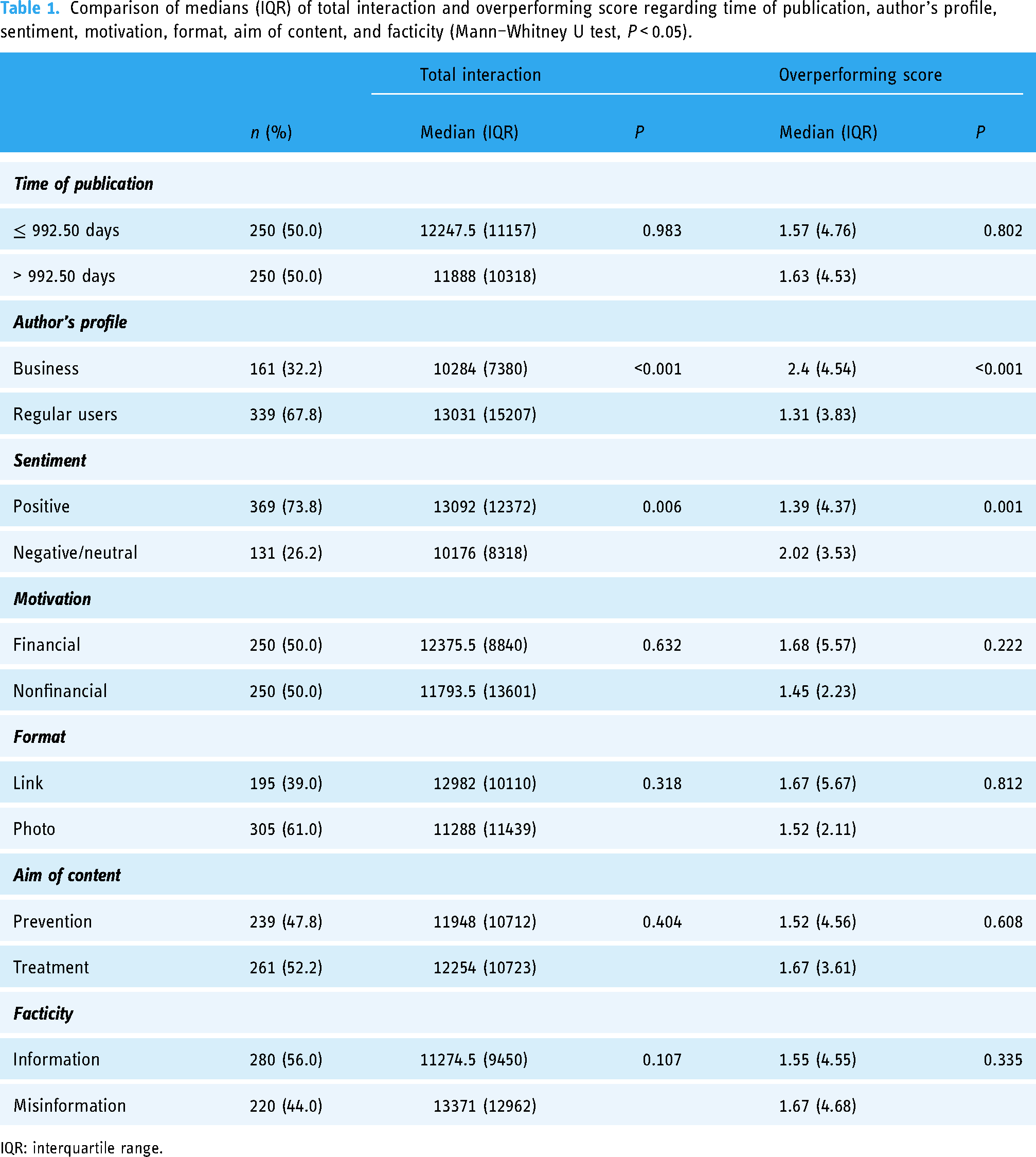
IQR: interquartile range.
Table 2 summarizes the distribution of posts according to dichotomized variable groups in relation to the aim of content. Posts related to prevention of dental caries were significantly linked to financial motivation (P = 0.016), whereas those posts related to the treatment of dental caries were significantly linked to time of publication (P = 0.002), negative/neutral sentiment (P < 0.001), and photo format (P < 0.001).
Distribution of total interaction, overperforming score, time of publication, author's profile, sentiment, motivation, format, and facticity according to dichotomized categories of aim of content (Chi-square test, P < 0.05).

Table 3 shows that the time of publication was positively associated with misinformation (odds ratio (OR) = 1.449; 95% confidence interval (CI): 1.007–2.085). In addition, positive sentiment (OR = 1.705; 95% CI: 1.095–2.657) and regular user profiles (OR = 1.931; 95% CI: 1.304–2.859) were positively associated with higher total interactions. In contrast, posts shared by business profiles (OR = 2.388; 95% CI: 1.615–3.531) and with negative/neutral sentiment (OR = 1.790; 95% CI: 1.182–2.709) were positively associated with higher overperforming scores.
Multiple logistic regression models for content facticity, total interaction, and overperforming score.

Unstandardized coefficient.
CI: confidence interval; OR: odds ratio; SE: standard error.
Discussion
These results align with a previous study that found 40.8% of Facebook posts related to dental caries contained misinformation. 16 The dissemination of inaccurate information on Instagram may be explained by posts authored by users without dental expertise, who often share personal experiences, home remedies, and positive sentiments. This contributes to the exchange of lay information about diseases and treatments on social media,23,24 enabling users to share and absorb health-related ideas, and fostering the acquisition of “experiential knowledge” from anecdotal narratives.25–27 However, this dynamic can also lead to the propagation of misleading information, as personal experiences can shape individual perspectives and influence collective decision-making.10,11,28 Posts shared by regular users garnered higher overall engagement, potentially due to the reassurance and advice offered by peers with similar health experiences. 26 Moreover, individuals with a stronger need for social connection tend to have a favorable view of digital advertisements, especially when endorsed by celebrities, which increases their appeal.29,30
The association between the longevity of content on Instagram and the prevalence of misinformation suggests that older information may become less accurate over time. This may result from user behavior, such as actively searching for outdated topics, or posting strategies that fail to reflect current scientific knowledge. In the context of dental caries, outdated information may persist due to a lack of updates, changing scientific recommendations, or the persistence of myths. Therefore, it is essential to develop an information infrastructure that prioritizes the dissemination of accurate content over misinformation. 31 Public health entities should focus on updating educational materials, debunking common myths through social media campaigns, and collaborating with platforms like Instagram to prioritize reliable content.
Additionally, posts expressing positive sentiments attracted more public engagement, likely because they resonate with the natural human tendency to seek content that promotes emotional well-being and offers optimistic solutions to health problems. Research on Facebook posts related to dental caries revealed a similar pattern, with posts featuring positive sentiments receiving more user interactions. 16 This highlights the role of emotional appeal in influencing user engagement on social media platforms. The preference for motivational content encourages higher levels of interaction, feedback, and social sharing, a phenomenon tied to the “positivity bias,” where individuals favor positive over negative information. 32 Information cascades—where content rapidly gains momentum once shared—further amplify the spread of positive messages. While this dynamic can promote beneficial health information, it underscores the importance of ensuring that optimistic messages are rooted in factual information.32,33
While positive content can be effective in spreading inspirational health messages, it is critical to distinguish between scientifically valid information and unproven home remedies. The COVID-19 pandemic demonstrated the dangers of misinformation, leading to delayed treatment and eroding trust in healthcare professionals. 34 Social media platforms like Instagram inadvertently contribute to the spread of misinformation, particularly when everyday users share unverified health advice. 9 Furthermore, the presence of negative posts and their influence on information dissemination underscores the need for balanced communication strategies that avoid sensationalism.26,32 The persuasive power of visual content, particularly in “before and after” treatment advertisements, highlights the importance of transparent and stringent regulations in online dental marketing. These measures are necessary not only to protect the public from misleading information but also to ensure that dental treatments are accurately represented. 35
This study also identified a connection between social media posts related to dental caries prevention and financial incentives, suggesting that commercial interests may drive some of these communications. On platforms like Instagram, companies frequently use promotional tactics, such as offering discounts or conveying positive messages, to build emotional connections and promote dental products or services.36–39 In some cases, misleading information may be disseminated to boost sales, with companies increasingly leveraging influencers or celebrities to expand their reach. 30 The research noted that commercial profiles, including those of dental clinics, often endorsed products like toothpaste, toothbrushes, and mouthwashes, positioning them as preventive solutions for dental caries. This raises concerns about the influence of commercial motivations on public health messages, potentially leading consumers to make decisions based on marketing rather than accurate information.
This study has several limitations. First, we restricted our evaluation to Instagram posts from English-speaking countries to achieve more precise content analysis. This methodological choice may have yielded results that reflect developed nations with higher levels of digital inclusion. The conclusions may differ when applied to other social media platforms. However, as digital information is not confined by geographical boundaries, the content and discourses on social media are global and emerge from diverse perspectives. In Western countries, where individuals have the freedom to consume and produce digital content, posts produced in English can influence opinions globally due to the widespread use of the language. Second, we did not account for regional variations that could affect the dissemination of information related to dental caries prevention and treatment. Finally, the sample size was limited due to the challenges associated with collecting and manually analyzing large datasets. However, previous studies have successfully drawn conclusions from similar sample sizes.9,14
Conclusion
In conclusion, despite the significant proportion of English-language Instagram posts related to dental caries containing misinformation, only sentiment and the author's profile were key predictive factors for total interaction and overperforming scores. Dental professionals must remain vigilant in identifying health beliefs shaped by misinformation to better guide patients in selecting and consuming accurate information. Additionally, policymakers should recognize the detrimental effects of false health information on public well-being and consider implementing strategies to enhance eHealth literacy and ensure access to reliable dental information.
Footnotes
Acknowledgements
The authors express their gratitude to Meta for providing access to the CrowdTangle platform, enabling the analysis of Instagram data in this research.
Contributorship
TSM was involved in conceptualization, investigation, methodology, and writing-original draft; AMJ in conceptualization and methodology; OSJ in methodology and writing-review; ML in data curation, formal analysis, investigation, methodology, and writing-review and editing; PEAA in writing-review and editing; and TC in conceptualization, formal analysis, investigation, methodology, project administration, supervision, and writing-review and editing.

Declaration of conflicting interests
The authors declared no potential conflicts of interest with respect to the research, authorship, and/or publication of this article.
Funding
The authors disclosed receipt of the following financial support for the research, authorship, and/or publication of this article: This work was supported by the Conselho Nacional de Desenvolvimento Científico e Tecnológico (grant number 406693/2021-8) and Fundação de Amparo à Pesquisa do Estado de São Paulo—FAPESP (grant number 2022/08823-5).