




Abstract
Objective
Accurate finger function assessment is crucial for monitoring the performance of daily hand activities. However, specialized digital applications are lacking for evaluating various finger tasks. This study aims to develop a custom digital biosensing application to assess finger dexterity.
Methods
We developed a digital biosensing application compatible with smartphones and tablets that enables 3-min testing of finger dexterity, measuring velocity and accuracy for each finger and each movement orientation. Data were collected for the dominant hand from a large cohort of healthy volunteers to establish population norms values.
Results
The construction of the application involved a comprehensive, multi-stage process designed to ensure functionality, user-friendliness, and cross-platform compatibility using the Flutter framework by Google with specific adaptations for Android and iOS. To evaluate the application and construct population norms, 318 healthy subjects, 197 females and 121 males, mean ± age 37.7 ± 13.5 years, were tested. Velocity was faster for the vertical and horizontal tests than all other tests and fastest for finger 2, while the pinch test was the slowest for all fingers. Deviation from any required test orientation was more evident for the circle test and mainly for finger 5, while the vertical and horizontal orientations were the most unerring. Analysis of finger dexterity by age disclosed better performance in the younger age group (<35 years); no effect of gender for both velocity and deviation was observed.
Conclusions
The developed digital application allows immediate evaluation of finger dexterity. The established population norms can provide a comparative standard for assessing patients with disorders like multiple sclerosis, sensory neuropathy, or stroke.
Introduction
Impairment in finger function can indicate motor weakness, limited range of motion, decreased sensitivity to light touch or proprioception, tremor, or impaired coordination, all leading to inappropriate finger movements and impairments in functional kinematics of the hand.
The concept of hand kinematics, which focuses on the motion-related aspects of hand function such as velocity and deviation, 1 is crucial for analyzing normal hand movement and for the rehabilitation of hand function impairments in various neurological diseases. For a successful rehabilitation process, it is of importance to correctly assess the impaired function of each finger in terms of movement velocity and movement accuracy by measuring the deviation from the planned trajectory, as finger function is not just about the strength or coordination of muscles but involves the effective execution of fine motor tasks that require skillful manipulation.
Currently, only few tools are available for this precise assessment of finger function. Most evaluations rely on clinical examinations using various tests that estimate muscle strength, coordination like finger-to-nose test, and sensation like tactile or proprioceptive testing, but not directly assessing function. Grasp and pinch strengths can be measured using a dynamometer, and various scales are used in clinical practice to evaluate the ability to move the hand easily and skillfully, including the ability to perform precise movements and execute tasks like turning and placing motions. Examples include the Dexterity Test (FDT), 2 and the Kapandji score for assessing thumb opposition. 3 Although these tests provide important information, they are time consuming, require professional assessment by a physiotherapist or occupational therapist, and do not directly correlate with functional capacity—the ability to perform everyday tasks, such as gripping, manipulating objects, and executing complex movements necessary for daily living, work, or recreation. While these clinical tests focus on specific aspects of hand movement and skill, they may not fully capture practical, real-world hand function. Moreover, these assessments do not measure how sensory feedback is integrated during the performance of fine motor tasks. Additionally, evaluations of hand function often rely on a range of self-reported questionnaires rather than direct clinical examinations, such as the Duruöz Hand Index, 4 the Michigan Hand Outcome Questionnaire, 5 and the Disability of the Arm, Shoulder, and Hand Index. 6 Relying solely on self-reporting, without incorporating actual clinical examinations, may lead to less accurate and comprehensive outcomes as they rely on the patient's perception, which can be influenced by mood, pain, or cognitive biases. Research shows that patients may overestimate or underestimate their abilities, leading to discrepancies between reported and actual performance.7,8
To objectively assess fine motor movements, finger dexterity is defined as the skillful and controlled manipulation of tools or objects by the fingers.9,10 Specifically, finger dexterity refers to the ability to perform tasks that require small, precise movements like typing, playing a musical instrument, sewing, or handling small objects. Higher levels of finger dexterity allow for greater control and efficiency in such tasks. This critical aspect of hand function underscores the importance of skillful finger movements in daily activities and rehabilitation outcomes. In contrast, other aspects of hand function, such as grip strength (overall hand power), wrist mobility (range of motion and strength), forearm rotation (turning motions), and hand-eye coordination, involve broader movements beyond finger precision.
Finger dexterity can be assessed by the Nine-Hole Peg Test, 11 and the Purdue Pegboard Test, 12 which measure the capacity to accurately place pins or pegs into holes. Additionally, the Minnesota Manual Dexterity Test, 13 and the O'Connor Tweezer Test, 14 assess precision and control in the manipulation of small objects. While these traditional tests focus on specific, isolated tasks (e.g. placing pegs or pins), developing digital applications can offer a more comprehensive assessment of finger dexterity. By integrating multiple tasks that evaluate a range of fine motor skills within a single platform, the digital app allows for a broader evaluation of hand function across various contexts. Moreover, it provides real-time feedback, standardize assessments, and can facilitate remote monitoring, making it a versatile tool for both clinical and home settings. Therefore, utilizing a digital platform for dexterity assessment presents multiple benefits over conventional non-digital methods.
In numerous neurological disorders affecting either the central or peripheral nervous system, disturbances in finger dexterity often arise not only from motor weakness but also from sensory perception and coordination deficits. Examples include multiple sclerosis, where demyelination in the central nervous system can lead to loss of fine motor control and sensory disturbances, such as numbness or tingling in the fingers.15,16 In Parkinson's disease, bradykinesia, tremors, and rigidity impair fine motor skills,17,18 amyotrophic lateral sclerosis causes degeneration of motor neurons, affecting voluntary muscle control and coordination, leading to weakness and loss of fine motor function in the fingers, often coupled with sensory changes that further exacerbate dexterity issues. 19 Peripheral neuropathy, often caused by diabetes or other systemic diseases, results in impaired dexterity through both sensory and motor dysfunctions.20,21 Carpal tunnel syndrome causes compression of the median nerve, leading to motor weakness and sensory deficits such as numbness and tingling in the fingers. 22 Similarly, Guillain-Barré syndrome, 23 disrupts the finger dexterity through combinedmotor and sensory impairments. To address this need, we have developed a digital application (app) specifically designed for objective and accurate assessment of finger dexterity.
Given that the velocity and accuracy of finger movements are critical aspects of daily living activities, our digital platform enhances the assessment of hand dexterity by providing a detailed evaluation of individual finger functions, including specific actions like pinching and opposition. These actions are integral components of hand dexterity, reflecting the ability to perform fine, controlled movements. By offering a comprehensive examination of these movements, our innovative approach could be particularly advantageous for detecting mild or even subclinical impairments that could be hard to detect in standard clinical examinations. These include weakness or reduced dexterity in a single finger, such as difficulty exerting normal pressure or performing precise movements like pinching or tapping; minor coordination issues between fingers that are not visible in standard tests; micro tremors; tracking dexterity decline over time due to fatigue, often overlooked in clinical exams; and detecting cognitive-motor interference, where subtle cognitive impairments affect motor performance. In the current study, we introduce the specialized digital biosensing app, optimized for both smartphones and tablets and report the data obtained from a large cohort of healthy subjects used to establish population norms in relation to age and gender.
Methods
Study design
The study consisted of two stages: First, the app was developed using a user-centered design approach through a comprehensive, multi-stage process. In the second stage, a cross-sectional study was conducted to evaluate the app and establish population norms. The study was performed at the Sackler Faculty of Medicine, Tel-Aviv University, and the Multiple Sclerosis Center at Sheba Medical Center, Tel-Aviv, Israel, over a period of 4 years.
Participants
Inclusion criteria
Healthy volunteers were recruited from both the professional and personal networks of the investigators to test the digital biosensing app.
Exclusion criteria
Participants with any neurological, rheumatologic, or orthopedic disorders that could impair hand function were excluded from the study.
Ethics
Sheba Medical Center Institutional Review Board (IRB) approved the study (ethics approval number SMC-5596-08).
A waiver for obtaining signed informed consent was approved as the study was non-interventional, involving a single-session assessment of hand function in healthy subjects. Oral informed consent was obtained from all participants. Data was collected, coded, and analyzed according to the ethical standards on human experimentation.
Digital biosensing application
The digital biosensing app was developed for use on smartphones and tablets, using the device screen-touch technology (https://pdactech.com). The app was designed to administer a 3-min test of finger movements to explore several dimensions of finger functionality. It includes five testing patterns performed in succession: vertical, horizontal, zigzag, and circle movements for fingers 1 (thumb), 2 (index), and 5 (little finger), as well as pinch movements between the thumb and each of the other fingers (1-2, 1-3 thumb-middle finger, 1-4 thumb-ring finger, 1-5), resulting in a total of 16 individual tests. Data were collected for the dominant hand. Average velocity was measured in millimeters per second (mm/sec) for each movement. For circular and zigzag movements, velocity was calculated by tracking the continuous motion of the finger along the designated path, providing a comprehensive measure of movement speed across the entire trajectory. Average deviations reflecting overall accuracy of the movements were measured as the magnitude of the distance in millimeters (mm) from the required line orientation, regardless of direction.
Measurements were obtained for each finger and across the different movement orientations.
Statistical analysis
Data reported are based on the sample tested in this study and are presented as mean, median, standard deviation, minimum, and maximum to give an overview of the central tendency and spread. A sample size of 295 healthy participants was calculated based on a 95% confidence level, a standard deviation of 1.75, and a margin of error of 0.2. This sample size was chosen to ensure sufficient statistical power and to accurately capture a broad range of normal finger dexterity while analyzing multiple variables. The Kolmogorov-Smirnov Test and the Shapiro-Wilk test were applied to test the normality of the data. We specifically calculated the 5th, 50th, and 95th percentiles to establish the distribution for each task and finger, providing insights into the range and central tendency of the data. These percentiles were chosen to give a comprehensive understanding of the data spread, capturing the extremes and the median values. Correlation was performed with age and gender. All statistical analyses and the creation of the graph plots were conducted with Python Software version 3.10.12, available at http://www.python.org on Google Colaboratory platform, https://colab.google/.
Results
Technical development of the interactive biosensing application for finger dexterity assessment
The construction of the app involved a comprehensive, multi-stage process designed to ensure functionality, user-friendliness, and cross-platform compatibility. The app was engineered to support both iOS and Android platforms to ensure a broad user base. Addressing the challenge of disparate screen device display sizes, we innovated by choosing a universally familiar and standardized reference object (i.e. a credit card) to serve for size calibration. Credit cards around the world are standardized in size according to the ISO/IEC 7810 ID-1 format, which specifies dimensions of 85.60 mm × 53.98 mm (3.370 inches × 2.125 inches). This uniform size makes credit cards an ideal reference object for size calibration, as it is consistent and recognized globally, ensuring that users anywhere can perform the calibration accurately with an easily accessible, standard-sized item. The calibration process involved the following steps: 1. User Instruction: The user is prompted to place a standard-sized credit card on the screen. 2. Device Sensing: The app then prompts the user to adjust the on-screen reference frame to match the exact size of the physical credit card. This ensures that the displayed measurements are accurate, regardless of the device's display size. 3. Confirmation: Once the on-screen frame matches the size of the credit card, the user confirms the alignment, and the app records this calibration to adjust all subsequent measurements accordingly.
We further addressed potential discrepancies in touch sensor responsiveness by using devices dedicated solely to the study, free from any additional programs, applications, or modifications that could introduce variability. This controlled environment minimized external factors that could influence touch sensitivity, ensuring that the data collected was consistent and reliable. It is of note that although the app does not directly measure tactile perception, it evaluates task outcomes that depend on it, such as movement accuracy and speed. If tactile perception is impaired, completing tasks will affect the app's measurements. Significant deviations or slow velocities may indicate underlying sensory or motor issues, as these outcomes are influenced by the user's tactile perception.
The app was developed within the Flutter framework provided by Google, which necessitated specific customizations for each platform: Java for Android and Swift for iOS. An example of the app feedback display of velocity and deviation for finger movements following vertical task assessment is presented in Supplemental Figure 1. This graphical feedback helps users assess how accurately and quickly they performed the required finger movements during a specific task.
Designed finger tasks
We designed specific tasks to assess finger dexterity using targeted movements within the app. We first selected horizontal and vertical movements, then incorporated more complex patterns such as circles and zigzags for finger 1 (thumb), finger 2 (index), and finger 5 (little finger) (Figure 1(A) and (C)–(E)). Additionally, we introduced two-finger tasks to simulate pinch movements between the thumb and each of the other fingers (1-2, 1-3, 1-4, 1-5), (Figure 1(B)). These tasks were developed to assess finger dexterity by integrating motor, sensory, and coordination skills within a simulated functional environment in the app, allowing us to measure the velocity and accuracy of each movement and assess individual finger performance.

Visual guide to finger dexterity testing in the digital application.
The app's sensitivity calibration routines successfully normalized input data, ensuring consistent performance measurements irrespective of hand size or contact surface area. Validation tests across various iOS and Android platforms demonstrated no significant difference in results between males and females, ensuring consistent performance measurements regardless of hand size or contact surface area.
Study participants
To assess the performance of the App and establish populations norms, 318 healthy subjects, 197 females, 121 males, mean ± age 37.7 ± 13.5 years (range 16–71 years), 90.6% right-handed, were included in the study. This group included a balanced representation of gender and covered various age ranges, ensuring the results reflect normal variability and provide reliable baseline norms for future comparisons.
Normality tests confirmed that the data followed a normal distribution. The Kolmogorov–Smirnov test statistic was 0.0553, with a p-value of 0.2744, and was further supported by the Shapiro–Wilk test statistic of 0.978, with a p-value of 0.108.
The 25th, 50th, and 75th percentiles of velocity and deviation for each dexterity test pattern and finger are presented in Figure 2(A) and (B), respectively, and the 5th and 95th percentiles are shown in Supplemental Table 1. Velocity was faster for the vertical and horizontal tests compared to all other tests, and fastest for finger 2, while the pinch test was the slowest test for all fingers, (Figure 2(A)). Deviation from any required test orientation was more evident for the pinch test and mainly for finger 5 indicating greater variability in performance, while the vertical orientation was the most unerring, (Figure 2(B)).
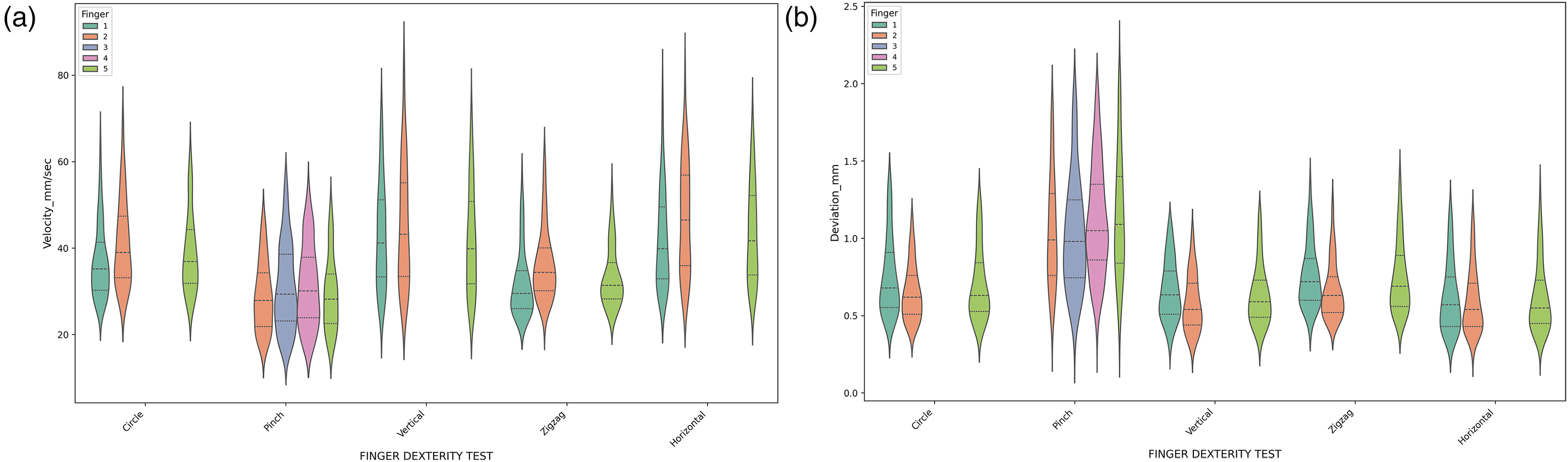
(A) Comparative analysis of finger velocity (mm/sec) across different dexterity tests: circle, pinch, vertical, zigzag, and horizontal. Each test is represented by a separate panel, and within each panel, data for all five fingers are depicted using violin plots. The width of each violin plot at a given velocity indicates the density of measurements, illustrating the distribution of dexterity scores for each finger within that specific test. A horizontal line within each violin denotes the median dexterity score. Markers for the 5th and 95th percentiles denote the range within the central 90% of the data falls. The combination of median lines and percentile markers provides a comprehensive view of both the central tendency and the dispersion of the dexterity measurements. (B): Comparative analysis of finger deviation (mm) across different dexterity tests: circle, pinch, vertical, zigzag, and horizontal. Each panel displays data for all five fingers using violin plots, where the width represents the density of measurements. The horizontal line within each plot indicates the median deviation for each test and finger. Markers for the 5th and 95th percentiles highlight the central 90% range of the data.
Analysis of the fingers dexterity by age, disclosed better performance in all tests in the younger age group (<35 years), Figure 3(A)—velocity, Figure 3(B)—deviation. The Pinch test, especially for Fingers 2 and 5, shows larger deviations compared to other tests, indicating it requires greater precision which is more affected by age.

(A) Velocity (mm/sec) by age group across finger dexterity tests. The distribution of finger velocity measurements across five dexterity tests, horizontal, vertical, circle, zigzag, and pinch divided into two age groups: ≤35 years (green) and >35 years (yellow) is shown by box plots. The central line within each box denotes the median velocity, while the box itself covers the interquartile range (IQR), representing the middle 50% of the data. Whiskers extend to 1.5 times the IQR, with outliers marked beyond this range. (B) Deviation (mm) by age group across finger dexterity tests. The distribution of deviation measurements across various dexterity tests, Horizontal, Vertical, Circle, Zigzag, and Pinch divided by two age groups: ≤35 years (green) and >35 years (yellow) is shown by box plots. The central line in each box represents the median deviation, while the box itself shows the interquartile range (IQR), which contains the middle 50% of the data. Whiskers extend to 1.5 times the IQR, with any outliers represented as individual points beyond this range.
No effect of gender for both velocity and deviation were observed, Figure 4(A)—velocity, Figure 4(B)—deviation.
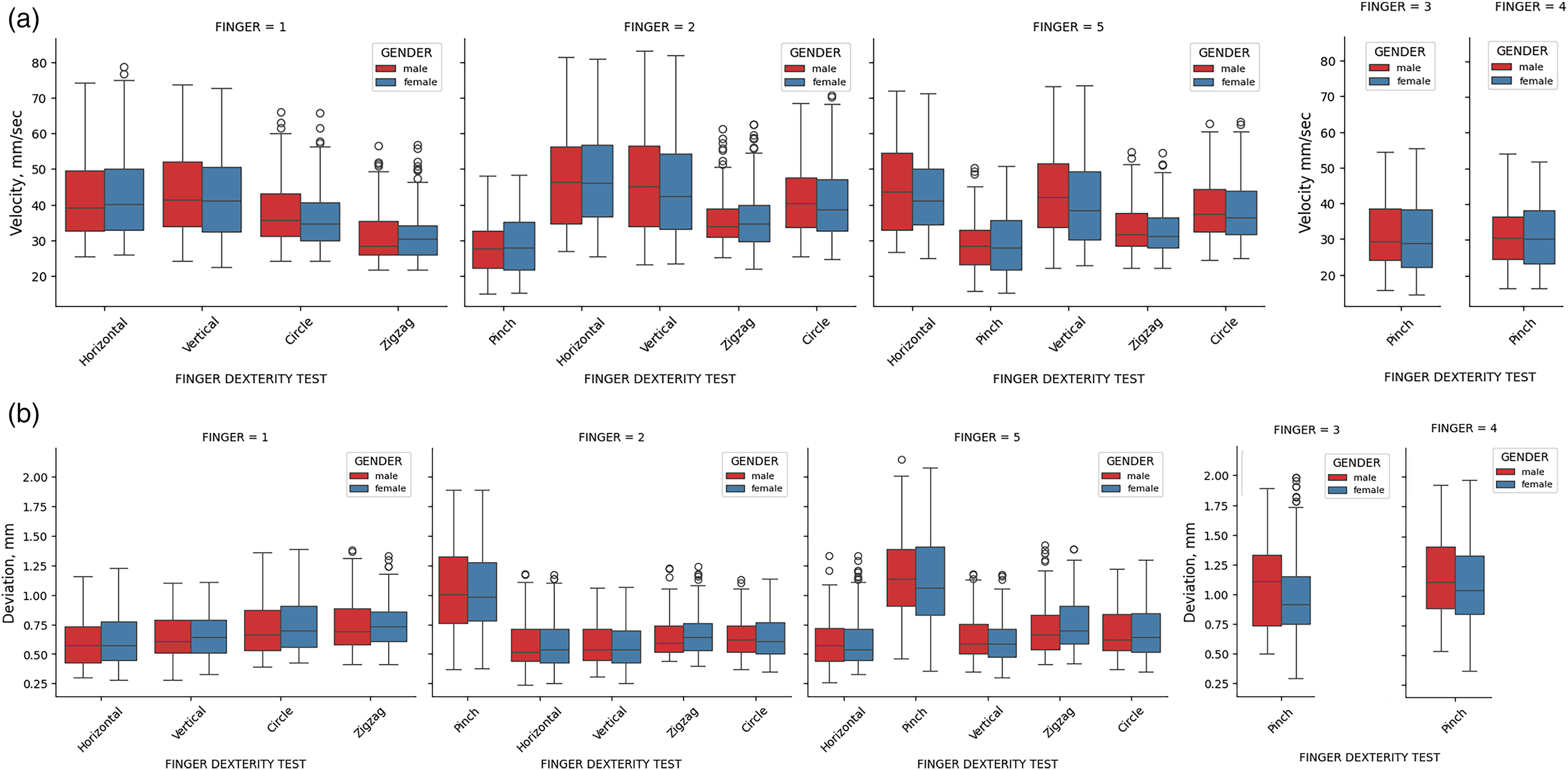
(A) Velocity (mm/sec) by gender across finger dexterity tests. The distribution of finger velocity measurements across five dexterity tests, horizontal, vertical, circle, zigzag, and pinch separately for male (red) and female (blue) participants is shown by box plots. The central line within each box denotes the median velocity, while the box itself covers the interquartile range (IQR), representing the middle 50% of the data. Whiskers extend to 1.5 times the IQR, with outliers marked beyond this range. (B) Deviation (mm) by gender across finger dexterity tests. The distribution of deviation measurements across five dexterity tests, horizontal, vertical, circle, zigzag, and pinch separately for male (red) and female (blue) participants is shown by box plots. The central line within each box denotes the median velocity, while the box itself covers the interquartile range (IQR), representing the middle 50% of the data. Whiskers extend to 1.5 times the IQR, with outliers marked beyond this range.
Discussion
Integrating motor, sensory, and coordination assessments using a digital tool to assess finger function, offers a nuanced perspective on finger dexterity impairments that might be missed by more traditional methods, potentially leading to more effective and personalized intervention strategies.
This nuanced approach has an added value as it enables a comprehensive analysis by simultaneously measuring multiple aspects of finger function, including motor skills by assessing the velocity and accuracy of movements, the ability to respond to sensory inputs of touch using the screen, and the coordination between fingers. Understanding the precise nature of a patient's dexterity issues, healthcare providers can develop personalized treatment plans that directly address the underlying problems, leading to better outcomes for the patient.
Developing the digital app was challenging, particularly in calibrating for disparate screen device display sizes. We addressed this by using a universally recognized object—a credit card—for size calibration. To ensure consistent data collection, we used dedicated devices with no additional programs or modifications, minimizing external factors that could affect touch sensitivity and sensor performance.
The established population norms of finger dexterity we obtained focused on percentiles to describe performance distribution by velocity and accuracy. No significant difference in finger dexterity was found between males and females, supporting the app's robustness across different user demographics. However, age was shown to impact finger dexterity, with younger individuals demonstrating faster movement velocities and better accuracy, evidenced by less deviation. This age-related decline in motor speed and precision was particularly noticeable in the Pinch test for Fingers 2 and 5, indicating these tasks may require greater accuracy, which diminishes with age. Conversely, tasks like Horizontal and Vertical movements showed smaller and more consistent deviations across age groups, suggesting they are less affected by age-related changes. The digital app assessment generates quantitative data that can be precisely measured and tracked over time, contrasting with non-digital tests where results may be more subjective or reliant on observer interpretation. Additionally, the digital app's ability to provide immediate feedback on performance is valuable for both the individual being assessed and the clinician. This feedback can help identify specific areas of difficulty and allow for immediate adjustment of the assessment or therapeutic approach.
Study limitations
(1) We focused on constructing population norms only for the dominant hand, which limits applicability to the non-dominant hand and may overlook key variations; (2) While the app provides valuable quantitative data, it may miss qualitative aspects of finger function; (3) Digital assessments in controlled settings may not fully capture the complexities of real-world hand function, limiting real-life applicability; (4) We did not compare the app to standard dexterity assessments, focusing instead on developing the app and establishing norms. In future studies we plan to include such comparisons in various patient groups; (5) Since a significant portion of our efforts was devoted to the development of the app itself, we did not conduct a comprehensive reliability analysis, such as test-retest reliability, to assess the consistency performance over multiple testing sessions.
Conclusions
The finger dexterity app we developed is a fast practical tool for accurate analysis of hand performance that has potential for use in remote medicine. The population norms obtained from our study offer promising prospects for the early detection of impairments in patients with various neurological conditions affecting hand function, such as multiple sclerosis, different forms of sensory and motor neuropathies, and stroke. We anticipate that the developed app will facilitate enhanced assessment of hand function impairments in patients, thereby enabling the recommendation of tailored rehabilitation strategies.
Supplemental Material
sj-docx-1-dhj-10.1177_20552076241297734 - Supplemental material for Development of an interactive biosensing application for assessing finger dexterity
Supplemental material, sj-docx-1-dhj-10.1177_20552076241297734 for Development of an interactive biosensing application for assessing finger dexterity by Michal Greenberg Abrahami, Yehuda Warszawer, Alon Kalron, Emanuel Shirbint, Maria Didikin and Anat Achiron in DIGITAL HEALTH
Footnotes
Contributorship
M.G.-A.: conceptualization; data curation; investigation; methodology; software; writing—review & editing; Y.W.: methodology; formal analysis; writing—review & editing; A.K.: investigation; methodology, writing—review & editing; E.S.: data curation, investigation; methodology; software; writing—review & editing; M.D.: investigation; methodology; project administration; writing—review & editing; A.A.: conceptualization; formal analysis; funding acquisition; methodology; supervision; writing—original draft; writing—review & editing.
Declaration of conflicting interests
The authors declared no potential conflicts of interest with respect to the research, authorship, and/or publication of this article.
Funding
The authors disclosed receipt of the following financial support for the research, authorship, and/or publication of this article: The study was supported by an independent grant received from Roche Pharmaceuticals Israel Ltd.
Guarantor
Michal Greenberg-Abrahami is the guarantor of this manuscript and accepts full responsibility for the work and conduct of the study, its accuracy and integrity.

Supplemental material
Supplemental material for this article is available online.
References
Supplementary Material
Please find the following supplemental material available below.
For Open Access articles published under a Creative Commons License, all supplemental material carries the same license as the article it is associated with.
For non-Open Access articles published, all supplemental material carries a non-exclusive license, and permission requests for re-use of supplemental material or any part of supplemental material shall be sent directly to the copyright owner as specified in the copyright notice associated with the article.
