



Abstract
Objective
In the digital age, eHealth is vital in modern healthcare, impacting medical services and public health. Despite its potential in disease management, a comprehensive bibliometric analysis is lacking. This study utilizes bibliometric methods to explore the evolution of eHealth in disease management from 1999 to 2023, aiming to discern the research status and trends.
Methods
A literature search was conducted using the Web of Science Core Collection (WOSCC) database. Publications and journals were quantitatively analyzed using Microsoft Office Excel 2023. Country/institution/author collaborations and keyword co-occurrences were analyzed using VOSviewer. CiteSpace was employed to analyze the citation bursts of reference. A global distribution network of publications was constructed and thematic trends were analyzed using R package “bibliometrix.”
Results
The study identified 1763 articles on eHealth in disease management. Since 2011, there has been a notable increase in publications, with the United States (n = 391, 22.08%) and the University of Sydney (n = 60, 3.40%) as leading contributors. High-quality journals primarily publish this research. Globally, 9631 authors contributed, with Chavannes, Niels H being the most prolific (n = 23). Author co-citation analysis indicated Eysenbach, G as the most cited (n = 336). Research currently focuses on developing a comprehensive eHealth framework, optimizing mHealth for chronic diseases, improving eHealth intervention trial reporting, assessing social factors in eHealth literacy, and examining telemedicine's role during the Covid-19 pandemic.
Conclusion
This study offers a comprehensive overview of eHealth research in disease management. eHealth's potential in disease prevention and treatment is significant. To enhance eHealth's impact, international collaboration, technological innovation, tailored intervention trials, addressing the digital divide, and solving legal and ethical issues are crucial. This study will guide future research endeavors, with the goal of enhancing eHealth's benefits and expanding its accessibility to a wider patient base.
Introduction
With the advent of the digital era, eHealth has become an integral part of the modern healthcare system. eHealth can be understood as a series of actions and practices that use electronic technologies to facilitate health management, communication, and data analysis. 1 In the field of disease management, eHealth applications typically include skill training, websites, electronic personal health records, remote patient monitoring, and education. 2 Since the late 1990s, the application and research of eHealth have gradually gained attention. It has not only changed the way medical services are delivered but also brought revolutionary impacts to disease research and public health practices. 3
A survey study targeting the 53 member states of the World Health Organization (WHO) European region showed that the development of eHealth has had a positive impact on improving the quality of medical decision-making in the region, enhancing patients’ self-management abilities, and promoting the formulation and implementation of public health policies. 4 Furthermore, with the integration of big data and artificial intelligence technologies, the potential of eHealth in disease prevention, diagnosis, and treatment has been greatly expanded. This has not only deepened our understanding of complex disease mechanisms but also propelled the development of precision medicine. 5
Bibliometrics is a quantitative and qualitative analysis method widely used in scientific literature, aimed at revealing the current status and development trends within a specific field. 6 In recent years, the current status and trends of various aspects of eHealth research, such as keyword theme distribution, 7 eHealth literacy, 8 health information management, 9 adoption of ehealth services, 10 and social impacts, 11 have been analyzed through bibliometrics. These studies highlight the broad, multidisciplinary nature of eHealth. Nevertheless, bibliometric analyses focusing on eHealth in disease management remain significantly scarce.
Given the increasing global burden of aging populations and chronic diseases, the role of eHealth in disease prevention and management has become increasingly prominent. Therefore, this study aims to trace the development of eHealth in disease research from 1999 to 2023 through bibliometric methods, using visualization tools. We will collect and analyze relevant scientific papers using the WOSCC database, aiming to identify key research areas, mainstream research topics and trends, as well as leading research institutions and scholars. With this quantitative analysis, we hope to provide readers with a comprehensive perspective to understand the current status and future potential of eHealth applications in diseases.
Methods
Search strategy
On February 26, 2024, a literature search was conducted on the WoSCC database (https://www.webofscience.com/wos/woscc/basic-search). The search formula was TS = (ehealth) AND TS = (disease), and we limited the document types to “articles” and “reviews,” excluding non-English literature (Figure 1).

Publications screening flowchart.
Statistical analysis
VOSviewer (version 1.6.20) 12 is a tool for bibliometric analysis and knowledge map visualization. It not only helps researchers identify and analyze patterns and trends in scientific literature but also reveals the knowledge structure and collaboration network of research fields through the generated relationship maps. In this study, we used this software to complete national and institutional analysis, author and co-citation author analysis, and keyword co-occurrence analysis.
CiteSpace (version 6.3.R1) 13 is a widely used literature visualization analysis tool in scientific research. This software helps researchers identify and analyze hotspots and trends in scientific literature. In this study, we used CiteSpace to analyze the citation bursts of reference.
The R package “bibliometrix” (version 3.2.1) (https://www.bibliometrix.org) 14 is an R software package specifically designed for bibliometric and scientometric analysis. In this study, we used it to construct a global distribution network of publications and perform topic trend analysis. Additionally, we used Microsoft Office Excel 2023 for quantitative analysis of the publications and journals.
Results
The number of publications and growth trends
A total of 1763 research articles were published over the past 24 years (1999–2023, Figure 2). The earliest publication was in the year 2003. 15 Looking at the growth rate of annual publication numbers, the number of papers published in the early period (1999–2002) was zero, indicating that research on eHealth in diseases had not yet attracted widespread attention during this time. Between 2003 and 2010, related papers were published sporadically, but the average annual publication volume was only about 3.4 papers, which was still in the initial stage of research. Starting from 2011, the annual number of publications increased significantly, with a growth rate of 180% that year and the number of papers has been on an upward trend since then. In the past five years (2019–2023), the number of related papers published accounted for 74.02% (1305/1763) of the total number of publications.

Annual publications in eHealth in disease research from 1999 to 2023.
Country and institutional analysis
The publications originated from 106 countries and 3092 institutions, with a primary concentration in Europe, North America, Asia, and Oceania (Table 1). The United States led the country publication count with 391 publications, accounting for 22.08%, followed by the Netherlands (n = 280, 15.91%), Germany (n = 189, 10.72%), and Australia (n = 181, 10.27%). China held a leading position in Asia with a total of 119 publications, making up 6.75%. To gain a deeper understanding of international collaboration trends, we filtered countries that contributed at least 10 publications each and created a collaborative network graph based on this criterion (Figure 3). The graph revealed active cooperation among multiple countries, such as the United States with Canada, the Netherlands, China, etc.; China also demonstrated a high level of collaborative activity with Canada, Australia, Germany, and South Korea.

Visualization of global distribution networks (A) and analysis of co-authorship between countries (B) for the eHealth in disease study.
Top 10 countries and institutions for eHealth in disease research.

Among the top 10 institutions by publication volume, the University of Sydney ranked first with 60 contributions, accounting for 3.40%, followed by the University of Toronto (n = 49, 2.78%), Leiden University (n = 48, 2.72%), and Radboud University Nijmegen (n = 45, 2.55%). Using a threshold of at least 10 publications, we conducted a screening and visualization analysis of the institutions and constructed a collaborative network graph based on their publication volumes and interrelationships (see Figure 4). Figure 4 illustrates that the University of Sydney has close cooperative relationships with the George Inst Global Hlth and Flinders University of South Australia; the University of Toronto maintains active collaborative connections with the University of British Columbia and the University of Melbourne.

Visualization of the analysis of co-authorship between institutions of the eHealth in disease study.
Journal analysis
A total of 1763 articles are spread across 544 journals, with the top 10 journals accounting for 684 articles, which constitutes 38% of the overall publication count. As shown in Figure 5, these leading journals have impact factors ranging from 1.4 to 5.8. Notably, four journals exceed an impact factor of 3 (Figure 5(A)). Furthermore, eight journals are categorized in the Q1 and Q2 quartiles according to the Journal Citation Reports (JCR).

The publication numbers, impact factors (A), and JCR quartiles (B) of the ten top-ranking journals for eHealth in disease research.
Authors and co-cited authors
Globally, 9631 authors participated in eHealth research related to diseases. Among the top 10 authors, three published more than 15 papers (Table 2). Chavannes, Niels H has the highest number of articles (n = 23), followed by Knitza, Johannes (n = 19) and Redfern, Julie (n = 16). Based on authors who published five or more papers, we constructed a collaboration network (Figure 6(A)). In this figure, the node for Chavannes, Niels H is the largest, and he has active collaborations with Car, Josip; Ho, Kendall; Kasteleyn, Marise J.

Visualization of authors (A) and co-cited authors (B) for eHealth in disease research.
Top 10 authors and co-cited author in eHealth in disease research.

Among the top 10 co-cited authors, three have been cited more than 150 times (Table 2). Eysenbach, G leads with 336 citations, followed by Norman, CD with 216 citations and Michie, S with 180 citations. We filtered authors who were co-cited at least 40 times and created a co-citation network map based on this criterion (Figure 6(B)). As shown in Figure 6(B), there are active co-citation links between different authors, such as Eysenbach, G with Bandura, A; Glasgow, RE, and Norman, CD with Xie, B; Fox, S.
Co-cited references
Among the top 10 most cited references, each was cited at least 49 times (Table 3). Notably, two papers were cited over 100 times: “Norman CD, 2006, J Med Internet Res” (n = 133) and “Moher D, 2009, BMJ-Brit Med J” (n = 106). To analyze co-citation relationships, we selected references that were cited at least 23 times and constructed a co-citation network map based on this criterion (Figure 7). As shown in Figure 7, “Norman CD, 2006, J Med Internet Res” has significant co-citation links with “Eysenbach G, 2001, J Med Internet Res” and “Braun V., 2006, Qual. Res. Psychol.”

Visualization of co-cited references for eHealth in disease research.
Top 10 co-cited references for eHealth in disease research.

Citation bursts in references
A citation burst refers to a phenomenon where the number of citations for a particular piece of literature significantly increases within a specific period following its publication, often indicating that the research topic or findings discussed in the literature have garnered widespread attention in the academic community. 26 In this study, we employed the CiteSpace analytical tool to identify 10 key references that exhibited strong citation bursts in the field of e-health and disease research (Figure 8). As depicted in Figure 8, each red horizontal bar represents the citation burst period for a reference, with these occurrences spanning from 2011 to 2019. Among these 10 references, “PRISMA Extension for Scoping Reviews (PRISMA-ScR): Checklist and Explanation” by Tricco AC et al. exhibited the most pronounced citation burst (strength = 10.91), followed by “Telehealth Interventions to Support Self-Management of Long-Term Conditions: A Systematic Metareview of Diabetes, Heart Failure, Asthma, Chronic Obstructive Pulmonary Disease, and Cancer” authored by Peter Hanlon et al. (strength = 8.98). Both of these references experienced their citation bursts between 2021 and 2023. Overall, the citation burst strength for these 10 references ranged from 6.47 to 10.91, with durations lasting between 2 to 5 years. Following the order in Figure 8, we summarized the main research content of these references in Table 4.
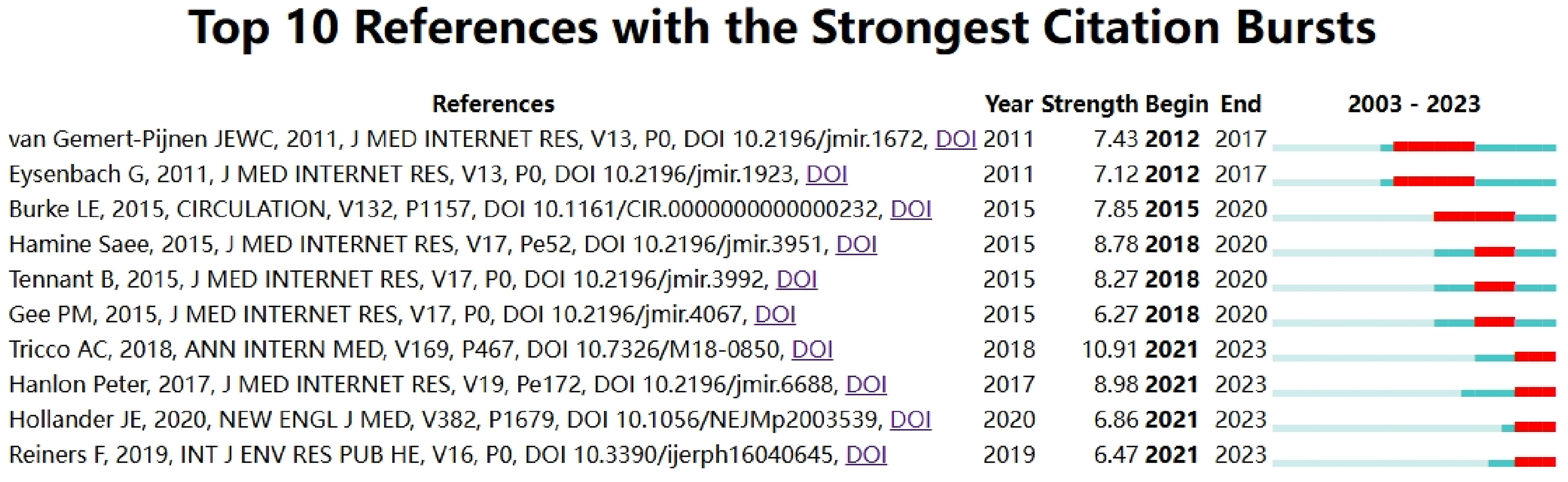
Top 10 references with the strongest citation bursts. Red bars indicate time periods with high citation.
The main research contents of the 10 references with strong citations bursts.

Hot topics and frontiers
Keyword Co-occurrence Analysis offers insight into the knowledge structure, topic distribution, and research hotspots and trends within a particular research field. Table 5 lists the top 20 high-frequency keywords in eHealth research concerning disease prevention and treatment. These keywords highlight several core focuses within the current eHealth domain, including the integration of technology, management of chronic diseases, dissemination and comprehension of health information, and addressing global health challenges such as the COVID-19 pandemic. We used VOSviewer to filter keywords appearing 20 times or more and constructed a network map (Figure 9(A)). These keywords can be categorized into three groups: firstly, technologies and platforms, which include eHealth, mHealth, telemedicine, digital health, telehealth, mobile health, and the internet; secondly, applications and research in diseases, which encompass chronic disease, cardiovascular disease, diabetes, COVID-19, self-management, physical activity, public health, and systematic review; and lastly, health literacy, covering eHealth literacy and health literacy.

Author keyword co-occurrence analysis (A) and Trend Topics analysis (B).
Top 20 keywords for eHealth in disease research.

Trend topic analysis of keywords (Figure 9(B)) indicates that from 2012 to 2014, research concentrated on utilizing electronic medical records and clinical decision support tools to enhance medical services. In 2015–2017, there was a shift in emphasis towards individual health behaviors and how to deliver health information to consumers via the internet, with key terms being “health behavior” “internet” and “consumer health information.” Since 2018, interest has pivoted towards the application of mobile health technologies in the self-management of chronic diseases and how smartphones and other digital tools can facilitate health behavior and management, with key terms including “mHealth” “self-management” “chronic disease” “smartphone,” and “health promotion.” Notably, during the COVID-19 pandemic period (2020–2023), research predominantly focused on telemedicine and digital health in disease prevention, diagnosis, and management, with primary keywords such as “COVID-19” “telemedicine” “telehealth” “digital health” “mobile phone” and “coronary artery disease.”
Discussion
The number of publications and growth trends
From 1999 to 2024, the number of publications related to eHealth and disease research experienced a process from non-existence to significant growth. .This trend has been primarily driven by technological advancements, global health challenges, and the need to enhance the efficiency of healthcare services. The development of mobile health applications, big data, and artificial intelligence has significantly improved the accuracy and effectiveness of eHealth tools in medical diagnostics and treatment. 36 Concurrently, global health challenges such as the management of chronic diseases, the aging population, and the COVID-19 pandemic have heightened the demand for eHealth solutions. 37 Additionally, in response to rising medical costs and the demand for high-quality healthcare services, eHealth systems have become an important means to improve service efficiency. 38 It is anticipated that the application of eHealth in medical practice will become more widespread in the future, and its popularity in academic research and practical applications will continue to rise.
Country and institutional analysis
A total of 106 countries and 3092 institutions worldwide have published literature on electronic health in disease research, reflecting the extensiveness and diversity of international collaboration. Despite the participation of countries across multiple continents, Europe and North America continue to dominate the field. The United States is the most representative, accounting for 22.08% of publications. China, as the Asian country with the highest volume of publications, has shown a significant growth trend over the past five years and has actively engaged in international cooperation, enhancing its influence in global electronic health research. This trend is likely related to the Chinese government's policies emphasized in the “Healthy China 2030” planning outline, which prioritize health, technology innovation, and the balanced allocation of medical resources. 39 International cooperation is crucial for the development of eHealth in the disease sector. Currently, developed countries dominate this field, while developing countries face challenges such as insufficient funding, weak infrastructure, lack of leadership, and poor governance. 40 To address these challenges, it is recommended to establish international eHealth standards, promote data interoperability and sharing, and strengthen resource sharing and technology transfer through the establishment of international cooperative partnerships and platforms, thereby promoting the overall development of global eHealth in the disease sector.
In terms of institutional output, the University of Sydney (n = 60, 3.40%) ranks first, followed by the University of Toronto (n = 49, 2.78%) and Leiden University (n = 48, 2.72%). It is noted that these three institutions are all within the top 100 universities globally, 41 indicating that eHealth research in diseases is favored by the world's leading universities. The collaborative network reveals good cooperative relationships between some institutions, such as the University of Sydney's partnership with the George Institute for Global Health and the Flinders University of South Australia. Such collaboration plays an important role in promoting innovative research and development in the global eHealth field concerning diseases. Based on these findings, researchers are advised to consider establishing joint research projects with these active institutions or to apply for their visiting scholar programs and educational projects.
Journal analysis
Among the top 10 journals by publication volume, eight are classified within the high-impact Q1 or Q2 categories. This highlights the significant influence that reputable international journals exert on progressing eHealth research pertinent to disease fields. The journals encompass diverse disciplines such as health care sciences and services, medical informatics, environmental sciences, public health, environmental and occupational health, and health policy and services. This diversity underscores the interdisciplinary approach inherent in eHealth research related to disease management. Consequently, we advise researchers to consider the interdisciplinary and diverse nature of their audience when drafting articles. Tailoring content to this broad readership can enhance the accessibility and impact of their research, ensuring that findings resonate with a wide-ranging and specialized academic community.
Authors and co-cited authors
Chavannes, Niels H. leads in the number of publications with a total of 23 papers. Among these, four have been cited over 40 times. These papers explore the application of eHealth technologies in various disease management and healthcare sectors, including a randomized control study on home monitoring for idiopathic pulmonary fibrosis patients, 42 the design of remote monitoring programs for COVID-19 patients, 43 lifestyle interventions for diabetes patients, 44 and the conditions and challenges in primary care practices. 45 Knitza, Johannes (n = 19) ranks second in publication volume, with two highly cited articles that systematically evaluate mobile applications in rheumatology 46 and investigate the awareness and use of Mobile health among chronic rheumatology patients. 47 Additionally, Redfern, Julie (n = 16), who ranks third in publication volume, focuses on research into eHealth applications in cardiovascular diseases.48,49Their research has highlighted three key issues that require ongoing attention in the management of diseases using eHealth: first, using e-health technology to improve the timeliness and accuracy of patient monitoring, especially in response to public health crises like COVID-19; second, promoting personalized health management by enhancing patients’ self-management abilities and participation to meet the specific needs of patients with chronic diseases; third, shaping new models of future medical practice through the development and application of e-health technology, aiming to improve the efficiency of the entire healthcare system.
The two most co-cited authors are Eysenbach, G. (n = 336) and Norman, C.D. (n = 216). In 2001, as the term eHealth began to gain popularity, Eysenbach's paper “What is e-health?” was among the first to discuss its academic definition, highlighting the significance of eHealth beyond technological advancements and marking an emphasis on the contemplation of electronic applications in health and a cultural shift in the field. 18 This paper provided an important framework for future eHealth research. Subsequently, Norman, C.D., along with Skinner, H.A., introduced the concept of eHealth literacy in two consecutive articles published in 2006, constructing a model that includes various types of literacy, 16 and designed the eHealth Literacy Scale (eHEALS) to assess consumers’ perceived skills in using information technology to manage health issues, 21 laying a theoretical and practical foundation for future research and application in the field of eHealth. Their work underscores that eHealth represents not merely a technological advancement, but a transformation in culture and practice, which is crucial for comprehending the role of eHealth in disease management.
Co-cited references
In this study, we compiled a list of the top ten most co-cited articles in the field of eHealth research related to disease management, focusing on three core themes: eHealth literacy (n = 3), evaluation of eHealth interventions and effectiveness (n = 5), and construction of eHealth models (n = 2). EHealth literacy is a crucial element for the successful application of eHealth in disease management. The eHealth Literacy Scale developed by Norman, C.D. 21 and Neter, E's research on the impact of social environments in the internet era on user eHealth literacy differences 25 provide references for assessing population eHealth literacy levels and developing strategies. In the information age, the issue of the digital divide has become increasingly prominent. Researching strategies and methods to enhance eHealth literacy and considering the synergistic effects of technological innovation, social policy, and educational strategies are vital for promoting the fair and efficient application of eHealth in disease management.
The evaluation of eHealth trials and their effectiveness is essential for verifying the efficacy of eHealth interventions. Facing the challenge of high user attrition rates in eHealth trials, Eysenbach, G's “The Law of Attrition” 20 offers new perspectives and analytical tools. Moreover, the high co-citation rates of Moher, D's “The PRISMA Statement” 17 and Webb, TL's review on using internet technologies to promote health behavior change 24 highlight the importance of systematic reviews and meta-analyses in assessing the effects of eHealth interventions. Such research can provide critical, high-quality evidence for clinical practices. However, at present, there is a relative paucity of rigorous trial studies on eHealth interventions for diseases, indicating a need for increased research efforts in this domain.
Explorations in constructing eHealth models are led by Eysenbach, G's “What is e-health?” 18 and van Gemert-Pijnen, JEWC et al.'s “A Holistic Framework to Improve the Uptake and Impact of eHealth Technologies”. 22 Their early explorations lay the foundation for clarifying the role of eHealth in disease management and establishing a comprehensive eHealth framework that integrates user participation, design innovation, and effective business models. Strengthening interdisciplinary cooperation in the future to comprehensively address the acceptance and integration issues of eHealth in healthcare systems is key to promoting the effective application of eHealth in disease management and improving patient health outcomes.
Hot topics and frontiers
In Table 4, we have summarized the core research topics of 10 cited burst articles. Analyzing these topics reveals the current research focus within the eHealth domain: this includes developing sophisticated eHealth frameworks to strengthen the integration of medical practices; optimizing mHealth applications for chronic diseases such as cardiovascular illnesses; enhancing reporting standards for eHealth intervention trials; assessing social factors that influence eHealth literacy; and examining the role of telemedicine during the Covid-19 pandemic.
A further analysis of key terms reveals the development trends of eHealth research in diseases. From a technological perspective, mobile health, telemedicine, and digital health have become critical areas of current eHealth research. In the future, integrating smart terminal applications, wearable health monitoring devices such as biosensors, and artificial intelligence algorithms to achieve preventive, diagnostic, monitoring, and personalized treatment solutions for diseases will emerge as a new research area.50–52 This integrated approach not only expands the application scope of eHealth in disease management but also deepens its connotation. However, the rapid transformation of technology has led to diversification and widespread application of eHealth intervention measures, requiring these measures to constantly update and iterate. Assessing the effectiveness of these measures faces challenges in controlling test environments and determining comparative interventions, necessitating the development of evaluation methods covering design, updating, and implementation stages, as well as the use of statistical techniques to handle complex datasets. 53 Moreover, the implementation of eHealth involves multiple legal and ethical barriers such as data management security, confidentiality protection, compliant storage, regulatory enforcement, and policy formulation. 54 Therefore, exploring methods to address these challenges is crucial for enhancing the confidence of policymakers and practitioners.
In disease application research, self-management, COVID-19, chronic diseases, cardiovascular diseases, and diabetes have become hot keywords. Despite the tremendous potential of eHealth in improving self-care for patients with chronic diseases, 55 supporting medication management, 56 promoting mental health, 57 and improving quality of life, 58 there is still a lack of sufficient evidence from quantitative, qualitative, and mixed-method research, necessitating more rigorous experimental design studies. 59 Public health monitoring and responding to emerging epidemics, such as the COVID-19 pandemic, are also research priorities, 60 reflecting the potential of eHealth in tracking health status, predicting disease trends, and addressing global health challenges. Notably, factors such as responsiveness, assurance, and tangibility of eHealth services are crucial for maintaining user trust in the post-COVID-19 era. 61
eHealth literacy is another prominent research theme, emphasizing the abilities and understanding required by individuals when using eHealth resources and services. 62 The level of eHealth literacy is influenced by various factors, including age, gender, literacy, socioeconomic factors, and language. 63 Therefore, special attention needs to be paid to socially vulnerable groups, such as the elderly, ethnic minorities, low-income individuals, those with lower educational levels, and rural residents. Currently, specific eHealth literacy education and appropriate eHealth intervention measures for these groups are relatively lacking, 64 which is an area worthy of future attention to promote health equity.
Limitations
This study employs bibliometric methods to systematically analyze the current state and development trends of eHealth research in the context of diseases. Our findings aim to provide a comprehensive reference for researchers in the field. However, there are several limitations to this study. Firstly, the research is confined to literature within the WoSCC database, which means that relevant studies in other databases may have been omitted. Additionally, due to language constraints, non-English literature was not included in the analysis, potentially overlooking some valuable research contributions. Lastly, due to temporal constraints in data acquisition, literature published in 2024 could not be incorporated into this analysis. Therefore, we might not reflect some of the most recent research outcomes. Future research could consider including a broader range of databases, covering literature in more languages, and updating to the most recent data to provide a more comprehensive research perspective.
Conclusion
From 1999 to 2023, research on eHealth in the field of diseases has shown a significant growth trend, peaking in recent years, indicating a high level of global interest in eHealth. Western countries such as the United States, the Netherlands, and Germany have made prominent contributions to this field, and international collaboration is crucial for driving innovative research. High-quality journals have become major platforms for publishing research findings, helping to ensure that results are widely recognized and disseminated. Core authors and co-cited documents provide an important theoretical and practical foundation for the field, guiding research directions. Current research focuses include improving and integrating eHealth frameworks to enhance medical practice, optimizing mHealth applications for chronic disease management, raising reporting standards for intervention trials, assessing social factors affecting eHealth literacy, expanding telemedicine applications in public health surveillance and response to sudden outbreaks, and addressing legal and ethical issues related to data security and privacy protection, among others. These focal areas reflect the challenges and opportunities faced by eHealth technologies in practical applications. With continuous technological evolution and increasing societal demand for health information, the application prospects of eHealth in disease prevention and treatment are broad.
Footnotes
Author’s note
Xinghe Zhang is also affiliated at Yunnan Key Laboratory of Integrated Traditional Chinese and Western Medicine for Chronic Disease in Prevention and Treatment, Yunnan University of Chinese Medicine, Kunming, China.
Declaration of conflicting interests
The authors declared no potential conflicts of interest with respect to the research, authorship, and/or publication of this article.
Funding
The authors disclosed receipt of the following financial support for the research, authorship, and/or publication of this article: This study was supported by Yunnan Province Innovation Team of Prevention and Treatment for Brain Diseases with Acupuncture and Tuina (Grant No. 202405AS350007), Yunnan Provincial Department of Science and Technology’s Biomedical Key Project (Grant No. 202102AA100016), and National Natural Science Foundation of China (Grant No. 82374614).
