



Abstract
Background
The internet has become an essential part of empowering people to access health-related information. Huge amounts of health-related information are available online, but few people have the skills to assess its validity and reliability. Accordingly, the concept of ehealth literacy competencies emerged to measure the skills necessary to validate such information. As a result, the purpose of this study was to assess Jordanian people’s e-health literacy, online health information utilization, and associated factors.
Methods
This population-based cross-sectional study was conducted from March to December 2023.
Results
Results: The study found that participants rated their e-health literacy at 28.94 out of 40, indicating a sufficient level of health literacy, and their online health information utilization at 39.62, indicating a high level of engagement with online health resources. Furthermore, it is revealed that e-health literacy is associated with gender and geographic region, whereas online health information utilization is associated only with chronic disease.
Conclusion
In Jordan, there is a balance between traditional and online health information use. While healthcare providers and primary health centers are the main sources of information, Jordanians show a sufficient level of e-health literacy, with females and the capital region exhibiting higher levels. Furthermore, Jordanians were more likely to use online health information. Nevertheless, it is crucial to work on improving internet platforms to enhance the quality of online health-related information.
Introduction
In today's changing world, with a growing number of individuals using the internet and rapid advancements in technology, we are witnessing progress in healthcare settings. The widespread availability of health information online empowers individuals to become better educated about their wellbeing, enhancing their ability to make decisions and actively engage in taking care of themselves. Moreover, technology, including artificial intelligence and robotic surgery, is becoming a part of our daily lives and is gradually finding its place in healthcare as well. Many people now routinely turn to the internet seeking health-related information.1,2
However, even with abundant health information online thanks to digital progress, some still rely mainly on traditional sources for their health information. 3 This highlights the importance of understanding that not all people have adopted the digital revolution in the same manner, as newspapers, magazines, and television are still preferable traditional sources of health information for many people. Moreover, for many people, their healthcare providers remain the most trusted and primary source of health information.4,5
Accordingly, the advancement in technology provides more flexibility to access health information anytime, anywhere. Yet, simply having access does not guarantee the validity of health-related information. 6 A significant portion of health-related information can be challenging for individuals to grasp due to the difficulty of evaluating information and relating it to their specific situation and their medical condition, or due to their level of comprehension.6,7 Therefore, acquiring specific skills is essential for seeking, comprehending, assessing, and utilizing online health information. These skills relate to the concept of electronic health literacy. 8 Norman and Skinner, the first researchers who addressed the e-health literacy concept, defined it as “the ability to seek, find, understand, and appraise health information from electronic sources and apply the knowledge gained to address or solve health problems”. 9
To date, this definition from Norman and Skinner has been the most frequently cited and adopted. 10 They outlined six core competencies that form the foundation of e-health literacy. These competencies start with traditional literacy, handling the essential skills such as reading, comprehension, communication, and writing. Next is health literacy, which includes the individual's ability to access online health information, evaluate its credibility, and use the information to make health-related decisions. Another competency is information literacy, which is the ability of the individual to access, evaluate, and properly utilize online health information. Media literacy means being able to choose, understand, and evaluate different types of information, as well as create your own; scientific literacy means using scientific methods to understand, evaluate, and make sense of health-related information; and computer competency means being able to deal with computer-related issues. 8
Significant promises can be derived from e-health literacy, as it offers numerous potential advantages that have a positive impact on individuals and healthcare systems. These benefits include, but are not limited to, improving accessibility to healthcare, enhancing convenience and timely services, enhancing the quality of health information, enhancing health equity, providing more communication channels, enhancing medication adherence, and providing comprehensive education.11–13
Several challenges can impact the effectiveness of e-health literacy. One major issue is limited access to technology, particularly among older adults, low-income individuals, and those residing in rural areas.14–16 Without reliable internet connections and smart devices, individuals cannot fully benefit from online health information. Furthermore, low digital literacy poses a significant barrier, as many older adults may struggle with navigating the web, using search engines, or identifying credible health information sources. This can lead to misinformation and underutilization of online resources. 17 Educational disparities also exacerbate these challenges, as individuals with lower educational levels may find it difficult to understand medical terminology or assess the accuracy of online health information. Language barriers further complicate access for non-native speakers, especially when information is not available in their native languages. These challenges contribute to health inequities, as individuals with lower e-health literacy may struggle to manage their health and make informed healthcare decisions, particularly in an era increasingly reliant on digital health solutions.18,19 The spread of e-health literacy is increasing, particularly in developed countries. Interestingly, literature reveals a growing trend in the assessment of e-health literacy in developing countries, with Jordan and Kuwait being the only Arabic nations with this trend.7,20–22
Hence, the accessibility, credibility, validity, and availability of online health information are of great concern. Currently, not all internet users are able to identify whether available online data is true or false. As a result, there is a growing need to identify who is accessing online health information and ensure that they have access to valid and reliable resources. In today's context, enhancing e-health literacy among the general population is widely recognized as an effective approach for enabling access to high-quality health information on the internet. 23
Worldwide, online health information-seeking is increasing. For instance, within the United States of America (USA), the availability of broadband internet has doubled, which promotes access to online health information resources via computers and smartphone devices. 24 As per Eurostat’s 2021 report, over half of Europeans used the internet to seek information related to health in 2020. Notably, the percentage of individuals seeking health information online exceeded 70% in countries such as Finland, Germany, and Denmark. Furthermore, Asian nations demonstrated an even higher inclination towards online health information-seeking, as reported by 10, 25, and 26.
At country level, according to a recent report by Data Reportal and Ookla, Jordan boasted a total of 9.95 million internet users by January 2023, indicating an impressive internet penetration rate of 88.0%. This statistic starkly differs from global data, which indicates 5.16 billion internet users, making up just 64.4% of the world's overall population. 27 Accordingly, in healthcare, there has been a rapid rise in the use of the internet. 21 While the internet's role in healthcare has grown exponentially, there remains a scarcity of research exploring the e-health literacy of the general population, their patterns of online health information utilization, and how these behaviors correlate with sociodemographic factors. To the author's knowledge, this study is the first to investigate electronic health literacy, online health information utilization, and the associated factors in Arab countries and the MENA region. It aims to assess e-health literacy within the Jordanian population, to what extent the Jordanian population utilizes online health information, and its associated factors.
Materials and methods
Study design
A descriptive cross-sectional population-based study was conducted among Jordanian adults.
Sample and setting
The research encompassed all the regions of Jordan. To select participants, a quota sampling approach was employed. This method involved treating each region as a quota and employing a randomized sampling technique to determine the sample size from each quota. Using Cochran's equation with a 95% confidence level and a 5% margin of error, we calculated the minimum required sample size as 385 individuals. We added an additional 30% to the minimum sample size to account for attrition or the influence of factors, resulting in a total of 500 participants (N = 500). Given that this study is population-based, the ideal sample size for each region was determined by multiplying 500 by that region's population rate.
The participants of this study were Jordanians and aged 18 or above. We collected data by using Survey Monkey to send a questionnaire via WhatsApp and Facebook groups between March and December 2023. The survey’s cover page asked potential participants to participate once they opened the link, indicating their agreement to the terms and thus obtaining consent.
Instrument
The following questionnaires were used to collect the data:
Age, gender, educational level, career, residential region (governorate), monthly income, marital status, presence of chronic disease, source of health information, last time seeking online health information, proficiency assessment of internet use, and device characteristics are all included in the sociodemographic data. Relevant literature22,26,28 served as the basis for proposing all the sociodemographic data items. The Arabic version of the electronic health literacy scale (eHEALS) consists of eight questions.
8
Arabic version of the online health information utilizing questionnaire (OHIU) to assess the utilization of the online health information
29
eHEALS is composed of eight questions, and a 5-point Likert scale ranging from 1 (strongly disagree) to 5 (strongly agree) is used to rate the questionnaire. We use the total score, which ranges from 8 to 40, to assess e-health literacy levels: scores between 8 and 20 indicate inadequacy, scores from 21 to 26 suggest problematic literacy, and scores within the range of 27 to 40 indicate sufficient e-health literacy.8,30 Initially developed in the English language, it demonstrated strong validity and reliability with a Cronbach’s α coefficient of 0.88 and a correlation coefficient (r) of 0.68.
8
Moreover, eHEALS was translated and validated into multiple languages, such as Arabic, where it had a Cronbach's α coefficient of 0.92 and a weighted quadratic Cohen κ coefficient of 0.76,
31
and Japanese, where it had a Cronbach's α coefficient of 0.93 and an r value of 0.63.
32
The eHEALS scale is effective when used with populations, including older adults, university students, teenagers, military veterans, and people from rural areas.33–36
The online health information utilization questionnaire (OHIU) consists of 12 items divided equally into three subscales: changing decisions, consulting others, and promoting self-efficacy. The OHIU rating is on a 5-point Likert scale ranging from (1) strongly disagree to (5) strongly agree. Higher scores indicate greater use of online health information. The Cronbach's alpha for OHIU is 0.90.29,37 The tool was translated back by two bilingual experts in the nursing field; the Cronbach alpha for OHIU in this study was 0.87.
Ethical considerations
The King Hussein Cancer Center’s Institutional Review Board granted ethical approval under approval number 22 KHCC 174. As is clearly explained on the cover page, initiating the survey implies the participant's consent. In addition to ensuring participants understood their participation was voluntary, participants also had the right to withdraw at any time. Meanwhile, confidentiality and privacy were assured and maintained.
Data analysis
Statistical analysis was conducted utilizing SPSS Version 29. Participants’ sociodemographic characteristics, internet use, comorbidities, e-health literacy level, and utilization of online health information were described as frequency, percentage, average, and standard deviation. We used an ANOVA to assess differences in both eHEALS and OHIU scores across multiple factors, including age groups, working status, education level, income, and region, to further explore the relationships between these variables. Additionally, ANOVA was applied to determine if significant differences exist in OHIU scores across different levels of e-health literacy. This comprehensive approach enables us to effectively test overall differences between groups and understand the impact of each factor.
Results
Table 1 shows that a total of 672 Jordanian adults participated in this study. More than half of them (n = 372, 55.4%) were female. While the mean age of the participants was 36.04 (SD = 11.32) years, around two-thirds of the participants in this study were young adults, as shown in Table 1. More than two-thirds of them were employed; nearly half of them had a bachelor’s degree; and almost two-thirds of them had a salary of 600 JOD or below. For marital status, nearly two-thirds of them were married, and around one-third of them were single. In total, 86.2% of them had health insurance. The majority of this study's participants were located in the central region, accounting for 55.5%, with 29.9% in the north region and 14.3% in the south region. Additionally, around a fifth of the participants were suffering from a chronic disease.
Demographic characteristics.

Table 2 shows that around two-thirds of the participants agreed that Jordan is a technologically advanced country. One-third of them rated their internet proficiency as good, while one-third rated their proficiency as very good. Almost all the participants had smart phones, and one-third of them had laptops. For the medical devices connected to the internet, the majority of the participants did not have any. Around 40.3% of the participants spent less than 4 h exploring the internet daily, while one-third spent less than 2 h. For the largest percentage of internet use, the results showed that 54.9% was spent on social media and 31.3% on news. Regarding the sources used to access medical information, the top three sources were: physician or health centers (55.5% of participants), medical websites (18.7%), and scientific books (10.9%). In terms of the last time health information was sought, the majority of the participants (48.7%) conducted a search during the past week.
Study participants’ internet use characteristics.

Table 3 displays the result of the e-health literacy scale; the total mean of e-health literacy was 28.94 out of 40. For its subcategory, the majority of this study's participants had sufficient e-health literacy, whereas 22.3% of them had problematic e-health literacy, and 6.8% had inadequate e-health literacy.
E-health literacy scale.

Table 4 illustrates the results of the OHIU online health utilization questionnaire. Based on responses from 672 individuals, the total mean score for OHIU was 39.628 (SD = 7.186) out of 60. For the OHIU subcategories, the mean score of changing decisions was 12.835 (SD = 3.127) out of 20. For consulting others, the mean score was 13.179 (SD = 2.853) out of 20. For promoting self-efficacy, the mean score was 13.615 (SD = 2.826) out of 20. This represents a high level of engagement with online health resources among the study participants.
Online health information among the adult Jordanian population.

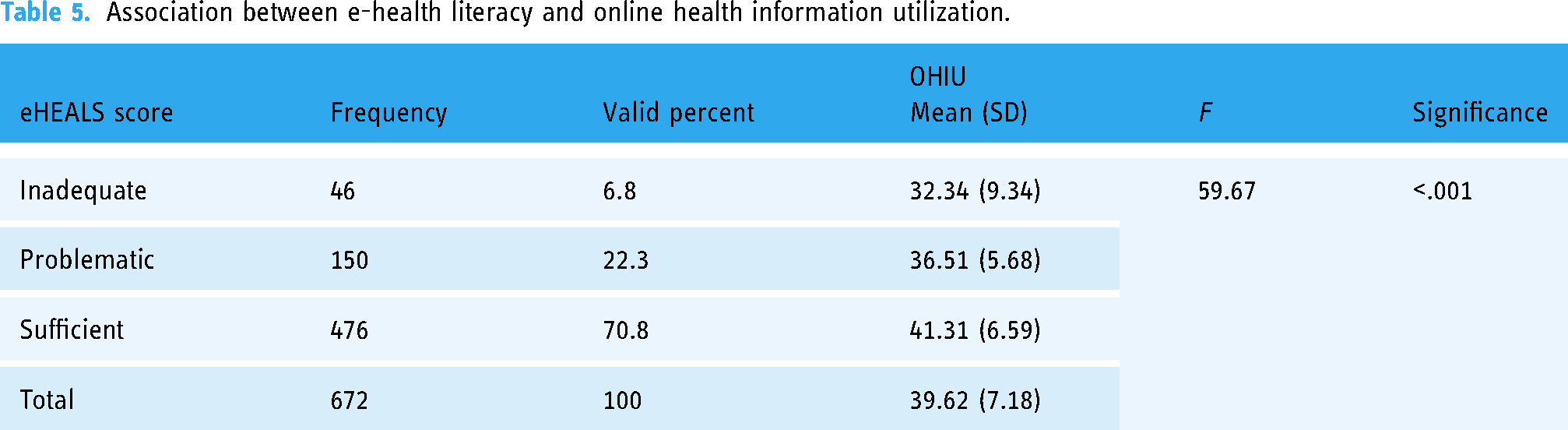
Table 5 shows that there is a statistically significant association between the level of e-health literacy and the utilization of online health information (p≤.05), as determined by the ANOVA test. As it appears, those who have an inadequate health literacy score have the lowest OHIU score (32.34), whereas those with a problematic health literacy score have a mean score of 36.513. Furthermore, those who have a sufficient health literacy score achieved a higher OHIU mean score (41.31).
Association between e-health literacy and online health information utilization.
ANOVA test
Table 6 illustrates the factors that contribute to e-health literacy and online health information utilization. The results showed that females gained higher eHEALS and OHIU scores. Furthermore, at the level of gender, the results show there is a statistically significant difference between males and females (p > .05). Additionally, based on the geographical area, the results present significant differences in the eHEALS score as (P > 0.05), whereas the center region achieved the higher eHEALS score. Regarding the OHIU, the results show that there is a statistically significant difference at the level of having chronic disease or not (p > .05).
e-Health literacy and online health information utilization and its associated factors.

Note. One-way ANOVA, p < .05.
Discussion
This study exists to assess the level of e-health literacy among the Jordanian population, as well as the degree of online health information utilization. Its goal is to identify the factors that influence e-health literacy and the use of online health information. The results of this study show that the majority of Jordanians rely on physicians and primary healthcare centers, considering them the primary source of health information. Dahiyat et al. reported a similar result. 38 Ghiasi also revealed a similar result, emphasizing the crucial role of healthcare workers in disseminating health information. 28 This highlights the important role that the primary healthcare centers and healthcare providers play in providing health-related information. Accordingly, the consistency of the results highlights the crucial role of primary healthcare centers and healthcare providers in shaping the information-seeking behavior of the Jordanian population.
Regarding internet use, the majority of this study's participants reported using the internet for around two to four hours on a daily basis, considering the technology essential to their lives. These findings are similar to the findings reported by previous research. 22 On the other hand, the findings of this study contradict those of another researcher, 39 who suggested that online sources were the primary source for obtaining health information. This contradiction could be attributed to studies being conducted during the COVID-19 pandemic. Moreover, this study's findings indicate that the majority of participants use the internet daily, and specifically, 369 participants (54.9%) utilize it for social media daily. This finding is similar to the study by Shiferaw et al., 39 which reported that 81.2% of its participants who had chronic diseases used the internet for social media. This could be related to the frequent use of the internet for social interaction, which emphasizes the importance of social media in their day-to-day activities.
In regards to the e-health literacy level among the Jordanian population, this study's results revealed that the majority of the participants had sufficient health literacy, which is congruent with findings from a Jordanian study conducted on online health consumers. 21 This study result is also similar to another Jordanian study conducted among nursing students. 40 Moreover, at the regional level, although there were different populations and settings, this study result is consistent with studies conducted in Kuwait, Saudi Arabia, and Lebanon, but this could be related to the fact that almost all of the participants in this study were internet users. In addition, they were younger adults, as the mean age was 36.04 ± 11.326 years. This could also be related to the fact that younger adults have more internet penetration than the older adult population 41 and may improve their e-health literacy.
However, a Jordanian study on undergraduate students found that the mean score for e-health literacy was inadequate. 22 This result's inconsistency highlights the importance of considering the specific characteristics of the study population. Discrepancies in age, educational level, and internet use patterns among participants may have a significant impact on e-health literacy levels. For instance, undergraduate students may not yet have developed the same level of health information-seeking skills as older participants. When these differences are taken into account, the study gives a more complete picture of e-health literacy in Jordan and shows how different population traits can lead to differences.
For the utilization of online health information, these study findings present a valuable insight into how the Jordanian population uses online health information when taking health-related decisions. Additionally, this study revealed interesting patterns regarding the three themes of the OHIU questionnaire: changing decisions, consulting others, and promoting self-efficacy. Regarding the changing decision theme, the study results show that the participants are willing to adapt and consider alternative health choices based on the available resources or the accessed information. This suggests a certain level of flexibility in their health-related decision-making process. This is in line with prior studies results41–45 which demonstrated that patients actively engage in making health-related decisions when equipped with online health information. Particularly within the consulting others theme, this study showed a tendency to seek advice or consultation from other external resources in order to make health-related decisions. The study's participants primarily sourced health information from physicians and primary health centers, a finding that aligns with previous literature findings.45,46 As they revealed, in-person interaction with doctors is the most significant factor in health-related decision-making.
For the promoting self-efficacy theme, the results show that participants generally demonstrated confidence in their ability to manage their health-related issues. This finding suggests that while people seek information and input from various sources, they still maintain a sense of self-assurance in handling their health-related issues. The information collected from online health resources may strengthen self-efficacy, empowering individuals to take proactive control of their health. This result is consistent with previous findings 47 that concluded that the new technology in advancing patient education and improving the accessibility of information led to boosting self-efficacy, which aids in enhancing treatment adherence.
Furthermore, this study results demonstrate that the shift in e-health literacy from inadequate to problematic to sufficient coincides with a dramatic increase in the online health information utilization mean score. This emphasizes the influence of health literacy levels on the utilization of online health information and resources, which means there is a positive relationship between e-health literacy categories and the OHIU total score. This in turn leads us to conclude that participants with better e-health literacy were better able to self-manage and engage in their own medical decision-making, which means a greater ability to follow preventive public health measures. These results are similar to those of earlier studies,47–51 which all showed that e-health literacy was the best predictor of health behavior and that having e-health literacy is linked to living a healthy lifestyle.
Regarding the influence of some sociodemographic factors on e-health literacy level and OHIU, this study's results illustrated that e-health literacy is significantly associated with gender, as females had higher e-health literacy than males. This is consistent with prior research findings.32,52–55 Actually, this result is not surprising, as the recognition of female participation in online surveys as an established sociological phenomenon53,56,57 and its essential role in differentiating e-health literacy.48,52,53,58 Additionally, the alignment between the results of this study and those of prior studies adds credibility to this study's results.
Interestingly, e-health literacy is significantly associated with geographic region. This study distinguished participants’ locations based on three regions (north, center, and south), and it was the central region that achieved the highest health literacy score. This could be attributed to several convincing factors. Because the central region frequently houses the capital city, it tends to benefit from more developed infrastructure, improved access to educational resources, and potentially greater exposure to advanced healthcare facilities. Collectively, these factors contribute to an environment that fosters higher levels of e-health literacy among its residents.
The varying degrees of urban and rural areas in the northern and southern regions of the study area present distinct challenges for e-health literacy. The northern region, which is generally more densely populated and developed, faces fewer obstacles compared to the southern region. In contrast, the southern region, with its larger rural areas and lower population density, encounters significant challenges related to reduced access to e-health resources and educational opportunities. These regional differences highlight the impact of geographical and socio-economic factors on e-health literacy and underscore the need for targeted interventions to address these disparities.
On the other hand, the results of this study are contradictory to the prior study findings, which revealed that chronic diseases are associated with higher e-health literacy. 55 However, this study revealed that there is no association between chronic disease and level of e-health literacy. This could be justified because more than three-quarters of the participants did not have any chronic diseases. The study found no significant association between e-health literacy and some sociodemographic factors, such as age, which contradicts the findings of previous literature.13,53,59–61 This could be due to the fact that the participants were young adults. Furthermore, these differences may be attributable to different populations and data collection tools. In addition, with the increasing integration of technology into our daily lives, people of various age groups could exhibit a similar level of e-health literacy.
Moreover, the study found no significant association between e-health literacy and education, which contradicts the findings of previous research.40,61,62 This could be justified by the fact that Tubaishat and Habiballah’s study was conducted on undergraduate students, which means all participants had the same educational level. Almoajel included only cancer patients, with less variation in their educational level, whereas this study was a population-based study among community-dwelling people, and the results could be related to the fact that the vast majority of participants in this study had a diploma or higher education level. Furthermore, the lack of associations at the educational level suggests that e-health literacy is not dependent on traditional education. People with varying educational levels exhibit a high level of e-health literacy.
For online health information utilization, this study illustrates a significant association between the presence of chronic disease and the level of OHIU, as those participants who have chronic disease exhibit a higher OHIU score than those who do not. This could be justified by the greater need for health-related information related to their health situation than that of healthy people. This is similar to the findings of two studies conducted by Bansil et al. 63 and Duplaga, 64 which showed that patients with one or more chronic diseases utilize online health information more than disease-free individuals. This association could be explained by the high necessity for chronic disease patients to actively participate in self-management and their involvement in taking decisions related to their health. This also relates to the crucial need for chronic patients to educate themselves about their disease. Furthermore, these findings indicate a greater reliance on online health information among participants with chronic diseases,47,64,65 implying a positive correlation between a higher level of online health information utilization and improved e-health literacy among individuals managing chronic illnesses. 10
Limitations
Several limitations exist in this population-based study. Due to the cross-sectional design, it was challenging to establish causal relationships between variables. Additionally, the data collection questionnaires were self-reported, and there are inherent limitations that could potentially affect the accuracy of the results. Even though this is a population-based study, more participants must be included in future research to represent the entire governorate.
Conclusions
This study revealed a balance between online health information resources and traditional methods of accessing health information. Notably, while healthcare professionals remain the primary sources of health information for the Jordanian population, online platforms are increasingly utilized, suggesting evolving trends influenced by technological advancements. The study addressed the fact that the Jordanian population has sufficient e-health literacy, consistent with national and regional research findings, emphasizing the importance of e-health literacy initiatives. Participants demonstrated adaptability in decision-making, consultation with others, and correlation between higher e-health literacy and increased online health information utilization, enabling proactive health management. Gender and geographic regions are considered associated factors with e-health literacy, with females and the capital region exhibiting higher e-health literacy. Surprisingly, no age or education associations were found. Notably, chronic disease was linked to increased reliance on online health information utilization, underscoring its vital role in supporting self-management. In addition, this study holds positive advantages for stakeholders and policymakers at the country level to customize online health information and services to better suit the requirements of the Jordanian population and to work on internet platforms in order to enhance the quality and quantity of online health information. Overall, the study advocates for targeted interventions that harness both traditional and digital health resources to empower effective health management.
Supplemental Material
sj-docx-1-dhj-10.1177_20552076241288380 - Supplemental material for e-Health literacy and online health information utilization among Jordanians: A population-based study
Supplemental material, sj-docx-1-dhj-10.1177_20552076241288380 for e-Health literacy and online health information utilization among Jordanians: A population-based study by Majeda A. Al-Ruzzieh, Yahia M. Al-Helih and Zaid Al-Soud in DIGITAL HEALTH
Footnotes
Contributorship
Majeda A. Al-Ruzzieh contributed to conceptualization, methodology, and writing–review and editing. Yahia AL-Helih contributed to conceptualization, methodology, supervision, analysis, writing–review and editing, and supervision. Zaid AL-Soud contributed to data curation.
Declaration of conflicting interests
The authors declared no potential conflicts of interest with respect to the research, authorship, and/or publication of this article.
Funding
The authors received no financial support for the research, authorship, and/or publication of this article.
Guarantor
Here is Dr Yahia Al-Helih declaring that I am responsible for the article, including for the accuracy and appropriateness of the reference list.

Supplemental material
Supplemental material for this article is available online.
References
Supplementary Material
Please find the following supplemental material available below.
For Open Access articles published under a Creative Commons License, all supplemental material carries the same license as the article it is associated with.
For non-Open Access articles published, all supplemental material carries a non-exclusive license, and permission requests for re-use of supplemental material or any part of supplemental material shall be sent directly to the copyright owner as specified in the copyright notice associated with the article.
