



Abstract
Objective
The rapid development of online healthcare has greatly promoted the transformation of healthcare service. The effectiveness of online healthcare is enhanced by the team that supports the doctor–patient connection. However, extant researches lack the comprehensive analysis of social networks within online healthcare team. In this study, we aim to clarify the characteristics and models of online healthcare team.
Method
This study focuses on the online healthcare context and collects data from online healthcare team. Using social network analysis, the social networks of online healthcare members are also developed as part of the research.
Result
This study uncovers the different modes of online healthcare teams from individual, team and organizational levels. These results shed light on the characteristics of an online healthcare team and show that such teams are capable of restructuring social networks. In addition, collaboration between teams allows for the development of multilevel relationships and the potential for the online healthcare team to evolve into a large-scale online healthcare organization.
Conclusion
Through social network analysis, this study offers a fresh viewpoint on online healthcare and its implications for management, team construction, and organizational restruction. By examining the characteristics and models of online healthcare team, this research offers valuable insights for improving the overall effectiveness of online healthcare.
Keywords
Introduction
In the United States, about 12 million people may die or suffer permanent harm each year as a result of medical mistakes, with the misdiagnosis rate in outpatient clinics reach 5.08%. 1 This phenomenon is not rare in China. The capability and resource of individual are limited, while an online healthcare team could obtain more thorough and objective diagnostic results. 2 Online healthcare team could help simplify the complexity in disease diagnosis, 3 decreasing the medical mistakes. Therefore, promoting the development of an online healthcare team is of great significance for offering more secure and excellent online healthcare services. 4
In the field of online healthcare, optimization and reconstruction of organizational structure has emerged as an important topic. 5 Online healthcare team just helps optimize the healthcare resources, it becomes necessary when the social interactions across different departments and districts become possible. Specifically, online healthcare team reshapes social relationships, improves clinical diagnosis accuracy and prevents the occurrence of disease misdiagnosis effectively. 6 However, there are some issues within online healthcare team, such as unclear labor division, a lack of efficient internal communication and analysis of team characteristics. To achieve high level of healthcare team, eliciting the social network and characteristic are prominent. Gradually, multidisciplinary team has become an important direction to achieve innovation and breakthrough, reaching a higher level of collaboration in online healthcare team. Thus, online healthcare team, particularly the interdisciplinary partnerships, might offer patients more specialized and professional services by efficiently integrating and leveraging a variety of healthcare resources7–9. Analyzing the characteristics and social network of online healthcare team is important for team collaboration and healthcare development.
Above all, focusing on the online healthcare team, this study collects data and analyzes the online healthcare team characteristics and its social network. In the context of online healthcare, this study aims to investigate the characteristics and models of online healthcare teams, clarify the internal mechanisms of online healthcare team development, and explore a larger scale of online healthcare team-online healthcare organization. Using information econometric analysis and visualization tools, we analyze the characteristics and models of online healthcare team through social network analysis. The results show that the online healthcare team effectively promotes professional interactions among doctors. Thus, by depending on cross-team and cross-professional interaction, the online healthcare team could realize collaborative innovation at the organizational level.
Method
Research logic
This study systematically analyzes the characteristics and mode of online healthcare team from the individual, team and organizational perspectives. About research method, this study employs network information measurement and visualization tools to examine the online healthcare teams. Social network analysis is the main method used in this study. Previous literature demonstrates that public health practitioners should utilize social network analysis as a potentially helpful reflecting tool to analyze network function, improve cooperation with other community partners, and assess the overall composition of their networks. 7 Social network analysis provides a new way to qualify interpersonal relationships. 8 It is also shown that the social network analysis can clarify relational structures and flows in primary health care. 9 Through social network analysis, the characteristics of teams, organizations could be reached. In addition, the Louvain algorithm is also used as a community discovery approach. It discovers the relationships between large-scale agglomeration through clustering method. This study focuses on the internal of online healthcare team, building a social network and analyzing characteristics of the online healthcare teams (Figure 1).

Research logic.
Data collection
The specific research context for this study is “Haodf Online.” Haodf online is known for collecting an enormous amount of excellent medical resources in order to provide users with high-quality healthcare services. In recent times, there has been a steady increase in the number of online healthcare teams consisting of doctors, nurses, technicians and scientific researchers from different departments, hospitals and regions. Consequently, it could provide comprehensive and timely online healthcare services for patients.
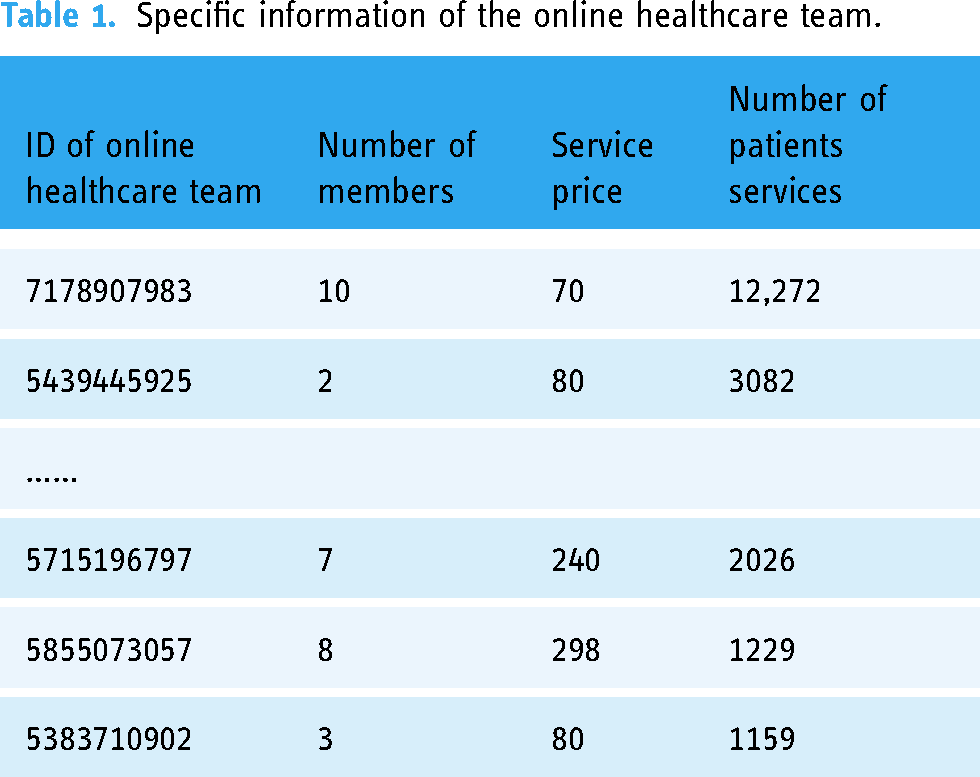
In this study, 14,663 team members’personal information and 3802 pieces of team information were collected. Details like the team name and member information are included in the data sets. Every online healthcare team, along with its members, is identified by a unique ID in order to protect their privacy. For the purpose of the final data analysis, 10,301 team members and 3791 online healthcare teams are kept. Table 1 represents an overview of certain team information.
Specific information of the online healthcare team.
Online healthcare team model construction
A social network made up of nodes and relationships is built in this study. Usually, a lead expert has higher possibility to accumulate social capital and occupy the core position in social networks.10,11 Moreover, team members frequently participate in online healthcare teams and have a variety of social network connections, which may help them build larger personal networks.
Further, this study uses Neo4j graphical database to transform structured data into social network data, in order to simplify the process of data storage, transfer, analysis and visualization. It could be seen that the online healthcare team consists of 13,194 nodes and 10,490 relationships, as shown in Figure 2.

Network model in online healthcare teams.
Results
Information econometric analysis of the social network
The results show that characteristics and models of the online healthcare team. As the complex dynamics of social network within the online healthcare team, this study aims to measure the network structure of online healthcare team using network information metrology. To clarity the overall network structure and network characteristics, network density, degree distribution, network diameter, average path length, average clustering coefficient and modularity coefficient are used as indicators of social network analysis. 12
Network density
The density of social network relationships represents the potential for establishing cooperative relationships. A density close to 1 indicates that the network has a large number of connections. This suggests that the network has strong cooperation capabilities. Its mathematical expression is shown in (1):
Degree of distribution
Degree refers to the number of relationships between members in a social network, while degree distribution refers to the probability distribution of individual degrees. In the real network, the degree distribution is typically right-skewed. This demonstrates the power-law distribution characteristics, which is an important criterion for evaluating scale-free networks. As shown in Figure 3, the degree distribution in this study follows a power exponential distribution, indicating that the social network of healthcare members has scale-free network characteristic. This means that there are “hub” nodes in the network, acting as “intermediaries” to connect different online healthcare teams.

Degree of distribution.
Network diameter
Network diameter refers to the shortest path between two members with social relationships. The average path length refers to the shortest path between any two members in the network. By analyzing the average path length, we identify cooperative teams within complex networks. Its mathematical expression is:
Network clustering coefficient
Network clustering coefficient represents the clustering degree of social relationships, and it is usually used to quantify the social network structure. By analyzing the clustering coefficient of healthcare members, the relationship closeness between members in the social networks is reached. Its numerical expression is:

Modularity characteristics
According to the relationships in the social network, this study classifies and analyzes the characteristics of the complex social network. The range of modularity coefficient is [−0.5, 1), and when the value reaches 0.3–0.7, the social network often displays strong modularity characteristics.
13
The mathematical definition of modularity coefficient is shown as follows:
Overall network characteristics.

Through the analysis of social network, in this study, network density and average clustering coefficient are relatively low. Most teams operate in a largely isolated manner. In addition, the modular coefficient is relatively high, indicating that part of the healthcare members has strong social network relationships, and hub nodes plays a key role in reconstructing social network, eventually forming large-scale online healthcare organizations. Therefore, this study further investigates the deep relationships in the social network based on the analysis of the overall network characteristics.
Cross-team partnership discovery
Last section reveals the characteristics of online healthcare team, based on this analysis, therefore, this paper further conducts a systematic analysis of online healthcare teams, in order to examine the complex relationship between online healthcare teams and the impact of cooperation on healthcare service mode innovation. The Louvain algorithm is a community discovery approach. It discovers the relationships between large-scale agglomeration through clustering method. Especially for networks with more nodes and fewer relationships, the clustering effect is more obvious.
Our analysis shows that there are 2856 independent healthcare groups in the social network relationship, which is significantly different from the 3791 online healthcare teams in the original data set. It indicates that there exists deep implicit cooperation relationships among online healthcare teams. That is to say, many healthcare teams integrate and cooperate to form a large-scale online healthcare organization.
Analysis of online healthcare organizations
Through clustering, it is shown that the online healthcare organizations are formed by different types of online healthcare teams, they collaborate and share resources to provide comprehensive care. Indeed, the internal structure of online healthcare organizations varies. This study takes into account a variety of characteristics, including organizational size and professional specialties. Table 3 shows the typical online healthcare organization.
Internal characteristics of online healthcare organizations.
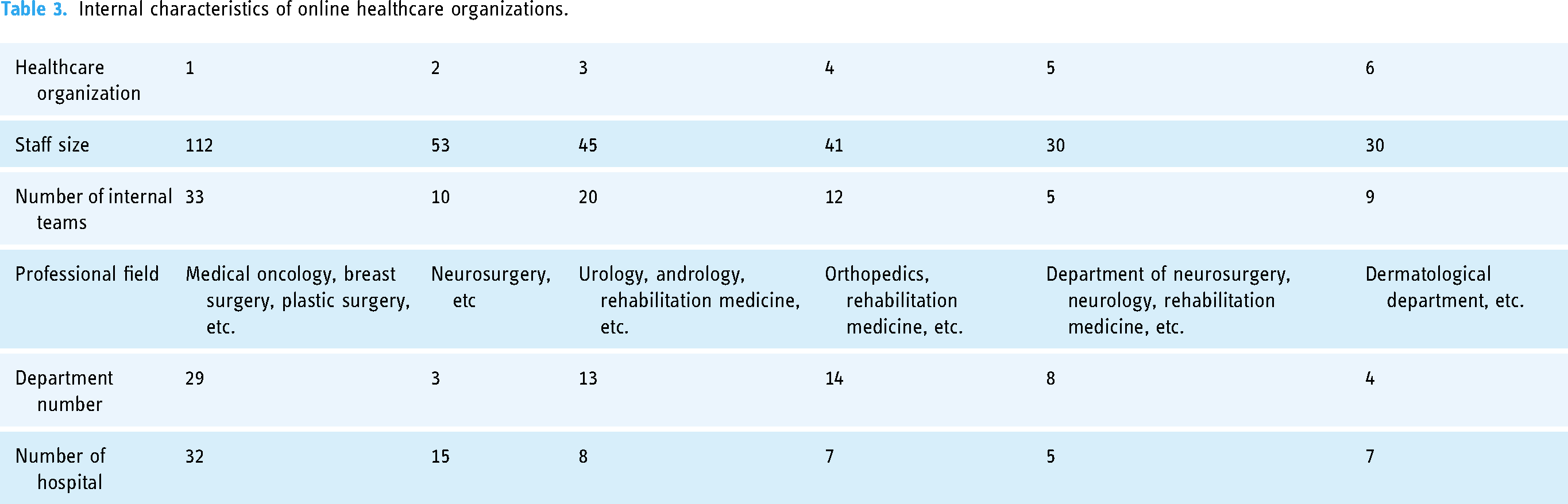
Currently, several important international cancer treatment centers have implemented a multidisciplinary approach to diagnosis, which involves collaboration among departments such as tumor surgery, interventional medicine, imaging, pathology and nursing. Online healthcare team 1 not only includes clinical departments for breast surgery, thyroid surgery, gynecology, radiotherapy, and interventional therapy, but also physical and psychological rehabilitation departments such as plastic surgery, medical cosmetology and medical psychology (Figure 4). The results show that online healthcare organization 1 is the largest, with 33 online healthcare teams consisting of 112 professional from 31 hospitals and 16 departments. Through this collaboration, organization 1 has access to a wealth of healthcare resources, enabling them to provide comprehensive services for breast tumor diagnosis, treatment and postoperative rehabilitation and plastic surgery.

Online healthcare medical organization 1 department distribution.
However, there exists different organizations, not all healthcare organizations have formed partnerships. For example, online healthcare organization 2 specializes in the clinical diagnosis and treatment of human nervous system. The organization is composed of 10 online healthcare teams, all of which have a background in neurosurgery. Generally, online healthcare team form online healthcare organization through certain social network relationship. However, the composition of online healthcare organizations can vary greatly due to the different professional backgrounds and requirements for teamwork.
Visualization of online healthcare organizations
Based on the structural characteristics of social network relationships, this study classified online healthcare organizations into professional homogenous healthcare organizations and professional complementary healthcare organizations. Gephi is used to depict the social network in online healthcare organizations in Figures 5 and 6.
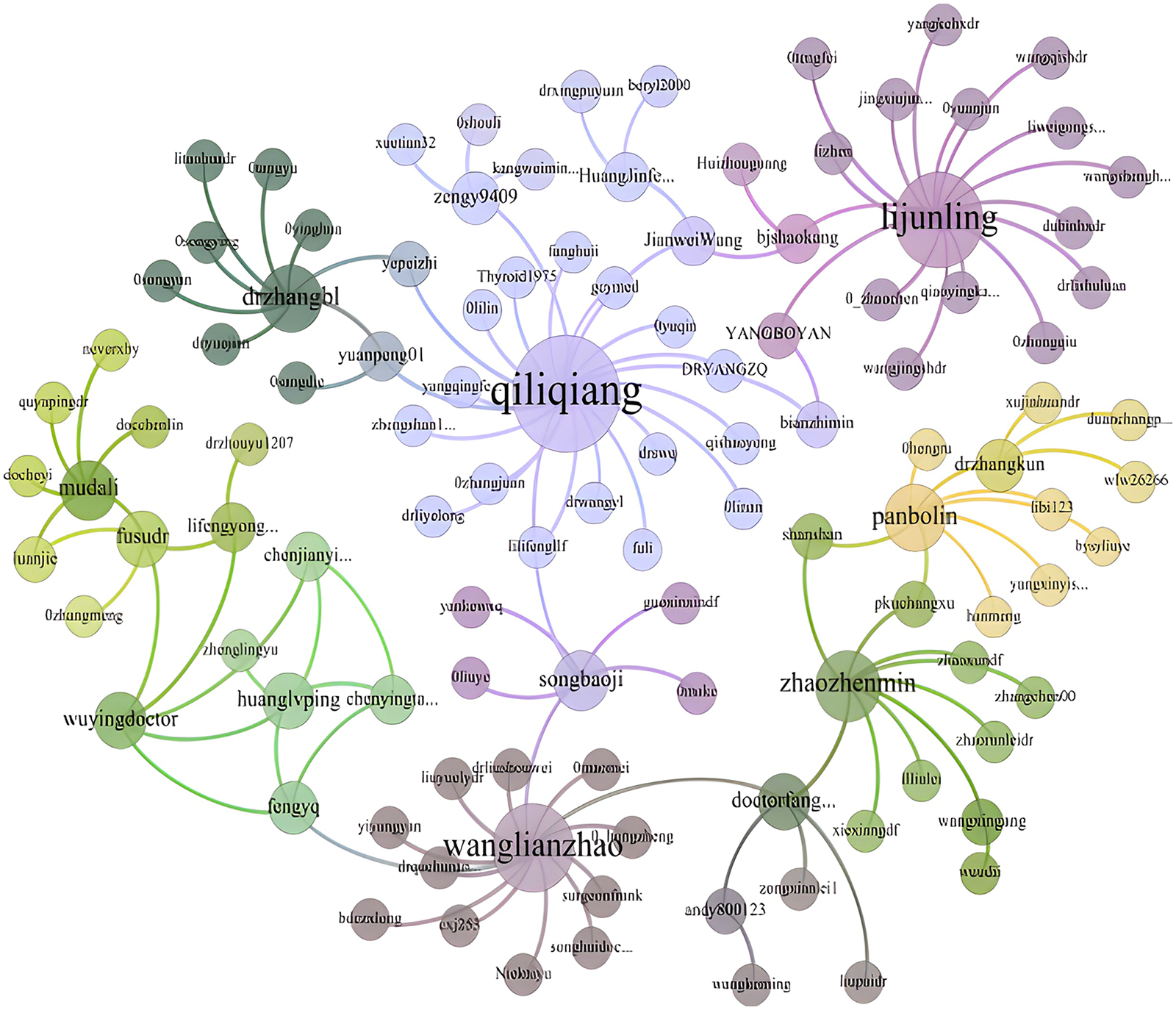
Professional complementary healthcare organizations.

Professional homogenous healthcare organizations.
Upon examining the social network structure, it becomes evident that professional supplementary healthcare organizations have a complex network structure that is primarily characterized by cross-team integration and multidisciplinary interaction. A primary healthcare cooperative connection leads the secondary healthcare teams.
In conclusion, it is evident that online healthcare teams form a systematic collaboration mode through the analysis of social network relationships. Furthermore, some team members have memberships in multiple teams, which is beneficial for coordinating internal activities and promoting the formation of external cooperative relationships. This enables the steady development of online healthcare teams in the constantly changing internal and external environment.
Discussion and implication
Prior works
Social network relationships have drawn a lot of attention from researchers. Social network analysis could uncover the internal structure of social network. 14 By establishing and eliciting social networks among healthcare professionals, researches of social network in online healthcare can foster interdisciplinary collaboration. It has been demonstrated that cooperation can be very beneficial for disaster management. 15 But periodically, the healthcare team can fall apart, which would be detrimental to the advancement of healthcare. 16 This study is based on the context of online healthcare, analyzing the characteristics and enriching current researches on social relationship network in online healthcare teams. This is beneficial for eliciting the characteristics and models of online healthcare.
Generally speaking, doctors establish casual connections based on their understanding of illness and treatment. 17 In social network, super users play a crucial role in advancing the transformation of information. 18 In addition, team heterogeneity may affect the expectations for online team-based services. 3 The performance of the team is also influenced by team diversity. 19 Online commentary has the potential to improve shared team situational awareness, especially in online healthcare teams. 20 Through a variety of resources, establishing a central position in the social network could greatly benefit individuals.
Examining the characteristics of virtual healthcare teams is essential for improving healthcare and team management. Social media and communication are essential components of an online healthcare team, fostering cooperation and coordination. 21 In complex social networks, resources, technology, and information are typically integrated to facilitate medical diagnosis and treatment. 22 Consequently, it is evident that research on online healthcare teams typically focused on user behavior, resource sharing, and innovative service delivery. Online healthcare teams with high coherence and regular engagement can more easily integrate resources and services from diverse professional backgrounds compared to individual doctors. 5
There are numerous benefits to utilizing an online healthcare team for clinic operations. First, maintaining competitiveness and creating value requires professional expertise. Collaboration among experts could enhance patient experience and the quality of online healthcare services. 10 Secondly, by sharing knowledge and seeking assistance from others, members of the online healthcare team can enhance their learning and improve their performance both as a team and individuals. 23 Additionally, online healthcare team members engage in a variety of social activities depending on their living situation. 24 An implicit cooperative relationship can be identified within an online healthcare team through social network analysis. Strong connections are beneficial for the flow of information, but if collaboration and exchange are limited within the organization, the network structure will become too inflexiable to foster innovation at the organizational level. 25 Furthermore, a multidisciplinary team can promote collective cognitive innovation because it is usually formed around an individual's network of relationships. Overall, research suggests that social connections may promote the use of information technology for task-oriented purposes. However, innovation activities are hindered by the structure of interdisciplinary healthcare teams and the diversity of professional backgrounds, which may result in a lack of innovation dissemination. 25
Above all, social relationships within the online healthcare team are advantageous for sharing information and fostering a cohesive team. Through social network analysis, it is evident that conducting research on social relationships and healthcare management helps to identify social networks. 13 In essence, the value of healthcare management could be realized through online healthcare services. Social networks facilitate the transfer and exchange of information, knowledge, and capital between individuals and organizations, thereby providing valuable insights and context for social network research. However, the characteristics and models of online healthcare teams have not been well studied in current research. Thus, this study aims to systematically analyze the functioning of online healthcare teams at the individual, team, and organizational levels, in order to investigate the characteristics of social network relationships within online healthcare teams.
Discussion
This study utilizes data from online healthcare teams to construct a social network model and analyze the cooperative relationships among team members. It examines the structural characteristics of online healthcare teams at the individual, team, and organizational levels. This study provides insights into online healthcare teams. Compared to previous research, this study focuses on the features of online healthcare, aiming to elucidate and clarify the internal mechanisms of online healthcare models and characteristics. 5 By strategically locating themselves within the network, online healthcare team could gain a competitive advantage, foster cross-team integration, and establish a large-scale online healthcare organization. This would optimize the allocation of medical resources and safeguard the quality and safety of medical services, enriching previous research on team collaboration. 10
In detail, from the perspective of the social relationship network, it can be observed that the social relationship network of online healthcare team exhibits the characteristics of a scale-free network. The social network tail is prominent, and key hub nodes connect various online healthcare teams. Secondly, it revealed that the online healthcare team can establish an online healthcare organization. The results of the social network analysis indicate that individuals’roles in the network vary due to the different positions they occupy and the complexity of their social relationships. The membership in multiple teams plays a crucial role in fostering collaboration among teams. Medical staff who occupy structural holes not only gain information and knowledge advantages for themselves, but also foster collaboration among teams and reshape the organizational structure of the medical service. Furthermore, from the perspective of teams and organizations, the overall operational mechanism of online healthcare teams is relatively independent and distributed. It is still in the stage of small-scale cooperation, which is not conducive to addressing the information silos and information isolation in the traditional healthcare system. Compared to the previous study, this study clearly elucidates the characteristics of online healthcare teams. 6 The analysis of organizational characteristics reveals a clear trend toward the aggregation and modular distribution of online healthcare teams. Additionally, advanced healthcare teams are increasingly leveraging social networks to facilitate cross-team cooperation, leading to the development of professional complementary and homogeneous online healthcare organizations.
Theoretical implications and practical implications
This study has theoretical implications for online healthcare service. Firstly, a new healthcare service model is being studied based on the social relationship network, cooperation mode, and network characteristics of online healthcare team. The results show that online healthcare team is evolving into a large-scale online healthcare organization through cross-team cooperation and multidisciplinary integration. This evolution helps to clarify the formation mechanism of the online healthcare team at three levels: individual, team, and organization, and enriches previous studies on online healthcare teams. 10 Second, this study clarifies the value of online healthcare teams by analyzing the characteristics of a specific online healthcare team. 13 The online healthcare team creates an open, interconnected social network. Furthermore, online healthcare teams could facilitate the sharing of information, knowledge, and technological resources, thereby fostering individual and group value creation. This, in turn, would lead to the realization of value and the provision of improved healthcare services for patients, thus extending current research on online healthcare collaboration. Thirdly, the study confirms that the online healthcare team can rebuild social network relationships and undermine the organizational structure of the traditional healthcare system through in-depth analysis of the online healthcare team's social network. In the healthcare field, the social relationship network of an online healthcare team can facilitate the seamless integration of digital elements and healthcare services. Therefore, in online healthcare, conducting a thorough analysis of the social relationship network characteristics of the online healthcare team is crucial for enhancing the quality of healthcare services and optimizing the allocation of medical resources. In terms of management practice, digital elements and medical service providers should be integrated at a deep level, encompassing individual abilities, organizational structure and system construction. This integration will promote the digital transformation of the online healthcare field. Online healthcare teams transcend the limitations of individuals, departments, or teams through modern information technology. This optimization of the organizational structure aims to establish a large-scale chemical and medical alliance organization focused on high-quality, refined, and cutting-edge disciplines, extending its influence to various professional fields. Therefore, online healthcare teams have the potential to enhance the quality of medical services and provide a comprehensive improvement to patients’medical experience.
Limitation and future research
This study focuses on online healthcare team and analyzes their characteristics, aiming to clarify the internal mechanism of their social network. However, the existing research also has some limitations. Firstly, this study focuses on analyzing the characteristics of online healthcare teams. Therefore, the results could be influenced by the models of online healthcare. The online healthcare system in China is in the developing stage and is relatively limited, providing ample opportunity for the expansion of online healthcare teams. In future research, further studies can be conducted on various types of healthcare teams to confirm the generalizability of this study. Second, this study focuses on the social network relationships within online healthcare teams. However, it lacks statistical methods such as regression, simulation, and analysis of the characteristics of social relationships, team performance, and innovation in online healthcare services. Future studies could incorporate additional research methods to further enhance the current research on online healthcare teams. In addition, a more in-depth analysis of the social relationship network within online healthcare teams could provide deeper insights into the mechanism driving online healthcare development.
Conclusion
In this study, we analyze the characteristics and models of online healthcare teams and develop a large-scale of online healthcare organization. Through the analysis of social networks within online healthcare teams, we can uncover the internal mechanism of these teams and gain insights into the characteristics and models of online healthcare development. This can help clarify the future direction of online healthcare team research. In addition, we acknowledge that there are some limitations in online healthcare. By analyzing online healthcare teams at a broader level, we can identify potential organizational issues and make some adjustment to help enhance the quality of online healthcare.
Footnotes
Acknowledgments
The authors declared no potential conflicts of interest with respect to the research, authorship, and/or publication of this article.
Consent statement
All the participants in this study have agreed the data collection. The rights of all individuals are not infringed.
Contributorship
DXY and ZX designed the study. WWH mainly takes charge of the methodology and modification of the study. DXY and YX analyzed the data. DXY assisted with data interpretation and theoretical background. All authors contributed to the writing and revision.
Declaration of conflicting interests
The authors declared no potential conflicts of interest with respect to the research, authorship, and/or publication of this article.
Ethical approval
The ethical approval is not applicable.
Funding
The authors disclosed receipt of the following financial support for the research, authorship, and/or publication of this article: This work was supported by the Social Science Planning Research Project of Shandong Province, National Office for Philosophy and Social Sciences of China (Grant Nos. 23DTQJ04 and 21AZD022).
Guarantor
DXY.
