



Abstract
Objective
The internet has become a preferred source for people seeking health information, including diet recommendations which are pivotal in the management of inflammatory bowel disease (IBD). Hence, we aimed to assess the quality of online information in China regarding IBD dietary recommendations.
Methods
The search engines Baidu and Bing were used to screen for their top 25 webpages using the keywords “inflammatory bowel disease diet,” “ulcerative colitis diet,” “Crohn's disease diet,” “inflammatory bowel disease nutrition,” “ulcerative colitis nutrition,” and “Crohn's disease nutrition.” The quality of information was assessed by two physicians according to the Journal of the American Medical Association (JAMA) benchmark, the Global Quality Score (GQS), and the DISCERN instrument.
Results
One hundred and eight webpages were selected for evaluation. The mean scores for JAMA, GQS, and DISCERN were 1.48, 3.11, and 36.20, respectively. Articles from professionals and non-profit organizations demonstrated superior quality compared to those from commercial and health portal websites. Many webpages failed to provide an explicit source of information or support for shared decision-making. The information on several pages lacked comprehensive descriptions of food types for IBD, with some pages even containing inaccuracies. No statistically significant differences in scores were observed between Baidu and Bing.
Conclusions
The quality of online information on IBD dietary recommendations in China is moderate to low and exhibits significant variation across different sources. This warrants joint efforts from online authors, internet platforms, and regulators, to improve the quality of popular medical information.
Introduction
Inflammatory bowel disease (IBD), including ulcerative colitis (UC) and Crohn's disease (CD), is a chronic relapsing disorder with an unknown cause, impacting millions worldwide with both intestinal and extraintestinal manifestations. 1 Diet is thought to play a role in the pathogenesis and progression of IBD, and current clinical guidelines mention diet as a central pillar of IBD management.2,3 Inappropriate dietary practices may escalate the risk of intestinal infections, exacerbate disease activity, and even lead to severe complications such as ileus and gastrointestinal perforation. Additionally, excessive dietary restrictions can detrimentally affect the social interactions of individuals with IBD and increase the risk of malnutrition. 4 Therefore, accurate and pertinent dietary education is crucial for the effective management and recuperation of the disease. Traditionally, dietary recommendations were conveyed by healthcare professionals, books, and educational brochures; however, the brevity of interactions between doctors and patients often hindered thorough comprehension.
The internet has become a popular source for medical and health-related information, providing access to a wealth of data, including dietary recommendations for IBD. One 2013 survey from the Pew Research Center showed that 72% of American internet users had looked online for health information of one kind or another within the past year. 5 The 48th “Statistical Report on Internet Development in China” revealed that by June 2021, China's internet user base surpassed 1 billion, with online medical information seekers numbering 239 million, representing 23.7% of the total online population. 6
The reliability of online health information often varies, with some sources providing inaccurate content that could mislead individuals’ decision-making processes.7,8 It is therefore imperative to evaluate the credibility of such information. Earlier research indicated that online nutritional advice lacks uniformity in quality. 9 One study analyzed the quality of Spanish online information on probiotics, yogurt, kefir, kombucha, fiber, and prebiotics. Using a 0–10 scale, the median quality score of the examined webpages was 3. 10 Yet, no research has assessed the quality of online information regarding IBD dietary recommendations in China. This study endeavors to evaluate the quality of this information, contributing to the progression of network medicine and IBD management.
Methods
Study design
This study is a cross-sectional analysis utilizing relevant scoring tools to evaluate the quality of information related to “Dietary recommendations for IBD” available on online search engines.
Data sources
Due to Google's inaccessibility in China, we chose Baidu (www.baidu.com) and Bing (www.bing.com), the two search engines most commonly used in China. 11 Keywords such as inflammatory bowel disease diet, ulcerative colitis diet, Crohn's disease diet, inflammatory bowel disease nutrition, ulcerative colitis nutrition, Crohn's disease nutrition (in Chinese, as recommended by the Chinese Standardized Terminology, http://shuyu.cnki.net/) were searched in each engine in December 2022. Baidu displayed 194,900,000 related results, while Bing showed 721,200,000. Considering common reading habits, the top 25 webpages for each keyword were selected. We established inclusion criteria for webpages to be freely accessible without password requirements, and exclusion criteria for irrelevant content, duplicated results, academic papers, news reports, advertisements, invalid links, videos, and images.
The webpages were evaluated by two independent physicians, and any disagreements were resolved by a third reviewer. When the online article pertained to nutritional therapy, the expertise of certified dietitians was also sought. All reviewers possessed extensive experience and in-depth professional knowledge in the field of IBD nutrition. The authorship, attribution, disclosure, and currency, as well as the detailed content, were acquired through careful examination of each website. These webpages were classified as commercial, health portal, news, professional, non-profit organizations, and patient resources.
Assessment of the quality
The Journal of the American Medical Association (JAMA) benchmark, Global Quality Score (GQS), and DISCERN instrument were used to assess the quality of the selected information.
JAMA benchmark
The JAMA benchmark, published by Silberg et al. 12 is widely used to evaluate the quality of internet health information.13,14 It includes four key evaluation criteria that are clearly visible on a website (Table 1), with one point awarded for meeting the requirements of each criterion, up to a total of four points.
JAMA benchmark.

Global Quality Score (GQS)
The GQS is a 5-point rating scale used to evaluate the overall quality of health-related webpages (Table 2), taking into account their usability and flow. 15
GQS criteria.

DISCERN instrument
DISCERN instrument, the most widely used tool for assessing the quality of online health information, was initially proposed by the University of Oxford Institute of Health Sciences in 1999.16,17 It comprises 16 items on a 5-point scale, covering three sections. The first section evaluates the publication's reliability, comprising eight questions. The second section concentrates on the quality of treatment-related information, featuring seven questions, while the 16th item assesses the publication's overall quality. The total score ranges from 16 to 80, with higher scores indicative of superior overall quality of the webpages.
Recommended food types
Based on evidence from the International Organization for the Study of Inflammatory Bowel Disease (IOIBD) and various international dietary guidelines, recommended food for IBD patients primarily centers around several types, including fruits/vegetables, carbohydrates, meats, fats, dairy products, alcoholic beverages, and food additives. Additionally, specific diets such as enteral nutrition preparation, the Mediterranean diet, the Crohn's Disease Exclusion Diet (CDED), and the Specific Carbohydrate Diet (SCD) are also mentioned.2,3,18,19 Each type was independently evaluated using the GQS according to dietary guidance from the IOIBD. Any aspects not mentioned would receive a score of 0.
Statistical analysis
Statistical analysis was conducted using SPSS software (version 26, IBM, Armonk, NY, USA). The intraclass correlation coefficient (ICC) was employed to assess interobserver reliability. All variables were assessed for normality using the Shapiro–Wilk test. Normally distributed continuous variables were presented as means and standard deviations (SDs), whereas non-normally distributed variables were reported as medians and interquartile ranges (IQRs). For nonparametric tests, the Mann–Whitney U test was utilized to assess the significance of different ranks. Categorical variables were analyzed using the chi-square test. P < .05 was considered statistically significant.
Results
Content characteristics
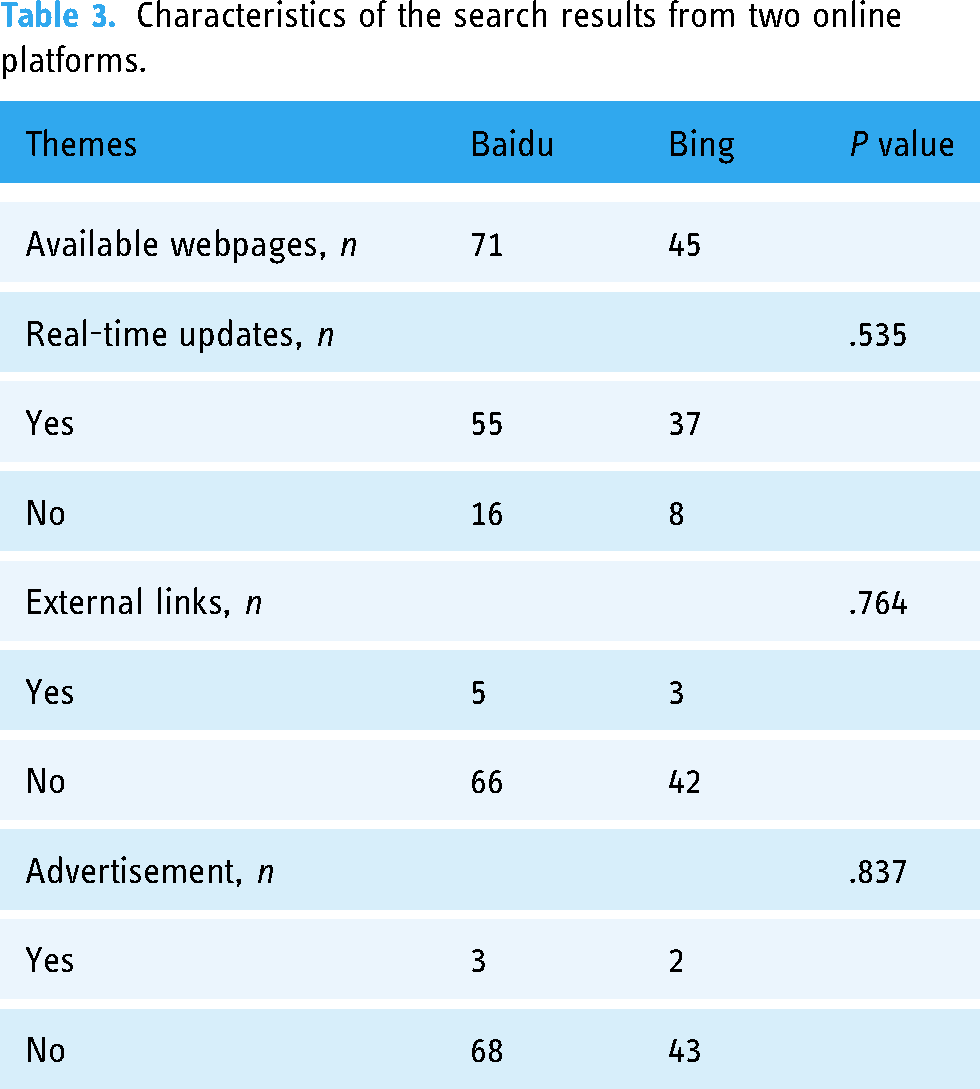
The search and selection processes for webpages are depicted in Figure 1, while the search results are presented in Table 3. A total of 71 and 45 webpages were retrieved from Baidu and Bing, respectively. No significant statistical difference was observed between the two search platforms regarding real-time updates, external links, advertisements, and authorship.

The flowchart of website search and selection.
Characteristics of the search results from two online platforms.
The two-way mixed effects model was used to evaluate the consistency of the rating scores from the two independent investigators. The ICC results between the two investigators for the JAMA scores (ICC = 0.994), GQS scores (ICC = 0.884), and DISCERN scores (ICC = 0.900) indicated a strong level of consistency.
Difference between Baidu and Bing
Although the median score of Bing in JAMA and DISCERN was marginally higher than that of Baidu, there were no significant differences in scores for the three scales between the two platforms (as shown in Figure 2A). To distinguish the differences between the two engines in more detail, we further compared the DISCERN section scores between Baidu and Bing (as shown in Figure 2B), but no statistical difference was observed in the scores across the three sections.
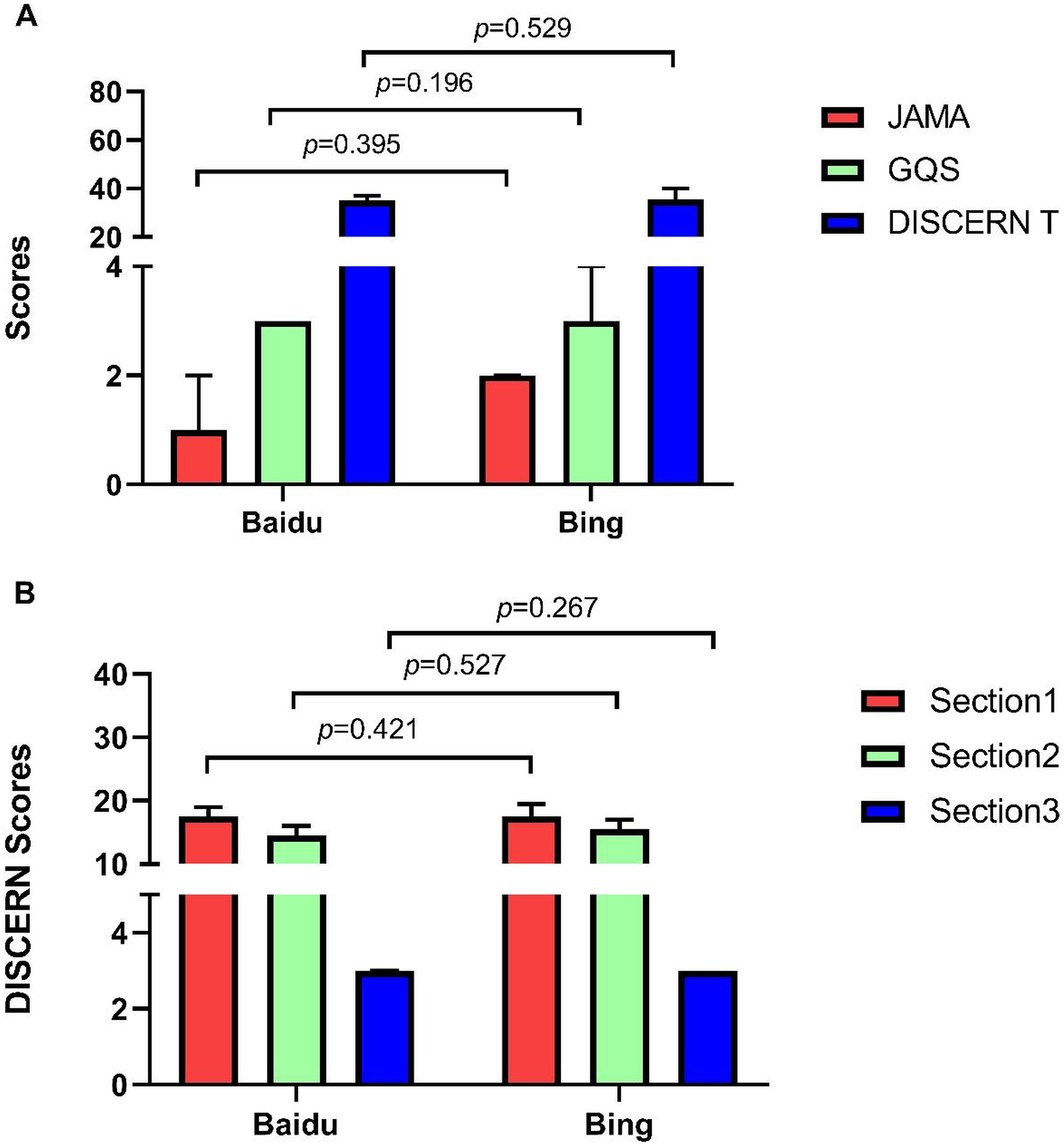
Overall comparison between Baidu and Bing: (A) median and IQR for JAMA, GQS, and DISCERN total scores; (B) median and IQR for the three sections of DISCERN.
Overall scores for Baidu and Bing
Upon consolidating the webpages from both platforms and eliminating duplicates, a total of 108 webpages were selected for further analysis. As per the JAMA benchmarks, the Venn diagram (as shown in Figure 3) reveals that none of the webpages satisfied all four criteria. Of the 108 webpages examined, 17 (15.74%) did not meet any criteria, 35 (32.41%) met one criterion, 42 (38.89%) met two criteria, and only 14 (12.96%) met three criteria. Additionally, the number and percentage of webpages fulfilling each criterion are depicted in Figure 4, highlighting the widespread lack of attributes and disclosure across the majority of the content. The average JAMA score for the 108 webpages was 1.48 on a 4-point scale (Table 4).

The Venn diagram of the 108 identified webpages according to the JAMA benchmark.

The numbers and percentages out of 108 identified webpages that met each criterion according to the JAMA benchmark.
The mean DISCERN, JAMA, and GQS scores of the 108 selected webpages.

DISCERN scores of the 108 selected webpages are presented in Table 4. The average scores for Section 1, Section 2, and Section 3 were 18.38, 15.82, and 2.92, respectively. The overall average score was 50.90, with a range from 19 to 65. Regarding reliability, many webpages failed to provide explicit information sources and identify areas of uncertainty. Concerning treatment options, the lowest-rated questions, Q15 (1.52), indicated a deficiency in support for shared decision-making.
Through the analysis of diverse webpage classifications, we discerned a trend wherein the quality of articles originating from professionals and non-profit organizations surpassed those emanating from commercial and health portal websites (as shown in Figure 5).

The JAMA, GQS, and DISCERN total scores from different types of webpages.
Evaluations of food types
Regarding the overall quality, the mean GQS score is 3.11 on a 5-point scale (Table 4). Among the 108 webpages reviewed, the majority referenced vegetables (90.7%), fats (82.4%), carbohydrates (80.6%), and meats (70.9%). Alcoholic beverages were mentioned by half of the sites (50.9%), whereas food additives (30.6%) and specific dietary patterns (23.6%) were rarely discussed (as shown in Figure 6). Despite the frequent reference to various food types, the quality of these recommendations was generally low and incomplete, primarily emphasizing foods to avoid rather than fully addressing the dietary needs of IBD patients. Many articles recommended restricting the intake of fiber-rich vegetables and fats without providing detailed information on each food type or distinguishing between the active disease phases or the presence of enterostenosis. Some webpages even contained incorrect information, such as recommending seafood or Chinese sauerkraut to UC patients.

The percentages and GQS scores from different types of food.
Discussion
In the modern era, accessing medical health information online has become the preferred method for many, due to its affordability and convenience. 3 This trend is particularly noticeable among young individuals with IBD, who mainly utilize internet sources for dietary recommendations.15,20 However, research on the quality of IBD online dietary education is scarce, with a focus on a solitary study evaluating only short videos, neglecting webpage content. 21 Text-based health education enables patients to more efficiently and repeatedly access and review information, compared to video-based content. Despite no significant quality differences in articles across search engines, advertising or irrelevant pages dominating search results impede accurate information access for patients. Varying quality in dietary recommendations, some of which include misinformation, can greatly affect patient decision-making and disease progression.
According to JAMA standards and DISCERN scores, most webpages received poor ratings, particularly regarding explicit information sources, updates, and areas of uncertainty. This may raise concerns about the information's authenticity and highlight the limited awareness of copyright protection in our country. High-quality online health information must include complete authorship details, regular updates, reliable sources, and necessary disclosures. 12 In the context of diet management, a crucial aspect of IBD treatment, the recommendation or avoidance of specific foods should be substantiated with explanations of mechanisms, associated risks, and benefits. 2 An incorrect diet might cause abdominal pain or diarrhea, and explaining the mechanism can improve patient compliance. 3 Yet, many online articles overlook these important aspects, thus diminishing the reliability of dietary recommendations.17,22 Furthermore, most webpages did not provide support for shared decision-making.17,23 To ensure patients fully understand the diet and improve compliance, it is imperative to maintain effective communication with IBD physicians and dietitians.
Previous studies have shown that the quality of health education information is significantly influenced by the author's identity.17,21 Our research indicates that articles authored by medical professionals and non-profit organizations surpass those by commercial, health portals and patients in terms of quality, and reliability. This disparity is attributable to medical professionals’ extensive knowledge of relevant IBD dietary guidelines and literature, whereas non-medical individuals, such as IBD patients, often base their information on personal experiences and perspectives, which may introduce biases. Thus, this emphasizes the critical importance of patient education.
Regarding the content of the articles, most webpages offered information of low to moderate quality. The IOIBD provides detailed recommendations for various types of IBD diets. 3 For patients with CD, it is advised to incorporate fruits and vegetables into their diet (if no symptomatic strictures) and to reduce the consumption of saturated fats, trans fats, and additives. Individuals with UC are encouraged to increase their intake of natural sources of omega-3 fatty acids. Both groups should limit their consumption of red meat and processed meat. Insufficient evidence existed to suggest alterations in the intake of wheat, gluten, poultry, alcoholic drinks excluding binge drinking, and refined sugars. Dietary adjustments should be made based on the disease's activity status.
However, our investigation showed that much of the online information deviates from these guidelines. Many articles generally recommend patients avoid consuming fiber-rich vegetables, fats, dairy, and alcohol, failing to distinguish between UC and CD or between active and remission phases. These biased or incorrect pieces of information can mislead patients, while excessive dietary restrictions may increase the risk of malnutrition. Previous studies have demonstrated similar misinformation in dietary recommendations for patients with celiac disease. 24 Furthermore, the discussion on food additives, nutritional supplements, and specific dietary patterns is limited. Enteral nutrition was particularly important for disease recovery in active CD patients. 25 However, a lack of large-sample clinical studies on specific dietary patterns (including CDED and SCD) for IBD persists, and the guidelines have yet to reach a consensus on this issue.26,27 This highlights the need for IBD clinicians and nutritionists to conduct more high-quality, well-designed research.
It is crucial to provide comprehensive and reliable science-based articles to ensure the accuracy and reliability of dietary recommendations for IBD patients, which requires content review by professional organizations, IBD physicians, or dietitians. Guidance for professional use of social media in nutrition and dietetics practice was collaboratively authored by nutritionists and members of the ethical committee. 9 They are expected to obey some code of ethics standards: professionalism, integrity, social responsibility, respect, civility, privacy protection, and conflict of interest management. The website “https://www.nutritionaltherapyforibd.org/” may serve as an exemplary model for good practices in articulating the scientific basis of dietary interventions for IBD, targeting both physicians and patients. Our study acts as a wake-up call to online health information providers, internet platforms, and regulators, encouraging them to provide more comprehensive health information.
Limitations
This study has certain limitations, primarily that the selected webpages might not adequately reflect the overall quality of information present on the broader internet. Additionally, the three instruments utilized for evaluating the quality of online information did not entirely capture the reliability of the content, especially concerning the particularities of dietary interventions. Consequently, we hope that more specialized tools specifically designed to evaluate nutrition-related online information will be developed, ensuring more accurate and reliable assessments of such health resources.
Conclusion
Our finding revealed that the quality of online information regarding dietary recommendations for IBD in China ranged from moderate to low and varied significantly by source. Articles from professionals and non-profit organizations demonstrated superior quality compared to those from commercial and health portal websites. The information about various food types was incomplete and at times incorrect, adversely affecting their decision-making and disease management. Therefore, we call upon online authors, internet platforms and regulators to conduct professional reviews of health information before its dissemination to ensure the accuracy and reliability of dietary recommendations for IBD on the internet.
Footnotes
Acknowledgments
The study would like to acknowledge all the authors.
YL reviewed the literature and drafted the manuscript. HG designed the study and critically reviewed the article. YL and LH conducted data collection and analysis, reviewed the literature, and critically reviewed the article. XMS, LYX, and WT reviewed the literature and critically reviewed the article. All authors reviewed and edited the manuscript and approved the final version of the manuscript.
Declaration of conflicting interests
The authors declared no potential conflicts of interest with respect to the research, authorship, and/or publication of this article.
Ethics approval
Ethics approval was not required in this manuscript.
Funding
The authors received no financial support for the research, authorship, and/or publication of this article.
Guarantor
HG.
