



Abstract
Objective
The Joint Commission International (JCI) and the Health Information Management System Society (HIMSS) are global accreditation groups for healthcare. JCI focuses on overall care quality, while HIMSS-Electronic Medical Record Adoption Model (EMRAM) looks at digital processes. Meanwhile, the Health Quality Standards (SKS) is Turkey's own system. It aligns with JCI and evaluates healthcare similarly. When a health institution wants to be accredited with one of these models, similar scope, process and criteria are repeatedly reviewed from different perspectives. However, it is not known whether the scope, process and criteria included in these models are related to the postmodern management approach (PMMA), which is one of today's business approaches. It is observed that today's businesses are dominated by PMMAs. Similarly, healthcare organizations are also influenced by PMMAs since they are qualified as businesses.
Methods
This study investigated the compatibility of the concepts, processes and criteria covered by SKS, JCI and HIMSS-EMRAM models with PMMAs. Using the Delphi technique, PMMAs were explained to subject-matter experts (SMEs) in the form of written texts delivered. SMEs evaluated whether the standards/criteria are compatible with PMMAs. During this evaluation, they examined whether the standard/criteria included in the relevant model are directly or indirectly indicative of these approaches. SMEs developed their standards/criteria for the approaches which no standards/criteria could be matched with. The binary pairwise comparison method was used to determine the weighted value of the proposed standards/criteria.
Results
SMEs proposed a total of 24 standards and 18 indicators for nine postmodern organizational management approaches.
Conclusion
The literature presented a proposal for new standards and indicators. They would be unique. They would address how well these three models fit the PMMA.
Introduction
The four models in the literature that measure the quality of services rendered by organizations are the Perceived Service Quality Model, Critical Incident Model, Servperf Model and Servqual Model. 1 These models, however, evaluate the quality based on the customer's perceptions and avoid using a different evaluation criterion. Therefore, they are inadequate in assessing the quality of complex services offered by healthcare organizations.
Today, it is known that the postmodern management approach (PMMA) dominates businesses. 2 PMMAs have become increasingly widespread for a range of purposes, such as quality, effectiveness, productivity, performance, innovation, competitiveness, digitalization, profitability, etc., and their effect on businesses has become evident. 3 The literature includes many studies demonstrating that these approaches are helpful for businesses when used correctly. For example, the ‘Total quality management approach’ and ‘Reengineering approach’ are based on the continuous improvement of the quality of produced goods and services and the satisfaction of customer expectations. Thus, the rate in businesses is improved continuously, minimizing errors. The ‘Outsourcing approach’ makes the operations of businesses sustainable by enabling them to outsource services they cannot provide using their resources. ‘Balance Scorecard’, which is the other approach, allows businesses to assess their current performance by evaluating their financial and strategic indicators.
Considering healthcare organizations specifically, it is understood that there are various models for the measurement of quality, productivity, effectiveness, digitalization, performance, etc. These could be listed, among others, as international models, such as Joint Commission International (JCI), 4 Health Information Management System Society (HIMSS)-Electronic Medical Record Adoption Model (EMRAM), 5 The International Society for Quality in Health Care (ISQUA) 6 and the European Foundation for Quality Management (EFQM), 7 and national models, such as Healthcare Quality Association on Accreditation (HQAA, 2022) 8 in the US, United Kingdom Accreditation Forum (2022) 9 in the UK, Health Quality Standards (SKS) 10 and Standards of Accreditation in Health (SAS) (Sağlıkta Akreditasyon Standartları, 2022) 11 in Turkey. However, the literature has no model that directly measures the degree to which the PMMA has attained in healthcare organizations.
In a study conducted by Şahin in 2020, 12 the SKS was compared with the SAS and JCI standards by analysing the documents. When SKS and SAS standards were evaluated based on dimensions and sections, it was observed that the standards were similar but different in structure. In the comparison, it was observed that SAS Hospital set standards are prepared in a very comprehensive manner for hospitals and are like JCI standards at many points and even some sections are more detailed. 12
In another study examining situational analysis for health policies, the steps of situational analysis are explained in detail: (a) problem identification (clearly defined research question and objective); (b) literature search (comprehensive search strategy); (c) data assessment; (d) data analysis (data reduction, visualization, comparison and conclusions); and (e) presentation of results as well as implications for practice, public policy and future research. In this study, the same methods were followed while comparing the scope, process and criteria included in the models. 13
Quality indicators for hypertension were developed in a study by Danhieux et al. 14 While developing quality indicators, international guidelines were used, and criteria were compared. New criteria were developed with experts in the field using the Delphi technique. It is not known whether any business management approach influenced the development of these criteria. 14
While the literature presents a number of studies that compare the used models in quality measurement on an indicator basis15,16,17, no study could be found that examines the extent to which these indicators measure the PMMA and makes comparisons from this perspective. It is seen that studies on measuring quality have a general scope and measurements are made through quality measurement models. In most of the studies, quality measurement models have been developed by combining more than one standard, indicator or criterion.
In this case, the question is to what extent the PMMA is applied in healthcare organizations. This study compared the widely used models to evaluate quality in healthcare organizations in Turkey, that is, JCI, SKS and HIMSS-EMRAM. The study has two key objectives:
to measure the extent to which the PMMA can be used within JCI, SKS and HIMSS-EMRAM models that are widely used in Turkey, and to propose a new set of standards/indicators to eliminate the deficiencies, if any, that will be identified upon the measurements performed.
The main motivation of this study is to measure the level of relationship between the scope, process and criteria included in the quality models commonly used in Turkey and PMMAs.
In this study, in the introduction part, the relationship between the widely used quality models in Turkey and PMMAs is analysed. Related studies in the literature are included. The place of the PMMA in quality measurement models used in health was investigated. In the methods section, the methods used in the research (comparative method, statistical analysis, Delphi technique and binary pairwise comparison) are explained in detail. The findings and the results of the analyses are shared, and a set of standards and indicators are proposed.
Methods
This study is intended to comparatively analyse the concepts, processes and criteria of JCI, Health Quality Standards (SKS) and HIMSS-EMRAM, which are listed among the indicator-based health quality measurement models, and to extend these models with unique and new standards so that they encompass the postmodern organizational management approach. The Delphi technique, Statistical Package for the Social Sciences (SPSS) and Binary Pairwise Comparison methods are given in Figure 1 and were used when developing the standards. The binary pairwise comparison method was used within the scope of the research because it is more comprehensive than other methods. In addition, this method includes a hierarchical structure in model development. 18

Methods used in research.
Several studies in the literature deal with the identification of PMMA. This study considered 24 PMMAs based on the earlier work by Cece and Köse. 19 The compatibility of the concepts, processes, and criteria covered by SKS, JCI and HIMSS-EMRAM models with the postmodern organizational management approaches was investigated. In this context, an assessment was made as to what extent the standards/criteria in JCI, SKS and HIMSS-EMRAM models overlap with the components of postmodern organizational management approaches given in Figure 2, such as total quality management, outsourcing, benchmarking, empowerment, governance, reengineering, etc. Subject-matter experts (SMEs) developed their standards/criteria for the approaches with which no standards/criteria could be matched.

Postmodern management approaches assessed by subject-matter experts.
Delphi technique
A team of 11 SMEs in health quality was formed. SMEs were provided with the details of PMMAs. They were asked to correlate the concepts, processes and criteria covered by SKS, JCI and HIMSS-EMRAM models with PMMAs.
Delphi technique was used to utilize expert opinions. With the Delphi technique, the common opinions of the group of experts on the subject are obtained through a rational and written approach and consensus is achieved. It is used for programme planning, policy development, predicting events and trends, and establishing standards. The reason why other methods of needs assessment were not used while obtaining opinions is that other methods are observation, occupational orientation, literature review, interview, measurement-testing tools and group meetings. Within the scope of the research, the Delphi technique was preferred due to the existence of standards and tables.
Application stages of the Delphi technique:
Identification of experts: A team consisting of experts in the field of quality in health was formed. Experts were selected from among physicians, nurses, quality coordinators, administrative staff and academicians who have worked in the field of quality in health for many years. However, the major selection criterion here was that they had previously worked in a hospital accredited with one of the SKS-JCI and SKS-HIMSS EMRAM or JCI-HIMSS EMRAM models. In the selection of experts, the criteria of having a large number of people, having up-to-date information and being objective, having different perspectives, being interested in the research and active participation were taken into consideration.
It was planned to work with 15 experts as a target. However, 11 people could be reached.
Round 1 – Filling in and analysing the Critical Analytical Evaluation Table by the experts. Round 2 – Refilling and analysing the table by experts. Conducting the third round according to the statistical result harmonization from the obtained data. Determination of standards according to the consensus results.
In cases where there is no correlation between the tables and PMMAs, expert suggestions, which can also be applied to the Delphi technique, are used. utilized.
Table 1 gives the analyses showing the compatibility of the standards/criteria with the PMMA, based on the data obtained by completion of the compatibility tables by SMEs. Eleven expert participants were asked to evaluate whether JCI, SKS and HIMSS-EMRAM standards/criteria are compatible with each other in terms of 15 different PMMAs. An Excel spreadsheet was first created to collect the answers of the experts. In this table, PMMAs and the standards of HIMSS EMRAM, JCI and SKS models are included with explanations. Experts evaluated the compatibility of PMMAs with the standards of the models. The evaluation criteria used by participants consist of two options: compatible/not compatible. Ten expert participants provided positive feedback, while one expert participant gave negative feedback. The data from expert participants were analysed using the SPSS, version 28.0.1.
Table of compatibility with postmodern management approaches matched with JCI, SKS and HIMSS-EMRAM Criteria.
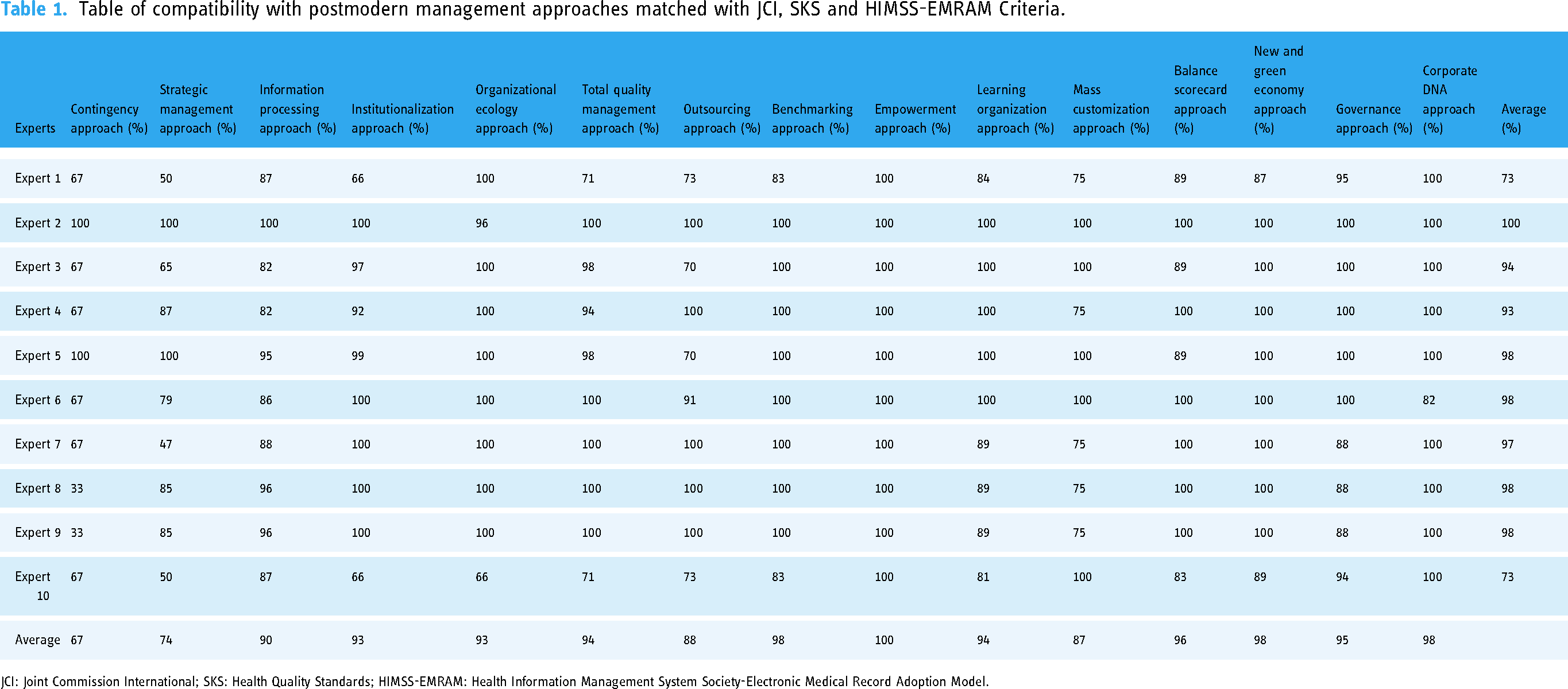
JCI: Joint Commission International; SKS: Health Quality Standards; HIMSS-EMRAM: Health Information Management System Society-Electronic Medical Record Adoption Model.
Categorical data were converted into measurement data to carry out statistical analyses. This conversion was performed by making the presence–absence reasoning with the coding method as 1 = compatible and 0 = not compatible. The compatibility scores (1 or 0) assigned to the standards under PMMAs by each participant were averaged for each approach. First, it was checked whether the resulting average scores were distributed homogeneously (Table 2). The Shapiro–Wilk test was preferred due to the low number of participants. 10 As understood from Table 1, only the ‘Strategic management approach’ and ‘Information processing approach’ were measured to be distributed normally (P > 0.05), while other approaches were observed not to be distributed homogeneously. The ‘Empowerment’ approach was excluded from the test since all the averages were identical.
Test of normality for variables (Shapiro–Wilk).

Results
As understood from Table 3, the compatibility rate with PMMAs, which JCI, SKS and HIMSS-EMRAM standards are matched with, was calculated as 93% in light of the data from 10 expert evaluators. Considering the data from expert evaluators, it was found that two out of 10 experts evaluated the rate of compatibility (73%) below the general average (93%), and eight experts considered the same rate above the general average. After reviewing the said criteria classified according to the 15 PMMAs to which standards were matched, it was understood that the least similar approach to the JCI, SKS and HIMSS-EMRAM standards is the contingency approach with a similarity/compatibility rate of 67%. Empowerment and organizational ecology approaches have, on the other hand, the highest similarity/compatibility rates (100% and 99%, respectively).
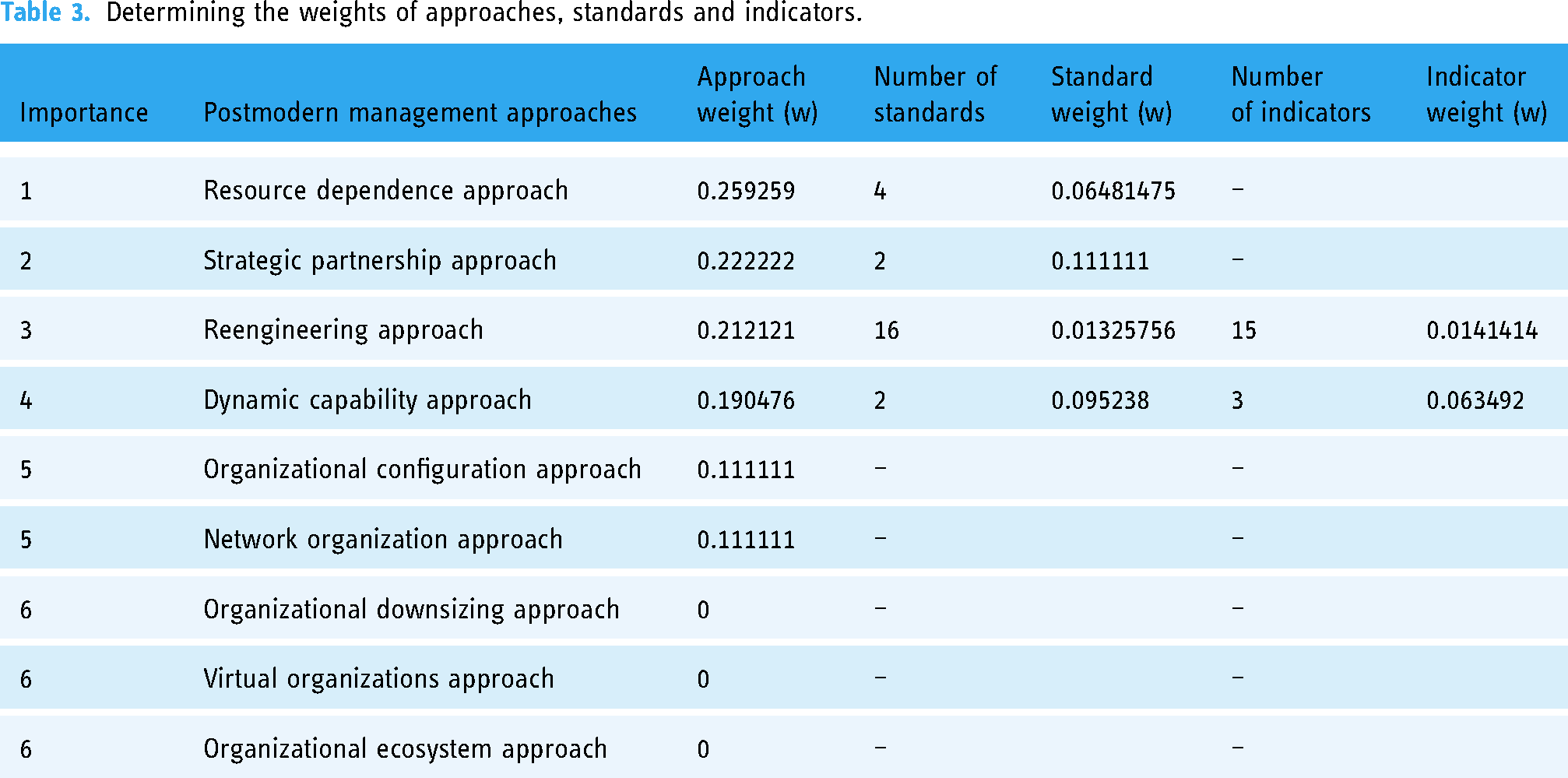
Determining the weights of approaches, standards and indicators.
Contingency, strategic management, information processing, outsourcing, and mass customization approaches remained below the general average and were found to be less compatible compared to the compatibility of JCI, SKS and HIMSS-EMRAM standards with each other. Consequently, 10 of the 15 approaches were found to be above the average when the similarity of JCI, SKS and HIMSS-EMRAM standards was assessed in terms of PMMAs.
Discussion
Proposal for Weighting (Scoring) the Proposed Standards
The Delphi technique was used to determine new standards/indicators based on the consensus results that emerged in the final step after SMEs evaluated the compatibility of PMMAs with JCI, SKS and HIMSS-EMRAM standards. SMEs were asked to propose indicators or standards for PMMAs given in Figure 3, which no standard could be incorporated into. Twenty-four standards and 18 indicators were proposed for these approaches by 11 experts. As part of applying the technique, the expert proposals 20 that could also be referred to for the Delphi technique were used since no correlation could be found between the JCI, SKS and HIMSS-EMRAM standards and nine PMMAs.

Postmodern management approaches with standards or indicators proposed.
The binary pairwise comparison method was used to reduce the approaches to a single weight value with the weights assigned by different experts. This approach relies on the determination that the weights will be established more quickly and analytically since it enables decision-makers to compare the approaches in pairs and provide scoring as to which approach is more valuable. Experts’ evaluations were considered when developing the weights. Thus, the common experience of experts with different experience levels was reduced to a single value through an analytical method. 21
A consistency test was carried out to assess whether the importance levels in the pairwise comparison matrix were consistent. In the next step, after the results of the decision matrix were found to be consistent, the weights of the matches in each matrix were reviewed. The order of weight is given in Table 3. Additionally, there are some approaches that provide the same weight value upon evaluation. For such approaches, the table was complemented with both approaches without any order performed.
SMEs submitted a total of 24 standards for nine postmodern organizational management approaches. In addition to the standard proposals, they also proposed 18 indicators. Table 3 gives the numbers and weights of the standards and indicators offered by experts about approaches.
After weighing the approaches, the standards were weighted in line with the number of standard proposals submitted for the approaches. This was carried out by dividing the number of proposed standards by the weighted value of the approach. Then the same process was repeated for the proposed indicators (Table 3). This gave the weight of each proposed standard and indicator. A scoring system of 10 is used for the purposes of SKS and JCI scoring systems. The HIMSS-EMRAM model, on the other hand, uses a scoring system ranging from 0 to 7. When it is intended to incorporate the proposed standards or indicators into SKS, JCI and HIMSS-EMRAM models, we, at this point, aim to add the proposals submitted in consideration of the importance levels (weights) of the indicators among themselves in accordance with the existing scoring systematics.
Strengths and limitations
This study has limitations. Within the scope of the research, after the determination of original standards with the Delphi technique, post-modern business management approaches were evaluated due to the large number of standards in SKS, JCI and HIMSS-EMRAM models. While analysing the answers given by the experts, firstly the contents of PMMAs were evaluated. It was assessed whether all standards are indeed compatible with these approaches. For this reason, a detailed literature review on PMMAs was conducted. The same method was applied to the proposed standards and indicators. For the criteria that were considered incompatible, PMMAs were explained to the experts and they were asked to re-evaluate.
Given the results obtained after weighting, the resource dependence approach was found to have the highest degree of importance with a rate of 0.2592. Four standard proposals were submitted for this approach. Due to the complexity of the diversity of services in the healthcare industry, it is impossible to utilize external resources for all services, and many services are outsourced. So, this makes the dependence on external resources very high. Additionally, the excess resources needed by healthcare organizations elevate the ecological dependence of such organizations. 22 Therefore, it is essential to be highly dependent on external resources. The replies given by the experts are directly proportional to these circumstances.
The strategic partnership approach was found to be of secondary importance with a rate of 0.2222. Two standard proposals were submitted for this approach. The reason that urges experts to consider this approach critical is that the partnerships established are crucial. If we regard healthcare organizations as companies on an individual basis, the number of other organizations with which they cooperate is very high. 23 For example, healthcare organizations make agreements with companies, such as medical device dealers, Hospital Information Management System Providers, pharmaceutical companies, etc., and fulfil their goals.
The reengineering approach was found to be of tertiary importance with a rate of 0.2121. Sixteen standards and 15 indicators were proposed for this approach. The healthcare industry shows no tolerance for mistakes due to its features that distinguish it from other industries. Therefore, efforts are used to eliminate the deficiencies by constantly reengineering the existing processes. 24 These efforts are coordinated under the topic of ‘health quality’. For this reason, the reengineering approach is crucial to healthcare organizations, always remaining an item on their agenda.
The dynamic capability approach was found to be of quaternary importance with a rate of 0.190476. Two standards and three indicators were proposed for this approach. The organizational configuration approach and the network organization approach were found to be equally important, with a rate of 0.111111. All these three approaches are strategically crucial to healthcare organizations. For example, a healthcare organization that accurately defines its core capabilities may outsource activities that do not fall within the scope of its capabilities. 23 Hospital employees tend to work more in teams rather than individually, where teamwork often becomes mandatory.
For this reason, being a team or group and achieving adaptation is very important to the quality of the service offered. That is why the organizational configuration approach was considered important among SMEs. Network organizations are structurally compatible with healthcare institutions in general terms since these organizations often have less authority and horizontal hierarchy and rely more on expertise. Expertise (specialization) in the healthcare industry is very high and follows a matrix structure. 25 Experts considered this approach important as they were themselves involved in this system.
No positive value emerged for the organizational downsizing approach, virtual organization approach and organizational ecosystem approach that took zero value. As healthcare organizations are growing and becoming widespread rather than downsizing, the importance of this strategy appears to be low for experts. While some services, such as telehealth, e-health, etc., have become more common in healthcare organizations, they are still not recognized adequately. Experts considered the organizational ecosystem approach important, but its importance remained lower than other approaches.
The literary studies on health argue that postmodernism impacts the measurement of factors such as health quality, productivity, performance, etc. This study discussed SKS, JCI and HIMSS-EMRAM comparatively and investigated their compatibility with PMMAs. The Delphi technique was used to comparatively discuss these standards and investigate their compatibility with PMMAs. Upon this review, SKS, JCI and HIMSS-EMRAM standards and PMMA approaches were found to be 93% compatible.
Other studies in the literature also remark that postmodernist management approaches affect all industries, including health, in an observable way. 26 Postmodernist approaches that started to be effective in many aspects of life led to perceptual changes in some concepts, such as health, illness, care, etc. 27 Depending on the actual social transformations, it is observed that the practices adopted in the healthcare industry are also changed. There is a change that acts on both medical treatment methods and management patterns. 28
Some studies exist, demonstrating that PMMAs affect the healthcare industry as well as the views of healthcare professionals. In this context, the study conducted by Zardosht in 2020 29 investigated the effects of postmodernist approaches on the services nurses provide in the healthcare process. This investigation established that the actual effects were so high that the definition of postmodernist nursing care could be introduced. 29 An analogous study by Petrovskaya 30 indicates that postmodernist approaches affect nurses’ ideologies and behaviours in the care process.
The example of PMMAs influencing the management pattern adopted by organizations is mainly observed under the total quality management approach. It is understood that organizations closely follow many concepts, such as quality, performance, productivity, etc., and constantly seek to improve their processes. In this context, indicators are continually being developed to measure productivity, quality and performance. 31 A study that compared the formal sets of indicators containing ∼1100 compulsory quality criteria in England, Germany, France and the Netherlands revealed that there are similar quality indicators. Still, countries also adopt criteria based on their healthcare systems. It is also argued that indicators are affected by existing managerial approaches. The surveys used in a study that reviewed the studies evaluating healthcare quality were discussed. The surveys were observed to have similar evaluation criteria. 32
Implications for policy and practice
After this review, the proposals for standards were collected regarding PMMAs, for which criteria matching could not be achieved. A new and unique set of standards and indicators was developed. The standard weights were determined for the new standards designed. This will allow the standards in the developed standard set to be added to SKS, JCI and HIMSS-EMRAM models without any effect on the existing scoring systematics if intended to do so.
The set of standards (comprising 24 standards and 18 indicators) developed in this study is crucial in terms of the adaptability of all three evaluation criteria. The standard set developed is the product of one of the rare studies in its field. In the literature, a study conducted by Şahin in 2020 12 compared the hospital criteria in SKS and SAS to JCI criteria by reviewing relevant documents. Virginio and Dos Reis 17 conducted a further study in 2019 to establish the relationships between JCI and EMRAM requirements. However, no standard was proposed in either study.
The following objectives are expected to be achieved with the standard and indicator set proposals made in line with post-modern business management approaches:
Inclusion of the standards and indicators proposed by the experts under the approaches in the SKS, JCI and HIMSS-EMRAM models, In the case of adding standards or indicators to the models, determining the impact of the standard or indicator to be added. To be able to see the effect of new standards to be added within all standards. It is expected to observe how new standards or indicators to be added may have an impact on the models.
It is possible to include the standard and indicator set proposed by the experts in all of the SKS, JCI and HIMSS-EMRAM models. As a result of the interviews with the experts, all experts stated that the standard and indicator sets they proposed should be in all models. They stated that these standards and indicator sets are directly related to quality in health, patient care and patient safety. In addition, experts stated that these standards and indicator sets should be included in all models after they are started to be used to be monitored and followed up.
Conclusion
The unique aspect of this study is not solely the proposals for a set of standards and indicators that emerged based on the assessment results for the compatibility of SKS, JCI and HIMSS-EMRAM models with PMMAs. At the same time, a framework was laid out for further studies in this field. While our research methodology was applied by the SKS, JCI and HIMSS-EMRAM evaluation models, it can be applied to other quality evaluation models used in national and international arenas. One of the intended future studies is to make an assessment by incorporating these standards/indicators into one of the SKS, JCI and HIMSS-EMRAM evaluation models and to obtain the outputs of this assessment.
In conclusion, this study addressed the compatibility of SKS, JCI and HIMSS-EMRAM models with PMMAs. Still, it excluded the evaluation models that we deem very valuable, such as the SAS, the ISQUA and the American Medical Association. It is considered that incorporating these models into future studies is crucial.
It is thought that our study will be beneficial for hospitals that want to be accredited with JCI, SKS and HIMSS-EMRAM models. The fact that SKS and JCI documents are similar shows that while fulfilling an SKS requirement, a JCI requirement is also fulfilled. At the same time, while the standards related to digitalization in the SKS and JCI documents are fulfilled, the standards related to the HIMSS-EMRAM model are also met. It is thought that the harmonization between the documents will be beneficial for a hospital in terms of managing the evaluation processes.
Footnotes
Contributorship
SC and IK developed the study protocol. SC and IK conducted a chart review to identify study subjects and extracted data. SC performed the data analysis. SC and IK wrote the paper. Both authors critically reviewed the manuscript and approved its publication.
Declaration of conflicting interests
The authors declared no potential conflicts of interest with respect to the research, authorship, and/or publication of this article.
Ethical approval
This study was approved by the Social Ethics Committee of Istanbul Medipol University of Social Sciences (ethics code: EKN:56). The study followed accepted ethical standards, as outlined in the Declaration of Helsinki, the purpose of the study was explained to the participants and written informed consent was obtained.
Funding
The authors disclosed receipt of the following financial support for the research, authorship, and/or publication of this article: This study was supported by the Scientific and Technological Research Council Of Turkey (TÜBİTAK)-Head of Research Support Programs (ARDEB) (DN 10S663).
Guarantor
SC.

Article Note
The following updates were made to this article:
1. The article type has been updated to Research Article. 2. The following elements have been set in English: a. The title of the article. b. In the Abstract section, the headings “Methods” and “Results”. c. The headings “Introduction”, “Methods”, “Proposal for Weighting (Scoring) the Proposed Standards” and “Strengths and limitations” within the text. d. The department and university name in affiliation 2.