



Abstract
Objective
This study aimed to determine the status of scientific production on biosensor usage for human health monitoring.
Methods
We used bibliometrics based on the data and metadata retrieved from the Web of Science between 2007 and 2022. Articles unrelated to health and medicine were excluded. The databases were processed using the VOSviewer software and auxiliary spreadsheets. Data extraction yielded 275 articles published in 161 journals, mainly concentrated on 13 journals and 881 keywords plus.
Results
The keywords plus of high occurrences were estimated at 27, with seven to 30 occurrences. From the 1595 identified authors, 125 were consistently connected in the coauthorship network in the total set and were grouped into nine clusters. Using Lotka's law, we identified 24 prolific authors, and Hirsch index analysis revealed that 45 articles were cited more than 45 times. Crosses were identified between 17 articles in the Hirsch index and 17 prolific authors, highlighting the presence of a large set of prolific authors from various interconnected clusters, a triad, and a solitary prolific author.
Conclusion
An exponential trend was observed in biosensor research for health monitoring, identifying areas of innovation, collaboration, and technological challenges that can guide future research on this topic.
Introduction
Biosensors for human health monitoring have been increasingly evolving owing to accelerated technological advancements, allowing the collection of information on objective parameters under various health conditions.1–4 This has directly affected the tracking and monitoring of quantitative data, leading to the search for new biomaterials and technological platforms that support remote data transmission and artificial intelligence (AI).5–8 The high price of smart devices is a challenge to their growth, and their success in this market depends on the value they bring to consumers. 9 The global wearable device market generated revenues of $16.2 billion in 2021 and is expected to reach $30.1 billion by 2026, achieving a compound annual growth of 13.2% between 2021 and 2026. 10 This study aimed to determine the current state of scientific production on biosensor usage for human health monitoring. A bibliometric methodology was used to answer the following questions: What is the state of scientific production on biosensor usage for human health monitoring? In which journals do the authors publish their findings? What are the main topics related to biosensors for human health monitoring? What are the main topics covered in the studies? Which authors have the highest level of scientific production and citations?
Wearable biosensors for health
Wearable biosensors are a technology consisting of simple and easily accessible devices for the general population that allow people a first approach to objectifying quantitative data on various health conditions, such as temperature, heart rate variability, daily steps, and nutritional status. 1 Their strength lies in the fact that, until a few years ago, it was impossible to record physiological parameters “in vivo” in subjects being studied, for example, workers performing heavy labor. These were only approached using anthropometry and effort perception questionnaires, which are minimal methods as they cannot ensure continuous monitoring and objectivity. 4 Biosensors allow the collection of solid and valid data for health research and monitoring, even under various working conditions.
Therefore, biosensors directly favor the collection of information on objective health parameters of physiological states, such as in the study on predisposing factors for migraine in children, 11 control and monitoring of children with autism, 12 and even psychological conditions such as fatigue in high-load workers and the resulting loss of productivity, welfare, and safety. 13
Relevant data on biosensor research, such as cardiac variability 14 and the relationships between electroencephalograms and hyperglycemia levels, were initially developed by recording heart rates. Another use of biosensors is for detecting the increase in circulating cortisol levels, which is strongly linked to stress. 15 Data on anxiety and depression are associated with changes detected directly through the contact between portable dermal or intradermal biosensors and biofluids such as saliva, tears, sweat, urine, and various interstitial fluids. 14
Sweat has attracted particular scientific interest as various methods and materials have been used to censor it. They observe thermoregulation and behaviors related to skin hydration. 7 This is essential for observing situations such as chronic or acute stress 4 or the development of depression, anguish, and others.
Similarly, chronic stress has been studied by recording parameters such as blood pressure and heart rate during movements that people make on a working day, allowing the modification of habits for a healthier life. 16 Moreover, it has been studied by monitoring the autonomic nervous system using rings on the fingers. 17
The future of biosensors in healthcare lies in the continuous improvement of biomaterials that enable a more detailed recognition of elements in biofluids through lab-on-a-chip technologies, which can be of great use in the rapid, accurate, and sensitive detection of viral diseases, increasing diagnostic efficiency and facilitating early intervention. 18
Biosensors have an important impact on health and biomedical monitoring as they provide continuous physiological information and biochemical parameters of humans through biosignal transformation into an observable response. They have many applications, such as physical fitness monitoring, risk and disease warning by monitoring glucose and lactate through human sweat, and microorganism detection, such as bacteria, fungi, and viruses such as SARS-CoV-2.2,3,5,19–22 The types include optical, electrochemical, enzymatic, immunosensor, microfluidic, plasmonic, and organic polymer biosensors.5,6,23–25 In terms of advances, there are electrochemical biosensors, which are portable and used in healthcare; tattoo potentiometric biosensors for real-time monitoring of G-type nerve agents (highly toxic chemicals); physiological biosensors, which are especially relevant for real-time blood analysis; biosensors based on sweat samples for the health and fitness status of the user; biosensors based on molecularly imprinted polymers and other biomimetic materials for electrochemical detection of cortisol under stress factors; and miniaturized and portable biosensors for diagnosing Alzheimer's disease.6,15,26–29
Low-cost platforms based on the “Internet of Things” enable remote connections between healthcare professionals and patients through smart biosensors. These devices generate a large amount of data, primarily stored in large information repositories (big data). These data are analyzed with the help of applications that use AI and deep learning technology to diagnose and treat diseases more quickly and effectively, allowing physicians to adapt to each patient and treat them precisely.8,30–35
Biosensor technologies and materials
The application of 3D printing technology has accelerated the large-scale production of highly versatile and easy-to-operate portable biosensors. Moreover, its conceptual design allows customization of the construction of objects, control of their textures and properties, serial or on-demand printing, use of multiple materials, and printing on desired surfaces, and its applications include the combination of microprinting and nanomaterials (NWs) for developing new medical devices, such as improving signal amplification by successfully detecting lactate concentration and sensitivity in human sweat with high sensitivity.36–40
Among the materials used for biosensor manufacture, zinc oxide NWs (ZnO NWs) are prominent. They are used for fluid detection owing to their high sensitivity, selectivity, simplicity, flexibility, low cost, and reliability. They enable stability in signal reading during corporate movements, multiple analyses in diagnosis, and accuracy of results. The incorporation of phenylboronic acid-based hydrogels allows biosensors to measure glucose from a distance and over a long period.2,19,20,41,42
Materials and methods
The method used was bibliometrics based on the inclusion of article data retrieved from the Science Citation Index Expanded (SCI-EXPANDED, or SCI-E), Social Science Citation Index (SSCI), and Emerging Sources Citation Index (ESCI) in Web of Science (WoS) on November 15, 2022. 43 The initial extraction was developed using a search vector 44 of the subject topics (TS, searching in the title, author keywords, keywords plus®, and abstract of a record), which included wildcards (“*”) and a textual proximity connector (NEAR/0): {TS = (wearab* NEAR/0 biosensor*)}, without temporal exclusion, with access to a data length between: SCI-E (1900–2022), SSCI (1956–2022), and ESCI (2015–2022).
The research team extracted and excluded articles unrelated to health and medicine in the following fields: WoS categories, article titles, journals (source titles), abstracts, author keywords, keywords plus, and funding organizations. As a result of this data curation, a new search vector was established, as detailed in the Supplementary Material. Table 1 describes the characteristics of the articles included in the corpus for analysis.
Characterization of document corpus to be analyzed.

The resulting set of retrieved, refined articles, dated 15 November 2022, was used to analyze the exponential growth of scientific production on biosensor usage for human health monitoring according to Price's law, to establish the presence of a critical mass in terms of the growing interest of researchers over time, and to determine the possibility of maintaining a sufficient number of articles to renew this area of knowledge as older documents become outdated due to their obsolescence.45–47
Moreover, it was of interest to subject the extracted document set to Bradford's law to understand where the scientific community researching this topic publishes its research and the possible level of concentration of some publication media that manage to gather researchers and become highly specialized sources of knowledge.48–52
The thematic focus of these studies was analyzed using keywords that, according to Zipf's law, tend to concentrate in a reduced number of high occurrences; the concentration is estimated as the square root of the set of keywords. 53 We worked with a set of keywords cleaned by WoS called Keyword Plus (KWP). 43 The analysis of the bases extracted from WoS was performed using the VOSviewer software, 54 and auxiliary spreadsheets were used.
In the second analysis phase, we opted for an academic elite approach, focusing on authors with the highest number of publications as determined by Lotkás law. The estimation was the square root of the total number of authors at the same level of scientific production.55,56 This applied to the citation concentration in a reduced number of articles that presented as many or more citations as the size of that subset, according to the Hirsch index (h-index), 57 and exploring the cocitation phenomenon using VOSviewer was interesting. The intersection of subsets, prolific authors, and articles within the h-index should approximate the prominent authors of the topic under study with high production and citation. Thus, it identified the most recognized researchers developing the frontier of this topic and their affiliations and interrelationships. 58
Results
Scientific production of wearable biosensors in healthcare and their global context
The data extraction from the WoS records resulted in 275 articles from 2007 to 2022, whose growth for the period of continuous and complete data (2010–2021) was 96% according to an exponential behavior (see Figure 1), which, according to Price's law, explained the growing interest in the study of wearable biosensors in healthcare.

Published articles over time (2010–2021) and exponential trend growth.
These articles were published in 161 journals, as shown in Table 2, albeit in a low concentration. They are mainly grouped by the core topics of 13 journals, as detailed in Table 3.
Zone of Bradford.

Empirical and theoretical value, incorporated for percentage error calculation.
Journals in the Bradford nucleus.

The percentage calculation error between the empirical and theoretical series is represented in Equation 1 below:

Keywords plus cooccurrence network. (a) Cooccurrence clusters; (b) cooccurrence clusters with average citations.
Coauthorship, proliferation, and prominence in research on wearable biosensors for health
Of the 1595 authors identified through VOSviewer, 54 1462 contributed to a single article on this topic, and only 125 were consistently connected to the total set in coauthorship. Figure 3a shows how these 125 authors are grouped into nine clusters (see details in Supplementary Material, Table A1). However, Figure 3b shows how one of these clusters concentrates on many authors with high citation level (nodes in red).

Coauthoring network. (a) Coauthorship clusters; (b) coauthorship clusters with average citations.
Both figures prompt us to review the prolific author set using Lotka's law 55 and, in contrast, to add an analysis of the h-index. 57 By applying the approximate calculation to the number of prolific authors (sqrt (1595) = 40), it was observed that the discrete choice of the number of published articles (three or four articles per author) accounted for four articles, for a total of 24 prolific authors, as shown in Figure 4 and Table 4.
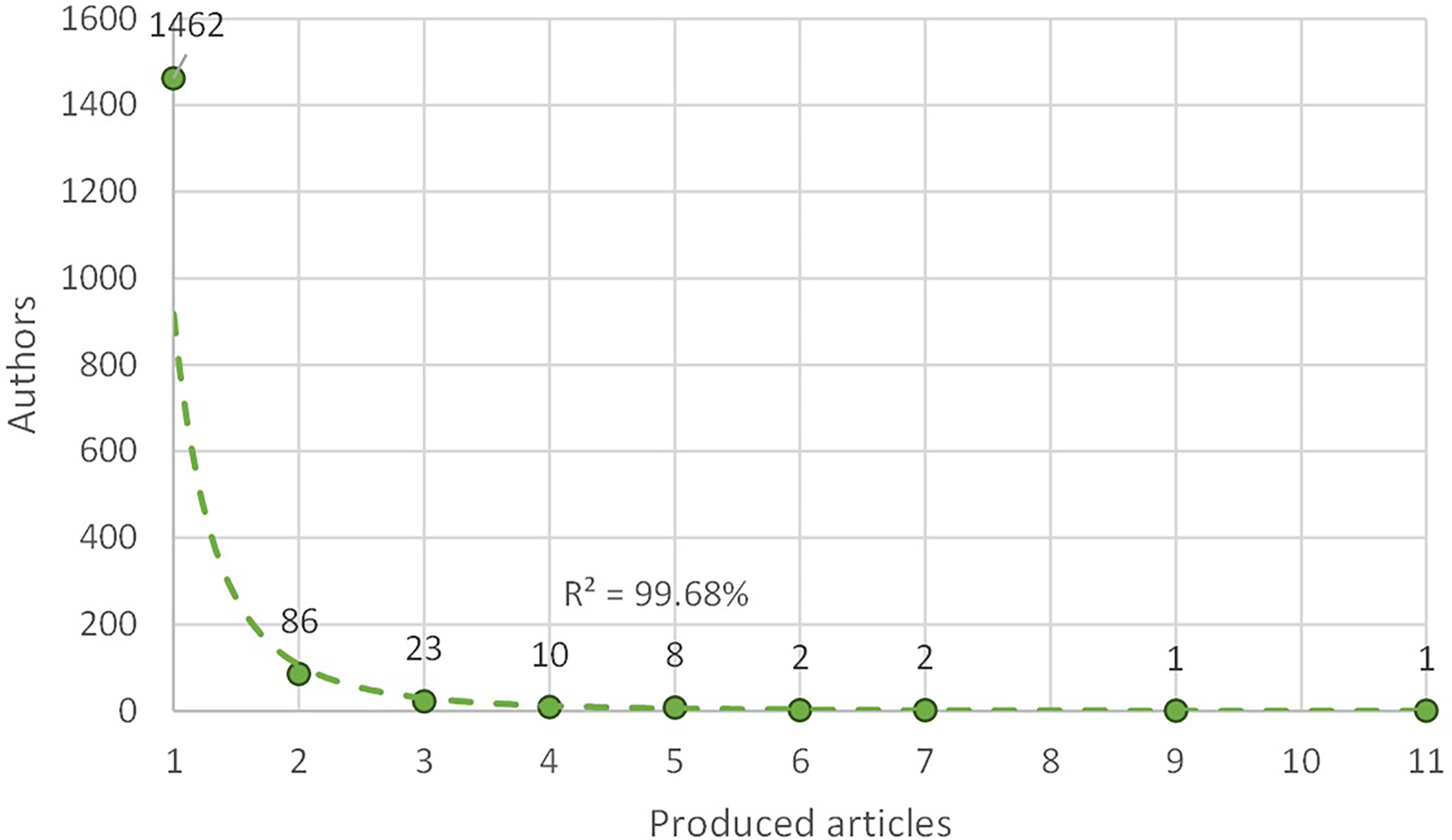
Authors by scientific production and power fit trend.
Prolific authors.
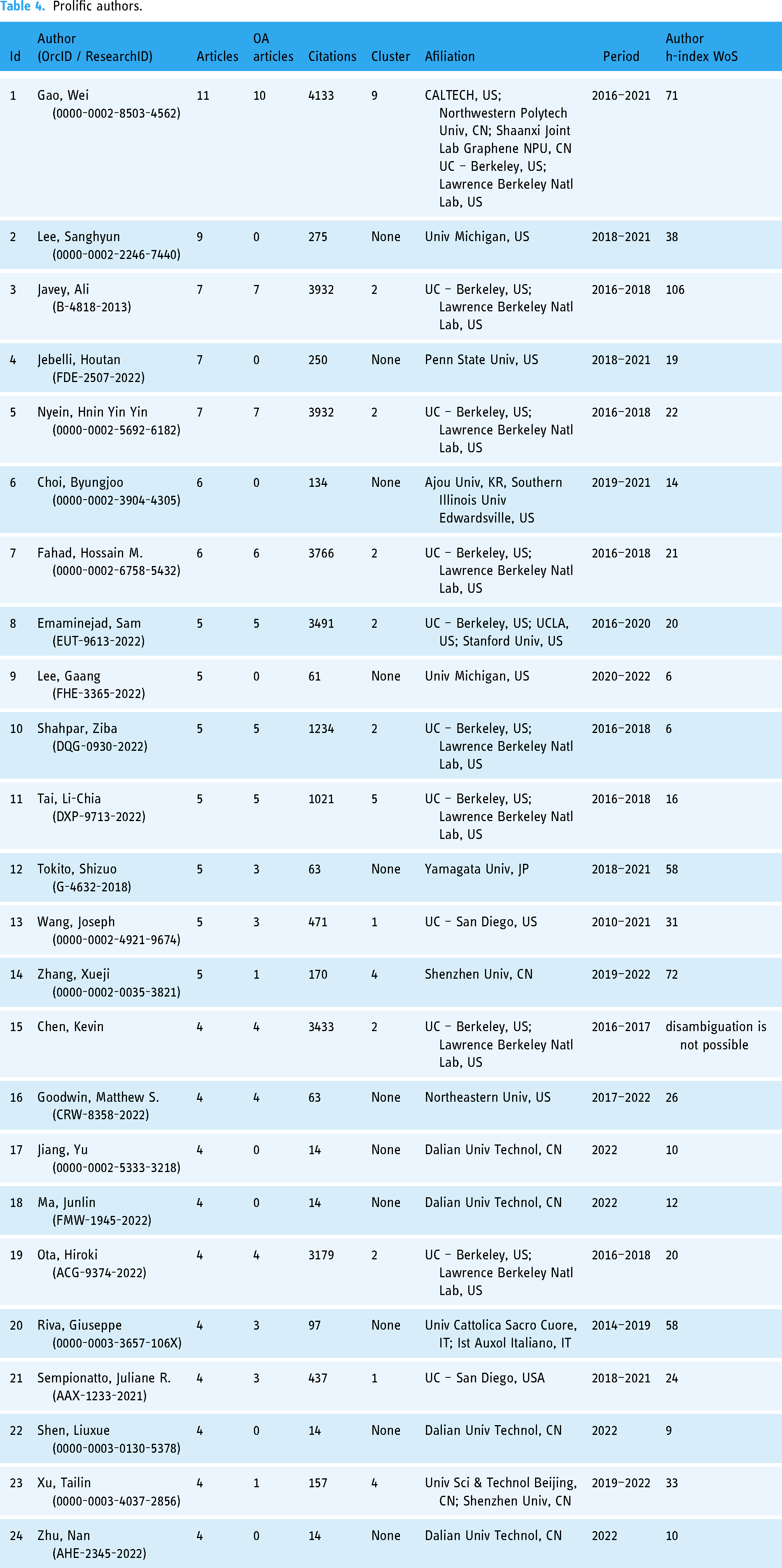
In addition, Table 4 shows that most of these authors were linked to Cluster 2, and a few were linked to Clusters 1, 4, 5, and 9. The high number of citations by authors belonging to Cluster 2 was striking, confirming what is shown in Figure 3b. In contrast, a few of the prolific authors discussed a research trajectory with multiple affiliations and international circulations of advanced human capital. 59 Considering all affiliated countries, the US (16 authors) and China (7 prolific authors) were prominent, followed by Italy, Japan, and Korea. This is a fractal of the global situation regarding the main affiliated countries contributing to global scientific production (43 countries or territories) on the topic under study, as shown in Figure 5.

Geography of scientific production on wearable biosensors.
As for the h-index, we had 45 articles cited more than 45 times (ranging from 46 to 2511 citations in WoS Core). These articles were from journals mainly published by Elsevier (11 articles), the American Chemical Society (ACS) (10), the Institute of Electrical and Electronics Engineers Inc. (IEEE) (6), Springer Nature Group (5), and John Wiley & Sons, Inc. (7). Moreover, the journals that published these articles were associated with one or more WoS research areas. The most common areas in these articles were Science & Technology—Other Topics (28), Chemistry (24), and Materials Science (13).
Moreover, it was important to determine whether this selected subset of highly cited articles was simply due to the passage of time and the possibility that the document was known and cited. Figure 6 shows that the passage of time explains only 5% (R2) of the volume of citations received.

Citations received by the h-index subset during the period.
In contrast, these articles are not uniquely cited in new works because, as shown in Figure 7, 29 of these 45 articles are related to health biosensors research and were simultaneously cited in new studies (the size of the nodes represents the citations received, the lines represent the cocitation relationships, and the color scale represents the year of publication).

Cocitation network in the h-index article subset.
Table 5 shows the intersection between the articles in the h-index set and the prolific authors previously shown in Table 4 in search of prominent authors, authors with high scientific production and with high citations.
Intersection between the h-index subset and the prolific authors.
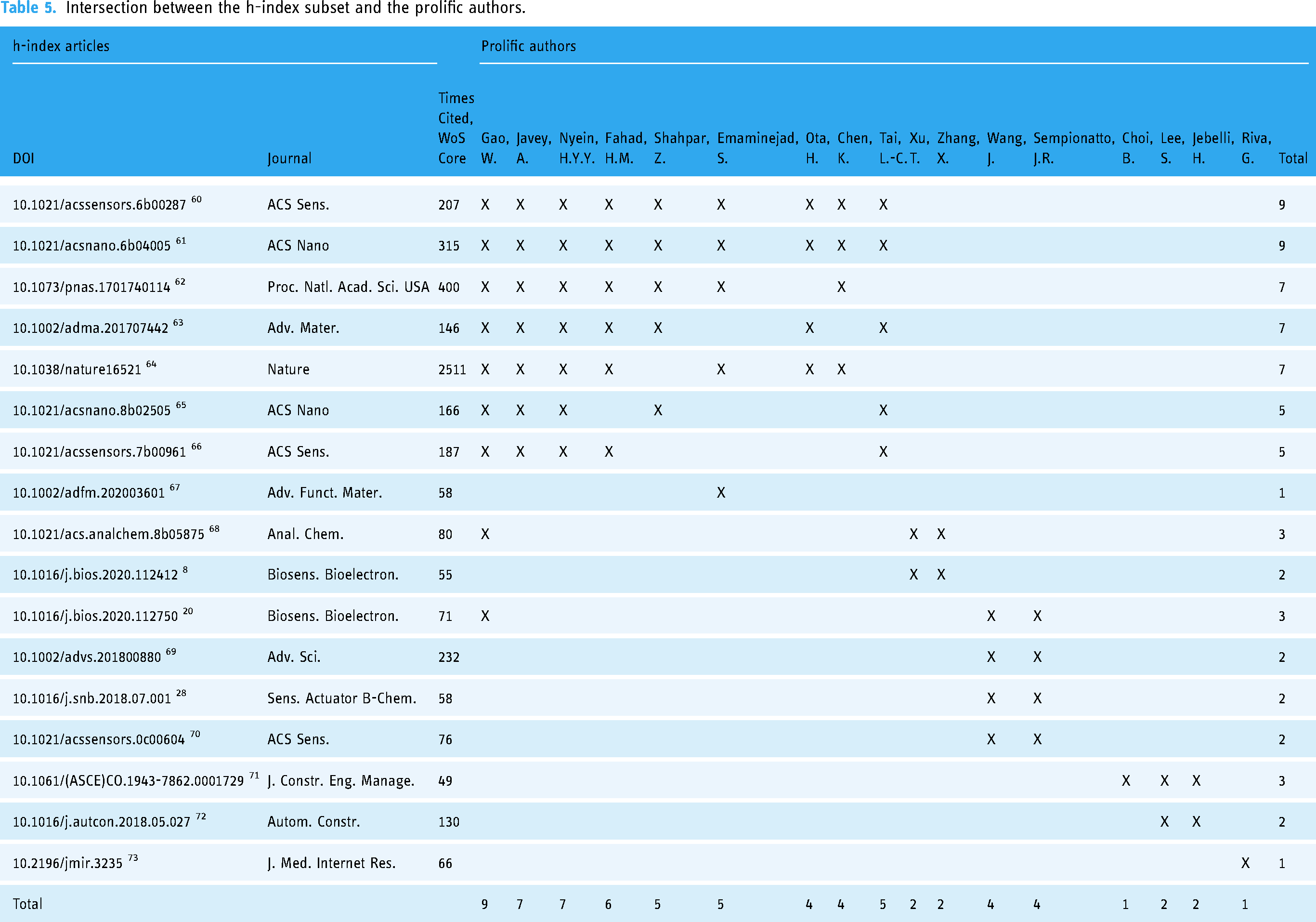
From the effective intersection, crosses between 17 h-index articles with 17 prolific authors emerged, highlighting the presence of clusters previously defined as 1, 2, 4, 5, and 9. These clusters are represented as a large subset of prominent authors interconnected by the centrality of W. Gao in this research topic.20,60–66,68 Additionally, the triad of prominent authors Choi, Lee, and Jebelli, 71 and the prominent “alone” author Riva 73 were identified. This coauthorship is illustrated in Figure 8.

Prolific coauthorship network in h-index article subset.
Finally, in the 17 articles observed in the h-index and produced by prolific authors, 70 author keywords were identified, with 51 words consistently related in a graph. From these relationships, six clusters were identified using VOSviewer and a fractionalization method, with the words shown in Figure 9 and detailed in Table 6.

Author keywords of prolific authors in the h-index article subset.
Clusters of author keywords using for prolific authors in h-index article subset.

Identical letters indicate the same document.
Generic terms among the set of keywords in this table.
In Table 6, the main thematic classification of wearable biosensors studied refers to their use for drug monitoring based on body fluids and sweat, vital signs related to the degree of individual stress, disease symptom detection, and remote health monitoring. In addition, AI has been used to process biosensor data and produce various material alternatives for wearable biosensors. Chemistry predominates as a WoS research area, together with a few applied sciences, particularly those with a biomedical emphasis. Health as a WoS research area was associated with only one article in this table.
Discussion
This study aimed to determine the current state of scientific production on biosensor usage for human health monitoring and to identify new research and development (R&D) on this topic. The bibliometric analysis described in this research provides an updated view of the scientific production of biosensors for health monitoring at the international level by using the classical bibliometric laws of Price, Bradford, Zipf, and Lotka, in addition to the h-index.
This study highlights several key contributions to the field of biosensor research for human health monitoring. First, the bibliometric analysis enables the detection of exponential growth in scientific production, confirming that it is a topic of great interest at the international level. Mainly, 13 core journals were identified, highlighting “Biosensors & Bioelectronics” and “ACS Sensors” as the journals with the highest number of articles (23 and 9, respectively) and citations (816 and 606, respectively). In contrast, the journal “ACS Nano,” although focusing only on four articles, had the highest number of citations (777) in its core. These 13 journals focused on biosensor science, technology, biotechnology, materials, NWs, nanoscience, nanotechnology, chemical sciences, medicine and health, and engineering. Moreover, it should be noted that the 45 most-cited articles (more than 45 times) showed that the passage of time explained only 5% (R2) of the volume of citations.
The KWPs with the highest occurrence, estimated at 27, were translated into nine clusters comprising 125 authors. These findings highlight the diversity and collaborative networks in health biosensor research. Authors with high citation counts were concentrated in one of these clusters. In contrast, “Gao, Wei” stood out as a prolific and prominent author due to the number of published articles and citations,22,27,60–66,68,74 which are mainly observed in open journals. The article “Fully Integrated Wearable Sensor Arrays for Multiplexed in Situ Perspiration Analysis,” published in “Nature,” 64 stood out in the existing literature.
In contrast to previous and more specific studies,75–77 this analysis provides an overview of trends in wearable biosensor research for human health monitoring. Although our approach is conceptually more limited than the scientometric analysis used by Coccia et al., 78 the results provide an overview of biosensor usage for monitoring various physiological parameters. Moreover, our results help recognize areas of interest in the epistemic community when considering biosensors for human skin health and exercise biosensing devices, establishing similarities and differences with previous work on their use in human healthcare.75,76 These findings present new challenges for technological development, as these devices enable real-time biomarker monitoring. 19
However, technological limitations persist, especially with biosensors intended to be more compact or placed in sensitive areas, such as the eyes, where power supply (batteries) can be an issue. 77 This difficulty is intensified when aiming for early diagnosis based on measurements obtained by integrating proprietary displays to visualize biomarkers. 79 These technological developments will challenge open lines for future research into prospective technologies. The breadth of works derived from Gao et al., 64 particularly their study entitled “Fully integrated wearable sensor arrays for multiplexed in situ perspiration analysis,” are an interesting source to be explored bibliometrically, establishing thematic and geographical limits of the scientific production that has been inspired by this study (2511 citations).
Although this was not the main objective of the study, we observed the effect of open access and its different types on citation frequency, as shown in Tables 3 and 4. 80 In contrast to other databases, such as Scopus, 81 WoS database supports the results of research that has already focused on the scientometric analysis of new technologies and their different uses in biosensors.78,82 Moreover, it should be noted that the complexity of author disambiguation due to digital identity issues83,84 was one of the main limitations of this study. We provide the specific record numbers in Table 4, particularly for the WoS h-index.
Conclusion
An exponential growth in wearable biosensors for human health studies in 2010–2021 was evidenced by 275 extracted articles (2007–2022). This suggests the growing interest of the scientific community in studying this topic. The following 13 out of a total of 161 journals accounted for 32% of the publications: Biosensors & Bioelectronics, ACS Sensors, ACS Applied Materials & Interfaces, Sensors, Advanced Materials Technologies, Analytical Chemistry, Biosensors, Sensors and Actuators B-Chemical, ACS Nano, Advanced Functional Materials, IEEE Sensors Journal, Scientific Reports, and Talanta.
At the author level, only 133 out of 1595 authors had two or more publications on the topic. Approximately 125 authors were consistently connected to the total set in coauthorship, representing a fragmentation of nine clusters. These 1595 authors represented affiliations from 43 countries or territories, including the United States, China, Italy, Japan, and Korea. However, the number of articles exceeding the h-index threshold within the extracted set was only 45 (16% of the total 275), with a notable citation level within the epistemic community. The intersection of this result with prolific authors was only 17 articles, highlighting the centrality of W. Gao.
In the academic discourse of the 275 articles studied, the main classification themes of wearable biosensors were related to their use for drug monitoring, vital signs, remote sensing of disease symptoms, and health. Moreover, it was possible to identify the appearance of AI in the processing of the extracted data and various alternatives to constructive materiality. Chemistry and other biomedical applied sciences are the predominant research areas of WoS.
In summary, this study provides a panoramic view of current trends in wearable biosensor research for human health monitoring and highlights areas of innovation, collaboration, and technological challenges that may guide future research in this field.
Supplemental Material
sj-docx-1-dhj-10.1177_20552076241256876 - Supplemental material for Wearable biosensors for human health: A bibliometric analysis from 2007 to 2022
Supplemental material, sj-docx-1-dhj-10.1177_20552076241256876 for Wearable biosensors for human health: A bibliometric analysis from 2007 to 2022 by Nicolás Muñoz-Urtubia, Alejandro Vega-Muñoz, Carla Estrada-Muñoz, Guido Salazar-Sepúlveda, Nicolás Contreras-Barraza, Nicolás Salinas-Martínez, Paula Méndez-Celis, José Carmelo-Adsuar in DIGITAL HEALTH
Supplemental Material
sj-zip-2-dhj-10.1177_20552076241256876 - Supplemental material for Wearable biosensors for human health: A bibliometric analysis from 2007 to 2022
Supplemental material, sj-zip-2-dhj-10.1177_20552076241256876 for Wearable biosensors for human health: A bibliometric analysis from 2007 to 2022 by Nicolás Muñoz-Urtubia, Alejandro Vega-Muñoz, Carla Estrada-Muñoz, Guido Salazar-Sepúlveda, Nicolás Contreras-Barraza, Nicolás Salinas-Martínez, Paula Méndez-Celis, José Carmelo-Adsuar in DIGITAL HEALTH
Footnotes
Acknowledgements
Not applicable.
Author contributions
Conceptualization, A.V.M., C.E.M., and N.S.M.; methodology, A.V.M.; software, A.V.M., and N.C.B.; validation, C.E.M., P.M.C., and G.S.S.; formal analysis, C.E.M.; N.C.B., and P.M.C.; data curation, A.V.M., C.E.M., N.S.M., and P.M.C.; writing—original draft preparation, N.C.B., G.S.S., C.E.M. and N.M.U; writing—review and editing, A.V.M., J.C.A., and N.M.U., supervision, N.S.M.; project administration, C.E.M.; funding acquisition, A.V.M.; G.S.S.; N.CB.; P.M.C. All authors have read and agreed to the published version of the manuscript.
Consent statement
Not applicable, only publicly available secondary data are used.
Conflict of Interest
The authors declare that the research was conducted in the absence of any commercial or financial relationships that could be construed as a potential conflict of interest.
Ethical approval
Not applicable, only publicly available secondary data are used.
Guarantor
Alejandro Vega-Muñoz (A.V.-M.).
Funding
The author(s) disclosed receipt of the following financial support for the research, authorship, and/or publication of this article: The Article Processing Charge (APC) was partially funded by Universidad Católica de la Santísima Concepción (Code: APC2024). Additionally, the publication fee (APC) was partially financed through the Publication Incentive Fund, 2023, by the Universidad Arturo Prat, (Code: APC2024), Universidad Andres Bello (Code: CC21500), Universidad Santo Tomás (Code: APC2024), Universidad de Las Americas (Code: APC2024).
Supplementary Material
As supplementary material, we have added the tuned search vector and Table A1 detailing the nodes in Figures 3(a) and 3(b). Additionally, the following supporting information can be downloaded at: www.DHJ/xxx,  : Biosensores_15_11_R275, in txt format for VOSviewer, and xlsx format for MS-Excel (non-specialized reader).
References
Supplementary Material
Please find the following supplemental material available below.
For Open Access articles published under a Creative Commons License, all supplemental material carries the same license as the article it is associated with.
For non-Open Access articles published, all supplemental material carries a non-exclusive license, and permission requests for re-use of supplemental material or any part of supplemental material shall be sent directly to the copyright owner as specified in the copyright notice associated with the article.
