



Abstract
Background
Oral health is closely related to general health and quality of life. School-aged children are at a critical stage for developing their self-care ability in oral health. Digital interventions can encourage and facilitate oral self-care in children.
Objective
This study aims to present the development of an educational chatbot for school-aged children to address their oral self-care and evaluate its usability.
Methods
The development and evaluation of the chatbot for oral self-care consisted of four stages: target behavior analysis, intervention design, system development, and the chatbot evaluation. The target behavior analysis identified barriers to children's engagement in oral self-care based on dentists’ clinical observations; hence, the requirements for achieving the desired behavior were categorized according to the capability-opportunity-motivation behavior model. Interventional functions were created following the behavior change wheel. A menu-driven chatbot was created and evaluated for usability as well as likeability.
Results
The barriers and requirements for achieving good behavior in school-aged children's oral self-care were identified by the dental professionals. Intervention strategy incorporated specific functions enriched with gamification features to support school-aged children in developing their abilities for engaging in oral self-care. The intervention functions consist of capability establishment, motivation enhancement, and opportunity creation, which were designed to support children in their oral self-care practices. The designed chatbot was piloted with a convenient sample of 30 school-aged children and their accompanying parents at the pediatric dental clinic. The results indicated good usability, with a mean usability score of 79.91, and high likeability with a mean score of 4.32 out of 5 for the designed chatbot.
Conclusions
The educational chatbot incorporated a combination of clinical dentistry practice and guidelines, aiming to promote oral self-care behavior in school-aged children. The designed chatbot achieved high scores for its usability and user likability.
Keywords
Introduction
Establishing good oral health habits in childhood is crucial for lifelong well-being. Neglecting oral health can lead to dental problems such as cavities and gum disease, which profoundly impact daily life, overall health, as well as academic performance.1–3 Behavioral factors significantly influence children's oral health,4–7 particularly during the school years, which are critical for shaping sustainable health behaviors, beliefs, and attitudes. 6 Therefore, school-aged children are recognized as key targets for implementing and managing preventive oral health strategies, 6 while oral health promotion programs are advocated worldwide.6–9 Despite global efforts, tooth decay remains widespread among this age group,8–10 underscoring the urgent need for effective interventions to promote good oral self-care behavior.
To enhance the effectiveness, interventions should ideally be grounded in theoretical behavior change models,11–13 which provide valuable frameworks for understanding behavior emergence, maintaining strategies, and facilitating behavior change. 13 Interventions are commonly proposed to promote behavior changes for achieving the desired behavior, however, designing effective interventions aimed at changing established behavior patterns is highly challenging. 14 Numerous behavior change theories have been proposed under different names, often with overlapping constructions, yet there is little guidance on selecting an appropriate theory for a specific context.15,16 The behavior change wheel (BCW) is a theory- and evidence-based framework that provides guidance for characterizing and designing behavior change interventions. 16 It guides developers in transitioning from behavior diagnosis to intervention design systematically and transparently. 16
The BCW framework consists of three layers: a “behavior system” at the hub, encircled by intervention functions and then by policy categories. 15 At the core of BCW lies the COM-B model, which identifies capability (C), opportunity (O), and motivation (M) as the essential components of a behavior (B) system, with these components interacting to generate behavior. 15 For individuals to engage in desired behaviors, they must possess the necessary capability, opportunity, and motivation. It has been reported that a behavior change requires modifying at least one of these components.14,15 Thus, the COM-B model has been widely used for behavior diagnosis and identifying the necessary changes to designing effective interventions for behavior change. 16 Intervention functions are designed to enhance capability, create opportunities, and inspire motivation to increase the interaction among these three elements in the behavior system to achieve the behavior change.15–17 However, only a few studies have explored oral hygiene interventions based on the behavior change theory. Thus, in this study, the BCW is considered ideal for investigating the oral health behavior of school-aged children.
With the rapid advancement of information and communication technologies, along with the widespread adoption of smartphones, presents significant opportunities for improving disease prevention, diagnosis, and management.18–23 People are increasingly interested in having their health information readily available on their smartphones, 23 leading to the continuous raise in the potential of mobile app interventions to promote health. Consequently, there has been substantial growth in the number of health-related apps aiming to promote health behavior.18–24 Similarly, many oral hygiene-related apps have recently emerged to facilitate good oral care behavior.23–25 However, most of these apps focus solely on enhancing the teeth brushing effectiveness to improve oral hygiene. 26 Criticism has been directed towards the lack of professional regulations for app development and the variability in information quality. 25 Thus, the development of mobile apps to support oral care is considered to be in its infancy. 25
Chatbots are conversational apps that simulate human-like conversation through text or voice interactions. 27 Their interactive and accessible nature enables personalized and timely support, making them invaluable intervention tools in encouraging and promoting positive health changes in individuals. With the ability to communicate at anytime from anywhere, chatbots provide a safe space for interacting with patients to promote health. 27 Healthcare-focused chatbots enhance user engagement and usability, 28 effectively delivering interventions that support health behaviors. Additionally, chatbots can integrate with popular social media platforms such as Facebook Message or LINE application, eliminating the need for users to learn new unfamiliar interfaces or download an app. 28 Thus, chatbots are increasingly becoming a part of healthcare worldwide. 27
Objective
This study aimed to develop an oral self-care educational chatbot as an intervention tool to promote school-aged children's oral self-care abilities. To enhance the intervention effectiveness of the behavioral change in oral health, the BCW was adopted to the design of the intervention functions.
Methods
We developed and evaluated a chatbot for oral self-care (COSC) aimed at empowering school-aged children to establish their abilities in oral hygiene. The development process involved four stages: (1) target behavior analysis, (2) intervention design, (3) system development, and (4) chatbot evaluation. A multi-disciplinary team, consisting of dental professionals, an e-health intervention specialist, and one informaticians with experience in interface design, collaborated in the development of COSC.
Target behavior analysis
In this study, the analysis of the target behavior consisted of behavior diagnosis and requirement identification, aiming to provide guidance for school-aged children to achieve good behavior in oral self-care. The behavior diagnosis applied the COM-B model 15 to investigate the existing behavior patterns and factors influencing the engagement in the desired behavior. Based on the behavior diagnosis, the requirements for promoting the engagement in the oral self-care were identified.
The target behavior analysis was conducted by the dental professionals (two pediatric dentists, one with 3 years of experience and the other with over 20 years, as well as a head nurse) from the Dental Services Department of a medical center in Taiwan. They identified the barriers to good oral health among school-aged children, pinpointed the main factors causing oral diseases, and determined the requirements for achieving good oral self-care behavior.
In the behavior system, capability, opportunity, and motivation interact to facilitate behavior change. 15 To ensure that school-aged children perform oral self-care appropriately, the requirements for fostering engagement in the desired behavior were categorized into capability, opportunity, and motivation components based on the COM-B model, with content provided by the dental professionals and extracted from clinical dentistry practice and guidelines.29,30
Intervention design
The target behavior analysis served as the foundation for the intervention design. To enhance intervention effectiveness, the BCW guided the formulation of intervention functions based on the results of the requirement analysis. These functions were developed to fulfill the objectives of establishing capability, enhancing motivation, or creating opportunities. Moreover, the concept of gamification, defined as the use of features to enhance desired behaviors and user engagement, 21 was incorporated into the intervention design to increase user engagement and enjoyment.
Capability establishment constitutes the central focus of this study, comprising both physical and psychological components. Physical capability refers to a child's abilities to achieve the desired behavior—oral self-care, while psychological capability pertains to a child's abilities to understand the reasons for engaging in oral self-care. Intervention functions aiming to foster children's physical and psychological capability were implemented by imparting oral hygiene skills and knowledge of oral care.
Motivation enhancement directs and guides children to engage in good oral care behavior, involving brain processes that encompass habitual and emotional responses. 15 This study addressed both reflective motivation, mediated by the psychological capability of understanding the importance of the desired behavior, and automatic motivation, which encompasses emotions and impulses arising from associative learning. 15 Intervention functions in this study aimed to enhance motivation of performing good oral self-care behavior in children were designed by providing positive oral care outcomes and illustrating negative oral health consequences.
However, motivation alone as the intention or desire to engage in good oral health behavior is insufficient for behavioral change. Consequently, a gap exists between motivation and actually performing the expected behavior. 31 Transforming motivation into action is necessary to overcome the gap and make behavioral change achievable. In this study, intervention functions were designed to create opportunities aimed to shape circumstances for children to engage in oral self-care behavior appropriately. These functions have the potential to bridge the gap between intention and actual implementation of the desired behavior.
System development
COSC was developed and integrated with one of the most popular instant-messaging applications, LINE, based on the design of intervention functions. LINE was selected for the following reasons: (1) LINE is the major social networking platform used in Taiwan with a high penetration rate (95.7%), 32 meaning that almost everyone in Taiwan uses LINE regularly. (2) Users can easily add a LINE bot as a friend and start communicating with it without additional app installation. (3) Most people in Taiwan interact with LINE bots intuitively, especially since the COVID-19 outbreak. The Center for Disease Control in Taiwan launched a LINE bot to provide the latest epidemic information and prevention policies to the public, and it has gained immense popularity with a high penetration rate. 33
The COSC was implemented using Python, MySQL, and Google Cloud Platform. A menu-based chatbot, which is the most commonly used type in the market today because of its simplicity, 34 was created to ensure effortless and intuitive use for school-aged children. Children can interact with the bot by simply pressing a button from the menu, without the need to type any text. COSC was built using a rule-oriented approach with a graphical interface based on a hierarchical decision tree. Whenever a user clicks a button from the menu, the decision tree guides the system to provide scripted responses. The bot's messages can be displayed as text, a menu system with buttons, or images.
COSC evaluation
The COSC evaluation was conducted to obtain feedback on the usability and likeability of the designed chatbot for children's oral care, as well as to identify any issues for improvement. The assessment was task-oriented and conducted in two stages: (1) expert evaluation with suggested modification for the COSC beta version and (2) usability testing for the final version.
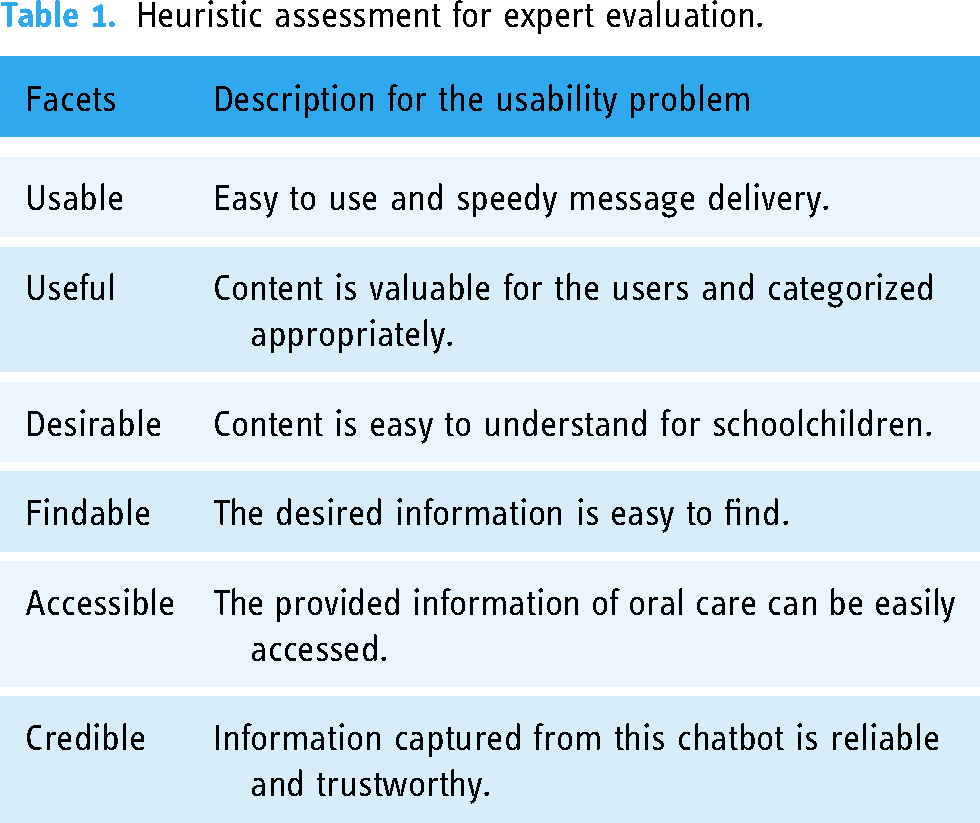
Expert evaluation was conducted by the multi-disciplinary team. The heuristic assessment, which was based on the Morville's Honeycomb model 35 of user experience and reported in one previous study, 20 was modified for the expert evaluation and is presented in Table 1. The usability of the final version chatbot, COSC, was evaluated by the patients aged 5–12 and their accompanying parents after receiving dental services at the pediatric dental clinic of a medical center.
Heuristic assessment for expert evaluation.
For the assessment of the final version COSC, participants were recruited from pediatric dental clinics between March and October 2022. The inclusion criteria involved children aged 5 to 12 years and their accompanying parents who were smartphone users. The participation was voluntary, and the accompanying parents were required to sign informed consent forms prior to participating in the study. Additionally, specific tasks were carefully designed to assess the children's ability to operate COSC, taking into account their attention spans. Eight tasks were ultimately selected for this purpose.
Participants were initially introduced to the features of COSC and provided with a list of the specified tasks (Supplementary material, Appendix) by a trained research assistant. Following the COSC introduction, both the child and his/her accompanying parent interacted with the COSC until they felt confident in operating it. Subsequently, the child was introduced to carry out the specified tasks using the think-aloud method, 36 verbally expressing the process of operating COSC while simultaneously performing the tasks to ensure focus and completeness. The time taken to complete the tasks was recorded. Finally, both the parent and child independent filled out the questionnaire and received a coupon worth NT$ 100 as compensation for completing the specified tasks and the self-administered questionnaire.
The questionnaire consisted of three parts: demographic variables, likeability assessment items, and usability test items. The parents were asked to complete the questions regarding demographics and the likeability assessment items of the COSC. Children responded to the usability evaluation items of the COSC independently. Younger children were given assistance if needed, such as reading the questions for them but without answering guidance.
The usability of the COSC was assessed using the slightly modified Chatbot Usability Questionnaire (CUQ). 27 Holmes et al. designed the CUQ specifically for evaluating the usability of conversation-driven chatbots, comparable to the system usability scale (SUS). 37 The CUQ addresses aspects of chatbot interfaces that are not covered by conversational questionnaires like SUS. Holmes et al. 28 recommended an optimal sample size of approximately 26 subjects for identifying chatbot usability issues.
The CUQ consists of 16 items, which were used to assess aspects related to a chatbot's personality, onboarding, user experience, and error handling. 28 The odd-numbered items of the CUQ are the statements related to positive aspects, whereas the even-numbered items are negative phrases. The questionnaire was rated on a 5-point Likert scale ranging from strongly disagree (1) to strongly agree (5). The CUQ scoring system was somewhat complicated as it contained items for both positive and negative aspects. For the positively oriented questions (odd-numbered items), one was subtracted from the respondent's rating. For the negatively oriented questions (even-numbered items), the respondent's rating was subtracted from 5. As a result, a consistent scale of 0 to 4 was provided for all items. The sum of the converted scores for the 16 items was then normalized to generate the final CUQ score, which ranged from 0 to 100. 38 The higher SUS score indicates better system usability.
The overall likeability was used to evaluate the extent to which the participants liked COSC. The likeability assessment comprised five items adapted from Chang et al., 20 and a 5-point Likert scale ranging from strongly disagree (1) to strongly agree (5) was employed. A composite variable was generated by summing the scores of these five items to gauge the participants’ likeability towards COSC.
Ethical approval
This study was performed in compliance with the Declaration of Helsinki and approved by the Institution Review Board of Chang Gung Memorial Hospital, Taoyuan, Taiwan (REC number: 202002455B0). The accompanying parents were required to sign an informed consent statement before participating in the study.
Statistical analysis
The data analyses were conducted in IBM SPSS statistics 20.0. Descriptive statistics were calculated for demographic characteristics, CUQ of the COSC, as well as the overall COSC likeability. Additionally, non-parametric analysis methods, including Mann–Whitney U test and Kruskal–Wallis test were employed to examine the usability scores of the COSC among children of different genders and age groups, respectively.
Results
Contents in COSC
In the analysis of target behavior, dental professionals identified that the main issues preventing children from achieving good oral health are insufficient knowledge and incorrect skills, as well as inappropriate parental attitudes toward oral health. Consequently, the requirements of oral hygiene skills and knowledge of oral care were confirmed. These requirements were categorized into capability, motivation, and opportunity components based on COM-B model.
For establishing children's capability in oral self-care, essential knowledge and skills related to oral hygiene habits were delivered through text messages or videos. To enhance their motivation, the delivery of information regarding the impact of poor oral health and the benefits of good oral care was proposed. Furthermore, creating opportunities was suggested as a strategy to increase the possibility of children engaging in the desired behavior.
Intervention functions
By applying BCW, intervention functions were created, and the links between the COM-B model components are presented in Table 2. For the capability establishment, training and modeling intervention functions were designed to foster children's physical capability of performing oral self-care through graphical instructions and video demonstrations. Graphical instructions were provided to impart children's oral hygiene skills, while videos were given to demonstrate as models for children to imitate how to perform oral cleaning. Education and enablement intervention functions were designed to enhance the children's psychological capability in oral self-care by providing knowledge about oral care, and tips for brushing and flossing. The provided knowledge included the importance and benefits of having good oral health, the impact of poor oral health, and the promotion of positive oral health behaviors, which were delivered through text, images, and videos.
Links between the “COM-B” model components and the intervention functions.

For motivation enhancement, education, persuasion, and incentivization intervention functions were developed to enhance children's motivation to engage in oral self-care. These interventions were designed to provide essential knowledge, promote positive attitudes, and offer incentives through the use of text, images, and videos, thereby encouraging children to actively perform oral self-care.
In this study, training and enablement intervention functions were designed to create opportunities for children to engage in the desired behavior. These interventions involved the delivery of prompts and triggers, as well as providing a synchronized video with arrow-guided brushing sequences to be used during brushing. The brushing duration was set at 2.5 min based on recommendations from oral health professionals. Since some literature advised brushing for at least 2 min, 39 while certain studies suggested a general duration of at least 2 or 3 min. 21
COSC format
The oral care information in the COSC was classified into six distinct categories presented as a menu bar. These categories include tooth brushing techniques, the importance of protecting teeth, brushing my teeth, videos for oral care, how dentists can help me, as well as quizzes and challenges. The structure is illustrated in the tree diagram shown in Figure 1. The screenshots of the COSC features are demonstrated in Figures 2–4.

The structure of the COSC. COSC: chatbot for oral self-care.

Screenshots of main menu and intervention functions for establishing capability. (a) Main menu and welcome message for registration have been completed successfully. (b) Demonstration of teeth brushing sequence with dental chart. (c) Providing knowledge of the importance of protecting teeth.

Intervention functions for creating opportunities. (a) Remind to check the focal areas and clean interdental spaces before brushing teeth. (b) Prompt message to remind users to engage with the COSC. COSC: chatbot for oral self-care.

Intervention functions for enhancing motivation. (a) Message of level-breaking and level-up in the “quizzes and challenge” feature. (b) Rewarding with applause sounds when completing a tooth brushing session.
“Tooth brushing techniques” and “importance of protecting teeth” sections provide oral hygiene skills and essential knowledge of oral care in both text and voice messages. The goal is to foster children's capability and enhance motivation in oral self-care.
“Brushing my teeth” illustrates often overlooked brushing areas through graphics accompanied by voice messages. Additionally, a 2.5-min brushing sequence with arrow-guided instructions was demonstrated in a gamification-concept animation video, with the aim of creating opportunities for children to engage in appropriate oral self-care. It starts with the last molar on the upper teeth, moving from one side to the other, and brushing from the outer surfaces to the inner surfaces. Subsequently, repeat the same pattern for the lower row of teeth, and conclude with brushing the tongue.
“Videos for oral care” embeds videos within the COSC aiming at increasing the accessibility for school-aged children with a lower literacy levels. Three types of videos can be found: techniques for dental cleaning, secrets of dental floss, and knowledge of oral care through narrated animations and dental professionals’ narration. “Dentists can help me” tells children that dentists play a critical role in helping them in developing good behavior in oral care, preventing and treating dental/oral diseases.
“Quizzes and challenges” consists of a test bank containing 160 true/false or multiple-choice questions, all created based on the clinical dentistry practice and guidelines.29,30 This feature was designed, incorporated in the gamification concept, aims to assist children in integrating the knowledge they’ve acquired and enhancing interactivity with the COSC. Children will receive a congratulatory message and earn virtual points for correct answers, while incorrect answers will prompt the COSC to provide the correct answers and encourage them to keep trying. After answering three consecutive questions correctly, children can earn a star badge, and upon accumulating five stars, they can receive a promotion of level-up. However, to prevent children from excessive use of mobile phones or addictive nature of gamification, the COSC prompts them with two options after answering three consecutive questions correctly: “Continue Challenge” or “End Challenge,” gently reminding them to consider taking a break.
Gamification. The COSC incorporates nine gamification features, surpassing the average usage in oral hygiene apps, which is 6.87. 21 Interaction concepts played a significant role in the design of the virtual chat with COSC. We incorporated features such as reminder, time pressure, and progressive disclosure to facilitate children's interaction with COSC and create opportunities for them to achieve the recommended duration of toothbrushing. Additionally, point system, badges, virtual goods, user levels, and virtual characters were integrated into the design of “quizzes and challenges” to inspire children to engage with the COSC.
COSC evaluation
Participant characteristics
A total of 30 children and their accompanying parents participated in this study, of which two questionnaires were incomplete. Data analysis was conducted using the 28 valid questionnaires, and Table 3 shows the demographic characteristics of the participants along with the CUQ score. The children had a mean age of 8.96 ± 2.06 years, and more than 80% of the accompanying parents were over 35 years old, with the majority being the child's mother. The mean completion time for the specified tasks for the children was 5.74 ± 1.21 min.
The characteristics of the participants.

CUQ: Chatbot Usability Questionnaire.
Usability test
The usability of the final version COSC was assessed by the children, and the results indicated CUQ scores ranging from 59.38 to 100, with a mean score of 79.91 ± 11.41, as shown in Table 3. Compared with the benchmark score of 68, the designed COSC usability was better than the average. Boys achieved slightly higher mean CUQ scores (81.04) than girls (78.61). Nevertheless, the results of the Mann–Whitney U test indicated no significant difference in usability scores between genders (p = 0.781). The highest usability score (83.21) was achieved by children aged 11–12 years, whereas the lowest CUQ score was attained by the 5–6 age group (71.35). Despite this, there was no significant difference in usability scores among age groups according to the Kruskal–Wallis test (p = 0.510).
Overall likeability
Regarding the COSC likeability (Table 4), nearly 80% of the respondents reported that COSC was useful, with 46.3% (13/28) strongly agreeing and 32.1% (9/28) agreeing. The majority of the respondents indicated that COSC was easy-to-use (67.9%, 19/28, strongly agreed, and 28.6%, 8/28, agreed). Half of the respondents strongly agreed that they liked COSC. Almost 80% of the respondents expressed that they would enjoyed using COSC for their children's daily oral care (39.3%, 11/28, strongly agreed, and 39.3%, 11/28, agreed). Respondents who “would recommend COSC to others” and “would enjoy using COSC for the children's daily oral care” showed similar response rates of strongly agree/agree.
Responses regarding the overall likeability of the COSC.

COSC: chatbot for oral self-care.
The feedback from the respondents highlighted that two features were the most preferred: “guiding for toothbrushing” and “quizzes and challenges.” Most parents responded that guiding toothbrushing sequentially for lasting 2.5 min was a valuable feature, since their children typically brushed their teeth for much shorter durations. Showing the sequential order of brushing lasting up to 2.5 min with a dental chart was regarded as a thoughtful feature that provides opportunities for children to engage in correct dental cleaning. Thus, eliminating the need for parents to repeatedly remind their children how long they should brush their teeth, making the process more efficient and effective. More than half of the children who participated in the study demonstrated a strong interest in the “quizzes and challenges” feature. Additionally, some accompanying parents noted that this feature, with its breakthrough and upgrade mechanism, motivates children to acquire more knowledge about oral care.
Discussion
To reduce the risk of tooth decay and promote the oral health of school-aged children, it is crucial for them to adopt appropriate oral self-care practices. A digital tool developed with the principles of behavior change theories can facilitate the engagement of the desired behavior.17,19,25 In this study, an educational chatbot was created to enhance school-aged children's ability in oral self-care and a multi-disciplinary team collaborated on its development, incorporating the BCW framework into the design of the intervention functions. Unlike existing oral health apps, COSC provides comprehensive information about oral care, with the aim of engaging school-aged children in oral self-care through establishing capability, enhancing motivation, as well as creating opportunity. The results indicated that the CUQ demonstrated good usability and high likability, with both parents and dental-care providers expressing positive receptiveness toward the educational chatbot as an intervention tool for promoting children's oral self-care.
The participation of dental professionals in the COSC development to investigate and validate the provided contents to ensure accuracy and reliability of the information. Fijačko et al. 21 suggested that collaboration with oral care experts could enhance the information quality provided in the app and present evidence-based dentistry self-care information to the targeted end users. However, studies have indicated that healthcare professionals seldom contribute to the development stage of oral health apps, 25 and only a small proportion were created based on dentistry evidence.21,24 Moreover, the accuracy of these oral care apps was rarely evaluated, resulting in poor and questionable information quality.22,25 Therefore, it is important to deliver users accurate and reliable information to promote oral care. Researchers have highlighted that the content quality and perceived accuracy of mHealth apps significantly impact their acceptability. 40
Furthermore, the ease of use was emphasized by the dental professionals and the e-health intervention specialist as a key principle in the development of the intervention tool. The primary goal was to create a user-friendly and interactive tool, ensuring that school-aged children can navigate and engage with it effortlessly to effectively perform oral self-care. The ease of use and trustworthiness of information were identified as key factors influencing the continued use of the mHealth application.27,41 In this study, a menu-driven navigation chatbot was developed to facilitate ease of use for school-aged children. Users can intuitively interact with COSC by selecting predefined menu options and receiving prompt and accurate responses from COSC backend. This menu-driven approach has been reported as user-friendly and highly successful in providing the required accurate information.34,42
Related health education apps have received justifiable criticism for not incorporating behavior change techniques. 24 Studies have consistently demonstrated that interventions designed based on behavioral theory are more effective compared to those that do not incorporate such theories.17,19,25 In this study, the COM-B model and BCW, 15 which are relatively recent developments in behavior psychology, 16 were adopted to target both the behavioral and intervention strategies. They provide valuable guidance for identifying the components of behavior change and developing effective strategies for interventions, thereby facilitating children's engagement in desired behaviors related to oral self-care.
However, motivating users to engage with the chatbot posed the greatest challenge during the design phase. Studies have shown that healthcare apps incorporating gamification features can enhance user engagement,21,43–46 boost satisfaction,43–45 and improve intervention effectiveness,23,43 thus fostering positive health behavior adoption.21,23,43 Nevertheless, a limited number of apps utilize gamification for educational purposes. 23 In this study, gamification features were integrated into the design of COSC to support educational, persuasive, and incentivizing functions. Feedback from participants indicated that the gamification design of the “quizzes and challenges” feature with level-breaking and level-up mechanisms was highly engaging and enjoyable for children, fostering their interaction with COSC. Additionally, research suggests that animated videos are highly effective in promoting long-term knowledge retention when delivering health messages. 24 To further enhance the effectiveness of the COSC intervention, this study incorporated animated videos to support training, modeling, and educational functions.
Strengths and limitations
This study contributes to the development of digital health innovations in school-aged children's oral self-care. To the best of our knowledge, this is the first study that incorporates gamification aspects and interactivity linked to the BCW for designing a digital intervention tool based on the dentistry practice and guidelines to provide comprehensive information for school-aged children in oral self-care. The results demonstrate that providing reliable and comprehensive information, as well as interventional functions with gamification, is perceived as valuable features.
However, there are still some limitations that should be addressed. One limitation of this study is that it recruited a small sample of participants through convenience sampling to assess the usability of COSC. Future studies could be conducted on a larger scale to address the effectiveness of the COSC intervention in behavior change and incorporate clinical indicators, such as oral hygiene status, to examine the efficacy of the chatbot intervention objectively and extensively. Furthermore, it would enable investigation into whether children adhere to the content rather than just clicking impulsively.
Additionally, we integrated gamification concepts into the intervention design to enhance engagement with the chatbot COSC, which may lead to children suffering from excessive use of smartphones. Thus, future research could aim to address both the potential harm caused by the addictive nature of gamified smartphone-based interventions, as well as the benefits for learning oral self-care.
Another limitation is that the chatbot was developed in Chinese, and some of the information provided is based on content from Taiwan's National Health Insurance Service, making it specific to Taiwan. Therefore, the current version of the chatbot is not yet available for other countries. Future research could follow the framework outlined in this study to develop chatbots in local languages, enabling their dissemination to other countries.
Conclusions
Given that rapid technological advancements gather and monitor patient data, as well as the facilitation of intervention advances through innovative mHealth apps, our research supports a robust and theoretically informed approach to promoting desired health behaviors through digital intervention. In this study, we engaged dental professionals in designing the chatbot to ensure evidence-based practices and content reliability. Furthermore, we adhered to the framework of the BCW to guide the development of this educational chatbot, with the primary aim of assisting children in adopting and maintaining proper oral self-care practices.
Supplemental Material
sj-docx-1-dhj-10.1177_20552076241256750 - Supplemental material for The gamification and development of a chatbot to promote oral self-care by adopting behavior change wheel for Taiwanese children
Supplemental material, sj-docx-1-dhj-10.1177_20552076241256750 for The gamification and development of a chatbot to promote oral self-care by adopting behavior change wheel for Taiwanese children by Wen-Jen Chang, Pei-Ching Chang and Yen-Hsiang Chang in DIGITAL HEALTH
Footnotes
Acknowledgements
We are grateful to anonymous reviewers for their valuable comments. Additionally, we extend our thanks to all the pediatric dental patients and their accompanying parents who participated in the research, as well as the staff of the Department of Pediatric Dentistry, Chang Gung Memorial Hospital, Taoyuan, Taiwan.
Author contributions
WJC developed the study design, co-design the COSC, supervised the study, drafted the manuscript, and revised the final version. PCC and YHC provided the clinical observations and the manuscript preparation and revision.
Declaration of conflicting interests
The authors declared no potential conflicts of interest with respect to the research, authorship, and/or publication of this article.
Ethical approval
The Institution Review Board of Chang Gung Memorial Hospital Taoyuan Brunch in Taiwan approved this study.
Funding
The author(s) disclosed receipt of the following financial support for the research, authorship, and/or publication of this article: This work was supported by the Ministry of Science and Technology, Taiwan, under Grant MOST 110-2221-E-182-052 and NSTC 112-2221-E-182-050.
Guarantor
WJC

Supplemental material
Supplemental material for this article is available online.
References
Supplementary Material
Please find the following supplemental material available below.
For Open Access articles published under a Creative Commons License, all supplemental material carries the same license as the article it is associated with.
For non-Open Access articles published, all supplemental material carries a non-exclusive license, and permission requests for re-use of supplemental material or any part of supplemental material shall be sent directly to the copyright owner as specified in the copyright notice associated with the article.
