




Abstract
Objective
The usage of digital information and communication technologies in European healthcare is growing. Unlike numerous technological possibilities, the present use of these technologies and perspectives towards them in relation to otolaryngology care have so far been of less interest. This study evaluates the utilisation of and attitudes towards digital information and communication technologies in cross-sectoral otolaryngology care among German patients.
Methods
A structured interview-based study was conducted at the outpatient facility of a tertiary hospital in Germany. It focused on chief complaints, current use of digital technologies, estimated benefits of increased digital technology use in otolaryngology care, and sociodemographic data. The detailed statistical analysis employed Chi-squared tests and multivariate logistic regression.
Results
A total of 208 otolaryngology patients completed the interview. Digital communication technologies exhibited a high penetration rate (91.8%) and were regularly used in daily life (78.7%) and for health reasons (73.3%). Younger age (p ≤ 0.003) and higher education levels (p ≤ 0.008) were significantly correlated with the increased digital communication technology use. The overall potential of eHealth technologies was rated significantly higher by younger patients (p ≤ 0.001). The patients’ chief complaints showed no significant influence on the current and potential use of these technologies for cross-sectoral otolaryngology care.
Conclusion
Regardless of their chief complaints, German otolaryngology patients regularly use digital information and communication technologies for health reasons and express interest in their further use for cross-sectoral care. To enhance digital patient communication in otolaryngology, attention should be given to treatment quality, usability, data security and availability and financial remuneration for service providers.
Introduction
In recent years, the utilisation of digital information and communication technologies (ICT) has witnessed a significant growth in both everyday life and healthcare provision. In North America, the current internet penetration rate stands at 93.4%, with Facebook reaching 82.3% of the general population.1,2 Interestingly, despite the impact of the coronavirus pandemic, Europe is still lagging behind in terms of internet use, with 89.2% of its population online. 2 Increased internet use has been observed in health care services, and the increasing popularity of online health information has shown different influences on a patient's medical care and compliance and the physician–patient relationship.3–7 The count of health and fitness applications available on major app stores surpasses 350,000, and a wide spectrum of eHealth tools exists, offering patients and healthcare providers novel prospects to empower patients and enhance health services.8–10
The World Health Organization (WHO) uses the term ‘eHealth’ to describe ICT use in support of health and health-related fields. 11 When mobile and wireless devices, such as mobile phones and tablets, are utilised for health reasons, the term ‘mobile health’ (mHealth) is employed, constituting a subset of eHealth. 12
The field of otolaryngology is no exception to this increase in modern ICT use for healthcare, depicting the increasing adoption of eHealth applications, even if the head and neck region's anatomy often requires specific tools for patient examination. 13 Examples from the last decade encompass teleconsultations, smartphone-based otorhinoendoscopy, preoperative diagnostics, virtual surgery planning and robot-assisted surgery, perioperative care, eHealth utilisation in diagnosing and treating speech, language, and hearing disorders and big-data driven medicine in otolaryngology.
Despite this rapid advancement, there is still a lack of knowledge concerning the status of digital ICT for cross-sectoral information transfer and communication in otolaryngology and people's attitudes towards its adoption and their willingness to further embrace it. Given the growing digitisation within otolaryngology care, addressing this knowledge gap has become imperative. This quantitative study involving otolaryngology patients was conducted at the Outpatient Department of Otolaryngology — Head and Neck Surgery of Tuebingen University Hospital in Germany to gain deeper insights into this subject.
Aims
The objectives of this study are to assess the utilisation patterns of digital ICT among otolaryngology patients and identify the underlying motivators driving their adoption for health-related purposes considering specific chief complaints within the field of otolaryngology. Additionally, this study aims to deepen the understanding of patients’ willingness to incorporate digital ICT into otolaryngology care and explore their anticipated benefits as well as concerns regarding data security.
Methods
This quantitative study was performed through in-person interviews using a structured interview guide and a systematic sampling technique, as described by Kelley et al., 14 at the Department of Otolaryngology — Head and Neck Surgery of Tuebingen University Medical Center in Germany. It was approved by the Ethics Committee of the Medical Faculty and the University Hospital of Tuebingen, Germany. To ensure that the study population aligned with the research objective and maintained consistency, the chief complaints of the participants must lie in the field of otorhinolaryngology. Furthermore, the participants must provide informed consent to participate and must be mentally capable of participating in the study. The exclusion criteria consisted of severe cognitive impairments and conditions that may negatively impact their ability to comprehend and respond to the interview questions. Further exclusion criteria consisted of terminal illness, critical medical conditions and communication barriers. The suitability for study participation was assessed by the study personnel.
Measures
Drawing on our prior research and pertinent literature, particularly concerning the use of modern ICT for cross-sectoral healthcare and health information searches, an interprofessional team of otolaryngologists, occupational and health service researchers and healthcare information technology experts developed a structured interview guide with four sections.6,15–20 The first section included sociodemographic characteristics. The second section focused on individual health-related information. The third section addressed the participants’ present use of ICT in their daily lives and for healthcare purposes. The final section aimed to explore attitudes, anticipated benefits and concerns and willingness to embrace digital ICT, especially for cross-sectoral care within otolaryngology.
Participants
A total of 270 outpatients from the Department of Otolaryngology — Head and Neck Surgery, Tuebingen University Medical Center were invited to join the study. Of these, 208 were willing to participate and agreed to the use of their data for the analysis. The overall participation rate of 77.0% provided a robust basis for the statistical analysis. 14
Further details of the study population are shown by gender in Table 1.
Characteristics of the study sample by gender (n = 208).
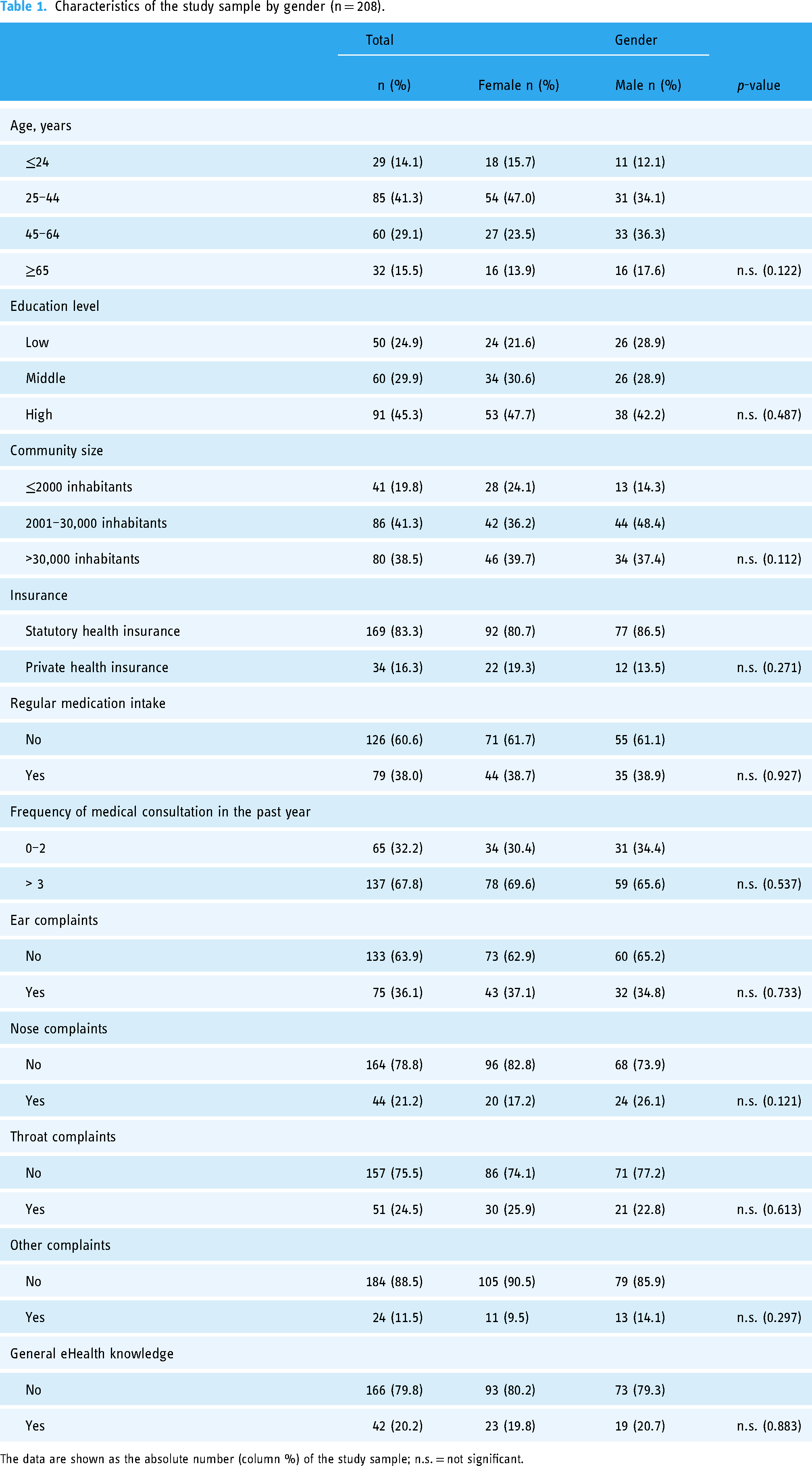
The data are shown as the absolute number (column %) of the study sample; n.s. = not significant.
Statistical analysis
To obtain a better understanding of the study-specific assertions, we initially conducted a descriptive analysis of the surveyed patients. Cross tabulations and the Pearson Chi-squared test were employed to determine variations in the relative frequencies across gender groups. The results are presented as numerical counts, percentages and two-tailed p-values.
We used multivariate logistic regression to examine the correlation amongst sociodemographic aspects, current use of digital ICT in daily life and for healthcare purposes, chief complaints and patients’ attitudes and receptiveness towards further eHealth use. To create the data set for these multivariate statistical calculations, statements regarding the potential use of eHealth were transformed from a four-point Likert scale to the following binary response variables: positive (fully, fairly) and negative (rather not, not at all). In addition, three binary response variables were defined. The first variable included all questions that focused on the potential of eHealth. The second variable included the expected benefits. The third variable addressed concerns about data security. To obtain positive values for the response variable, at least half of the explanatory variables had to be answered positively. The results are expressed as odds ratios (ORs) with 95% confidence intervals (CIs).
For all statistical results in this study, the significance level was set at α = 0.05. Non-respondents to specific statements were excluded from the analysis pertaining to those statements. All computations were performed using IBM SPSS (IBM Corp., Armonk, NY, USA).
Results
Characteristics of the study sample
A total of 208 outpatients actively participated by granting consent for their data to be employed in this study. The mean age of the study cohort was 44.7 years, with a standard deviation of 17.1 years. The male-to-female ratio was 0.79 to 1.
Younger otolaryngology patients were significantly more educated, much less likely to take medications regularly and had fewer physician contacts (all p ≤ 0.001). Age, chief complaint (ear, nose, throat and other) and gender did not exhibit significant associations with insurance status, method of appointment scheduling and general eHealth knowledge. A detailed analysis of the sociodemographic data, health status (particularly focusing on the present chief complaints) and general knowledge about eHealth is shown by gender in Table 1.
Sociodemographic aspects, chief complaints and utilisation of digital ICT among otolaryngology patients
The penetration and utilisation levels of digital ICT in the otolaryngology patient group were notably high, encompassing both daily life and healthcare purposes. Accordingly, 73.3% of the interviewed otolaryngology patients use the internet for health reasons, indicating a higher penetration rate than regular email use (67.8%) and social network membership (48.1%). Detailed results regarding the penetration and utilisation rates of digital ICT by otolaryngology patients are presented in Figure 1.

Penetration and use of modern ICT in daily life and for health reasons in %.
Regarding online health-related information searches, specific disease-related information took precedence with a prevalence of 58.2%. This was followed by inquiries into medication-related details (34.6%), specific treatment options (34.1%), physician rankings (25.4%) and hospital rankings (19.2%).
Although the overall penetration and utilisation rates of digital ICT for daily life and health reasons were high, their use by the study population displayed a significant positive association with age and education (all p ≤ 0.008). Younger and more highly educated otolaryngology patients were significantly more likely to have computers with internet access and smartphones. Highly significant differences between young adults and senior participants were particularly evident in smartphone ownership (96.6% ≤ 24 years, 37.5% > 65 years), social network membership (96.6% ≤ 24 years, 12.5% > 65 years), internet use in daily life (96.6% ≤ 24 years, 43.8% > 65 years) and daily internet use for health reasons (86.2% ≤ 24 years, 34.4% > 65 years). Also of interest for the further development of digital medicine in otolaryngology are the high penetration rates of smartphone ownership and internet use for health reasons by the study population during adulthood (smartphone ownership: 25–44 years: 96.5%, 45–64 years: 66.7%; internet use for health reasons: 25–44 years: 86.7%, 45–64 years: 71.7%). As for the chief complaints among the interviewed patients, no significant variance was discernible in the adoption of digital ICT for daily life or health reasons. The sole exception laid in the heightened penetration of the social network membership among patients with throat complaints. Medication intake was notably associated with a significantly lower penetration rate and lesser use of digital ICT in daily life (all p ≤ 0.005). However, there was no significant difference found in internet use for health reasons. Note that regular medication intake exhibited a significant correlation with higher age (p < 0.001).
Although we observed no significant gender-related difference in the utilisation of digital ICT for daily activities, the interviewed female patients showed significantly higher rates of internet use for health reasons (p = 0.041). Somewhat surprisingly, the chief complaints displayed no substantial influence on the use of digital ICT for health reasons.
Otolaryngology patients’ attitudes and willingness towards eHealth applications for cross-sectoral care
Overall, the study cohort showed a positive attitude towards and willingness to use eHealth applications for cross-sectoral patient care.
The top-ranked response was the willingness to use hospital apps that provide information about the hospital itself and general information about the treatment processes prior to admissions. This response was selected by 65.7% of the participants. Following closely, 61.1% expressed interest in receiving personal medical test results by email, whilst 58.0% preferred online appointment scheduling. Notably, 57.7% found value in receiving automated text message reminders for appointments. A similar percentage (57.7%) conveyed the desire to receive discharge summaries and prescriptions electronically.
Despite this overarching positive outlook, only 27.4% reported having no concerns about data security pertaining to online physician–patient communication. Interestingly, only 15.9% of the otolaryngology patients indicated that they would like to consult with their physicians via video chat. In terms of the important issue of quality assurance, 77.9% of the respondents indicated that online health-related information should be checked by medical experts. Additionally, 48.8% of the interviewed otolaryngology patients showed a positive attitude towards the future use of a personal electronic health record (PEHR) if they retain control over access and the ability to manage personal health.
Detailed results regarding the interviewed patients’ attitudes towards and willingness to use eHealth technologies for cross-sectoral care are shown in Table 2.
Attitudes towards and willingness to use eHealth technologies for cross-sectoral otolaryngology care.

The data are shown as absolute numbers (column %) of the study sample.
For a better understanding, note that multiple answers were possible for questions related to chief complaints; therefore, the number of chief complaints slightly exceeded the patient count within the study sample.
In response to the “What benefits do you expect by further integration of modern ICT in cross-sectoral care?” question, a notable 60.1% of the study participants indicated “Time savings and reduced travel expenses” as their expected advantage. Merely 16.8% of the questioned patients reported no anticipated benefits from the expanded adoption of eHealth in cross-sectoral patient care. A comprehensive breakdown of the expected benefits reported by the interviewed otolaryngology patients is shown in detail in Figure 2.

Expected benefits of increased eHealth use in cross-sectoral otolaryngology care in %.
Multiple logistic regression analysis showed that men displayed notably fewer concerns about data security when employing digital ICT for health reasons (OR 1.91, 95% CI 1.01–3.61) and that they may have a more favourable attitude towards eHealth (OR 1.54, 95% CI 0.79–2.99). This analysis also demonstrated that older patients exhibited heightened concerns about data security (OR 0.54, 95% CI 0.36–0.80), expressing a more reserved attitude towards eHealth (OR 0.39, 95% CI 0.25–0.61). Although the difference was not significant, more highly educated patients tended to report a more positive attitude towards further use of digital ICT for cross-sectoral care (OR 1.70, 95% CI 0.85–3.38). Remarkably, neither insurance status nor regular medication intake nor the types of present chief complaints within the field of otolaryngology significantly influenced the patients’ reported concerns about data security. Similarly, the same held true for their willingness to use digital ICT for health reasons.
Intriguingly, the multiple logistic regression analysis targeting the association between the current digital ICT usage and the attitude towards eHealth unveiled a positive correlation with having a smartphone and using the internet on a daily basis. Further details regarding the interrelation between the participants’ digital ICT usage and their eHealth attitude are presented in Table 3.
Association between the present use of modern ICT and the attitudes towards eHealth for cross-sectoral otolaryngology care.

Discussion
Although numerous recent national and international studies have delved into the utilisation of eHealth for diagnosis and treatment in otolaryngology care,13,21–34 the current state and attitudes of otolaryngology patients towards the sustained use of digital ICT, even in the post-CoViD-19 pandemic era, remain insufficiently understood. This knowledge gap raises legitimate concerns that must be further addressed. These aspects are of increasing significance because of the widely acknowledged potential for enhancing healthcare through eHealth applications, including diagnosis and treatment in the field of otolaryngology. Consequently, eHealth has garnered support from policymakers and international health authorities. Notably, the executive boards of the WHO have acknowledged eHealth's potential in fortifying healthcare systems and enhancing quality, safety and access to care whilst also recognizing the role of mobile wireless technologies in public health.35,36 For Europe, the European Commission developed in 2022 a regulation to set up a “European Health Data Space (EHDS)” in order to unleash the full potential of health data. 37
Hence, this study aims to elucidate the utilisation and willingness of German otolaryngology patients to employ digital ICT for health-related purposes along with their expectations regarding the benefits and concerns pertaining to data security.
For the sociodemographic aspect of the study sample, the sex ratio (male:female = 0.79:1) was a bit lower than that observed in the general populations of Germany and the United States (0.98:1 and 0.97:1, respectively).38,39
The mean age of the study sample (44.7 years) closely approximated the average age within the general German population (47.8 years), showing a notable divergence of nearly 7 years when compared to the average age of the US population (38.5 years).38,39
Whilst the daily internet usage among the included otolaryngology patients displayed a substantial penetration rate (78.8%), this level remained below the proportions of internet usage determined in Germany (94.0%) and the US (93.4%).40,41
Our study also revealed a significant association between the internet use of otolaryngology patients for health-related purposes and both younger age and higher levels of education. These findings were in line with those of studies conducted in fields beyond otolaryngology and outside of Germany, where the present study was conducted.15,42–47 Notably, the data also highlighted a discernible uptick in internet use among otolaryngology patients for both daily life and health-related purposes in recent years. 17 The results that younger otolaryngology patients have a significantly higher penetration rate for modern ICT and internet use for health reasons compared to older patients have several implications for digital health in otolaryngology. Healthcare providers must develop digital health interventions that specifically address the preferences and habits of specific patient groups. The results raise the hypothesis that older otolaryngology patients may need more education and training programs to improve digital literacy relevant to remote monitoring and telemedicine in cross-sectoral otolaryngology care and self-management of their health, which aligns with findings from several studies in different medical fields.47–49 Although this study did not specifically focus on eHealth literacy, note that 77.9% of the participants expressed a desire for medical experts to review available online medical information. This underscores the importance of further research to evaluate the quality of health-related information accessible online and its potential impact on the quality and safety of cross-sectoral otolaryngology care. This also underscores the need for a further structured investigation about the role of eHealth literacy for the further adoption of digital health information, eHealth technologies and digital care services. Of particular interest for further research is the role of eHealth literacy for otolaryngology patients’ empowerment and engagement, informed decision making, communication and collaboration in digital cross-sectoral care and adaptability and adoption of new digital health technologies in otolaryngology. Surprisingly, the patients’ chief complaints within the field of otolaryngology (e.g. ear problems) did not significantly influence their use of digital ICT for everyday life or health-related purposes. Notably, there was no discernible increase in the adoption or willingness to embrace digital ICT among patients with ear problems despite the recent emphasis of eHealth developments in otolaryngology on this population.21–24,28–30,32,50 The overall positive attitude towards the utilisation of online appointment management systems combined with automated reminders, which have already found success in other medical fields and several countries, highlights the considerable potential for increased efficiency in cross-sectoral appointment management and reduced no-show rates.51–53 These findings indicate the appropriateness of introducing these types of eHealth applications in cross-sectoral care throughout the field of otolaryngology.
The willingness of the participating otolaryngology patients to receive their discharge summaries (57.7%) and test results online (61.1%), along with their positive disposition towards the use of a PEHR (48.8%), underlines the substantial potential of eHealth in otolaryngology for enhancing the quality and efficiency of cross-sectoral care and empowering patients throughout the treatment process. These results echo the findings from eHealth studies in other medical fields and countries, underscoring the need for further advancements in the cross-sectoral online transfer and storage of personal medical information within otolaryngology.54–57 Consequently, we recommend exploring cloud-based solutions managed by professional health IT organisations and PEHRs for communication and storage of personal health-related information for cross-sectoral care in otolaryngology and other medical fields, ensuring robust data security and availability.
The study participants expressed a range of anticipated benefits from a deeper integration of eHealth into cross-sectoral otolaryngology care. Most frequently mentioned were time savings, reduced travel expenses, improved medical care accessibility in rural areas and enhanced self-management of their health. These expectations aligned with findings from eHealth studies outside the field of otolaryngology, which suggested that digital applications can enhance adherence and self-management in patients with chronic diseases.58–61 However, note that whilst the otolaryngology patients in this study demonstrated high penetration rate and willingness to use eHealth applications, only 15.9% of the study population preferred consulting with their physicians via video chat. Additionally, the existing literature highlights numerous organisational, technical, personnel and reimbursement barriers to further implementing ‘telecare’ in rural areas.62,63
Although these aspects were not systematically explored, consequently representing a major limitation of this study, we suspect that numerous organisational and technical challenges, including concerns about data security, which were indicated by 64.6% of the study participants, and the reimbursement barriers contribute to the reluctance to engage in video consultations. Other factors could be the fear of a reduced physician–patient relationship in video consultations. Regarding the potential barriers to digital ICT adoption by otolaryngology patients that are related to data security and privacy concerns, concerns about data breaches, lack of trust, legal and regulatory compliance, cybersecurity risks and concerns about data ownership must be addressed in further studies. For this, the authors recommend a multifaceted approach for further development of digital medicine in cross-sectoral care. This multifaceted approach includes implementing robust security measures, ensuring compliance with privacy regulations, building trust through transparent data practices and providing education and support to patients and healthcare workers to enhance their digital literacy and confidence in using digital ICT solutions for cross-sectoral care.
As further limitations of this study, only otolaryngology patients were examined, the ethnic aspects were not specifically assessed, the age groups were questioned, and the study population included only German-speaking patients. Therefore, the results cannot be directly extrapolated to other patient populations or other countries. This underscores the need for further comprehensive investigations in various medical fields and different countries, especially concerning the needs of patients and healthcare providers focusing on eHealth literacy, data safety and availability, technical usability, potential barriers to digital ICT adoption and suitable financing models before implementing eHealth applications in cross-sectoral care.
Therefore, despite being occasionally overlooked in eHealth research, our results highlight the necessity for further examination of these topics to comprehensively evaluate digital communication and telehealth in otolaryngology. This is especially crucial given that these aspects, alongside the relationship between age and eHealth utilisation amongst otolaryngology patients, could be pivotal factors in its successful implementation.
Conclusion
In conclusion, the rapid growth of digital communication technologies and telehealth presents a transformative opportunity of improving cross-sectoral otolaryngology care. This study highlights that otolaryngology patients are not only prepared for this paradigm shift, but also hold a strong belief in the substantial potential of digital communication technologies to enhance healthcare. They express the willingness to embrace eHealth applications.
To harness the full potential of this disruptive innovation and enhance patient safety and care quality in otolaryngology, future studies should explore the integration of eHealth across diverse applications in cross-sectoral care. Otolaryngologists, public health researchers and eHealth experts have vital roles to play in advocating for digital physician–patient communication. This advocacy should prioritise the key aspects in further eHealth studies, such as treatment quality, data security, technical usability, and sustainable financing models.
Moreover, incorporating telehealth, particularly digital physician–patient communication concepts, into general medical education within otolaryngology can be a proactive step to preparing future healthcare professionals for this evolving landscape. Overall, embracing digital transformation in otolaryngology can pave the way for more efficient, accessible and patient-centred care.
Footnotes
Declaration of conflicting interests
The authors declared no potential conflicts of interest with respect to the research, authorship, and/or publication of this article.
Funding
The author(s) disclosed receipt of the following financial support for the research, authorship, and/or publication of this article: We acknowledge the support of ‘Deutsche Forschungsgemeinschaft’ and the Open Access Publishing Fund of the University of Tuebingen with the financing publication fees.
Ethical approval
Institutional ethics approval was obtained through the Ethics Committee of the Medical Faculty and University Hospital of Tuebingen, Germany, prior to the study (Ethics approval registration number: 514/2016B02).
Guarantor
MH and SB.
Contributorship
All authors participated in the design and conception of the study. AH, MH, and LS collected the data. MH, AH, LS, FH, and CE performed the statistical analysis and drafted the tables and figures together with SB. MH, LS, CE, AHW, FH, SB, and HK performed the literature review. MH, LS, AH, and FH drafted the manuscript. All authors read and approved the final manuscript. MH and SB are accountable for all work. LS submitted the manuscript.
