



Abstract
Introduction
Problematic internet use among the elderly is an emerging area as previous studies focused more among the young people. Only a few studies focused on problematic internet use at the level of individual characteristics of older adults or on mitigating factors at the level of the older adult's family, ignoring family-level disruptive factors.
Objective
The purpose of study is to investigate the relationship between conflict with children and problematic internet use among the elderly, as well as the mediating mechanisms and boundary conditions of the relationship.
Methods
The valid sample of study composed of 428 older adults from 39 different villages and communities in central China. Data analyses were conducted by SPSS, MPLUS, and SmartPLS software. To test our hypotheses, we implement several quantitative methods, including confirmatory factor analysis (CFA), correlations analysis, and ordinary least squares (OLS) regression. Also, we employed partial least square structural equation modeling (PLS-SEM) for robustness testing.
Results
The results indicated that conflict with children was positively associated with problematic internet use of old people; psychological depression mediated the relationship between conflict with children and old adults’ problematic internet use; sociability moderated the effect of conflict with children on psychological depression; and living situation moderated the effect of psychological depression on problematic internet use among the elderly.
Conclusion
The current research improved the understanding of the mechanisms that produce problematic internet use among the elderly and helped prevent or reduce problematic internet use in older adults in terms of family support systems and individual ability characteristics.
Keywords
Introduction
Internet usage among the old has been a common phenomenon nowadays, and the elderly is an important target group of the internet. 1 Previous literature has revealed the benefits of internet usage among the old, such as decreasing their sense of isolation and depression, 2 improving their cognitive health, 3 and helping them learn about the risk of disease. 4 However, the excessive use of internet among the older adults and its harmful effects has also been noticed. 5 China's Internet Life for Seniors 2020 report shows that the average senior user over 60 spends 64.8 minute online per day, and each senior user logs into an app at an average of five times per day. Moreover, almost half of elderly respondents experience negative psychological states, such as anxiety or restlessness, when their smartphone is not connected to the internet, which are typical withdrawal reactions of internet addiction. 6 There has been a lack of consensus among scholars on the definition of excessive internet use, so that the problem of defining the term still exists as of today. 7 And various terms, such as susceptible problematic internet use, internet addiction, internet dependency, and pathological internet use, are used interchangeably to describe addictive or problematic internet use.8–11 In addition, for this particular study, the term problematic internet use (PIU) was used to define the cognitions and behaviors associated with ‘using the Internet to cause psychological, social, school, and/or work difficulties in a person's life’. 12 Because the term ‘problematic internet use’ encompasses a broader range of problem behaviors from mild to severely disruptive, it is more applicable to our focus on problematic behaviors arising from internet use among older adults. Meanwhile, compared to other groups, the elderly has worse psychical function; therefore PIU can cause greater harmful effects on the senior group's both physical and mental health, such as eye problems, cervical spondylosis, cardiovascular and cerebrovascular diseases, insomnia, cervical spondylosis, lumbar spondylosis, and emotional changes.13,14 Thus, PIU is no longer just a problem for young people but has also become a challenge for older adults to address and improve.
However, PIU among the elderly is an emerging area as previous studies focused more among the young people. As far as we know, only few research has paid attention on factors that affect the PIU among the elderly, the negative effects of PIU of the old, and some mechanisms of those relationships. Existing research is limited and has focused on the influence of individual characteristics (depressive symptoms, habits, and self-control),15,16 social support17,18 factors on internet addiction, or PIU among older adults. In Chinese cultural intext, family intergenerational relations are of prominence and play important roles throughout the life cycle.19,20 But no article paid attention to the factors (i.e., conflict with children (CWC)) in family system that may lead to or exacerbate PIU among the elderly. Yet focusing on these factors is critical to reducing PIU among older adults at the source. Because the center of life of the elderly shifts from society to family after retirement, the family becomes the most important support for the daily life, spiritual comfort, and material resources of the elderly.21–23 Therefore, family factors are one of the most influential factors affecting the psychological and behavioral aspects of older adults.24–26 And, existing studies showed that interaction with children was significantly negatively associated with the internet addiction of old people. 18 Then, on the other hand, do disruptive factors within the family system (e.g., CWC) have an impact on PIU in older adults? If so, what are the causes and mechanisms involved? And where are the boundaries of action for such effects? These are all questions that deserve in-depth exploration, which will help find ways to reduce addiction in older adults.
The present study bases on the conservation of resource (COR) theory to explain the effect of CWC on the PIU among the old. The COR theory emphasizes the tendency of individuals to strive to acquire, maintain, nurture, and protect the resources they value, and individuals tend to invest in new resources to recover from the loss of resources when resources are lost.27,28 However, with limited resources, individuals need to cope with multiple life problems in their daily lives. 29 In this case, based on the principles mentioned earlier, when individuals experience more family conflicts (e.g., CWC) in the family system, the resources they get from their children reduced. As a result, they would turn to other ways to supplement their social resources and psychological resources which are vital for them. Previous research has suggested that stressful life events (e.g., CWC) predict PIU, 30 so we can assume that as CWC increases, older adults will have fewer resources that they can replenish via the internet. However, preference for online social interactions is one of the most important factors influencing problematic internet use (PIU), 31 so we can hypothesize that conflict with children is positively associated with PIU.
Meanwhile, family conflicts and severe family dysfunction imply inadequate familial resources. 32 The COR theory argues that both the potential threat of resource loss and the actual loss of resources trigger negative emotions such as tension and stress in individuals, which affect their psychological well-being. When resource loss is large or depleted, individuals will enter a defensive state and appear irrational behavior in order to protect resources. 33 Therefore, on the basis of COR theory, we assume that psychological depression (PD) plays a mediating role in the relationship between CWC and PIU among older adults.
Moreover, individual personality traits are vital to help explain a variety of vital life outcomes.34,35 However, to the best of our knowledge, no article paid attention to the boundary effect of individual personality traits on the relations between the CWC and PD among older adults. For older adults, they are more likely to spend their lives within the family, which is their primary source of resources.21,23 But seniors with high sociability have more other resources to cope with the depletion of resources due to CWC. 36 So, older adults with higher sociality are more capable of getting new resources from new relationships, thus reducing the loss of resources. As a result, their PD will be improved as well. Therefore, we consider sociality as a moderator. More precisely, we hypothesized that high sociality could weaken the effect of CWC on depression.
Also, considering the special characteristics of older adults, their living situation (LS) can also affect their resource status. Those older adults who live alone are more often left to cope with poor mental health and negative emotions on their own, while those who are living with others are able to access resources to improve their mental health by asking for help. It has been established that older adults who live alone are more likely to experience PIU,5,17 while those who live with their children have lower levels of PIU. 18 Therefore, we consider living situation as another moderator variable. More specifically, we speculated that living alone would strengthen the effect of depression on PIU among older adults.
In summary, the specific objective of the present research is to fill the gap in the existing literature about the elderly's PIU by presenting a case study of China. Based on the COR theory, first, we analyze the effect of CWC on PIU among the old. Second, we examine how CWC affects PIU among the elderly. Specifically speaking, depression plays a mediating role between CWC and the elderly's PIU. Finally, by testing the moderating mechanism in aforementioned relationships, we reveal the moderating role of sociality and living situation. Figure 1 presents the conceptual model.

Conceptual model.
Literature review and hypothesis
Main effect of conflict with children on problematic internet use
With the trend of aging and increasing life expectancy, older adults are becoming more dependent on family resources and family functions.21–23 However, family conflicts, especially with children, are detrimental to the harmony of family relationships and can reduce the financial and emotional support from children of older adults.37,38 Therefore, poor quality relationships with adult children is detrimental to parents’ mental health.39,40 For older adults, children can provide social support in the form of love, advice, and care as a protective resource to help older adults cope with stressors. 41 Those older adults who receive support from their families may feel a greater sense of self-worth, and this enhanced self-esteem may also be a psychological resource that encourages optimism, positive affect, and better mental health. 42 In addition, family members can also regulate each other's behavior and provide information and encouragement to act in healthier ways. 43 Conflict with children, however, becomes a source of stress, which can undermine older adults’ psychological well-being. 41 This is because poor interpersonal relationships may lead to health-damaging behaviors as coping mechanisms to deal with stress. 44 The COR theory suggests that in situations where resources are lost, access to resources becomes particularly important and individuals tend to invest in new resources to recover from the loss of resources. Conflict with children represents a loss and shortage of family resources. 32 Support resources from children and extended psychological resources, which are so important to older adults, are diminished, which is detrimental to their ability to cope with the problems of aging. Therefore, with the loss of family resources, older adults turn to other ways to supplement the social and psychological resources that individuals need, and that is through the internet for online support and leisure.
In fact, the internet has in some ways created a safe environment for shy or avoidant individuals to gain social connection and social support through anonymity.
45
Moreover, the internet can be regarded as a special kind of social media to meet the specific needs of individuals.
46
Besides getting social support from the internet, several studies have provided important information on the benefit of internet use on the old's self-rated health,47,48 mental health,49,50 cognitive function,3,51 and subject well-being.52,53 A considerable amount of existing research has shown that people with poor interpersonal relationships are more likely to be at increasing risk of internet addiction,54,55 because the lack of offline social resources can be supplemented by online social communication.
56
In other words, internet use can supplement the social and psychological resources that older adults need in order to gain and maintain individual advantages and good social relationships to ensure their survival. And the internet addiction was positively predicted among those people who come from families in which family conflict existed and severely dysfunctional families.32,57,58 Based on the COR theory, the massive loss of family resources due to conflict with children can cause older adults to become addicted to the internet to access and recover social and psychological resources, thus creating PIU among the elderly. Therefore, we propose the following hypothesis:
Hypothesis 1 (H1). Conflict with children can positively predict older adults’ problematic internet use.
The mediating role of psychological depression
Aging is accompanied by a number of problems, including depression, which is a significant public health problem affecting the mental health of older adults. In China, approximately 31.2% of older adults exhibit depressive symptoms. 59 The COR theory provides a theoretical explanation for how conflicts with children can lead to depression in older adults. The COR theory suggests that individuals deplete psychological resources to cope with stressors in their lives, producing negative states such as PD, psychological distress, depletion, and burnout.27,28 In the Chinese cultural context, children are required to provide resources such as financial support, life care, and spiritual comfort to older adults. 60 Intergenerational relationships play an important role in the mental health and well-being of older adults.61,62 However, older adults experience not only closeness and cohesion with their children but also alienation and conflict. 63 Well-communication between older adults and their children facilitates the former's psychological well-being. 64 Conversely, however, conflict between the elderly and their children can diminish the well-being of the elderly and lead to PD.65–67
On the other hand, the COR theory suggests that individuals have limited resources, and when they deplete their resources and feel negative emotions, they will take appropriate measures to replenish their resources.
68
Addiction to the internet provides such a channel for them to replenish their social resources on the one hand and to release their stress and rejuvenate on the other.45,46,52 However, older adults with PD are more likely to indulge in internet use to satisfy their emotional and psychological needs, which eventually leads to PIU.
5
A considerable number of existing empirical studies have confirmed that PD is an important predictor of PIU. Overall, we propose the following hypothesis:
Hypothesis 2 (H2). Psychological depression mediates the positive relationship between conflict with children and problematic internet use among old adults.
The moderating role of sociality and living situation
Personality traits, broadly defined as ‘the relatively enduring patterns of thoughts, feelings, and behaviors that reflect the tendency to respond in certain ways under certain circumstances’,
69
have been consistently shown to be associated with a variety of vital life outcomes.34,35,70 Extraversion, characterized by sociability, assertiveness, and energy,
71
is often correlated with greater well-being and decreased depressive symptoms.
70
In particular, sociability plays an important role in protecting people from psychological distress and increasing well-being.
36
The COR theory also provides us with a theoretical explanation of how sociability affects the role of CWC on PD. The COR theory suggests that when resources are lost, individuals will recover resources and energy by acquiring new resources through other ways. Individuals with high sociability can facilitate the application of social support,
72
as well as replenish and restore family and psychological resources depleted by CWC by making new friends to acquire more resources.
36
Thus, individuals with high sociability mitigate the resource depletion from conflict, which in turn weakens the positive relationship between CWC and PD. Thus, we propose the following hypothesis:
Hypothesis 3 (H3). Sociability moderates the positive relationship between conflict with children and psychological depression among old adults. In particular, the positive relationship between conflict with children and psychological depression was weaker for older adults with high sociability.
The COR theory indicates that individuals in a negative psychological state such as PD will pursue other approaches to compensate for resources. And since family and children are the essential sources of resources for older adults,21–23 the LS of older adults also affects their resource status. For example, seniors living alone face a range of challenges, such as the inability to complete household tasks because of debilitating health, the need to handle complex service environments on their own and dealing with family issues from a distance.
73
And these challenges cause them to experience precariousness, which is the internal instability and insecurity that comes from a lack of or difficult access to basic resources.
73
Then it can be assumed that for older adults in a DP state, older adults living alone are less likely to have access to family resources in a more rapid time frame. In contrast, non-living alone older adults can ask for help and support from family members and children through direct interaction.
22
We therefore suggest that LS can moderate the effect of DP on PIU. More specifically, the LS of older adults living alone enhanced the positive relationship between PD and PIU. Hence, we propose the following hypothesis:
Hypothesis 4 (H4). Living situation moderates the positive relationship between psychological depression and problematic internet use among old adults. In particular, the positive relationship between psychological depression and problematic internet use was stronger for older adults living alone.
Methods
Sample and procedures
The data were collected from October to December 2021. Participants were given RMB reward when they completed the questionnaire. Trained interviewers conducted the questionnaires in villages and urban communities in central China. Our questionnaire did not address any sensitive topics that might make participants uncomfortable. All participants were informed about the study procedure and voluntarily participated in the questionnaire, and they signed a written informed consent in accordance with the Declaration of Helsinki.
The sample of our study composed of 570 participants from 39 different villages and communities in central China. Removing the questionnaires with uncompleted, missing values and failed attention tests, a valid sample of 428 was obtained for our study (206 males and 222 females, mean age = 68.67 years old, SD = 6.60). With regard to the level of education, the number of older people with junior high school education or less was the largest, accounting for 65.89% (n = 282). In terms of self-rated health, the percentage of self-reported healthier and self-reported less healthy was 62.15% (n = 266) and 14.49% (n = 62), respectively. In terms of income status, 76.64% (n = 328) of older people have monthly income of less than 5000 RMB, which is the highest percentage.
We compared valid and invalid respondents with regard to the major demographic characteristics, including age, gender, and education level. The t-test results show that non-response bias may not be a major concern in our research. 74
Measurement
Following previous studies, we developed the survey instrument with a double back-translation approach.29,75,76 We first developed an English version of the questionnaire, then translated it into Chinese, and then conducted back-translation with two independent translators to ensure conceptual equivalence of the survey items. All measurement items of latent variables are based on 5-point Likert scales. Table 2 lists the results of factor loadings, reliability, and validity of measurement items, showing good reliability and validity for each of these variables.
Conflict with children (CWC)
CWC is defined as how often the older adult disagreed with his or her adult resident children in the past year. Referring to the study by Suitor and Pillemer, Wu et al., and Yang et al.,18,32,77 we assessed conflict between older adults and their children with one survey item. CWC is defined as how often the older adult disagreed with his or her adult resident children in the past year. 77 So, we asked, ‘how often do you conflict with your children?’ and provided participants with the following five response options: very infrequent, relatively infrequent, fairly, more frequent, and very frequent. Thus, higher scores represent a higher level of conflict between older adults and their children.
Problematic internet use (PIU)
We measured PIU by the four items from Internet Addiction Scale. 78 The items are ‘In the past 6 months, the average time I spend online per week has increased much more than before’, ‘I cannot stop every time I go online’, ‘I find myself spending more and more time online’, and ‘I spend more time online than before’. The measurement was evaluated using the 5-point Likert scale, ranging from 1 (strongly disagree) to 5 (strongly agree).
Psychological depression (PD)
We adapted four items from Depression Anxiety Stress Scales (DASS-21) of Henry and Crawford to assess psychological depression in older adults. 79 The items are ‘I couldn’t seem to experience any positive feeling at all’, ‘I can’t seem to get the energy to do things’, ‘I feel like I have nothing to look forward to’, and ‘I feel sad and depressed’. All items were evaluated using the 5-point Likert scale, ranging from 1 (strongly disagree) to 5 (strongly agree).
Sociability
We used four-item scale by Zhang et al. to measure sociability. Sociability belonged to one dimension of the extraversion of the Big Five Inventory 2. 71 The items are ‘I am outgoing and like to socialize’, ‘I am relatively quiet’, ‘I am sometimes shy and introverted’, and ‘I am talkative and chatty’. It is worth noting that the second and third items use reverse scoring. The measurement of sociability was evaluated using the 5-point Likert scale, ranging from 1 (strongly disagree) to 5 (strongly agree).
Living situation
Referring to the study by Meshi et al., 5 we measured the living situation of older adults using a question, that is, ‘Do you live alone’. This is a dummy variable that equals 1 if the respondent is living alone and 0 if otherwise.
Control variables
To control for alternative explanations, we take demographic information of the participants, including age, gender, education level, personal income, and self-rated health.17,18,80 Age was measured in years (over 55 years old), and gender was represented by a dichotomous variable (1 = male, 0 = female). Education level was represented by eight categorical variables based on the special characteristic of education for the elderly in China. Self-rated health indicated participants’ ratings of their overall health, ranging from 1 (poor) to 5 (excellent). The level of individual income per month was represented by seven categorical variables: <500 RMB, RMB 500–1000, RMB 1000–2000, RMB 2000–5000, RMB 5000–10,000, RMB 10,000–20,000, and more than RMB 20,000.
Analytic strategy
Data analyses were conducted by SPSS, MPLUS, and SmartPLS software. To test our hypotheses, we implement several quantitative methods, including descriptive statistics, correlations analysis, ordinary least squares (OLS) regression, confirmatory factor analysis (CFA), and partial least square structural equation modeling (PLS-SEM).
Results
Common method bias
Harman's single-factor test was conducted to check for the potential effects of common method bias. All scale items were subjected to exploratory factor analysis in SPSS to test for common method variance. The results showed that in the unrotated factor structure, the variance explained was 26.93%, which did not reach 40%. 81 In addition, we used confirmatory factor analysis (CFA) to test for common method bias in MPLUS software. It can be found in Table 1 that the one-factor model does not demonstrate good fits(χ2/df = 32.821, RMSEA = 0.273, SRMR = 0.213, CFI = 0.450, TLI = 0.328), while the fitting index of three-factor model is relatively ideal (χ2/df = 32.821, RMSEA = 0.273, SRMR = 0.213, CFI = 0.450, TLI = 0.328), thus confirming again that there is no obvious common method bias in this research. 82
Results of CFA.

Note: PIU: problematic internet use; PD: psychological depression.
Reliability and validity tests
We performed CFA in MPLUS software on the three variables of PIU, PD, and sociability to determine their discriminant validity. The results (Table 1) indicate that compared with other alternatives, the fit indices of the three-factor model used in this study best meet the acceptable standard: χ 2/df = 2.635, RMSEA = 0.062, SRMR = 0.039, CFI = 0.973, TLI = 0.965, while other alternative models show poor fits to the data. Moreover, as shown in Table 3, the correlation coefficient of PIU, PD, and sociability is less than the square root of their AVE, which further confirms the good discrimination validity of the variables in this study. 83
In addition, the results of factor analysis demonstrate that all factor loadings are significant. Generally speaking, if the composite reliability exceeds 0.7 and the average variance extracted is greater than 0.5, the convergent validity can be considered as good. Obviously, the CR and AVE of these three variables are within the acceptable range (Table 2). Overall, the measures of key variables contained competent reliability and validity.84,85
Survey measures.

Note: PIU: problematic internet use; PD: psychological depression.
Descriptive and correlation analysis
The results of descriptive statistics are demonstrated in Table 3. It can be found that, as we hypothesized, there are some strong correlations between the key variables discussed in this research. For example, CWC is significantly positively correlated with PD (r = 0.489, p < 0.01), and PIU is also significantly positively correlated with PD (r = 0.379, p < 0.01).
Descriptive statistics and correlations among all variables.
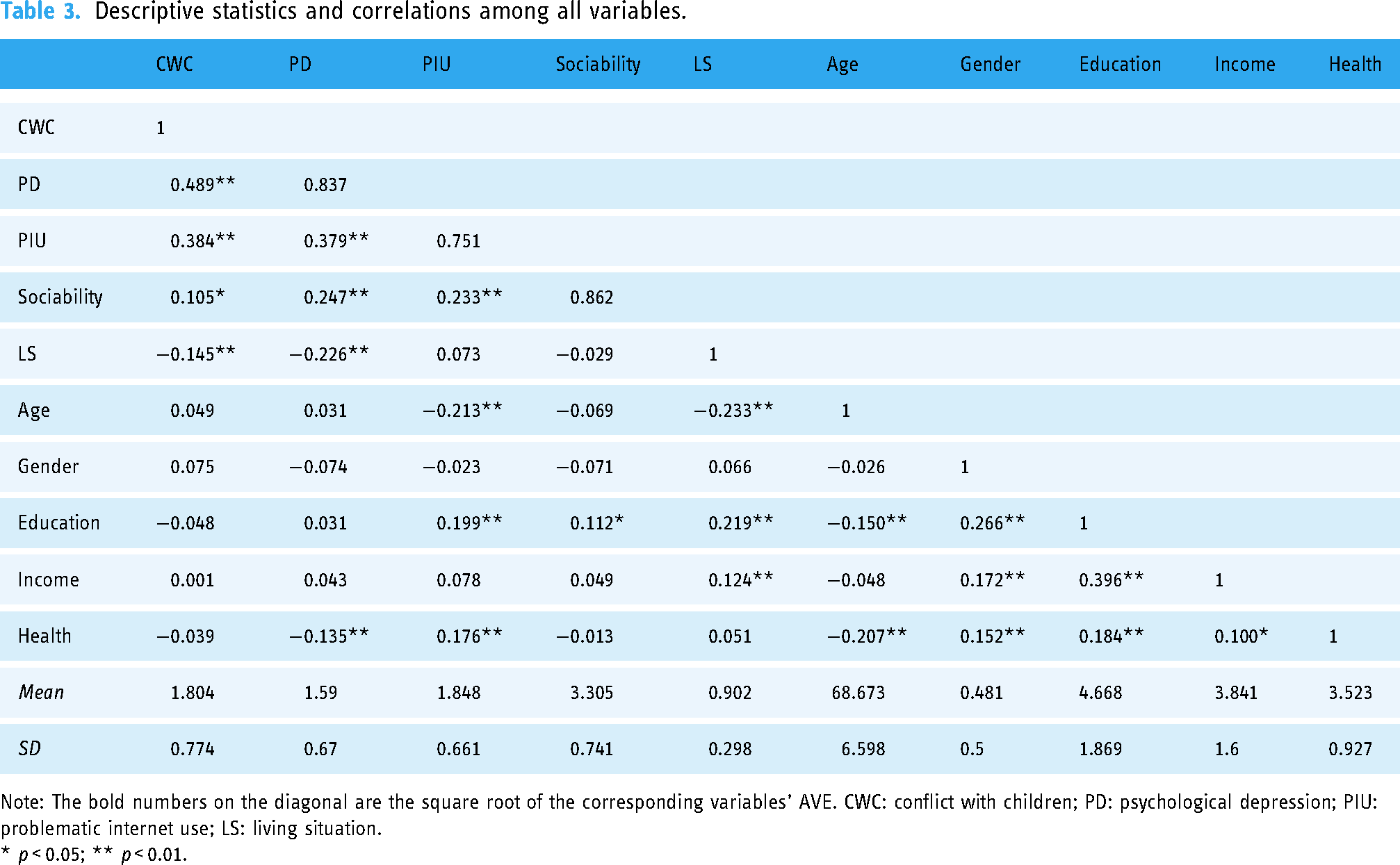
Note: The bold numbers on the diagonal are the square root of the corresponding variables’ AVE. CWC: conflict with children; PD: psychological depression; PIU: problematic internet use; LS: living situation.
* p < 0.05; ** p < 0.01.
Hypotheses testing
We used ordinary least squares (OLS) regression analysis to test for the hypotheses in SPSS software. According to the numbers in Table 4, we can find that CWC is positively associated with PIU (H1: β = 0.357, p < 0.01), which proves the hypothesis 1. CWC is positively associated with PD (β = 0.431, p < 0.01), and when CWC and PD enter the regression equation simultaneously, both the positive relationships between CWC and PIU (β = 0.250, p < 0.01) and positive relationships between PD and PIU (H2: β = 0.248, p < 0.01) remain at the significant level. Therefore, PD plays a partial mediating role in the relationship between CWC and PIU, which proves hypothesis 2. Moreover, we calculated the ratio of the indirect effect to the total effect and found that the effect size was 29.94%.
Results of OLS regression analyses that examine the mediating effect.

Note: N = 428. The numbers in parentheses indicate the value of t. CWC: conflict with children; PD: psychological depression; PIU: problematic internet use.
It is necessary to centralize the data before testing the moderating effect. Construct the interaction item CWC × Sociability with CWC and sociability, set PD as the dependent variable, and put the control variable, CWC, sociability, and the constructed interaction item (CWC × Sociability) in sequence for hierarchical regression analysis. The results (Table 5) demonstrate that the interaction item CWC × Sociability has a significant negative impact on PD (H3: β = −0.171, t = −3.516, p < 0.01), suggesting that sociability negatively moderates the relationship between CWC and PD, which proves hypothesis 3. To more intuitively reflect the moderating pattern of sociability, we plotted an interaction effect diagram (Figure 2), in which the slope is calculated by adding or reducing a standard deviation from the mean value of sociability.

Moderating effect of sociability.
Results of OLS regression analyses that the test moderating effect.

Note: N = 428. The numbers in parentheses indicate the value of t. CWC: conflict with children; PD: psychological depression; PIU: problematic internet use; LS: living situation.
* p < 0.05, ** p < 0.01.
Similarly, the moderating effect of LS is also tested according to the above steps. Construct the interaction term PD × LS with PD and LS, set PIU as the dependent variable, and carry out hierarchical regression analysis. The results (Table 5) suggest that the interaction term PD × LS is positively associated with PIU (H4: β = 0.567, t = 4.576, p < 0.01), indicating that LS plays a moderating role between PD and PIU, which indicates that hypothesis 4 of this study is tenable. And the moderating pattern of LS is also vividly displayed through its interaction effect diagram (Figure 3).

Moderating effect of living situation.
Additional analysis and robustness test
We conducted partial least square structural equation modeling (PLS-SEM) using SmartPLS to additionally test the moderated mediation model. PLS-SEM facilitates the advancement and extension of the theory.
The results (Figure 4) showed that the standardized root mean square residual (SRMR) of the constructs was 0.072, which was below the threshold of 0.08 (Hu & Bentler, 1999). Hence, PLS-SEM fit index met the acceptable standard.

Result of the research model (*** p < 0.001; ** p < 0.01).
The R2 values of the latent construct indicated the model strength, ranging from 0 to 1 (Cai & Shi, 2022). The R2 values for PD and PIU are 0.300 and 0.256, respectively, indicating the model R2 values showed 30.0% variance in mediator variable emotional exhaustion and 25.6% variance in dependent variable safety behavior, which showed the research model was explanatory power.
Q2 reflects the predictive relevance (Hair et al. 2017), which is obtained by blindfolding. Values of 0.02, 0.15, or 0.35 indicate that an exogenous construct has a weak, medium, or large predictive relevance for a certain endogenous construct, respectively (Hair et al. 2017). The Q2 values for PD and PIU are 0.228 and 0.134, respectively, suggesting that the exogenous constructs have medium predictive relevance for the endogenous construct under consideration.
The moderated mediation model analysis was conducted through 5000 samples of bootstrapping approach. We tested the moderated mediation model based on the significance levels of path coefficients (p < 0.05). First, we performed robustness tests on the existing research hypotheses. The results (Table 6) indicated a significant positive relationship between CWC and PIU (H1: β = 0.242, p < 0.001). The results support that intention to verify PD partially mediates the relationship between CWC and PIU (H2: β = 0.164, p < 0.001). The moderating effect of SO on the relationship between CWC and PD was negatively significant (H3: β = −0.142, p < 0.01). The moderating effect of LS on the relationship between PD and PIU was positively significant (H4: β = 0.138, p < 0.001). Hence, H1, H2, H3, and H4 were further verified. Second, the results (Table 6) also indicated the SO moderated the indirect relationship between CWC and PIU via aggravated PD (β = −0.046, p < 0.01). Hence, the moderated mediation model was also significant. Specifically, the meditating relationship between CWC and PIU via aggravated PD was weaker when the SO was higher.
The PLS-SEM testing results.

Discussion
The present study's goal is to explore the effect of CWC on the PIU among the old, as well as the mechanisms of the relationship. A total of 428 older adults from China were investigated for data analysis, and the results reveal that CWC has a positive impact on the elderly's PIU through the mediating variable of PD. Meanwhile, those seniors with high level of sociability have a less adverse effect on their PD by CWC than those with low level of sociability. In other words, sociability moderates the relationship between CWC and PD. In addition, older adults living alone have a more adverse effect on their PIU by PD, which means that living situation moderates the association between PD and PIU among the old. Also, we will discuss the theoretical implications and practical significance in the next section.
The current research examined the impact of family factors which lead to or exacerbate PIU among the seniors. Although some studies have focused on PIU of the old,5,17,86 no studies have focused on those factors in the family system that can cause or exacerbate PIU in older adults and the mechanisms underlying this relationship. However, focusing on these factors plays an important role in preventing and mitigating PIU among older adults. To fill in these gaps, we conducted an empirical analysis about these topics among Chinese older adults. Consequently, the results of the present study have theoretical significance. First, according to the COR theory, this study suggested the positive impact of CWC on the elderly's PIU. Previous studies have suggested that families are the primary source of resources for seniors, and family factors have a direct impact on older adults.21–23 However, no studies have focused on family factors that cause or exacerbate PIU in older adults. Intergenerational relationships can affect the internet use of older adults. 3 Therefore, when CWC increases, older adults face a continuous loss of resources, and they have to excessively acquire new resources through the internet, 87 which eventually leads to older adults’ PIU. The results of this study expand the scope of research on PIU of the elderly and enriched theories of family intergenerational relations. More importantly, this result is consistent with the findings of previous studies. The self-worth orientation theory assumes that self-worth is the ultimate cause of people's behavior. Previous research suggests that stressful life events may predict problematic internet use (PIU) in individuals by undermining their self-worth and that individuals are prone to problematic internet use (PIU) when they gain compensatory self-worth in online social interactions.30,31,88 Second, according to the COR theory, the results of our study demonstrated an important mediating mechanism of how CWC effect the elderly's PIU. In other words, PD played a mediating role on the relationship between CWC and PIU of the old. Older adults deplete resources because of CWC, which can deplete psychological resources and produce negative emotions such as PD, leading them to choose to supplement resources through internet use. 87 However, over-indulgence in the internet to obtain new resources can produce PIU. 18 Therefore, this study extends the research on the enhanced mechanisms of PIU among older adults and verifies the mediating role of PD. Third, based on the COR theory, the present analysis indicated that sociability moderated the relationship between CWC and PD, and LS moderated the relationship between PD and PIU among the old. Specifically, high sociability weakens the positive effect of CWC on PD in elderly people, and living alone reinforces the positive effect of PD on PIU among old adults. Because high sociability allows more access to supplemental resources, 36 the ability to cope with the loss of resources due to CWC is stronger. Seniors who live alone, however, have less access to resources 73 and will need the internet more to access resources and release stress in the face of PD situations. Therefore, this paper extends the research on the role of sociability and living situation of older adults.
Furthermore, the results of this study have practical implications. Researchers conducting studies on internet use among older adults should be aware of our findings and focus on PIU among older adults. Consequently, the present study suggests three specific ways to reduce or prevent PIU among older adults. The first measure is to strengthen the family support system of older adults, especially reducing intergenerational conflict and improving intergenerational relationships. Establishing positive communication and relationships with children not only provides older adults with necessary resources such as financial support and life care 21 but also provides them with positive psychological resources. 42 Meanwhile, as an important component of social support for older adults, family social support is crucial to the mental health of older adults. Emotional and practical support from family members can reduce the occurrence of psychological stress, 89 thus reducing the occurrence of depression. 90 Therefore, families should play a greater role in the prevention and reduction of PIU among older adults. The second measure is for the community to pay more attention to the mental health of older adults. Community life is also an important source of resources for older adults. The community can develop a series of activities for older adults to help them experience more positive mental experiences 91 and improve their sociability, for example, organizing regular exercise, group gatherings, and mental health lecture activities. Thus, communities can enrich the social and recreational life of seniors, which not only can exercise and improve mental health but also can gradually get rid of internet addiction. The third measure is to pay more attention to the elderly who are living alone. Because older adults living alone have to deal with the challenges of life on their own, they are more likely to experience instability and other negative emotions. 73 Therefore, society needs to pay attention to the resources of these elderly people in their daily lives and provide them with timely support in both material and spiritual aspects. At the same time, society and children need to guide the elderly to use the internet properly so that they can have a healthier experience of using the internet.
Although our research has theoretical and practical implications, there are some limitations. First, the measurements in this study are based on self-reported data, which has the risk of obscuring objective facts. Therefore, future studies need more objective measurement tools to test the stability and reliability of the findings of this study. And, this study only focused on the effect of the frequency of CWC on PIU, and the effect of the degree of CWC on PIU needs to be considered in future studies. Second, the study was conducted on older adults who have children, but in fact there are also seniors without family. However, considering the reality and traditional culture of China, where most Chinese people have children and intergenerational relationships are important throughout their lives,19,20 our study is still relevant. Future studies should add those seniors without family to the research scope and focus on their PIU. Moreover, this study focused on conflict with children of China elderly and did not pay attention to elders in other cultural contexts; thus, future study could replicate this study in other culture. Third, since this paper is a cross-sectional study of questionnaire data, endogeneity issues are inevitable. Future studies can test and control for endogeneity issues through longitudinal follow-up surveys or instrumental variable methods. Furthermore, the independent-dependent self may moderate the relationship between CWC and PD; future study could further explore it.
Conclusion
Older adults are an important target group for the internet. Previous literature has focused more on the benefits of internet use among older adults, but only very little literature has focused on problematic internet use among older adults, and these articles have not focused on factors in the family system that may cause or exacerbate PIU in older adults. Considering that the family becomes the most important support for daily life, spiritual comfort, and material resources for older adults after retirement, we need to pay attention to the impact of disruptive factors in the family system on PIU in older adults. Therefore, the purpose of this study is to investigate the effect of disruptive factors within the family system on the PIU among the old. Specifically, we aim to figure out the relationship between CWC and PIU among the older adults, as well as the mechanisms of the relationship. In summary, the findings of present study reveal the impact of CWC on the elderly's PIU. We suggested that CWC can lead to or aggravate the PIU among the old while damaging the mental health of the elderly, which means causing the PD. More importantly, for those older adults with high sociability, CWC is more likely to reduce PD. And the effect of PD on PIU among the elderly would be enhanced for those seniors who are living alone. Researchers should focus on the relationship between CWC, PD, PIU, sociability, and living situation in order to work on preventing or reducing PIU among the older adults. Improving family support systems and the mental health of the elderly, enhancing the social skills of the elderly, and caring for the elderly living alone, can reduce the risk of PIU among the older adults.
Footnotes
Declaration of conflicting interests
The authors declared no potential conflicts of interest with respect to the research, authorship, and/or publication of this article.
Ethical approval
The studies involving human participants were reviewed and approved by School of Sociology, Wuhan University. Written informed consent for participation was not required for this study in accordance with the national legislation and the institutional requirements.
Funding
The authors disclosed receipt of the following financial support for the research, authorship, and/or publication of this article: This work was supported by the Independent Research Project of Wuhan University and the Major Program of Ministry of Education Key Research Institute of Humanities and Social Sciences of China (grant numbers 2021XWZY009 and 22JJD860009).
Guarantor
YY.
