




Abstract
Background
Internet addiction disorder (IAD) has emerged as a significant public health concern in the digital age, with implications for mental health and social wellbeing. Despite growing recognition, IAD remains a relatively nascent field within academic research.
Methods
We conducted a comprehensive bibliometric analysis to explore the global research landscape and trends of IAD. Our methodology involved analyzing author analysis, journal analysis, keywords, and citations in publications related to IAD from 2004 to 2024.
Results
We identified “internet addiction,” “internet gaming disorder,” and “adolescent” as the most frequently occurring keywords, highlighting significant research areas within IAD. The analysis revealed that terms like “social media addiction,” “problematic smartphone use,” and “COVID-19” have gained prominence in recent years, reflecting the evolving nature of digital technology's impact on mental health. Clustering analysis illustrated the interdisciplinary nature of IAD research, integrating insights from psychology, sociology, network science, and psychiatry. Citation analysis identified highly influential papers, such as Kuss and Griffiths’ review on social networking addiction and Brand et al.'s I-PACE model for internet-use disorders.
Conclusions
Our findings highlighted the importance of continuing interdisciplinary research to address the multifaceted challenges of IAD. Future research should focus on the intersections of digital behaviors with mental health, personality traits, and social dynamics to develop comprehensive strategies for prevention and intervention.
Keywords
Introduction
Internet addiction disorder (IAD) is a behavioral addiction characterized by excessive or poorly controlled preoccupations, urges, or behaviors regarding internet use that lead to impairment or distress. 1 This disorder encompasses a variety of online activities, including excessive gaming, social media use, and general internet browsing. 2 Today, IAD is recognized as a serious public health issue, although it is not yet formally included in the Diagnostic and Statistical Manual of Mental Disorders (DSM-5). Instead, the DSM-5 lists Internet Gaming Disorder (IGD) as a condition warranting further study, highlighting the need for continued research and clinical attention. 3 The epidemiology of IAD reveals varying prevalence rates across different populations and regions. Global estimates suggest that approximately 6% of the population may be affected by IAD, with higher rates observed among adolescents and young adults. Studies indicate that the prevalence can range from 1.5% to 8.2%, depending on the diagnostic criteria and assessment tools used. 4 The disorder's impact is far-reaching, contributing to significant mental health issues such as depression, anxiety, and social isolation.5,6 It also impairs academic performance, occupational functioning, and social relationships. 7 The economic burden of IAD includes direct healthcare costs and indirect costs related to lost productivity and other social consequences. 1
Research on IAD has expanded rapidly over the past two decades, driven by the increasing ubiquity of the internet and digital technologies. Early research primarily focused on defining and conceptualizing the disorder, as well as identifying its prevalence and risk factors. 8 Recent studies have delved into the neurobiological and psychosocial mechanisms underlying IAD. 9 Advances in neuroimaging have revealed that IAD may involve dysregulation in brain regions associated with reward processing, impulse control, and emotional regulation.10–12 These findings suggest that IAD shares similarities with other behavioral addictions and substance use disorders.13,14 Psychological and behavioral studies have highlighted various risk factors for developing IAD, including personality traits such as neuroticism and impulsivity, as well as environmental factors like family dynamics and peer influence.15,16 Moreover, the COVID-19 pandemic has accentuated the relevance of IAD research, as lockdown measures and increased reliance on digital platforms have led to a surge in internet use and related addictive behaviors. 17 Consequently, there is a growing emphasis on developing effective prevention and intervention strategies. Cognitive-behavioral therapy (CBT) and digital detox programs are among the most studied approaches, showing promise in reducing IAD symptoms.16,18
Bibliometric analysis is a quantitative method used to analyze the academic literature in a specific field. It involves the use of statistical tools to evaluate publication patterns, citation networks, and research trends over time. This approach helps in identifying key contributors, influential publications, and emerging areas of interest within a research domain. 19 Bibliometric methods typically include citation analysis, co-citation analysis, and collaboration network analysis. Citation analysis examines how often specific papers or authors are cited in the literature, indicating their impact and influence. 20 Co-citation analysis identifies papers that are frequently cited together, suggesting a conceptual or methodological linkage. 21 Collaboration network analysis maps the relationships between authors, institutions, and countries, revealing the collaborative dynamics in the field. 22 These analyses can uncover the most prolific researchers, leading institutions, and dominant research themes, providing valuable insights for future research and policy development.
In this current bibliometric analysis, we intended to provide a comprehensive overview of the research landscape of IAD, highlighting the evolution of scientific inquiry and identifying gaps that need further exploration. The primary objective of this study is to conduct a bibliometric analysis of the global research landscape on IAD over the past 20 years. By systematically analyzing the academic publications in this field, we aim to achieve several specific goals: identify the most prolific authors, influential publications, and leading research institutions in the field of IAD; explore the evolution of research topics, methodologies, and themes over time, highlighting emerging areas of interest and shifting focuses; investigate the collaboration patterns among researchers, institutions, and countries, identifying key partnerships and collaborative networks; and identify under-researched areas and suggest potential directions for future studies to advance the understanding and management of IAD. By providing a detailed overview of the field, this bibliometric analysis could inform researchers, clinicians, and policymakers about the current state of knowledge and the areas that require further investigation. It can also facilitate the development of targeted interventions and policies to address the growing challenge of Internet Addiction Disorder.
Methods
Data source and search strategy
In this study, all literature data were sourced from the Web of Science Core Collection database, which encompasses academic publications from nearly 300 different disciplines worldwide.23,24 Prior research scholars have demonstrated its effectiveness in bibliometric analysis. The timeframe for literature analysis in this article spans from January 1, 2004 to May 9, 2024. The search formula employed is as follows: TS = (“Internet Addiction Disorder” OR “Internet Addiction Disorders” OR “Internet Addiction” OR “Internet Addictions” OR “Social Media Addiction” OR “Social Media Addictions” OR “Smartphone Addiction” OR “Smartphone Addictions” OR “Internet Gaming Disorder” OR “Internet Gaming Disorders”). Only English-language relevant literature from the search results was included for analysis, while letters, comments, and conference proceedings were excluded. Duplicates were removed using the Web of Science platform's deduplication feature, and irrelevant records were manually screened and excluded based on title and abstract review.
Data analysis
After confirming the accuracy of the data, we exported the screened and optimized raw dataset in .txt file format, which includes important information such as titles, authors, keywords, affiliations, countries/regions, citations, journals, and publication dates. Subsequently, we utilized Microsoft Office Excel 2021, VOSviewer (version 1.6.18), CiteSpace (version 6.1.R6), and the R package “Bibliometrix” as the primary tools for data analysis and visualization.
CiteSpace, 25 developed by Chaomei Chen, is used to analyze key information in the field of research by creating specific domain network maps to identify potential trends, frontier hotspots, and research directions. In this study, we employed this software for co-occurrence and clustering analysis of authorship, research institutions, and countries/regions. VOSviewer,26,27 developed by Nees Jan van Eck and colleagues in 2010, is a software tool for bibliometric analysis, used for data extraction and processing. We utilized VOSviewer to analyze the distribution of countries/regions, institutions, author collaborations, keyword distributions, and co-occurrence relationships. Bibliometrix,28–30 developed by Aria and Cuccurullo in 2017, was used in this study to analyze the evolution trends of keywords in the literature. It is an R language tool for comprehensive bibliometric and scientometric analysis.
Results
Publication and citation analysis
The trend of publication volume and citation frequency from 2004 to 2024 is depicted in Figure 1. Both the annual publication volume and citation frequency show a clear upward trend over the years and are still on the rise. It is noteworthy that the publication volume in this field remained at a relatively low level in the early years until 2009 when both publication volume and citation frequency exhibited explosive growth. Except for occasional years where the numbers remained relatively stable compared to the previous year, the publication volume and citation frequency reached their peak in 2022 (613 publications, 22,733 citations). The separate analysis related to COVID-19 was presented in Supplemental Figure S1. Furthermore, this study further conducted a polynomial fitting on the cumulative publication volume by year, as shown in Supplemental Figures S2 and S3.

Trends in the published articles and citation counts of internet addiction disorder research from 2004 to 2024. The annual publication quantity and citation frequency of research on internet addiction disorder from 2004 to 2024.
Countries/regions analysis
Analysis of the origin of relevant publications by country/region, visualization of the spatial distribution of research achievements in the field, and global cooperation relationships in this area help us understand the development potential and future focus of this field. Supplemental Table S1 shows the countries/regions that have made significant contributions to research on IAD. It is worth noting that China and the United States hold a core position in this field, with both countries leading significantly in terms of publication and citation frequency.
We can understand the output of articles from each country/region in Supplemental Figure S4, where publications with international collaboration and those authored domestically are differentiated by different colors. The geographical distribution of important countries contributing to research in this field in an intuitive and three-dimensional manner was presented in Supplemental Figure S5.
Author analysis
The top 10 authors ranked by publication volume and total citations are listed in Supplemental Table S2. Notably, the author with the highest publication volume is Griffiths, Mark D. from Nottingham Trent University, UK (167 publications), which is nearly twice the number of publications by Potenza, Marc N. from Yale University, USA (89 publications), who ranks second. The publication trends of authors from 2004 to 2024 are illustrated in Supplemental Figure S6. Clusters of authors with frequent academic exchanges are represented by different colors in Supplemental Figure S7. Supplemental Figure S8 further visualizes these collaboration relationships from a temporal perspective.
In Supplemental Figure S9, the number of connecting lines and the size of the dots respectively indicate the closeness of relationships and the frequency of co-citation, demonstrating the aforementioned relationships among authors.
Institution analysis
The top 10 institutions ranked by publication volume and citation frequency are listed in Supplemental Table S3. It can be observed that Nottingham Trent University in the United Kingdom ranks first in both publication volume and citation frequency (192 publications, 12,587 citations), leading by a significant margin over the second-ranked institution, The Catholic University of Korea in South Korea (114 publications), and Kaohsiung Medical University in Taiwan (5960 citations). This highlights its prominent position in the field. The visualization analysis of collaboration relationships among these institutions is presented in Supplemental Figure S10. Supplemental Figure S11 provides a more intuitive understanding of the chronological sequence of collaboration relationships among institutions.
Journal analysis
The journals ranking high in publication volume and citation frequency in the field of IAD are listed in Supplemental Table S4. Journals with high publication output include International Journal of Environmental Research and Public Health (321 publications), Journal of Behavioral Addictions (258 publications), Frontiers in Psychiatry (228 publications), and Addictive Behaviors (182 publications). It is notable that among the top 10 journals by publication volume, more than half (6) are in the Q1 quartile, with the remainder in the Q2 quartile. This trend is even more significant in the ranking of cited journals, where 8 are in the Q1 quartile. The top-ranked Computers in Human Behavior (9591 citations) has over 4000 more citations than the second-ranked Journal of Behavioral Addictions (5948 citations), with a high impact factor of 9.8. Additionally, Psychiatry Research, with an impact factor of 11.3 and 2387 citations, ranks ninth.
The co-citation relationships among these journals are visually presented in Figure 2. Based on the co-citation relationships among the journals, their research content similarity can be briefly categorized into four clusters. The largest green cluster consists of journals such as Journal of Behavioral Addictions, Addictive Behaviors, and Frontiers in Psychiatry, focusing on psychiatry and clinical psychology. The largest point in the graph represents the most cited International Journal of Environmental Research and Public Health, which is part of the blue cluster, along with journals like PLoS ONE, International Journal of Mental Health and Addiction, and BMC Psychiatry, covering psychiatry and multidisciplinary areas. Lastly, there is a cluster including Psychiatry Research, BMC Public Health, and Psychiatry Investigation, primarily focusing on psychiatry and public environmental health. The yellow cluster is not prominent in the graph. Supplemental Figure S12 provides further insight, showing that journals like Healthcare and Heliyon, located in the blue cluster, have only recently begun research in the field of IAD.
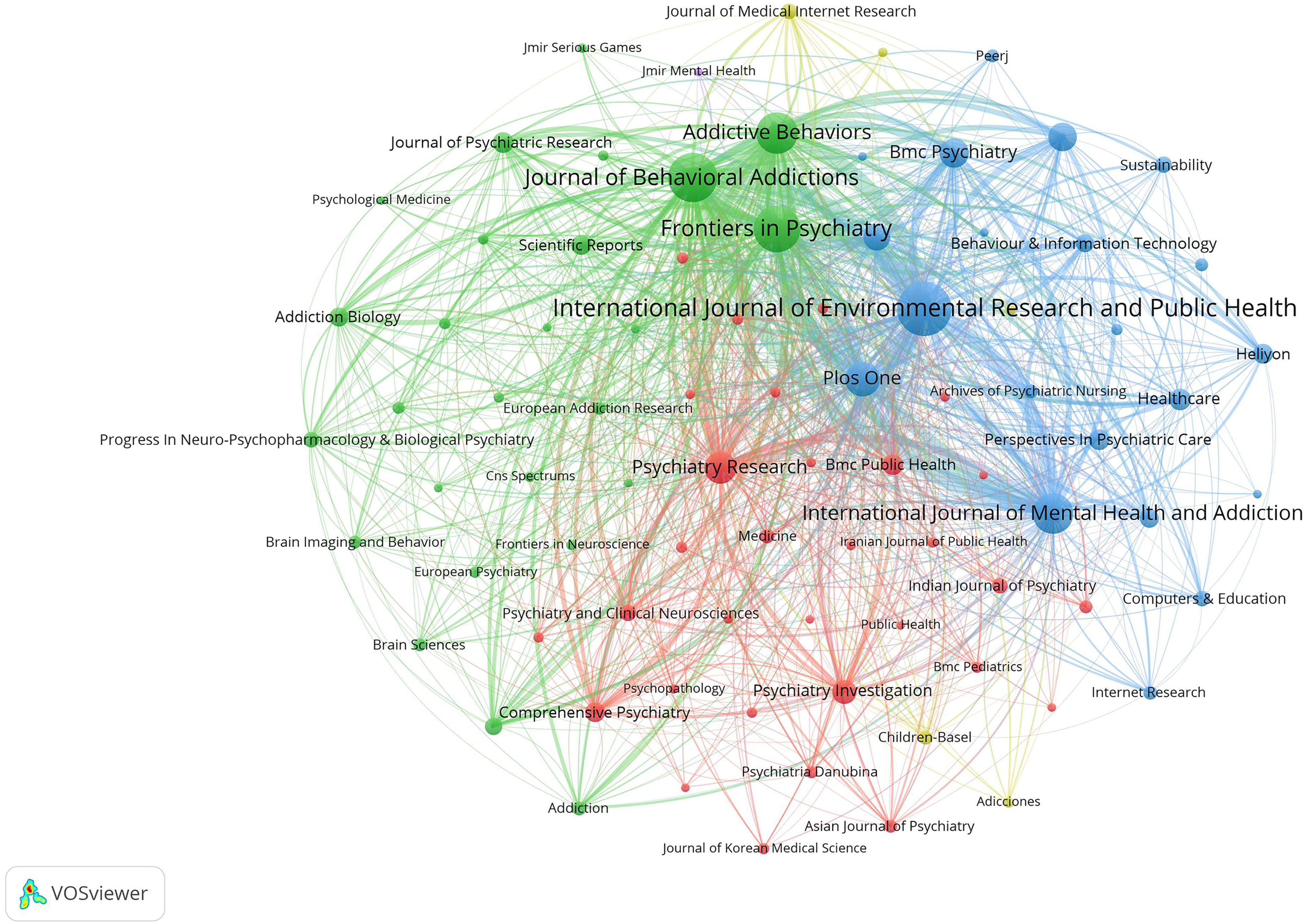
Network visualization of journal publication volume, collaboration, and citation relationships in the field of internet addiction disorder from 2004 to 2024. The graph depicts the co-citation relationships among research journals, with node size indicating the frequency of co-occurrence and connections indicating co-citation relationships. Node size reflects the significance and influence of journals in the network.
The co-citation relationships among the main journals in this field are illustrated in Figure 3. Psychiatry, psychology, and multidisciplinary studies remain the primary research directions for the depicted journals. Notably, larger points such as Computers in Human Behavior, Journal of Behavioral Addictions, CyberPsychology and Behavior, and PLoS ONE, the first two being primary representatives of the red cluster and the latter two occupying significant positions in the green and blue clusters respectively, are prominent in the graph. These journals rank high in citation frequency, and the thickness of the lines between them indicates their close relationships. Keeping an eye on these four journals and their latest publications can help researchers in the field of IAD stay updated with the latest advancements.
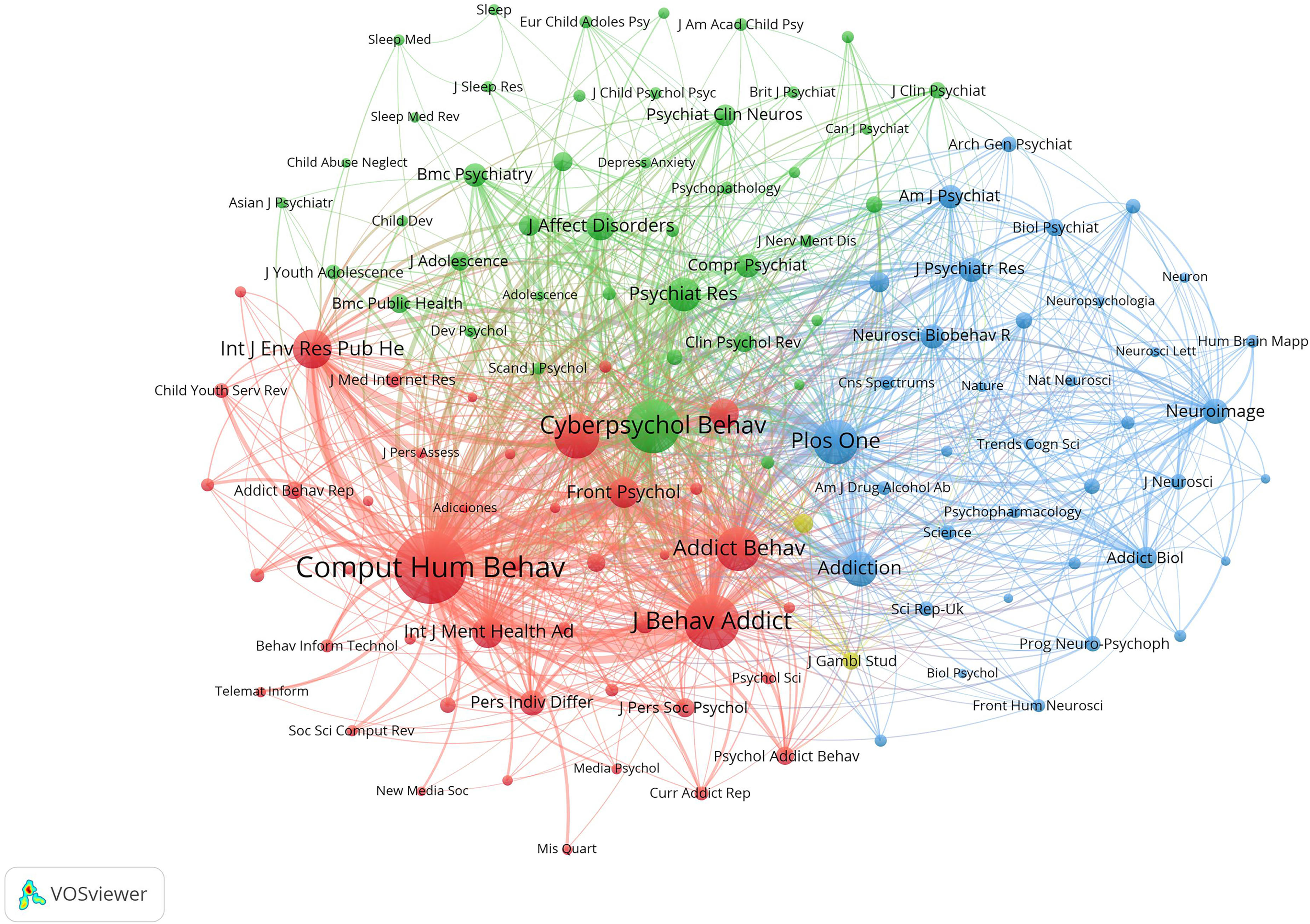
Visualization analysis of the collaboration network of journals in VOSviewer. Journals in different clusters are distinguished by nodes of different colors, with node size representing their frequency of occurrence.
In the overlay double-mapping diagram of Supplemental Figure S13, we can more intuitively grasp the citation relationships among the journals and the changes in research focus. Citation relationships are represented by lines connecting citing journals on the left to cited journals on the right. Thicker bands indicate more significant citation relationships. Through the prominent green bands, it is evident that journals primarily focused on pharmacy, medicine, and clinical medicine tend to cite articles from psychology, education, and sociology journals. Similarly, the thicker light blue bands indicate that journals focusing on psychology, education, and health sciences tend to cite literature from molecular biology, biology, genetics, health sciences, nursing, pharmacy, psychology, education, and sociology.
Keywords analysis
Keyword analysis plays a crucial role in bibliometric analysis as it reflects the main content or theme of an article. By analyzing keywords, researchers can better understand the current status and future trends of the research field. The top 20 keywords ranked by frequency of occurrence and total link strength are presented in Table 1. Keywords such as internet addiction (949 occurrences), internet gaming disorder (662 occurrences), and adolescent (551 occurrences) are among the most frequently appearing keywords, indicating the hot topics in the field of IA.
Ranking of the top 20 major keywords of internet addiction disorder from 2004 to 2024.

Figure 4 illustrates the trend of keyword occurrence frequency from 2004 to 2024. The length of the lines on the horizontal axis indicates the duration of keyword popularity, while the size of the points represents the frequency of keyword occurrence. Keywords that appeared earlier tend to be located at the bottom of the graph, such as literature review, world of warcraft, caudate, and substance abuse. In contrast, keywords that gained attention later include internet addiction, adolescent, and internet gaming disorder, with recent keywords like nonsuicidal self-injury, gaming motivation, and social media addiction becoming more prominent in recent years.

Keywords co-occurrence network mapping and correlation analysis of internet addiction disorder research from 2004 to 2024. The visualization analysis depicts the duration of keyword popularity over time for the top 30 keywords ranked by frequency from 2011 to 2024. In this visualization, line length represents the duration of popularity, while dot size indicates the frequency of occurrence, organized chronologically.
The clustering dendrogram in Figure 5 categorizes these keywords. The green cluster on the left mainly includes words related to the internet, such as video game, smartphone, social media, and addictive behavior, while the blue cluster on the right consists of terms related to mental health, such as depression, insomnia, anxiety, and stress. The largest red cluster primarily consists of medical and sociological terms, including gaming addiction, psychopathology, adolescent, self-control, and personality.

The dendrogram of keywords categorizes them into three main clusters based on their similarities.
Figure 6 presents the co-occurrence relationships among keywords, providing insights into potential relationships and hot trends in the field. The largest point, internet addiction, is in the yellow cluster along with terms like prevalence, personality, and gender. The green cluster represents terms related to sociology and network science, with adolescent, addiction, smartphone, internet, and social media as primary representatives. The blue cluster on the right contains terms related to behavioral and psychiatric aspects, such as internet gaming disorder, behavioral addiction, and impulsivity. Additionally, the prominent red cluster includes terms related to psychology and sociology, such as depression, anxiety, loneliness, smartphone addiction, and stress.

The keyword map illustrates the connections between studied keywords in internet addiction disorder research. Nodes, categorized by color, represent different clusters of keywords. Node size indicates the frequency of co-occurrence, while connections between nodes depict relationships among keywords.
Supplemental Figures S14 and S15 provide further visualization analysis based on the strength and chronological sequence of the co-occurrence relationships shown in Figure 6. Terms such as depression, anxiety, game, COVID-19, social media addiction, and gaming disorder are highly discussed in the field of IAD. Terms that have garnered more attention in recent years include gaming disorder, COVID-19, problematic smartphone use, and social media addiction, highlighting their significance in current research progress in the field.
In Supplemental Figure S16, the similarity between keywords is visualized through multiple correspondence analysis, with the distance between them indicating their similarity or dissimilarity. The colors distinguish three main clusters to clarify the differences and similarities among keywords. In the largest blue cluster, sociological terms predominate, such as social network, youth, and college student. The red cluster on the right contains fewer keywords, mostly related to psychology, including depression, stress, and anxiety. The green cluster encompasses terms related to the internet, such as video game, internet, and social media. Given the significantly higher volume of research on social networking and gaming compared to shopping, we have included a dedicated figure (Supplemental Figure S17) that contrasts the hotspots of social networking (in red) and gaming (in blue). This figure highlights the distinct research focuses within these two dominant areas of IAD. Additionally, we have provided separate figures for each domain (social networking, gaming, and shopping) to illustrate the unique hotspots and trends within each area (Supplemental Figures S18–20). These figures aim to offer a more nuanced understanding of how different forms of internet use contribute to IAD.
Figure 7 displays the top 25 keywords with the strongest burst of citations. Among them, keywords with higher burst intensity like psychiatric symptoms (burst intensity 23.99) and internet addiction (burst intensity 22.48) have shorter durations of attention. Conversely, keywords like computer use (burst intensity 13.6) and college students (burst intensity 11.24) have been under sustained attention for a longer period. Particularly noteworthy are keywords located at the bottom of the graph, including physical activity (burst intensity 9.37), addictive behaviors (burst intensity 8.88), network analysis (burst intensity 8.88), social media addiction (burst intensity 8.05), and sleep (burst intensity 7.63). These keywords have garnered significant attention in recent years and play crucial roles in the current research on IAD.

The diagram illustrates the 25 primary keywords characterized by pronounced bursts of citations, denoted by red spikes on the timeline. These bursts signify sudden surges in citation counts, signaling pivotal moments of emerging crucial questions or solutions within the field.
Highly cited references analysis
The purpose of co-citation analysis is to understand frequently cited papers in the research field and the journals where these papers are published. Table 2 presents information on the top 15 highly cited articles. The most cited article is a review titled “Online Social Networking and Addiction-A Review of the Psychological Literature,” 31 authored by Kuss DJ and Griffiths MD, published in 2011 in the International Journal of Environmental Research and Public Health. The authors investigate the increasing prevalence of addiction to social networking sites (SNS) and discuss and interpret SNS addiction from various aspects, including usage, motivation, and personality, based on an extensive literature review. This review raises awareness about the addictive nature of frequent SNS usage.
Ranking of the top 15 major highly cited references of internet addiction disorder from 2004 to 2024.

The second most cited article is a review titled “Integrating psychological and neurobiological considerations regarding the development and maintenance of specific Internet-use disorders: An Interaction of Person-Affect-Cognition-Execution (I-PACE) model,” 32 authored by Brand et al., published in 2016 in Neuroscience and Biobehavioral Reviews. The authors propose the I-PACE model as a theoretical framework to understand specific Internet-use disorders, such as Internet gaming, gambling, and pornography. This model delineates the triggering and moderating variables and intermediary variables in these disorders, contributing to future research and clinical practice in related fields.
Another notable article is “Development and Validation of a Smartphone Addiction Scale (SAS),” 33 published in 2013 in PLoS ONE by Kwon et al. The authors developed the SAS to effectively differentiate and characterize individuals with smartphone addiction. They conducted surveys on 197 participants and employed factor analysis, internal consistency testing, t-tests, analysis of variance, and correlation analysis to validate the reliability and validity of the SAS. This scale provides a useful tool for further research on smartphone addiction, although the authors acknowledge certain limitations of the SAS that researchers should consider when using it.
Figure 8 displays a heatmap illustrating the main research directions of highly cited articles. Different research directions are represented as distinct clusters in the heatmap, where darker colors indicate a higher number of citations for that direction. It is evident that the largest and darkest cluster in the figure focuses on internet gaming disorder. Representative articles include “Issues for DSM-V: Internet addiction” 34 by Block, Jerald J. in 2008 and “The association between Internet addiction and psychiatric disorder: A review of the literature” 6 by Ko in 2012. Further insights into the relationships between the literature on different research directions are provided in Figure 9. The largest cluster, #0 internet gaming disorder, appears to have developed based on earlier topics such as #2 smartphone addiction, #3 icd-11, #4 COVID-19, #5 social media addiction, and #8 problematic internet use, as indicated by the directional arrows. Subsequently, #0 internet gaming disorder has led to the emergence of topics such as #9 attention deficit hyperactivity disorder, #11 disorder of environmental origin, and #12 adolescence, demonstrating the interconnectedness and progression of research in the field of internet addiction syndrome.
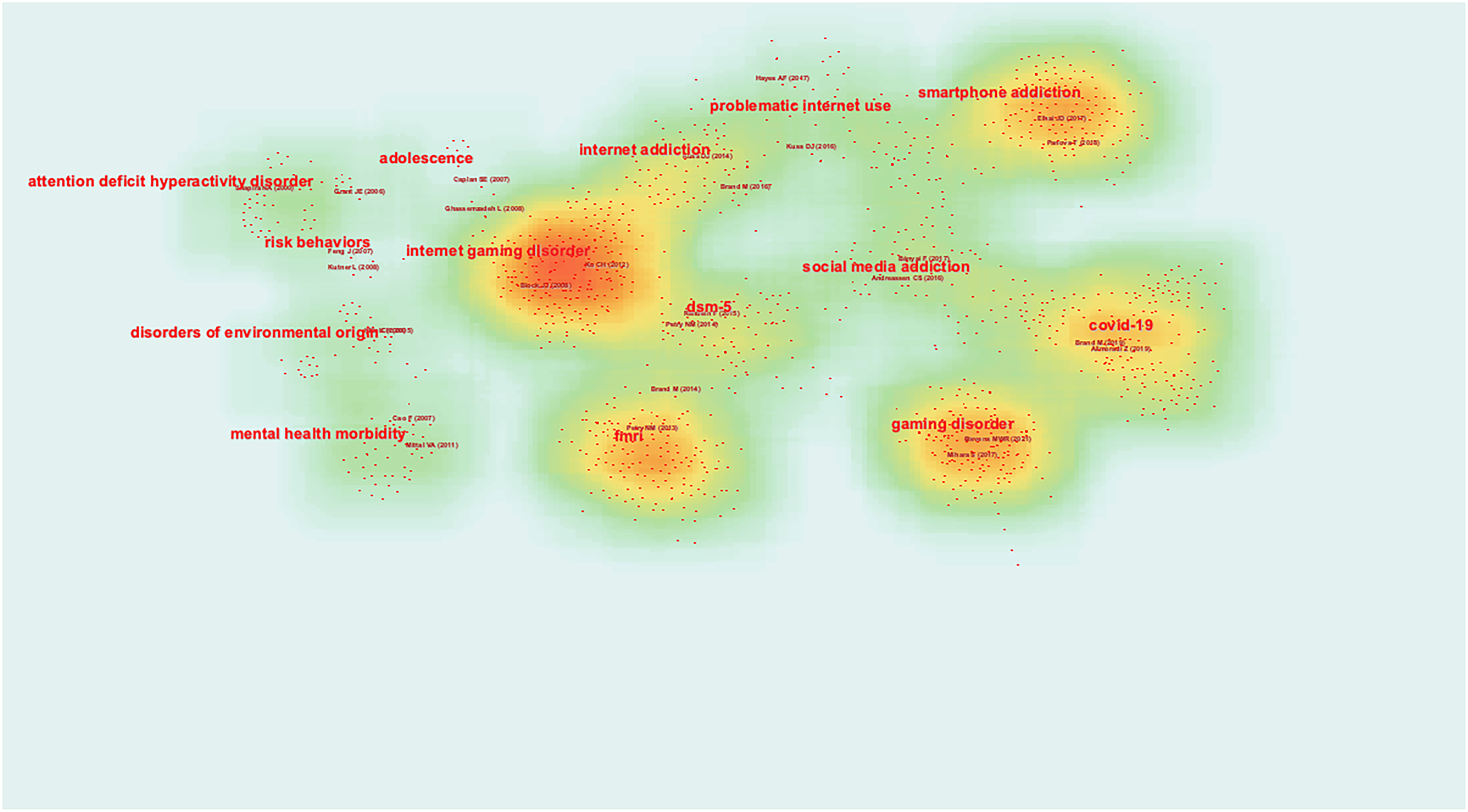
Highly cited references citation and co-citation analysis of internet addiction disorder from 2004 to 2024. Visualization overlays the main research directions of highly cited literature, with darker colors indicating more citations to literature in that direction.

References are grouped based on their likeness, where smaller numbers denote larger clusters, with #0 denoting the most substantial cluster. Node size reflects the frequency of co-citations, while the connections between nodes depict co-citation associations.
Figure 10 illustrates the basic characteristics of the top 25 burst-ranked citations. The burst periods for most citations range from 3 to 4 years. The citation with the highest burst strength is the review titled “Internet Addiction: A Systematic Review of Epidemiological Research for the Last Decade” 7 by Kuss et al. published in Current Pharmaceutical Design in 2014 (burst strength 48.33). This is followed by the article “An international consensus for assessing internet gaming disorder using the new DSM-5 approach” 35 by Petry et al. published in Addiction in 2014 (burst strength 44.21), indicating significant attention received by these two publications in the field. Articles that are still in their burst period in recent years include “The Interaction of Person-Affect-Cognition-Execution (I-PACE) model for addictive behaviors: Update, generalization to addictive behaviors beyond internet-use disorders, and specification of the process character of addictive behaviors” 36 by Brand et al. published in Neuroscience and Biobehavioral Reviews in 2019, and “Global prevalence of gaming disorder: A systematic review and meta-analysis” 37 by Stevens et al. published in the Australian and New Zealand Journal of Psychiatry, suggesting that these articles may represent current hot topics in the research on internet addiction syndrome.

The diagram illustrates the 25 primary references characterized by pronounced bursts of citations, denoted by red spikes on the timeline. These spikes signify sudden surges in citation counts, signaling pivotal moments of emerging crucial questions or solutions within the field.
Discussion
Our bibliometric analysis of IAD research over the past 20 years reveals several key insights into the field's development, current trends, and future directions. We identified the most prolific authors, influential publications, leading research institutions, and prevalent research themes. Furthermore, we highlighted significant collaborative networks and emerging research areas. Clinically, these findings underscore the importance of recognizing IAD as a critical mental health issue, necessitating the development and implementation of effective prevention and intervention strategies. By mapping the research landscape, this study provides a foundation for clinicians to stay informed about the latest advancements and to incorporate evidence-based practices in their work with individuals affected by IAD.
Our analysis shows that research on IAD has grown exponentially since the early 2000s, with a significant increase in publications and citations. This trend mirrors the increasing global concern about the psychological and social impacts of excessive internet use. Previous studies, such as those by Young 38 and Griffiths, 39 laid the groundwork by defining and conceptualizing IAD and highlighting its potential mental health consequences. Our findings build on this foundation, showing that contemporary research has delved deeper into the neurobiological underpinnings and psychosocial mechanisms of IAD. For example, studies utilizing neuroimaging techniques have identified alterations in brain regions associated with reward processing and impulse control in individuals with IAD. 16 This progression in research not only validates earlier concerns about the disorder but also enhances our understanding of its complex etiology. From a clinical perspective, the evolution of IAD research highlights the need for comprehensive assessment and treatment approaches. The identification of neurobiological markers suggests that interventions should not only address behavioral symptoms but also consider underlying neurological factors. CBT has been shown to be effective in treating IAD, particularly when combined with strategies aimed at improving impulse control and emotional regulation.40,41 Additionally, the rise in publications related to specific internet-use disorders, such as IGD, emphasizes the necessity for tailored interventions that address the unique aspects of different types of internet addiction.42,43 Clinicians must stay abreast of these developments to provide informed and effective care. While the DSM-5 does not formally recognize IAD, our analysis highlights emerging consensus on behavioral subtypes (e.g. compulsive use, withdrawal symptoms, tolerance, and negative impacts) that may inform future diagnostic frameworks. Subthreshold IAT traits, such as excessive use without severe functional impairment, could align with the “mild” category in addiction nosology, necessitating further validation through longitudinal and cross-cultural studies.
Our analysis of collaboration networks reveals a robust international effort in IAD research, with significant contributions from institutions in China, South Korea, the United States, and the United Kingdom. This global collaboration is crucial for addressing the multifaceted nature of IAD, which varies across cultures and regions. Collaborative efforts, such as those involving large-scale cross-cultural studies, can provide valuable insights into how sociocultural factors influence the prevalence and manifestation of IAD. 44 Moreover, the presence of well-established research clusters indicates a strong foundation for continued collaborative efforts, which can lead to more comprehensive and generalizable findings. Researchers are encouraged to engage in cross-disciplinary and cross-border collaborations to enhance the field's knowledge base and develop more effective intervention strategies.
Keywords analysis is crucial in bibliometric research as it elucidates the primary themes and evolving trends within a specific field. In our study of IAD, the analysis of the top 20 keywords by frequency and link strength, as presented in Table 1, revealed “internet addiction,” “internet gaming disorder,” and “adolescent” as the most prominent. The high frequency of these terms, with “internet addiction” appearing 949 times, “internet gaming disorder” 662 times, and “adolescent” 551 times, highlighting the central focus areas in IAD research. This suggests a significant and sustained interest in understanding the broad concept of internet addiction, its manifestations in gaming disorders, and its impact on adolescents. The trend analysis of keyword occurrences from 2004 to 2024, depicted in Figure 4, provides insights into the evolving research interests. Initially, keywords like “literature review,” “World of Warcraft,” “caudate,” and “substance abuse” were prevalent, reflecting early academic efforts to understand IAD in the context of specific games and associated neurobiological aspects. However, recent years have seen a shift towards keywords such as “non-suicidal self-injury,” “gaming motivation,” and “social media addiction,” indicating an expansion of the field to encompass broader behavioral and psychological dimensions. The clustering dendrogram (Figure 5) further categorizes these keywords into distinct thematic clusters. The green cluster, associated with terms like “video game,” “smartphone,” and “social media,” highlights the diverse digital platforms contributing to IAD. The blue cluster, including “depression,” “insomnia,” “anxiety,” and “stress,” points to the mental health repercussions of IAD. The largest red cluster, featuring “gaming addiction,” “psychopathology,” “adolescent,” “self-control,” and “personality,” indicates a comprehensive approach combining medical, psychological, and sociological perspectives. Figure 6's co-occurrence relationships among keywords reveal significant trends and interconnections within IAD research. The yellow cluster centered around “internet addiction” includes terms like “prevalence,” “personality,” and “gender,” suggesting a focus on demographic and personality traits associated with IAD prevalence. The green cluster emphasizes sociological and network science aspects, with “adolescent,” “addiction,” “smartphone,” “internet,” and “social media” as primary representatives. The blue cluster addresses behavioral and psychiatric aspects, including “internet gaming disorder,” “behavioral addiction,” and “impulsivity,” reflecting the focus on behavioral and psychological dimensions.
Highly cited references are pivotal in bibliometric analysis as they identify the foundational studies and influential theories that have significantly shaped the research field. The top 15 highly cited articles, as presented in Table 2, highlight critical contributions that have directed the course of IAD research. The most cited article, “Online Social Networking and Addiction—A Review of the Psychological Literature” by Kuss and Griffiths, 31 has been instrumental in raising awareness about the addictive nature of SNS. This comprehensive review discusses various psychological aspects of SNS addiction, such as usage patterns, motivations, and personality traits, emphasizing the need for continued research and intervention strategies. Another highly influential article, “Integrating psychological and neurobiological considerations regarding the development and maintenance of specific Internet-use disorders: An Interaction of Person-Affect-Cognition-Execution (I-PACE) model” by Brand et al., 32 provides a robust theoretical framework for understanding specific Internet-use disorders, including internet gaming, gambling, and pornography. The I-PACE model has significantly impacted subsequent research and clinical practices by offering a structured approach to studying the etiology and maintenance of these disorders. Additionally, the “Development and Validation of a Smartphone Addiction Scale (SAS)” by Kwon et al. 33 is noteworthy for its development of a reliable and valid scale to assess smartphone addiction. This tool has facilitated numerous studies on the prevalence and impact of smartphone addiction and has become critical for researchers and clinicians in identifying and addressing this issue. Over the past two decades, the conceptual focus of IAD research has shifted from foundational debates on diagnostic validity (e.g. parallels to substance addiction in the 2000s) to mechanistic explorations of neurocognitive-behavioral interactions (e.g. the I-PACE model) and, recently, to societal-level analyses of digital behaviors amplified by crises like COVID-19. Early studies emphasized universal criteria (e.g. “time spent online”), whereas contemporary work prioritizes behavioral subtypes (gaming and social media) and contextual factors (e.g. lockdown effects and cultural norms). This shift mirrors technological advancements—from static surveys to real-time digital phenotyping—and a growing recognition of IAD's heterogeneity, urging future frameworks to balance clinical rigor with adaptive prevention strategies.
Our analysis of keyword trends and highly cited references highlights several emerging areas in IAD research that merit further exploration. The increasing focus on specific internet-use disorders, such as social media addiction and problematic smartphone use, reflects the changing landscape of digital technology and its pervasive influence on mental health.45,46 Additionally, the COVID-19 pandemic has exacerbated issues related to excessive internet use, emphasizing the need for research into its long-term effects on mental health and wellbeing. 47 Keywords such as “gaming disorder,” “COVID-19,” “problematic smartphone use,” and “social media addiction” have gained prominence in recent years, indicating their significance in current research. This trend suggests a growing recognition of the multifaceted nature of IAD, encompassing various forms of digital engagement and their unique challenges. 32 The clustering of keywords into thematic groups reveals the interdisciplinary nature of IAD research, integrating insights from psychology, sociology, network science, and psychiatry. 31 Future research should continue to explore these intersections, examining how digital behaviors intersect with mental health, personality traits, and social dynamics. 48 Our findings offer vital insights for clinical and policy responses to IAD. Clinically, terms like CBT and impulsivity stress the need for interventions addressing both behavioral symptoms (e.g. cutting screen time) and underlying issues (e.g. emotion regulation training). The I-PACE model's focus on person–environment links also backs personalized approaches, such as family therapy in collectivist settings, to tackle triggers like academic stress. Policy-wise, the rise in social media and smartphone addiction concerns post-2019 points to the need for regulations like age-based screen time rules, tech transparency mandates, and digital literacy in schools. Leading research from China and South Korea, notably China's gaming curbs, offers perspectives for global policy.
Limitations
Despite the comprehensive nature of our bibliometric analysis, several limitations must be acknowledged. First, our analysis was restricted to English-language publications indexed in the Web of Science Core Collection, potentially excluding relevant non-English studies and literature from databases like Scopus or PubMed. The analysis indicates a notable geographical concentration in IAD research, primarily in English-speaking nations, which may result in an overrepresentation of their contributions in the existing literature. This may marginalize contributions from non-English speaking regions and limit the diversity of cultural perspectives. Future research should prioritize inclusive data collection and actively seek collaborations across different geographical areas to address these imbalances. Second, the rapidly evolving nature of digital technology means that some recent developments and trends may not yet be fully reflected in the literature. Third, bibliometric analysis primarily focuses on quantitative metrics such as publication and citation counts, which may not fully capture the qualitative aspects of research impact and significance. Future studies should consider incorporating a broader range of data sources and qualitative assessments to provide a more comprehensive understanding of the research landscape. Fourth, the field of IAD is multidisciplinary, and the included publications may span various domains, potentially leading to variability in terminology and conceptualizations of the disorder. Disciplinary differences in citation practices (e.g. self-citation tendencies or preference for foundational works) may have influenced the representation of certain research themes or regions. Finally, while citation analysis reveals influential works, it may disproportionately reflect older studies due to cumulative citation advantages. Future research could mitigate this by incorporating alternative metrics to capture real-time scholarly impact.
Conclusion
Our bibliometric analysis of IAD research over the past two decades provides valuable insights into the field's development, current trends, and future directions. The findings highlight the significant progress made in understanding the neurobiological and psychosocial mechanisms of IAD, the importance of international collaboration, and the emerging focus on specific internet-use disorders. Additionally, these insights can inform future research directions, policymaking, and clinical practices, contributing to a deeper understanding and effective management of IAD in the digital age. Future research could prioritize inclusive data collection strategies that incorporate non-English publications and diverse databases to reduce geographical bias. Additionally, fostering cross-regional collaborations and validating findings across different cultural contexts could enhance the comprehensiveness and generalizability of IAD research.
Supplemental Material
sj-doc-1-dhj-10.1177_20552076251336940 - Supplemental material for Research landscape and trends of internet addiction disorder: A comprehensive bibliometric analysis of publications in the past 20 years
Supplemental material, sj-doc-1-dhj-10.1177_20552076251336940 for Research landscape and trends of internet addiction disorder: A comprehensive bibliometric analysis of publications in the past 20 years by Xiaodong Cheng, Yan Fan, Sen Li, Xiao Li, Shushu Jin, Cong Zhou and Yu Feng in DIGITAL HEALTH
Supplemental Material
sj-docx-2-dhj-10.1177_20552076251336940 - Supplemental material for Research landscape and trends of internet addiction disorder: A comprehensive bibliometric analysis of publications in the past 20 years
Supplemental material, sj-docx-2-dhj-10.1177_20552076251336940 for Research landscape and trends of internet addiction disorder: A comprehensive bibliometric analysis of publications in the past 20 years by Xiaodong Cheng, Yan Fan, Sen Li, Xiao Li, Shushu Jin, Cong Zhou and Yu Feng in DIGITAL HEALTH
Footnotes

Author contributions/CRediT
YF and CZ designed the study and supervised the conduct of the study. XC collected the data and wrote the original draft. YF, SL, XL, and SJ contributed to the data collection and interpretation, statistical analysis, and modified the article. All authors reviewed and have approved the final manuscript.
Funding
The author(s) disclosed receipt of the following financial support for the research, authorship, and/or publication of this article: This study was supported by the Medical and Health Science and Technology Development Plan of Shandong Province (grant numbers 202003061210, 202304011343), the Key Research and Development Plan of Jining City (grant numbers 2021YXNS024, 2023JNZC141), the Cultivation Plan of High-level Scientific Research Projects of Jining Medical University (grant number JYGC2021KJ006), the Ministry of Education's Industry School Cooperation Collaborative Education Project (grant number 220900242232529), and the Supporting Fund for Teachers’ Research of Jining Medical University (grant number 600903001).
Conflicting interests
The author(s) declared no potential conflicts of interest with respect to the research, authorship, and/or publication of this article.
Data availability
The datasets analyzed during this study are available from the corresponding author on reasonable request.
Supplemental material
Supplemental material for this article is available online.
References
Supplementary Material
Please find the following supplemental material available below.
For Open Access articles published under a Creative Commons License, all supplemental material carries the same license as the article it is associated with.
For non-Open Access articles published, all supplemental material carries a non-exclusive license, and permission requests for re-use of supplemental material or any part of supplemental material shall be sent directly to the copyright owner as specified in the copyright notice associated with the article.
