



Abstract
Objective
The subjects’ physical activity levels and enjoyment of exercise after 15 min of virtual reality (VR) physical activity of different intensities were compared.
Methods
Thirty-two subjects were selected for a mixed crossover experiment. They were randomly assigned to exercise in three VR games with different exercise intensities. Acceleration data of the subjects were collected and subjects’ exercise enjoyment and exercise levels were compared. The subjects’ emotional efficacy and arousal during exercise were measured and evaluated using the Feeling Scale (FS) and the Felt Arousal Scale (FAS), and the acceleration data were evaluated by clustering using the fuzzy c-mean (FCM) clustering algorithm.
Results
A one-way ANOVA was performed on FS and FAS before and after VR physical activity, P overall p = .003 in FS, before and after low-intensity (LI), medium-intensity (MI), and high-intensity (HI) VR physical activity, the p-values were.087, p = .027, and p = .021, respectively. p < .001 in FAS, before and after LI, MI, and HI VR physical activity, the p-values were .029, < .001, < .001. According to the FCM clustering of acceleration activity counts by LI, MI, and HI, the clustering centers of the right arm acceleration counts were 2016.77, 6118.31, and 9923.45; the clustering centers of the right thigh acceleration counts were 248.30, 1895.22, and 3485.60; and the clustering centers of the combined upper and lower limb acceleration counts were 1443.83, 4415.47, and 7149.13.
Conclusion
VR physical activity enhances subjects’ sense of enjoyment of exercise and emotional arousal, with moderate intensity VR physical activity having the best effect. VR physical activity is skewed toward high upper-extremity activity and low lower-extremity activity. The combined intensity of VR physical activity matches that of traditional exercise, and it can achieve the workout effect of the traditional workout modality.
Introduction
Lack of physical activity and insufficient exercise is one of the major risk factors for the development of chronic diseases, with the total number of deaths due to lack of physical activity exceeding half a million per year (The Lancet), and the World Health Organization (WHO) recommends that adults stay physically active by doing 150 min of moderate-intensity or 75 min of vigorous-intensity aerobic activity per week. Physical activity 1 is any bodily movement produced by skeletal muscles that results in the expenditure of energy and is categorized by the intensity of the exercise, which includes low-intensity (LI), medium-intensity (MI), and high-intensity (HI) activities. 2 Regular physical activity can reduce the risk of disease, 3 has an important role in promoting physical development and strengthening physical fitness, can effectively promote the physical development of the human body, improve the body's material metabolism, 4 and moderate physical activity for the prevention and regulation of adolescent mental health is evident and effective. 5
When game elements are applied to the movement process. 6 The combination of video games and physical activity is known as active play, and replacing the sedentary behavior of spending time by actively playing games for whole-body exercise is helpful to help young people solve the crisis of insufficient exercise,7,8 and is of great significance in encouraging young people to engage in sports. 9 Especially under the influence of the global epidemic, the physical activity level of young people is getting more and more attention from society, the way people's physical activity has been transformed, and virtual reality (VR) sports stand out. 10 For young people, active play will be more fun and better suited for daily physical activity than traditional aerobic activities.
VR is a simulated environment created by computer and electronic technology. The use of various sensing devices enables participants to immerse themselves in virtual practices and engage in a variety of activities.11,12 Evans 7 sees future VR research in active VR games as a way for different populations (including the elderly and sedentary) to engage in regular physical activity. Street 13 explored the use of VR games to motivate adults to be physically active and promote health, suggesting that movement games offer a new way to increase or replace physical activity in the short term. However, more research is needed on the effectiveness of VR games as a long-term health promotion strategy. Viana 14 notes that exercise games may be an interesting alternative to traditional forms of exercise and can be used as a tool to enhance physical health.
This experimental study examines the relationship between the intensity of VR exercise and the intensity of traditional exercise, evaluates VR physical activity patterns, explores whether exercise games based on virtual reality environments are equivalent to traditional exercise, and defines whether VR exercise can be a fun way of exercising to meet physical activity guidelines.
Materials and methods
Subjects
Thirty-two subjects including 15 males and 17 females were recruited from a university in Wuhan, China. All subjects completed a general health questionnaire that included their lifestyle for the past month. Inclusion criteria for the subjects were as follows: (1) age 18–35 years; (2) full-time university students in general higher education not majoring in physical education; (3) right-handed acquirers; (4) no self-reported diagnosed illnesses, no heart disease or hypertension, no history of mental illness, no history of chronic physical illness; (5) complete the Physical Activity Readiness Questionnaire to ensure that the subjects were healthy and mentally fit, with no contraindications to exercise; (6) inactive people who had not exercised regularly for the past 6 months (<150 min/week of medium physical activity 3 ). Before the formal experiment, all subjects voluntarily completed the Informed Consent Form for the Wuhan Institute of Physical Education University Student Exercise and Mental Health Study and obtained approval from the Medical Ethics Committee of Wuhan Institute of Physical Education.
The experiment used standard methods to test basic characteristic indicators such as body and weight, and body composition analyzer Body Measure (X-SCAN PLUS II) to measure indicators such as body fat percentage and body mass index (BMI), the data collected from the physical fitness test were analyzed using descriptive statistics using Stata MP 14.1 to obtain the mean and standard deviation (M ± SD), with statistical significance all set at p < .05, and the characteristics of the subjects were summarized by gender, as shown in Table 1.
Physical test data of subjects.

BMI: body mass index; b BMP: beats per minute; c MET: metabolic equivalent.
Experimental design
To avoid interference due to potential order effects, each experiment was separated by at least 7 days and the experiments used a randomized crossover design in which subjects were randomly divided into six combinations of intensities to be tested: low-medium-high, low-high-medium, medium-low-high, medium-high-low, high-low-medium, high-medium-low. Subjects visited the laboratory in four visits; at the first visit, subjects were asked to fill out a questionnaire to get a basic overview, explain the experimental procedure, and perform a physical fitness test. Immersive exercise was used during the second–fourth visit to the lab, including low, medium, and high exercise intensities. Subjects were familiarized with the game prior to testing, while warm-up activities were performed, and subjects performed 15 min of VR exercise at different intensities each time. The intensity of physical activity during the experiment was assessed by a heart rate monitoring instrument and two triaxial accelerometers (right arm and right thigh) monitoring. Subjects were asked about the Feeling Scale (FS) and Felt Arousal Scale (FAS) before the VR exercise intervention. After the VR exercise intervention, subjects were again asked about FS and FAS. The flowchart of the experiment is shown in Figure 1.

Experimental flow chart.
Instrumentation and outcome measures
VR sports games
This study conducted experimental tests using the HTC VIVE PRO Professional (HTC, Taiwan; Value, Washington), which consists of a head-mounted display, two infinite control grips, and two positioners. Participants used the head-mounted display and the handles to move through a VR environment, guiding participants to create the sensation of being in a real environment.
Six general college students with regular exposure to VR games were selected to test the VR games and heart rate was recorded in the exercise state using Polar (Polar, Kempele, Finland) heart rate bands, and heart rate15,16 data were used to define the intensity of the VR games. Based on actual test feedback, six VR exercise games were included in this study, all of which have been widely advertised and tried out by the general public, and which elicited movement behavior in subjects during gameplay including upper and lower limb movements. These were LI: Adventure Climb and Aircar; MI: Beat saber and Holopoint; HI: OhShape and Hot Squat as shown in Table 2.
Introduction to VR sports games, Game Classification LI: Adventure Climb VR and Aircar VR, MI: Beat Saber VR and Holopoint VR, HI: OhShape VR and Hot Squat.

VR: virtual reality.
Reserve heart rate17,18 (Heart Rate Reserve, %HRR) (average heart rate per minute during activity − resting heart rate)/HRR × 100% 7 to judge the exercise intensity of VR games. The range of reserve heart rate percentages used to set exercise intensity in this study was LI19,20: 30%−39% HRR, MI: 40%–59% HRR, and HI: ≥ 60% HRR. According to a study by LEE, Lin21,22 et al. noted that excessive use of VR (typically ≥30 min in length) could cause some degree of damage to the subjects’ eye health. Therefore the duration of VR physical activity was set at 15 min, and 2–3 min of the warm-up exercise was performed before the formal experiment.
Accelerometer and intensity of movement classification
Accelerometers are used to assess the level of physical activity of the human body in daily life by collecting movement data in the sagittal, coronal, and vertical axes. The output of the accelerometer is given in the form of “counts” (activity counts), so counts can also be used to classify the intensity of exercise 23 (Table 3). Activity counts are the result of summing the absolute values of measured changes in acceleration over some time, and the intensity of exercise can be classified by the intensity reference standard for activity counts24,25 into sedentary behavior (<100 counts/min), LI physical activity (100–1951 counts/min), MI physical activity (1952–5724 counts/min), and HI physical activity (5725–9498 counts/ min).

In this study, the Actigraph GT3X accelerometer was worn on the subject's right arm and right thigh, and acceleration data were extracted from minute 1 to minute 15 during exercise, with a time interval of 60 s for data extraction.
FS and FAS
In this study, the FS and FAS were used to effectively measure participants’ emotional arousal and emotional validity before and after exercise. 26 participants were asked to rate their current mental-emotional state before and after exercise. The FS uses 11 feeling levels to assess emotional valence, ranging from −5="very bad” to +5="very good,” and participants are asked to answer the question: Please choose the number that best describes how you feel right now. The FAS has a total of six levels of emotional arousal, which participants rate by answering the question: indicate how “excited” you are right now, ranging from 1= “low” to 6= “high,” with arousal levels ranging from relaxed to aroused. The FS and the FAS provided each participant with a level of pleasure and excitement before and after exercise.
Experimental equipment
(1) Physical fitness test: Body composition analyzer—Body meter (X-SCAN PLUS II) (2) VR equipment: HTC VIVE PRO Professional Edition, the device contains a head-mounted device, two infinite control handles, two locators, etc. The headset is 2880 × 1600 combined pixels, 615PPI (pixel density), the display is AMOLED 90HZ, there are two front cameras, two integrated microphones, suitable for most glasses, can adjust the headband, headrest, as well as pupil spacing and lens distance; control handle built-in 960mAh rechargeable lithium-ion battery; locator is SteamVR Tracking 2.0, supporting a wide range of spatial solutions, tracking space of up to 7 m × 7 m. (3) Heart rate monitor: heart rate meter polar. (4) Triaxial accelerometer: Actigraph GT3X.
Clustering algorithm
This study attempts to use a clustering algorithm as a data analysis method to investigate how to classify the training samples into several classes under the condition that the labeling information of the samples is unknown. Cluster analysis is also known as unsupervised learning, unsupervised learning is a machine learning problem of learning models from unlabeled data, which requires the model to find regularities in the data. The advantages of unsupervised algorithms are that they do not require human annotation of acceleration data, are not constrained by supervisory information, do not require labeling, can greatly expand data samples, and can automatically assess exercise intensity.
In cluster analysis, fuzzy clustering algorithms are a hot topic of current research, the most popular of which is the objective function-based fuzzy clustering method, which reduces clustering to a nonlinear programming problem with constraint bands and obtains fuzzy partitioning and clustering of the data set by the optimal solution. Among the objective function-based clustering algorithms, the fuzzy c-mean (FCM) algorithm is the most theoretically sound and widely used, 27 and was first derived from the optimization of ‘hard’ clustering objective functions. FCM clustering is a clustering algorithm in which the degree of affiliation determines the extent to which each data point belongs to a particular cluster. In 1973, Bezdek proposed the algorithm as an improvement of the hard c-means clustering method. Unlike k-means and other classical clustering algorithms in which the data belongs to only one cluster, the data in the FCM algorithm may belong to two or more clusters to some extent, and its degree of affiliation accepts any value in the interval [0,1], and indicates the probability that the sample belongs to a particular class utilizing the degree of affiliation. This type of representation is more expressive of the data, including a more detailed representation of the data and the cluster relationships between the data and clusters.28,29 Compared to the hard clustering of k-means, the FCM algorithm provides more flexible clustering results.
This experimental study explores the difference and connection between VR physical activity patterns and traditional movement patterns, and this relationship is unknown. When it comes to the fuzzy boundaries between things, the FCM can categorize things according to certain characteristics or requirements, and it can provide more scientific and reasonable clustering results compared to other classical clustering algorithms, therefore, this study adopts the FCM clustering algorithm to analyze the data clustering of the collected VR physical activity counts.
FCM algorithm
The FCM algorithm determines the class of each sample point by optimizing the affiliation of each sample point and achieves the classification of the sample data.
See Figure 2. For the degree of hot and cold, we take three fuzzy subsets: cold, warm, and hot. For a certain temperature, it may belong to two subsets at the same time. To be more specific, we need to provide a function that describes the “degree,” i.e., the affiliation. Each sample is given an affiliation function that belongs to each cluster, and the samples are grouped by the magnitude of the affiliation value. FCM has three key parameters: the number of clusters, the center of mass of the clusters, and the cluster corresponding to the closest center of mass of each data point.

Schematic diagram of membership classification.
FCM incorporates the essence of fuzzy theory and provides more flexible clustering results compared to the hard clustering of k-means. Usually, the objects in a dataset cannot be divided into clearly separated clusters. Therefore weight is assigned to each object and each cluster, specifying the degree to which the object belongs to that cluster. Probability-based methods can give such a weight, but a suitable statistical model is difficult to build, so the FCM with natural, nonprobabilistic properties is chosen. For example, formula (1) is the objective function of fuzzy clustering:
Constraint conditions of FCM algorithm: the sum of the membership degree of a sample for each cluster is 1, as shown in Formula (2):


The number of iterations is shown in formula (7), where T is the number of iterative steps and ε is the error threshold. The clustering is completed when the maximum variation of membership degree does not exceed the error threshold.
FCM algorithm steps
The steps of the FCM algorithm are shown in Figure 3:
choosing the number of categories C = 3, the number of samples N = 8760, choosing a suitable m = 2, and initializing the matrix U0 determined by the affiliation function (initialized between random values [0,1]). (2) Calculate the centroids of the clusters

Fuzzy c-mean (FCM) clustering step diagram.
Results
FS and FAS
Thirty-two subjects participated in three VR exercise intervention trials, and a total of 96 groups of FS and FAS data were obtained. The normality test of FS and FAS data was carried out, and the test results showed that all passed the normality test, and then the homogeneity of variance test was performed. The test results are shown in Table 4.
Homogeneity of variance tests for FS and FAS.
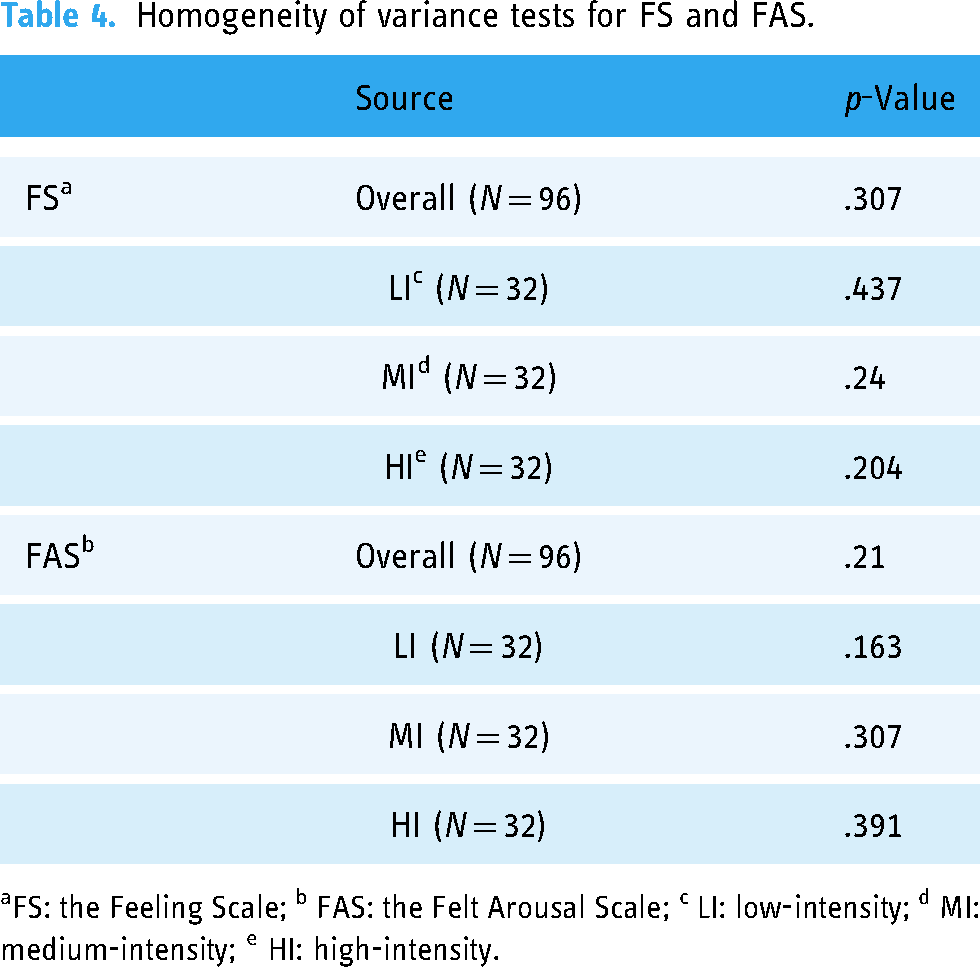
FS: the Feeling Scale; b FAS: the Felt Arousal Scale; c LI: low-intensity; d MI: medium-intensity; e HI: high-intensity.
According to Table 4, in the analysis of homogeneity of variance, the calculated p-values are all greater than .05, indicating that the condition of homogeneity of variance is satisfied, and one-way ANOVA can be performed.
One-way ANOVA analysis of FS before and after the intervention of VR exercise at different intensities was performed, and the results from the FS showed that (Table 5): statistically analyzing p = .003 < .05 for the overall, it was concluded that VR exercise had a significant effect on improving the subjects’ enjoyment of exercise. Categorized and analyzed by VR exercise intensity, p = .087 > 0.05 at LI and p = .21 > .05 at HI, it was concluded that there was no significant effect of VR exercise on improving the level of enjoyment of exercise of the subjects under both LI and HI of VR exercise. p = .027 < .05 under MI, it is concluded that there is a significant effect of VR MI exercise on improving the level of exercise enjoyment of the subjects.
One-way ANOVA of the feeling scale before and after the experiment.

LI: low-intensity; b MI: medium-intensity; c HI: high-intensity.
A one-way ANOVA was performed on the FAS before and after the intervention of VR exercise of different intensities, and the results from the FAS showed (Table 6) that in overall (p < .001), LI (p = .029), MI (p < .001), and HI (p < .001), the p-value was less than .05, which means that it is significant, i.e., the VR exercise was able to improve the agitation level of the subjects.
One-way ANOVA of the felt arousal scale before and after the experiment.
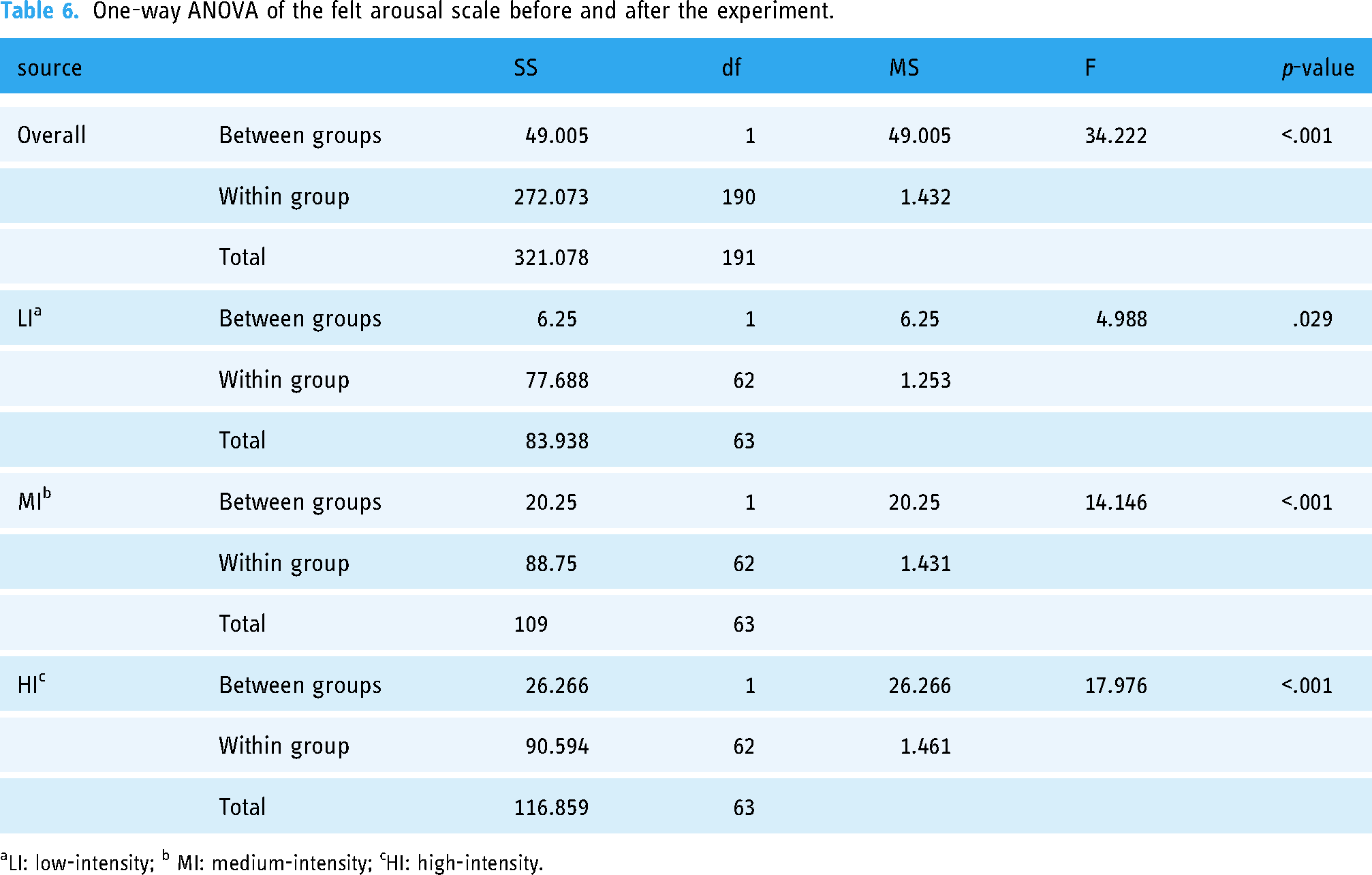
LI: low-intensity; b MI: medium-intensity; cHI: high-intensity.
Clustering results
In this study, the relevant data collected by the Actigraph GT3X triaxial accelerometer were first exported and organized to obtain the acceleration data of the right thigh and the right arm through ActiLife 6.0 software. 25 Thirty-two subjects participated in three VR exercises with different exercise intensities, with 2–3 min of preparatory activities before the experiment, and the length of each VR exercise intervention was 15 min, which resulted in a total collection of 1440 sets of valid data, and each set of data contained right arm and right thigh X, Y, Z three-axis acceleration counting data and vector acceleration counting data, respectively, totaling 11,520 entries. Each set of data was labeled according to the intensity of the VR exercise in which the subjects participated.
The intensity reference standards 24 according to the activity technique cut point (counts/minute) were: sedentary (0–99), LI exercise (100–1951), MI exercise (1952–5724), and HI exercise (5725–9498).
Clustering of acceleration activity counts for upper and lower extremities in VR physical activity
The acceleration counts on the right arm were cluster centered in the first category: X:2382.19, Y: 1928.74, Z: 1777.52; in the second category: X:7028.86, Y: 6031.65, Z: 4969.70; and in the third category: X:11524.5, Y: 9901.31, Z: 7319.21 (Table 7). According to the reference standard, the first category is LI VR physical activity, the second category is MI VR physical activity, and the third category is HI VR physical activity. From the results, it can be seen that the right arm has the highest level of activity in the x-axis (coronal axis) and the second highest level of activity on the y-axis (sagittal axis), The clustering visualization is shown in Figure 4.

Clustering visualization of right arm acceleration counts.
FCM clustering of triaxial acceleration counts in the right arm and right thigh.

x-axis: coronal axis; b y-axis: coronal axis: sagittal axis; c z-axis: vertical axis; FCM: fuzzy c-mean.
The acceleration counts of the right thigh were clustered in the first category with centers of X: 62.76, Y: 262.39, Z: 323.76; the second category with centers of: X:1032.48, Y: 2048.05, Z: 2253.45; and the third category with centers of: X: 2615.64, Y: 3510.36, Z: 3766.49 (Table 7). According to the reference standard, the first category is LI VR physical activity, the second category is MI VR physical activity, and the third category is HI VR physical activity. The right thigh acceleration count clustering visualization is shown in Figure 5.
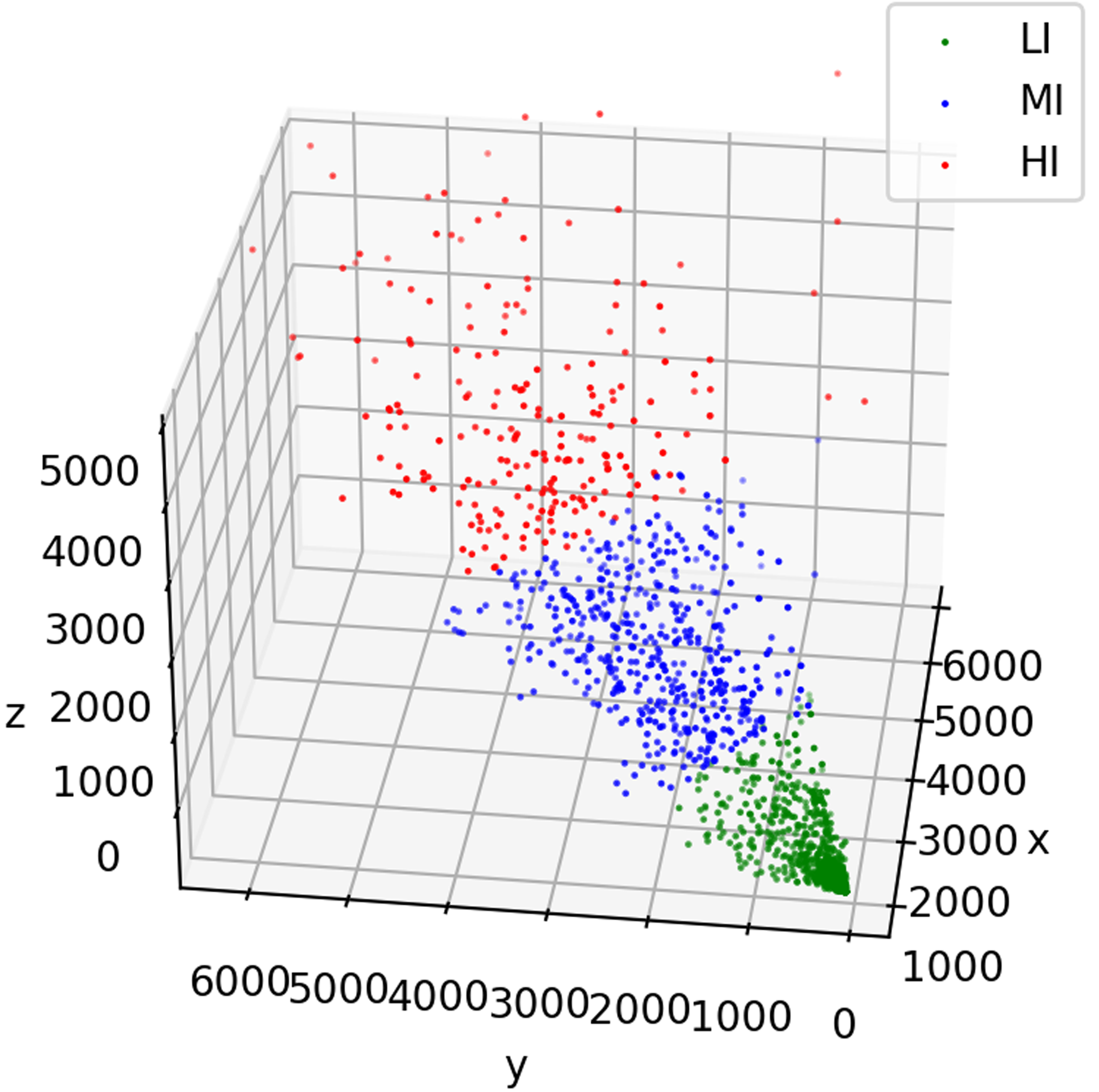
Clustering visualization of right thigh acceleration counts.
Clustering of vector acceleration activity counts for upper and lower limbs in VR physical activity
The study of the intensity of motion should not only study the characteristics in a certain direction, but also the integrated intensity of motion at the spatial location in which it is located, and in this study, we chose to cluster the vector acceleration activity counts for cluster analysis.
The vector acceleration counts were subjected to FCM clustering and the obtained cluster centers are shown in Table 8. The clustering centers of activity counts of the right arm were 2016.77 for the first category, 6118.31 for the second category, and 9923.45 for the third category, which belonged to LI, MI, and HI, respectively. The clustering centers of activity counts in the right thigh were 248.30 for the first category, 1895.22 for the second category, and 3485.60 for the third category, which belonged to LI, MI, and HI, respectively. VR physical activity is a whole-body activity, we chose to analyze the intensity of the exercise by combining the upper and lower limbs in a cluster analysis according to the transfer of triaxial activity counts to vectorial activity counts. The overall acceleration count clustering results are shown in Table 7, the first category is 1443.83, the second category is 4415.47, and the third category is 7149.13. which belongs to the LI, MI, and HI, respectively.
FCM clustering of the right arm and right thigh vector acceleration counts.

Discussion
The main research methods for assessing VR exercise intensity include questionnaire methods, heart rate monitoring methods, and motion sensor measurements. The questionnaire method is generally measured in the form of a scale, which is suitable for studies with large sample sizes, but has low reliability and validity, tends to limit the type of physical activity, and does not accurately assess the level of physical activity. Debska 30 also used Polar's VantageV pulse meter to monitor heart rate and assess participants’ exercise intensity during a 10-min VR motion video game session; Cao 31 uses Fitbit devices to monitor the heart rate of people who need to be physically active and to measure energy expenditure levels and exercise intensity. However, the heart rate detection method is inaccurate in judging the human body's movement status only through the heart rate, and the heart rate data is susceptible to the influence of external factors, thus causing errors in the measurement.
Accelerometers are widely used in physical activity monitoring to facilitate objective quantitative and generalized physical activity assessment and also have high accuracy, reliability and validity in measuring physical activity levels.32–35 It is not only an instrument to record acceleration but also an acceleration-based physical activity monitor that monitors the amount of daily physical activity of an individual while objectively assessing the level of physical activity. 36 In Snyder's 37 study, the exercise intensity was captured by cyber bike sensors to compare the effect of virtual competitors and on-site competitors on the exercise intensity when riding a VR-enhanced fixed bicycle (“cyber cycle”); Zhang 38 proposed an exercise game called Virtual Internet Marathon and uses a set of sensors to capture acceleration and monitor the intensity of the user's movement; Gorsic 39 designed a competitive arm rehabilitation game for players while measuring the intensity of movement using inertial sensors built into the rehabilitation device.
FCM algorithms have been used to identify activity types and assess physical activity levels. Lee 40 proposes a method to monitor bodily activities in daily life by using a portable measuring device with a single three-axis accelerometer, and extracting the mean and standard deviation of acceleration and related features from acceleration data. Finally, the FCM algorithm is adopted to identify these features. The results show that the accuracy of standing, sitting, lying, walking, and running is 99.5%. Lee 41 developed a PC-based activity recognition program to analyze the changes in acceleration signals for six activity modes: standing, sitting, lying, walking, running, and falling, based on the changes in acceleration signals measured by movement and physical activity, and finally used the FCM algorithm to recognize the six activities, and the recognition rate was above 98% for all of them. The study proves that the recognition accuracy of the FCM algorithm is high and achieves good results with important practical applications. This also leads us to use the algorithm to conduct research.
According to the characteristics of VR movement, subjects mainly move through the control handle, and due to the limitation of space, there is an activity difference between the lower limb and upper limb movement activities. The intensity and degree of activity of the upper limbs are greater than the degree of leg movement, and it has surfaced that VR movement is superior to the lower limbs in terms of upper limb function. 42 Some studies have shown that there are differences between the dominant hand and nondominant hand in locomotion, in order to reduce the error of the experiment, we chose the experimental subjects are right-handed sharp practitioners. Of course, in future experiments, we will conduct larger-scale experiments to verify the results, including but not limited to different dominant hand groups and different age groups.
The VR physical activity increased the emotional arousal of the subjects, and its good interactive feeling could attract the subjects, and the degree of arousal increased with the increase of the intensity of the VR exercise, of course, it may also be due to the exercise itself to make people aroused is also related to the exercise itself, which needs to be further verified.
In this study, a total of six VR exercise games with low, medium, and high exercise intensities were selected from a large number of VR games, all of which have been widely publicized and tried by the general public. It is worth mentioning that even in traditional sports, the test results of testers of different ages and exercise levels may be different under the same exercise program and exercise load, so the selection and division of game intensities discussed in this article is a general situation.
Subjects who are new to VR exercise can have high heart rate levels even under low physical activity. In VR physical activity, subjects with different genders and differences in exercise levels affect the traditional heart rate and sensor detection accuracy. When it comes to fuzzy boundaries between things, it seems more reasonable to use the fuzzy clustering method to evaluate VR physical activity patterns in this study.
We performed FCM clustering on the vector velocities of the hands and feet, and the purity assessments of the clusters were 80.08% for wrist acceleration counts clustering, 71.31% for lower limb acceleration counts clustering, and 82.54% for overall acceleration counts clustering, which is a relatively satisfactory result for data clustering. The data were recorded as accelerometer values per minute, and the intensity labels of the dataset were labeled according to the intensity of the exercise in which the subjects played the game. Most of the VR sports selected in this study were intermittent sports modes, and the data of intermittent moments were not excluded to ensure the completeness of the sport's intensity, so the intensity of the intermittent moments did not match the label. Afterward, VR games with continuous motion can be selected to explore the clustering accuracy of the algorithm for VR physical activities.
Conclusions
The results of the experiment showed that 15 min of VR physical activity could increase the subjects’ level of exercise enjoyment and excitement. MI VR physical activity has a significant effect on improving subjects’ exercise enjoyment, probably because LI VR physical activity is interesting but with little exercise, HI VR physical activity is too large and easy to fatigue, and MI VR physical activity ensures the fun of VR exercise with the right amount of exercise.
In VR physical activity, arm activity counts have a degree of motor activity greater than the reference range at their corresponding motor intensity. Leg activity counts at their corresponding exercise intensities had low exercise intensities, and the degree of MI and HI exercise activity was less than the reference range. The VR physical activities as a whole are analyzed, and the VR physical activities at different exercise intensities meet the reference standard of the exercise intensity at the cut point of the activity counts. The FCM clustering is effective and can accurately classify the activity intensities of the VR exercises.
We also combine sensors and machine learning, and propose a new method to capture acceleration movement data from college students using motion sensors to realize unsupervised learning for exercise intensity assessment. It is verified that the VR exercise intensity matches the traditional exercise intensity and can achieve the exercise effect of the traditional exercise mode, and the VR physical activity can be used as an interesting alternative to the traditional form of exercise.
Footnotes
Authors’ Notes
Texi Zhang and Xiaoyue Xiao contributed equally to this article.
Contributorship
TXZ, XYX, and JM conceived the study. TXZ and XYX performed the literature search and screening, experimental design, data extraction, cluster analysis, and pattern evaluation, and TXZ and XYX wrote the manuscript with the help of JM. JM supervised the manuscript and accepted the grant. All authors were involved in revising the manuscript and finalizing the final version. All authors have read and agreed to the published version of the manuscript.
Declaration of Conflict of interest
The authors have no conflicts of interest to declare.
Ethical approval
The study was approved by the Medical Ethics Committee of Wuhan Sports Institute (2022021).
Funding
The authors disclosed receipt of the following financial support for the research, authorship, and/or publication of this article: This work was supported by financial support from the Scientific Research Team of Wuhan Sports University (grant number 21KT03), the Teaching Research Program of Wuhan Sports University (grant number 202214) and the Postgraduate Education Teaching Reform Research Project of Wuhan Sports University (grant number YJSJG2021016).
Guarantor
JM.
