



Abstract
Objectives
Although previous studies have initially noted that psychological needs satisfaction (PNS) might be a significant risk factor for technology addiction (e.g. online gaming addiction and Internet addiction), specific mechanisms involved in the association between PNS and adolescent smartphone addiction are largely unknown. Based on self-determination theory, this cross-sectional study constructed a multiple mediation model to examine whether PNS will influence adolescent smartphone addiction through the mediating roles of social anxiety and loneliness.
Methods
Eight hundred and ninety-nine Chinese adolescents answered the questionnaire including measures of PNS, social anxiety, loneliness, and smartphone addiction. SPSS 24.0 was used for common method bias test, reliability test, and correlation analysis, and Mplus 7.4 was used to examine the mediating roles of social anxiety and loneliness in the multiple mediation model.
Results
This study found that (1) PNS was negatively associated with adolescent smartphone addiction; (2) loneliness significantly mediated the association between PNS and smartphone addiction while the mediating role of social anxiety in this association was nonsignificant; and (3) social anxiety and loneliness also sequentially mediated this association.
Conclusion
This study further enriched potential mechanisms linking PNS and smartphone addiction among adolescents, which may contribute to intervention and prevention programs for adolescent smartphone addiction from the perspective of improving both PNS and negative emotions including social anxiety and loneliness.
Keywords
Introduction
Smartphone use has grown at an unpredictable rate in recent years, especially among adolescents, one of the fastest growing groups who own and regularly use smartphones. 1 The quantity of smartphone users in China has reached around 1.065 billion, among which adolescents aged 10 to 19 years account for up to 14.3%. 2 Though smartphones provide great convenience, its prolonged use may put adolescents at higher risks for smartphone addiction. 3 “Smartphone” and “mobile phone” in recent research seem to synonymously refer to mobile devices with capabilities for email, text messaging, video viewing, and wireless Internet access,4,5 and their addictive use has been described by diverse terms such as smartphone/mobile phone addiction,6,7 problematic smartphone/mobile phone use,8,9 or excessive smartphone/mobile phone use.10,11 Although a proper terminology for this phenomenon is an ongoing controversy, the term “smartphone addiction” has been increasingly recommended. 12 Generally considered as a type of behavioral addiction, 12 smartphone addiction is defined as one's uncontrollable and excessive use of smartphones with neglecting professional and personal activities and suffering from negative consequences in life.13,14 Since the high prevalence (e.g. 22.8% among Chinese adolescents) 15 and adverse physical and mental health outcomes (e.g. vision problem, sleep disturbance, and depression) 16 of smartphone addiction have aroused widespread social concern, it is necessary to explore more potential triggering factors as well as mediating mechanisms underlying the development of smartphone addiction, which may further provide implications for its cost-effective prevention and intervention.
According to the perspective of self-determination theory (SDT), 17 the satisfaction of inherent psychological needs of autonomy, competence, and relatedness is regarded as indispensable nutrients for one's development. Consistent with SDT, individuals whose basic psychological needs are not met in daily lives may tend to integrate other activities (e.g. using smartphones) into their lives in a problematic manner, thereby developing more externalizing behaviors such as smartphone addiction.18,19 Empirical evidence also revealed that psychological needs satisfaction (PNS) was a significant risk factor for smartphone addiction.20,21 When adolescents experience low PNS, their unmet psychological needs could be compensated by various functions of smartphones (e.g. chatting online, visiting social media, and playing games),22,23 which meanwhile made it easier for them to indulge in smartphones excessively and thus experience higher risks of smartphone addiction.24,25 To the best of our knowledge, only one research 26 further investigated potential mechanisms linking PNS and smartphone addiction via one specific mediator (i.e. fear of missing out). Given that negative emotions (e.g. social anxiety and loneliness) have been proven as crucial mediators underlying the maintenance and development of technology addiction (e.g. video game addiction and social networking sites addiction)27,28 induced by various risk factors, however, the mediating role(s) of negative emotions have not yet been considered in the link between PNS and smartphone addiction. From the view of aforementioned crucial mediating roles of specific negative emotions, it is hence warranted to address the knowledge gap regarding the specific mechanisms underlying the association between PNS and smartphone addiction by examining the mediating roles of social anxiety and loneliness among Chinese adolescents.
The mediating role of social anxiety
According to SDT, 17 the satisfaction of basic psychological needs is significantly associated with one's psychological health and one recent review 29 likewise summarized that individuals with high levels of PNS tend to experience more wellbeing in life. This perspective suggests that PNS may be closely related to the level of social anxiety, which is defined as people's negative experiences (e.g. distress, discomfort, fear, and avoidance) in social situations and their deliberate avoidance of these situations, culminating their fear of receiving negative evaluations from others. 30 Previous studies have proved that, during childhood and adolescence, PNS was negatively associated with social anxiety.31,32 For example, adolescents with high PNS may take a more positive and optimistic attitude toward negative evaluations in interpersonal relationships as they have perceived more self-confidence and higher levels of wellbeing, thereby reducing the possibility of social anxiety. 32 Additionally, adolescents who experience high PNS may feel loved and cared for in interpersonal settings and then show a greater willingness to build and maintain these relationships, which in turn reduce the risk of social anxiety.31,33 Therefore, it is reasonable to speculate that PNS will be negatively associated with adolescents’ social anxiety.
Furthermore, social anxiety has been proven to be a significant risk factor for adolescents’ externalizing behaviors, especially smartphone addiction.10,34,35 Empirical studies found that more social anxiety was related to higher interpersonal sensitivity, manifested by interpersonal inferiority and negative expectations about interpersonal interactions, making individuals tend to escape from realistic social interactions.36,37 Meanwhile, smartphone's features such as anonymity and escapism can alleviate negative feelings involved in both social anxiety and interpersonal sensitivity and motivate adolescents to use it compulsively and persistently, thereby exacerbating the risk of smartphone addiction.37,38 Moreover, adolescents with high social anxiety tend to engage in constant and detailed scrutiny of their negative social performance, as well as evaluate themselves negatively,34,39 which would trigger smartphone overuse in situations of social interactions to avoid negative emotions, and then increase the possibility of smartphone addiction.40,41 Furthermore, virtual social interactions mediated by smartphones could not only alleviate physical fears and worries (the core symptom of social anxiety) but also serve as a safe and comfortable social setting for adolescents, and thus the preference for virtual interactions provided by smartphones in turn drives adolescents to develop smartphone addiction.8,42 Based on the assumption of SDT, we suppose that social anxiety could mediate the relation between PNS and smartphone addiction and propose the following hypothesis:
Social anxiety would mediate the relationship between PNS and adolescent smartphone addiction.
The mediating role of loneliness
Loneliness may be another important negative emotion that mediates the relationship between PNS and smartphone addiction. Based on SDT, 17 recent research has shown that high PNS significantly contributed to the improvement of wellbeing and various health outcomes including negative emotions.29,43,44 Consistent with this perspective, PNS serves as an important psychological factor which may have a significant impact on individuals’ loneliness (i.e. one's subjective feeling of being excluded from the outside world, which will determine how people interact with others and with the outside world). 45 Empirical studies also further revealed that one's unmet PNS is positively related to a higher degree of loneliness.46,47 Specially, individuals with high frustration of psychological needs were experiencing more negative feelings of social isolation and lower levels of satisfaction in social relationships, which might be also closely related to higher levels of loneliness.48–50 Conversely, those adolescents with a higher satisfaction of psychological needs are more likely to experience a stronger sense of belonging and higher life satisfaction through the trust obtained from interpersonal relationships, thereby protecting them from the risk of loneliness. 51
From the perspective of SDT, 17 low PNS is a risk factor for loneliness which may be further positively related to adolescent smartphone addiction. When adolescents are suffering from loneliness, smartphones are used as an available approach for them to escape the feeling of loneliness and related negative experiences and also help them feel relaxed, thereby stimulating their motivations to indulge in smartphones more frequently and resulting in smartphone addiction.6,52,53 Adolescents who are experiencing loneliness prefer to surf the Internet, play games, or attend online interactions instead of face-to-face communication to release this negative feeling or improve their belonging and relationship needs,54,55 thus further exacerbating the risk of smartphone addiction.42,56,57 Moreover, those who suffer from loneliness are more likely to develop negative perceptions and be dissatisfied with real life, which motivate them to turn to the virtual world (e.g. smartphones or Internet) for escape and compensation and hence reported a higher level of smartphone addiction.58,59 Based on the perspective of SDT and given that PNS is negatively related to loneliness which may further exacerbate smartphone addiction, the following hypothesis speculated that loneliness may be an important mediator through which PNS would affect adolescent smartphone addiction:
Loneliness would mediate the relationship between PNS and adolescent smartphone addiction.
Multiple mediating effects of social anxiety and loneliness
Based on the above discussion on the association of PNS with smartphone addiction, one important question deserves further examination, that is, whether PNS could also affect smartphone addiction through the multiple mediating effects of social anxiety and loneliness. Several empirical studies in diverse cultural contexts may indirectly support the sequential mediating effects of social anxiety and loneliness in the relationship between PNS and smartphone addiction.60,61 During adolescence, social anxiety is considered as a crucial antecedent of emerging loneliness, 62 and adolescents with high degree of social anxiety tend to show fear of and avoidance to social interactions or situations, which prevents them from developing social skills or building positive social relationships, thereby experiencing higher levels of loneliness.61,63 High level of social anxiety also make adolescents experience more frustration and failure in social circumstances and feel that they are not accepted by surrounding people and environment, and then contributed to more negative feelings of loneliness. 64 Taken together, lower PNS may lead to a higher level of social anxiety which is related to stronger loneliness, and thus increase the possibility of smartphone addiction. Therefore, we proposed the following hypothesis:
Social anxiety and loneliness could sequentially mediate the relationship between PNS and adolescent smartphone addiction.
The current study
Based on SDT, this cross-sectional study aims to examine the associations between PNS, social anxiety, loneliness, and smartphone addiction by examining a multiple mediation model to address four questions: (1) whether PNS would negatively influence adolescent smartphone addiction; (2) whether social anxiety would mediate the relationship between PNS and smartphone addiction; (3) whether loneliness would mediate the relationship between PNS and smartphone addiction; and (4) whether social anxiety and loneliness would act as sequential mediators in above relationship. This study would not only deepen our understanding of how PNS is associated with adolescent smartphone addiction, but also offer valuable suggestions to policymakers, educational workers, or clinicians to develop more cost-effective prevention and intervention programs for adolescent smartphone addiction. This article is presented following the “Strengthening the Reporting of Observational Studies in Epidemiology (STROBE)” checklist for cross-sectional studies (https://www.strobe-statement.org/checklists) (see details in Supplemental file).
Method
Participants
By convenience sampling, this cross-sectional study recruited 937 adolescents in the age range of 10 to 24 years (a closer and better fit with the development of adolescents nowadays). 65 These adolescents include middle school and high school students from Shenzhen (a Special Economic Zone in China), which has also been a first-tier city in the worldwide and well-known for its rapid economic growth. 66 After understanding the research aim and participants’ rights, all participants signed informed consents and then filled out the paper-pencil questionnaire survey in the classroom setting voluntarily and anonymously. After excluding 38 samples (who did not answer more than 5 questions continuously) to avoid possibly biased results of data analysis caused by these invalid responses, 67 and the final sample consisted of 899 adolescents (47.1% females; Mage = 15.96, SD = 1.46, range = 13–18 years). Guided by the recommended sample size-to-parameter ratio of 20:1 in structural equation modeling, 68 our final sample size meets the requirement of at least 620 participants for examining the multiple mediation model. This study was approved by the ethics committee at the affiliation of the corresponding author.
Measurement
Psychological needs satisfaction
The Chinese version 69 of the Basic Psychological Needs Scales 70 used a 5-point Likert scale (1 = totally disagree, 5 = totally agree) to measure 21 items with three dimensions (e.g. the need satisfaction of autonomy, competence, and relatedness). The example item is “I feel pressured in my life.” After reverse coding, a higher mean score indicated higher levels of PNS. The scale has shown good reliability among Chinese adolescents.21,71,72 The Cronbach's α of the scale was 0.88 in this study.
Smartphone addiction
Smartphone addiction was measured by the 17-item Mobile Phone Addiction Index 73 with 4 dimensions (i.e. inability to control cravings, anxiety and feeling, withdrawal and escape, and productivity loss) on a 5-point Likert scale (1 = strongly disagree, 5 = strongly agree). The example item is “You feel lost without your smartphone.” A higher mean score indicated higher levels of smartphone addiction and previous studies have shown that the scale is a reliable instrument among Chinese adolescents.21,74,75 The Cronbach's α of the scale was 0.89 in this study.
Social anxiety
The Social Anxiety Scale for Children 76 was used to measure social anxiety on a five-point scale (1 = totally inconsistent, 5 = totally consistent) and showed good reliability in Chinese adolescents. 77 After reverse coding, a higher mean score indicated higher levels of social anxiety. In this study, the Cronbach's α of the scale was 0.87.
Loneliness
The Chinese version 78 of the short-form UCLA Loneliness Scale (ULS-8) 79 was used to measure loneliness on a four-point Likert scale (1 = never, 4 = always). This scale included eight items (e.g. “I feel isolation from others.”). After reverse coding, a higher mean score represented higher levels of loneliness. This scale showed good reliability among Chinese adolescents52,80 and its Cronbach's α was 0.80 in this study.
Common method bias
The common method bias was examined by Harman's single-factor test. The result revealed that there were 11 factors with the original root greater than 1 and the first factor to explain the variance was 22.1%, demonstrating that this study did not present significant issues of common method biases. 81
Data analysis
The data collected in current study was recorded on the computer and processed using SPSS 24.0. The common method bias test, reliability test, and correlation analysis among variables were performed in SPSS 24.0. Then we used Mplus 7.4 to examine the multiple mediation model with the full information maximum likelihood estimator for handling missing data, with a rate of 0.2% to 3% in this study. The model's goodness-of-fit was evaluated by comparative fit index (CFI; good fit > 0.90), Tucker-Lewis index (TLI; good fit > 0.90), root mean square error of approximation (RMSEA; acceptable fit < 0.08), and standardized root mean square residual (SRMR; acceptable fit < 0.08).
Results
Description and correlation
Table 1 presents the mean and standard deviation of all variables and also correlation coefficients in the current sample of 899 adolescents aged between 13 and 18 years. As expected, the results of correlation analysis showed that PNS was negatively related to social anxiety (r = −0.57, p < 0.001), loneliness (r = −0.64, p < 0.001), and smartphone addiction (r = −0.30, p < 0.001), respectively. That is, adolescents with higher satisfaction of psychological needs tended to report lower degrees of social anxiety, loneliness, and smartphone addiction. Social anxiety was positively related to loneliness (r = 0.48, p < 0.001) and smartphone addiction (r = 0.26, p < 0.001), and loneliness was positively associated with smartphone addiction (r = 0.36, p < 0.001).
Descriptive statistics and correlation analysis.

Note. ***p < 0.001. M: mean; SD: standard deviations.
Examination for the multiple mediation model
The multiple mediation model showed a good fit to the data (χ2 = 238.795, p < 0.001; TLI = 0.940; CFI = 0.959; RMSEA = 0.075, 90% confidence interval (CI) = 0.066–0.084; SRMR = 0.038). As shown in Figure 1 and Table 2, firstly, PNS was negatively related to social anxiety (β = −0.62, p < 0.001), which in turn was not significantly associated with smartphone addiction (β = 0.05, p > 0.05), thus the mediating effect of social anxiety between PNS and smartphone addiction was nonsignificant (indirect effect = −0.03, p > 0.05, 95% CI = −0.10 to 0.04). Secondly, PNS was negatively associated with loneliness (β = −0.62, p < 0.001), which in turn was positively associated with smartphone addiction (β = 0.29, p < 0.001), thus the mediating effect of loneliness between PNS and smartphone addiction was significant (indirect effect = −0.18, p < 0.001, 95% CI = −0.28 to −0.09). Finally, social anxiety was positively associated with loneliness (β = 0.18, p < 0.001), and the sequential mediating effect of social anxiety and loneliness between PNS and smartphone addiction was significant (indirect effect = −0.03, p < 0.01, 95% CI = −0.06 to −0.01).

Examination for the multiple mediation model. *p < 0.05, ***p < 0.001.
Examination for the multiple mediation model.
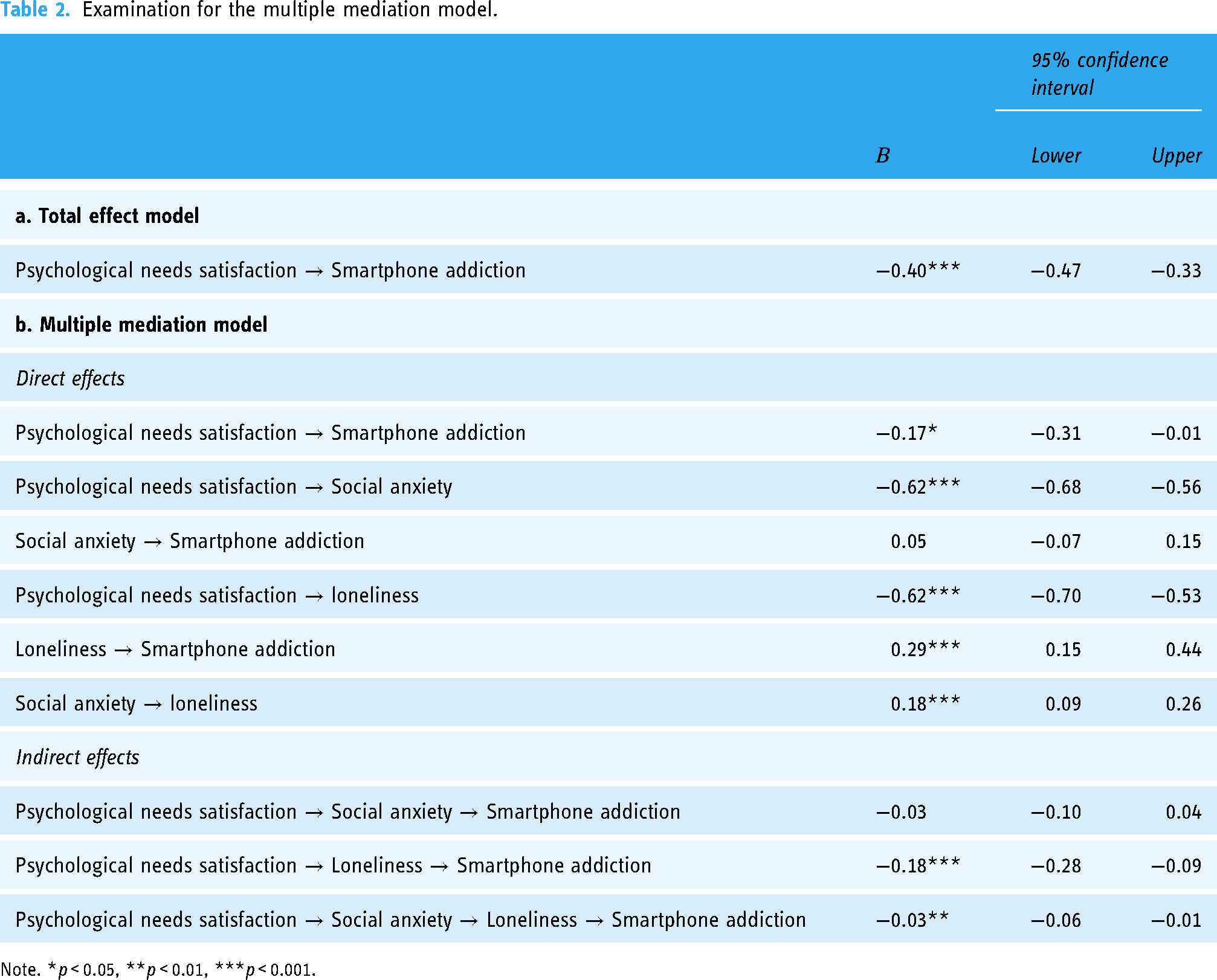
Note. *p < 0.05, **p < 0.01, ***p < 0.001.
Discussion
In this study, we constructed a multiple mediation model to reveal how PNS was linked to adolescent smartphone addiction through the mediating roles of social anxiety and loneliness among Chinese adolescents. The results showed that low satisfaction of basic psychological needs would increase the severity of social anxiety and further lead to increased loneliness, and then put adolescents at higher risks of developing smartphone addiction.
The mediating role of loneliness
Our first finding supported that loneliness serves as a significant mediator in the association between PNS and smartphone addiction, in which low levels of PNS would increase loneliness among adolescents and then led to a high level of smartphone addiction. For the first part of the mediation pathway that PNS was negatively associated with loneliness which is consistent with SDT, basic psychological needs are needed to be met for people to experience a sense of connection, satisfaction, and wellbeing, especially in interpersonal relationships. 17 High PNS was positively associated with positive emotions, whereas there was a negative correlation between PNS and negative emotions (e.g. loneliness, depression, and shame).29,50 Furthermore, when basic psychological needs of adolescents are met, their abilities of regulating emotions and solving problems can be improved and they can reasonably solve interpersonal problems and build positive relationships with others, which further mitigate the severity of loneliness.82,83 The second stage of the mediation pathway between loneliness and smartphone addiction found in this study was consistent with previous findings which reported a positive association between loneliness and smartphone addiction.6,52 When individuals are unable to establish and maintenance satisfying interpersonal relationships in real life, they may turn to smartphones, a widely used tool for consuming time and easing negative emotions including loneliness and seeking immediate relief from negative emotions temporarily.53,84,85 Moreover, lonely individuals tend to exhibit incompetence in social relationships, and they are less willing to communicate with others face to face. In contrast, they are more eager to establish supportive interpersonal relationships through virtual smartphones, a substitute for interpersonal communication.6,53 The reason might be that individuals with emotional problems (e.g. loneliness and depression) are more likely to consider that they are incapable of socializing in real living, and hence they prefer online interactions as the anonymity and the lack of nonverbal clues of online social interaction will reduce the potential threat of interaction.52,86 Moreover, lonely adolescents are more likely to form a positive attitude to online relationships and feel more understood in the virtual communication and connection, and thus it will make adolescents more inclined to interact via online approaches and hence more prone to smartphone addiction.6,87 As a consequence, adolescents with lower PNS experience high levels of loneliness, which in turn leads to high risk of smartphone addiction.
The mediating role of social anxiety
Our second finding found that PNS was negatively linked to social anxiety, but social anxiety was not significantly associated with smartphone addiction. In line with SDT, 17 social relationship is extremely important to individual development and can make individuals perceive a sense of connection and association in surrounding environment, which is one of the basic psychological needs determining better psychological development and higher wellbeing. We found that PNS was negatively associated with social anxiety which is consistent with previous findings that adolescents who experienced low PNS tend to show negative self-assessment and self-beliefs and exhibit poor performance in the social interaction, making it difficult to attain positive and strong social bonds.87,88 Meanwhile, a low level of PNS put adolescents at higher risks of experiencing social avoidance, fear of being criticized, worthlessness, low self-efficacy, and high internal shame, which further stimulate social anxiety. 89 Conversely, when the basic psychological needs of adolescents are adequately met, it can promote them to develop a higher sense of self-worth, to be less sensitive and vulnerable in interpersonal relationships, and to reduce the risk of social anxiety.31,32 For the second part of the mediation process between social anxiety and smartphone addiction, our finding suggested that the link between social anxiety and adolescent smartphone addiction was not significant. One of the possible explanations is that social anxiety may indirectly affect smartphone addiction through other potential mediators. For example, social anxiety was found to be positively related to smartphone addiction through the mediating effect of self-concept clarity. 34 Adolescents with higher level of social anxiety tend to focus on negative information about themselves8,90 and these inaccurate cognitions may threaten their self-cognitive clarity (i.e. the degree to which one's definition of self-concept is clear and uniform). 91 Those make individuals feel inferior and worthless, and then further look for alternative satisfaction through social networks and increase the risk of smartphone addiction. 92 In addition, adolescents with social anxiety tend to exhibit high interpersonal sensitivity (i.e. showing interpersonal inferiority complex, restlessness, and negative expectations of interpersonal communication), 93 which may be further alleviated by the anonymity feature of online communication via smartphones but meanwhile also exacerbate the risk of smartphone addiction. 37
Multiple mediating roles of social anxiety and loneliness
The third finding of this study also showed that social anxiety and loneliness sequentially mediated the link between PNS and smartphone addiction. As adolescents with higher levels of social anxiety may face more difficulties in interpersonal interactions and show withdraw from social interactions, these difficulties and withdrawal intentions would hamper their abilities to form meaningful social communication and increase the discrepancy in interpersonal relationships they would like to achieve, ultimately contributing to more negative feelings of loneliness.61,63 Adolescents with social anxiety are more likely to miss out opportunities to establish intimate relationships due to avoidance behaviors, or encounter difficulties in getting along with others due to weak social skills, and hence they may face a higher risk of loneliness.60,62,64 Then, people always choose to use smartphones to eliminate the loneliness triggered by social anxiety.42,57 Therefore, if the basic psychological needs of adolescents are not met, they may become more anxious in social context and have a desire to withdraw and resist, which increased the level of loneliness and further exacerbate the possibility of smartphone addiction.
Contribution and limitations
The findings had some contributions on the intervention and prevention of adolescent smartphone addiction. First, as smartphone use in China becomes younger and more popular, our research suggests that government regulation should tighten and crackdown on the online cultural market and strive to eliminate disadvantaged information that endangers the physical and mental health of adolescents. Second, from the perspective of school policy makers, given that social anxiety and loneliness are important factors linking PNS and adolescent smartphone addiction, schools should focus on adolescents who are lonely and out of the group. It may be helpful to improve the intervention efficiency of smartphone addiction. Third, since adolescents are in a critical period of development and maturity, it will be more effective for parents and educators to pay more attention to psychological conditions of students and reduce their negative emotions through available approaches (e.g. cognitive reconstruction and interpersonal skills training). Finally, adolescences may regulate their behaviors consciously and participate in social activities actively. Meanwhile, it may be best to seek support from parents, friends, or teachers for coping negative emotions instead of indulging in smartphones for escape.
Although this study provides above valuable contributions, it also has several limitations. Firstly, this study was a cross-sectional design which is hard to infer causality, and thus future studies should probe longitudinal designs or intervention experiments to confirm the causal assumptions in this study. Secondly, this study collected data from adolescent self-reported questionnaires, potential biases may affect the validity of the data. Therefore, future research can improve it by collecting data from multiple samples (e.g. parents, classmates, and teachers). At last, all participants in our study were restricted to adolescents from Guangdong province, China. Therefore, future research may examine the cross-cultural generalization of the conclusions among individuals from different age groups, areas, or cultural contexts.
Conclusions
Overall, this study extended our understanding of how PNS was related to smartphone addiction among adolescents by building a multiple mediation model. Our finding revealed that low PNS was a significant risk factor for adolescent smartphone addiction, and further mediation analysis also suggested that not only loneliness is one of the key explanatory pathways for the link between PNS and smartphone addiction, but also social anxiety and loneliness could sequentially mediate the relationship between PNS and adolescent smartphone addiction.
Supplemental Material
sj-doc-1-dhj-10.1177_20552076231203915 - Supplemental material for Psychological needs satisfaction and smartphone addiction among Chinese adolescents: The mediating roles of social anxiety and loneliness
Supplemental material, sj-doc-1-dhj-10.1177_20552076231203915 for Psychological needs satisfaction and smartphone addiction among Chinese adolescents: The mediating roles of social anxiety and loneliness by Ruimei Sun, Wanying Li, Sihan Lu and Qiufeng Gao in DIGITAL HEALTH
Footnotes
Contributorship
RS and WL contributed to writing—original draft and writing—review & editing. SL contributed to writing—review & editing. QG was involved in funding acquisition, investigation, methodology, project administration, supervision, and writing—review & editing. All authors reviewed and edited the manuscript and approved the final version of the manuscript.
Declaration of conflicting interests
The authors declared no potential conflicts of interest with respect to the research, authorship, and/or publication of this article.
Ethical approval
The ethics committee of Shenzhen University approved the research (number: 2020005).
Funding
The authors disclosed receipt of the following financial support for the research, authorship, and/or publication of this article: This work was supported by the Ordinary University Scientific Research Project Fund of the Department of Education of Guangdong Province (2022WTSCX096).

Supplemental material
Supplemental material for this article is available online.
References
Supplementary Material
Please find the following supplemental material available below.
For Open Access articles published under a Creative Commons License, all supplemental material carries the same license as the article it is associated with.
For non-Open Access articles published, all supplemental material carries a non-exclusive license, and permission requests for re-use of supplemental material or any part of supplemental material shall be sent directly to the copyright owner as specified in the copyright notice associated with the article.
