



Abstract
Overview
Smartphone use has dramatically increased worldwide, contributing to a profound change in interpersonal interactions. They have become the primary medium of human interaction, and smartphone addiction, consequently, has become a modern-day reality. Recent research on smartphone addiction has provided diverse explanations regarding the correlation between gender and addiction. Therefore, this study aims to analyse the correlation and variance among smartphone addiction, gender and interpersonal attachment.
Methods
The participants included Taiwanese citizens and the questionnaires were randomly distributed; 1190 valid questionnaires (534 males, 656 females) were collected. Descriptive statistics were computed to observe the average value and standard deviation between interpersonal attachment and gender. Next, Spearman's ρ was conducted to interpret the correlation among smartphone addiction, gender and interpersonal attachment. Finally, the participants were divided into three groups based on their pre-determined level of smartphone addiction: high, moderate and low addictions. The Analysis of variance (ANOVA) was performed based on interpersonal attachment as the independent variable to determine any statistically significant difference among the three levels.
Results
There are four patterns of interpersonal attachment: secure, avoidant, dismissing and anxious attachments. The correlation analysis revealed a significant positive correlation between interpersonal attachment and smartphone addiction (p > 0.000), while revealing no relationship between gender and smartphone addiction or gender and interpersonal attachment. Additionally, the ANOVA indicated the difference was statistically significant in the groups of high and moderate addictions; no statistical significance was identified in the group of low addiction (p < 0.204).
Conclusion
This study revealed that there was no correlation between gender and smartphone addiction, but rather, a positive correlation between smartphone addiction and interpersonal attachment. This positive correlation suggests both high and moderate addiction groups display insecurity in their interpersonal attachment. Therefore, to lower the prevalence of unhealthy smartphone addiction, maintaining healthy interpersonal relationships is suggested.
Introduction
Internet addiction and smartphone overuse – especially during the COVID-19 pandemic – might be multi-dimensional issues, accompanied by substance abuse and including several variants with different neurobiological underpinnings.1,2
Presently, smartphone applications are replacing the constructs that constitute the various elements of human behaviour. Digital technology has evolved to the point where our devices play the roles of experts, teachers, family doctors or shopping consultants. 3 The rapid advancements in smartphone technology are, undoubtedly, contributing to progress – and a larger pool of resources at our fingertips. However, addiction to devices has become a modern-day reality, causing real harm to those affected. Considerable research has been performed on smartphone addiction – that is, the dependence on smartphones. 4 Various smartphone features, because of their indispensability to the user, induce his/her attachment to the smartphone. These features include social technologies that keep users engaged with colleagues, friends or family. Additionally, smartphones contribute to personal development and provide a sense of achievement. Smartphones fulfil the innate needs of people worldwide, which contributes to the risk of dependence on devices, and this may, in turn, lead to an inseparable attachment – and finally, addiction. 5 A few researchers have indicated that as compared to the general population, the social isolation of patients diagnosed with smartphone addiction is higher, and their physical and mental health is worse. 6
John Bowlby, who proposed the attachment theory in 1950, saw attachment behaviour as a function of evolution, ensuring humanity's survival. This implies that as attachment-causing medium evolves over generations, people protect their mindset by seeking attachment to the most compelling medium of the times; this constitutes the attachment relationship. Interpersonal attachment is categorised by four attachment styles: secure, avoidant, dismissing and anxious. 7 Studies have shown a significant correlation between insecure attachment and non-medical clinical psychiatric disorders; avoidance is associated with social and attachment relationships. 8 People tend to seek substitutes to attach to, when they prefer avoiding crowds.
To date, there are three different fields of thought based on research into gender and smartphone addiction. First, female addiction is generally more pronounced than male addiction. 9 Females appear to be more prone to emotional imbalance, 10 so they use smartphones to redress this imbalance. Second, males succumb to smartphone addiction to alleviate stress. Stress is known to influence depression and smartphone addiction. 11 Third, there is no relation between gender and smartphone addiction. 12 Smartphones have become ubiquitous, and many people rely on them even while walking – these are the ‘smartphone zombies’. 13 This is a global phenomenon, impacting all genders.
Therefore, this study analyses the correlation among gender, interpersonal attachment and smartphone addiction. Additionally, it reveals whether there are statistically significant differences between the level of smartphone addiction (high addiction, moderate addiction, and low addiction) in relation to the different styles of interpersonal attachment.
Smartphone addiction
The ontological addiction theory (OAT) is a metaphysical model of psychopathology. It assumes that humans easily form unrealistic beliefs about the way they think they exist, and these beliefs can become addictive.5,14,15 For instance, ‘Nomophobia’ refers to the fear of not being able to use a smartphone, which is regarded as placing too much reliance on smartphones. 14 Several researchers have suggested that smartphone addiction is a new phenomenon, and one of the most common non-medical addictions. 16 Presently, smartphones have become indispensable in many people's lives. To avoid the risk of addiction, reluctance to indulge in the use of smartphones has arisen. 17
Moreover, a few studies indicate that the use of smartphones changes in different social circumstances, which implies that the use may vary depending on the nature of the relationship. 18 Research also suggests that social pressure increases the risk of smartphone use to avoid the harmful psychological impacts related to relevant real-world social interactions. 18 The negative effects impact people's social and mental well-being, which aggravates addiction, while they feel anxious at the prospect of building social relationships and dealing with daily routines.19–21
Cultures influence people's values, motivations and communication styles, which differentiates the relationship between smartphone addiction and other factors based on region or location.22–24 This study presumes a correlation between smartphone addiction and social relationships, and therefore, an investigation and analysis were performed to assess whether gender and interpersonal attachment influence crucially on smartphone addiction. From this perspective, the study sets a new direction for identifying smartphone addiction to more reliably identify the key to addiction, or to understand the significance of specific influences.
Gender and smartphone addiction
Findings suggest economic factors, Internet availability, social norms and certain addiction-related health factors may significantly relate to gender-related differences in smartphone addiction tendencies across countries. 25 So far, researchers have suggested that the manner of smartphone use differs according to gender.26,27 For example, males often play games, watch videos and listen to music when they use smartphones; females send text messages, take calls or use social applications more often. Additionally, there is a significant difference in the severity of smartphone addiction across genders.3,28
A few studies have argued that females experience higher levels of smartphone addiction compared to males. With the increasing popularity of social applications, female users tend to have a closer connection to the Internet and spend less time interacting with people in the real-world.29,30 A few studies have suggested that addiction is associated with negative health implications, with males appearing more vulnerable than females.3,25,31
However, other researchers suggest little significant difference between smartphone addiction and gender. 12 Research on smartphone addiction and students’ perception of the support they receive from social relationships indicates that the level of perceived social support of females was statistically higher compared to males, but smartphone addiction levels do not significantly differ based on gender. 32
Smartphone addiction is not merely about overindulging in smartphone use, but also how it affects the physical and mental conditions of those suffering from depression, anxiety and low quality of sleep. 33 To sum up the literature mentioned above, this study holds three viewpoints related to gender and smartphone addiction: (1) females are prone to addiction; (2) males are prone to addiction and (3) there is no meaningful relationship between addiction and gender.
Interpersonal attachment
The attachment theory is related to the interaction between children and their main caregivers. 34 Children's natural survival instincts lead them to seek protection. To do so, they attempt to maintain a certain degree of proximity with their caregivers. Self-protection and the supporting behaviours are inherent human instincts. 35 Teenagers and adults also display attachment behaviours for their sense of security and the need to be recognised and protected by those to whom they are attached.35,36 Therefore, the attachment theory provides a significant framework for how interpersonal attachment affects interpersonal relationships, and the variety of consequent mental behaviours of the individuals in question. 37 This framework is divided into two overarching attachment categories: secure and insecure attachments. In terms of secure attachment, individuals display either secure attachment or dismissing attachment, and have a positive perception of self, whereas individuals categorised as having an insecure attachment display anxious attachment or avoidant attachment and have a negative perception of self.
On the one hand, secure attachment can be described as a safe haven. 38 Individuals raised in an environment of secure attachment possess better problem-solving and confrontation management abilities. They display a better comprehensive understanding of their emotions, greater sympathy, empathy and moral development. There is a profound relationship between attachment theory and one's ability to adapt and fit into one's social surroundings. 39 It is an effective predictor of a positive social response. 40
On the other hand, the side effects of insecure attachment are profoundly relevant to the field of psychology and consequent treatment. 41 Self-compassion influences the relationship between attachment insecurity and depression as well as the quality of life, which contains theoretical and clinical implications for psychotherapy and future research. 42 Many teenagers and adults at risk of social exclusion tend to suffer from insecure attachment, 43 which may cause certain behavioural problems or harmful attachment to material goods, 44 such as addiction to technology, caffeine, sugar, shopping or gambling.45–49
There are four distinct styles of interpersonal attachment: (
Interpersonal attachment may be a reason for smartphone addiction, and people with insecure attachment may become attached to a smartphone because of the convenience of engaging with one's device to satisfy their need for security.
Method
Research problem
This study aims to investigate and analyse the relationship between gender, interpersonal attachment and smartphone addiction in Taiwan to ascertain a correlation between gender and smartphone addiction or a correlation between interpersonal attachment and smartphone addiction. Additionally, it aims to identify whether the public has a sense of attachment to smartphones based on gender differences and social interpersonal problems. The questionnaires were administered to a random sample of Taiwanese citizens and 1190 valid questionnaires were received.
Questionnaire, reliability and validity
To perform this study, an online questionnaire survey was conducted from 15 February 2022 till 30 April 2022, and the questionnaires were distributed to Taiwanese people. A total of 1244 questionnaires were retrieved and 1190 valid questionnaires were collected, including 534 males and 656 females. There were two questionnaires: the first one was the Relationship Style Questionnaire (RSQ) developed by Wang et al. 7 This is one of the scales of the online psychological test provided by the Taiwan Institute of Psychotherapy to classify participants into one of the following four attachment styles: secure, avoidant, dismissing and anxious. The second questionnaire was the Smartphone Addiction Scale-Short Version (SAS-SV) developed by Kwon et al., 55 which has been widely adopted by scholars and translated into many different languages. According to the SAS-SV, if the respondent scores higher than 34, they will be categorised into the group of high smartphone addiction; between 23 and 33, into the group of moderate smartphone addiction; and lower than 22, into the group of low smartphone addiction. 55
Number of distribution of participants
After calculating the formula of the RSQ, Table 1 reflects the distribution of interpersonal attachment styles across genders as follows: 336 participants with secure attachment (169 males, 197 females), 182 participants with avoidant attachment (90 males, 92 females), 392 participants with dismissing attachment (177 males, 251 females) and 250 participants with anxious attachment (98 males, 152 females).
Distribution of interpersonal attachment across genders.

N: overall number of people.
Table 2 presents gender distribution across the three levels of smartphone addiction as follows: 544 participants with high addiction (230 males, 314 females), 568 participants with moderate addiction (265 males, 303 females) and 78 participants with low addiction (39 males, 39 females).
Distribution of genders across the three levels of smartphone addiction.

N: overall number of people.
Table 3 shows the distribution of interpersonal attachment styles across the level of smartphone addiction. A total of 366 participants were categorised under secure attachment (123, 199 and 44 with high, moderate and low addictions, respectively), 182 participants were categorised under avoidant attachment (120, 58 and 4 with high, moderate and low addictions, respectively), 392 participants were categorised under dismissing attachment (176, 191 and 25 with high, moderate and low addictions, respectively) and 250 participants were categorised under anxious attachment (125, 120 and 5 with high, moderate and low addictions, respectively).
Distribution of interpersonal attachment style across the level of smartphone addiction.

N: overall number of people.
All analysis was performed using the IBM SPSS Statistics 26 based on quantitative analysis of descriptive statistics, correlation analysis and analysis of variance (ANOVA). Descriptive analysis was performed for average value, standard deviation and total number of participants. Spearman's ρ was conducted to interpret the correlation among smartphone addiction, gender and interpersonal attachment. This was intended to better understand whether people are attached to smartphones based on the attachment styles they exhibit, and to analyse whether there is a significant positive correlation between gender and interpersonal attachment. In terms of ANOVA, based on interpersonal attachment as the independent variable, this study analysed if there was a statistically significant difference among the three levels of smartphone addiction (Figure 1).

Conceptual framework.
Results
This study attempted to investigate the correlation and variance in terms of gender, interpersonal attachment and smartphone addiction based on the analysis of descriptive statistics, normal distribution and ANOVA (multiple comparisons).
Descriptive statistics
This study reported the average value and standard deviation of smartphone addiction across four different styles of interpersonal attachment in descriptive statistics. The average value of avoidant attachment was 35.69 – the highest among the 4 styles. Anxious attachment had the second-highest average value: 33.95. Secure attachment had the lowest average value: 30.69. This result revealed that individuals categorised as displaying avoidant attachment are prone to smartphone addiction; those categorised as displaying anxious attachment may also experience the same issue.
The average value and standard deviation of smartphone addiction were documented across genders. The average values of smartphone addiction in males and females were 32.24 and 33.10, respectively, indicating a higher prevalence of female smartphone addiction.
Correlation analysis
In Table 4, ‘*’ represents a significant correlation at 0.05 level (two-tailed), whereas ‘**’ represents a significant correlation at 0.01 level (two-tailed). In the analysis of Spearman's ρ, the correlation coefficient between gender and smartphone addiction was .056 (p < 0.053), which was not significant. Therefore, there was no significant correlation between gender and smartphone addiction, which led to it being rejected. Additionally, the correlation coefficient between gender and interpersonal attachment was .049 (p < 0.90), which was not significant and led to it being rejected, too.
Spearman's ρ – gender, interpersonal attachment and smartphone addiction.

N: overall number of people; Sig. (2-tailed): significance.
The correlation coefficient between interpersonal attachment and smartphone addiction was .125** (p > 0.000), which was significant. This result revealed that there is a positive correlation between interpersonal attachment and smartphone addiction – that is, one's interpersonal attachment style plays a significant role in smartphone addiction (Figure 2).

Relationship-significance diagram.
The result of Spearman's ρ showed little correlation between gender and interpersonal attachment and between gender and smartphone addiction. However, there was a positive correlation between smartphone addiction and interpersonal attachment; therefore, it was retained. This result suggests that people intimately engage with their smartphones after encountering certain issues with interpersonal relationships.
ANOVA along with multiple comparisons
According to the SAS-SV, if the respondent scores higher than 34, they will be categorised into the group of high smartphone addiction; between 23 and 33, into moderate smartphone addiction group; and lower than 22, into the low smartphone addiction group. 53 Among 544 participants with high addiction, the results of ANOVA (Table 5) revealed a statistically significant difference between interpersonal attachment and smartphone addiction (F (3.207), p > 0.023).
ANOVA – high addiction.

ANOVA: analysis of variance; df: degrees of freedom; F: F-test; MS: mean square; P: significance; SS III: type III sum of squares.
Among 568 participants with moderate addiction, the result of ANOVA (Table 6) revealed a statistically significant difference between interpersonal attachment and smartphone addiction (F (2.816), p > 0.039).
ANOVA – moderate addiction.

ANOVA: analysis of variance; df: degrees of freedom; F: F-test; MS: mean square; P: significance; SS III: type III sum of squares.
Among 78 participants with low addiction, the results of ANOVA (Table 7) revealed that there was no statistically significant difference between interpersonal attachment and smartphone addiction (F (1.570), p > 0.204) (Figure 3).

Relationship-significance diagram.
ANOVA – low addiction.
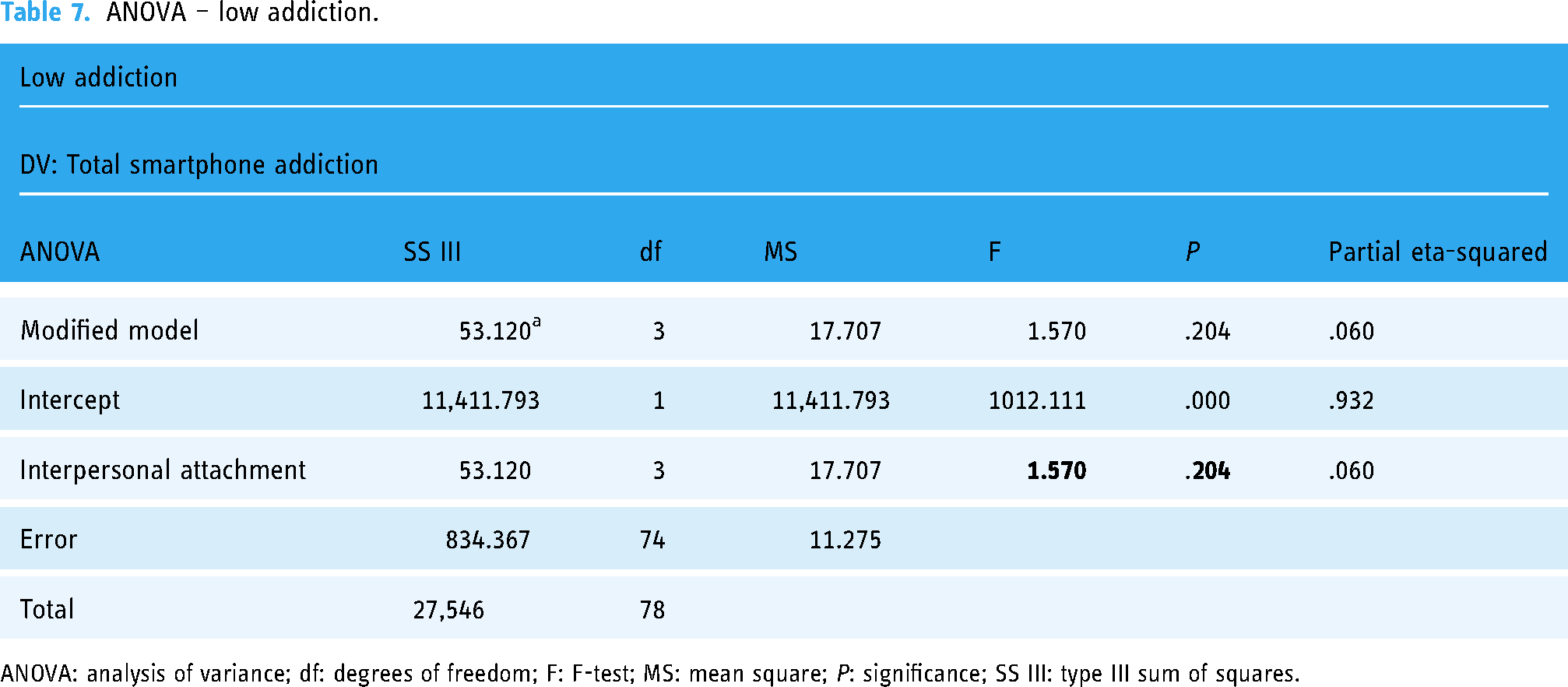
ANOVA: analysis of variance; df: degrees of freedom; F: F-test; MS: mean square; P: significance; SS III: type III sum of squares.
Multiple comparisons of the overall analysis revealed that there was no significant difference between avoidance attachment and anxiety attachment (p < 0.054) – that is, avoidance attachment and anxiety attachment are related, as a negative perception of self is a trait inherent in both forms of attachment. There was, however, a significant difference between secure and dismissing attachments (p > 0.003), indicating that the two are different in nature. Individuals with dismissing attachment tend to prefer being alone, unlike individuals with secure attachment (Table 8).
ANOVA – multiple comparison.

Discussion
To sum up the result of the analysis: first, the average value of avoidant attachment is the highest among the four styles in descriptive statistics. Second, the result of the correlation analysis revealed a positive correlation between interpersonal attachment and smartphone addiction, while revealing no relationship between gender and smartphone addiction or gender and interpersonal attachment. Finally, the participants were divided into three groups based on their pre-determined level of smartphone addiction: high, moderate and low addictions. ANOVA revealed a statistically significant difference between interpersonal attachment and high, as well as moderate, smartphone addictions. Additionally, it revealed that there was no significant difference between interpersonal attachment and low smartphone addiction, which implies a difference between interpersonal attachment and high and moderate smartphone addictions. The result of multiple comparisons also showed a difference among the four styles of interpersonal attachment. However, it did not show any significant statistical difference in avoidant and anxious attachments, both of which have the same characteristic of having a negative self-perception.
When social and interpersonal pressures arise, people may turn towards spirituality to gain a sense of security or develop a psychological attachment to their smartphones. In this study, participants were divided into four styles of interpersonal attachment: secure, avoidant, dismissing and anxious. This study indicated that individuals with avoidant attachment attempt social self-exclusion, and therefore, for self-protection, such individuals are more prone than others to turn to their smartphones (or other outlets) in search for attachment. The investigations conducted in this study revealed 182 participants with avoidant attachment. Calculated against the 1190 valid questionnaires, it can be argued that 1 in every 6.5 people displays avoidant attachment – and this is the highest ratio among the four styles. Hence, this study revealed a higher ratio of individuals with insecure attachment. The impact of avoidant attachment on interpersonal relationships cannot be ignored.
Conclusion
This study was conducted by means of quantitative analysis. The questionnaire (RSQ) developed by Wang et al. classified participants into one of the four attachment styles: secure, avoidant, dismissing and anxious. The average value of smartphone addiction was higher among those displaying tendencies of avoidant and anxious attachments. This suggests that individuals with either of these attachment styles have a negative self-perception and are at greater risk of smartphone addiction. The correlation analysis revealed no relationship between gender and smartphone addiction or gender and interpersonal attachment; it revealed a significant positive correlation between interpersonal attachment and smartphone addiction. This lends further support to the argument that individuals with insecure attachment are more prone to smartphone addiction. Next, the questionnaire (SAS-SV) developed by Kwon et al. divided the participants into three groups based on their pre-determined level of smartphone addiction: high, moderate and low addictions. The ANOVA revealed a statistically significant difference between interpersonal attachment and high and moderate smartphone addictions.
It is noteworthy that this study was limited to Taiwanese participants, in Taiwan, to assess the phenomenon of smartphone addiction. Owing to differing cultures and values around the world, conducting this investigation in another country may affect the results.
Based on an investigation and results analysis, this study concluded that increasing social support for individuals can effectively counteract smartphone addiction, allowing individuals with the condition to integrate into social environments and alleviate feelings of depression or anxiety.
This study identified a positive correlation between interpersonal attachment and smartphone addiction in Taiwan. When people with insecure attachment attempt self-exclusion from interpersonal relationships, they risk suffering from addiction. The more people attempt to escape reality, the more they may turn towards their smartphones as a solution to their problems. It is suggested to re-evaluate our engagement with our smartphones to avoid harmful habits. Additionally, we should embrace social relations, actively interact with others and strive to establish strong interpersonal relationships. Nonetheless, the attachment style notwithstanding, it is significant that individuals strive to understand themselves and better manage external relationships to reduce the occurrence of smartphone addiction.
Contributions
Source of the Interpersonal Attachment Scale: Chinh-Fu Wang (1995). Path model for love relationships of college students in Taiwan. Doctoral dissertation, Graduate Institute of Counseling, National Changhua Normal University.
Source of the Smartphone Addiction Scale: Kwon, M., Kim, D. J., Cho, H., & Yang, S. (2013). The smartphone addiction scale: development and validation of a short version for adolescents. PLoS One,
Footnotes
Declaration of conflicting interests
The author(s) declared no potential conflicts of interest with respect to the research, authorship, and/or publication of this article.
Ethical review approval
Research Ethics Committee Nation Taiwan University, NTU-REC No.:20201ES029.
Funding
The author(s) received no financial support for the research, authorship, and/or publication of this article.
