



Abstract
Objectives
Given the current shortage of blood donors in the USA, researchers have tried to identify different strategies to attract more young people and spread the voice of donors’ needs.
Methods
A systematic literature review is conducted to investigate the current mobile applications used to track, attract, and retain donors. We also provide some preliminary results of a pilot study, based on a cross-sectional survey of 952 participants (aged 18 to 39), about the willingness of donors to use mobile apps as tools for encouraging blood donation. The data is collected using a 20-item questionnaire, which includes four constructs of the Theory of Planned Behavior to assess the respondents’ willingness to donate blood. A range of statistical techniques, including univariate analysis, multivariate analysis, and structural equation modeling, were utilized to analyze the collected data.
Results
The 37 research articles, selected after applying several exclusion criteria, are classified into five main categories. The majority of the research (44.1%) is about using mobile apps to find blood donors and blood centers, followed by publications on using mobile apps to encourage blood donation (26.4%) and to recruit blood donors (14.7%). The remaining studies are about retaining blood donors (8.8%) and using mobile apps for scheduling donations (5.8%). Our pilot case study suggests that 73% of participants have favorable perceptions toward a blood donation mobile app.
Conclusions
Many efforts have been undertaken to employ mobile apps to make blood donations more convenient and create communities around donating blood. The case study findings suggest a high level of readiness of using mobile apps for blood donation among the younger generation.
Introduction
Blood donation is a noble act as it helps save human lives worldwide. According to the World Health Organization (WHO), more than 100 million blood donations occur annually, and 65% of blood transfusions in low-income countries are given to children under 5. 1 However, since the emergence of the COVID-19 pandemic, there has been a concern about the availability and sufficiency of blood transfusions to meet patient needs. Therefore, increasing awareness and encouraging young people to become regular donors is a priority for healthcare organizations.
Historical studies have demonstrated the motivators and deterrents of blood donation behaviors and intentions, including altruism, 2 the perceived need for donations, 3 fear,4,5 and extrinsic rewards. 2 In the healthcare and transfusion sector, much research has been conducted to find different mechanisms to find, encourage, recruit, and retain blood donors. One of these mechanisms has been the mobile health applications.
Mobile health or mHealth is defined as medical and public health practice supported by mobile devices. 6 Currently, a vast majority of people use apps that collect or deliver healthcare information. Those apps provide patients and providers engagement and a new way to improve health outcomes. 7 In fact, some studies have shown that using mHealth or mobile health applications can actually increase around 22.7% the number of appointments for donating blood, saving around 600,000 lives. 8
In this paper, we first conduct an extensive literature review on mobile health application that have been analyzed in the research perspective for finding, encouraging, recruiting, retaining, and scheduling blood donations. This literature review examines the different technologies, applications, and types of services of these mobile apps and presents an overview of the different ways that blood donors are found and tracked.
After understanding the different types of apps and their benefits in blood donation encouragement, we present a case study where we utilize a cross-sectional web-based survey conducted in young population to observe their attitudes toward blood donation and the use of apps for blood donation. The study will show that a high percentage of participants are willing to use mobile apps to help track their blood donations.
Our study will also show which social media platform is more commonly used among potential donors; therefore, this can be used for future campaigns for recruiting and retaining more donors in the future.
Systematic literature review
To study mobile applications for blood donor tracking, attraction, and retaining, we utilize a systematic literature review. 9 The primary purpose of the systematic review is to identify, study, and investigate the suitable existing approaches. We first carried out a “Search Process” to identify potential research papers from the scientific databases using pre-selected search keywords or strings, including “blood donors” and “mobile applications.” We had to identify these search strings to avoid findings from non-related research papers. Among various scientific databases, we used four digital database sources, including (i) IEEE Xplore, (ii) ScienceDirect, (iii) Springer Link, and (iv) the Association for Computing Machinery. We aim to identify research papers published in reputable conferences, journals, and books. The overall process for the systematic literature review is shown in Figure 1.

Attrition of systematic literature thorough processing. Adapted from the work of Kitchenham and Charters. 9
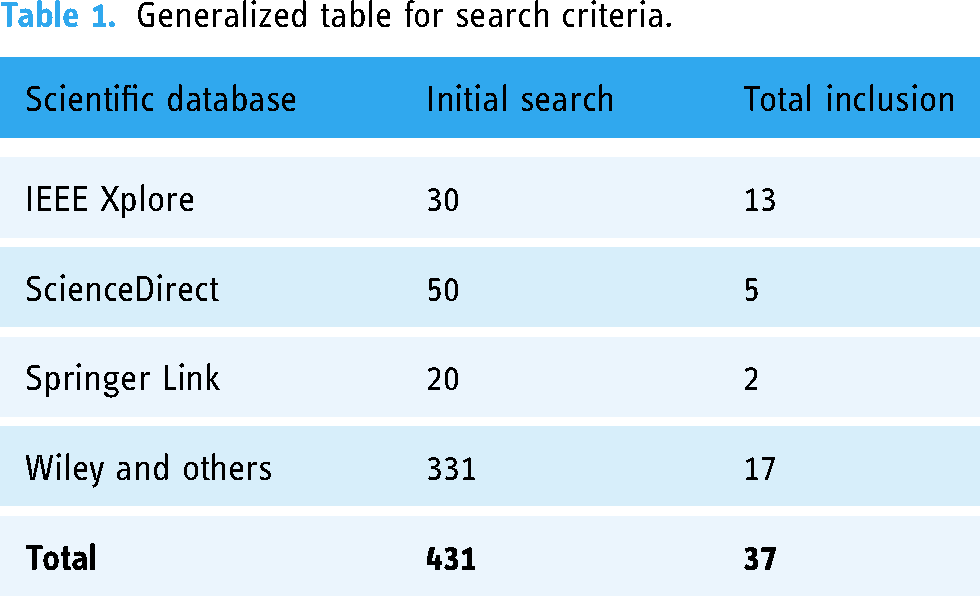
We also filtered publication topics including Blood Donors Mobile Applications for Springer Link, Mobile Applications for Blood Donors for IEEE Explore, and “Mobile App” blood donation for ScienceDirect. A total of 431 studies were found during the initial search (IEEE Xplore 30, ScienceDirect 50, Springer Link 20, and Wiley and others 331) as shown in Table 1. Once the search processes were completed, we conducted a screening process for finding relevant papers based on the paper title, followed by reading and understanding their respective abstracts and conclusions. We applied several exclusion criteria to narrow down the final set of relevant papers. These criteria include (i) duplicate papers (ii) full-text availability, and (iii) papers that are not related to blood donor identification, attraction, and retention (Table 2).
Generalized table for search criteria.
Overview of exclusion and inclusion.

The detailed identification of the 37 analyzed registers is shown in the PRISMA flow diagram in Figure 2.

PRISMA flow diagram of the literature review.
In this review, our primary focus is on mobile applications that specifically target the blood donation issue. However, it is worth noting that some of the studies we present also incorporate the integration of mobile applications with social media and digital communication technologies. To ensure clarity for our readers, when we mention mobile applications, we are referring to software applications specifically designed for smartphones and tablets that use online communication and can connect with a variety of platforms including social media.
To determine the trends in terms of mobile applications for blood donation, we have classified the papers into five main categories: mobile applications for (1) finding blood donors and blood donor centers (44.1%), (2) encouraging blood donation (26.4%), (3) scheduling blood donations (5.8%), (4) recruiting blood donors (14.7%), and (5) retaining blood donors (8.8%). Figure 3 represents the statistics of the classified papers.

Categories of the surveyed papers.
Mobile applications for finding donors. Blood donation is a voluntary act that helps save millions of lives every year. However, most of the time, when a patient requires a blood donation, the donor is typically a patient's friend or a family member. 10 In some unfortunate cases, the patient's blood group might not match with friends and relatives, which creates a significant pressure for both the patient and the patient's family to find a suitable donor. Blood banks are a frequent option; however, it should be noted that only packed red blood cells (RBCs) can be stored for up to 42 days before being transfused to a patient, and it is clinically prohibited to use blood that has been donated 30 days prior for a patient that has a serious condition. 11 Searching for a live donor is a tedious process and mobile applications that help alleviate this situation are needed.
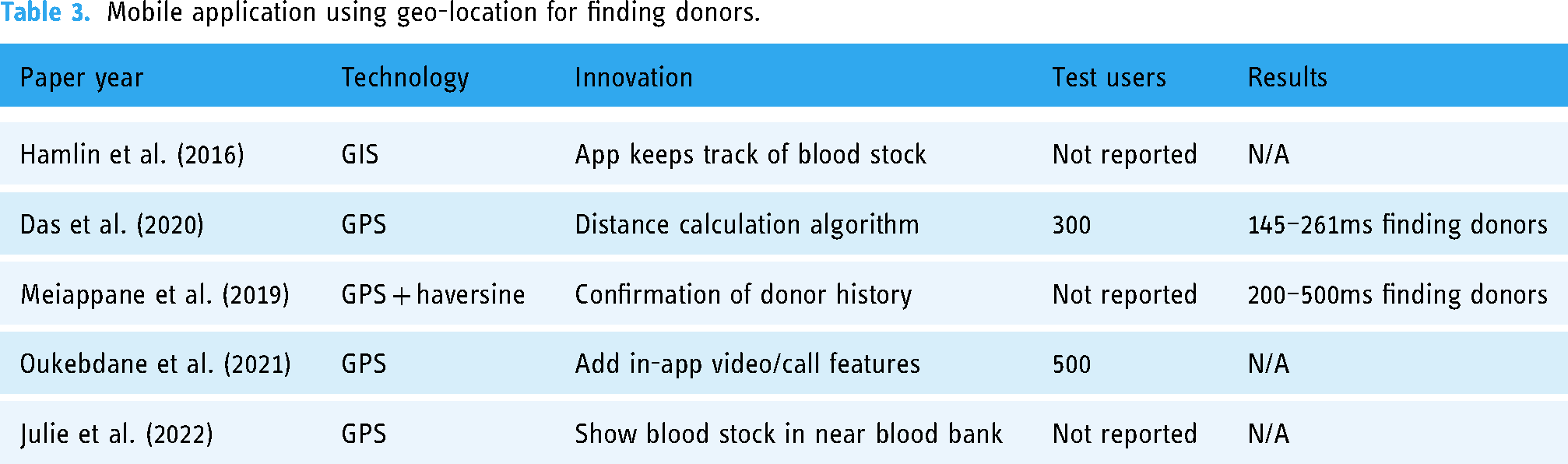
Geo-location apps: Applications that find donors using geo-location are the most common. Hamlin et al. 12 developed a mobile application that uses a Geographic Information System (GIS) to check nearby donors in a map and provides a list of the available donors in an area. Similarly, Das et al. 10 developed a mobile application that uses Global Positioning System (GPS) to find donors of requested blood groups in a radius of 5 km of the current mobile phone location. The innovation of this approach consists of a distance calculation algorithm that estimates the actual distance between the requester and the donor. Meiappane et al. 13 also use GPS and Haversine Mathematical Algorithm 14 to search the nearest donor accessible and additionally confirm the medical case history of the donor with the Department of Health and Welfare. Julie et al. 15 also use GPS technology and provide an architecture that also permits manually donor search or hospitals. Table 3 shows the diverse mobile apps developed using GIS and GPS technologies.
Mobile application using geo-location for finding donors.
Internal message exchange apps: Sending and requesting messages are also common in finding blood donor applications. For example, Fahim et al. 16 developed a mobile app that broadcasts messages across the maintained volunteer donor network and requests a response of the donor available to donate. Volunteer donors can reply to indicate their intention of donating blood. Turhan 17 developed an application for Android phones to periodically send a donor's location information to blood centers and receive alerts. The location is directly sent by the donor's phone via an application that the donor downloaded and configured. Similarly, Bhowmik et al. 18 receive via broadcasting the location of potential donors that have downloaded their application. This application particularly can work in Android, iOS, or Windows phones. Tatikonda et al. 19 also present an alternative app for finding donors. However, the application is only based on the reported location that the volunteer donor provides when registered in the application.
Powered by machine learning apps, Maraz et al. 20 used sentimental analysis to process user feedback, response rate of the donor, and current geo-location information for blood collection and distribution systems. The authors developed a bidirectional LSTM model 21 to analyze the sentiment of the user feedback. This analysis is later used to request and find donors.
Mobile applications for encouraging blood donations. Encouraging blood donations is an essential task for maintaining the level of donors across the country. Several mobile applications make the direct interaction between users and blood centers possible, which have an impact on donor encouragement. In 2016, Domingos et al. 22 developed an application called “Blood Hero.” The application applied the gamification concept, which enables users to be rewarded by social acts related to blood donation.
The authors’ purpose was to increase the number of blood donations and block stock in blood centers, while at the same time introducing new technology in health services to the population. In 2019, Hegedus et al. 23 developed “Blood Note” (Figure 4), a mobile app for promoting and facilitating blood donation. The application provides a preliminary test to determine if a donor can donate at a predetermined point of time. Other mobile applications have been successful in recruiting new donors. For example, in Lima, Peru, Chiara et al. 24 developed an app that was capable of informing 80% of their participants, who had not any experience with blood donation, about the donation process.

Example of mobile app for promoting and facilitating blood donation. Menu taken from the work of Livitz et al. 4
Other mobile apps have been developed to provide help with donation campaign management. For example, Dutta et al. 25 developed a mobile app for registering campaign agencies and campaigns for blood donation. Once a campaign has been scheduled, the app contacts all the registered donors via text messages. In 2018, Sih Uy 26 developed a mobile app for disseminating information regarding blood donation in the Philippines using the data of Red Cross Philippines. The mobile app is also updated with news, announcements, and promotional materials in order to encourage blood donation among the population.
Mobile applications for scheduling donations. In 2014, the American Red Cross launched a blood donor app 27 that helps people track their blood donations and schedule new ones (Figure 5). The app is available on iOS and Android devices. While the app exceeds more than 1 million of downloads, user reviewers complain about the inability of the app to find donor centers to schedule appointments.

American Red Cross blood donor app.
Ghamloush et al. 28 presented a work in which they incorporate a predetermined scheduling system into a mobile application for donors. While the model was implemented for a specific non-profit organization, there are still several limitations for sharing data of schedules between donors and central blood units. Alfonso et al. 29 proposed a Mixed Integer Non-Linear Programming (MINLP) model to schedule appointments of blood donors. They tried to identify the optimal appointment scheme to minimize the waiting time of all donors in a day. The approach was theoretically tested, but not implemented in real scenarios. Therefore, currently the main and dominant app for scheduling blood donations is the one from the American Red Cross. 27
Mobile applications for recruiting blood donors. Western countries are encountering difficulties in recruiting and maintaining their donor pools, 30 mainly due to a lack of recruitment and retaining processes. If noted in this survey, the vast majority of mobile applications are from Eastern and Third World countries, as they are striving to build modern transfusion systems with a high degree of safeguard against transmissible diseases. 31 Voluntary, non-remunerated blood donation is often termed “altruistic” since donors receive no material incentives for donating. 32
Then, mobile applications may play an important role in the recruitment of blood donors because they are widely used.
In 2011, Rahman et al. 33 developed a mobile application for blood donor recruitment called “Smart Blood Query,” where a new donor receives a registration ID that acts like a “virtual donor” card that makes the process of donation easier because the donor can avoid the typically long questionnaire regarding health issues. The problem is that to obtain this virtual donor card, donors need to make a previous mandatory doctor's visit.
Mobile applications for retaining blood donors. Retaining blood donors is an open research area in the medical field. Retention is defined as preventing donors from lapsing and eventually becoming inactive. Ferguson et al. 34 and Masser et al. 35 suggest interventions that make blood donation a completely planned action sequence, including inviting the donor to make an appointment, sending them reminders and contacting them if they fail to keep a donation appointment. Mobile apps are important resources in this sense.
Yuan et al. 36 conducted a study that showed that 81.3% of the participants would prefer app notifications to remind them about upcoming blood donations. However, 64% were concerned about receiving too many alerts or messages or insufficient protection for personal information (53.5%).
In 2013, Satchell et al. 37 performed another study to seek the best practices for employing mobile apps and social media to enhance the loyalty rates of young blood donors. The study first reveals three types of user's archetypes and three distinct approaches to donating blood. The user archetypes that emerged from the study are as follows: technologists interested in the systems and the machinery behind the process, biologists wanting to know more about the role of the blood after donating, and escapists looking for distractions to help them cope with donation anxiety. The distinct approaches to donating blood are the following: silent, users that avoid talking about the blood donation; spontaneous, users that prefer to donate on the fly; and sharers, users with heavy use of social media that wants to share. The authors created a mobile app interface to satisfy each group of users and approaches for blood donation. The authors also showed that sharing statistics is useful for retaining donors (Figure 6).

Statistics sharing that can help retain donors. Taken from the work of Foth et al. 37
This review revealed that many efforts have been undertaken to employ mobile apps to make blood donations more convenient and create communities around donating blood. The next section adds our own findings to this discussion of donors’ attitudes toward using mobile apps for blood donation.
Methods for the case study
This study utilizes a cross-sectional web-based survey conducted via Qualtrics at Kennesaw State University (KSU), Georgia. Participants included students, faculty, staff, as well as their family and friends (aged 18 to 39). The online survey was distributed through multiple channels, KSU Today (the university's daily electronic newsletter), emails with links to the survey, and LinkedIn groups. Data were collected between 23 June and 7 July 2022. This study was approved by the local Institutional Review Board (IRB) at KSU.
Online written consent was obtained from the participants before responding to the survey questions. After accessing the consent form located at the beginning of the questionnaire, participants could either accept participation and continue to the questionnaire or decline participation by exiting the survey. The number of participants was 952 upon removing those who did not complete the question of how likely a respondent will install a mobile app if the app can help track the contribution with blood donations. Based on Raosoft sample size calculator (http://www.raosoft.com/samplesize.html), a sample size of at least 381 participants is required to achieve a margin of error of 0.05 and a 95% confidence level. Our sample data of 952 entries is well above this required sample size.
The Theory of Planned Behavior (TPB) 38 was employed to create survey research questions using an eight-item adapted scale to assess the four constructs of the TPB. These constructs were (1) attitudes toward blood donation, (2) subjective norms of peers and loved ones, (3) perceived control of behavior, and (4) intention to donate blood.
The questions related to TPB are shown in Table 4. The construct of attitudes toward blood donation and the subjective norms related to perceived social and peer pressure were assessed using three distinct questions each. Additionally, one question was utilized to gauge perceived control over blood donation behavior, while another question captured the intention to donate blood.
Survey questions on the theory of planned behavior (TPB) toward blood donation.

Furthermore, the survey gathered demographic data from participants, including their educational background, marital status, race, and ethnicity. To assess participants’ inclination toward utilizing mobile apps for blood donation, a single question was posed: “If a mobile app can assist me in monitoring my societal contributions through blood donations, I would be willing to install and utilize it.” Respondents were provided with a 7-point Likert scale to indicate their response, ranging from 1 (Extremely unlikely) to 7 (Extremely likely).
The survey questions were thoroughly evaluated to ensure that there was no intentional bias. The independent factors included demographic variables, the composite scores of the four constructs of TPB, and the number of current social media usage. The dependent variable is the likelihood of the participant using a mobile app to help track blood donations. Subsequently, a binary variable was created to identify whether a participant was mobile app-friendly based on the cutoff level of 5, i.e., if the participant responded either “Likely,” “Somewhat Likely,” or “Extremely Likely” to use the mobile app.
Qualtrics data were exported to Minitab version 20 (Windows) for analysis, and descriptive statistics were calculated and reported. Chi-square analysis was conducted to explore the association of the independent variables with the binary dependent variable of participants’ perception of using a mobile app for blood donation. Moreover, the data were analyzed using Partial Least Squares Structural Equation Modeling (PLS-SEM) through the utilization of SmartPLS.4 software (SmartPLS GmbH, Bonningstedt, Germany). PLS-SEM is a variance-based structural equation modeling approach that is fairly robust to non-normal data, can handle both reflective and formative measurement models, and is suitable for exploratory analysis about relationships between variables.39,40 The primary objective of our analysis is to validate the theoretical model established upon the framework of the TPB.
Results
Demographic characteristics
In this study, among the 952 participants, 499 (52.42%) are male and 389 (40.86%) are female. The majority of participants are US-born (85.40%) and White/Caucasian (53.68%). Similarly, over 50% of participants have an education level of a bachelor's degree or higher. More detailed demographic information of the participants can be found in Table 5.
Demographic characteristics of survey participants.

The respondents were also asked about their current social media use by selecting among nine different types that are provided in the survey. The results presented in Figure 7 shows that Facebook and Twitter are most popular among the survey participants, followed by Instagram and LinkedIn. Other common social media such as TikTok, YouTube, Snapchat, Reddit, Pinterest, and WhatsApp are also present in the survey responses.

Types of social media use.
The respondents’ comfort level and familiarity with technology was assessed indirectly using the number of social media outlets that they use currently. The data suggested that 31.4% of the respondents use only one social media and 19.3% use two social media outlets, whereas 20.8% use at least five different social media outlets (Figure 8).

The percentage of the number of social media used by participants.
Overall, about 73% of participants report willingness to use the mobile app to help track their blood donations (Figure 9). This ratio is consistent among both female (73%) and male (76%) participants.
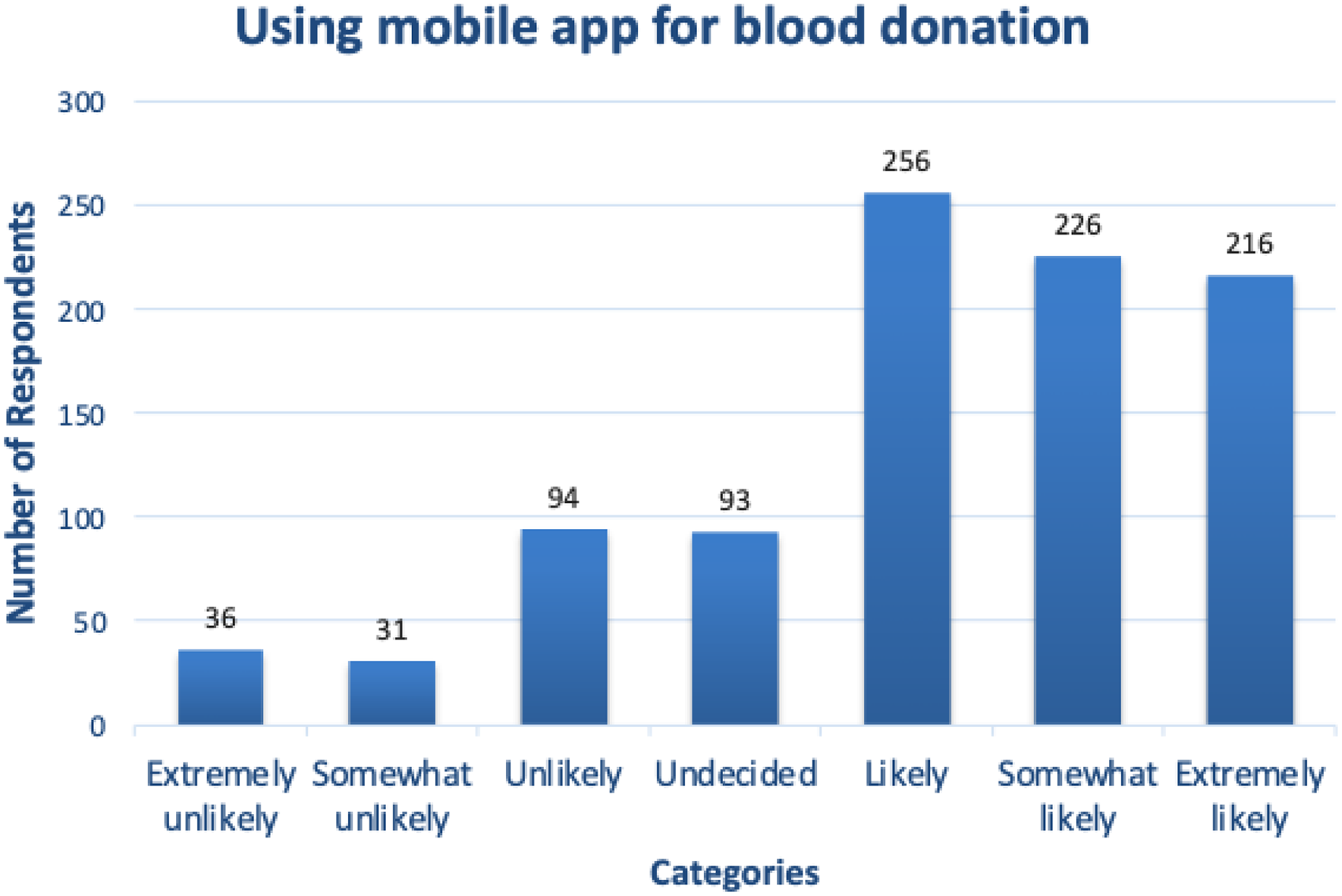
Attitude toward using mobile app for blood donation.
Additionally, the correlation between the likelihood of using the blood donation app and the total number of social media use has been analyzed, but the result is not significant (p-value = 0.38).
Mobile app preference and TPB factors
The participants’ preferences toward a mobile app were assessed using a 7-point Likert scale, where higher values indicate a more favorable inclination. Four constructs derived from the TPB model were employed to measure different aspects: attitude, subjective norms of peers and loved ones, perceived control, and intention toward donating blood. Intrinsic motives were represented by attitude and perceived control, while the subjective norms of peers and loved ones represented the extrinsic motive.
We removed two items from the attitudes and subjective norm scales due to low factor loadings. The factor loading for the attitude item (“For me to not donate blood is”) was 0.08, indicating that respondents may have failed to pay attention to this reversely worded item, while the subjective norms construct item (“Most people whose opinions I value would approve of my donating blood on a regular basis”) had a factor loading value of 0.28. These low values indicate that these variables do not strongly align with the constructs being measured and contribute less to the overall measurement. By eliminating these variables, we can focus on more meaningful and reliable indicators in the analysis.
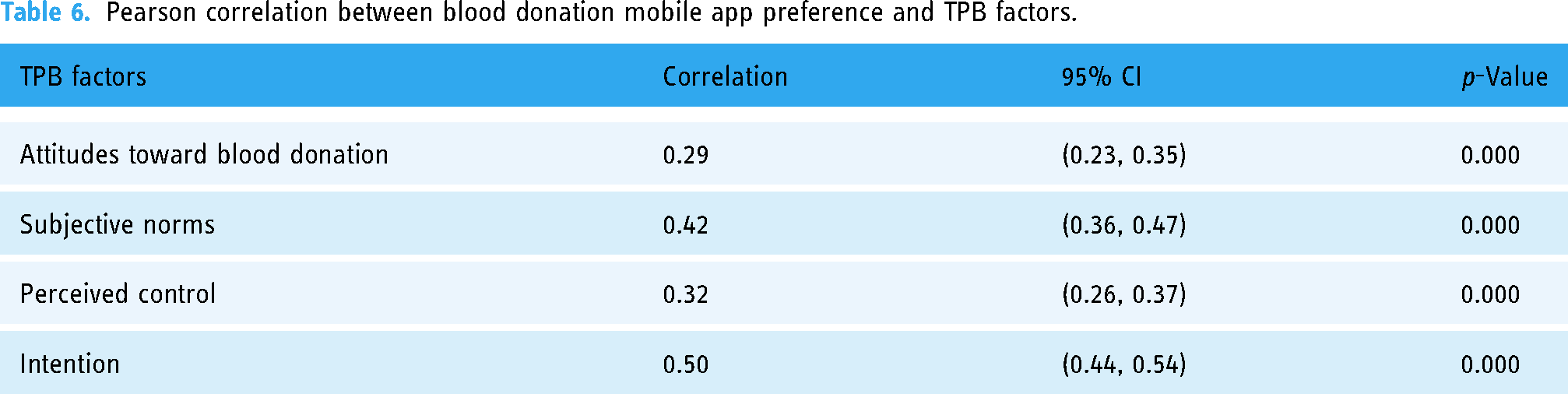
To evaluate the strength and direction of the monotonic relationship between mobile app preference and each of the four TPB variables, statistical analysis based on Pearson correlation coefficient was utilized.
Table 6 illustrates that participants’ preference for using a mobile app for blood donation shows positive and statistically significant correlations with all four TPB factors. The intention variable exhibited the strongest correlation (r = 0.50), followed by the subjective norms (r = 0.42), perceived control (r = 0.32), and attitude (r = 0.29).
Pearson correlation between blood donation mobile app preference and TPB factors.
Mobile app preference and associated demographic factors
We conducted Chi-square test (with a significance level α = 0.05) for the association to determine how different demographic factors such as biological gender, birthplace, marital status, and education level affect their preference of whether to use blood donation mobile app, as shown in Table 7. In this analysis, the binary dependent variable, Mobile App Preferred, was created using a cutoff level of 5 on the 7-Likert scale of the likelihood responses on blood donation mobile app use. Mobile App Preferred = 1, when respondents expressed that they are likely, somewhat likely, or extremely likely to use a mobile app, and Mobile App Preferred = 0 if otherwise.
Chi-Square test of association of mobile app usage and demographic factors (number/percentage %).

Table 7 contains detailed information on the significant factors based on the p-value of the Chi-square test. Three factors, education level, marital status, and race and ethnicity, have been found to be strongly correlated with the binary outcome of whether or not the respondents will use blood donation mobile app.
Structural equation modeling result
The detailed structural model using PLS-SEM is shown in Figure 10, where all the path coefficients are significant. To evaluate construct reliability, the internal consistency of TPB latent variables, namely, attitude and subjective norm, is examined. The composite reliability score for the attitude construct is 0.74, while that for subjective norm is 0.83, both surpassing the threshold of 0.70 indicating a satisfactory level of internal consistency. The average variance extracted (AVE) value of all the constructs is higher than 0.50, indicating adequate convergent validity. Moreover, all constructs exhibit a variance inflation factor (VIF) <= 2, well below the acceptable threshold of 10, indicating no concerns regarding multicollinearity. Furthermore, the outer loadings of all the indicators are above 0.70 for the convergent validity test. The coefficient of determination (R2) for intention is R2 = 0.34 and for mobile app preference is R2 = 0.28, both of which are considered sufficient.

Structural model of mobile app preference. Note. *p < .05; **p < .01
In our study, the control variable, education level, was categorized into two groups: those with a bachelor's degree or higher (coded as 1) and those without (coded as 0). To assess the significance of the path coefficients, we employed a bootstrap method with 5000 subsamples. A two-tailed test was conducted using a Student's t-distribution with a 95%.
The results of the PLS-SEM in Table 8 show that attitudes (path coefficient = 0.11, p < 0.001), subjective norm (path coefficient = 0.46, p < 0.001), and perceived control (path coefficient = 0.18, p < 0.001) were all positively related to intention to donate blood. Additionally, there is a significant positive relationship between intention to donate blood and mobile app preference (path coefficient = 0.43, p < 0.001). The mediation effect of intention to donate blood is shown in Table 9. Consistent with the TPB, we found that attitudes, subjective norms, and perceived control were related to mobile app preference indirectly via intention to donate blood. We also found that perceived control had a significant direct effect on mobile app preference. Among the indirect paths to predict the preference for blood donation mobile app, the one starting from subjective norm and connecting through intention was the most relevant to explain the mobile app preference.
Summary SEM result.

Summary of the indirect effects.

Discussion
The aging baby boomer blood donor base, coupled with decreases from younger age groups, is an ongoing public health concern and impacts all people in need of blood transfusions regardless of gender, age, racial, or ethnic background. Despite demonstrated effectiveness of regular donations from the baby boomer generations, America's Blood Centers cites millennials and younger donors failing to donate at similar rates. Thus, it is critical to enhance the sustainability of the blood supply in the USA by creating a framework that effectively recruits and sustains a younger, diverse generation of blood donors. Recent findings suggest that the blood donation mobile app may play an important role in recruiting, engaging, and retaining young blood donors.
In this pilot study, we investigate the attitude toward using a mobile app for blood donation among the younger populations (aged 18 to 39). In addition to demographic information, our survey also captures participants’ intention to donate blood based on the social cognition model, TPB, as well as their current social media usage. To the best of the authors’ knowledge, this is one of the first studies that examine the association of TPB factors that measure the blood donation intention toward the perception of using a mobile app.
The multivariate analysis suggests that approximately 73% of participants have favorable perceptions toward a blood donation mobile app, which is slightly higher than the ratio (two-thirds) found by a previous study conducted in 2016. 36 Demographic factors, such as education level, marital status, and race and ethnicity, are found to be significant (p-value <= 0.05) in participants’ attitudes toward a blood donation mobile app. Approximately 48% of participants with less than a high school diploma are likely to use mobile apps versus 70% of participants with higher education degrees. Race and ethnicity also influence the perception of blood donation mobile apps, with American Indian or Alaska Native being mostly favorable to use a mobile app (about 81%), followed by White/Caucasian together with Native Hawaiian or other Pacific Islander (both around 76%). The multi-racial group has the least likelihood of using the mobile app (at 50%).
Additionally, our findings show that participants’ intentions to donate blood, measured by the four constructs of the TPB model, are positively correlated with the preference for using a blood donation mobile app. The participants who are more likely to donate blood are more interested in using a mobile app to help them track their contribution to society with blood donations. This finding is encouraging for researchers who are developing different mobile apps to assist in effective donor recruitment and retention.
Our survey also collects information about participants’ current use of social media outlets to investigate if this correlates with the likelihood of using a mobile app. Even though we hypothesize that the number of social media use can potentially be a predictor of whether a participant is likely to use a blood donation mobile app, no statistically significant findings can be drawn between these two based on the current data.
Our exploratory study also examined the structural model, which included the TPB elements as well as demographic factors such as the participants’ education level. Consistent with previous findings, 40 our results indicate that the TPB factors play a significant role in explaining the intention to donate blood and indirectly impact the preference of using blood donation mobile app through such intention.
Specifically, perceived control emerges as the strongest factor influencing the intention to donate blood, while the intention to donate blood exhibits the strongest positive impact on the preference of using a mobile app. Moreover, education level not only affects the intention to donate blood but also influences the preference of using a mobile app. Our analysis suggests that individuals with a higher education level, specifically those with a bachelor's degree and above, are more likely to engage in blood donation and utilize mobile apps for this purpose.
The results of our study have several practical implications. Firstly, the utilization of blood donation mobile apps can be an effective strategy to engage and support blood donation efforts. Collaborating with other blood donation centers to develop and launch their own mobile apps, along with targeted campaigns, can help address the shortage of young blood donors.
Secondly, subjective norms play a crucial role in motivating blood donation and mobile app usage. Therefore, initiatives aimed at improving subjective norms and fostering a positive perception of blood donation can be highly effective. Promoting the positive impact of blood donation through various channels can help shape societal attitudes and encourage more individuals to participate.
Lastly, considering that individuals with higher levels of education are more inclined to install blood donation apps, partnering with educational institutions presents a valuable opportunity to reach this demographic. Engaging high schools and universities in blood donation promotion and actively encouraging the younger generation to become blood donors can have a significant impact on increasing participation rates.
Limitations
This study has a few limitations. First, the scope of survey participants is relatively limited. The survey was conducted at one public university in Georgia; thus some of our findings may not be generalizable to other different regions. Second, even though the composite reliability is sufficient, Cronbach's alpha for TPB questions in the current survey is comparably low. This is partly due to the small number of questions on two of the constructs, the perceived control, and the intention to donate blood. As a part of our future work, we plan to include more questions in each of the TPB constructs. Additionally, our survey lacks the participants’ age group information; thus our current study is unable to capture the difference, if any, between Millennial Generation and Generation Z in blood donation behavior as well as receptiveness toward a blood donation mobile app. Lastly, it is important to note that our study did not collect data on participants’ previous blood donation status. This limitation restricts our analysis in terms of comparing participants based on their previous donation versus non-donation status.
Moreover, our study has a limitation in that it did not account for other mobile app usage-related concerns. For example, the installation and use of mobile apps can pose challenges, particularly for older adults who may not be as familiar with the technology. Additionally, it is worth noting that not all mobile applications for blood donation are available in different languages. Therefore, it is important for app designers to consider the needs of senior citizens and individuals who are non-native speakers of the language in which the app is developed.
These considerations can significantly impact the actual usage of the software and potentially influence blood donation rates. In future research, we plan to address these factors to determine their direct effect on blood donation rates.
Despite these limitations, the pilot survey results show a high degree of receptiveness for a blood donation mobile app among younger generations. The mobile app can also be used to effectively attract and retain donors. The willingness of using a mobile app is also positively correlated with the donors’ intention to donate blood which provides further support for blood banks and centers to invest in developing convenient mobile apps.
Conclusion
There is an urgent societal need to successfully recruit a younger generation (aged 18–39) of sustainable blood donors to complement and eventually replace the aging baby boomer generation. This requires novel approaches on both sides of the blood supply chain to create a sustainable blood donor base. Technological advancements have provided great potential for mobile apps to alter and improve blood donation recruitment and retention. Our systematic literature review of the current mobile applications that are used to track, attract, and retain donors indicates the importance of these mobile apps from both the donor's and the blood center's perspectives. The preliminary results of a pilot study, about the willingness of donors to use mobile apps as tools for encouraging blood donation, suggest a high level of adoption readiness among the younger generation.
Footnotes
Acknowledgements
The authors would like to thank the following students for their assistance in creating Qualtrics surveys and performing preliminary data analysis: Emily Rodriguez-Jacobo and Ashley McNeal.
Contributorship
All authors are involved in the conceptualization of the study. MV conducted the searches, the screening, and the extraction of the selected papers. LL, RK, and AMU performed the data cleaning and multivariate analysis. LL and DZ carried out the analysis using structural equation modeling (SEM). All authors contributed, reviewed, and approved the manuscript.
Declaration of conflicting interests
The authors declared no potential conflicts of interest with respect to the research, authorship, and/or publication of this article.
Ethical approval
The study was conducted in accordance with the National Commission for the Protection of Human Subjects of Biomedical and Behavioral Research and approved by the Institutional Review Board of Kennesaw State University (IRB-FY22-527).
Funding
The authors received no financial support for the research, authorship, and/or publication of this article.
Informed consent
Online written consent was obtained from the participants before responding to the survey questions. Participants were allowed to terminate the survey at any point of time if they desired. Following the General Data Protection Regulation (GDPR), confidentiality and privacy were protected. All the identifiable confidential information is removed for data analysis.
Guarantor
LL.
