



Abstract
Objectives
The purpose of this study was to investigate the impact of eHealth, the use of information and communications technologies to improve or enable health and health care, on lifestyle behaviors through social support and patient empowerment as serial mediators.
Methods
We conducted an anonymous online survey of 29 items in October 2019 to assess Chinese people's eHealth activities (i.e. engaging in online health-related activities), social support (including emotional and instrumental support) and patient empowerment, for a lifestyle change. A total of 681 respondents aged 18 or above (49.9% males) with an average age of 30.8 completed the survey.
Results
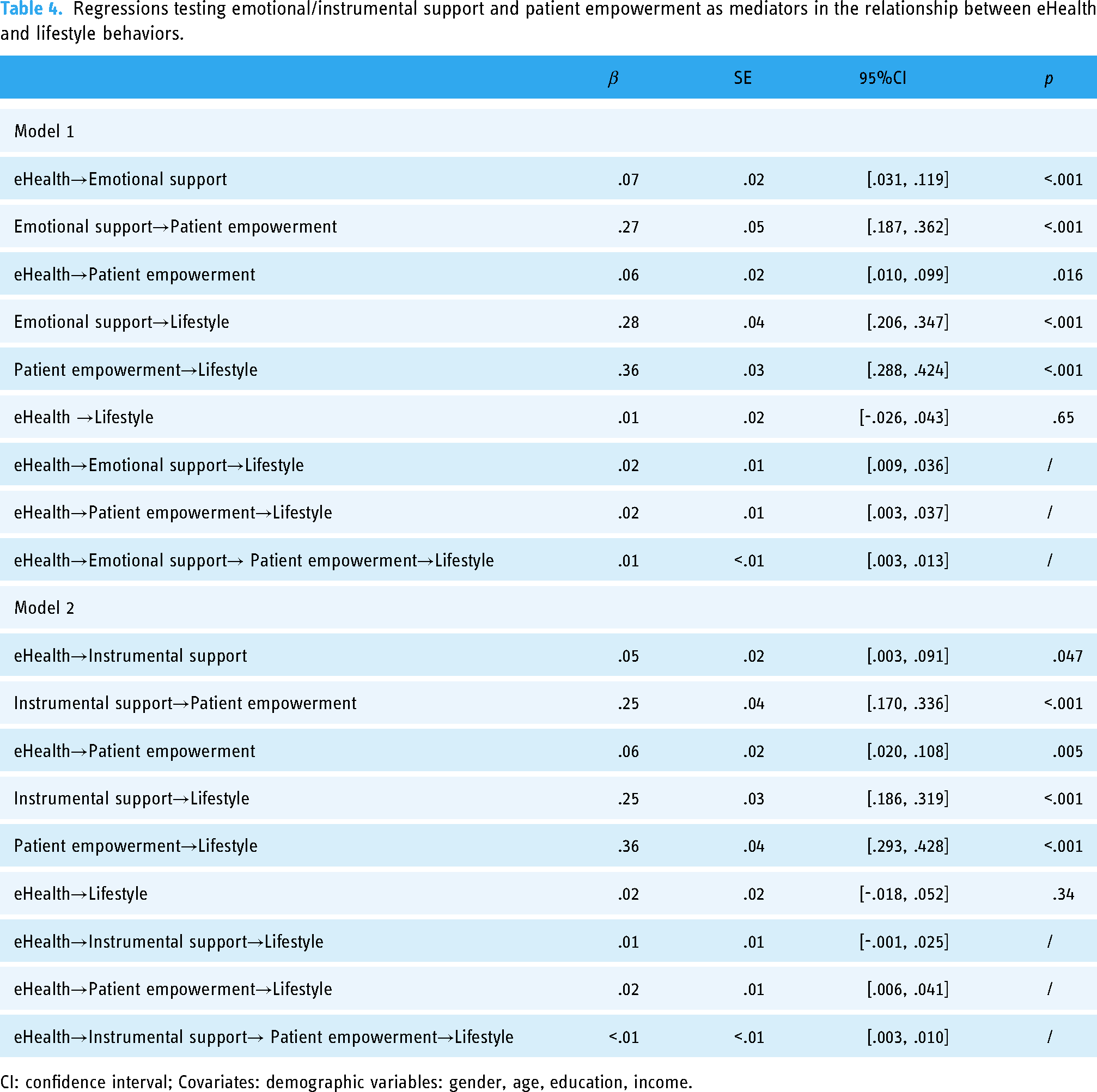
Social support (including emotional and instrumental support) and patient empowerment were found to be salient mediators between eHealth and lifestyle behaviors. Specifically, engaging in eHealth activities can improve both perceived emotional support and instrumental support from care networks, of which both would increase patient empowerment, which subsequently prompted healthy lifestyle behaviors (β = .01, confidence interval (CI): [.003, .013] for emotional support as the first mediator; β < .01, CI: [.003, .010] for instrumental support as the first mediator). However, the results showed that engaging in eHealth activities was not directly associated with a healthy lifestyle (β = .01, p = .65).
Conclusions
Our findings suggest that eHealth is effective and useful to drive people into action to develop healthy lifestyle behaviors. Particularly, by providing multiple potential sources of social support, eHealth will promote both emotional support and instrumental support, which is vital to increase patient empowerment, and eventually leads to healthy lifestyle behaviors.
Introduction
eHealth, one of the products of the wide application of information and communication technologies (ICT) in health care, refers to “the use of ICT, especially the internet, to improve or enable health and health care.” 1 eHealth enables individuals to access more resources needed for health care (e.g. information and medicines), and allows both patients and providers to actively engage in health care processes. Research has documented an array of benefits of eHealth interventions, such as increased health screening, 2 enhanced patient-provider communication, 3 improved patient activation and empowerment 4 and improved quality of life.5,6 For these reasons, nowadays, the internet has increasingly become a mainstream avenue of approach to health care in China. For instance, Jiang found that Internet applications, such as email, social media and patient portals, have been increasingly used for patient-provider communication in China. 7 Despite the beneficial role of eHealth in improving clinical outcomes has been a focus of public health research in the past years, there remains a paucity of research examining the influence of eHealth on lifestyle behaviors, which are important for diseases prevention and control, and potentially determine individuals’ quality of life.
Previous eHealth and lifestyle studies have invariably focused on online public health campaigns as eHealth interventions (e.g. websites designed for healthy eating promotion) in changing individuals’ lifestyle behaviors, such as physical activities and dietary behaviors.8,9 However, prior research has relatively ignored how ordinary eHealth activities in people's daily routines, such as looking for internet health-related information, purchasing medicine or vitamins online, and checking medical test results through patient portals, influence their lifestyles. The effects of eHealth interventions may be attributable to media messages, 10 which are strategically produced and diffused to target certain populations (e.g. pregnant women and cancer survivors) within a specific period of time. For instance, Carolan-Olah et al. developed an informative and useful website for online information provision to promote healthy diet and exercise in pregnancy, and their findings have supported the effectiveness of the eHealth intervention in positive changes in health outcomes. 8 Nevertheless, the impact of eHealth on lifestyle behaviors can manifest itself in a less strategic way, insofar as the internet has become a salient and alternative approach for individuals’ routine health care activities (e.g. information acquisition and patient-provider communication). Therefore, the current study focuses on people's routine eHealth activities for health care rather than on eHealth campaigns.
Of particular interest in this study is the role of social support and patient empowerment may play in mediating the relationship between eHealth and lifestyle behaviors. Social support, as defined in this study, is functional support that involves the degree to which the usage of eHealth interventions in real life serves specific functions that provide health-related information and emotional comfort to empower patients and lead a healthy lifestyle among them, with two common types of the function being emotional support and instrumental support. 11 Emotional support refers to the psychological support that helps an individual feel loved and cared for, and that bolsters one's sense of self-worth. 12 Whilst instrumental support is the assistance in problem-solving through information or tangible and practical help. 13 The health-protective properties of social support have been well established in the literature. For instance, Kalichman et al. found that eHealth was significantly associated with perceived social support in people living with HIV/AIDS because they were likely to solicit medical advice from professionals over the internet and receive empathetic care and support from online communities. 14 Likewise, engaging in eHealth activities such as patient portal usage or internet health information seeking was also found to be associated with increased social support in other studies.15,16 Furthermore, we can expect that eHealth and social support would equip patients with needed health care skills for individual empowerment.17,18 For instance, Barak et al. maintained that eHealth activities such as online community engagement could empower patients through social support provision that contributed to one's sense of control, self-confidence and health care skills. 17 Subsequently, eHealth users who have received adequate social support and feel empowered are likely to engage in healthy lifestyle behaviors to maintain good health.
Building on previous research, the current study proposed and tested mediation pathways linking eHealth to lifestyle behaviors, with additional assessment of the mediating roles of social support and patient empowerment (see Figure 1). Specifically, two types of social support, namely emotional support and instrumental support, were differentiated to investigate how eHealth varies in its influence on lifestyle outcomes according to different types of social support. That is, we postulated that the change in emotional and instrumental support, then patient empowerment, served as the underlying mechanism between eHealth activities and lifestyle behaviors. This study thus hypothesizes that (a) eHealth is associated with lifestyle behaviors; (b) the effect of eHealth on lifestyle behaviors would be mediated by social support; (c) the effect of eHealth and lifestyle behaviors would be mediated by patient empowerment and (d) eHealth would also affect lifestyle behaviors by sequential intervening variables: social support and patient empowerment.

Conceptual framework.
Methods
Sample
This study was approved by the research ethics committee of the author(s)'s institution. The data were collected through an online survey in October 2019. Respondents were recruited online according to APA ethical standards by Wenjuanxing (https:// www. wjx. cn/), a Chinese commercial survey website like Amazon Mechanical Turk (MTurk). From a sampling pool of 2.6 million preregistered members, Wenjuanxing recruited participants from different geographic areas of China. Adult members (aged 18 and above) received an e-mail containing a clear introduction to our survey, and they can access the online questionnaire through a link. The original questionnaire was developed in English and later translated into Chinese. Before starting the survey, respondents were assured that all the responses would be anonymous and used in academic research and provided consent to join this study. Eventually, a total of 681 respondents participated in the survey. The average age of the sample was 30.8 years (ranging from 18 to 65), with 49.9% males, 82.5% college or above graduates, 65.5% married and 54.2% having a monthly income between 4000 and 10,000 Chinese yuan (CNY).
Measures
eHealth activities were measured by a series of questions derived from Kontos et al. 19 to assess everyday engagement in eHealth activities. Respondents were asked whether they have ever engaged in seven online health-related activities in the past 12 months: (a) look for health or medical information; (b) buy medicine or vitamins online; (c) look for a health care provider; (d) use email or the Internet to communicate with a doctor or a doctor's office; (e) make appointments with a health care provider; (f) track health care charges and costs and (g) look up test results. Dichotomized responses (0 = no, 1 = yes) were added up as the measure of eHealth activities (M = 3.12, SD = 1.56).
Emotional support and instrumental support were measured with a social support scale based on Shakespeare-Finch and Obst. 20 The scale was widely used to measure both emotional ad instrumental support. Sample items of emotional support include: “I feel I have a circle of people who value me” and “there is someone I can get emotional support from.” Sample items of instrumental support include: “I have someone to help me if I am physically unwell” and “there is someone who can help me when I am unable.” A total of 11 items were used and scaled with a five-point scale continuum from 1 (strongly disagree) to 5 (strongly agree). The items were averaged to create the measure of emotional support (M = 3.74, SD = .78, Cronbach's alpha = .75) and instrumental support (M = 3.55, SD = .81, Cronbach's alpha = .71).
Patient empowerment was measured using two items adapted from Audrain-Pontevia and Menvielle 21 to give a comprehensive and focused assessment. Respondents were asked to indicate to what extent they agree with three statements on a five-point scale when 1 meant “strongly agree” and 5 meant “strongly agree.” Sample items include: “I can make every possible effort to achieve disease goals” and “I can manage my disease conditions.” An index of patient empowerment was created by adding the items and dividing them by two (M = 3.61, SD = .81, Cronbach's alpha = .70).
Lifestyle was measured using a scale addressed from previous research. 22 The scale was used previously in the Chinese context, which was similar to this study. Participants were asked to rate the extent to which they have engaged in healthy lifestyle behaviors, such as spending about 8 hours sleeping every day, exercising regularly, and having enough time for enjoyable activities. A five-point scale was used (1 = never, 5 = always), and the answers were averaged with a high score denoting a healthier lifestyle (M = 3.36, SD = .74, Cronbach's alpha = .76). The descriptive details of the focal variables are shown in Tables 1 and 2.
Descriptive statistics of eHealth activities.

* p < .05; ** p < .01; *** p < .001
Descriptive statistics of emotional support, instrumental support, patient empowerment and lifestyle.

Data analysis
SPSS version 22 was used to analyze the data. First, a bivariate Pearson correlation was conducted to show bivariate associations between eHealth, emotional support, instrumental support, patient empowerment and lifestyle behaviors. Second, SPSS PROCESS (Model 6) 23 was used to examine the mediating effects of social support and patient empowerment in the relationship between eHealth and lifestyle behaviors. In the analysis, a 95% confidence level for the confidence interval (CI) was used, bootstrapping with 5000 iterations using a bias-corrected method.
Results
Bivariate correlations among key variables of this study are presented in Table 3, indicating significant correlations among eHealth, emotional support, instrumental support, patient empowerment and lifestyle behaviors (r ranging from .12 to .61, p < .01 and below).
Zero order correlation of key variables.

* p < .05; ** p < .01; *** p < .001.
As depicted in Table 4, no significant direct association was found between eHealth and lifestyle behaviors. Whereas, results in Table 4 supported the indirect relationship between eHealth and lifestyle behavior via (a) emotional support (β = .02, CI: [.009, .036]), (b) patient empowerment (β = .02, CI: [.003, .037]), (c) emotional support and patient empowerment in sequence (β = .01, CI: [.003, .013]) and (d) instrumental support and patient empowerment in sequence (β < .01, CI: [.003, .010]). No significant mediation effect of instrumental support between eHealth and lifestyle behaviors was revealed.
Regressions testing emotional/instrumental support and patient empowerment as mediators in the relationship between eHealth and lifestyle behaviors.
CI: confidence interval; Covariates: demographic variables: gender, age, education, income.
Discussion
The purpose of this study was to examine the influence of eHealth on lifestyle behaviors, social support and patient empowerment. Results of the current study indicated that emotional support, instrumental support and patient empowerment were potential mechanisms linking eHealth and lifestyle behaviors. Specifically, engaging in eHealth activities can promote both emotional and instrumental social support, which may lead to an increase in patient empowerment, then resulting in healthy lifestyles. These findings extend the previous literature by explicating that people's routine eHealth activities for health care were beneficial to improve healthy lifestyle behaviors. Details of the results are discussed hereunder.
As expected, the hypothesized mediation effects of social support and patient empowerment in the distal relationship between eHealth and lifestyle behaviors were supported. Specifically, we proposed that the change in emotional support, instrumental support and patient empowerment is the mechanism of eHealth's influence on lifestyle behaviors. First, engaging in eHealth activities can improve both perceived emotional support and instrumental support, and higher levels of emotional support and instrumental support would increase patient empowerment, which subsequently prompted healthy lifestyle behaviors. The internet allows users to engage in a variety of eHealth activities, and it is understandable that as people perceived greater support such as adequate internet health information, timely health counseling, comfort and encouragement from online communities, and easy access to electronic medical records via a patient portal, they are likely to be empowered for self-care and health management. 24 As a result, empowered patients with sufficient knowledge and high efficacy to maintain health and wellness would be more likely to practice healthy lifestyle behaviors. Second, patient empowerment mediates the influence of eHealth on healthy lifestyle behaviors. It is not surprising that eHealth would increase patient empowerment. As patients become more capable of using eHealth services to fulfill their health care needs, they are empowered to maintain healthy lifestyles competently. Third, perceived emotional support can also expedite the healing process and play a mediation role between eHealth and lifestyle behaviors. Whereas instrumental support did not mediate the association between eHealth and lifestyle behaviors. This finding was consistent with prior research suggesting that, compared to instrumental support, emotional support was more salient to improving patients’ adherence to health advice and maintaining healthy lifestyle behaviors.25–28 Nevertheless, scholars suggested that emotional support usually exerts influence in combination with other types of social support, such as informational support and instrumental support. 26 Despite that instrumental support did not mediate the association between eHealth and lifestyle behaviors, it serves as an indispensable part that potentially strengthens the influence of emotional support by gratifying one's informational and instrumental needs.
However, findings indicated that there is no direct association between eHealth and healthy lifestyle behaviors. One plausible explanation may be that eHealth, investigated in the current study, was a behavioral variable that emphasized individuals’ usage of new information technologies for health-related purposes, such as health information seeking, online patient-provider communication and online medicine purchasing. However, we need to know more about the attitudinal or cognitive consequences of eHealth, which are critically important to the changes in individuals’ lifestyle behaviors. For instance, one might be sophisticated to use the internet to search for health information (e.g. cancer prevention, diet and weight loss), but he/she might end up with unhealthy lifestyle habits due to inadequate social support and low health locus of control.29,30 Thus, it is understandable to think that engaging in eHealth activities does not necessarily translate to healthy lifestyle behaviors, and this calls for a further investigation of the underlying mechanisms through which eHealth would influence lifestyle behaviors.
Taken together with the findings in the analyses, this study illustrates indirect pathways in the relationship between eHealth and healthy lifestyle behaviors and uncovers three salient mediators: emotional support, instrumental support and patient empowerment. This may suggest that eHealth is effective and useful to drive people into action to develop healthy lifestyle behaviors such as keeping regular exercise, engaging in social activities and getting enough sleep. Particularly, eHealth will promote both emotional support and instrumental support, which is vital to increase patient empowerment, and eventually leads to healthy lifestyle behaviors.
The current study has heuristic value and practical implications for public health research. First, given the important role of eHealth in lifestyle improvement, multifaceted strategies should be implemented to prompt eHealth services. For instance, the internet would be more effective to disseminate health-related information, facilitating patient-provider communication and allowing access to social support. Thus, we should continue to improve the ICT infrastructure to improve the accessibility of eHealth services and create better conditions for eHealth interventions. Second, considering the significant role of emotional support, instrumental support and patient empowerment as mediators in the relationship between eHealth and lifestyle behaviors. Health care professionals who use the internet to deliver counseling services should pay more attention to patients’ emotions, feelings and psychological needs, and provide comfort and emotional support accordingly. Meanwhile, practitioners should also continuously improve quality eHealth services, such as providing credible and useful health information and building harmonious health-related online communities for patients’ informational and emotional support acquisition. Third, it is equally important to enhance patients’ eHealth literacy and health competence so that they would be capable of taking use of eHealth services appropriately. For instance, practitioners can implement intervention programs to educate patients and improve their ability to distinguish trustworthy health information on the internet and find licensed professionals for health counseling.
Limitations
Several limitations of this study should be noted. First, the cross-sectional nature of the survey might preclude an assessment of causal relationships. To draw an accurate conclusion of the causal direction between eHealth, social support, patient empowerment and lifestyle behaviors, experimental research design or multi-wave longitudinal investigations are required to better understand the relationships examined. Second, the variable measuring eHealth did not account for frequency or duration of uses but only having participated in a variety of eHealth activities. This provides a limited measure of individuals’ eHealth activities. To overcome this problem, scholars should consider eHealth usage frequency and duration of time spent to better understand people's eHealth behaviors which are routine and habitual choices. Third, respondents with bias might be overrepresented in online survey samples. Thus, the findings of this study are skewed and cannot be generalized to the whole population in China. Scholars should use probability sampling and replicate this study in other sociocultural contexts. Fourth, this study identified two types of social support and patient empowerment as important mediators in the relationship between eHealth and lifestyle behaviors, and other potential intervening variables might be neglected. Future research should further the exploration to fill the research gap. In addition, this study only investigated general eHealth activities in China, with the specific eHealth systems used by the participants and the geographical area participants live in being not controlled for. Therefore, interpreting the findings of this study should be cautious with the ecological validity. Future research may investigate specific eHealth solutions and take geographical backgrounds into consideration to further validate and expand the findings of this study.
Conclusion
This study offers empirical evidence supporting the associations between eHealth and healthy lifestyle behaviors, with additional assessment of underlying mechanisms. Although engaging in eHealth activities might not be directly associated with lifestyle improvement, eHealth can exert an influence on lifestyle behaviors via emotional support, instrumental support and patient empowerment. Understanding these relationships can help enhance eHealth services, promote the adoption of eHealth and improve the public's healthy lifestyle behaviors.
Footnotes
Contributorship
PLL conceptualized and designed the study, conducted data collection, analyzed the data and drafted the manuscript. YZ conducted data collection, analyzed the data and reviewed and edited the manuscript and approved the final version of the manuscript. XZ reviewed and edited the manuscript and approved the final version of the manuscript.
Declaration of conflicting interests
The authors declared no potential conflicts of interest with respect to the research, authorship, and/or publication of this article.
Ethical approval
This study meets established ethical standards and has obtained ethics approval.
Funding
The authors disclosed receipt of the following financial support for the research, authorship, and/or publication of this article: This research is supported in part by grants from the University of Macau, including CRG2021-00002-ICI, ICI-RTO-0010-2021, CPG2021-00028-FSS and SRG2018-00143-FSS, ZXS PI; Macau Higher Education Fund, HSS-UMAC-2020-02, ZXS PI.
Guarantor
N/A.
