




Abstract
Objective
Drawing upon the health belief model, this study aims to analyze the message characteristics of coronavirus disease 2019 (COVID-19) vaccination promotion messages posted by influential Chinese public health institutions and how those characteristics affect audiences’ participative engagement on Weibo, which is a popular social media site in China.
Methods
Two Chinese phrases for the COVID-19 vaccine were adopted as search terms to retrieve qualified posts on Weibo from 1 December 2019 to 18 March 2023. A total of 2546 posts by the top nine most impactful public health institutions were retained for quantitative content analysis. Message characteristics derived from the health belief model and participative engagement indicators were coded by the authors.
Results
Among health belief model constructs, the collective-oriented constructs (i.e., benefits, cues to action, and susceptibility) appeared in almost half of the posts, while the individual-oriented constructs (i.e., barriers, self-efficacy, and severity) were mentioned less. Moreover, negative binomial regression models revealed that collective-oriented constructs and self-efficacy facilitated engagement, while other constructs played impeding roles.
Conclusions
Appearances and functions of the health belief model's constructs in the COVID-19 vaccination promotion context are closely associated with China's collectivistic culture. Furthermore, constructs conforming to people's psychological traits are likely to promote public engagement and may facilitate vaccination behavior.
Keywords
Introduction
Although an increasing number of countries have loosened the regulations (e.g., travel bans, social distancing, and regular nucleic acid tests) regarding the COVID-19 pandemic, 1 promoting COVID-19 vaccination remains indispensable to curb the pandemic's resurgence. 2 As of January 2023, nearly 70% of the world population had received at least one dose of a COVID-19 vaccine. 3 However, vaccine allocation is unbalanced between developed and developing countries, and the coverage rate in specific at-risk groups (e.g., people aged over 60 and children) is suboptimal.2,4 China, as one of the most populous countries in the world, achieves the large-scale vaccination objective but also experiences slow vaccination promotion among certain groups. 5 For instance, the COVID-19 vaccine coverage in China before October 2022 has already exceeded 90%, but promoting vaccination among the elderly is still on the way. 5 Yet as the Chinese government is branded with its collectivistic culture and embracement of collectivization in political and economic policies, getting all people vaccinated is the most emphasized health-promoting goal during the pandemic. 6
The burgeoning social media propels public health institutions and professionals to leverage social media platforms to conduct health promotion and education.7,8 During the pandemic, the Chinese government strived to embrace social media as a cost-effective channel to promote COVID-19 vaccination. 9 Also, it is prevalent for the public to seek health information online. 10 Thus, understanding the content characteristics of COVID-19 vaccination promotion messages released by public health authorities is crucial for evaluating past efforts and formulating proper strategies for future public health emergencies. Furthermore, since social media enables health information generation, acquisition, sharing, and endorsing, mirroring audience engagement and response to persuasive information,10,11 it is also imperative to learn how health content characteristics affect participative engagement to inform social media-based health promotion campaigns. 12
To fulfill the preceding objectives, the health belief model (HBM) was adopted as the overarching framework. HBM comprises six components—perceived susceptibility, perceived severity, perceived benefits, perceived barriers, cues to action, and self-efficacy. 13 Perceived susceptibility refers to a subjective evaluation of the likelihood of contracting a disease. 14 Perceived severity refers to an assessment of the disease's seriousness and the magnitude of its ramifications. 14 Perceived benefits denote an individual's beliefs about the effectiveness of an action to alleviate the disease threat.13,14 Contrary to perceived benefits, perceived barriers represent an evaluation of factors that discourage one from practicing preventive behavior (e.g., fear of side effects). 13 Regarding the last two components, cues to action stand for stimuli that trigger the desire to adopt the preventive behavior, and self-efficacy is an individual's self-confidence in their ability to execute the behavior. 13
Since its inception, HBM has been widely adopted to understand why people succeed or fail to take preventive health measures. 15 Noticeable efforts also confirmed HBM's explanatory power in analyzing, designing, and delivering health campaign messages. For instance, Madden and associates’ content analysis of websites related to the HPV vaccine based on HBM found that more than half of the websites reported benefits, severity, and susceptibility. 16 Another content analysis of HPV vaccine coverage on YouTube by Briones and associates found that fewer than half of the videos indicated the high benefits of the vaccine and susceptibility to HPV, while more than half of them reported barriers and severity. 17 Wang and Lu's 18 analysis of COVID-19 vaccine-related tweets from three international news agencies disclosed that the most mentioned HBM construct was barriers, followed by benefits, susceptibility, cues to action, severity, and self-efficacy.
Although studies have shown how HBM enlightens health-related content analysis and design,19,20 scant efforts have been paid to bridging HBM constructs and participative engagement. However, participative engagement is critical in the social media context because social media affords more flexible content-based interaction than traditional communication patterns. 21 Some scholars also interpret the intensity of participative engagement as the effect of online health promotion. 22 Previous studies commonly took three social media metrics (the number of retweets, likes, and comments) to capture three conceptual dimensions (viral reach, affective evaluation, and message deliberation) of participative engagement.12,21,22
Taking the above rationales into account, this study aims to investigate the message characteristics of COVID-19 vaccination promotion messages posted by representative social media accounts of Chinese public health institutions under the guidance of HBM. Furthermore, we intend to examine how the message attributes affected participative engagement on Chinese social media. Besides the primary constructs of HBM, mentioning target groups (e.g. children and the elderly) or not is incorporated because boosting vaccination coverage in specific groups has been repeatedly underscored in China's vaccination promotion strategies.
23
Therefore, the two research questions of this study are as follows.
RQ1: To what extent did COVID-19 vaccination promotion posts posted by Chinese public health institutions convey information related to susceptibility to COVID-19, the severity of COVID-19, benefits of vaccination, barriers of vaccination, cues to vaccination, self-efficacy, and target groups? RQ2: How did the seven message characteristics (as enumerated in RQ1) influence social media users’ participative engagement, including sharing, commenting, and liking?
Method
This is an observational study based on textual data (i.e. posts) collected from one of the most prevalent Chinese social media platforms, Sina Weibo (https://weibo.com/, hereafter Weibo). To answer our research questions, quantitative content analysis was adopted. Manual coding and formal analysis were performed by two native Chinese speaker researchers through online collaboration in March 2023. Methodological details are elucidated in the following sections. Informed consent is not necessary for this study because it does not involve animal or human subjects. All data were collected from open-accessed posts released by public health institutions intended for public health education and promotion.
Data
We retrieved posts from Chinese public health institutions’ official accounts on Weibo, the biggest microblogging site in China, 24 with 252 million daily active users by the first quarter of 2022. 25 The central government of China required affiliated public institutions to create and maintain Weibo accounts to enhance government responsiveness. 26 As a result, numerous government agencies in China communicate with the public on Weibo, including agencies in the public health sector. 27 To ensure representativeness, the ten most influential public health authorities’ Weibo accounts were included based on the latest report released in January 2022 by the Weibo Data Center and the Public Opinion Research Center of the People's Net. 28 It should be noted that the account of the Health Commission of Guangxi Province closed public access to its historical posts, leaving nine accounts in the following analyses, including China's national health commission and eight provincial health commissions (accounts’ detailed information is listed in Table 1). According to the report, an account's impact is a composite index comprising dissemination scope, online service quality, interaction degree, and identity level. 28 The higher the score, the higher the impact.
Accounts’ detailed information.

We set the data collection period from 1 December 2019 to 18 March 2023. Huang and associates indicated that 1 December 2019 was the symptom onset date of the first identified COVID-19 patient in China. The ending date, 18 March 2023, is the day before our formal analysis. 29 The combinations of the Chinese words for “COVID” and “vaccine” were adopted as the search terms. Through the built-in search function of Weibo, we were able to retrieve relevant posts containing any of the search terms under each account in the specified time range. Since our study focuses on how Chinese public health authorities promoted COVID-19 vaccination on social media, posts without an explicit purpose of promoting COVID-19 vaccination were eliminated, resulting in a final sample consisting of 2546 posts. Here, we provide a sample post not explicitly promoting COVID-19 vaccination to better illustrate our selection criteria: “Recently, the Beijing Municipal Center for Disease Control and Prevention issued guidelines for preventing environmental pollution in COVID-19 vaccination sites. The guidelines indicate that after the injection, the cotton swab pressed on the inoculation site should be uniformly discarded in a designated recycling container and should not be taken away from the COVID-19 vaccination site.”
Analysis
Content analysis, “a research technique for making replicable and valid inferences from texts to the contexts of their use,” 30 was selected as the primary method. The unit of analysis in this study is every single post. We constructed a codebook (as shown in Table 2) according to the HBM framework to better quantify the posts of interest. For HBM's core constructs, if one post met the definition of a construct in the coding book, then the corresponding value was coded as one; otherwise, zero. For other constructs, such as the three indicators of participative engagement, we coded the numbers as displayed on Weibo. We also considered other constructs that may affect participative engagement, including content (e.g. availability of supplementary information) 31 and account (e.g. number of followers) 32 characteristics.
The codebook of this study.

Note. HBM: health belief model; COVID-19: coronavirus disease 2019.
Examples here are sentences selected from qualified posts.
We conducted pilot coding to examine the agreement between the coders before formal analysis. Two authors first coded 280 (11.00%) randomly selected posts to calculate the intercoder reliability after training. Cohen's Kappa coefficient was adopted, 22 and the average value was 0.60 (ranging from 0.40 to 0.90) in the first round, which denotes moderate agreement. 33 In the second round, we discussed the incongruencies and settled comprehension divergence. Another 100 posts were randomly sampled to retest the intercoder reliability. The average value of Cohen's Kappa coefficient reached 0.82 (ranging from 0.66 to 0.95), indicating a satisfactory agreement between the coders. 33 The remaining posts (N = 2166) were split into two halves for independent coding.
Following the previous experience of predicting social media participative engagement indicators,32,34 two competing count models (i.e. the Poisson model and the negative binomial model) were compared to answer RQ2 due to the count variable nature of the outcomes. We also follow previous practices to adopt the multivariate analysis of variance (MANOVA) for robustness check,11,32 which helps cross-validate the count model's findings.
Results
Descriptive statistics of core constructs are listed in Table 3. Regarding RQ1, Table 3 shows that among HBM constructs, benefits were most frequently mentioned (68.54%), followed by cues to action (63.83%), susceptibility (43.17%), barriers (25.77%), self-efficacy (21.96%), and severity (13.16%). It can be inferred that the primary vaccination promotion strategy adopted by Chinese public health authorities was to accentuate the benefits and provide action stimuli. An additional analysis was performed to examine the internal relations within the HBM constructs (see Appendix A). Pearson chi-square tests ( Appendix Table A2) show that benefits, cues to action, and susceptibility were likely to co-occur in a post, implying that the public health authorities mainly advocated vaccination by demonstrating the COVID-19 vaccine's power and encouraging the public to get vaccinated to mitigate the spread of the virus. More than one-third of the posts (36.84%) had clear target groups, such as people over 60, teenagers, and pregnant women.
Descriptive statistics of categorical variables (N = 2546).

Regarding RQ2, we first compared the two competing models with the three participative engagement metrics as outcome variables and other variables as predictors. Besides, the posting date was controlled on a monthly basis (i.e. 39 month-based dummy variables were put into the model) to parse out potential confounding effects. For example, the number of infected cases is constantly changing, and controlling the time factor partly contributes to ruling out the influences from such time-varying variables. Additionally, the “abrupt policy shift” timepoint (i.e. 7 December 2022) in China's domestic pandemic control was considered and controlled to minimize the confounding effect brought by the policy change. 35 The “New 10-point Plan” was issued on 7 December 2022 to ease the impact of longstanding control measures. 35 With the initiation of the “New 10-point Plan” large-scale nucleic acid testing, health code checking, and centralized quarantine were no longer required for most cases. 36 Hence, the rolling out of the new plan denotes a relaxation of China's COVID-19 control. The comparison results (as shown in Appendix B) indicate that the negative binomial model can always produce smaller residuals than the Poisson model in predicting the three metrics. Therefore, we chose the negative binomial model to predict the three participative engagement indicators. The multicollinearity test revealed that there were no multicollinearity problems (the maximum VIF value was 1.64).
As displayed in Table 4, the three negative binomial regression models demonstrate that mentioning susceptibility (for retweets: B = 0.74, p < .001; for comments: B = 0.36, p < .001; for likes: B = 0.51, p < .001) and benefits (for retweets: B = 0.63, p < .001; for comments: B = 0.27, p < .01; for likes: B = 0.24, p < .05) was positively associated with three kinds of participative engagement while mentioning severity (for retweets: B = −0.56, p < .001; for comments: B = −0.93, p < .001; for likes: B = −1.12, p < .001), barriers (for retweets: B = −0.51, p < .001; for comments: B = −0.57, p < .001; for likes: B = −0.89, p < .001), and target groups (for retweets: B = −0.59, p < .001; for comments: B = −0.75, p < .001; for likes: B = −0.80, p < .001) was negatively associated with them. Cues to action (B = 0.24, p < .05) and self-efficacy (B = 0.42, p < .001) were only positively associated with commenting. Among the remaining variables, it can be inferred that an original post featuring media richness (i.e. multimodality) and supplementary information free and sent by an account with more fans is more likely to trigger participative engagement. The robustness check results are summarized in Appendix C, which were highly similar to the findings of negative binomial regressions, confirming the robustness of our results.
Results of negative binomial regression models on participative engagement (N = 2546).
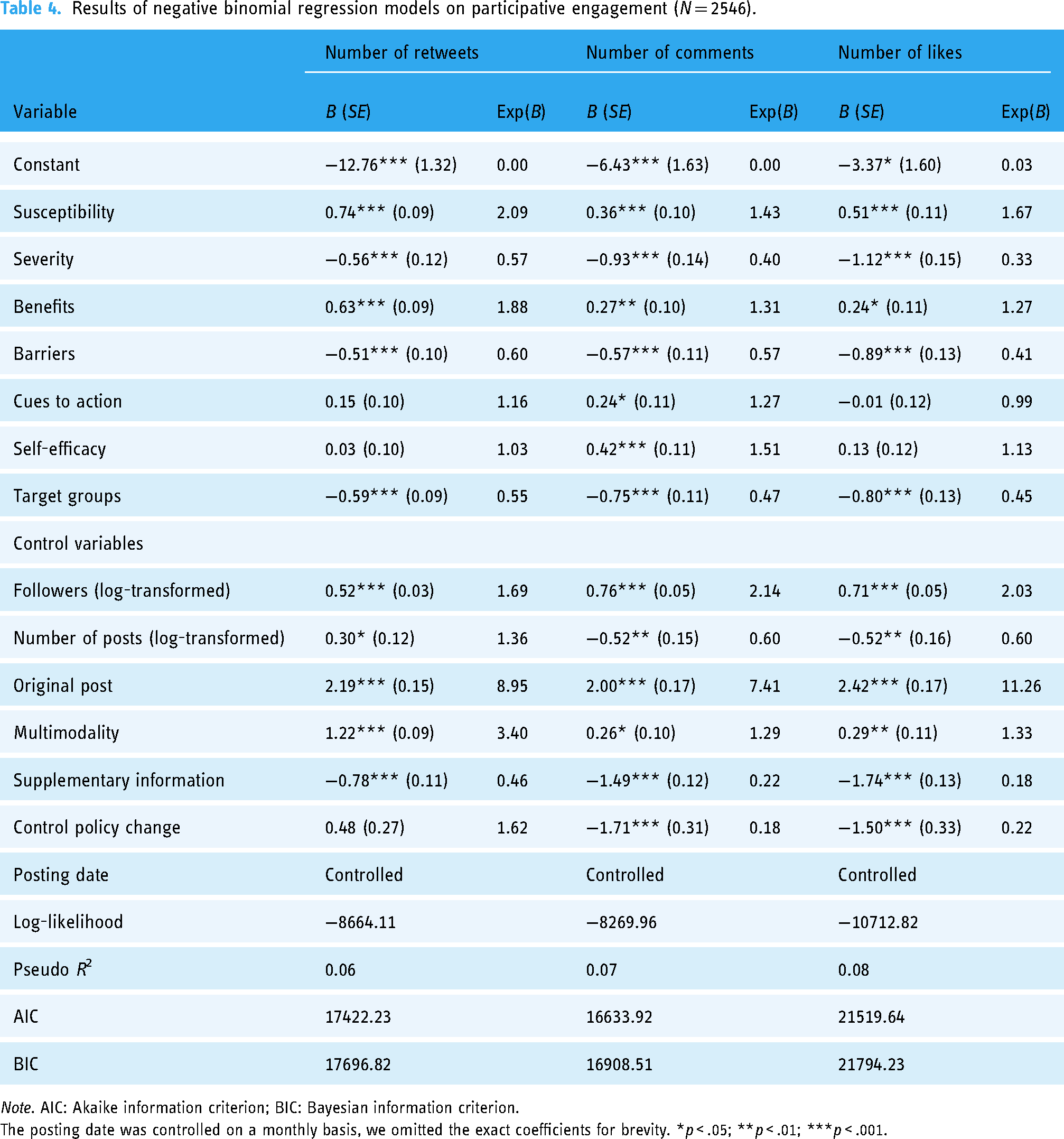
Note. AIC: Akaike information criterion; BIC: Bayesian information criterion.
The posting date was controlled on a monthly basis, we omitted the exact coefficients for brevity. *p < .05; **p < .01; ***p < .001.
Discussion
This study analyzes the presence of HBM constructs in Chinese health authorities’ vaccination promotion posts and examines how those constructs affect engagement indicators. Some intriguing findings merit further discussion.
Similar to a previous study by Li et al., 20 cues to action and benefits were mentioned in most posts. Besides, as a concept referring to the chance of being infected, susceptibility is widely adopted and appeared in almost half of the posts. 14 Other constructs were mentioned less, including barriers, self-efficacy, and severity. The “fragmented” presentation of HBM constructs echoes previous findings, which may be partly due to the long-established collectivistic culture in China. 19 The collectivistic culture sets group aims as priorities and emphasizes the roles of interdependence and external social norms in combating the COVID-19 risk. 37 Thus, highlighting group safety and mass mobilization are frequently employed strategies in promoting COVID-19 vaccination in collectivistic cultures-oriented societies. 37 Accordingly, benefits and cues to action are mainly about the vaccine's effectiveness in building the colony immune defense, containing the virus contagion, and protecting the whole society. On the other hand, susceptibility also reminds audiences that COVID-19 is highly contagious and endangers public health. Contrarily, barriers, self-efficacy, and severity are mainly individual-oriented aspects, such as whether the vaccination causes adverse reactions (i.e. barriers) or whether one can get the vaccine conveniently (i.e. self-efficacy).
The negative binomial regressions show that frequently appeared constructs in posts (i.e. benefits, cues to action, and susceptibility) held positive associations with at least one of the participative engagement indicators. These HBM components are rooted in collectivism, which may arouse a high degree of collective identity and encourage Weibo users’ active engagement. For instance, to protect the safety of the neighborhood or the broader community, users may be alert to the highly infectious virus and retweet the message to exhibit the function of countermeasures and encourage others to practice the recommended behaviors. In addition, self-efficacy, which indicates one has the ability to perform the recommended response, helps strengthen people's confidence in COVID-19 vaccination. 38
The negative effects of severity, barriers, and target groups on participative engagement may be ascribed to the impact of loss frames. Compared with benefits and self-efficacy, which underscore the COVID-19 vaccine's strengths and individual competence in performing the behavior, severity, barriers, and target groups are more relevant to personal losses. The prospect theory suggests that people are risk-seeking when precautions are framed in losses but risk-averse when precautions are framed in gains. 39 Consequently, loss frames are deemed more effective for encouraging detection behaviors, while gain frames are more effective for facilitating prevention behaviors. 40 As a typical preventive behavior, vaccination framed in losses would be less persuasive and more likely to inhibit engagement than those framed in gains.
However, it should be noted that we merely provide a tenable explanation (i.e. collective-oriented constructs vs. individual-oriented constructs) for the differential effects of message characteristics but do not rule out other possible explanations. For instance, some fear appeal theories (e.g. the extended parallel process model) suggest that perceived threat is composed of perceived severity and perceived susceptibility, in which perceived susceptibility represents an individual's beliefs about his or her likelihood of experiencing the health threat.38,41,42 Thus, susceptibility can also be treated as an individual-level factor derived from the personal appraisal of external threats. According to Tang et al., 8 posts containing susceptibility help the audiences understand the risk of COVID-19, contributing to participative engagement amidst uncertainty. In summary, susceptibility as a content characteristic focused more on COVID-19's impacts on public health, while susceptibility as a psychological appraisal leans toward individual perception. The individual-level perception of susceptibility may also arouse fear and stimulate engagement. These complementary explanations require fine-grained evidence from surveys or experiments to examine. Similarly, regarding the promoting roles of benefits, cues to action, and self-efficacy in participative engagement, an alternative explanation could be that the positively valenced constructs conform to the Chinese government's commitment to building a harmonious society and advocating positive energy in the whole society. According to Chen and Wang, 43 the positive energy discourse underscores maintaining a positive attitude in daily life, even in the face of public crises. Therefore, adopting benefits, cues to action, and self-efficacy in vaccination promotion posts strengthens hope and one's determination to overcome difficulties, which complies with the tenets of positive energy and boosts morale in combating COVID-19. Those constructs may further stimulate social media users’ engagement.
It is worth noting that some inconsistent findings exist in other studies. For example, a computer-assisted content analysis study by Tang et al. based on HBM found that severity significantly promoted public engagement on Twitter while benefits’ predicting effect on public engagement was not significant. 8 Two reasons may account for this. For one thing, the Western context highlights independence and self-determination when facing health risks.37,44 Emphasizing severity might intensify their COVID-19 risk perception, which in turn motivates online engagement, such as retweeting or endorsing the severity-laden tweets. Contrarily, interdependence is highly valued in a collectivist society such as China, leading to reduced individual capacity to take preventive measures and nurturing a risk-averse mentality. 44 Hence, accentuating severity may trigger a boomerang effect among Chinese netizens and induce information avoidance since it largely heightens the concern of personal loss. These cultural differences could partly explain the opposite effects of severity on participative engagement in the two studies or two divergent cultural settings. For another, the study by Tang et al. 8 was performed in the first six months of 2020, when COVID-19 vaccines were still under development. Against that background, the benefits of the COVID-19 vaccine as an effective defense for preventing COVID-19 were not fully recognized then. However, our study wraps an extended period, enabling a sufficient demonstration of the COVID-19 vaccine's effectiveness. All the disparate findings underscore the significance of cross-context comparisons, especially utilizing longitudinal and comparative evidence to warrant a more nuanced understanding.
Practical implications
This study bears some practical implications for vaccination campaigns on social media. First of all, as an integral part of the public health campaign, vaccination promotion should adhere to the context-sensitive or culture-sensitive principle by designing tailored persuasive messages conforming to the cultural characteristics. In China, emphasizing vaccination's benefits in lowering group contagion's possibility and presenting explicit cues about vaccination motivate people to follow social norms and vaccinate for the public good. Second, potential losses at the individual level should not be overemphasized. On social media, people may already encounter numerous posts (especially personal narratives and help-seeking messages) elucidating COVID-19's severity. 32 Of great importance is to strengthen self-efficacy by providing detailed instructions on getting the vaccine, which would entice deeper levels of information diffusion, deliberation, and nurturing positive attitudes toward the national vaccination program. Third, although enhancing vaccination coverage among specific groups aligns with the policies, public health practitioners must balance the threat and efficacy. Since an overdose of threats on certain groups compromises the messages’ persuasive power, a better strategy may be providing direct guidance or encouragement to the whole population and decreasing the occurrence frequency of specific groups. Fourth, the roles of control variables also inform Chinese public health authorities on maximizing the influence of vaccination promotion posts. It is advisable to create original posts using multiple media types (e.g. infographics and videos) to present detailed persuasive messages to facilitate online public participation, which may translate into vaccination behavior in the offline setting.
Limitations
The findings of this study should be interpreted with caution. Only the top nine public health authorities’ posts were analyzed, which overlooked other less influential accounts. Future attempts covering more public health authorities could disclose a comprehensive landscape of China's COVID-19 vaccination promotion. Besides, critical time points can be further explored, such as whether the promotion strategies differed before and after milestones (e.g. government approval of certain vaccines) or how content characteristics were associated with participative engagement at different phases of COVID-19 infection (e.g. waxing or waning). 20 Moreover, participative engagement differs from actual vaccination behavior. Whether posts containing HBM constructs activate actual vaccination necessitates further testimony. Lastly, the retrospective nature of this study restrains our ability to check data integrity before the formal analysis. Future research may pursue a real-time data collection approach to better curate the social media corpus and retrieve a complete dataset.
Conclusions
Drawing on the HBM framework, this theory-driven content analysis scrutinizes how prominent Chinese health authorities promoted COVID-19 vaccination on social media. We found that collective-oriented constructs were more employed than individual-oriented ones, which is consistent with the features of collectivistic culture. The relationships between HBM constructs and participative engagement were discussed, demonstrating the differential effects of health concepts. The function of a newly added context-specific variable—target groups, was also disentangled. Our findings not only summarize past efforts in social media-based public health campaigns during the pandemic but also provide reference to coping with future public health emergencies.
Footnotes
Acknowledgements
The authors would like to thank the anonymous reviewers who provided valuable feedback which helped improve the quality of the paper.
Declaration of conflicting interests
The author(s) declared no potential conflicts of interest with respect to the research, authorship, and/or publication of this article.
Ethical approval
This study did not require approval by the institutional review board because it involved the use of public access data only.
Funding
The author(s) received no financial support for the research, authorship, and/or publication of this article.
Informed consent
Informed consent is not necessary for this study because it does not involve animal or human subjects. All data were collected from open-accessed posts released by public health institutions intended for public health education and promotion.

Appendix A
Pearson chi-square tests of internal relations among health belief model (HBM) constructs (N = 2546).
Appendix B
The comparison between the Poisson model and the negative binomial model.
Appendix C
Results of the robustness check (multivariate analysis of variance [MANOVA]).