




Abstract
In many regions of the world, with the gradual increase in the supply of COVID-19 vaccines, COVID-19 vaccination has changed from centralized government control to personalized selection. When choosing a location for COVID-19 vaccination, in addition to subjective preferences, objective information (such as the expected waiting time at a COVID-19 vaccination location and the crowdedness and reliability of the vaccination location) also need to be considered. However, it is not convenient for an individual to collect and compare such information. To address this issue, this research applies web content mining to extract the conditions of COVID-19 vaccination locations. Then, a novel asymmetric calibrated fuzzy inverse of column sum and fuzzy Vise Kriterijumska Optimizacija I Kompromisno Resenje recommendation mechanism is proposed. Finally, an intelligent system is developed to assist a user in selecting a personalized COVID-19 vaccination location. In a regional experiment conducted in Taichung City, Taiwan, the developed intelligent system was applied to assist 20 users in choosing personalized COVID-19 vaccination locations. The successful recommendation rate was 95%.
Introduction
COVID-19 vaccination is a dynamic and compound multi-criteria decision-making (MCDM) process. 1 First, it is a dynamic decision-making process, because after a person completes a dose, he/she still needs to consider whether to inoculate the next dose. Secondly, the MCDM process is compound because it involves many sub-processes, such as deciding whether to vaccinate, choosing a vaccine brand, and deciding on the time and location of vaccination. These decision-making processes do not only consider subjective preferences but are greatly influenced by external information and intervention. However, some external information (such as the expected waiting time) is not easy to collect or aggregate, which causes people's confusion when choosing personalized vaccination locations. The motivation of this research is to help solve this problem.
This study aims to establish an intelligent system to assist users in choosing personalized locations for their COVID-19 vaccination. This issue is important because the vaccination performances of different COVID-19 vaccination locations may not be the same. According to reports,2–3 some vaccination locations have issued the wrong brands of COVID-19 vaccines, 4 undiluted COVID-19 vaccines, or other types of vaccines (e.g. a cold vaccine). Some clinics even pretended to vaccinate. In addition, people want to go to reliable clinics with few patients and no waiting for COVID-19 vaccinations. However, this requires a cross-clinic comparison, which is troublesome for an individual. Furthermore, among various COVID-19 vaccination decisions, the selection of a personalized vaccination location is a less subjective one. In most regions, the supply of COVID-19 vaccines is becoming more and more abundant, which gives people a strong motivation for choosing personalized COVID-19 vaccination locations rather than being fully controlled by the government. Obviously, this issue has not been fully investigated. Most past of the work are about the investigation and enhancement of people's willingness to vaccinate,5–6 the selection of locations to set up vaccination sites,7–9 or the distribution of people among different vaccination locations in a centralized control manner. 10
An intelligent system is developed in this study for assisting in personalized COVID-19 vaccination location selection. The intelligent system considers the preference of a user and the conditions of vaccination locations, so as to recommend a personalized COVID-19 vaccination location. In the recommendation mechanism of the intelligent system, first, the asymmetric calibrated fuzzy inverse of column sum (acFICSM) method, modified from the fuzzy inverse of column sum (FICSM) method, 11 is proposed to derive the fuzzy priorities of criteria critical to the selection of a personalized COVID-19 vaccination location. Subsequently, web content mining (WCM)12–14 is applied to extract the conditions of clinics and generate statistics relevant to the application. Finally, fuzzy Vise Kriterijumska Optimizacija I Kompromisno Resenje (fuzzy VIKOR) 15 is used to evaluate and compare the overall performances of COVID-19 vaccination locations. The top-performing COVID-19 vaccination location is recommended to the user.
The remainder of this paper is organized as follows. Section “Literature review” is dedicated to the literature review. Section “methodology” describes the proposed methodology, including the intelligent system, automated data collection, and the method for assessing and recommending COVID-19 vaccination locations. Section “Regional experiment” details the application of the intelligent system in a regional experiment in Taichung City, Taiwan. Section “Conclusions” provides the conclusions of this study as well as some possible topics for future investigation.
Literature review
COVID-19 vaccination
The delivery system, formulation, dosage form, and the route of administration all affect the efficacy and safety of COVID-19 vaccination. 16 Therefore, a government should strive to ensure the procurement and delivery of COVID-19 vaccines. 17 To this end, Teerawattananon and Dabak 17 established a five-step procedure: considering pilot projects, using pre-qualification, establishing national task forces, discouraging bilateral negotiations, and measuring success. If COVID-19 vaccines are insufficient, a government should also develop priority strategies,18–19 which has been contributed to the success of COVID-19 vaccination in countries like Israel. 19
COVID-19 vaccination decision-making
COVID-19 vaccination is a subjective and uncertain decision-making process. Lee and Chen 20 mentioned that about one-third of Americans were not sure whether they needed to be vaccinated against COVID-19 and were worried about being forced to vaccinate. In contrast, most other people were worried about not being vaccinated as soon as possible. Different groups have different considerations when making decisions about COVID-19 vaccination. According to the survey results of Abdallah and Lee, 5 interventions based on social norms can help increase the willingness of college students to vaccinate.
COVID-19 vaccination site selection
Bertsimas et al. 21 considered the effects of vaccination and the variability in mortality rates across age groups and then optimized a bilinear, non-convex optimization model to determine the locations of vaccination sites.
Çakır et al. 7 proposed the spherical bipolar fuzzy weighted average operator to determine the location of a mobile COVID-19 vaccination site. Four criteria were considered: distance, the easiness of transportation, environmental conditions, and capacity.
A parking lot or auditorium can also be a COVID-19 vaccination site.22–23 However, it is difficult to compare these places with hospitals or clinics. In addition, many points of dispensing (PODs) for COVID-19 vaccination distribution are located in large parking lots. Keith et al. 24 warned that the high temperature of such an environment might cause damage to the staff and volunteers.
COVID-19 vaccination location selection
The survey by Fisher et al. 8 showed that the hesitancy and ethnicity of people affected their choices of COVID-19 vaccination locations. For example, black people and people who were not sure whether to get COVID-19 vaccines preferred to be vaccinated in their doctors’ offices.
Cabezas et al. 10 formulated COVID-19 vaccination location selection as a two-stage stochastic linear programming (LP) model problem, in which people expressed their preferences for different vaccination locations with limited capacity. The optimal solution to the LP model assigned people to vaccination locations to maximize their average preference. The premise of this type of method is that people are willing to be centrally arranged for their COVID-19 vaccinations.
Methodology
The methodology proposed in this study can be described from three aspects. The first is the architecture and operating procedures of the established intelligent system, the second is the automatic collection of clinic data, and the third is the method for evaluating and recommending COVID-19 vaccination locations.
Intelligent system: Architecture and operating procedure
The intelligent system for assisting personalized COVID-19 vaccination location selection is composed of six main parts: user interface, web content miner, system database, the acFICSM module, the fuzzy VIKOR module, and the central control unit (see Figure 1).
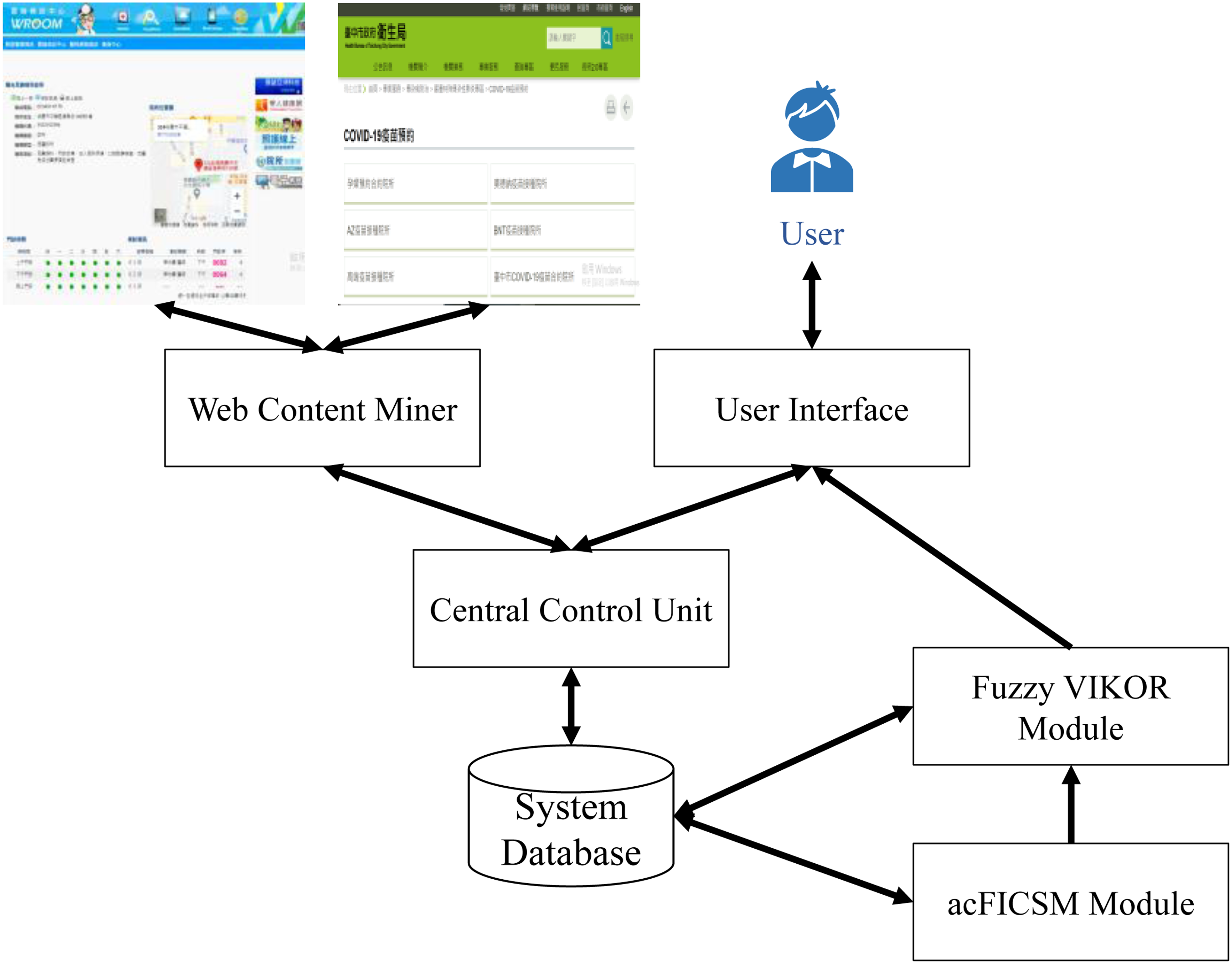
The system architecture.
The operating procedure of the intelligent system involves the following steps:
The web content miner collects and analyzes the data of COVID-19 vaccination locations. The collected data are saved into the system database. The web content miner generates the statistics about each COVID-19 vaccination location. A user inputs his/her preference via the user interface. The inputted preference is saved into the system database. The acFICSM module derives the fuzzy priorities of criteria based on the user's preference. The fuzzy VIKOR module evaluates and compares the overall performances of COVID-19 vaccination locations by considering the user's preference and the data and statistics of COVID-19 vaccination locations. The top-performing COVID-19 vaccination location is recommended to the user via the user interface.
An activity diagram is presented in Figure 2 to illustrate the operating procedure, which clarifies the roles of these parts. The steps are described in the following sections.

Activity diagram showing the operating procedure.
Without loss of generality, all fuzzy parameters and variables in the proposed methodology are given in or approximated by triangular fuzzy numbers (TFNs). 25 At first, acFICSM is proposed to derive the fuzzy priorities of criteria that affect the selection of a personalized COVID-19 vaccination location.
Automatic clinic data collection
List of COVID-19 vaccination locations
The first information about COVID-19 vaccination locations to be collected is the list of all COVID-19 vaccination locations with specific COVID-19 vaccines. Relevant information is usually posted on the website of a municipal health bureau, in the form of web pages and pdf attachments. An example is shown in Figure 3 of Appendix 1. The required information includes the region, medical institution name, address, telephone, and ways to request an appointment. Such information is embedded in a table, as shown in Figure 4 of Appendix 1. In the proposed methodology, the required information is extracted using WCM in an offline manner because of the following reasons:
Basically, the content of this list will remain unchanged. Relevant information only needs to be retrieved once and is available to all subsequent users. This task belongs to the pre-stage of system construction. Therefore, no user is waiting in line. There is no urgency to obtain relevant information.

Online information about COVID-19 vaccination locations.

A table containing the list of vaccination locations for a specific COVID-19 vaccine.
The WCM process is as follows:
Step 1. Consider a (or the next) brand of COVID-19 vaccine. Step 2. Browse the webpage containing the list of vaccination locations for the COVID-19 vaccines. Step 3. Copy the table of COVID-19 vaccination locations. Step 4. Paste to a worksheet. Step 5. Parse the pasted data. Some fields (region and ways to request an appointment) contain multiple data items and need to be split, as illustrated in Figure 5 of Appendix 1. As a result, the number of records is increased. Step 6. If all brands of COVID-19 vaccines have been considered, stop; otherwise, return to Step 1.

Data splitting results.
In addition, cross-referencing the data collected for different COVID-19 vaccine brands can identify vaccination locations that administer more than one vaccine brand. Such vaccination locations run the risk of mistaking the vaccine brand.
Distance between a user to each nearby COVID-19 vaccination location
The next information to be extracted is the distance from a user to each nearby COVID-19 vaccination location, which is done in an online manner. For this purpose, the relevant information is provided by online maps with navigational functions, such as Google Maps. There are a number of vaccination locations near a user, giving the user a lot of options.
The automatic and online WCM process is as follows:
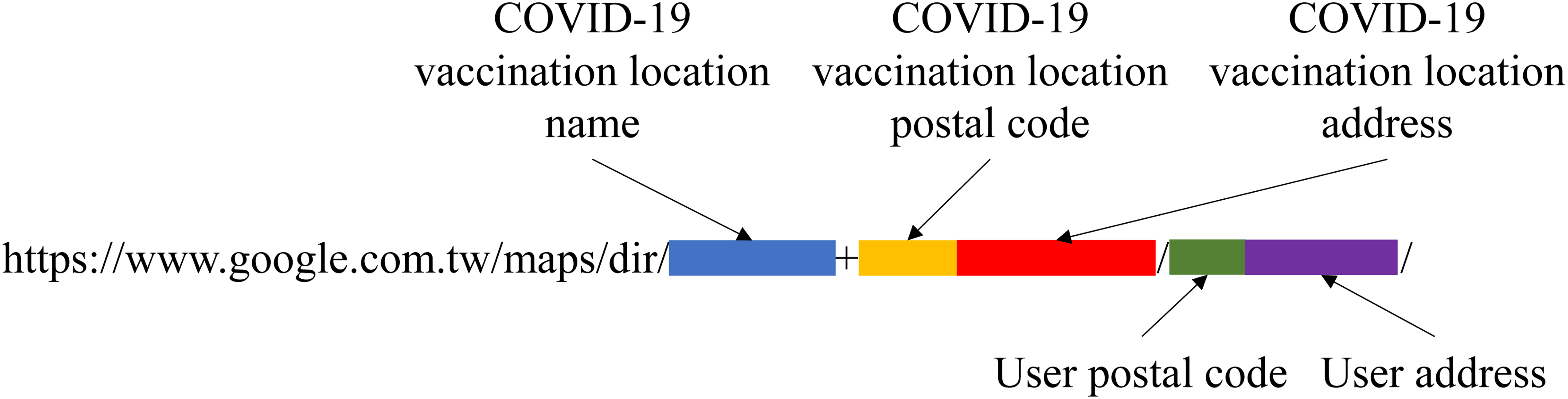
Step 1. A user inputs his/her address and the required brand of COVID-19 vaccine. Step 2. Consider a (or the next) vaccination location that provides the required COVID-19 vaccine. Step 3. Generate the universal resource locator (URL) for querying the distance from the user to the COVID-19 vaccination location, as illustrated in Figure 6 of Appendix 1. Step 4. Read and process the webpage query as plain text.
26
Step 5. Locate the keyword and extract the required data, as illustrated in Figure 7 of Appendix 1.

Generating the required URL.

Extracting the required data.
Estimated waiting time at each nearby COVID-19 vaccination location
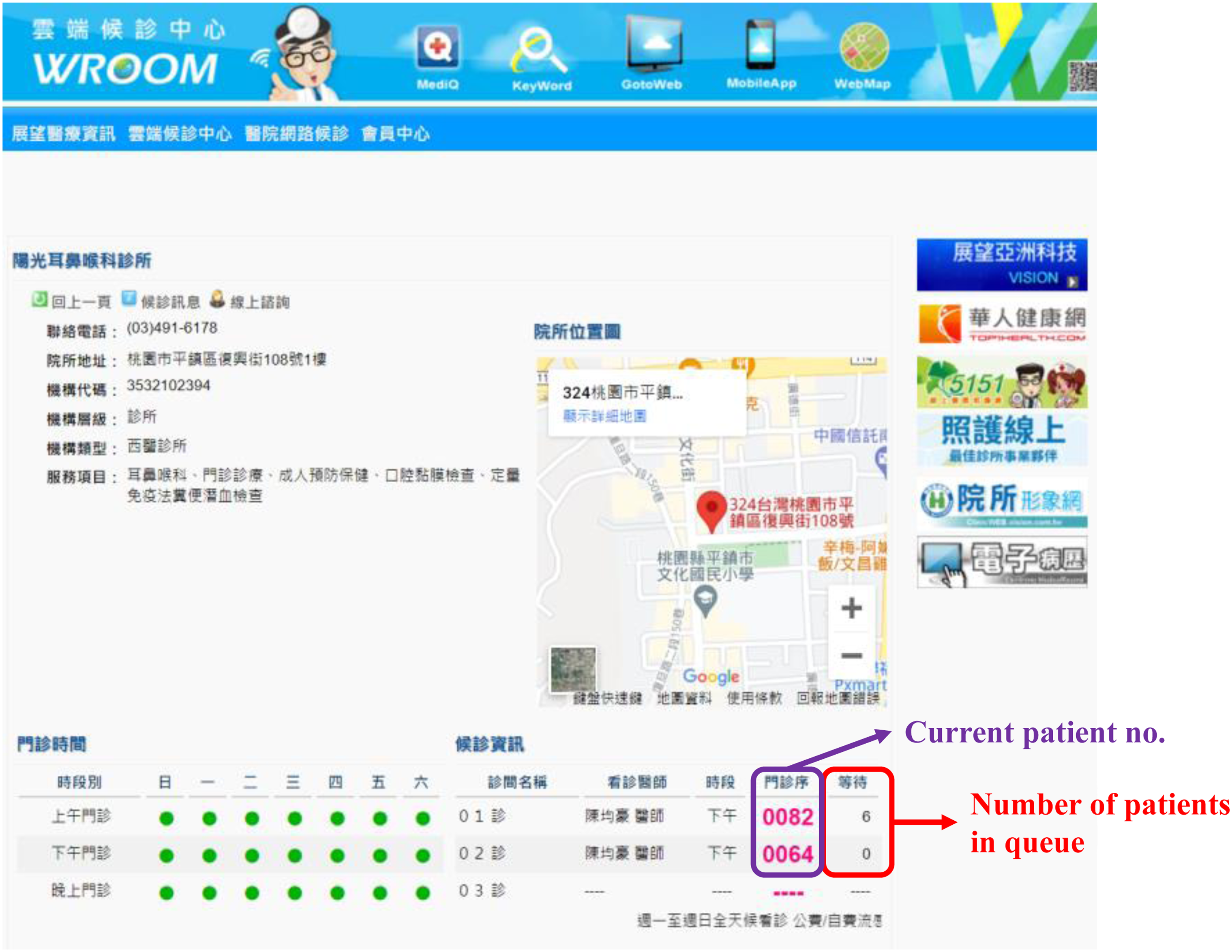
The expected waiting time at a COVID-19 vaccination location will also affect an individual's willingness to choose the vaccination location. However, it is difficult to collect such information from each COVID-19 vaccination location. Therefore, we resort to an online publicly available information resource
27
(see Figure 8 of Appendix 1) that provides two types of information for each clinic (or hospital):
c(t): the current patient number at time t, and u(t): the number of patients in the queue at time t.

National cloud clinic queue management system
Based on the two types of data, the average waiting time at each vaccination location is estimated as follows.
First, at time t, the number of patients in the clinic is



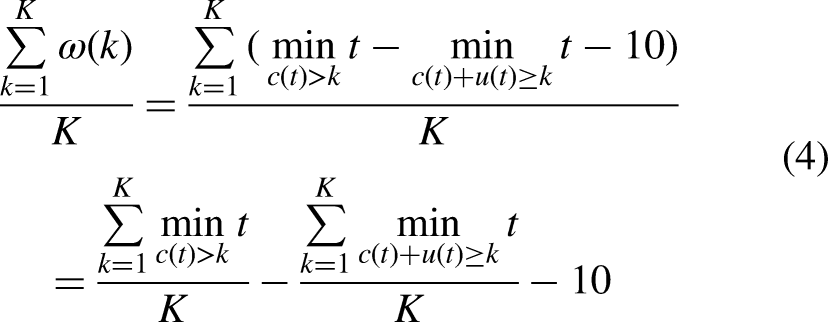
Assessing and comparing COVID-19 vaccination locations
acFICSM for deriving the fuzzy priorities of criteria
The acFICSM method is an extension of the FICSM method that has been shown to be more precise than some prevalent methods such as fuzzy geometric mean (FGM)28–29 and fuzzy extent analysis (FEA)30–31 which are also based on approximation.11,32 In addition, compared to methods based on α cut operations, such as ACO 28 and xACO, 33 FICSM, and acFICSM are more efficient and suitable for online applications.
In the beginning, a user is asked to make pairwise comparisons of the relative priorities of criteria. The results are put in a fuzzy judgment matrix


Step 1. Derive the fuzzy priority of criterion i using FICSM as
11

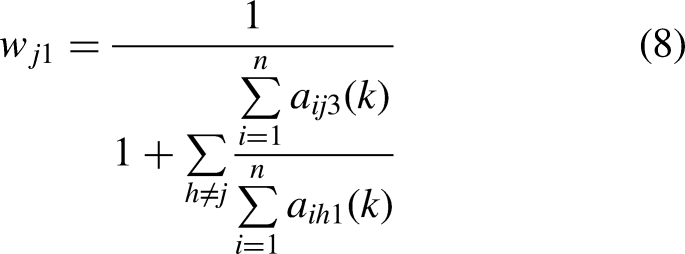






RI is the random consistency index. 34
Step 3. If
Step 5. Derive the priority of criterion i from the crisp judgment matrix



The derived priority is indicated with
Step 6. Calibrate the fuzzy priority of criterion i in the following manner:



Fuzzy VIKOR for evaluating COVID-19 vaccination locations
Subsequently, the fuzzy VIKOR method 15 is applied to evaluate the overall performance of each COVID-19 vaccination location. The fuzzy VIKOR method comprises the following steps:
Step 1. Determine the best and worst performances in optimizing each criterion:


Step 2. Compute the normalized fuzzy distance from each COVID-19 vaccination location to the best performance:



Step 4. Compute the value of

Step 5. Defuzzify




Regional experiment
Background
To evaluate the effectiveness of the intelligent system, it has been applied in a regional experiment in Taichung City, Taiwan, to assist 20 users in selecting personalized COVID-19 vaccination locations. Factors that influence their choices of personalized COVID-19 vaccination locations include5–6,39–40:
Reported vaccine effectiveness and side effects; Vaccine supply and demand; Government regulation and company mandates; Severity of the COVID-19 pandemic; Coworker influence; Past vaccination experience; Personal health issues and beliefs; Freedom of choice; Convenience of vaccination.
as illustrated in Figure 9. Before choosing a personalized vaccination location, a user has decided to vaccinate and choose the brand of vaccine. Subsequently, the following factors will come to play:
Distance to a COVID-19 vaccination location; Expected waiting time at a COVID-19 vaccination location; Reliability (i.e. the correctness in administering COVID-19 vaccines) of a COVID-19 vaccination location; Crowdedness, which is opposite to the easiness of maintaining social distance.
The fuzzy approach was implemented as a standalone application using Microsoft Access 2019 on a PC with an i7-7700 CPU 272 3.6 GHz and 16 GB RAM and has been applied by 20 users within November 2021. The generation of users was based on the principle of convenience sampling. Convenience sampling is a type of non-probability sampling in which people are sampled simply because they are a convenient source of data for researchers. 41 All users were personally invited by the project team. These users were chosen merely based on proximity. Whether they represented the entire population or not was considered. Their ages ranged from 25 to 40 years old, with half males and half females. In the following, the first user, a 32-year-old girl, is taken as an example to illustrate the application of the intelligent system.
Factors that influence a user’s vaccination decision.
Application of the intelligent system
The user compared the priorities of criteria in pairs. The results are summarized by the following fuzzy judgment matrix:


Fuzzy priorities of criteria derived by the user.
The COVID-19 vaccine brand chosen by the user was BNT. Only vaccination locations administering this within about 20 min from the user were considered. As a result, there were five nearby COVID-19 vaccination locations, shown by red pins in Figure 11. Fuzzy VIKOR was applied to assess and compare the overall performances of these COVID-19 vaccination locations. The details of these vaccination locations were collected using WCM and are summarized in Table 1.
COVID-19 vaccination locations near the first user.
COVID-19 vaccination location details.

The performance of a COVID-19 vaccination location was evaluated according to the rules depicted in Table 2. The evaluation results are summarized in Table 3. There was no perfect COVID-19 vaccination location.
Rules for evaluating the performance of a COVID-19 vaccination location.

Performances of COVID-19 vaccination locations.

Subsequently, the best and worst performances in optimizing each criterion were determined. The results are shown in Table 4.
Best and worst performances in optimizing each criterion.

The normalized fuzzy distance between each COVID-19 vaccination location and the best performance was measured. The measurement results are summarized in Table 5.
Normalized fuzzy distance between each COVID-19 vaccination location and the best performance.

The values of
The

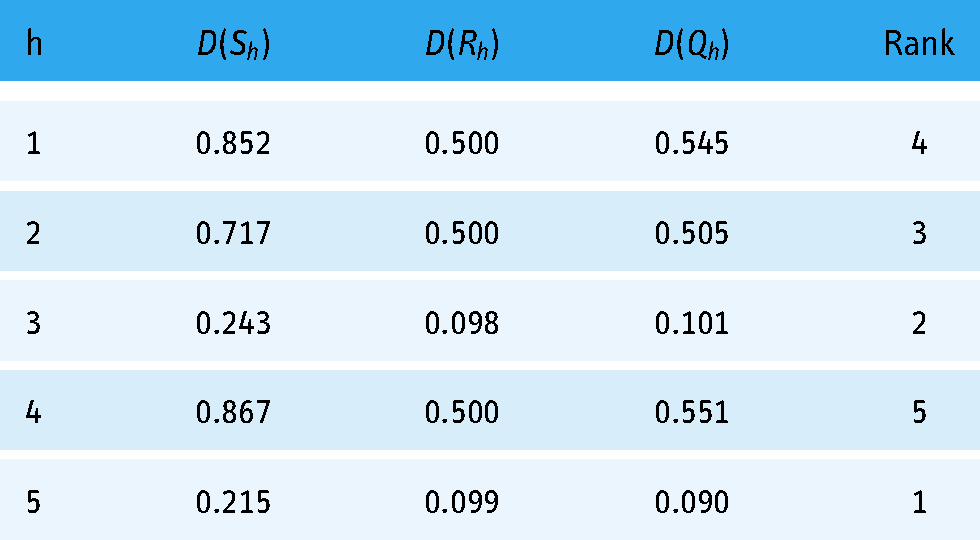
The defuzzified values of these performance measures are summarized in Table 7. Based on the defuzzification results, COVID-19 vaccination locations were ranked, as shown in Table 7. COVID-19 vaccination location #5 achieved the lowest value
Defuzzification results.
According to the experimental results, the following discussion was made:
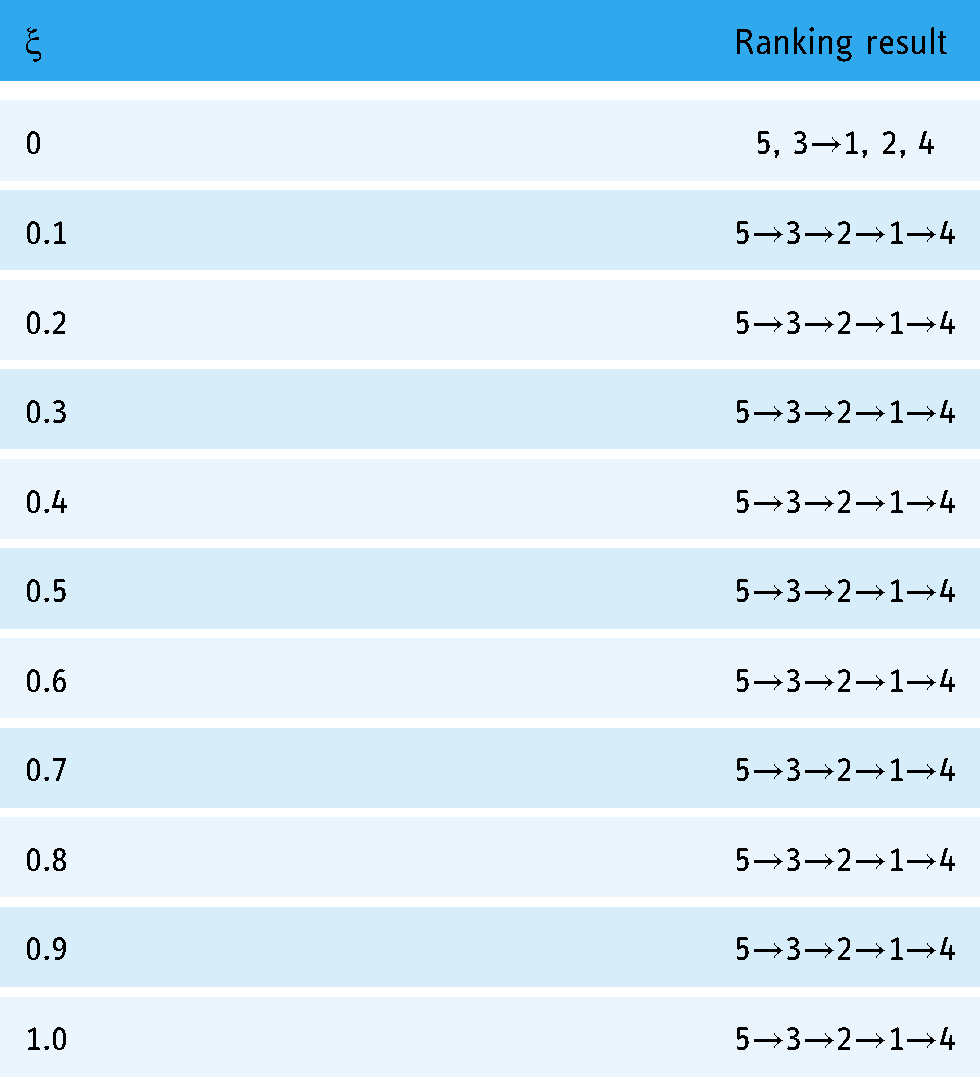
The most suitable COVID-19 vaccination location for the user was COVID-19 vaccination location #5 where the expected waiting time was the shortest. The reliability of this COVID-19 vaccination location was also the highest. However, the superiority of COVID-19 vaccination location #5 over COVID-19 vaccination location #3 only met the second condition. Therefore, both COVID-19 vaccination locations could be recommended to the user for their consideration. In contrast, COVID-19 vaccination location #4 ranked last, because its expected waiting time was longer than those of others. A parametric analysis has been conducted to examine the effect of ξ on the ranking result. When the value of ξ was large, the performances on all criteria were equally emphasized. With a small value of ξ, the criterion with the highest priority or the worst performance was considered. The results are summarized in Table 8. The superiority of COVID-19 vaccination location #5 over others was basically not affected by the value of ξ. In addition, when ξ was set to 0, the ranking result was “5, 3→1, 2, 4,” which means that COVID-19 vaccination locations #5 and #3 achieved the same performances. Similarly, COVID-19 vaccination locations #1, #2, and #4 were indistinguishable. The recommendation results of 20 users and their choices are summarized in Table 9. The successful recommendation rate was 95%, high enough to support the effectiveness of the intelligent system.
Results of parametric analysis.
Recommendation results to 20 users and their choices.

Conclusions
In the early stage of the COVID-19 pandemic, due to the lack of vaccines, COVID-19 vaccination was centrally controlled by each regional government. With the rapid progress in the research and development of COVID-19 vaccines, COVID-19 vaccination has become more and more popular. The government has begun to let people choose the type of vaccine and the time and location of vaccination. This makes COVID-19 vaccination a personalized medical process. When choosing a location for COVID-19 vaccination, in addition to personal preferences, objective information also needs to be considered. However, such information is not easy for an individual to collect or even compare. In order to help people choose personalized COVID-19 vaccination locations, this study develops an intelligent system. The recommendation mechanism of the intelligent system is a joint application of acFICSM, WCM, and fuzzy VIKOR, which is a novel attempt in this field.
The intelligent system has been applied in a regional experiment to assist 20 users in choosing personalized COVID-19 vaccination locations. According to the experimental results, the most important criterion in choosing a personalized COVID-19 vaccination location was the reliability of a COVID-19 vaccination location, while the least important criterion was the distance to a COVID-19 vaccination location. In addition, almost all users followed the recommendations, resulting in a successful recommendation rate of 95%.
So far, the COVID-19 pandemic has not ended, and epidemiologists have begun to suggest that everyone is vaccinated with more than 2 doses of COVID-19 vaccines. Each vaccination is an individual decision-making process and the priorities of criteria may vary. The intelligent system developed in this study can be applied to these decision-making processes and compare their differences.
Footnotes
Author contributions
All authors contributed equally to the writing of this paper.
Declaration of conflicting interests
The authors declared no potential conflicts of interest with respect to the research, authorship, and/or publication of this article.
Ethical approval
Not required.
Funding
The publication fee of this paper was supported by Ministry of Science and Technology, Taiwan.
Guarantor
Not required.
