



Abstract
Objective
Alarmingly, the individuals’ reach and coverage to get vaccinated in developing regions during the pandemic is a massive challenge for concerned authorities. This study aimed to demonstrate how cyberchondria play a significant role in a classical health belief model. Cyberchondria may influence cognitive factors (e.g. self-efficacy), which may contribute to an increase in attitude–behavior gap. Especially in the context of a health-centric scenario, it may discourage individuals to take protective measures.
Method
By using the cross-sectional research design, the authors conducted a quantitative survey in Pakistan and collected 563 responses from 303 male respondents (rural = 91; urban = 212) with (Urban M:35.5, standard deviation (SD):13.4) and rural M:37.5, SD:8.4).
Result
The findings indicate that decision self-efficacy among males is stronger than that in females. It dominates other determinants, which can dampen the individuals’ intentions to get vaccinated. For instance, the effect of conspiracies and perceived seriousness was noted nonsignificant and weak. In females, perceived seriousness was stronger determinant than in males. In addition, the negative effect of decision self-efficacy was noted in the case of females, and conspiracy and cyberchondria had a negative role.
Conclusion
This study highlights valuable implications for future research in infodemic, health communication and health literacy, and practical implications for regulatory bodies and public administration.
Keywords
Introduction
The World Health Organization declared the COVID-19 pandemic on March 11, 2020. As of June 2022, 536 millions of cases were recorded, and more than 6.3 millions of fatalities have occurred worldwide. 1 A vaccination program is one of the most effective means of fighting the COVID-19 pandemic. The majority of governments in the world have announced large-scale vaccination plans for COVID-19. 2 The vaccination rates are considerably lower in developing countries, where vaccine supplies are scarce. Only 27% of people received the first dose of vaccine until the third quarter of 2022. 1 Once this vaccination is available and reaches a high level coverage, nonpharmaceutical treatments will limit the spread of the virus. 3 Considering current strategies, vaccination rates of 85% to 95% are necessary to prevent an outbreak of severe infections. 4 The intention to get vaccinated against COVID-19 is regarded as a key variable for predicting actual vaccination uptake, next to the availability of vaccines; a meta-analysis demonstrated the health-related intention following casually from the respective health behavior. 5 An adequate supply of vaccination doses is necessary but not sufficient for effective vaccination uptake. If intention is very low among the public, the success of a COVID-19 vaccination campaign may be seriously threatened.
The effects of gender on vaccine uptake have been examined, but the results are inconsistent. 6 For example, Jiménez-Garcia et al. 7 found the same predictors of vaccine uptake among both men and women in Spain. In their gender-stratified analysis, they suggested that lower coverage rates among women could be explained by comorbidities, social support, and healthcare provider bias. An investigation among 11 European countries over 7 influenza seasons found that being male predicted influenza vaccination in 7 of the 11 countries, including France. 8 In most of these studies, gender was examined as an explicative factor of vaccine uptake, which prevented an understanding of the factors that might differ between male and female. In a study in Norway, gender-specific analyses were used, but they only focused on examining vaccine history as a factor that influences influenza vaccine uptake. Results show that men who had previously received an influenza vaccine were likely to continue the vaccination if their spouse had received an influenza vaccination in the past. 9 Thus, further examination of the gender-based comparison in the targeted population can bring valuable findings to understand the effect of sociocognitive dynamics.
In recent years, the internet has proven to be an important source of health information because of the rapid advancements in information technology. Most people who use the internet to search for health-related information do so in a nonpathological or even in an adaptive way, but a subgroup search online repeatedly and excessively and experiences a significant increase in anxiety. This behavior has been described as cyberchondria (CYB). 10 In the early stages of the COVID-19 outbreak, the internet has become an essential conduit for vital public health and safety information. The COVID-19 fear is positively associated with problematic social media usage. 11 However, by increasing internet exposure, under conditions of great uncertainty and risk, the pandemic is likely to have exposed greater numbers of people to the risk of developing CYB. Although various countries are actively carrying out COVID-19 vaccinations, experts, and interested individuals still have concerns about the current technology involved in the vaccines. These questions include the side effects, 12 the efficacy, 13 and whether the testing of the COVID-19 vaccine has been rigorous; consequently, a significant portion of the public remains hesitant about getting vaccinated. 14 The current COVID-19 pandemic raises new and obvious challenges in relation to this problem. The internet and social media contain extensive information related to COVID-19. In news and articles, most of the pieces of information are incomplete and inaccurate. 15 The rapid, massive, and unrestricted sharing of information on social media platforms during the COVID-19 pandemic has set fertile grounds for fake news and conspiracy beliefs related to the virus. 16 Vaccine intention is affected by the belief in COVID-19 conspiracy, which has become a barrier to vaccination. In this “infodemic” context, the role of conspiracy beliefs on vaccination intent has not been well understood. In response to this issue, the effect of barrier-driven belief in COVID-19 conspiracy on vaccine intention was analyzed.
On the basis of above discussed arguments, the present study aimed to answer the following research questions.
High level of health concern, stress, and depression are intrinsically associated with CYB, which remarkably affect the mental and physical wellbeing of individuals. Researchers are still investigating the effect of online health information seeking on anxiety, depression, and quality of life.
17
The current study will make substantial contribution to this concern. As a potential gap in the current literature, the present study aims to underline the role of CYB in classical HBM. Accordingly, the role of CYB in the case of individual's decision to get vaccinated was proposed. The cognitive factor of decision-making efficacy was adopted as a replacement for the classic HBM's perceived self-efficacy to understand the individual's intentions to act. Moreover, conspiracies and their crucial role in the public understanding of scientific health protective measures were considered. Specifically, the conspiracies effect as a hurdle has been proposed in the current research. Furthermore, in the target population, even the rate of individuals with first COVID-19 vaccine is low compared with the rest of the world. The study can significantly contribute to the understanding of the role of decision-making self-efficacy and CYB in this context. The rest of the article is structured as follows. First, the theoretical framework of HBM was reviewed. Then, the research hypotheses were presented in the context of related theoretical perspectives. The data collection methods and results were reported following the development of hypotheses and models. Lastly, the practical and theoretical implications, limitations, and future research directions of this work were discussed.
Theoretical stance: Adapted health belief model
This section provides a discussion on how HBM is significant to elaborate the health protective behavior. In this section, the significance of HBM and holistic view are discussed, and related hypotheses are enumerated. Health-related behavior is elucidated most effectively by the HBM, because it incorporates attributes of risk perception and behavioral evaluation. 18 Before COVID-19, HBM was used to investigate breast self-examination, 19 oral cancer prevention, 20 and healthy housing material selection of boomers. 21 Additionally, HBM has been used to evaluate the role of community pharmacists in providing effective communication to society 22 and the citizens’ readiness to obtain vaccines. 23 A significant and meaningful aspect of HBM is the extensive use of the model in recent years for depicting public health protective behavior. The current research initiative adopted HBM, primarily because it helps in defining (1) perceived seriousness and cues to action, which drive individuals’ protective behavior; 24 (2) the current study further stretched the stance of Nexøe et al. 25 as exogenous constructs (perceived barriers driven belief in COVID-19 conspiracy) in the HBM, which helped in explaining health-protective behavior. Gender difference in health protective behavior and HBM have been used to investigate physical activity, 26 cancer screening uptake, 27 health consumption and alcohol use, 28 and the acculturation of health belief and tuberculosis prevention. 29 The effect of gender studies were inconsistent with previous findings.29,30 The complete view of HBM with respect to gender difference can be determined by studying the vaccine intention difference in terms of gender. The aim of investigating the gender in HBM is to provide the broader spectrum and their difference perception toward vaccine intention. In the subsequent section, HBM-based hypotheses will be discussed in detail.
HBM-based hypotheses
The following section helps in determining and elaborating the hypotheses based on HBM. This section aids in confirming the hypotheses related to “cues to action,” “perceived seriousness,” “perceived benefits of being protective,” and “conspiracy driven perceived barriers.” Several recent studies have emphasized the significance of (1) cues to action, (2) benefits of being vaccinated, (3) psychological barrier triggered by the COVID-19-related conspiracies, and (4) perceived seriousness, which were considered as exogenous to conceptualize health-protective behavior. 31 Based on HBM, perceived seriousness to any health issue may trigger human cognition and behavioral change. 32 Tajeri et al. 33 considered perceived seriousness as the degree of sensitivity to the situation, where the higher chances of being exposed push individuals to conceptualize the health risk. Zampetakis and Melas 23 mentioned perceived health risk as an individual's perceived potential adverse consequences if the protective measures are ignored. 23 Vaccination conspiracy theories are among the diverse sets of beliefs that affect vaccination behavior.34,35 In the case of COVID-19, HBM implies that the higher sense of exposure to misinformation and a greater degree of perceived risk can lead to belief in conspiracies. 36 Different psychological characteristics greatly influence vaccination. Ang et al. 37 argued that people with more barriers to obtain healthcare services are likely to suffer from low psychological wellbeing. 38 Furthermore, conspiracy belief serves as barriers to take COVID-19 vaccine in Pakistan, thus increasing the safety risk and fear of new vaccine of COVID-19.39,40 This conspiracy belief has become a hinderance to adopt health orientation, 41 drives negative emotion, and affects psychological resilience. 42 Accordingly, the following constructs’ relationships are proposed to boost the COVID-19 vaccine intention in developing countries such as Pakistan during the pandemic to map their health-protective behavior. The adopted theoretical stance argues that a greater sense of exposure helps individuals in quantifying the risk proactively to adopt preventive measures, such as vaccination. 43 The next section determines the hypothesis related to the role of decision self-efficacy (DSE) for uptake vaccination intention.
Role of decision self-efficacy in HBM
In this section, the role of DSE in the context of HBM and the effect of DSE aid on vaccination uptake decision making will be discussed. As a construct in the HBM, self-efficacy is an important determinant of health, 44 because it is a key factor for the initiation and execution of health protective behaviors. 45 During the COVID-19 pandemic, general self-efficacy was related to mental health problems in several populations, as reported by Mo et al.46,47 Moreover, higher self-efficacy is associated with fewer mental health problems during the COVID-19 pandemic. 48 The application of HBM in the context of COVID-19 might help in reducing stressful behaviors that might provoke anxiety and fear. 49 DSE has also been identified as an important variable in the development of intention toward health-related behaviors. DSE refers to the degree to which individuals feel confident about their ability to successfully engage in decision associated with COVID-19 vaccination intake. Within the HBM, the current study stretched the spectrum of self-efficacies and proposed a new view as a DSE to examine the COVID-19 vaccine intake intention, because these attributes need more to be further explored to maximize the explanatory power of the HBM, as discussed by Jones et al. 24 The forthcoming section will elaborate and determine the hypothesis related to CYB to define the health centric behavior.
Role of cyberchondria in defining health centric behavior
The current section helps in understanding the effect of CYB toward intention to get COVID-19 vaccine. The following section provides a detailed view of CYB on the basis of explained context hypothesis. CYB refers to an increase in anxiety about one's own health status as a result of excessive reviews about online health information.50,51 Through excessive online search, cyberchondriacs compared to others find more information regarding the pandemic situation. This behavior increases cognitive load, and person feels susceptible to the disease. 52 The term CYB is derived from the term hypochondriasis, which is a condition that involves excessive and chronical worrying about being seriously ill. 53 According to the hypochondriasis theory, fear of illness causes individuals to avoid problems and increase their anxiety levels. A frequent reliance on reassurance may contribute to anxiety. As this process continues, it induces preoccupation with illness. 54 Individuals with perceived susceptibility and fears of being infected with COVID-19 might pursue reassurance seeking behavior by checking bodily sensations, hand washing, or repeated media search. People who have severe concerns about their health may try to seek reassurance.55,56 Increased time spent searching online for symptoms has been associated with functional impairment,57,58 and problematic internet use. 59 Thus, CYB can be impaired, causing harm to individuals. 57 Interestingly, social media use during COVID-19 may result in exposure to misinformation, thus causing CYB. 60 Laato et al. 52 argued that information overload triggers the severity and CYB behavior, which leads to panic decision making. The current research revisited the stance Laato et al. 52 by using a conceptual view to investigate the CYB influence on intention to get COVID-19 vaccine. Although the research in this area is still in its infancy, studies have shown that online health research represents a reliable risk factor for heightened anxiety regarding subjective health status. Gender difference may amplify people's reassurance-seeking behaviors related to vaccine intake. The present study aimed to evaluate depression, viral anxiety, and obsessive thinking over the COVID-19 among gender caused by various conditions that changed during the pandemic and how reassurance-seeking behavior acts as a protective behavior against the COVID-19 pandemic during psychological difficulties. This study aims to explore the association between CYB or obsession with COVID-19 between males and females. Accordingly, the following hypotheses have been proposed.
H1: Perceived seriousness of COVID-19 positively affects the individual's intention to get COVID-19 vaccine.
H2: Cues to action positively affects the individual's intention to get COVID-19 vaccine.
H3: Conspiracies driven perceived barriers negatively affects the intention to get COVID-19 vaccine.
H4: Benefits of being vaccinated positively affects the intention to get COVID-19 vaccine.
H5: Decision self-efficacy positively affects the intention to get COVID-19 vaccine.
H6: Cyberchondria negatively affects the intention to get COVID-19 vaccine.
Methods
Instrument development
This provides a discussion of the methodology adopted for data collection, tools, and techniques used to clean the data, and the analysis methods for data collection. This study employed a quantitative approach. Based on the literature, a questionnaire consisting of multiple items and constructs was designed. A previously designed questionnaire based on the HBM that was developed by a panel of epidemiologists, psychologists, and clinicians was used. 61 Likert scale questionnaires were used to assess intent to receive a COVID-19 vaccine, and HBM constructs. Sociodemographic factors such as age, level of education, family income, and urbanization were considered as control variable and were measured as nominal variables. We analyzed factors relevant to HBMs about the COVID-19 vaccination, such as CYB (defined as subjective estimates of the risk of obtaining COVID-19 based on three items) as proposed by McElroy and Shevlin. 62 Perceived seriousness or the severity and consequences of having COVID-19 was derived from three items as suggested by Bechard et al. 63 The perceived benefits were determined by evaluating five items (value or efficacy of receiving the COVID-19 vaccine) as proposed by Mo and Lau. 64 The scale included items such as “Getting the COVID-19 vaccine will decrease my chances of dying from COVID-19.” A scale that measures perceived barriers as belief in COVID-19 conspiracy (obstacles to receiving COVID-19 vaccination) was adapted from Shapiro et al. 65 to measure five items, while two items were eliminated as noted with factor loadings lower than 0.60. DSE was measured using five items and cues to actions (triggers for receiving COVD-19 vaccination) by using a three-item. Intention to receive the COVID-19 vaccine was assessed using four items validated by Wong et al. 66 The questionnaire was initially developed in English. Furthermore, the back-translation approach been used. In the supervision of volunteer English and Urdu speaking natives, back translation was performed to address the instrumental validity and content reliability as suggested by Brislin. 67 After two rounds of revisions, the questionnaire survey was approved for data collection purpose.
Data collection process
A cross-sectional, web-based, and anonymous survey was conducted through an online questionnaire during the last quarter of the year 2021 and first quarter of the year 2022. The survey link was disseminated and advertized by the researchers through Facebook and WhatsApp, which are the most popular ones in the targeted region. According to the inclusion criteria, respondents must be residing in Pakistan and have their national identity card as citizens of the country. Respondents who completed the survey received a note encouraging them to make the survey link available to all of their contacts. This study was conducted after obtaining ethical approvals from the affiliated academic institution. Respondents were informed that their participation was voluntary and that they consented to completing the questionnaire. In total, 1500 participants opened the survey, and 785 (52.33%) decided to stop reading the informed consent welcome page. The study eliminated 152 (10.13%) incomplete questionnaires and those who did not respond to the intention-outcome measures. A total of 563 questionnaires were completed in the study, representing a response rate of 37.53%. The authors received low response rate, as the degree of conspiracies and distrust related to ongoing pandemic protection initiatives in the region still makes audience reluctant to share their personal opinion publicly. Table 1 presents the profile of respondents based on gender, as shown in Table 1. The explanation for Table 1 is listed in Appendix A.
Descriptive profile of the collected sample (n = 563).

The study comprised a single quantitative approach for behavioral modeling, as proposed in the study. Instrument bias was eliminated using Harman's single-factor assessment to measure the maximum variance among the proposed constructs, as suggested in the existing literature. 68 Expressly, in the overall model, the maximum variance by single factor was 37.05. Moreover, the common latent factor (CLF) testing was performed on the adapted instrument as followed by Keren et al. 69 The study observed no difference of >0.20 in the regression output of models with and without CLF. Thus, the adapted instrument excludes the risk of common method biasness.
Partial least squares structural equation modeling (PLS-SEM) is an emerging business and social science technique that is designed to effectively manage sample size and non-normal facts. 70 In the description of the measurement model, the constructs are ensured to have appropriate indicator loading, convergent validity, composite reliability, and discriminant validity for inclusion in the structural model. The analysis of structural models involves the calculation of path coefficients and determination of their significance. Two distinct nonparametric techniques, namely multi group analysis (MGA) as advised by Henseler et al. 71 and permutation test 72 employed MGA after evaluating both the measurement and structural model. Moreover, before performing the MGA, measurement invariance was first established using the measurement invariance for composite (MICOM) method. 73
The detailed analysis is reported in Appendix B.
Data analysis
In this section, data analysis was performed using SMART PLS-SEM after the data collection and cleaning process. PLS-SEM was used to evaluate the measurement and structural models and conduct a multigroup analysis to compare the effects of each HBM model dimension on COVID-19 vaccination intention by using Smart PLS 3.3.2 software. 74
Measurement model assessment
In the first step of the analysis, the acceptability of measurement models for males and females must be verified. The assessment of measurement models requires the evaluation of latent variable (LV) reliability and validity. The reliability of a model can be evaluated using two coefficients, namely, the composite reliability (CR) and the extracted average variance (AVE), which are advised to be above 0.70 and 0.50, respectively.72,75 The measuring model employed in this study examined seven variables, namely, CYB, perceived seriousness, perceived benefit, belief in COVID-19 conspiracies, DSE, cues to action, and intention to get COVID-19 vaccine. The loading of each indicator on its corresponding LV must be computed and compared to a threshold for evaluating the model's reliability. For indicator reliability, Hair et al. 68 recommended a cutoff value of 0.60 as the least acceptable value in the case of LVs. Table 2 shows the LVs for the respondents in the two groups.
Result assessment for the measurement model.
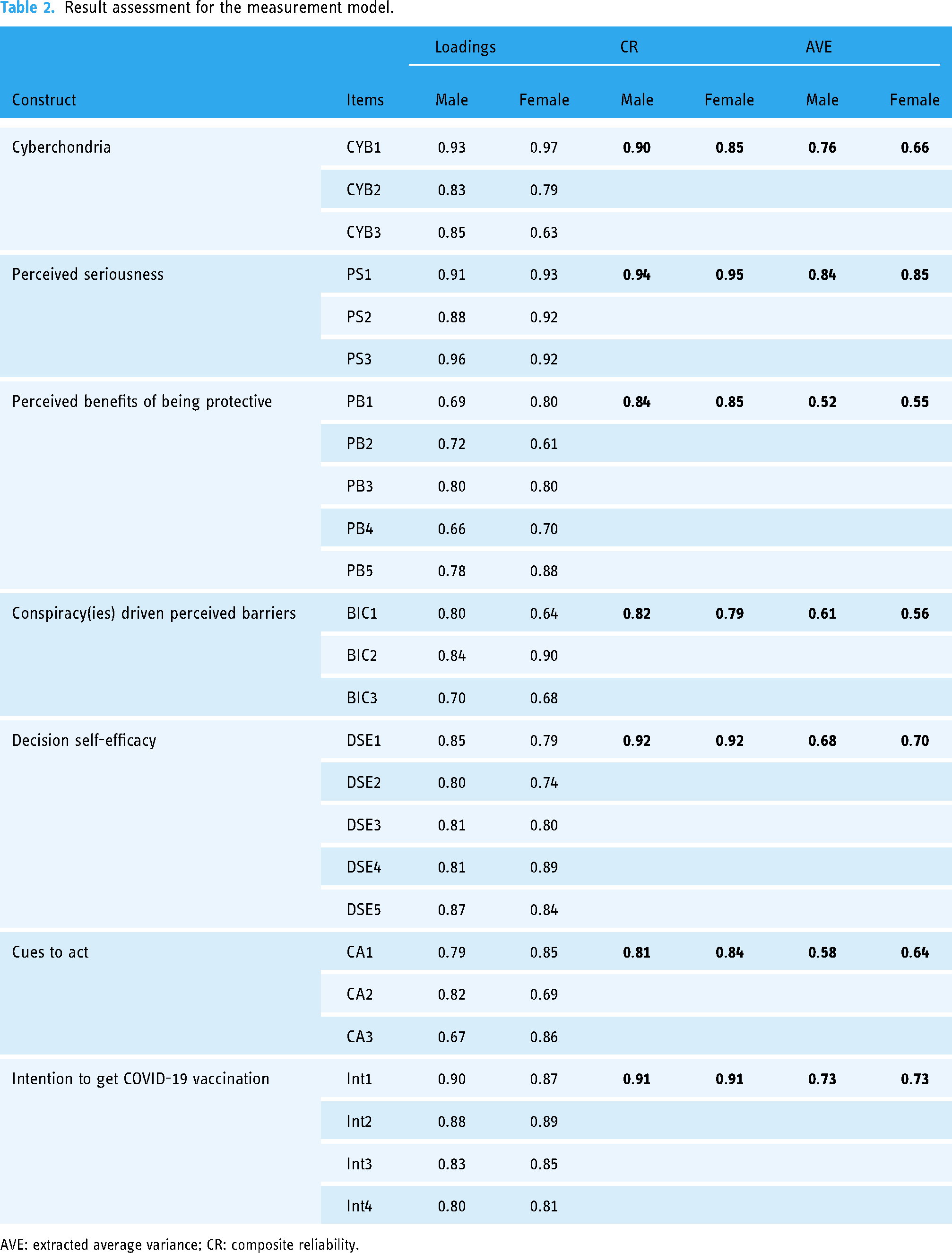
AVE: extracted average variance; CR: composite reliability.
The findings suggest that the measurement methodology is sufficiently reliable. The convergent validity of the measurement model for both groups was evaluated, and the LV and CR were set to be greater than 0.60 and 0.70, respectively, for the results to be deemed acceptable. 76 The convergent and divergent reliability results observed within the recommended ranges as advised by Hair et al. 77 are listed in tabular form (see Appendix B). The heterotrait–monotrait (HTMT) has demonstrated discriminant validity by using construct criteria of 0.85 and 0.9. This study evaluated discrimination using a conservative HTMT of 0.85 (see Appendix B).
Structural model assessment
A second phase of the research evaluated the structural models for gender-specific settings. The structural model was considered by evaluating both the R squared (R2) and Stone-Geisser (Q2) criteria for intention toward a vaccine and the significance of the path coefficients for each group. 78 The R2 values for intentions toward the COVID-19 vaccine were 0.40 for females and 0.34 for males. The Q2 must be >0 for a structural model to be considered predictive 78 ; in this instance, Q2 values were 0.07 and 0.071 for female and male intention toward vaccines, respectively. The findings of structural model evaluation and hypothesis testing by using 5000 bootstraps resample and 5000 permutations are obtained. The graphical representation of the structural model is shown in Figure 1.

Graphical repetition of structural path analysis results of MGA.
MGA
MGA was used to compare the results on the basis of gender. Perceived seriousness, conspiracy driven perceived barriers, CYB-driven susceptibility, and perceived benefits of being protective are significant in female participants. The role of DSE and the perceived seriousness of pandemic crisis were noted as the most dominating ones, thus supporting previous findings.47,79 Alarmingly, the conspiracy-driven barriers was observed as most dampening factor while mapping female's intentions to get vaccination. Geoghegan et al. 80 also underlined the role of rumors, which is challenging among females. Our results revealed that cues to action, DSE, CYB, and perceived benefits hypotheses were significant in male's participants, whereas conspiracies-driven barriers and perceived seriousness of COVID-19 were insignificant. DSE improved the intention to get COVID-19 vaccination. These findings were aligned with previous findings, in which DSE helped in formulating protective actions and responses to the pandemic crisis. 81 Consistent with previous studies, 82 males are more rational and strong in decision making. In line with the literature 83 the current study also highlights that males having less effect of misinformation in their surroundings which establish conspiratorial thinking. Appendix C reports the results of the structural model and MGA assessments using two different nonparametric methods. The next section will elaborate the results discussed in this section and the related theoretical and practical implications derived from findings of the current study.
Discussion and implications
The prime goal listed in the Introduction section was to address through the quantitative analysis reported in the Discussion and implications section. The following subsection will include the discussion on the basis of the proposed research questions.
Theoretical implications
The current research has several theoretical implications. First, the current research can distinguish results on the basis of its theoretical stance, as the proposed model for the study was adopted from HBM (a psychosociological model). It can predict and understand individuals’ health-protective behavioral intentions while adapting two extended theoretical views simultaneously, including institutional factors such as normative and regulative support as a part of cues to act in the HBM, particularly the adoption of regulative and normative support intended to address one of the least studied sections of HBM, as stated in the literature. Therefore, the study contributes its unique stance to the existing literature on HBM and institutional view. Second, the adaption of factors from CYB and DSE as two valuable constructs was also revisited. The current research proposed the critical role of DSE as determinants of perceived health-protective behavioral intentions during COVID-19. Theoretically, this revisiting of self-efficacy as a construct can be a part of a cognitive theory or as an empirical research-based initiative to deepen the understanding and effectiveness of HBM. The current adopted view of self-efficacy can be suggested to examine health-protective behavioral intentions of digital in the sphere of social setting. Moreover, several research initiatives have studied the physical and psychological effects of outbreaks of severe infectious diseases according to different demographic variables, such as whether examining individuals from specific socio-economic settings or behavioral mapping in case of a specific segment of society on the basis of their demographic attributes. However, no studies have focused on the physical and psychological impacts of outbreaks of COVID-19 on genders. No research initiative has compared the CYB or the effect of DSE among genders in any particular setting. Furthermore, the adapted HBM was examined in case of gender differences, thus enriching the understanding about the cultural context with HBM as a theoretical ground and social media usage behavior in society.
Practical implications
The COVID-19 pandemic has resulted in several conspiracy beliefs about its origin, seriousness, and attempts to stop its spread. In the digital era, this condition exhibits higher level of trust on social media post related to COVID-19 vaccine that is prone to conspiracies. The results of this study revealed that men and women experience COVID-19 pandemic differently. Women are more inclined toward conspiracies which ultimately leads them toward rejection of vaccination. Therefore, when authorities are designing health-related contents, their focus should be more critically toward the female cognition and attention. The recent pandemic crisis has shifted world from conventional to digital sphere in most of the social and economic affairs. The internet world comprised of pull architecture, where only desired piece of information comes up for the reader. Thus, the current study highlights that such electronic transformation results in challenges for the new post-truth era of information. With wide availability of digital communication technologies, our findings suggest that CYB results in crisis. To counter CYB, authorities must establish censorship policy to address the rumors and conspiracies timely. A team should be well trained and technically expert to handle this CYB crisis, which is the primary responsibility of every stakeholder. The CYB crisis can be addressed by strengthening citizens’ abilities in assessing information on social media sites which is crucial in combating health-related conspiracy theories. Therefore, relevant governmental and nongovernmental authorities need to develop an effective digital health literacy program, related policies, and an effective social media campaigns to curb conspiracy theories and misinformation concerning the pandemic. Thus, the study addresses the challenges related to mistrust, post-truth era crisis, infodemic, information sharing, and seeking behavior and trust in media.
Conclusion and limitation
This section helps in making a conclusion derived on the basis of above discussion and what limitations are faced by this study which needs to re-examine in the future studies. In the present study, we investigated the heterogeneity of health belief models and the intention toward COVID-19 vaccination and the effect of HBM constructs on intention toward COVID-19 vaccination between males and females in Pakistan. Many scholars have suggested several assumptions, models, and frameworks, which have been used for understanding the health behaviors that may vary between males and females. 87 Considering these findings, the comparison of male and female intentions toward vaccination contribute to the literature on gender intention toward vaccination. Based on the findings from the current study, the significance of this contribution increases significantly. This study aimed to examine the gender differences in vaccination intentions in the developing world, because limited literature has focused on the moderating effect of gender on vaccine intentions. 95 Further, this study was the first to employ the MICOM approach suggested by Henseler et al. 96 to test measurement invariance in PLS-SEM utilize both Henseler's MGA and the permutation method to conduct MGA in the context of health behavior in Pakistan. This MGA makes a significant contribution to the vaccine intention literature.
Despite its significant findings, the study still faces limitations. The study examined one of the developing regions only. The future study can also compare other developing regions to make the findings more generalized. Second, the Hofsted's recommended cultural factors were examined in the case of addressed region to examine the dynamics of cultural factors. CYB appears to be a multidimensional construct, reflecting both anxiety and an element of compulsiveness. In this study, we only considered CYB as a perceived susceptibility of COVID-19. Future studies can include other three dimension to measure CYB in more comprehensive manner. DSE plays a crucial role in initiating changes in preventive health behaviors and sustaining those behaviors. In terms of public understanding socioscientific issues, the role of DSE is critical in health centric behavior. Therefore, DSE can be further examine in case of other health centric issues, apart from infodemic, such as influenza vaccination, or cosmetic surgeries.
Footnotes
Author contribution
JM and CJ was involved in conceptualization; FA in formal analysis; OHR in investigation; SM in nethodology; JM in supervision; TSA in validation; RS and FA in writing—original draft; and RS, AZ, and FA in writing—review and editing
Availability of data and material
Data will be available on reasonable request.
Declaration of conflicting interests
The author(s) declared no potential conflicts of interest with respect to the research, authorship, and/or publication of this article.
Ethics approval
Ethical clearance from the ethical committee from the Department of Science and Technology of Communication—University of Science and Technology of China provided.
Funding
The author(s) received no financial support for the research, authorship, and/or publication of this article.

Appendix A
Appendix B
According to Fornell and Larcker, discriminant validity is defined as the square root of the extracted average variance for each construct being greater than the sum of the correlations between these constructs and those in the model.72,100 Additionally, the heterotrait–monotrait (HTMT) ratio has been recently developed as an accurate criterion for more conventional evaluation techniques, such as the Fornell–Larcker criterion. 101 The explanatory power of the structural model was determined by calculating the R2 value for each of the endogenous construct Hair et al. 100 More importantly, the R2 value should always be interpreted according to the context of the study based on the R2 value from related studies and models of similar complexity. 102 A measurement invariance criterion for MGA should be set for both female and male groups with respect to intention toward vaccine. 103 The use of measurement invariance for composite (MICOM) method is suitable for partial least squares structural equation modeling (PLS-SEM). 104 The MICOM method consists of the three following steps: (a) evaluation of configural invariance, (b) evaluation of compositional invariance with the correlation of constructions, and (c) evaluation of equal means and differences. MGAs require partial measurement invariance, which is achieved by defining a configuration and composition invariance.
Hair Jr, Sarstedt, Henseler, and Ringle recommend checking for measurement invariance before conducting MGA between two or more groups by using SEM.74,100 However, most methods that assess SEM measurement invariance assume standard factor models. A PLS-SEM model uses a composite model to generate latent variable scores. 74 Henseler and Ringle suggested the use of a composite-based analytic method called MICOM as a strategy that is more suitable for PLS-SEM analysis. 74 The MICOM model was chosen for analysis, because the present study aims to compare a model across the two groups by using PLS-SEM. MICOM is a three-step method that entails (a) determining configural invariance, (b) establishing compositional invariance, and (c) determining equal means and variances. MICOM was used to determine that both groups share partial measurement invariance (Table 3), which is important for evaluating and comparing the differences between the MGA groups and the PLS-SEM results. 74 Henseler's MGA and the permutation test. 71 These methods are considered the most conservative PLS-SEM methods for comparing the path coefficients of two groups. 75
Henseler's MGA directly compares each bootstrap sample's group-specific bootstrap estimates. The p-value must be <0.05 or higher than 0.95 to indicate a difference of at least 5% between the coefficients of a particular route between two groups. 75 The subsequent section provides a discussion of the data analysis technique for the assessment of the measurement and structural model along with MGA to determine the gender intention difference in vaccination.
Appendix C
Results hypothesis testing.

| Relationship | Path Coefficient | Confidence interval (95%) biased corrected | p-value difference | ||||
|---|---|---|---|---|---|---|---|
| Female | Male | Female | Male | Path coefficient difference | Henseler MGA | Permutation | |
| PS → INT | 0.28 | −0.24 | [0.34, 0.07] | [0.10, 0.44] | 0.52 | −0.52** | −0.58** |
| CA → INT | −0.15 | 0.17 | [0.04, 0.28] | [0.12, 0.28] | 0.02 | 0.32 | 0.37 |
| PB → INT | 0.21 | 0.16 | [0.05, 0.28] | [0.06, 0.34] | 0.05 | −0.05* | −0.05* |
| BIC → INT | −0.22 | 0.06 | [0.13, 0.16] | [−0.31,0.04] | 0.16 | 0.28* | 0.28** |
| DSE → INT | −0.30 | 0.31 | [0.15, 0.42] | [0.45, 0.17] | -0.60 | 0.60** | 0.60** |
| CYB → INT | −0.11 | −0.10 | [0.24, 0.08] | [0.25, 0.09] | -0.01 | −0.05* | −0.05* |