



Abstract
Objective
A common assertion in the social media literature is that passive media use undermines affective wellbeing, and active media use enhances it. The present study investigated the effects of social media use on negative affective wellbeing during pandemic crises and examined the mechanism underlying these effects through perceived uncertainty.
Methods
Three studies were conducted during the Delta variant phase in the post-peak period of the COVID-19 pandemic in China. Participants were recruited from the medium-high-risk infection areas in late August 2021. Study 1 used a cross-sectional survey to explore the relationships between social media use, uncertainty, and negative affect during the pandemic crisis. Study 2 employed a repeated-measures experiment to demonstrate how social media use and (un)certainty impact negative affect. Study 3 utilized a one-week experience sampling design to examine the role of uncertainty in the relationship between social media use and negative affect in real life.
Results
Despite some inconsistencies regarding social media use's direct effect on negative affect, across the three studies, perceived uncertainty was critical in linking pandemic-related social media use to individuals’ negative affect, particularly for passive use.
Conclusions
The relationships between social media use and affective wellbeing are complex and dynamic. While the perception of uncertainty provided an underlying mechanism that links social media use to individuals’ affective wellbeing, this mechanism may be further moderated by individual-level factors. More research is needed as we seek to understand how social media use impacts affective wellbeing in uncertain contexts.
From the Athenian Plague to the recent monkeypox outbreak, humankind faces the challenges of infectious diseases more frequently than ever. This is especially evident in recent decades, with the emergence and re-emergence of influenza outbreaks becoming a constant worldwide health risk. 1 Facing highly fatal infectious diseases that were previously unknown can lead to significant social disruptions and place substantial psychological burdens on individuals.2,3 While many scholars raised concerns that social media use (SMU) of information that features the pandemic crisis might be a risk factor for individuals’ adverse psychological outcomes, some called for an understanding of the buffering role of SMU in mitigating the negative psychological consequence of such existential threats.4–6 Indeed, since the COVID pandemic, the general public's growth of the internet and media usage for information has been observed in unparallel magnitudes.6–8
Increasing evidence suggests that pandemic-related SMU was an important factor associated with individuals’ negative affective wellbeing during the outbreaks. For example, using online self-report questionnaires, studies in Germany, China, and the United Kingdom have found that individuals’ anxiety and depressive symptoms were significantly correlated with their media usage in COVID-19-related information.9–11 However, the SMU in these studies was mainly investigated in individuals’ frequency and average time spent consuming (e.g. watching and reading) the pandemic information on social media in general. Focusing solely on how one's frequency/duration of social media usage is associated with their psychological wellbeing may be overly simplistic within this ever-evolving technological environment.12–14 SMU is increasingly complex. Users now hold various options (e.g. co-creating news, sharing, and commenting) when interacting with social media (i.e. active use) than merely passively consuming information (i.e. passive use) from the internet.13,15,16
A common assertion in social media literature is that passive SMU (PSMU) undermines wellbeing, while active SMU (ASMU) enhances wellbeing. 17 Previous studies have generally conceptualized ASMU as activities involving direct interaction with others (e.g. sending messages or posting a status update) and PSMU as the act of observing or consuming content on social media without engaging in direct exchange with others. 18 However, despite the widespread acceptance of the ASMU and PSMU hypotheses, empirical evidence on the relationship between SMU and affective wellbeing has been inconsistent. 17 While a critical review revealed a negative relationship between PSMU and affective wellbeing and a positive relationship between ASMU and affective wellbeing, 18 a recent meta-analysis suggests that neither ASMU nor PSMU is associated with negative affective wellbeing (i.e. psychological distress). 19
With the relationships between SMU types and affective wellbeing remain inconclusive, many studies have attempted to elucidate the underlying mechanism linking SMU to affective wellbeing. 20 Some researchers have suggested that PSMU can trigger social comparisons and envy, leading to psychological distress, while ASMU predicts subjective wellbeing by fostering social capital and promoting feelings of social connectedness. 18 Nonetheless, in the context of crisis events, the function of social media (i.e. as a major tool for emergency communications) could be very different from its daily use. It is unclear whether the negative effects of PSMU and the positive effects of ASMU could be extended to the context of pandemic crises, especially in pandemics like COVID-19, where economic activities, social interactions, civil liberties, and education are constantly interrupted at all levels. 21 Therefore, understanding how SMU impact one's affective wellbeing during a persistent and dangerous health threat is an important area of inquiry for the research community.
One major reason that drives people to use social media in crises may be the feeling of uncertainty (i.e. a sense of lack of information regarding ‘whether, where, when, how, or why an event has occurred or will occur’). 22 As an inevitable feeling that most people experience at all stages of crisis events, uncertainty is also crucial to individuals’ mental health, especially in mood disturbance and emotional distress.23–25 Health communication scholars under the influence of uncertainty management theories tend to consider uncertainty a negative state people wish to reduce.22,26 Characterized by numerous unknowns, the COVID-19 pandemic was unavoidably an uncertain and stressful situation.1,7 As a result, those who experienced more uncertainty during the pandemic might engage in more information-gathering behaviours.
While in the era of the Black Death, people turned to religion to seek a rational explanation for what was happening; in the modern era, people seek information from social media when facing uncertainties in crises. 1 Nevertheless, the occurrence of pandemic outbreaks was often accompanied by an overabundance of information which carries a vast amount of misinformation, rumours, and controversial opinion. 27 This surge of information may render consuming pandemic-related information on social media less effective in reducing uncertainty through converging ideas and helping people understand what is happening. Instead, increased exposure to pandemic information may exacerbate one's sense of uncertainty, leading to mental simulation of potential losses associated with the pandemic (e.g. death and economic consequences), thus inducing negative affective responses. 24
Meanwhile, the nature of the pandemic (as a highly infectious disease) and the corresponding social distancing policies made various forms of communication and social support shift online, providing social media with the capacity to play a functional role in fostering resilience and buffering stress.6,28 By interacting with others on social media (e.g. sharing information, ideas, and experiences) with a vast network of individuals, people gain informational and social support that allows them to reappraise the stressors and uncertain situations during the pandemic in a positive way, thereby mitigating their negative affect. Hence, in contrast to other mechanisms studied in SMU literature, the perception of uncertainty may be a more plausible mediator explaining the effect of SMU on affective wellbeing during pandemic crises.
Moreover, researchers have suggested that feelings of uncertainty can increase people's curiosity about emotional events, such as a pandemic outbreak, thereby strengthening their affective response. 22 Recent research has found that Twitter topics covered by pandemic themes were mainly associated with users’ negative affect (i.e. anger, anxiety, and sadness). 29 It is possible that people with more perceived uncertainty may be more engaged with pandemic-related content (either actively or passively) on social media and more susceptible to negative affect online. Given that social media can keep information about crises accessible to the public with little restraint, an individual's feelings of uncertainty and pandemic-related SMU might also interact to influence their affective wellbeing during pandemic crises.
The present study
Studies have provided initial support to the potentially problematic role of general SMU on mental health in the context of pandemic crises, yet how individuals’ behavioural engagement on social media influences their affective wellbeing is still an under-examined phenomenon. Therefore, the aim of this research was to extend our understanding of the link between SMU and affective wellbeing during pandemic crises in a more granular approach. In particular, we aimed to examine the effect of PSMU and ASMU on people's negative affect and explore the potential mediating or moderating role of perceived uncertainty in the relationship between SMU and negative affect.
Study 1
To explore the associations between SMU, uncertainty, and negative affect in the pandemic context, Study 1 utilised a cross-sectional survey design. Following the PSMU–ASMU hypothesis, we anticipated a positive relationship between PSMU and negative affect, and a negative relationship between ASMU and negative affect. Drawing on prior research in the literature, we hypothesized that PSMU would positively predict perceived uncertainty, which would in turn predict higher negative affect. Conversely, we expected that more ASMU would predict less perceived uncertainty, predicting lower negative affect. It was also expected that the impact of SMU on negative affect would be stronger when individuals hold more feelings of uncertainty.
Methods
Participants
Participants were recruited via Credamo (an online survey platform) on 18 and 19 August 2021. Given that China has implemented the ‘normalized epidemic prevention and control’ model at the time of data collection, to recruit participants who were influenced by the waves of Delta-variant infection, only participants who were in Jiangsu, Henan, Hubei, and Hunan provinces (i.e. locations that were with medium–high risk infection) were able to respond to the survey. The initial sample consisted of 1011 participants who responded to the online survey. Sixteen participants who answered the survey in an exceedingly short completion time (<300 seconds) were not included in the current study. Sample characteristics are presented in Table 1. Of the 995 participants included, 525 were females (Mage = 28.80, SD = 6.97), 468 were males (Mage = 30.32, SD = 7.50), and two did not specify gender. Overall, participants reported a high level of pandemic concern.
Sample characteristics.

Measures
Participants’ general perception of life uncertainty was examined using a four-item scale that was adapted from Colquitt et al., 30 α = .85. Negative affect was measured using the Depression, Anxiety, and Stress Scale-21 (DASS-21), 31 α = .93. Participants’ SMU was first assessed by asking the amount of time (in hours) they spent seeking pandemic information on social media 1 . Then, Escobar-Viera et al.'s 32 7-item Passive and Active SMU Scale was used to examine individuals’ pandemic-related behavioural engagement on social media. The internal consistencies were good for PSMU (α = .74) and ASMU (α = .84).
Procedure
The explanatory statement was the landing page. Participants were informed that their participation in the research was voluntary, and submission of the completed survey would be taken as an indication of their consent to participate. If they agree to participate, participants could click the ‘Continue’ button at the bottom of the landing page. Following informed consent, participants started the survey that assessed their demographics, SMU, perceived uncertainty, and negative affect. Due to the nature of the questions (DASS-21) within the survey may elicit mild distress, participants were informed that they could withdraw from the study at any point if they changed their minds. Appropriate support services were also provided at the survey's beginning and end. Each participant who completed the survey received a ¥10 payment.
Data analyses
Data were analysed using SPSS 28.0 and Mplus 8.7. Main study variables were screened for missing data, normality assumptions, and outliers. Preliminary analyses revealed significant effects of age, gender, education, employment, and mental health history on the main study variables. Thus, they were included as covariates for subsequent analyses (Table S1, in supplement). Associations between SMU, perceived uncertainty and negative affect were first examined using Pearson correlation and partial correlation controlling for demographic variables. To explore the potential moderating role of perceived uncertainty, two moderation analyses—with the PSMU and ASMU as the independent variables, uncertainty as the moderator variable, and negative affect as the dependent variable—were performed using SPSS PROCESS Marco (Model 1). Then, a path analysis using structural equation modelling (SEM) was performed in Mplus to examine the possible mediating role of uncertainty on the relationship between SMU and negative affect.
Results
Descriptive statistics and correlation results are presented in Table 2. There were significant small-to-moderate associations between individuals’ ASMU, perceived uncertainty, and negative affect. PSMU had only a positive relationship with perceived uncertainty. SMU time had negligible effect sizes and was not associated with uncertainty and negative affect.
Descriptive statistics and correlations between the main study variables.

Note. Raw means and standard deviations are presented. Bivariate correlations (n = 989) are displayed above the diagonal, and partial correlations (n = 980) controlling for age, gender, education, employment, and mental health diagnosis are displayed below the diagonal.
SMU: social media use.
*p < .05.
**p < .01.
To examine whether these associations could be explained by individuals’ perceived uncertainty in the pandemic context, the results of moderation analyses were first inspected. Table 3 reveals that uncertainty did not moderate the relationships between SMU and negative affect. While ASMU and perceived uncertainty uniquely predicted negative affect, PSMU did not. Instead, mediation analysis revealed that PSMU predicted negative affect indirectly through uncertainty. Specifically, more PSMU was associated with more perceived uncertainty, which was associated with higher negative affect. While path analysis showed that ASMU and uncertainty remained positive predictors of negative affect, unexpectedly, PSMU became a negative predictor of negative affect.
Results of the mean-centred moderation and mediation analyses for negative affect.

Note. CI: confidence interval; NA: negative affect; ASMU: active social media use; PSMU: passive social media use.
Controlling for age, gender, education, employment, and mental health status.
*p < .05.
**p < .01.
Discussion
Contrary to our expectation, the correlational findings did not support the common PSMU–ASMU hypothesis (i.e. PSMU predicts poor psychological wellbeing, and ASMU predicts better wellbeing). 18 Rather, current findings showed that ASMU positively predicted one's negative affect during a pandemic crisis. Prior research suggests that ASMU can enhance affective wellbeing by providing individuals with more opportunities for social capital and emotional aid.18,33 However, Study 1 investigated pandemic-related ASMU, which may contain less personally emotional components. People may be less likely to seek emotional aid through pandemic-related ASMU, as such interaction often occurs privately online. 17 Furthermore, ASMU during crises (e.g. responding to or expressing strong opinions and emotions online) may increase users’ risk of engaging in distressing discussions or debates, thus increasing their negative affect.
PSMU, on the other hand, has demonstrated a complex relationship with negative affect. Path analysis showed that PSMU predicted both lower negative affect (directly) and higher negative affect (indirectly) through increased perceived uncertainty. Previous research has found that PSMU is associated with poor affective wellbeing in daily life. 18 A possible explanation for our contradictory findings may be using SEM (which included both PSMU and ASMU in the model) in the current study. The correlation results have revealed a strong link between ASMU and PSMU. It is possible that ASMU acted as a suppressor for PSMU on its association with negative affect, 34 resulting in the non-significant and positive relationship between PSMU and negative affect being strengthened and reversed. Thus, accounting for the effect of ASMU revealed a negative effect of PSMU on negative affect. It is possible that scrolling through feeds or reading posts provided individuals with opportunities to stay informed about the pandemic and observe how others are coping with the crisis, thus beneficial to affective wellbeing. However, it is important to realize that the SEM results suggest that PSMU impact negative affect through dual pathways. While viewing pandemic-related posts may help individuals learn how to handle crisis events, if the consumption of pandemic-related information led to increased uncertainty, their negative affect would also increase. For example, seeing others experiencing the same challenges may elicit one's feelings of worry about not doing enough to protect themselves or their loved ones, thus increasing uncertainty.
These findings provided us some initial understanding about the relationship between SMU and affective wellbeing. Given that different approaches in assessing media use may affect the results regarding the associations between SMU and wellbeing in critical situations, 35 it is necessary to use diversifying methods to examine whether these findings could be replicated.
Study 2
To address the limitation of the cross-sectional survey and further examine how SMU influence negative affect over time, Study 2 used a three-way factorial experiment design. Specifically, Study 2 examined the effect of SMU and uncertainty on negative affect by performing a 2(SMU: passive vs. active) × 2(condition: uncertain vs. certain) × 3(time: pre-test vs. immediate post-test vs. delayed post-test) factorial design. Given that inconsistent finding has been observed in Study 1 compared to prior SMU research conducted in daily life, our hypotheses on the SMU's impact on negative affect and the role of (un)certainty on this effect were exploratory.
Methods
Participants
Participants were recruited from social media platform (WeChat
2
) in Haidian, Beijing (i.e. a medium-risk infection area reported by the National Health Commission) during late August 2021. Prior to recruitment, a G*power 3.1 analysis was conducted to determine the necessary sample size for a repeated-measures analysis of variance (ANOVA) with within–between interaction design. The analysis indicated that a total of 60 participants were needed to detect a medium effect size, f = 0.25, α err prob = .05, power = 0.95, number of groups = 4, number of measurements = 3, corr among rep measures = 0.5, and non-sphericity correction
Of the 134 participants (Mage = 25.46 years, SD = 6.90; 80 females, 53 males, one did not specify) included, most participants (71.6%) were full-time students. All except six participants held or were attending an undergraduate degree. All except nine participants reported having no mental health diagnosis history. Overall, participants reported a moderate pandemic concern (M = 3.18, SD = 1.05). Each participant who completed the study received an ¥80 payment.
Pre-experiment preparation
After arriving in the laboratory, participants were presented with explanatory statements, and signed consent forms were procured. Then, participants were instructed to sit in front of a laptop to complete the baseline survey. The pre-experiment survey assessed participants’ sociodemographic characteristics (i.e. age, gender, education, occupation, and mental health diagnosis) and negative affect (i.e. negative emotions, 36 α = .86). Then, participants were randomly allocated to one of the four conditions as follows: ASMU × uncertain (n = 30), PSMU × uncertain (n = 34), ASMU × certain (n = 35), and PSMU × certain (n = 35).
Experiment manipulation
First, participants were told that they would take part in two unrelated tasks—SMU and (un)certainty writing.
Then, participants were randomly allocated to complete an ASMU task or PSMU task. Following Verduyn et al., 37 the experimenter explained to the participants what passive use and active use include. In the current study, the SMU task was tailored to be in accord with the pandemic context. Printed instructions were also provided to the participants. Specifically, participants were asked to use Weibo 3 (i.e. a microblogging site often described as the Chinese Twitter) on their phone, actively or passively for 10 minutes for pandemic-related information. To ensure that participants followed protocol, participants were asked to recall the content they viewed during the social media task at the end of the post-manipulation questionnaire. In addition, participants were asked to select and mark the activity that best described their involvement in the social media task (e.g. browse, like, share, comment, and post) they did during the social media task. Participants who did not pass the compliance check (e.g. using Weibo passively when asked to use actively) were excluded from subsequent analyses.
After completing the SMU task, participants were asked to complete a (un)certainty writing task. Participants were randomly allocated to a certainty condition or uncertainty condition. The priming method followed van Horen and Mussweiler's 39 experimental steps. Specifically, participants were asked to read a paragraph about several (un)certain events after the pandemic outbreak and write how (un)certainty shapes their own lives. Printed instructions and a one-page writing sheet were provided to the participants. Participants’ perceived uncertainty was assessed directly after the writing task. Participants were asked to respond to ‘how do you feel right now?’ from 0 (very uncertain) to 100 (very certain). A univariate ANOVA was performed to examine whether the manipulation was successful controlling the influence of the SMU task. The results showed that there was a significant difference between uncertain (M = 52.31, SD = 25.58) and certain (M = 71.46, SD = 19.77) groups’ levels of uncertainty, F(1,132) = 12.60, p < .001, η2 = .15.
Post-manipulation questionnaire
Participants completed a brief online questionnaire that assessed their negative affect (α = .89). After completing the post-manipulation measures, participants were notified that a follow-up survey (same as the post-experiment questionnaire) would be sent to them at 9:00 p.m. in the evening.
End-of-day questionnaire
All except eight participants responded to the survey (94.03%). The survey included all items from the post-manipulation questionnaire (negative affect: α = .87).
Data analyses
The analyses were performed using SPSS 28.0. First, a univariate ANOVA (bootstrapped with 5000 resamples) was conducted to examine whether there were significant differences in participants’ negative affect between groups before the experiment. The results showed no difference in participants’ negative affect at the baseline, F(1,130) = 1.93, p = .17. Then, a three-way repeated-measures ANOVA was conducted to evaluate the effect of SMU types, (un)certainty condition, and assessing time on participants’ negative affect. Mauchly's test of sphericity indicated that the sphericity assumption had been met, χ2(2) = .29, p = .87. Partial eta square was used to report the effect size of experiment conditions on negative affect, where pη2 = .01 indicates a small effect, pη2 = .06 indicates a medium effect, and pη2 = .14 indicates a large effect. 40
Results
Table 4 reveals no significant three-way or two-way interactions between SMU types, (un)certainty conditions, and assessment time, except for a two-way interaction between (un)certainty and assessment time. Within-subjects contrasts showed that priming (un)certainty significantly changed participants’ negative affect across the three assessment times. Pairwise comparisons revealed that negative affect increased after priming uncertainty (MD = −1.53, p = .005) and decreased after priming certainty (MD = 1.82, p < .001). However, the effect of priming uncertainty did not last until the end of the day. Participants in the uncertain condition displayed a drop in negative affect (MD = 2.43, p < .001) at the end of the day, with no difference between their negative affect at the end of the day and that assessed at baseline (MD = .89, p = .11). Negative affect in the certain condition remained stable immediately after the task (MD = −.45, p = .40) and were significantly lower than that assessed at baseline (MD = 1.36, p = .01).
Results of the three-way repeated-measures ANOVA.

Note. UC: (un)certainty condition; SMU: social media use; Time: assessment times.
The within-subjects contrast also indicated significant differences in participants’ negative affect before the SMU task and after the SMU task. However, pairwise comparisons did not reveal any significant changes for passive (MD = −.65, p = .20) or active (MD = .94, p = .08) participants between these two assessment times. Inspecting the pairwise comparison results for ‘SMU × (Un)certainty × Time’ (see Figure 1) revealed that only passive participants in the uncertain condition displayed significant increases (MD = −2.24, p = .002) in negative affect, while only active SMU participants in certain condition displayed decreases (MD = 2.70, p < .001) in negative affect. Similarly, the effect of uncertainty on negative affect in the passive participants did last until the end of the day, with no difference between their negative affect at the end of the day and that assessed at baseline (MD = 1.18, p = .12). The effect of certainty on negative affect in active participants remained stable after the task, and their negative affect was lower than that assessed at baseline (MD = 1.76, p = .02).

Negative affect over time as a function of passive SMU vs. active SMU in different conditions. Error bars represent 95% confidence interval. Raw means and standard deviations of negative affect in each experiment group are presented in Table S2.
Discussion
Study 2 employed a repeated-measures experimental design to examine the impact of SMU and (un)certainty on negative affect. The results showed no significant changes in passive and active use participants’ negative affect at the post-experiment assessment. However, inspecting the simple main effects analysis revealed that passive use participants who were prompted by uncertainty reported significant increases in negative affect, while active use participant who were prompted by certainty reported declines in negative affect. Previous studies have found that (un)certainty can influence affective states by prompting the mental simulation of possible event outcomes. 24 Our results also showed that priming participants’ (un)certainty elicited changes in negative affect over time. It is possible that the detrimental effect of PSMU on affective wellbeing (as commonly assumed) only depends on individuals’ increased perception of uncertainty, while the buffering effect of ASMU on negative affect only depends on individuals’ sense of certainty.
Moreover, we observed an extended effect of ASMU on negative affect for participants in the certain condition at the end of the day. This finding supports the proposition that social media can play a buffering role in negative affective wellbeing by reframing individuals’ perception of the stressors positively (i.e. more certain). 6 It should be noted that recent research suggested that G*Power analysis can underestimate the sample size needed for complex designs involving between- and within-subject factors. 41 Performing a sensitivity power analysis 41 with means, standard deviations, and within-subject correlations revealed insufficient power to detect small interaction effects (<50%) for the current sample, except for ‘SMU × Time’ and ‘(un)certainty × Time’. For individual comparisons we were interested in, only the comparisons of negative affect among active participants with certainty primed showed sufficient power to detect changes over time. Hence, it is unclear whether the non-significant effects in Study 2 reflected the true impact of SMU on negative affect or if it was due to the small sample size. Alternatively, the non-significant effect of SMU over time may result from the 10-minute SMU task being too brief that its effect does not influence one's affect level across the day. Since individuals often do not only use social media once a day, conducting more ecologically valid research may help uncover the associations between SMU, perceived uncertainty, and negative affect in real life.
Study 3
To increase the ecological validity of the current investigation, Study 3 utilized a one-week experience sampling methodology (ESM). Specifically, Study 3 investigated the temporal relations between individuals’ SMU and affect on both within-person and between-person levels. Likewise, Study 3 also explored the potential moderating or mediating role of perceived uncertainty on the relationship between SMU and negative affect. Given the longitudinal nature of the data, Study 3 also examined if SMU and uncertainty would predict affect over time and whether a reverse relationship between negative affect and SMU could be identified.
Methods
Participants
One hundred seventy-nine participants were recruited via Credamo on 18 August 2021. To recruit participants who were influenced by the waves of Delta-variant infection, participants’ internet protocol location was limited to the medium–high risk areas (i.e. Jiangsu, Henan, Hubei, and Hunan provinces) that National Health Commission reports at the time of data collection. Data screening showed that participants responded to 86.34% of the ESM survey notification (range: 3%–100%) on average. Following Verduyn et al., 37 participants who responded to <60% of the survey (n = 15) were excluded from the current study. In addition, eight participants who responded to the survey in a perfunctory pattern (e.g. selecting same answers for same questions throughout the surveys) were also excluded. Of the 156 participants (Mage = 30.97 years, SD = 6.86; 95 females) included, most participants held an undergraduate degree or above (88.5%), were employed (89.7%), and reported no mental health diagnosis history (92.3%).
Procedures
Pre-ESM. An explanatory statement was provided on the landing page, informing participants of the study's aim, confidentiality, and options for support if needed. Participants were also informed that the study would last for about a week and that an anonymous identification code would be required if they agreed to participate. Consent was provided by clicking the ‘Agree to Participate’ button and proceeding with the study. Participants’ SMU time (M = 2.00 hours, SD = 1.14), pandemic concern (M = 4.64, SD = .60), and sociodemographic information necessary to describe the sample were assessed before ESM surveys.
ESM phase. The daily survey started on 19 August and ended on 24 August 2021. The ESM items were delivered and completed using Credamo's mini program 4 on WeChat. Following Verduyn et al., 37 participants were notified on WeChat five times per day between 10 a.m. and midnight for six consecutive days (see Supplement 4 for an example of the ESM surveys administration in a day). Each notification contained an in-app Credamo survey, which asked participants to answer questions about their affect (0 = very positive, 100 = very negative; M = 27.50, SD = 19.02), uncertainty (0 = very uncertain, 100 = very certain; M = 56.95, SD = 23.47), SMU-passive (0 = not at all, 100 = a lot; M = 59.36, SD = 23.50), SMU-active (0 = not at all, 100 = a lot; M = 48.48, SD = 26.39), and other media use (0 = not at all, 100 = a lot; M = 52.85, SD = 26.16) at the moment of completing the survey.
For compliance check, participants were asked to briefly write down the keywords of the pandemic information they obtained from social media since the last time we asked. Due to a technical error, participants’ data were missing for one time point (Day 2 Time 3). Thus, 4218 experience sampling observations were obtained. Participants received ¥2 for completing a single ESM survey and could receive up to ¥60 for completing all ESM surveys.
Post-ESM. Of the 156 participants who were retained in the ESM phase, 155 completed the post-ESM survey, which asked them to report their pandemic-related SMU (M = 2.29 hours, SD = 1.12) and level of pandemic concern (M = 4.50, SD = .72) in the past few days. Each participant received ¥20 for completing the pre-ESM and post-ESM surveys.
Data analyses
Given the nested structure of the data, a series of multilevel models with participants’ affect as the outcome variable were conducted using Mplus 8.7. 43 The grandmean centring approach was applied for predicting variables in the analyses. The intercept-only model was first estimated to determine the amount of variance at each level. The null model results revealed that the intraclass correlation coefficient was 178.40/(178.40 + 158.04) = 0.53, suggesting that about 53% of the total variance in participants’ affect was due to interindividual differences, and 47% could be attributed to within-person fluctuations (and errors). To increase the precision of estimates for the predictor variables at the within-person level, a two-level model including participants’ demographics (age, gender, and mental health) and other media use was also performed. The results showed that these variables explained 7.9% of the within-person variance in participants’ affect. Other media use (β = −.13, p < .001) and gender (β = −.43, p = .003) significantly predicted participants’ momentary affect, while age and mental health did not. Hence, gender and other media use were included as covariates in subsequent analyses where applicable.
For the moderation analysis, a two-level random intercept model was first conducted to examine the within- and between-person associations of SMU and momentary uncertainty with individuals’ affect (Model 1). Then, a random slope model was performed to investigate whether the heterogeneity in the within-person association between momentary SMU and affect could be explained by participants’ average levels of uncertainty (Model 2). For the mediation analysis, a multilevel SEM with PSMU and ASMU as the independent variables, momentary uncertainty as the mediating variable, and affect as the dependent variable was performed following Preacher et al.'s 44 analysis recommendation for a 1-1-1 mediation model 5 . Goodness-of-fit was assessed, and the results showed acceptable model fit: Standardized Root Mean Squared Residual (SRMR) = .02/.03 (within/between), Root Mean Square Error of Approximation (RMSEA) = .06, and Comparative Fit Index (CFI) = .96. 45
Finally, a lag-1 multilevel vector autoregression model (with 10,000 iterations) was conducted to explore whether SMU and momentary uncertainty had a delayed effect on individuals’ affect, and if a reverse relationship between affect, SMU, and uncertainty could be identified. Following a prior study, 37 between-day lags (participants’ first ratings in the morning) were excluded from the lagged analysis.
Results
Table 5 presents the Bayesian multilevel estimates for the within- and between-person associations. The results revealed no associations between participants’ SMU and momentary affect within-person. However, PSMU was positively correlated with negative affect, and ASMU was negatively correlated with negative affect between-person. Momentary uncertainty was only associated with affect within-person, but moderation analysis showed a significant interaction effect of average momentary uncertainty on individuals’ affect (Beta1 ON average MU). Specifically, when average momentary uncertainty was low 6 , the positive association between PSMU and negative affect was altered—more PSMU was associated with less negative affect.
Bayesian multilevel model estimates (with 10,000 iterations) of the within-person and between-person associations of SMU and momentary uncertainty with affect.
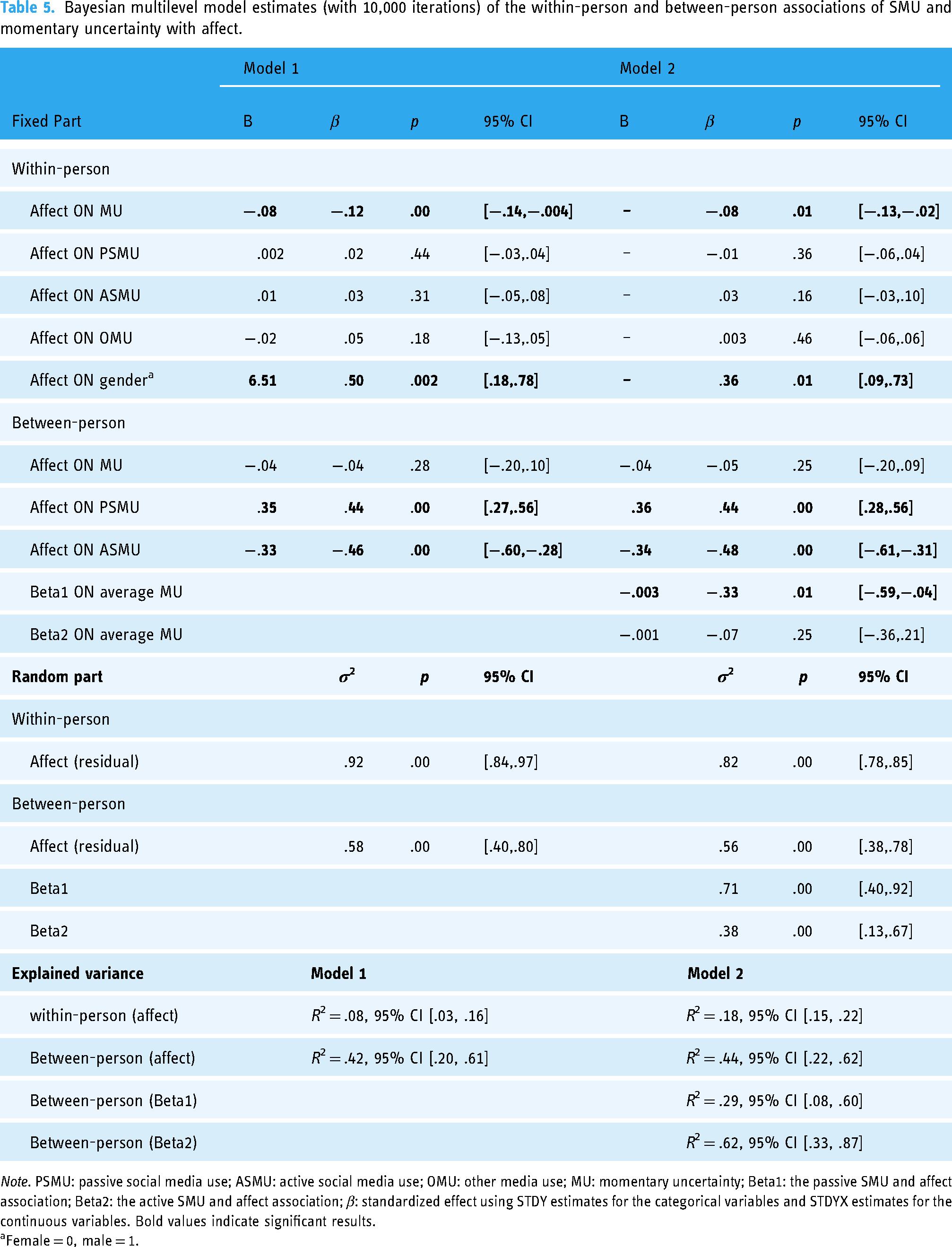
Note. PSMU: passive social media use; ASMU: active social media use; OMU: other media use; MU: momentary uncertainty; Beta1: the passive SMU and affect association; Beta2: the active SMU and affect association; β: standardized effect using STDY estimates for the categorical variables and STDYX estimates for the continuous variables. Bold values indicate significant results.
Female = 0, male = 1.
The multilevel SEM analysis indicated that SMU significantly predicted individuals’ uncertainty at both within- and between-person levels, as presented in Table 6. Specifically, individuals engaging in more PSMU than usual and more PSMU compared to peers reported higher levels of uncertainty, while the opposite held for ASMU. Moreover, SMU types directly predicted affect at the between-person level, whereby higher levels of PSMU were associated with more negative affect, and higher levels of ASMU were associated with less negative affect. Furthermore, SMU types indirectly predicted affect through uncertainty at a within-person level. The fixed slope analysis showed that increases in ASMU were associated with decreases in momentary uncertainty and a subsequent decrease in negative affect. Conversely, increases in PSMU were linked to higher momentary uncertainty and an increase in negative affect. However, the random slope model revealed that the indirect effect of ASMU on affect was not significant when the mediation effect was assumed to vary across individuals.
Multilevel structural equational modelling predicting individuals’ negative affect.

Note. Momentary uncertainty was rated in the opposite direction of other study variables, in which a higher score indicates less feelings of uncertainty. Bold values indicate significant results.
SD: posterior standard deviation; CI: confidence interval; ASMU: active social media use; PSMU: passive social media use.
Finally, the results of the lagged analysis showed that neither PSMU, ASMU, uncertainty, nor participants’ momentary affect at one time point (T1) significantly predicted their affect level at the next data collection (T2). Rather, how participants felt (i.e. affect level) at T1 significantly predicted less ASMU (β = −.12, SD = .02, 95% CI [−.16,−.07]) and less perception of certainty (β = −.08, SD = .02, 95% CI [−.13,−.04]) at T2.
Discussion
At the within-person level, the findings revealed no direct effect of SMU on momentary affect during the pandemic. Instead, the effects of ASMU and PSMU on negative affect were mediated by perceived uncertainty, in different ways. Specifically, PSMU aggravated negative affect through an increased sense of uncertainty, whereas ASMU alleviated negative affect through increased feelings of certainty. Nevertheless, it should be noted that the random slope analysis indicated that ASMU's indirect effect on affect might vary across individuals. There may be some individual-level factors that potentially moderate ASMU's indirect effect.
At the between-person level, the results showed a negative effect of ASMU on momentary affect, suggesting that individuals who reported more ASMU experienced less negative affect compared their peers. There was also a direct effect of PSMU on affect, suggesting that those who reported more PSMU tended to experience more negative affect than their peers. These temporal associations align with the PSMU–ASMU hypothesis, which posits that PSMU predicts poor wellbeing, and ASMU predicts better wellbeing. 18 Moreover, the relationship between PSMU and affect varied depending on individuals’ perception of uncertainty. When perceived uncertainty was low, individuals who reported more pandemic-related PSMU, on average, reported less negative affect than others. This finding highlights the importance of considering individual differences in the sense of uncertainty when examining the effects of PSMU on affect.
Finally, we did not observe any delayed effects of SMU on negative affect. Instead, the results demonstrated that individuals’ negative momentary affect predicted their subsequent engagement in ASMU and perceptions of uncertainty. This pattern may be attributed to the nature of pandemic-related ASMU. Unlike ASMU in daily life, pandemic-related ASMU often involves the active exchange of pandemic-related information with others on social media, which may be more cognitively effortful and emotionally arousing. Thus, when individuals experience negative emotions, they may be inclined to reduce their desire to interact with distressing content online to avoid the risk of intensifying their negative affect. Additionally, negative affect has been found to impact one's perception of risks in unexpected and indeterminacy situations (e.g. a pandemic crisis), which may explain the increased sense of uncertainty. 24
General discussion
Social media has become an inextricable part of most people's life. We entrust it with the vital function of emergency communication during crises, yet less is known about how it impacts individuals’ affective wellbeing in public health crises like an ongoing pandemic. The current research investigated the effects of individuals’ SMU engagement patterns (PSMU and ASMU) on affective wellbeing during the Delta variant phase in the post-peak period of the COVID-19 pandemic in China. We particularly explored the potential role of perceived uncertainty in explaining the effects of SMU on negative affect using a cross-sectional survey, experiment manipulation, and experience sampling.
Effects of SMU on negative affect
Overall, our findings seem to challenge the widely assumed PSMU and ASMU hypotheses, which suggest that PSMU negatively affects affective wellbeing while ASMU enhances it. 18 Importantly, the results from the three study designs were inconsistent. The cross-sectional survey (Study 1) revealed a weak and positive association between pandemic-related ASMU and negative affect; and a non-significant association between PSMU and negative affect (when the influence of ASMU was not accounted for). In contrast, the experience sampling results (Study 3) showed that more ASMU was associated with less negative affect, and more PSMU predicted a higher negative affect. We speculate that the finding of only Study 3 supporting the PSMU–ASMU hypothesis (a within-person approach), and not Study 1 (a between-person approach), suggests that how SMU influences affective reactions is inherently a within-person phenomenon. Scholars have noted that using between-person designs (such as cross-sectional surveys) to investigate within-person processes is often the reason why studies are incapable of providing evidence to support their theory involving within-person phenomena. 46 This may also partly explain the inconsistent conclusions about the PSMU–ASMU hypothesis on affective wellbeing in the social media literature, where 75% of the research employs cross-sectional designs. 20 On the whole, these results support to the recent concerns that social media can be disruptive to people's affective wellbeing during pandemics,4,5 and the proposition that social media holds a functional role in mitigating negative affect. 6
How SMU impacts negative affect: the perception of uncertainty
Across the three studies, our findings suggest that perceived uncertainty plays a critical role in linking SMU to individuals’ negative affect during the pandemic context, particularly for pandemic-related PSMU. At a within-person level, the experimental manipulation in Study 2 revealed that priming passive SMU participants’ sense of uncertainty substantially increased their negative affect. Further, analysing individuals’ immediate experience in Study 3 demonstrated that those who used more PSMU than usual reported a significant increase in perceived uncertainty, subsequently predicting their negative affect. These findings highlight the importance of perceived uncertainty in explaining the temporal dynamics between pandemic-related SMU and affective wellbeing. At the between-person level, the mediating role of perceived uncertainty appears to exhibit less stability concerning the relationship between pandemic-related PSMU and negative affect. While the cross-sectional results from Study 1 showed a significant indirect effect of perceived uncertainty, the experience sampling results from Study 3 showed no significant indirect effect of perceived uncertainty between-person. Nevertheless, a significant interaction between PSMU and perceived uncertainty emerged as a predictor of negative affect at the between-person level. Specifically, the positive impact of PSMU on negative affect was mitigated and even reversed among individuals with low levels of uncertainty. Despite certain inconsistencies, these findings, in general, illustrate that the detrimental effect of pandemic-related PSMU on affective wellbeing may be largely contingent upon individuals’ perception of uncertainty.
The mediating role of perceived uncertainty on pandemic-related ASMU and negative affect was found to be significant only at the within-person level. Specifically, the experiment results from Study 2 showed that priming active SMU participants’ sense of certainty led to a notable reduction in negative affect. Additionally, findings from the experience sampling in Study 3 revealed that individuals who engaged in higher-than-usual levels of ASMU reported a decrease in uncertainty, which subsequently predicted a decrease in their negative affect. However, it should be noted that the significant within-person indirect effect of ASMU on negative affect was not consistent across individuals, suggesting that there may be individual-level factors moderating this indirect effect. For example, one such factor could be the level of social support (e.g. informational and instrumental) individuals receive through their engagement in pandemic-related ASMU. 6 A recent theoretical framework proposed by Marzouki et al. 6 suggests that SMU can act as a buffer against negative affect by fostering collective resilience and reframing one's threat perception, thereby reducing perceived uncertainty. Hence, the perception of uncertainty may not be the most dominating mechanism for the relationship between pandemic-related ASMU and affect. The indirect effect of perceived uncertainty may be influenced by other cognitive and emotional components that modulate individuals’ collective resilient processes on social media. More research is needed to examine how perceived uncertainty interacts with other independent variables linking ASMU to affective wellbeing. By delving into these interactions, a more comprehensive understanding of the complex dynamics between ASMU, perceived uncertainty, and affective wellbeing can be attained.
Before concluding, several limitations should be considered. First, SMU is a multi-dimensional concept encompassing more than just behavioural engagement. 13 We only focused on the behavioural dimension of SMU on a particular type of social media (i.e. microblogging sites) on a single platform (i.e. Weibo). Future investigation may consider examining different dimensions of SMU engagement (e.g. cognitive and social) on individuals’ affective wellbeing. In addition, social media platforms have unique functional features, norms, and cultures, 16 and individuals’ behavioural patterns on different platforms may influence their affect differently. For example, the emerging microblogging platform Mastodon (a decentralised social network on the internet) seems to create more independent and closer communities to respond to the needs of different groups of people. It is unclear how individuals’ behavioural engagement with these platforms may influence their crisis-related SMU engagement and their affective wellbeing when facing ongoing public health threats. Furthermore, though microblogging sites are popular sources of crisis information during disaster events, it is unclear whether these findings could be generalised to users on other social media platforms, such as video-sharing social network sites. Future research could explore how different types of SMU (in general and crisis-related use) on different social media platforms (or multiple platforms) contribute to amplifying or buffering individuals’ emotional distress in times of crisis.
Conclusion
Despite the limitations, this research provided preliminary evidence regarding the impact of SMU engagement patterns on individuals’ negative affect in crisis situations involving highly infectious diseases. Together, these findings highlight the complexity of the relationships between SMU (both passive and active) and negative affective wellbeing, with a significant reliance on individuals’ perception of uncertainty within the pandemic context. Moreover, it is worth noting that the indirect effect of uncertainty on the relationship between SMU and negative affect may be subject to additional moderation by individual-level factors. Further research is necessary to gain a comprehensive understanding of the underlying mechanisms and implications inherent in these findings.
Supplemental Material
sj-docx-1-dhj-10.1177_20552076231181227 - Supplemental material for Social media use, uncertainty, and negative affect in times of pandemic crisis
Supplemental material, sj-docx-1-dhj-10.1177_20552076231181227 for Social media use, uncertainty, and negative affect in times of pandemic crisis by Yun Wu, Zihao An, Yi Lin, Jingyue Zhang, Bo Jing and Kaiping Peng in DIGITAL HEALTH
Footnotes
Acknowledgements
The authors would like to thank all participants that took part in the study. The authors also appreciate the support of Mr Taylor Hamilton for helping with the English translations of the measures and Ms Mi Zhang for advising on the ESM analysis.
Contributorship
YW: Conceptualization, Methodology, Software, Formal Analysis, Visualization, Writing—original draft preparation. ZA: Conceptualization, Methodology, Investigation. YL: Data Curation, Experiment Materials Translation, Writing—original draft preparation. JZ: Investigation, Data Curation. BJ: Conceptualization, Methodology. KP: Supervision, Writing—reviewing & editing, Funding Acquisition.
Data availability
The data set that analysed during this study would be available on Open Science Framework (OSF) repository directory. Detailed information about study materials, measurement tools, and Mplus syntaxes used in the current study can be found at OSF (osf.io/7c65b).
Declaration of conflicting interests
The author(s) declared no potential conflicts of interest with respect to the research, authorship, and/or publication of this article.
Ethical approval
Ethics approval was obtained from the Research Ethics Committee of the Department of Psychology at Tsinghua University.
Funding
This research was supported by the Spring Breeze Fund (2020Z99CFG013) of Tsinghua University. YW is supported by the ‘Shuimu Tsinghua Scholar Program’.
Guarantor
YW.

Supplemental material
Supplemental material for this article is available online.
Notes
References
Supplementary Material
Please find the following supplemental material available below.
For Open Access articles published under a Creative Commons License, all supplemental material carries the same license as the article it is associated with.
For non-Open Access articles published, all supplemental material carries a non-exclusive license, and permission requests for re-use of supplemental material or any part of supplemental material shall be sent directly to the copyright owner as specified in the copyright notice associated with the article.
