




Abstract
Background
Parents’ feeding practices in the first 2 years of life have profound effects on children's survival, health and development throughout their lives. Decisions on how to feed infants and young children should be based on the best information and evidence, not influenced by commercial interests. China is the largest and fastest-growing market for formula milk products. Social media has emerged as a distinctive marketing avenue that can reach consumers directly. Weibo is one of the most popular Chinese social media platforms. This study examined four of the most popular milk formula brands’ official Weibo accounts: Biotime, Mead Johnson, YiLi-Prokido, and Friso.
Question
What messages posted and what marketing practices and tactics are used by formula milk brands on Weibo.
Methods
We manually downloaded all posts in the four accounts between 1 January and 31 December 2018. Based on previous studies, we developed a marketing practices coding framework and selected ten mutually exclusive categories for coding and analysing the posts.
Findings
Among 2667 original posts analysed, 65% were from three dominant categories: user engagement (939/2667, 35.2%), parenting advice (516/2667, 19.3%), and celebrity endorsement (327/2667, 12.3%). Other categories included making pseudo-health or nutrition claims and portraying breastfeeding as a painful or problematic experience.
Conclusion
Widespread marketing practices and tactics were found in the four examined Weibo accounts of formula milk brands. Monitoring and regulation of formula milk marketing on social media are urgently needed. Social media platforms should also be held accountable for protecting a supportive breastfeeding environment.
Keywords
Background
Parents’ Feeding practices in the first two years of children's lives have profound effects on their survival, health, and development throughout their lives. 1 Decision on how to feed infants and young children should be based on the best information and evidence, not influenced by commercial interests. Breastfeeding is essential for infant and young child health and maternal health regardless of socioeconomic status. 1 The World Health Organization (WHO) recommends that all infants be exclusively breastfed for the first 6 months of life and continue to be breastfed for up to 2 years. 2 Among barriers to breastfeeding is the rapid increase of commercial milk-based formula sales. Growing evidence suggests that formula marketing decreases mothers’ confidence in their ability to breastfeed and is associated with a weaker intention to breastfeed and a shorter duration of exclusive breastfeeding.3–6 Recently, WHO and UNICEF launched a report on the impact of breastmilk substitutes in infant marketing on feeding decisions and practices. Formula milk marketing was found to be “pervasive, personalized and powerful” and used distorted science to manipulate and exploit parents’ anxieties and aspirations, undermining their confidence in breastfeeding. 7
Concerns about the marketing of infant formula are not new. Forty years ago, the World Health Assembly endorsed The International Code of Marketing of Breastmilk Substitutes (the Code); it intended to protect babies, mothers, and health professionals from inappropriate marketing of breast milk substitutes (BMS) and associated feeding bottles and teats. It required governments to outlaw any advertising or promotion of BMS to the general public. 8 It included prohibitions related to the nutritional and health claims made on labels and images that idealize artificial feeding. 8 In reality, infant formula marketing remains. China is the largest and fastest growing infant formula market due to its increasing population size and middle-class income families,1,9 accounting for one-third of global sales. 10 The Chinese government introduced an advertising law in September 2015. 11 This law restricts media advertising of dairy products, beverages, and other foods that claim to be substitutes for breast milk. 11 However, our previous study showed that milk formula was freely advertised on many popular Chinese parenting apps. 12
China has a highly active digital media environment. 13 The Chinese-owned Weibo, which combines features of Twitter, YouTube, and Instagram, is one of China's most popular social media platforms. 14 Weibo reached 530 million monthly active users as of the end of the first quarter of 2021. 13 Around 80% of users are young people aged 23–39. 14 Many Chinese women are active Weibo users while experiencing life events like pregnancy and the early stage of motherhood as a source of information. Over 1.5 million corporates have verified official Weibo accounts, including milk formula brands and companies. The milk formula industry can potentially reach a large pool of young parents through Weibo for marketing purposes.
Research has shown tobacco, alcohol, and food companies marketing on Twitter, 15 YouTube, 16 and Instagram. 17 Milk formula companies using social media for marketing have been exposed increasingly in recent years.18–22 This study aims to explore common themes and marketing practices used by four formula milk brands on their official Weibo accounts.
Methods
Study design
This was a cross-sectional prospective descriptive study using publicly available information on Chinese Weibo. We conducted a content analysis of the posts in the milk formula brands’ official Weibo accounts. Because of the nature of this study, no human research ethics approval was required.
Data collection
In January 2019, we searched Weibo for the official accounts of the 31 milk formula brands and 79 brand variants advertised on Chinese parenting apps. 12 We found a total of 32 official accounts and ranked them by the number of followers as of 23 January 2019. An official account was identified by carrying the Weibo verification badge. The top five accounts, Dumex, Biostime, Mead Johnson, Yili-Pro, and Friso, each had over 1.4 million followers, were selected for this study. Since Dumex had not posted any content since October 2018, it was not included. The final analysis included four milk formula brands with active Weibo accounts and over one million followers.
Posts were collected from Weibo through the Application Programming Interface, which acts as an 'entrance' for developers and data scientists, in February 2019. We manually downloaded all posts between 1 January 2018 and 31 December 2018 from the four accounts into a Microsoft Excel spreadsheet, including post content, the total number of Forwards, Comments, and Likes. Posts were successively saved in Excel files through their corresponding hyperlinks using Python 3. 23 Since using the Application Programming Interface may limit the range of posts accessed, 24 we also manually checked the account feeds during this period to ensure there were no missing posts.
Data collection instrument
Marketing strategy categories used in previously published social media studies were applied to develop an initial coding framework.17,25–27 They included: branding elements, celebrities, competitions, corporate social responsibility or philanthropy, engagement, links, special price promotions, and event sponsorships or partnerships17,27 To focus the analysis on the content created by the four brands we only included the original posts in the analysis. The development of the data collection instrument included three stages. (1) We coded one hundred original posts from each account using an iterative coding process into the initial coding categories. A new category was created if a post could not be coded into existing initial categories. The new categories were 'fear appeals of breastfeeding', 'claims that milk formula is very close to breast milk', 'parenting advice', and 'health and nutrition claims of milk formula'. The categories removed from the initial category list were 'brand elements’ and 'links’, as we were interested in original posts only. The initial analysis was conducted by one rater, and the emerging codes were discussed and agreed upon by all authors. (2) Two raters independently coded a sample of 32 posts each to ensure the framework's coding rules and associated hierarchy were viable. The two raters would discuss any discrepancies and agree on a code. (3) The final inter-rater reliability was established by both raters independently coding the same random sample of 10 posts from each account (totaling 40 posts). The inter-rater agreement was identical (kappa = 1). All authors agreed on the final set of ten coding categories, which were mutually exclusive (Table 1).
Weibo posts coding categories and definitions.

Data processing
We downloaded a total of 4579 posts between 1 January 2018 and 31 December 2018 from the four Weibo accounts, including 2842 original posts. After removing posts about other products, such as lactose drinks, yogurt, and yogurt drinks, 2667 original posts were finally analysed (Figure 1 Flow Chart of Posts Selection). Each post could only be coded into one category. A coding hierarchy was applied when a post could potentially be coded into more than one category. This was primarily based on the relative frequency of the possible categories. For example, if a post was about pain or the emotional upset of insufficient breastmilk and made nutrition claims about milk formula, it would be coded as 'breastfeeding fears’ since there were fewer posts about breastfeeding being problematic than nutrition claims about milk formula. Applying this coding hierarchy, compared with a checklist approach, we could capture topics that were less frequently posted to ensure that specific details of posts were not overlooked.

Flow chart of posts selection from the four Weibo accounts (1 January – 31 December 2018).
Data analysis
Two raters were randomly assigned to rate two Weibo accounts each. If raters were unsure how to categorize a post, they would discuss and code together or consult a third rater. Descriptive statistics were generated in Excel for each account and included the total number of posts during the data collection period, the number of followers, numbers and percentage of original posts, total Likes, and Comments of the original posts of the ten coding categories.
Results
Characteristics of the posts
A total of 4579 posts were downloaded between 1 January and 31 December 2018. Among them, 2842 (62.0%) were original posts and 1737 (38.0%) were reposting. Of the 2842 original posts from the four accounts, 175 were related to products other than milk formula (for example, Lactose drinks) and were excluded. Biostime was the brand with the most followers of 2.4 million, and Friso was the least followed with 1.4 million followers. On average, each official account had 1.9 million followers and posted 1145 posts, among those 710 being original posts (62%) during the data collection period. Weibo users actively interacted with these brand accounts via Likes (ranging from 12,065– 92,434) or Comments (ranging from 13,760– 51,061) on the original posts (Table 2).
Characteristics of the sample Weibo accounts (1 January – 31 December 2018).
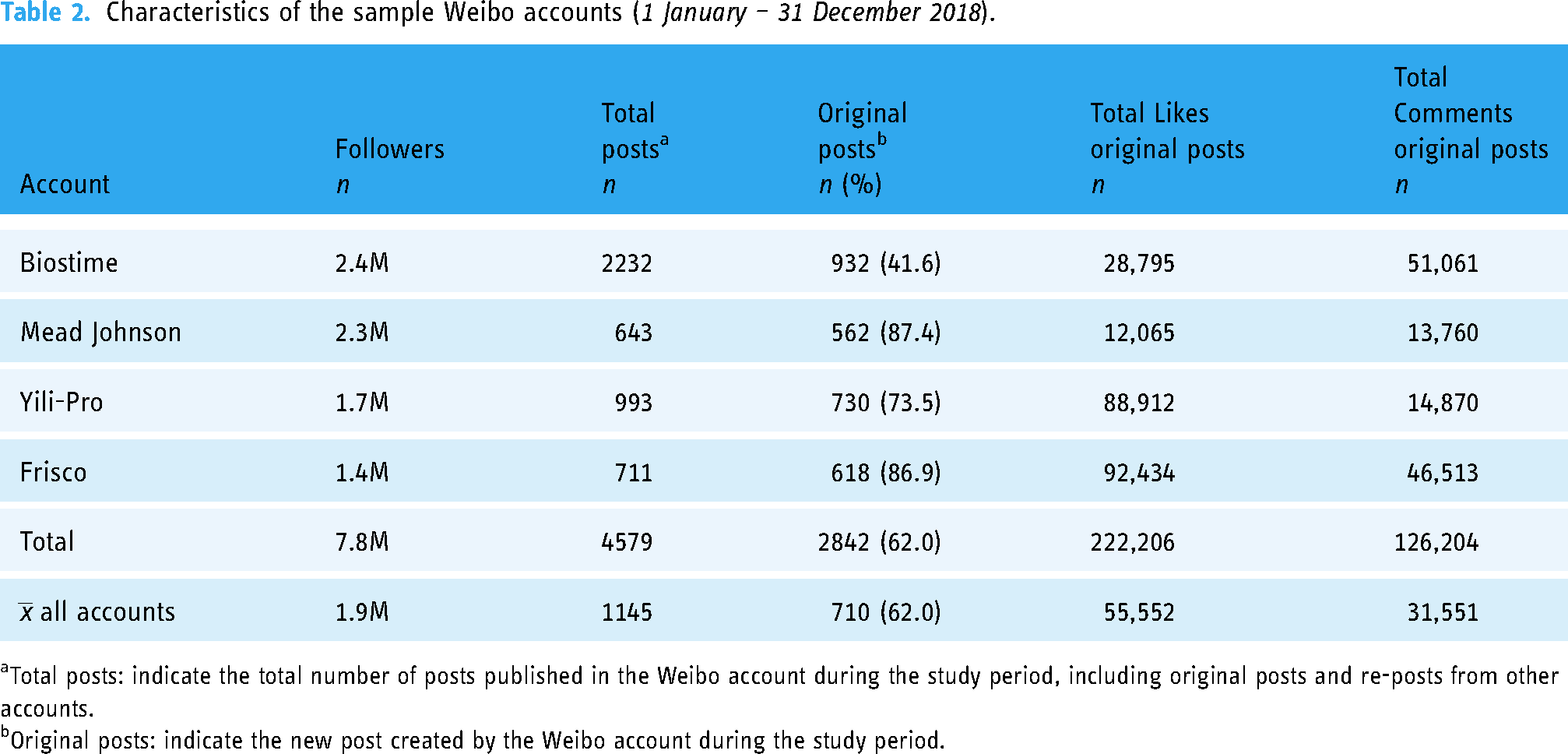
Total posts: indicate the total number of posts published in the Weibo account during the study period, including original posts and re-posts from other accounts.
Original posts: indicate the new post created by the Weibo account during the study period.
Coding categories
A total of 2667 original posts were analyzed and coded (Table 3). The top three categories with the highest proportions of posts across all four accounts were: user engagement (n = 939; 35.2%), parenting advice (n = 516; 19.3%), and celebrity endorsement (n = 327; 12.3%); accounted for over 65% of all the original posts.
Frequency and percentage of coded original posts by coding categories (1 January – 31 December 2018).

User engagement
This category was the most common type of post that prompted more Likes, Shares, and Comments in the Friso, Mead Johnson, and Biostime accounts (n = 253; 41.1%, n = 233; 41.6% and n = 268; 33.9%, respectively). Some posts used “fill in the blank” posts to tempt users’ engagement by writing comments:
Beautiful memory:
What did you partner say: ____________ when he found out you were pregnant?
-@Mead Johnson, 20/11/2018
The brand also communicated with users by asking them to tag the brand in their personal posts, reposts, or write comments to win lucky draws. A Lucky Draw is held by the “Weibo Lucky Draw platform”, an official account that handles all the lucky draw activities by Weibo account holders. Any company or brand that wants to initiate a lucky draw campaign must inform the platform and share a post with activity guidelines (share, repost, follow), activity time, and prizes, then tag the “Weibo Lucky Draw” platform. For example: Biostime selected the milk source from the coastal farmland of Normandy, France. This is because the cows here are the best. It makes every drop of milk rich in minerals and micronutrients, which is the first choice of the royal family. Repost this post and leave a comment on your impression of Biostime's farmland; you could win the lucky draw for a Biostime probiotic. @Weibo Lucky Draw platform.
-@Biostime 24/04/2018
Parenting advice
All four brands posted original parenting information posts; for Yili-Pro, this was the most frequently posted category, making up 32.7% (n = 230). Posts in this category also included the promotion of online parenting sessions. These brands invited well-known pediatricians or health professionals to present online, and parents were encouraged to participate and ask questions. The information usually covered children's feeding, health, and development issues. Questions raised included pregnancy health and nutrition concerns, young children's health problems, and postpartum body shape. For example: #hot moms’ tips# in order to have enough calcium, pregnant women have to eat a lot of food. Actually, it is very easy to get calcium supplements instead.
-@Friso 20/11/2018
Celebrity endorsement
All four brands used celebrity endorsement as a primary technique to market their products, with 12.3% (n = 327) of coded posts featuring a well-known celebrity. For example, a television host with more than 120 million followers, and an actor with more than 50 million followers, were the brand spokesperson of Yili-pro and Biostime, respectively. Mead Johnson and Friso did not have specific brand spokespeople featured in their posts. Some social media influencers collaborated with the brands to share their 'real' stories on formula milk products by creating a conversation or making posts. For example: As an actor, he has been committed to diversifying his role on screen; in daily life, he fulfilled the role of a good father. He always tries to give “the best” to his children. Moreover, he often comes to the Normandy coastal ranch to enjoy his life with his loved ones. On 10 September, #Biostime cooperates with the actor Liu Yie to promote natural protection for children#, and we would like to explore the “natural power” of the Normandy farmland coast in France with you.
-@Biostime 04/09/2018
Other categories
The remaining coded posts were across seven categories: including special sales or promotion (n = 281; 10.6%), health and nutrition claims (n = 151; 5.6%), corporate social responsibility – breastfeeding promotion (n = 83; 3.1%), corporate social responsibility – philanthropy (n = 28; 1.0%) and fear appeals of breastfeeding (n = 18; 0.6%). Further, 13.2% (n = 93) of posts published by Yili-pro were about being the sponsorship or title sponsor of event/TV reality shows, including “Thank you Dr Cui”, “Great kids”, “Hi, Baby”, “Kiss my baby.” Biostime had 8.7% (n = 69) of coded posts were about “claims that milk formula is very close to breast milk”. For example: Autumn is coming, the weather is getting cold, and some babies with weaker immune resistance are more likely to get sick. Biostime is the first to add LPN® whey protein to milk powder. It has similar active ingredients to breast milk, helps the development and maturity of the baby's immune system, and protects the baby's growth∼
-@Biostime 25/08/2018
In addition, all four accounts published posts to portray breastfeeding as inconvenient or problematic to arouse fear of breastfeeding. For example: Most French mothers return to work within three months after giving birth. They eagerly want their own lives back. In their opinion, breastfeeding is the best but not essential; mixed feeding with milk powder is acceptable. They love their children, but children are independent individuals. Postpartum body sculpting and wearing professional attire are also their pursuits.
-@ Biostime 08/10/2018
DISCUSSION
We found evidence that BMS manufacturers used Weibo, one of the most popular Chinese social media platforms, to promote their brands and products, despite the code prohibiting any advertising or using any promotional technique to prompt sales of breast milk substitute products. The content analysis revealed an alarming amount and variety of formula milk marketing activities, such as providing parenting advice and information on child feeding, using celebrities to endorse their products, offering special sales or promotion incentives, and claiming health or nutrition benefits in the examined brands’ official Weibo accounts, which sometimes are not easily recognizable as marketing BMS.
Our findings showed that formula milk brands used Weibo to establish a “positive” brand image and to forge trust and emotional connections with users, especially with new and expecting parents through parenting advice, celebrity endorsement, and other tactics. During the Covid-19 pandemic BMS companies frequently used digital platforms, including social media (Facebook, Instagram, and Facebook parents’ groups) to directly reaching parents. 22
The formula brands used pseudo-health and nutrition claims to normalise formula feeding, undermining China's ratification of the Code. A report also identified unfounded health claims of BMS on immunity that prompted fear and increased BMS product donations related to COVID-19. 22
The Code prohibits the use of health personnel within healthcare settings and calls on health workers to promote and encourage breastfeeding, but it is not specific about the circumstances under which they may provide infant feeding advice. Infant formula companies tried to reach and engage followers on Weibo by providing parenting advice through free health consultancies or online seminars. The presence of health professionals on BMS's social media may increase formula milk brand awareness, encourage traffic to a brand's online platforms, and expose followers to additional marketing content.18,28 Further, we found formula companies and health professionals jointly produced some parenting education programs broadcasted online with the prominently visible brand name and logo. By encouraging followers to repost, access links, post Comments, or Likes other digital media content, BMS companies could provide greater exposure to manufacturer-generated marketing content. A South African study found that BMS companies provided parents with information about infant and young child feeding on Facebook. 21 Another multi-countries study also found BMS companies hosted educational infant and young child feeding on digital platforms directed to parents during the Covid-19 pandemic. 22 However, these may not be perceived as BMS marketing activities that violates the Code.
Celebrity endorsement is a common and effective strategy used in advertising.29,30 However, no regulation explicitly prohibits financial relationships between manufacturers and celebrities. In addition, in an attempt to show they were socially responsible, some BMS brands posted information, such as they provided infant and young child feeding educational materials or engaged health professionals to provide free online health consultation, claimed to be a title sponsor of breastfeeding promotion events, or donated formula milk products to the children living in a poor and remote area. These tactics are extremely harmful as they can mislead followers that the companies are having a positive impact on the society. 7
All four examined accounts employed a fear appeal of breastfeeding to idealise formula feeding. Specifically, posts portrayed breastfeeding as “problematic”, “painful”, “affecting mothers’ body shape”; and “unattainable by most mothers”. Fear appeals can lead to a lack of breastfeeding self-efficacy and undermine mothers’ confidence in their ability to breastfeed. 31 Posts within this category also perpetuated the misperception that breastfeeding would change a mother's body shape, which has been identified as a barrier to breastfeeding, including in Chinese mothers.32,33
Strengths and limitations
The strength of the study is several folds. We analysed a large number of original posts (n = 2667) on the four milk formula brands’ official Weibo accounts. We used robust data collection, coding, and analysis methods, including developing the coding categories based on previous research. We found a variety of strategies and tactics used by these formula brands, some similar to reported in other types of social media, such as promoting their products and engaging users on posts,21,22 notifying sales, or promotional discounts.18,34 We also uncovered less reported tactics, such as celebrity endorsement, health and nutrition claims, especially by one brand (15.6%), and higher level sponsorship for TV events/reality shows (13.2%) of another brand.
The limitations included that we focused only on the original posts created by the four milk formula brands and did not analyse content created by other accounts and then reposted in these four brands; this may underestimate the reach of posts and types of marketing messages. In addition, we could not capture Likes and Comments per post, and some posts could attract more Likes or Comments than others. Another limitation was that each post was coded only into one category, using a coding hierarchy; this may underestimate the overall frequency of some of the more popular post categories. Finally, these findings were a snapshot of the data collection period between 1 January 2018 and 31 December 2018.
The increasing use of social media for milk formula marketing demands new strategies for monitoring and enforcing the Code.12,19,20,35 As a few transnational companies dominate the global milk formula market, coordinated global action is needed to reduce BMS marketing in the digital context to protect and promote breastfeeding. 35
Conclusion
The findings showed active marketing and promotion of infant formula by BMS companies on the popular Chinese social media Weibo. The findings also highlighted that the Code in the current digital era should be strengthened to prevent formula companies and brands from advertising on social media. Given that digital media are rapidly superseding traditional media for disseminating information and persuasive marketing promotions, this study provides further evidence that monitoring and restricting milk formula marketing on social media is urgently needed to protect breastfeeding. We also need effective counter messages and leveraging on social media for breastfeeding promotion.
Supplemental Material
sj-docx-1-dhj-10.1177_20552076231155683 - Supplemental material for Formula milk brands marketing on Chinese social media Weibo – a content analysis
Supplemental material, sj-docx-1-dhj-10.1177_20552076231155683 for Formula milk brands marketing on Chinese social media Weibo – a content analysis by Jing Zhao, Becky Freeman, Ruihua Guo and Mu Li in Digital Health
Footnotes
Contributorship
Jing Zhao, conceptualization of the paper, development of methodology (including data collection instrument), data analysis, draft manuscript. Becky Freeman, conceptualization of the paper, development of methodology, manuscript revision, supervision. Ruihua Guo, conceptualization of the paper, data extraction, development data collection instrument and data analysis, draft manuscript. Mu Li, conceptualization of the paper, development of methodology, data analysis, manuscript revision and finalization, supervision.
Declaration of conflicting interests
The author(s) declared no potential conflicts of interest with respect to the research, authorship, and/or publication of this article.
Ethical approval
This study was a cross-sectional prospective descriptive study using publicly available information on the Chinese social media platform Weibo. We conducted a content analysis of the posts made to milk formula brands’ official Weibo accounts. Because of the nature of this study, no human research ethics approval was required.
Funding
The author(s) received no financial support for the research, authorship, and/or publication of this article
Guarantor
There is no guarantor for this study.

Supplemental material
Supplemental material for this article is available online.
References
Supplementary Material
Please find the following supplemental material available below.
For Open Access articles published under a Creative Commons License, all supplemental material carries the same license as the article it is associated with.
For non-Open Access articles published, all supplemental material carries a non-exclusive license, and permission requests for re-use of supplemental material or any part of supplemental material shall be sent directly to the copyright owner as specified in the copyright notice associated with the article.
