




Abstract
Objectives
For breastfeeding mothers, online support groups through Facebook may be a more convenient and preferred source for accessing breastfeeding information and support, but few studies exist that examine the use of Facebook groups specifically for breastfeeding support. This study explores the sources of support among users of Facebook breastfeeding support groups and a possible mechanism by which support received on Facebook may translate to behavioral outcomes among breastfeeding mothers.
Methods
From July–September 2017 a survey was distributed online to African American mothers (N = 277) who participate in breastfeeding support groups on Facebook. The survey assessed network support from Facebook and other sources of breastfeeding support, perceived breastfeeding norms, breastfeeding self-efficacy and breastfeeding attitudes. Correlations and linear regression analysis were used to examine the relationship between covariates and outcome variables.
Results
The average intended breastfeeding duration among participants in this study was 19 months. Participants reported the highest amount of breastfeeding support received from their Facebook support group, in comparison to other sources of support, and Facebook support was significantly correlated with intended breastfeeding duration (p < 0.05). Self-efficacy and breastfeeding attitudes remained significant predictors of intended breastfeeding duration within the final regression model.
Conclusions
Breastfeeding support received within Facebook groups may compensate for inadequate support received within mothers’ networks. More research is needed to understand the mechanism through which Facebook support may contribute to prolonged breastfeeding durations.
Keywords
Introduction
Over the last decade the number of US adults engaging in social media network sites has steadily increased, with Facebook remaining the most widely used platform. In the USA, 68% of all adults use Facebook. 1 The current literature on the use of social media and social networking sites highlights the popularity of social media across diverse demographics, including parents, of whom 75% report using social media. 2 Social media provides an opportunity for users to engage in an array of human experiences and daily interactions, such as providing and receiving support. 2
A study by Pew Research Center revealed that social media is a source of parenting information and advice, with 45% of mothers indicating that they ‘strongly agree’ they receive support from their friends on social media. In this study 50% of mothers indicated that they received emotional support, specifically regarding parenting issues, on social media as well. 2 The patterns of social media use among mothers suggest that social media may help mothers at different stages of parenting, from early postpartum and infant feeding, through later stages of child rearing. 3 , 4
Social media, social support and breastfeeding
Breastfeeding is the preferred source of infant nutrition, 5 and support for breastfeeding is a critical factor in ensuring a mother will be able to overcome breastfeeding challenges. The literature on breastfeeding support most commonly focuses on support received in person and via phone. 6 However, researchers in the lactation field have also called for the use of social media to support breastfeeding mothers, a push to adapt to the changing landscape of how mothers exchange support and information. 7 , 8 Furthermore, among the actions detailed in the Surgeon General’s 2011 call to action to support breastfeeding, was the use of new media and forms of electronic communication to reach young women and their families. 6 , 9
Several qualitative studies have examined breastfeeding support groups on social network sites, identifying themes of support, 6 as well as the use of social network sites to meet unmet informational needs, to build skills for breastfeeding, 6 ,10–12 and to overcome social isolation. 12 , 13 In a study with Finnish mothers of preterm infants (N = 22) who were a part of a Facebook peer support group, researchers found that mothers often received inadequate support for breastfeeding from the nurses while in the hospital postpartum and accessed peers in their Facebook group to obtain needed information and support. 11 In a study with African American mothers, participants reported social media platforms as the preferred mechanism for obtaining important information during the antepartum and postpartum periods. Among exclusively breastfeeding mothers, Facebook was described as invaluable in providing support. 12 The association with exclusive breastfeeding and online support is an important finding considering that African American mothers in the USA fall below the recommendations to exclusively breastfeed for six months. 14
In addition to providing support for breastfeeding mothers, the use of social media may also influence breastfeeding attitudes, breastfeeding norms and self-efficacy for breastfeeding. One study found that exposure to informational messages on breastfeeding pages on Facebook led to pro-breastfeeding attitudes. 15 Furthermore, media exposure to breastfeeding improves self-efficacy and may also shift breastfeeding norms. 16 , 17 A randomized controlled trial conducted in Vietnam evaluated the combined and individual effects of a mass media campaign to promote breastfeeding and interpersonal counseling on exclusive breastfeeding practices. 17 Through interpersonal counseling, study participants developed breastfeeding knowledge, skills, and received breastfeeding support. The results showed that the combination of interpersonal counseling and the mass media campaign led to greater changes in psychosocial factors, which in turn, positively impacted breastfeeding behaviors. 17 Separately, the mass media campaign and interpersonal counseling were also significantly associated with more positive social norms surrounding breastfeeding. 17 The findings from this study highlight the influence of media in shaping breastfeeding norms, which may also apply within social media environments.
Quantitative studies, particularly studies that explore the mechanism by which online peer support relates to breastfeeding outcomes are limited. 7 , 8 Studies that explore mothers’ experiences in online settings are also lacking from the literature. Furthermore the, benefits of breastfeeding may be slightly greater among African Americans who suffer the burden of multiple morbidities that breastfeeding protects against. 18 Considering the social and cultural barriers to breastfeeding experienced by African American mothers, research that focuses on this population is needed. Measuring the extent of breastfeeding support received, both through Facebook and through other sources, can inform the development of more tailored breastfeeding support services for African American mothers in the future.
Theoretical framework
The integrated model of behavior prediction (IMBP), which integrates the Theory of Planned Behavior (TPB), the Theory of Reasoned Action (TRA) and draws constructs from other theories, such as social cognitive theory, was applied to this study. 19 The IMBP describes intention to perform a behavior as the strongest predictor of behavioral outcomes. Behavioral intention, in turn, is determined by an individual’s attitude toward the behavior, perceived norm and personal agency. 19 According to the model, behavior is likely to occur if the individual has strong intentions to perform the behavior, necessary skills to perform the behavior and if environmental constraints to performing the behavior are absent. 20
Perceived norms, as measured within IMBP, includes both injunctive and descriptive norms. 21 Injunctive norms are determined by an individual’s normative beliefs (whether influential persons approve or disapprove of a behavior). 19 , 21 Descriptive norms, on the other hand, describe the perceived prevalence of a behaviour. 22 The final construct within the IMBP, personal agency, includes self-efficacy and perceived control (one’s perception of the degree to which certain factors make it easy versus difficult to complete the behavior). Perceived behavioral control is also frequently operationalized as self-efficacy across breastfeeding literature, which may be a stronger predictor of breastfeeding.22–26 Therefore, for this research study, self-efficacy to breastfeed was measured instead of personal agency.
Finally, within the IMBP model, factors like media and intervention exposure are categorized as distal variables that indirectly influence behaviour. 19 Support received through the Facebook group and other sources of support therefore serve as distal factors that indirectly influence breastfeeding intentions. The primary outcome measured in this research study was intended breastfeeding duration, which was defined as ‘The number of months or weeks that a mother intends to provide any breastmilk to her child’.
The following conceptual model (Figure 1) depicts the relationship between the constructs and primary study outcome, intended breastfeeding duration.
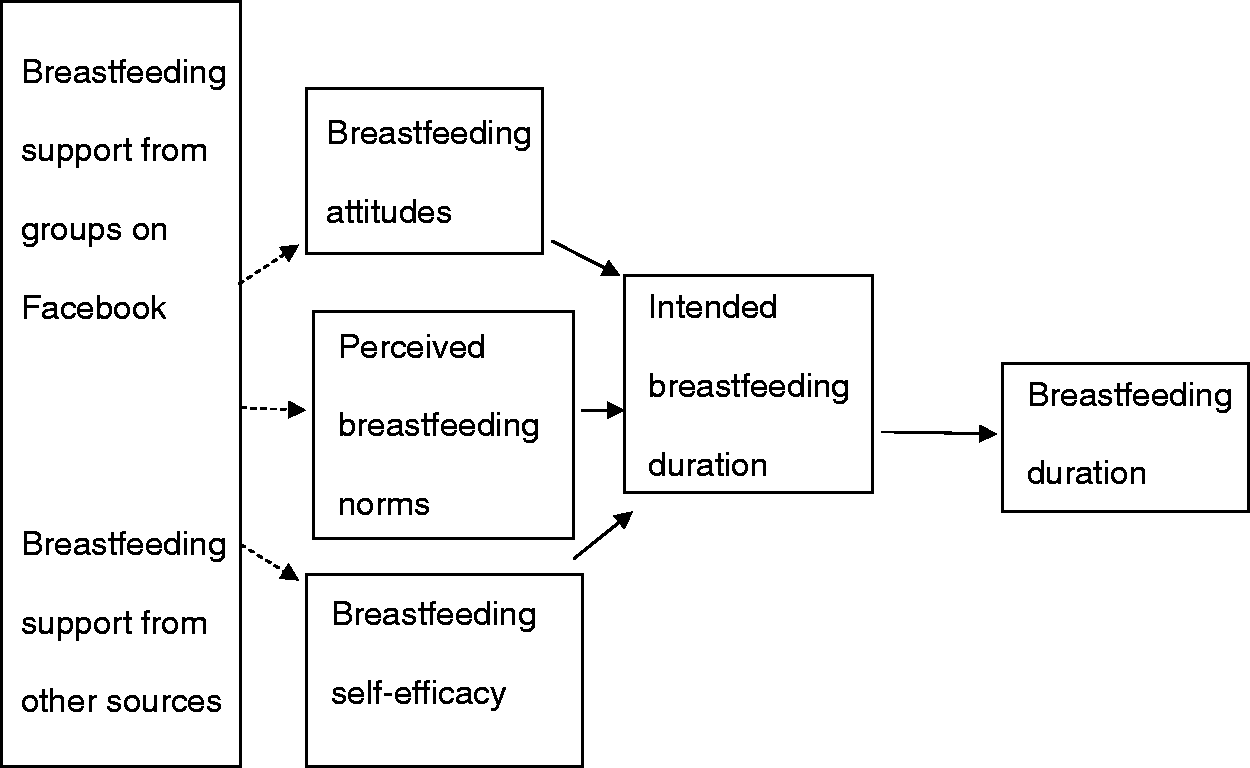
Conceptual model describing the relationship between online breastfeeding support and breastfeeding intentions and duration.
Purpose
This study is part of a larger mixed methods study that explores the experience and breastfeeding outcomes of African American mothers who participate in Facebook groups for breastfeeding support.
27
The purpose of this research is to identify the sources of breastfeeding support for mothers who participate in support groups on Facebook and to explore a possible mechanism by which support received on social network sites leads to behavioral outcomes among breastfeeding mothers. The following research questions were addressed: RQ1: Who are the sources of breastfeeding support for African American mothers participating in breastfeeding support groups on Facebook? RQ2: In comparison to other sources of breastfeeding support, what is the relationship between breastfeeding support received from social network sites (SNS) support groups and breastfeeding duration, as moderated by perceived breastfeeding norms, breastfeeding attitudes and breastfeeding self-efficacy?
Methods
Population
The target population for this study was self-identifying African American mothers who were breastfeeding at the time of data collection and also participating in a breastfeeding support group on Facebook. Breastfeeding was defined as the receipt by the infant of any breastmilk within the past 24 hours. 28 Additional inclusion criteria required that participants were first-time mothers, to eliminate previous breastfeeding experience as a predictor of future breastfeeding intentions 29 and 18 years old or older.
Measures
A survey with 29 questions was designed to address the research questions and to measure the constructs within the theoretical model for the survey. The survey took approximately 15 minutes to complete. Prior to data collection, the lead author conducted two rounds of pretesting with six expectant and new mothers, three subject matter experts, and a survey methodologist. The survey measures are described in detail below.
Breastfeeding support
Breastfeeding support was defined as ‘the availability of information and assistance for breastfeeding’. An adapted version of The Network Support for Breastfeeding (NSB) instrument measured breastfeeding support from members within the Facebook group and other sources of breastfeeding support. 28 The original scale was developed to measure the availability and quality of the network support for breastfeeding. The Cronbach’s alpha (α) for the original instrument showed a reliability coefficient of 0.87–0.90. For the original instrument, researchers used an inductive approach to identify significant sources of breastfeeding support among a population of African American mothers. 28 The extent of support for each person in the mother’s network was reported. Using the findings from this research, the lead author of this study applied a deductive approach to develop categories of breastfeeding support sources African American mothers may encounter in addition to the support they receive from the Facebook support group. The resulting network support scale for breastfeeding used in this study had five questions and measured support received from the participants’ Facebook support group (α = 0.69), spouse or partner (α = 0.87), mother (α = 0.88), other family members (α = 0.89), friends/peers (α = 0.88), and healthcare providers (α = 0.90). In addition to the five categories listed, mothers were provided an opportunity to list one additional source of breastfeeding support they considered significant and completed the scale for that individual. The five questions within the scale measured the following from each source of support: how much emotional support was provided for breastfeeding; how knowledgeable they were about breastfeeding; how important they believed breastfeeding to be; and how supportive they were of the mother’s decision to breastfeed in the face of breastfeeding problems. Response options ranged from 1 = Not at all to 4= Very much.
Breastfeeding attitudes
The IOWA Infant Breastfeeding Scale 30 was used to measure breastfeeding attitudes. The IOWA Infant Breastfeeding Scale consists of 17 items, in which eight items reflect positive attitudes towards breastfeeding and the remaining reflect favorable attitudes towards formula feeding. Response options for each item range from ‘Strongly disagree’ to ‘Strongly agree’. 30 This scale has been tested for validity and reliability across diverse populations, including African Americans. 31 The initial studies on reliability and validity predicted acceptable reliability scores, with Cronbach’s alpha scores ranging from 0.85 to 0.86. 30 For this study, the Cronbach’s alpha score was 0.70. Possible scores range from 17 to 85. Scores ranging from 70 to 85 are categorized as a positive attitude towards breastfeeding. Scores of 49–69 are categorized as having a neutral attitude towards breastfeeding. Scores ranging from 17 to 49 are categorized as having a negative attitude towards breastfeeding. 13
Breastfeeding self-efficacy
Self-efficacy was defined as ‘A mother’s belief that she will be able to organize and carry out the actions necessary to breastfeed her infant’, as defined in a previous study.28 The 14-item Breastfeeding Self-Efficacy Short Form (BFSE-SF) scale was used to measure breastfeeding self-efficacy. 23 Similar to the IOWA Infant Breastfeeding Scale, the BFSE-SF scale has been used to measure self-efficacy across diverse populations of breastfeeding mothers. 32 , 33 Reliability testing for the short form scale yielded a Cronbach’s alpha coefficient of 0.94. 34 The researchers noted that this scale may be used to determine the efficacy of various types of breastfeeding interventions and to identify women at risk for early breastfeeding cessation. 34 Possible scores for the breastfeeding self-efficacy scale range from 14 to 70, with a higher score indicating higher self-efficacy. 13 Items are scored by a 5-point Likert scale with response options ranging from ‘Not at all confident’ to ‘Always confident’. Within this study, the alpha was 0.89 for the breastfeeding self-efficacy scale showing reliability measurements similar to previous studies.
Perceived breastfeeding norms
The scale used to measure perceived breastfeeding norms in this study consisted of 10 items (α = 0.86). 17 The scale had a possible range from 10–60 with a higher score indicating a more positive perceived norm for breastfeeding. The factor analysis conducted on the original scale suggested adequate internal consistency for the items in the scale. 17 The scale includes items such as ‘Most people who are important to me (e.g. family members, friends) think I should breastfeed my infant for one year or longer’, with response options ranging from 1 (‘Strongly disagree’) to 6 (‘Strongly Agree’).
Facebook indicators
Frequency of using the support group was measured using a single question adapted from a Pew Research Study on the use of social media use. The question asked, ‘About how often do you visit this Facebook group?’ and included the following response options: several times a day; about once a day; 3–5 days a week; 1–2 days a week; every few weeks; less often. 35 This scale has been used in other studies measuring social support on social network sites. 36 Length of participating in the support group was assessed by the following question, which was also adapted from the Pew Research Center study on social media use: ‘About how long ago did you start using this Facebook support group?’ 35
Breastfeeding intentions (intended duration of breastfeeding)
Breastfeeding intentions, or intended duration was defined as ‘The number of months or weeks that a mother intends to provide any breastmilk to her child’, and was measured by a single open-ended question, ‘How many weeks or months do you plan to breastfeed or provide pumped milk to feed your baby?’
Demographics
The following demographic information was collected within the survey: current breastfeeding duration, state of residence, country of birth, birth year, highest level of education, household income and marital status. In addition, the survey collected information on medical complications or factors during delivery that may influence breastfeeding outcomes, such as preterm births, multiple births, Caesarean deliveries, intensive care stays, and other medical conditions experienced by the infant that affected feeding.
Recruitment and data collection
A convenience sample of participants were recruited directly from Facebook. The lead author used key words to search Facebook for breastfeeding support groups for Black mothers, identifying nine support groups. The lead author joined each group and contacted the page administrator(s) to provide information about the study and to request permission to recruit participants. Study participants were recruited from six of the nine identified groups. The number of group members in each participating group ranged from 106 to 26,000 at the time of data collection. The Facebook post described the purpose of the study and included the Qualtrics link to access the informed consent letter, the survey screener and the survey. Survey entries were housed in Qualtrics for the duration of the study within a password protected account.
During the data collection process, the researcher closely monitored the demographics of survey respondents in Qualtrics. In addition to the initial study announcement, the lead author also scanned the largest participating Facebook group for potential participants and sent Facebook messages with the study announcement directly to women who potentially qualified for the research study. The survey link remained open for two months. This study was approved by the Human Subjects Institutional Review Board at a southeastern University in the United States.
Statistical analysis
Following survey administration, survey data was downloaded from Qualtrics and analyzed in SPSS. Frequencies were run for categorical variables and descriptive statistics were run for continuous variables. Breastfeeding duration and breastfeeding intended duration were converted from weeks to months when necessary.
To answer RQ1, the network support score for each source of breastfeeding support was calculated by adding the items together and computing the mean. The calculated scores ranged from 0 to 3, with 0 indicating no support received. Mean scores for all non-Facebook sources of support (e.g. mother, peers) were then averaged to form one score, called non-Facebook support. This was compared to Facebook support scores. In addition, a dichotomous variable was created to determine the percentage of participants who did (scores greater than 0) and did not (scores of 0) receive any amount of breastfeeding support from each source.
To answer RQ2, a composite score for breastfeeding self-efficacy and breastfeeding attitudes was created by calculating the sum across the items within the scales. The two scales measuring injunctive and descriptive norms were combined to create one composite score measuring perceived breastfeeding norms. Three items within each scale, which reflected less favorable perceived breastfeeding norms, were first reverse coded. Correlations were calculated to measure the relationship between breastfeeding attitudes, breastfeeding self-efficacy, perceived breastfeeding norms, breastfeeding support scores and intended breastfeeding duration. Correlation analyses were also conducted to detect any significant relationships with participant characteristics, such as age, income and current breastfeeding duration.
A multiple linear regression analysis was conducted to determine if breastfeeding self-efficacy, breastfeeding attitudes, and perceived breastfeeding norms moderated the relationship between breastfeeding support and intended breastfeeding duration. Variables for the model were mean-centered to avoid multicollinearity. Interaction terms were then created using the mean-centered Facebook support and moderating variables. Step one of the regression model included the independent variable, moderating variables and the dependent variable. The computed interaction terms were added to the regression model in step two. Models were compared for significance and to determine the effect of the moderators on the relationship between Facebook breastfeeding support and intended breastfeeding duration.
Results
Participant demographics
Over 300 mothers attempted to take the survey, which was completed by 277 participants. Respondents were most commonly screened out because they were not first-time mothers. Participants’ ages ranged from 19 to 42 years old. The average age of respondents was 29 (N = 265, ± 4.8). Breastfeeding duration at the time of the survey ranged from 1 week to 40 months, with an average breastfeeding duration of 9.4 (± 8.1) months; 76% (N = 211) of participants had an infant older than three months; 75% were also married or cohabitating with their partner (N = 210) and nearly 69% (N = 190) held a Bachelor’s degree or higher. Approximately 10% of survey respondents reported experiencing at least one of the medical complications listed in the survey (Table 1).
Survey participants’ demographics and characteristics.

The majority of participants (N = 220, 79%) reported joining the Facebook breastfeeding support group one year ago or less. The majority of participants (N = 234, 84.4%) also reported visiting the group once a day to several times a day. There were no participant demographics that were significantly related to intended breastfeeding duration, though age did approach significance (p = 0.05) (Table 1).
RQ1: Sources of breastfeeding support
Nearly all participants reported receiving support from each outside source of support measured: spouse/partner, mother, healthcare providers, other family members and peers. Participants’ network breastfeeding support scores differed, however, between each source of support. The Facebook breastfeeding group support had the highest average score of 2.7 (± 0.38) out of 3. The lowest network support scores were reported from the maternal grandmother, which on average had a score of 1.7 (± 0.88).
Outside of the categories listed in the survey, nearly 40% (N = 104) of participants also reported an additional significant source of breastfeeding support. Among these participants, common responses included WIC and the Le Leche League. A number of respondents who listed this additional source of support also described healthcare providers, such as licensed lactation professionals, or listed multiple sources previously captured within the survey. Since respondents often described sources that overlapped with categories previously measured within the survey, responses for other sources of breastfeeding support were excluded from calculating non-Facebook support. The average score for total non-Facebook support was 1.8 (± 0.49), in comparison to Facebook support (2.7, ± 0.38). Table 2 displays the network support scores for breastfeeding for each source of support.
Average support score across each source of breastfeeding support.

RQ2: Relationship between breastfeeding support received from SNS support groups and breastfeeding duration, as moderated by perceived breastfeeding norms, breastfeeding attitudes, and breastfeeding self-efficacy
Table 3 displays the scores across the moderating variables measured in this study and intended breastfeeding duration. The average score on the infant feeding attitudes scale for participants in this study was 72.2 (± 6.1). On average, participants in this survey scored 59.4 (± 9.2) for breastfeeding self-efficacy, with a possible range from 14–70. The average score for perceived breastfeeding norms was 34.1 (± 10.7), which a possible range from 10 to 60. Intended breastfeeding duration ranged from 2 months to 48 months. The average intended breastfeeding duration was 18.9 months (± 9.07). Correlation analysis revealed a significant relationship between the following independent variables and intended breastfeeding duration: Facebook support, peer support, breastfeeding self-efficacy, breastfeeding attitudes and current breastfeeding duration (Table 4.). A significant relationship was not detected for the non-Facebook breastfeeding support variable and intended breastfeeding duration. Non-Facebook support therefore was not included in the regression analysis. Interaction variables were created for Facebook support and breastfeeding self-efficacy, perceived breastfeeding norms and breastfeeding attitudes for inclusion within the linear regression model.
Breastfeeding self-efficacy, attitudes, norms and intended breastfeeding duration.

Correlations between independent variables and intended breastfeeding (BF) duration.

*p ≤ 0.05
The linear regression model included two blocks. The variables in model one accounted for 39% of the variance in predicting intended breastfeeding duration (F (5, 239) = 30.59), p < 0.001. Breastfeeding self-efficacy, breastfeeding attitudes, and the current breastfeeding duration of participants were significant predictors. Block two added the interaction terms between Facebook support and the moderating variables. Model two (R2 = 0.40, F (9, 235) = 17.46), p < 0.001) was significant in predicting the outcome variable as well. The F change for model 2, however, was not statistically significant, indicating that the addition of the moderating variables did not impact the overall variance predicted, ΔR 2 = 0.01, ΔF (4, 235) = 1.03, p = 0.39 (Table 5). The individual interaction terms were also not statistically significant within the model.
Predicting intended breastfeeding (BF) duration among African American mothers in Facebook support groups.

*p < 0.05, **p < 0.01, ***p < 0.001
Discussion
To the researchers’ knowledge, this is the first study to employ quantitative methods to: (a) examine the extent to which mothers who participate in Facebook breastfeeding support groups receive support from other sources within their networks, and (b) to examine the relationship between breastfeeding support received on Facebook with breastfeeding outcomes. It is also the first study to quantitatively measure mothers’ perceptions of how much breastfeeding support they receive within this type of setting, specifically through a scale designed to measure breastfeeding support.
Sources of breastfeeding support
The findings from this study suggest that the majority of African American mothers who participate in Facebook groups for breastfeeding support receive varying levels of breastfeeding support from other sources within their networks as well. Other studies on breastfeeding among African American mothers suggest that mothers may not receive adequate support from breastfeeding support professionals and healthcare providers. 24 Conversely, in this study, support from healthcare providers, which included lactation consultants, received the second highest average score for support, following Facebook groups. In addition, findings from this study are different from other research findings which suggest that a mother’s spouse and mother are important factors in determining breastfeeding initiation and continuation, especially when receiving informational or emotional support from these sources. 37 , 38 Considering that participants in this research reported that the amount of support received from these sources was not as high as the amount of support received from Facebook, it is possible that the support received within the Facebook group compensated for less support and/or any negative support received within these traditional networks. Other studies with mothers who seek support online for breastfeeding found that mothers sought additional support to supplement that found from their in-person networks. 10 , 12 , 39
Facebook support for breastfeeding and breastfeeding outcomes
Considering that breastfeeding support is a predictor of breastfeeding duration, it is important to understand how and if support received within social media groups, particularly Facebook, relates to mothers’ decisions on breastfeeding duration. Within this study, Facebook support, and not the total support received outside of Facebook, was significantly correlated with intended breastfeeding duration, which suggests that support mothers receive within the Facebook group may be an important factor relating to breastfeeding decisions. These findings are also consistent with other research findings that underscore the positive influence of peer support on a mother’s breastfeeding decisions. 40 No other studies, however, have examined breastfeeding peer support groups exclusively implemented online for Black mothers.
The average breastfeeding duration for participants at the time of data collection was nine months. This is an important finding in that mothers have reported a lack of support to sustain long-term breastfeeding, which mothers are able to receive within Facebook groups that include group members at various breastfeeding stages. 41 Furthermore, the average intended breastfeeding duration for mothers in this study was approximately 19 months, which exceeds the current rates for breastfeeding duration among African American mothers. 42 The high frequency in which participants reported visiting their Facebook groups, the high levels of support received from the groups, and the significant association between Facebook support and intended breastfeeding duration again suggests that mothers who participate in Facebook breastfeeding groups receive the support needed to sustain breastfeeding. The cross-sectional design of this study, however, does not allow for the determination of causality. Thus, it is not possible to determine if the reported intended breastfeeding duration preceded participating in the Facebook groups or resulted from participation.
The interaction terms with Facebook support and the predicting variables of interest (self-efficacy, perceived breastfeeding norms and breastfeeding attitudes) were not significant within the regression model. The findings therefore suggest that the direction and/or strength of the relationship between Facebook support and intended breastfeeding duration is not affected by the variables examined in this study. Furthermore, only breastfeeding self-efficacy and breastfeeding attitudes remained significant predictors of intended breastfeeding duration within the regression model, which is consistent with other studies on breastfeeding intentions and duration. 24 ,43–45 The findings from this study therefore suggest that while Facebook support may be an important factor, based on the bivariate analysis, breastfeeding self-efficacy and breastfeeding attitudes are stronger predictors of breastfeeding outcomes.
Participants in this study on average scored high on the breastfeeding self-efficacy scale and breastfeeding attitudes scale. These findings are not surprising given that the study included a population of breastfeeding mothers, but are still of interest considering the role of self-efficacy in predicting breastfeeding outcomes. 13 In one study conducted among breastfeeding African American mothers, self-efficacy predicted breastfeeding duration and breastfeeding exclusivity at four weeks and 24 weeks post-partum. 33 A unique finding in this study is that perceived breastfeeding norms were not significantly correlated to intended breastfeeding duration in the final model, unlike other studies, which discuss the importance of norms particularly among African American mothers. 13 , 24
Implications for future studies
Facebook remains the most widely used social media platform across all age groups of adults in the USA and the community structure of Facebook provides a convenient platform for creating online support groups. 46 However, younger adults, specifically between the ages of 18–24, are more likely to use Snapchat, Instagram and Twitter, in comparison to older adults. 46 Considering imagery may play a positive role in shifting breastfeeding norms and self-efficacy, Instagram particularly, may provide another effective channel for exchanging breastfeeding information and support among younger mothers. 47 Furthermore, the practices of Facebook users may shift due to recent security and privacy incidents. The exploration of Facebook practices based on perceptions of information security, as well as the use of other social media sites, warrant further exploration. Ultimately, targeted social platforms should reflect the use and preference of the target population.
In the future, longitudinal studies are needed to examine changes in self-efficacy, perceived breastfeeding norms and breastfeeding attitudes over time for mothers who join breastfeeding support groups online. Future studies should also measure any changes in intended breastfeeding duration over time and final breastfeeding duration. Furthermore, this study examined one potential model, in which self-efficacy, attitudes and norms were explored as moderators. Other literature suggests that online breastfeeding attitudes and norms may be influenced by positive breastfeeding messages on social media. 15 Facebook use, therefore, may modify the relationship between breastfeeding self-efficacy, perceived breastfeeding norms and breastfeeding attitudes. Therefore, researchers should consider alternative models that test different pathways in future studies.
Finally, the popularity of one of the Facebook groups, which had over 25,000 members, may have also influenced the results of this study. In one study, researchers created simulated breastfeeding pages on Facebook with varying levels of popularity. 15 The impact of different types of breastfeeding messages delivered by mothers and health experts and the popularity of the Facebook pages were compared with participants’ breastfeeding attitudes and intentions. They found that very popular Facebook pages that incorporated testimonial messages from mothers, or messages that were a mix of testimony and information, were viewed as more persuasive than the same types of messages delivered on less popular pages. In the current study, differences in independent and dependent variables based on the size or popularity of the Facebook group were not assessed. Future studies examining Facebook support groups should examine these factors as well, as less active Facebook groups may have differing effects on breastfeeding outcomes than more active or popular groups.
Limitations
This study used convenience sampling, which may have introduced selection bias among the survey participants and limits the generalizability of these findings. Furthermore, the cross-sectional study design restricts the ability to claim causation within the results. In addition, participants in this study may have had other sources of breastfeeding support outside of the five categories measured in this study, which could have impacted the score calculated for non-Facebook support. Due to the overlap in other support sources listed by participants with previously defined categories within the survey, the ‘other’ category of support was not included in the score for non-Facebook support. The five support categories included in the survey, however, are common sources of breastfeeding support, as described by mothers. 28
Conclusion
The use of social media support groups for breastfeeding mothers provides an alternative channel for receiving breastfeeding support and may compensate for inadequate support received in other settings. Facebook support was significantly correlated with intended breastfeeding duration in this study. However, it was not significant in the final regression model. While perceived norms, breastfeeding attitudes and breastfeeding self-efficacy were not found to be moderators between the relationship of Facebook support and intended breastfeeding duration, self-efficacy and breastfeeding attitudes were significant predictors of intended breastfeeding duration for mothers in the support groups on Facebook. Longitudinal studies are needed to better understand how Facebook peer support groups impact breastfeeding intentions and ultimately how long mothers breastfeed.
Footnotes
Acknowledgements
We would like to thank the Facebook groups and participants for their involvement in this research study.
Conflict of interest
The authors declare that there is no conflict of interest.
Contributorship
AR researched literature, conceived the study, developed the survey, recruited participants and analyzed the data. MD was involved in gaining ethical approval. CL, MD and AKA provided feedback on the analysis. AR wrote the first draft of the manuscript. All authors provided feedback on the conceptualization of the study, reviewed and edited the manuscript, and approved the final version of the manuscript.
Ethical approval
The ethics committee of University of Georgia approved this study (REC number: MOD00004791)
Funding
The author(s) received no financial support for the research, authorship, and/or publication of this article.
Guarantor
AR
Peer review
This manuscript was reviewed by a single individual, who has chosen to remain anonymous.