




Abstract
Artificial Intelligent (AI) applications in e-health have evolved considerably in the last 25 years. To track the current research progress in this field, there is a need to analyze the most recent trend of adopting AI applications in e-health. This bibliometric analysis study covers AI applications in e-health. It differs from the existing literature review as the journal articles are obtained from the Scopus database from its beginning to late 2021 (25 years), which depicts the most recent trend of AI in e-health. The bibliometric analysis is employed to find the statistical and quantitative analysis of available literature of a specific field of study for a particular period. An extensive global literature review is performed to identify the significant research area, authors, or their relationship through published articles. It also provides the researchers with an overview of the work evolution of specific research fields. The study's main contribution highlights the essential authors, journals, institutes, keywords, and states in developing the AI field in e-health.
Keywords
Introduction
In today's world, E-health is an essential part of human life. It allows using the data privately and commercially for health-related activities and information and communication technologies (ICT). E-health is the umbrella term for several approaches, such as telehealth, telemedicine, m-health (mobile health), electronic health records (EHR), big data, wearable technology, and artificial intelligence (AI). 1 AI has a wide range of applications in Ehealth. Due to the enormous potential of AI, physicians began to integrate the reasoning foundations of intelligent procedures into medical diagnosis.2,3 AI is transforming the healthcare sector: Diagnosis and treatment including follow-up. A certain sickness may be recognized by software powered by AI before any complications arise i.e., breast cancer. 4 It aids in the search for novel medical treatments for certain patients. As AI is progressively used to understand the daily routines and demands of the patients, healthcare professionals will be better equipped to provide feedback, direction, and support for maintaining health.5,6 AI is computational intelligence in which machines and devices can imitate natural intelligence, such as learning, reasoning, and problem-solving. The applications are robotics, machine learning (ML), reasoning and decision-making, natural language processing, and computer vision. 7 AI improves the relationship between patients and medical care by facilitating personalized treatment and medical practice from a traditional perspective. AI enhances the accuracy, speed, and quality of the analysis and treatment of patients. 8
P4 medicine systems that include predictive, personalized, preventive, and participative characteristics significantly enhance medical services for patient-centric care. 9 Currently, the most advanced countries utilize P4 medicine strategies in E-Health and Telemedicine via E-Government development plans. A recent research article by Ref. 10 promotes preventive measures to cut costs and improve patient health using data mining and ML algorithms. The study compiled the most up-to-date data analytics methods for disease classification and detection and their interconnections. The accuracy of the results of these algorithms depends on the input data. However, medical-related data is highly complex due to the presence of unstructured data in the system, and due to privacy concerns, it becomes more challenging. To address these kinds of challenges, expertise in data processing is essential. A concept-centric literature review is carried out by, 11 covering the articles associated with big data analytics in healthcare from the Scopus and Web of Science databases. The research identified “MEDICINE” as the most popular subject area for big data analytics. The authors focused on the nature of analytics to cover the descriptive, predictive, or prescriptive nature. They found that the most popular category is “predictive analytics” with 47%, the second category is prescriptive analytics with 33%, and the last one is “descriptive analytics” with 24%. However, there is no classification for participatory.
AI is playing a significant role in making the world digital. Additionally, with its vast applications, AI has become helpful in e-health or digital health in organizing and retrieving the composite electronic health record (EHR). 12 For instance, advanced ML algorithms and, more recently, deep learning algorithms based on learning modelling approaches are convenient for dealing with complex healthcare data. These algorithms can organize complex data and provide high throughput analysis. 13 Chronic disease is one of the costly problems, but it is preventable. An effective way of implementing preventative methods can be promising in reducing the mortality rate. Prescriptive analytics is a less developed area. 14 However, based on the current literature review, the authors have identified a rich trend of prescriptive analytics models that can handle live stream data.
Furthermore, to prevent human errors such as subjectivity and to leverage the information extracted from data processing, human judgment is likely to be less involved in dealing with extensive data from heterogeneous data sources. Prescriptive analytics models can be constructed and modified dynamically in this way. Prescriptive analytics is a field where prior knowledge about the domain is required. Also, a deep understanding of deep learning, ML, big data analytics, and AI is essential for achieving the required objectives from existing data. In Ref. 15, ML methodology extracted deep data from the massive Electronic Health Record (EHR) of respiratory disorders for illness prediction. The authors used AI to analyze the relapse duration in this disease.
Moreover, EHR can be helpful in risk forecast, treatment process, and information imputation. 16 Conventionally, an EHR is used for the early warning score for the blood pressure and heart rate measure. In Ref. 17, an AI-based system is presented to accurately measure critical illness earlier and deliver the clinician-referenced data from EHR. The authors designed the system on a temporal convolutional network. They took health records of four Danish municipalities, including the data relating to the bio-microbiology, biochemistry, and medicines of 18 years older patients from 2012 to 2017.
This bibliometric analysis study covers AI applications in e-health. It differs from the existing literature review as the journal articles are obtained from the Scopus database from its beginning to late 2021 (25 years), which depicts the most recent trend of AI in e-health.
The Scopus database was searched for publications from January 1996 to December 2021 with relevant keywords, including “AI”, “ML”, “neural networks”, “smart healthcare”, and “electronic health records”. The bibliometric analysis is employed to identify significant re- search areas, influential authors, and leading journals in the e-Health sector. It also provides insights into the evolution of the adoption of AI applications in the e-Health sector. The bibliometric analysis is employed to find the statistical and quantitative analysis of available literature of a specific field of study for a definite period. It is like a review method that raises the significant research area, authors, or their relationship through published articles. It also provides the researchers with an overview of the work evolution of specific research fields. The study's main contribution highlights the essential authors, journals, institutes, keywords, and states in developing the AI field in e-health.
This research is conducted to identify the importance of AI in E-health and answer the following research questions. RQ1: What are the prominent researchers, institutions, countries, and publications in the area of Adoption of Artificial Intelligence Applications in the e-Health
RQ2: What are the major themes, theories and methods, trends and relevant sources for publications?
Based on the above research questions the following objectives are outlined:
Objective 1: To identify the prominent researchers, institutions and determine the impact of geographical focus on the Adoption of AI Applications in the e-Health
Objective 2: To identify major themes, annual topic trends, theories, and methods of current AI applications in the e-Health.
The remainder of this study is organized in the following way: Section 2 undertakes related work on AI and E-health bibliometric analysis. Section 3 presents the background. The research methodology and the screening process are explained in Section 4, and the analytical results and findings are discussed in Section 5. The findings are discussed in Section 6 with limitations and future work directions. Finally, Section 8 concludes the manuscript.
Background and related work
AI applications in e-health have evolved considerably in the last 25 years. To track the current research progress in this field, there is a need to analyze the most recent trend of AI in e-health. Bibliometrics is a quantitative study of literature and a measurable tool for identifying developmental patterns in a particular sector to acquire quantifiable, reproducible, and objective data. The bibliometric analysis allows scholars and other stakeholders to understand a subject of study better while also encouraging multidisciplinary collaboration. The increasing use of AI in health care improves the analysis of relevant research. The body of related literature continues to evolve at a rapid pace. As a result, healthcare-related AI research is exploding in the present healthcare literature. Even though AI research in health care has grown in popularity, only a few bibliometric evaluations have focused on AI applications in specific health issues like depression. A bibliometric analysis of general healthcare-related AI studies may be used to create a map that can assist researchers in evaluating the evolution of healthcare-related AI research and the future direction of patterns and trends. Keeping up with the rapidly expanding field of healthcare-related AI research can help practitioners and policymakers embrace chances to use AI to improve the well-being of patients and healthcare professionals.
AI is considered a multidisciplinary area that is very promising when we apply it in health-care. For instance, 18 surveyed the application of AI techniques in medical cyber-physical systems for patient data privacy. The authors reviewed ML algorithms that extract features from data and present the data and output of decision support to the healthcare department. A survey 19 measured AI's impact on protecting personal data. Also, in the research study, 20 the authors presented the concept of deploying blockchain technology with AI in e-health. Blockchain technology combined with ML algorithms can provide secure storage of data and reduced cost In addition, 21 presented a survey on the application of AI in e-health by reviewing 13 peer-reviewed research articles. The research concentrated on cardiovascular and circulation illnesses, expert systems and e-health platforms, feature extraction, high dimensionality, and analytical tests. Medical personnel's profession is also impacted by AI.
A web-based poll of 791 psychiatrists was carried out from 22 countries to ascertain their views on the implications of AI. The poll reveals that medical professionals have a range of opinions regarding technology while also being concerned about ethical, practice, and regulatory challenges22,23 conducted the literature survey on incorporating AI methodologies in clinical decision support systems. The authors surveyed 75 articles from the Web of Science and PubMed databases. Another survey was performed to evaluate cardiologists’ knowledge of digital health and tool usage. 24 In Ref. 25, a scoping review was performed to assess medical students’ training in e-health. The study contained papers from 2014 and mainly focused on AI, internet of things (IoT), mobile health, and telehealth. 26 discusses the applications of AI, i.e., diagnosis and treatment, patient observance, and administrative role in the health system and challenges for its implementation.
Yang et al. 27 conducted a literature review on AI and big data applications in health care. The authors collected articles on different machine-learning algorithms to process big data regarding patient care. In Ref. 28, a scoping review of 42 articles between January 2009 and May 2009 analyzes explainable AI models called (XAI). The authors evaluated the XAI models based on publication year and the ML models, data sets, and scope using IEEE Xplore, ACM, and MEDLINE databases. The presented manuscript mentioned that improving XAI modeling in medicine requires more effort.
In another study, 29 a review was presented to differentiate the strengths and weaknesses of AI implementation using EHR within the USA and China. The authors analyzed the current AI research trends in this study by covering 1186 articles from Pub-Med and Web of Science databases between 2008 and 2017. Furthermore, a literature review 30 is conducted to study the AI and ML applications and predictive models in oncology surgery to differentiate between patient-generated health data and patient-reported surveys. Another review surveyed the different ML methods and how they are applicable in managing and organizing the data to facilitate practitioners’ and patients’ proper treatment. 31
Guo et al. 32 presented a bibliometric analysis of 1473 articles from 5235 from a web of science from 1995 to December 2019 to investigate AI research related to E-health. The authors analyzed the bases of the title, abstract and full article (on need) and found the research that implements AI-based methods, i.e., artificial convolutional networks, neural networks, and vector support machines for cancer, Alzheimer, anxiety, and diabetes. The authors in Ref. 33 also perform the bibliometric analysis using the Web of Science database. They analyzed the 40147 English language articles from 1975 to 2019. The conceptual, social, and intellectual framework of AI research is discussed in this article. To better comprehend the societal changes brought about by AI and get ready for a “good AI society”, it offers 136 evidence-based research questions.
Moreover, another bibliometric analysis is presented on AI research related to depression disorder, 2 and it is found that the United States has more research articles than other countries. This analysis obtained reports from the Web of Science from 2010 to 2018 and evaluated their exploratory factors and latent Dirichlet allocation.
Moreover, 34 conducted a bibliometric analysis and literature review on applying AI and ML in vascular surgery. The literature from the 249 journals from the beginning to February 2021 was retrieved by the authors using Embase, Ovid HealthStar, and MEDLINE. The authors found carotid artery disease, abdominal aortic aneurysms, and peripheral arterial disease using the most well-known ML and AI techniques, including neural networks, random forests, k-nearest neighbours, and support vector machines. They included publications from the clinical, technological, or both of these sectors.
The above literature review shows the importance and impact of Bibliometric analysis in the e-health sector. However, in this paper, the researchers address the gaps that are not covered in the earlier bibliometric studies related to the e-health sector.
Methodology
In this research study, the Scopus database collects articles related to AI and e-health. This research study uses the Scopus database to conduct bibliometric analysis. The Scopus database accumulates pieces about AI and e-health. Bibliometrics is a fantastic tool for knowing about research dynamics with the help of different metrics. Bibliometrics is attached to library science. The bibliometric analysis measures the impact of journals, other documents, and scholars. It also helps with the allocation of research funding.35,36 As a result, researchers and other interested parties can use bibliometric analysis to understand a subject of study better and encourage multidisciplinary collaboration. 32
The reason for choosing Scopus database for this research is that the Scopus database is more popular and has a comprehensive database compared to other databases available on the market. It includes a broader range of research articles with completeness, and its metadata is available in a consistent format. 37 Furthermore, the Scopus database has a different coverage policy and scope than the Web of Science. In other words, the Web of Science database does not have enough entries to search for citations for journals, authors, and countries.33,38 It is found in Ref. 39 that Scopus contained 84% of journal titles of Web of Science while 54% of Scopus journal titles are found in Web of Science. Moreover, the Scopus database contains numerous non-English language articles compared with the Web of Science. Elsevier created the Scopus database in 2004. The Scopus database contains abstracts, citations, and other relevant papers’ metadata. It is also helpful for scientometrics and bibliometric studies. 40 It is widely regarded as one of the largest compiled databases, with scientific journals, books, conference proceedings, and other materials selected through a content selection phase and ongoing re-evaluation.
Scopus covered more than 240 disciplines. Annually, more than 3 million articles were added to the Scopus database. The researchers, students, and librarians have confidence in using that database because the data from above 7000 publishers are screened independently by the Content selection and advisory board. Scopus contains around 82 million documents, 1.7 billion referenced references, 17 million author profiles, 234 thousand books, and over 80 thousand institutional profiles.41,42 In other words, Scopus is metadata used to evaluate the research. Scopus provides three approaches (search, discover, and analyze) for data access. The authors, articles, and advanced search are done in the search approach, while authors’ keywords and shared references for identifying research organizations are done in the discovery approach. On the other hand, the analysis approach was used to find the citations.43–45 Our present article uses titles and keywords to search and collect the data. The query is given below:
TITLE ((“ E-health” OR” electronic health” OR” ehealth” OR” digital health” OR” mobile health” OR” m-health” OR” telemedicine” OR” telehealth” OR” digital medicine” OR” EHR” OR” electronic health records” OR” Smart healthcare” OR” Remote health”) AND (“ AI” OR” AI” OR” ML OR” Deep Learning” OR” Deep neural networks” OR” Neural network” OR” Fuzzy logic” OR” Predictive analytics” OR” prescriptive analytics”) OR (“ Healthcare informatics” OR” Health care informatics” OR” Health care Data Analytics” OR” Healthcare Data Analytics” OR” Health Informatics” OR” Medical Informatics”)) OR KEY ((“ E-health” OR” electronic health” OR” ehealth” OR” digital health” OR” mobile health” OR” m-health” OR” telemedicine” OR” telehealth” OR” digital medicine” OR” EHR” OR” electronic health records” OR” Smart healthcare” OR” Remote health”) AND (“ AI” OR” AI” OR” ML” OR” Deep Learning” OR” Deep neural networks” OR” Neural network” OR” Fuzzy logic” OR” Predictive analytics” OR” prescriptive analytics”) OR (“ Healthcare informatics” OR” Health care informatics” OR” Health care Data Analytics” OR” Healthcare Data Analytics” OR” Health Informatics” OR” Medical Informatics”)) AND (“ prediction” OR” predictive” OR” predictive analytics” OR” Personalized” OR” Personalized Analytics” OR” Preventive” OR” Preventive Analytics” OR” Participatory” OR” Participatory Analytics”).
According to the literature, it is more accurate to search the articles if the titles and keywords contain words related to AI and e-health terms. For instance, in Ref. 46, an improved clinical decision-making system is made by inputting the electronic health care record (e-HCR) into ML software in the cardiology department. In another article, 47 the authors discussed the importance of AI and robotics in telemedicine during the COVID-19 spreading. An intelligent pillbox 48 is designed using convolutional neural networks, image recognition, and 3D printing. This smart pillbox device is connected via Bluetooth and helps the patient in various ways regarding taking the medicine type and reminders. The authors 49 employed the deep learning algorithm with EHR to reduce mortality rates. Through state-of-the-art, the keywords found in the title of the manuscript, like AI, ML, neural networks, smart healthcare, electronic health records, and so forth, are used to search the respective articles. In Scopus, OR, AND, AND NOT, PRE/ and W/ operators are used for searching. Our research applied the AND and OR operators to explore the articles for titles and keywords.
The searching and screening phase was done in December 2021, which contained all the articles ranging from 1996 to 2021. The resulting documents are 5409 in number. From the result, the medicine field produced 3663 articles in the AI and e-health area. Computer science is second in participating in the AI and e-health research area. While business management, agriculture and biological science, arts and humanities, economics, veterinary, dentistry, earth, and planetary sciences have meager contributions in this research area. In the screening phase, 2622 articles are extracted from the total. It included only the journal articles in English and excluded all other articles written in French, Croatian, Portuguese, and Spanish. In addition, the collected database excludes the fields, i.e., physics, chemistry, environment, material sciences, earth and planetary sciences, arts and humanities, veterinary, dentistry, and psychology. The articles were not included from the year 2022. The number of journal articles contributed by the medical field is 2011, and the computer science field is 756. The above two phases are listed in Table 1.
AI and E-health in the different subject areas.
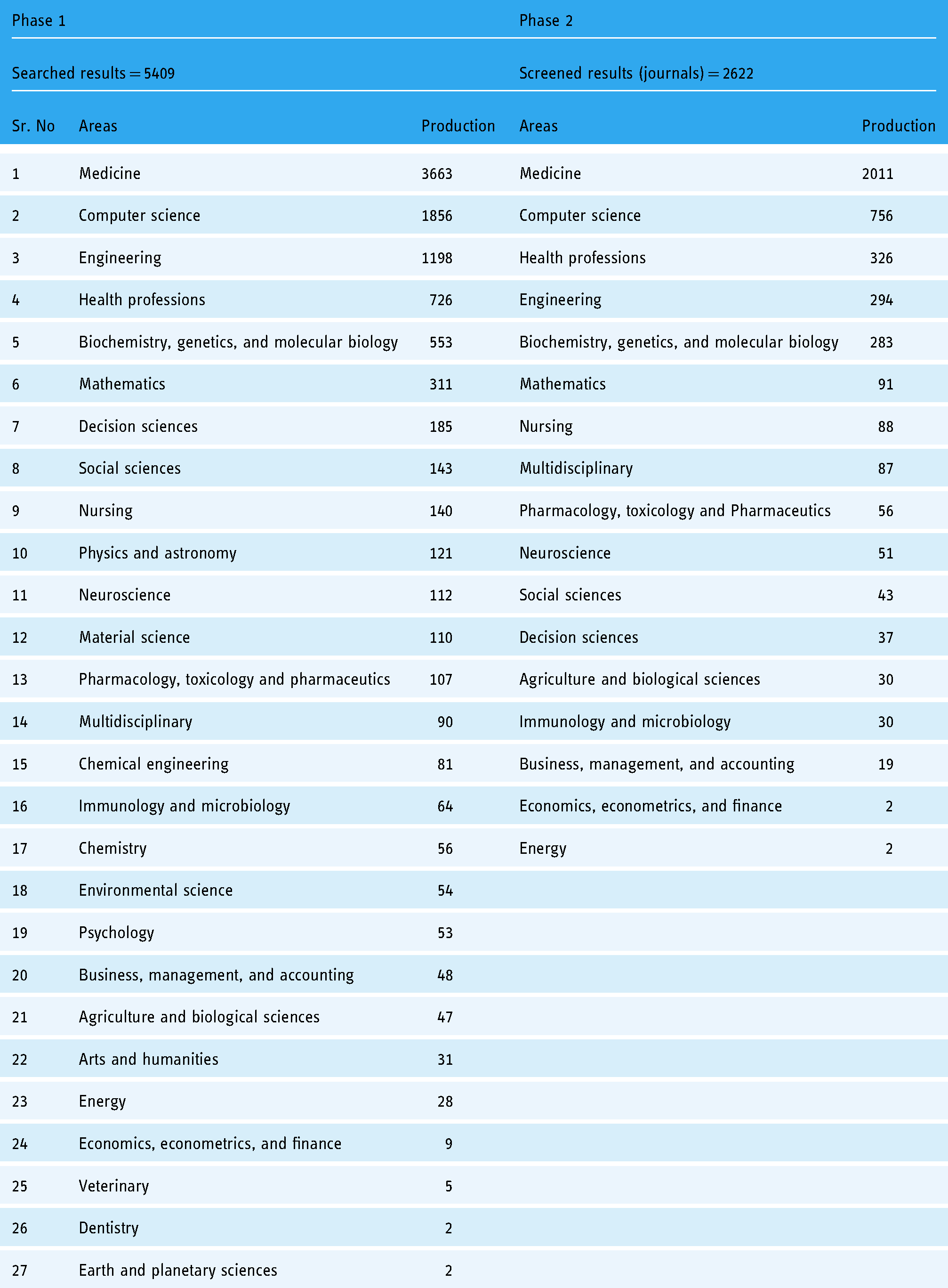
The search and screening of e-health and AI articles are implemented before citation analysis. The R-based software named Biblioshiny is used to carry out this analysis. It eases the amalgamation between various graphical and statistical packages. Biblioshiny provides a web interface for bibliometrics. Its features are beneficial for researchers in the case of importing, gathering, converting, and plotting scientific data. It is also used to analyze conceptual, intellectual, and social knowledge structures and to plan for the source, author, and manuscript.50,51 Bibliometrix is more feasible than other software in collecting Scopus, PubMed, and Web of science data. The screened articles 2654 were passed through the Biblioshiny software for analysis purposes.
In this analysis, 766 articles are included in this study are journals and books written by 12565 authors. It is also found that the documents a single author wrote are fewer in number (106) than those authored by multiple authors (12459). The ratios between the total number of documents to the total number of authors and vice versa were recorded as 0.211 and 4.75, respectively. The total number of co-authors of sample articles was created as 6.36. Overall, the author's collaboration index was calculated as 4.92. From 1996 to 2021, the average number of publications per year is 3.03, and there are 113950 articles referenced for these publications. With time, the total average citation on each document and year-wise average citation per document is recorded as 18.81 and 4.015, respectively. From the document contents perspective, the number of keywords appearing in the titles of the references of articles is 11772. Additionally, 5228 keywords were found related to the authors of publications. The overview of screened articles is mentioned in Table 2.
Summary of screened articles.

Results and findings
The Scopus database was searched for publications from January 1996 to December 2021 with relevant keywords, including “AI”, “ML”, “neural networks”, “smart healthcare”, and “electronic health records”. The bibliometric analysis is employed to identify significant research areas, influential authors, and leading journals in the e-Health sector. It also provides insights into the evolution of the adoption of AI applications in the e-Health sector.
Author keyword analysis
In this section, the most frequent occurrence of keywords is presented, which is done from the Bibliometrix tool. Authors used keywords to represent the summary of their articles. Keyword analysis represents the concept and structure of knowledge related to a specific research field. It provides an elusive overview of the research domain.52,53 The 20 calculated keywords from the analysis are divided into two parts. The first part contained the keywords that represent the data processing techniques, i.e., ML, AI, natural language processing, telemedicine, health informatics, eHealth, digital health, mobile health, e-health, prediction, mhealth, health information technology, data mining, covid-19, clinical decision support, and medical informatics. In this part, the keyword ML occurred 554 times, deep understanding appeared 165 times, AI 157 times, and 131 times medical informatics.
On the other hand, the second part consisted of keywords representing the data itself. It included electronic medical records and electronic health records. The authors used electronic medical records 46 times and electronic health records 420 times. Figure 1 presents the graphical representation of mostly used author's keywords.

Occurrence of authors’ keywords.
The keyword analysis shows the impact of ML and deep learning algorithms on digital health as with the help of these algorithms the challenges related to medical can be addressed towards improving efficiency, effectiveness, and responsiveness of public health and healthcare services
Word dynamics
This section elaborates on the usage of words yearly. Figure 2 shows the occurrence of keywords, i.e., AI, deep learning, e-health, electronic health record, health records, health informatics, and ML, for 22 years from 1999 to 2021. From the analysis, most of the research domains started appearing in the early year. However, their usage with time became less, and many of the keywords have minimal usage periods, but research related to them increases yearly. For instance, the keywords electronic health records and ML started in 2005.

Yearly cumulate occurrence of keywords.
Furthermore, up to 2021, the authors’ occurrence reaches more than 400. While the keyword AI appeared in approximately 2010, its usage is less than 200 up to 2021. Along with AI, keywords like deep learning, e-health, electronic health record, and health informatics started their journey from 2006 to 2021, but their usage is less than 200.
Annual topics trend
In this section, the inclination of topics that is related to AI and e-health is discussed. Trending topics provide an overview of researchers’ interests and future impact. 54 In Fig 3, the trending topics are taken from 2010 to 2021. In 2010, the research on ‘self-care’, ‘interoperability’, and medical information was started, but the research on ‘self-care topic’ lasted until 2017, ‘interoperability’ lasted until 2018, and ‘medical information system’ lasted until 2015. From 2011 to 2018, the work on ambient intelligence, chronic disease management, internet, and security arose, but the work on decision support systems lasted until 2020. The research areas like adherence, home health monitoring, ambient assisted living, information systems, and pattern recognition were started in 2012 but mostly lasted in 2014 and others in 2018. On the other hand, the comparative effectiveness research topic trend from 2013 to 2021.

Trending of topics yearly.
Moreover, the articles on delivering healthcare, patient-centered care, biomedical informatics, healthcare information technology, health information technology, communication, genomics, e-health, and telemedicine spanned from 2014 to 2018, 2019, and 2020 respectively. In 2015, the topics like medical informatics application, technology, clinical decision support, electronic medical record, primary care, e-health, and medical informatics originated, but they lasted from 2018 to 2020. While in 2016, two topics, i.e., patient portal and electronic health records, started trending but work on the ‘patient portal’ stopped in 2018 but on electronic health records is up to 2021. In 2017, data mining, health informatics, and electronic health records were trending and lasted in 2020; work on the ‘prevention’ topic is ongoing up to 2021. In 2018, only one research related to natural language processing was raised, but it soon lasted until 2020. There are very few topics that trend up to 2021. For instance, research on digital health, AI, deep learning, ML, predictive model, risk factor, emergency department, and covid-19 was started in 2019 and 2020. These topics are directed toward 2021. Based on these results, it can be expected that AI-based models that can provide predictive analytics and prescriptive analytics will drive the future of digital healthcare.
Co-occurrence of keywords
Keywords co-occurrence analysis is a simple method to find the existence of keywords in a large number of articles. It shows the research front and hot topics of the particular field. This study employed the VOS viewer to analyze the co-occurrence keywords depicted in Fig 4. There are mainly three clusters (red, green, and blue) prominent in this figure. The nodes represent the keywords. The larger node size means a larger keyword occurrence count in a single article.

Keywords co-occurrence network visualization.
In addition, the closer link between the two keywords depicts their high co-occurrence. The red cluster contained the keywords related to human health care, i.e., health care delivery, patient participation, primary health care, privacy, and precision medicine. In addition, the green cluster is limited to AI, data mining, information retrieval, decision tree, and learning algorithms. Moreover, the health care keyword is also found in this cluster, which relates to AI. The last prominent blue collection consists of the keywords, i.e., controlled study, cohort analysis, retrospective study, and incidence. The analysis under keywords co-occurrence network visualization shows three main cohorts that are correlated with each other. The analysis is based on 2622 research articles and focuses on three research themes i.e., Patient-centric, process-oriented, and AI-based algorithms.
Annual scientific production
In this section, the production rate of articles is discussed from 1996 to 2021. In the beginning years from 1996 to 2007, the researchers started working on the areas related to AI and e-health. Still, the published articles were very few, such as 2.63 articles per year. In addition, from 2008 to 2013, the climbing production rate started increasing. For instance, in 2008, only 11 articles were found on this topic, while in 2013, the publishing rate reached 92, so in phase 2, the average article per year is 39.5, almost 15 times more than in phase 2. By working gradually, a total of 128 articles were found in 2014; in 2018, the total number of scientific articles reached 240. Its production rate graphs never went down when researchers started exploring these areas. In 2019, 403 articles appeared related to this research; in 2020, the article numbers reached 549. As AI inspires the whole world with its applications and benefits, that's why more researchers are contributing to this research area, and 586 articles were recorded in the last months of 2021, which is around 297 articles per year in phase 3. The production rate of papers is also depicted in Fig 5, in which the graphical representation is shown between published article rates with their respective years.

The production of articles from 1996 to 2021.
Most relevant sources of articles
This section describes a list of top journals that published articles related to AI and E-health through bibliometric analysis. In the academic area, journal analysis is employed to find the core journals in a particular field. In addition, Bradford's law is used to find the scattering citations of respective subjects and identify the most-cited journals. The Bradford law defines how the literature on a given topic is distributed throughout publications. The concept is based on a study conducted by L. Jones in the Science Museum Library in London in 1933. It was first reported in the journal” Engineering” by Bradford in 1934 and then in the same author's book” Documentation” in 1948. 55 Bradford's law is defined as. “If the journals that contain articles on a certain subject are ordered in descending order of the number of articles they contain, then successive zones of periodicals with the same number of articles on the subject create the simple geometric series I: n: n2.” Fig 6 shows the most influential journals that contribute to the publishing process of articles. It is the graphical representation of journals’ names versus several documents. The Journal of Biomedical Informatics published most of the articles (180). The Journal of Biomedical Informatics is a peer-reviewed journal by Elsevier publisher. It has an impact factor of 6.317 (2020). This scientific Journal published articles related to health informatics and translational bioinformatics. American Medical Informatics Association Journal published 154 articles. The American Medical Informatics Association Journal has an impact factor of 4.112, less than the impact factor of the Journal of Biomedical Informatics. It is also a peer-reviewed scientific journal by Oxford University Press and covers the research areas related to health informatics from the American Medical informatics Association. The third Journal contributed to the publication of 102 Journal of Medical Internet Research articles. It is a peer-reviewed open-access medical journal with an impact factor of 5.43 by the JMIR publisher. It published articles that are related to e-health. The other Journal, the International Journal of Medical Informatics, produced 99 articles related to health informatics, with an impact factor of 3.21 (2016). The BMC Medical Informatics and Decision Making published 93 computer science, bioinformatics, and biostatistics. It had an impact factor of 2.796 in 2021.

Journal names that published more articles.
Furthermore, the IEEE Journal of Biomedical and Health Informatics has a high impact factor of 5.772, covering recent research on health informatics and biomedical. According to the bibliometric analysis, it published 83 journals. The PLOS ONE and BMJ OPEN contributed 54 and 45 journals, respectively. The AI in Medicine journal covers the areas of AI in medicine and health care concerning theory and practice. It has published 43 articles.
Moreover, the Journal of Medical Systems and JMIR Medical Informatics produced 40 and 39 journals. On the other hand, AMIA (Annual Symposium Proceedings. AMIA Symposium) and JMIR of Mhealth and Uhealth contributed 30 articles. The analysis found that Applied Clinical Informatics published only 21 articles related to health informatics and biomedical.
Most relevant authors
Bibliometrix tool helps the researchers find the top leading authors in the respective field with their contributions. Lotka's law is used to find the pattern of author productivity in a specific area. In bibliometric studies, Lotka's direction is very prevalent. It is defined as the relative frequency distribution of an author's production in each subject, a hyperbolic, inverse square function is predicted; for example, a minority of the field's authors are producing most of the papers. To put it differently, the proportion of writers who make n contributions is around 1n2 of those who make one. Still, the ratio of all authors who make a single involvement is roughly 60%. 56
From Fig 7, it is clear that above 80% of authors are involved in one publication and above 5% of authors have published more articles.

The top 20 authors with their publication count.
Figure 8 represents the top 20 authors with their article numbers and fractionalized articles for additional clearance. The analysis found that LI J was the author of 30 articles with 4.14 fractionalized articles. The other author, LI Y, has written 28 journals and co-authored 4.66 articles. The articles published by Zhang Y and Wang y were 27 and 25, respectively. The other two researchers Luo Y and Wang F, wrote 21 articles with 4.25 and 3.43 fractionalized articles, respectively.

Frequency distribution of author productivity through Lotka's law.
On the contrary, LI X published 20 articles and co-authored 3.25 articles. While Das R, Denny JC, Liu X, Liu Y, and Wang L contributed 19 publications. In addition, Cai T, Chen Y, Shah NH, Wang J, Wang X, and Zhang Z have written 18 journals on this presented study. According to the bibliometric analysis, Hripcsak G and Huang Z wrote 17 articles with 3.51 and 3.98 fractionalized articles, respectively.
Co-authorship
Co-authorship analysis highlights the foremost authors in the research fields of AI and e-health. Figure 9 visualizes the co-author analysis with threshold 10. Each node represents the author, and nine node clusters are found in this figure. The links between the authors illustrate the research collaboration among them. The thick link line depicts strong cooperation. For instance, Wang Y. and Li J. are the core authors in the red nodes cluster. While Li J. has 30, and Wang Y. has 25 publications in the respective field.
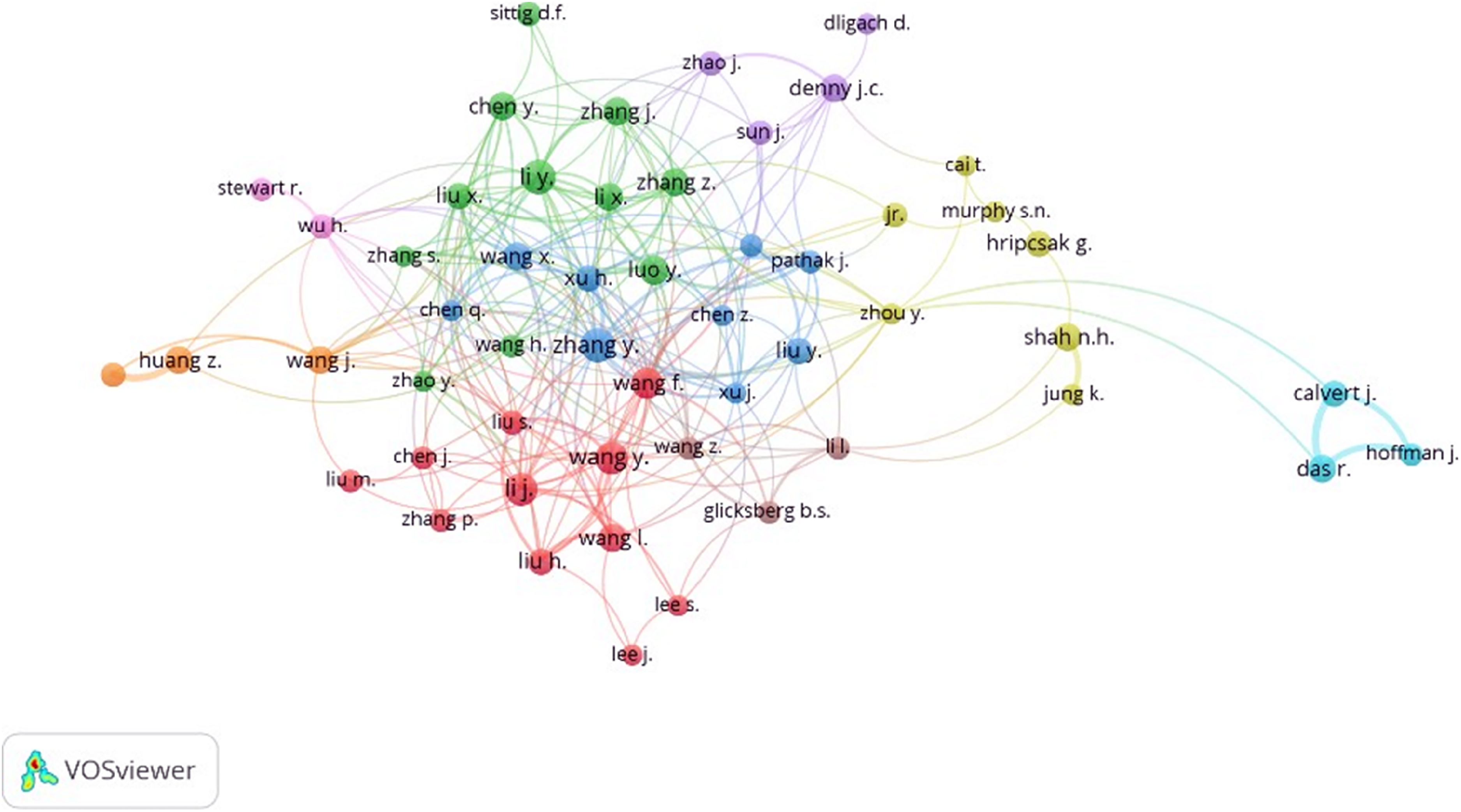
Co-authorship threshold ten network visualization.
It is found from the analysis authors in the red cluster have research links with blue, orange, and yellow groups. On the other hand, Zhang Y. was a core author in the dark blue node cluster with 27 research articles related to AI and e-health. The light blue set contains only three authors, i.e., Calvert J., Das R., and Hoffman. J with minimal cooperation with the yellow nodes cluster. On the contrary, the orange nodes cluster dark and light purple nodes clusters also have few authors with very little collaboration. Overall, the trends in coauthorships show that today's scientists are more engaged in collaborations compared to the past as several collaborative software is available in the market
Most relevant institutions
This section demonstrates the top 20 institutions whose researchers contributed more to AI and e-health research. In Fig 10, the most dominating institution found after the analysis is the University of California, and 151 articles are associated with it. The Harvard Medical School researchers wrote 141 articles, while Stanford University published 137. In addition, Icahn School of Medicine at Mount Sinai and Vanderbilt University Medical Center contributed 109 and 104 articles, respectively. Columbia University published 101 articles. The above are lists of universities whose counting is more than a hundred. Next is a list of universities whose publications are less than a hundred. The University of Washington has published 95 articles. The University of Michigan and Northwestern University contributed 80 and 70 articles. Other universities like the University of Pennsylvania, Vanderbilt University, University of Pittsburgh, University College London, University of Oxford, University of Utah, Duke University, and the University of Florida have published 67, 55, 54, 51, 43, 42, 41, and 41, respectively. On the other hand, hospitals and clinics have also published their research. For instance, Mayo Clinic, Massachusetts General Hospital, and Brigham and Women's Hospital have contributed 59, 57, and 42 publications, respectively.
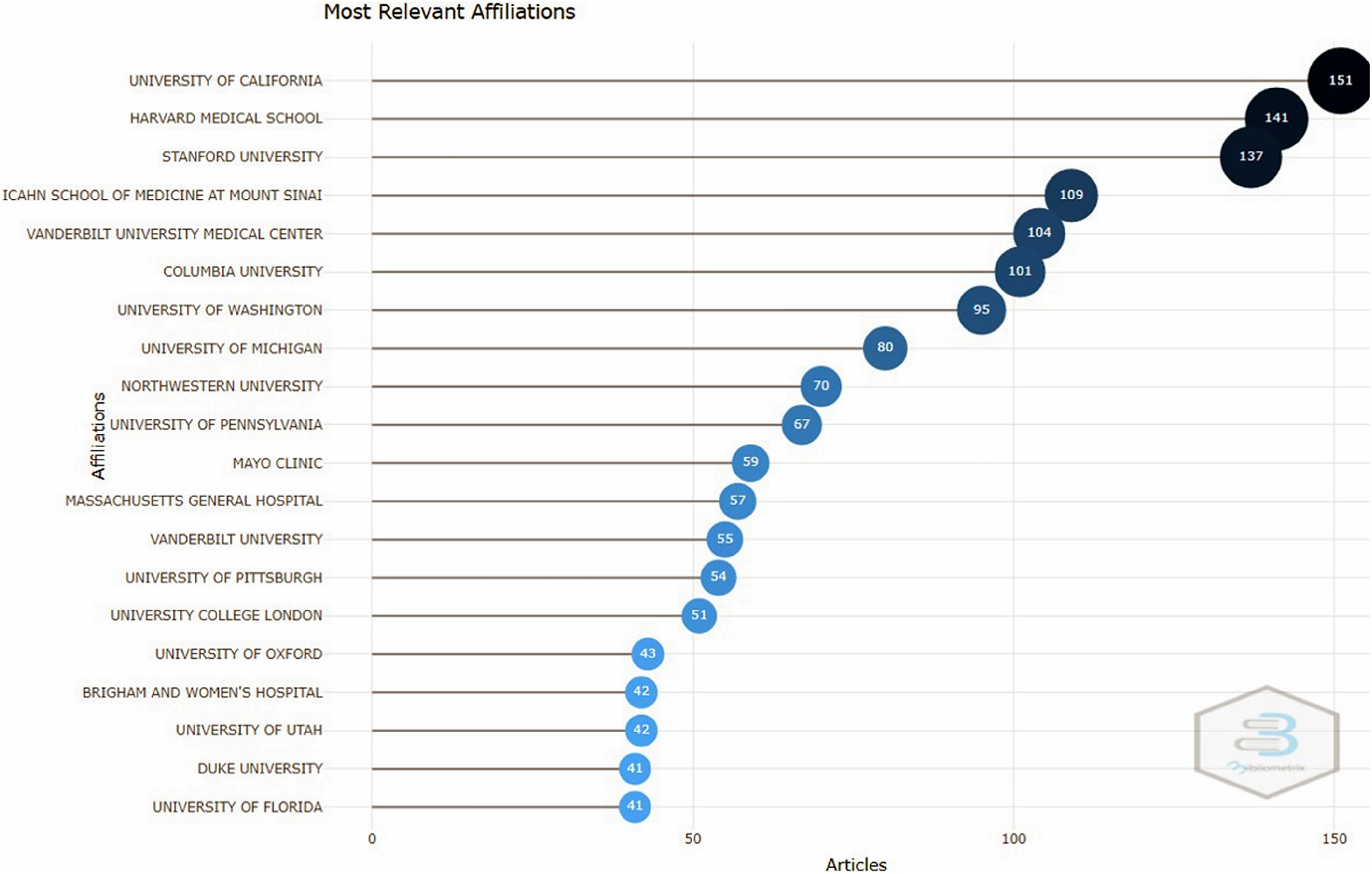
Top 20 most contributed institutions.
Country scientific production
Figure 11 depicts the scientific production rate of 20 countries collaborating more in research from 1996 to 2021. According to the analysis, researchers in the USA have published more articles than in other countries. Moreover, from Asian countries, China contributed to 897 journals. In contrast, the articles from India, Japan, and South Korea were recorded as 205, 225, and 90, respectively. The researchers in Middle Eastern countries, i.e., Israel and Saudi Arabia, have published 74 and 71 articles. After China, the United Kingdom has become dominated by other Asian countries. On the contrary, European countries, i.e., Spain, Germany, Italy, Netherlands, France, Sweden, Switzerland, Denmark, and Greece, have published 240, 239,202, 182, 177, 91, 75, 69, and 64, respectively. presents an analysis of scientific production and impact among 35 most productive countries in the world.

Country-wise production rate.
Most cited countries
Figure 12 represents the 20 countries whose articles are more cited by other researchers. At the top of the list, the country is the USA, and it got 23,873 citations with an average 21.9 citation rate. China is in second place with 3046 citations but first in the Asian countries with high citations. After China, the journals of The United Kingdom, Canada, Netherlands, Spain, and India are studied and referenced by other countries. On the contrary, the journals of other Asian countries, i.e., India, Korea, and Japan, have citations 1019,572 and 170, respectively. From the analysis, Japan is the least cited country, with an average citation of 11.33, compared to others. The European countries, i.e., Netherlands, Spain, Germany, Italy, New Zealand, Sweden, Greece, France, Austria, and Turkey, have citation rates of 1201, 1081, 993, 490, 411, 402, 398, 382, 241, and 184, respectively. In comparison, the Middle Eastern countries Saudi Arabia and Israel have referenced 309 and 296 times.

Country-wise citation rate.
Most global cited documents
Bibliometrix tool helps the researchers analyze the most cited journals with DOI and citations rate per year. Figure 13 also presents a graphical representation of the top 20 cited journals. This section discusses the globally cited documents concerning the total number of citations and citations per year. According to the analysis, the first paper was published in PLOS MED journal in 2011 and cited 830 times, a systematic overview of the impact of e-health on the quality and safety of health care. The authors categorized the technologies for e-health as being divided into storing and managing data, clinical decision support, and distance medical facilities. However, they found very little research on the risks and implementation costs of e-health technologies. 57 Another paper, 58 with citations 684 times, presented the review, challenges, and opportunities for healthcare by deep learning in 2017. From the author's point of view, it is easy to carry out the models from complex biomedical data with the help of deep learning technology.

Top 20 globally cited documents.
In Ref. 59, Miotto Riccardo and its authors 2016 described an unsupervised representation deep learning technique for clinical prediction patient model named deep patient with the help of electronic health records. According to the analysis, it is cited 608 times. The authors used 76214 test individuals with 78 illnesses from distinct clinical domains and chronological frames to evaluate their findings. The results outperformed representations based on raw EHR data and alternative feature learning algorithms by a large margin. The top-performing predictions included severe diabetes, schizophrenia, and several cancers. Moreover, the article 60 presents an argument to prove that ML is beneficial in predicting cardiovascular risks. For evaluation, routine clinical data of 378256 UK families were analyzed by ML algorithms and predicted for ten years. Another journal cited 226 times in a journal of medical internet research in 2010. It performed a systematic literature review of the available electronic data to find the definition of health 2.0 and medicine 2.0. The authors found that health 2.0 and medicine 2.0 are under developing research. 61 In Ref. 62, deep learning is employed to make a temporal relationship between events from HER for heart failure. The authors found that cardiac failure risk can be predicted through deep learning-based models before 12 to 18 months. This article got cited 301 times by other researchers.
Discussion
This analysis provides a comprehensive understanding of the current state of AI and e-health. It offers exciting information on keywords, authors, top-ranked journals, and institutes.
Reflection on bibliometric analysis
Based on our bibliometric analysis, the real-time data combined with ML algorithms for e-health applications are advantageous in managing and preventing pandemics. Moreover, IoT and blockchain technologies work effectively with AI regarding data storage, processing, and privacy. The most used keywords by academics are “ML” and “electronic health records”. Keywords related to “AI” and “human healthcare” are more co-occurred. The most popular themes are digital health, AI, deep learning, ML, predictive modeling, and COVID-19. Black, Ashly D., et al. (2011) and Miotto, Riccardo, et al. (2018) are two papers that have received many citations worldwide. The highest-ranking journals that published publications connected to AI and e-health are the Journal of Biomedical Informatics, the American Medical Informatics Association, and the Journal of Medical Internet research. LI J, LI Y, Zhang Y, and Wang Y are the most influential authors and co-authors in the field. Journal articles published by academics from the United States and China have received the most citations.
Research propositions
This research study presents a proposition for conducting a bibliometric analysis and how to perform it in a structured manner. However, in this account only Scopus database is used to obtain the data; a full-scale empirical study would need to address more fine-grained characteristics by obtaining data from databases including Web of Science, Google Scholar, and PubMed, that will ultimately broaden the scope of this study. To expand the scope of this research remarkably, this research work also proposes to take in account the publications authored in French, Croatian, Portuguese, and Spanish as this study focuses only on journal papers written in English.
Limitations and future work directions
There are certain limitations to the study offered here. The first step is to conduct a bibliometric analysis using the Scopus database. If the papers are also obtained from other databases, such as Web of Science, Google Scholar, and PubMed, the scope of this study might expand significantly. Second, this research only looks at journal publications. The scope of this study will be developed in the future by including books, dissertations, and conference papers. Third, journal papers written in English are considered, although publications authored in French, Croatian, Portuguese, and Spanish will also be helpful for analysis. Moreover, articles are not taken from the year 2022, i.e., physics, chemistry, environmental, material sciences, art and humanities, veterinary, planetary sciences, and psychology. The search is limited to abstracts and titles.
Contributions to research/theoretical implications
It will offer beginner researchers information on keywords, authors, top-ranked journals, and institutes. This research will be expanded in the future to include thematic analysis and topic modeling. Furthermore, using real-time data combined with ML algorithms and e-health will be advantageous in managing and preventing pandemics. IoT and blockchain technologies, on the other hand, will work well with AI regarding data storage, processing, and privacy.
Hereafter, the addition of these factors will broaden the spectrum of the domain of AI and e-health for researchers and scholars as AI transforms healthcare systems from every perspective. The bibliometric analysis yielded important implications in this study. According to the study, AI and e-health are both new and developing technologies. With minimal uncertainty, public awareness of these topics is growing, not only among academics but also among the general population. This research will aid practitioners, and governing authorities in understanding how to execute it.
Conclusion
AI is a game-changing technology that is revolutionizing health care. It transformed ineffective healthcare systems with more efficient computerized systems. E-health aims to enhance healthcare systems by combining information and technologies. We conducted a bibliometric analysis on 2622 academic articles published between 1996 and 2021 associated with using AI in e-health. Author keywords, word dynamics, yearly subject trends, globally cited documents, and most prominent journals, authors, in-institutions, and nations were all included in the citation study. According to the survey, the most used keywords of ML and electronic health records by academics from major institutes, including the University of California, Harvard Medical School, and Stanford University. It can also be seen from the word dynamics that keywords like AI and ML are used less frequently up to 2021. Besides, keywords related to AI and human healthcare are more co-occurred.
Furthermore, the most popular themes are digital health, AI, deep learning, ML, predictive modelling, and COVID-19. Over time, it was discovered that the number of journals published on these hot topics had increased to 586. BLACK AD, 2011, PLOS MED, and MIOTTO R, 2017, BRIEF BIOINFORM are two papers that have received many citations worldwide. The highest-ranking journals that published publications connected to AI and e-health are the Journal of Biomedical Informatics, the American Medical Informatics Association, and the Journal of Medical Internet research. Similarly, LI J, LI Y, Zhang Y, and Wang Y are the most influential authors and co-authors. Besides that, when compared to other countries, most academics, particularly those from the United States and China, have put in much effort and are leading the way in researching unique features of AI, ML, and data mining in the healthcare field, and have received the most citations. This analysis provides a comprehensive understanding of the current state of AI and e-health.
Footnotes
Declaration of conflicting interests
The author(s) declared no potential conflicts of interest with respect to the research, authorship, and/or publication of this article.
Funding
The author(s) received no financial support for the research, authorship, and/or publication of this article
