




Abstract
Objective
Dentistry necessarily requires close face-to-face contact with patients, so it was largely halted during the COVID-19 pandemic. During this pandemic, teledentistry (TD) could be a novel way to resume dental practice. It was aimed to investigate the satisfaction of the parents who received teledentistry (TD) service in a pediatric dentistry clinic during the COVID-19 pandemic, as well as other factors that may have contributed to this satisfaction.
Methods
It was conducted using a telephone survey to interview the parents who used the TD system between June and December 2020. The survey includes participant demographics, COVID-19 anxiety, TD system, reasons for using TD, and Internet use in the field of health. Five-point Likert scale was used. A Chi-squared test was used and p < 0.05 was accepted as significant.
Results
Most of the participants stated that they had no trouble connecting to the TD system (82.5%), and 119 participants reported that the system helped them to solve their health problems. Significant relationships (p < 0.05) were found between overall satisfaction and parental job, level of education, anxiety level (3 questions), and use of the Internet in healthcare (4 questions), whereas no associations were found regarding the other variables (p > 0.05).
Conclusions
Parents benefited greatly from the TD system and would be open to using it after the pandemic. The education and parental job categories of parents, anxiety level, and use of the Internet in healthcare seem to have relationships with overall satisfaction.
Introduction
The COVID-19 pandemic has created a unique situation around the world because of the spread and severity of the COVID-19 virus, causing great damage to the healthcare systems of various countries. Because the virus is transmitted by coughing, sneezing, inhaling droplets transmitted by speech, and touching the mucous membranes of the mouth and nose after interacting with virus-infected surfaces, healthcare workers are at a higher risk.1,2 Dentists are one of the health professionals who are at the highest risk because of their regular contact with the oropharyngeal area during dental treatments. For this reason, all non-emergency dental procedures in Turkey, as well as the rest of the world, were postponed to avoid disease transmission.
Current dental practices must be reconfigured in terms of cross-infection risk and ongoing oral and dental health practices, given the ongoing COVID-19 pandemic conditions and the trend of increasing cases. 1 In this regard, teledentistry services can provide an innovative solution for dentistry during and after the current pandemic.
Teledentistry services can be defined as the use of telecommunications and technology to protect public health, diagnose, and treat dental diseases in situations where access to healthcare is critical. 3 In the COVID-19 pandemic, where social distancing and travel constraints are imposed and elective dental procedures are postponed, teledentistry services can be used for remote diagnosis and treatment planning. Using these methods, advanced triage is performed without having to go to the healthcare facilities, and the patient–physician relationship is established without the risk of contact.
Teledentistry services can be used in areas such as triage, diagnosis and treatment planning, oral-dental health control, oral-dental health education, and consultation between physicians. 4 These services make it easier and faster to receive high-quality health care at a reasonable cost. Expenses such as staff and medical supplies used in polyclinic examinations and treatments are kept to a minimum. By minimizing unnecessary diagnosis and treatment planning, a convenient communication strategy between health units is established. In addition, patients can reach health services in a shorter time by being referred to specialist physicians.5,6
Teledentistry services are not widely used today, despite their numerous benefits. The fact that healthcare professionals may find the system complex and technologically challenging explains this issue.6–8 Inadequate infrastructure and Internet access, as well as a lack of technical understanding and financial reimbursement issues, all contribute to the inability to actively use these procedures. Patients, on the other hand, do not actively prefer teledental services due to the difficulty of obtaining them, the lack of face-to-face communication, and the fear of not being able to fully explain their complaints. However, there are also studies indicating that patient satisfaction is high in teledentistry systems. Patients are generally satisfied due to the convenience of use, quick access to healthcare, and time and money savings.9–11
The objective of this study is to investigate the satisfaction of the parents of patients using teledentistry services during the COVID-19 pandemic and other factors associated with this satisfaction.
Methods
The study was conducted in compliance with the Declaration of Helsinki, with the approval of the local ethics committee (approval number: 2021/01-14). All volunteers who took part in the study gave their consent to participate and have their data stored.
Teledentistry system
To limit the risk of contact during the COVID-19 pandemic, a teledentistry system was established in the Department of Pedodontics at the Faculty of Dentistry of Necmettin Erbakan University. To the best of our knowledge, this was the first teledentistry system in Turkey. Patients were given teledentistry appointments throughout the pandemic through the faculty website. Cisco webex system integrated into the Turcasoft program, which is a patient follow-up program, was used to conduct the video-conference interview. When the patients’ appointment time arrived, an SMS was delivered to their telephones along with a link. The relevant link was used to establish a teledentistry interview with the video-conference system. Teledentistry interviews were conducted with three research assistant physicians working in the pedodontics department. The study sample included all patient parents who used the Teledentistry System between June 2020 and December 2020, for a total of 624 patient parents. Between February and March 2021, the study’s primary objective, the retrospective collection of patient opinions, was completed.
Study design/protocol
This was a retrospective observational descriptive research study that was conducted using a telephone questionnaire. This study investigated at COVID-19 anxiety, the ease of using the teledentistry system, the rationale for teledentistry use, and Internet use in the context of health during the COVID-19 pandemic, as well as demographic characteristics of the participants, in five sections (Table 1).11–13 Participants responded to the questions using a five-point Likert scale ranging from “strongly disagree” to “strongly agree.”
The survey used in the study.
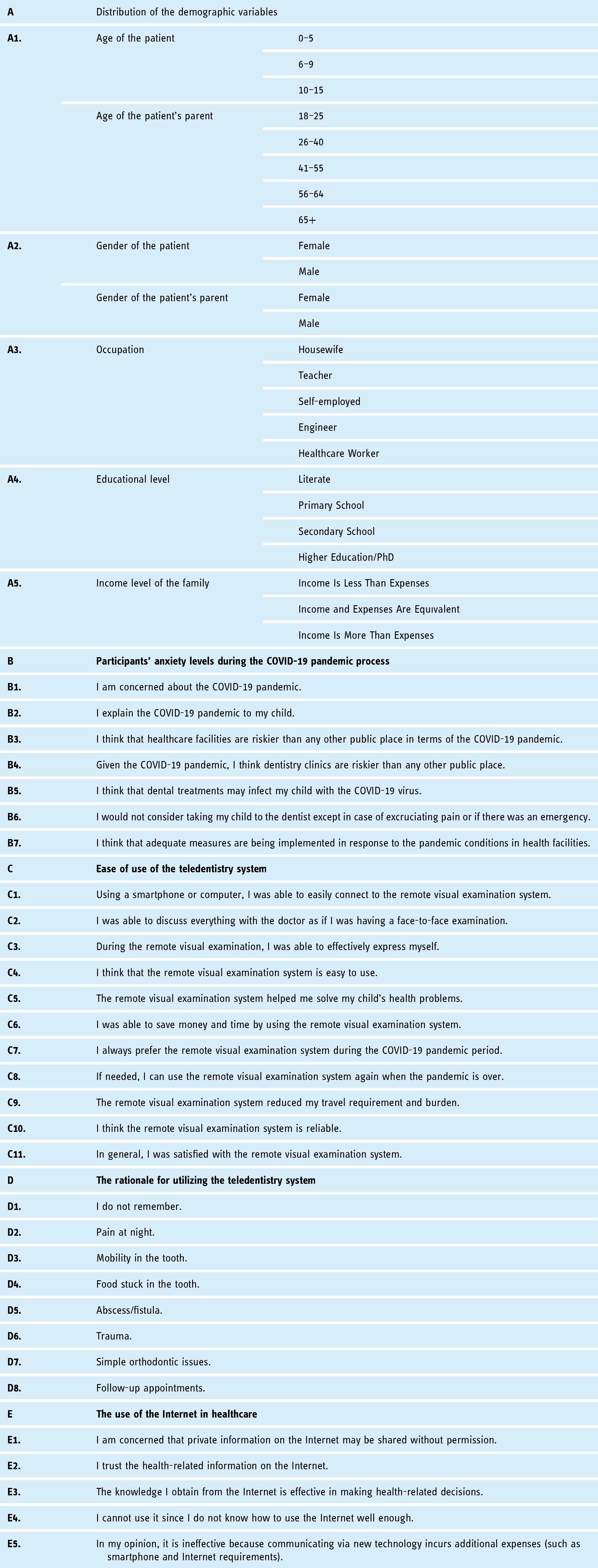
Before beginning the study, the survey was administered twice to a pilot group, which represented about 10% of the overall study population, with a 1-week delay between each administration, and a reliability analysis was performed. The parents of 560 patients were included in the main study, but the pilot participant group was not. However, only 149 of the 560 parents who were contacted completed the entire survey.
Data analysis
SPSS for Windows 17.0 software was used for statistical analyses. Descriptive statistics for demographics and all other data were reported as frequency (%) values. Test–retest reliability analysis was performed. The Chi-squared test was used in the analyses. The p < 0.05 threshold was considered statistically significant in all these analyses.
Results
The test–retest analysis yielded a reliability coefficient of 0.969.
Demographic characteristics of the participants
The study was completed with 149 patient parents who benefited from the teledentistry system in the six months between June 2020 and December 2020. Of the 149 parents, 94 (63.1%) were female and 55 (36.9%) were male. While most of the parents in the study (75.8%) were between the ages of 26 and 40, most of the patients (53%) were children in the mixed dentition stage between the ages of 6 and 9. Housewives made up 49.7% of the parents, and their household income to expenditure ratio was reported to be equivalent at a rate of 57.7% (Table 2).
Distribution of the demographic variables.

Anxiety levels of the participants during the COVID-19 pandemic
While 79.9% of participants were concerned about the COVID-19 pandemic (B1), the majority (74.5%) did not think that dental treatment could pose a risk of transmission (B5). Almost all participants (91.9%) believed that adequate measures were implemented in health facilities in response to the pandemic conditions (B7) (Table 3).
Participants’ anxiety levels during the COVID-19 pandemic process.

Ease of use of the teledentistry system
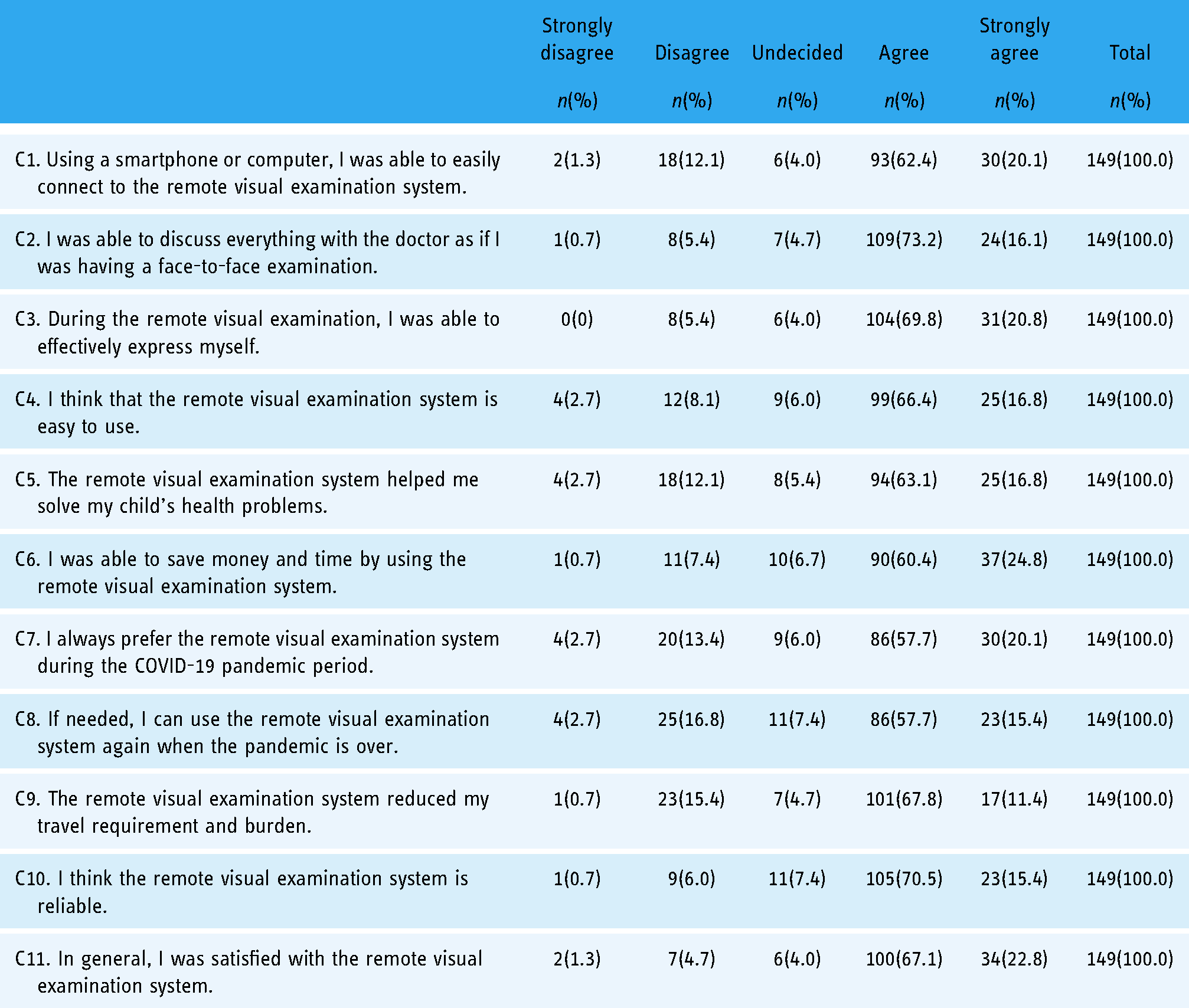
Totally, 82.5% of the participants stated that they could easily connect to the teledentistry system (C1), and 119 participants reported that the system helped them solve their health problems (C5). While 73.1% of the participants said they would use the teledentistry technology again if needed once the pandemic ended (C8), nearly all participants (89.9%) said they were generally happy with the remote visual examination system (C11) (Table 4).
Ease of use of the teledentistry system.
The rationale for utilizing the teledentistry system
The most common reason for teledentistry use was spontaneous pain (D2) (53%), followed by the presence of an abscess (D5) (18.1%, Table 5).
The rationale for utilizing the teledentistry system.

The use of the Internet in healthcare
While the percentage of participants who are concerned that private information on the Internet may be shared without permission is low (32.3%) (E1), the percentage of participants who indicate they trust health information on the Internet is high (71.1%) (E2). Furthermore, most participants (85.9%) reported that they found the communication provided by new technologies (smartphones, tablets, and computers) to be effective in healthcare (E5) (Table 6).
The use of the Internet in healthcare.

The relationships between C11 and other variables
According to the Chi-squared analysis of the study, there were significant relationships between C11 and parental job (p = 0.013), the level of education (p = 0.019), B2 (p < 0.001), B5 (p = 0.025), B7 (p < 0.001), E1 (p = 0.036), E2 (p < 0.001), and E3 (p = 0.016), whereas no associations were found regarding the other variables (p > 0.05, Table 7).
The relationships between C11 and other variables.

Discussion
Teledentistry is an innovative healthcare system that aids in patient triage and communication with the following patients, as well as in the evaluation of diagnosis and treatment outcomes, and in making recommendations for clinicians. 14 This study aimed to emphasize the effectiveness of the teledentistry system in the COVID-19 pandemic in Turkey. The results of the study showed that most of the parents of the patients are generally satisfied with the teledentistry system.
Many dental procedures generate aerosols that spread the virus among patients and healthcare providers. 15 As a result, most countries provided only emergency treatment during the pandemic, while other procedures were postponed. In the face of infectious epidemics such as COVID-19, teledentistry provides a new, simple, and accessible way to keep dental services from being disrupted. In contrast to these findings, the majority of parents of study participants did not believe that dental treatment could transmit COVID-19 and that dental clinics were potentially more dangerous than other public places. This situation can be interpreted as parents preferring to avoid contact with health institutions by using the teledentistry system for convenience.
The teledentistry system, similar to the findings of the study, provides patients with quick and easy access to health services. It reduces the number of visits, which saves both money and time. More patients can be served because physicians save time.16–18 Patients and/or their parents can easily connect to the system via the Internet and smartphones/tablets, and report their complaints in the same manner as they would in a face-to-face examination. These characteristics of teledentistry; becomes a significant advantage, particularly during pandemic periods when epidemic diseases such as COVID-19 occur. During their teledentistry appointment, the majority of participants in this study indicated that they were able to successfully express their complaints and use the system easily. They also stated that they would be able to use the teledentistry system again during and after the pandemic.
According to our findings, teledentistry seems to give a response in terms of spontaneous pain and dental abscess problems. This result can be considered similar to the previous findings. 12 However, pediatric dentists should not be overlooked because teledentistry could only manage the problems via using virtual elements. It may only have a relaxing effect on the parental anxiety regarding the oral health problems of their children. According to a 2021 study conducted in a pediatric dentistry clinic, 59% of teledentistry appointments required routine face-to-face treatment. 19 Thus, if needed, certain treatments must be handled in a very closer period of me by dental appointment.
When the overall acceptability of the teledentistry method (C11) analyzed, compared to the other findings, such relationships were found for parental job and education levels. In addition, B2, B5, and B7 seem to have significant relationships with C11. Because of these relationships, it is possible to conclude that parents who are concerned about the COVID-19 pandemic, and who inform their children about it, who do not want to visit clinics and make contact are satisfied with the teledentistry system. Again, when the overall satisfaction is examined, it can be concluded that because they think that dental treatments and/or contact treatment may transmit COVID-19, they only want to visit clinics in emergency and necessary situations, and they use teledentistry services to determine what these necessary conditions are.
The relationship between B7 and C11 showed that the parents think that health facilities take sufficient precautions and that they are satisfied with the system, with teledentistry systems being one of these measures. Patients from various age groups, genders, and educational levels reported in a study conducted during the severe acute respiratory syndrome epidemic that they were not concerned about the virus being transmitted in dental clinics and that they believed adequate precautions were taken in healthcare institutions. 20
Although teledentistry services offer numerous advantages, studies have also shown that they are not as reliable as clinical procedures. Most of the time, because no organization is accountable for the security of patient data in health services, problems about patient data security may occur. 21 Given the significant relationship between E1 and C11, it is concluded that patients believe their teledentistry data will be retained in the hospital environment and that their privacy would be protected. Although it does not represent the majority (32.3%), there is a patient group concerned about their privacy. In a 2016 study to assess patient satisfaction with telemedicine services in a pain clinic, most patients (95%) expressed concern about their privacy and claimed that unauthorized information sharing could occur. 22 Another study evaluating a telemedicine service in the field of neurophysiology highlighted that the clinical, ethical, and legal implications of telemedicine were not entirely comprehended by the patients. 23
Because telehealth applications, whether via video conference or application, are not widely used in our country, the number of clinical studies that contribute to the literature is also limited. When the literature was reviewed, it was discovered that it was only used in the field of dermatology. 24 During the COVID-19 pandemic period, however, the Ministry of Health approved a new regulation governing all telehealth services. In this context, studies are being conducted in order for all telehealth applications to be used as routinely applicable treatments. As a result, patients and physicians will be served within the legal framework, and ethical and legal violations will be avoided.
The patients’ responses to questions E2 and E3 about Internet use regarding health suggested that they were on a search to find accurate information. Participants of another study on the use of the Internet in health communication reported that the health information obtained via the Internet was insufficient and that they were unsure about the accuracy of the information. At the same time, it was emphasized that the Internet is not always effective in making health-related decisions. 25 For this reason, telehealth procedures have been determined to be incredibly useful in terms of communicating with physicians and providing access to accurate information without having to visit a health facility.
Most patients who indicated they were satisfied with the system in item C11 also stated that telehealth services may incur additional costs due to new technology and so may not be utilized effectively. The study was conducted on patients who could be examined remotely using a teledentistry system. As a result, patient groups that are unable to benefit from the system due to technological limitations remain unknown. Furthermore, after the pilot group was excluded, the survey was completed with only 149 patient parents rather than the remaining 560 participants. The low participation rate; can be explained by factors such as inability to be reached, lack of time, and unwillingness to express an opinion. This number may not be representative of the entire society, which includes people of all ages, genders, educational levels, and financial statuses. As a result, it should be attempted to increase the number of participants in new studies that are being planned.
Patients were more satisfied during the COVID-19 period, according to a comprehensive study investigating patient satisfaction with telehealth services, and the younger population was more interested in these systems. However, it was emphasized that among face-to-face and telehealth examination performed under the same conditions, face-to-face examinations should be preferred. 26
When pediatric dentistry is taken into account following the pandemic, patients can receive suggestions for preventive care using the teledentistry system. In order to lower the risk of caries, dietary suggestions, patient referrals to oral hygiene resources, and oral hygiene instruction can all be given. 19
Considering all results, the teledentistry system appears to be a promising method for initial examination, diagnosis, and treatment planning. However, for comprehensive treatment procedures, face-to-face clinical appointments should be scheduled, and it should be remembered that these systems are not a one-to-one replacement for clinical approaches.
Conclusion
As a result; teledentistry systems, which offer significant benefits to both the patient and the dentist, are expected to become commonplace soon. This study also indicated that the teledentistry system substantially aided the patients’ parents and that the parents might continue to utilize the system after the pandemic ended. The education and parental job categories of parents, anxiety level, and use of the Internet in healthcare seem to have relationships with overall satisfaction. Despite this overall satisfaction, patients are concerned about data privacy; in the area of health information obtained from the Internet, it has become clear that patients do not fully trust.
Footnotes
Contributorship
MAI wrote the whole manuscript text, which was revised by EK, MK, and TT who helped in the ideas of study. TT helped in analyzing the data and plotting the results. MK, MAİ, and EK helped in the sample collection. All authors reviewed the manuscript.
Declaration of conflicting interests
The author(s) declared no potential conflicts of interest with respect to the research, authorship, and/or publication of this article.
Ethical approval
The ethics committee of Necmettin Erbakan University Faculty of Dentistry Ethics Committee for Non-Pharmaceutical and Non-Medical Products Research approved this study (2021/01-14).
Funding
The author(s) received no financial support for the research, authorship, and/or publication of this article.
Guarantor
MAI
