




Abstract
Advances in knowledge and technology have created opportunities to help monitor child growth. Thus, we conducted a systematic review to determine if the use of mobile apps resulted in improved growth outcomes for children. We include articles published related to children's growth with poor nutritional status. The relevant articles were searched from PubMed, ScienceDirect, Scopus, ProQuest, and Google Scholar. Twelve studies were identified, which is the use of the mobile app to monitor growth in undernutrition and obesity in children. Six studies found that the use of mobile apps improved undernutrition child growth and improved parents’ and/or front health workers’ knowledge to prevent, treat, and monitor children with undernutrition. Six studies stated that the use of mobile app helps overweight/obese children lose weight and motivate them to achieve ideal body weight. Mobile apps for monitoring the growth of children with various standards are likely a promising means for early detection of growth failure and guiding overweight/obese children in gaining normal weight. Studies with large sample sizes and long-term interventions and follow-ups are needed to help assess the effectiveness of mobile app intervention programs and their impact on multiple growth outcomes more comprehensively and accurately.
Introduction
The early years of a child's life are the most important period for their health and development. Early child development sets the foundation for lifelong learning, behaviour, and health. The healthy growth and development of infants and young children are of paramount importance for children to develop their full physical and mental potentials. 1 Although child growth is a crucial period, more than 100 million children worldwide are failing to grow. In 2020, globally, WHO stated about 149.2 million children under the age of 5 years were stunted, 45.4 million wasted, and 38.9 million overweight. 2
Child growth failure (CGF) is expressed as stunting, undernutrition, and obesity, and children under 5 years of age (0–59 months) are a specific subset of undernutrition excluding micronutrient deficiencies, that is characterized by the relationship between insufficient height and weight at a given age, and this subset is most universally described in terms of univariate ‘growth standards’, for which age-specific heights and weights are compared to healthy reference populations.3,4 In a child with suspected impaired growth, a detailed evaluation should be conducted to identify the cause. 5 Based on walker's research, risk factors for child growth are nutrition (childhood undernutrition, overnutrition, iodine deficiency, iron deficiency, and other nutritional factors), infectious disease, environmental exposures, and parenting factors. 6 Therefore, a child with growth failure need to be treated as soon as possible.
Child with growth failure under treatment will have their growth to be assessed and recorded over time. This will allow the child to be monitored by comparing their growth with a normal range for other children of the same age and gender, relative to a reference population. 7 Advances in knowledge and technology have created opportunities to help monitor the treatment progress of a child with poor nutritional status. Since child care is part of health service in that provided by the government and recorded, the use of technology to monitor child growth and development is needed. Emergence of smartphones and mobile devices has the potential to facilitate the use of technology in monitoring such as mobile applications. In 2021, the percentage of mobile device users reached 89.76% of the world's population and the percentage of internet users worldwide reached 59.5% of the global population; in total of 92.6% mobile device user who accessed the internet8,9 indicating mobile applications are accessible to anyone. Thus, mobile applications to monitor child growth provide many great benefits because it is easy to use, saves time, can be recorded automatically, and is available to millions of users. The objective of this systematic literature review was therefore to see the result of the use of mobile apps to monitor growth outcomes.
Methods
Search strategy
We identified the eligible literature through a systematic search in five electronic databases: PubMed, ScienceDirect, Scopus, ProQuest, and Google Scholar without time-window restriction. The search used a combination of keywords of mobile app, monitor, growth (anthropometric, growth, weight, length/height), and poor nutritional status in the child (underweight, stunting, wasting, malnutrition). After the abstracts were retrieved and screened, we evaluated the full text of the articles that related to mobile app use for monitoring and children's growth.
To read the article, first, pay attention to the title, then read the article and make notes. The article was retrieved and read by the first author. The first author and second author discussed the retrieved article, then the second author and the rest authors discussed and came to an agreement to use the article.
Inclusion and exclusion criteria
To be eligible for inclusion, the article must present the data from an observational study that includes (a) use of mobile app to monitor a child with poor nutritional status; (b) quantitative and descriptive result; (c) original research articles. The papers that are included are English papers.
Retrieved articles were excluded if (a) the outcome only had a descriptive result and/or was not defined/determined by number; (b) retrieved articles are non-English papers; (c) monitored subjects above 19 years old; (d) non-original research articles and grey literature. As the use of mobile apps to monitoring malnutrition has been reviewed thoroughly elsewhere, the aim of the present review was to see the result of the use of mobile apps to monitoring growth outcomes which include nutritional status in a child such as stunting and malnutrition.
Data extraction
For all articles, the following data were independently extracted: year of publication, study design, participant sampling, country, number of participants, and growth outcome. All articles use mobile apps with technology features to monitor the treated child, which includes recorded assessment anthropometry of the monitored child, comparing the assessed growth data with a standard growth chart, and recommendations or tips to improve child conditions.
Result
The literature search identified 5346 records, of which 3723 were excluded after the removal of duplicates. Using the inclusion and exclusion criteria by screening the title and abstract for relevance to the research question, we selected 40 full texts for further assessment. A total of 22 studies were excluded after screening for relevant and sufficient information. In total, 12 studies were included in our final systematic review (Figure 1).

Flowchart for article selection.
Mobile app for monitoring undernutrition in child
Six studies evaluated the result of using mobile applications to monitor undernutrition in a child at least with one indicator such as parents/caretaker knowledge or anthropometric scales (weight for age (WAZ), height for age (HAZ), weight for height (WHZ), and BMI for age (BMIZ)). The result of these studies shown in Table 1. indicated that mobile app usage for monitoring improved undernutrition child growth and parents' and front health workers' knowledge to prevent, treat, and monitor a child with malnutrition.10–15
Mobile app for monitoring obesity in child
Six studies evaluated the result of using mobile applications to monitor obesity in a child at least with one indicator such as knowledge or anthropometric scales (weight for height (WHZ), BMI for age (BIMZ)). The result of these studies shown in Table 2. stated that mobile app usage for monitoring helps overweight/obese children lose weight and motivates the child to achieve an ideal body weight.16–21
Discussion
The mobile phone application for monitoring growth in a child is mainly designed for two end users: healthcare workers or parents. Overall, the use of this technology by these two end users has a positive impact on child growth. However, the contexts of the impact differ between these end users.
The moderate underweight children were often misclassified as normal weight, which resulted in lost opportunities for early identification of malnutrition. The misclassification cases were mainly associated with the healthcare workers from community volunteers who have minimal training and supervision on the classification of children's growth status. The automated calculation to determine the children's growth status in mobile phone applications has helped untrained and less experienced healthcare workers to accurately classify the children's growth status. The visual display of the growth chart in the mobile phone application increases the understanding of inexperienced healthcare workers which results in a better response by scheduling follow-up counselling sessions/referrals. Other than that, the mobile phone application also expedites data collection from community health posts and submission to higher-level healthcare providers compared to the conventional paper-based method allowing a quicker and effective intervention to help the children.
The mobile phone application for monitoring growth in child benefits parents in a variety of ways such as helping the parents to better understand and interpret the growth charts. Individual or dedicated visual feedback on a child's development makes it easier for parents to monitor their child's progress. During the visit, the mobile phone application also serves as a logbook or manual registration book, replacing the hand-held book. The hand-held book is easily lost or forgotten during the appointment, resulting in a lack of data measured.
The result of the current review is in line with other systematic reviews on using mobile apps to monitor nutritional outcomes. DiFillipo's review about the use of mobile apps to improve nutrition outcomes among adults resulting in behavioural changes in reviewed studies included increased adherence to diet monitoring with an app but decreased effort to continue diet without an app. Moreover, Langarizadeh's review about mobile apps for weight management in children and adolescents resulted in lower body mass, decrease in body weight, and improvement in physical activity.22,23
Despite the fact that the mobile phone application for monitoring growth in a child provides various benefits to healthcare workers, the mobile phone application does not ease the workload of the healthcare workers when they are already overburdened with various tasks. Budget restrictions also make it difficult to provide healthcare workers with mobile phones. Thus, deploying the initiative on a large scale might be difficult without financial support and commitment from the government or a private organization. Issues related to the use of the digital tools that emerged during the studies included data loss as a result of technical difficulties with the server, a lack of mobile phone network coverage in remote areas, and the necessity to charge the phone on a regular basis. Furthermore, parents voiced concerns about the data acquired on their children, including concerns about its security and possible privacy risks.
Several aspects of the mobile phone application for monitoring growth in a child can be improved as outlined by the studies in this systematic review. The culture or local contexts need to be incorporated into the information provided in the mobile phone application to make it more appropriate for the local environment. Appropriate training is required, and complete deployment needs a pilot study to determine the appropriate local features. The ability to exchange information with a family doctor or other healthcare professional is important for some of the parents. The lack of mobile phone network coverage in remote areas requires the ability to directly transfer the data from the mobile phone to the computer via a cable.
Furthermore, validation of the data entered by parents, which is a significant first step, is needed as reported to be missing in many apps. 24 Not much research has been conducted which leads to limitations to this study. In addition, some of the studies in the current review presented in small sample size and short follow-up period. In future, more robust research works are necessary to address these limitations.
Conclusion
Mobile apps for monitoring the growth of children with various standards are likely a promising means to early detection of growth failure, guiding overweight/obese and undernutrition children in gaining normal weight. In the future, more research to validate the data self-monitored by using mobile apps should be conducted. Furthermore, studies with large sample sizes and long-term interventions and follow-ups are needed to help assess the effectiveness of mobile app intervention programs and their impact on multiple growth outcomes more comprehensively and accurately.
Use of mobile app for monitoring undernutrition in children.

Use of mobile app for monitoring obesity in children.
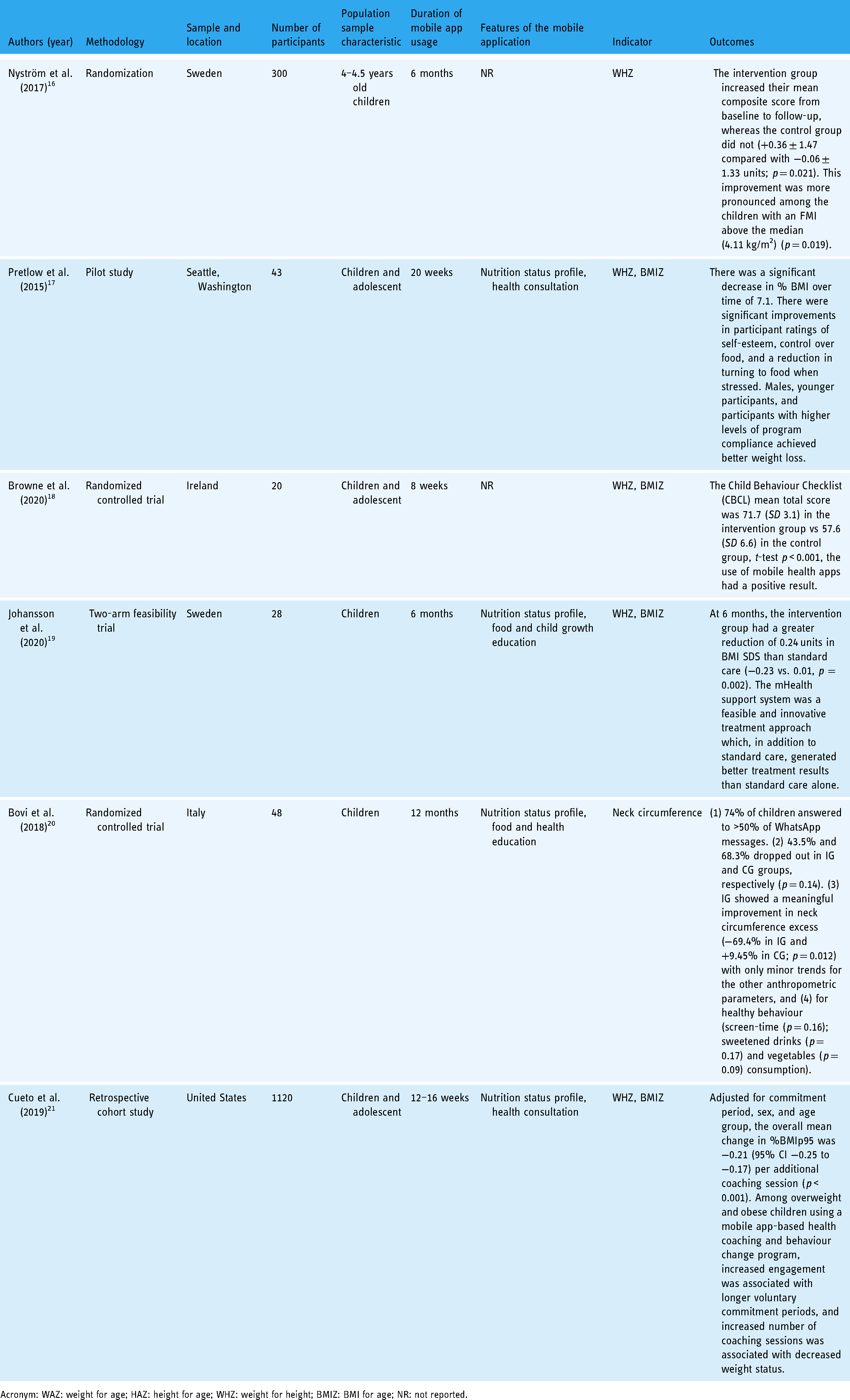
Acronym: WAZ: weight for age; HAZ: height for age; WHZ: weight for height; BMIZ: BMI for age; NR: not reported.
Footnotes
Acknowledgement
Not Applicable.
Contributorship
SRN was responsible for conceptualizing the study and approved the final revision of the protocol. TCK was collecting the literature, writing the first draft, and the final revision of the review protocol. RR was writing the discussion section. CB assisted in conceptualization.
Declaration of conflicting interests
The author(s) declared no potential conflicts of interest with respect to the research, authorship, and/or publication of this article.
Ethical approval
This is a scoping review of published literature and does not require ethical approval
Funding
The author(s) received no financial support for the research, authorship, and/or publication of this article.
Guarantor
Siti Rahayu Nadhiroh.
