




Abstract
Objective
As a new medical service mode, the value of mobile health (mHealth) services has received increasing attention and recognition. However, compared with the owners of mobile devices, the user scale of mHealth services is still small. It is well known that doctors’ recommendations have an important impact on what kind of medical service patients choose. To explore the key factors affecting doctors’ recommendation of mHealth services to patients, and to provide countermeasures for mHealth service providers and hospital managers, so as to promote doctors to recommend mHealth services to more patients.
Methods
Through literature review, expert consultation and pre-test, a questionnaire including 22 questions was designed, and 114 valid questionnaires were collected by online research. Net Promoter Score (NPS) was used to evaluate doctors’ recommendation willingness, and multivariate logistics analysis was used to evaluate the key factors affecting doctors’ recommendation willingness.
Results
The NPS of doctors was 6.06%, among which the recommenders, neutrals and critics accounted for 29.56%, 46.96% and 23.48%, respectively. The attitude towards mHealth services and whether they pay attention to and/or are willing to try new technologies are the key factors affecting the doctors’ recommendation, and the usefulness for patients most often emphasized by mHealth service providers to doctors does not affect doctors’ recommendation willingness. In addition, whether mHealth services can help doctors establish personal brands may be a potential factor to enhance doctors’ recommendation willingness.
Conclusion
In order to improve the recommendation willingness of doctors, mHealth service providers and hospital managers should focus on doctors who have a positive attitude towards mHealth services and are highly innovative (which often means younger and lower professional levels). At the same time, they should think about how to use mHealth services to help doctors establish personal brands in the future.
Introduction
The number of people with mobile phones or other portable electronic communications equipment in the world has increased exponentially over the past decade.1,2 According to Newzoo's latest report, 3 global smartphone users will reach 3.9 billion worldwide in 2021, representing modest year-on-year growth of +6.1%. The number of users in different regions is shown in Figure 1. Recent advances in mobile technology enable mobile devices to perform many previously unrealized functions. 4 In the field of health care, mobile devices have also been widely used. 5 One of the important applications of mobile devices represented by mobile phones in the medical field is mobile health (mHealth). There is no international consensus on the definition of mHealth. The Global Observatory for eHealth of the World Health Organization (WHO) defines mHealth as a medical and public health practice supported by mobile devices (such as mobile phones, patient monitoring devices, personal digital assistants, and other wireless devices). 6 Some researchers further defined it as the use of mobile and wireless communication technologies to improve disease management, drug compliance, medical decision-making, medical education, and research.7,8 In addition to the use of simple features of mobile devices, such as voice calls and short message services, mHealth also includes more complex applications designed for medical, public health, and fitness purposes. 9

2021Global smartphone users per region.
Compared with traditional offline medical services, one of the unique advantages of mHealth services is to enable patients to monitor and control their health status without time and space constraints.10,11 A WHO report also noted that mHealth services contributed to alleviating the shortage of medical resources and improving access to medical services for patients. 12 There are also studies pointing out that mHealth services can help reduce the number of patients in large general hospitals. 13 In particular, during the COVID-19 pandemic, the vast majority of countries adopted mandatory closure policies at different stages to avoid the spread of the SARS-Cov2 due to large-scale population gatherings. 14 In addition, some hospitals have also delayed selective surgery and non-emergency outpatient appointments, 15 and set some restrictions on face-to-face medical services. 16 Therefore, it is more difficult for patients to obtain offline medical services than before. With the advantages of portability, mobility, personalization and ubiquity, 17 mHealth services have played a significant role in this special period, and many hospitals have begun to provide basic medical support for the public through mHealth services. 18
Moreover, many studies have proved that mHealth services are beneficial to patients in the treatment and management of various chronic diseases including diabetes,19,20 hypertension, 21 22 and chronic obstructive pulmonary disease (COPD), 23 as well as heart failure, 24 arrhythmia, 25 coronary heart disease26and other cardiovascular diseases. At the same time, it has played an active role in reducing weight, 27 quitting smoking, 28 and developing various good lifestyles and habits. 29 Obviously, whether during the COVID-19 pandemic or not, mHealth services can bring benefits to patients.
In China, smartphone ownership among adults aged 18–34 reached 93% in 2015. However, by the end of 2020, the scale of mHealth services users in China accounted for only 67% of the total number of mobile Internet users, and there is a big gap compared with other common functional Internet applications. 30 This shows that many people are not users of mHealth services, but they are likely to benefit from mHealth services. Previous studies have found that perceived ease of use, perceived usefulness, content quality and accuracy, and consumer attitudes affect the use of mHealth services.31,32 However, as everyone knows, medical services are significantly different from other services, which makes patients particularly cautious in choosing certain medical services. In addition to the factors mentioned above, there is an important factor that affects the patient’s choice of medical services, that is, the recommendation of medical service providers (often doctors),33–35 and the same is true for mHealth services. 36 If doctors are willing to recommend more mHealth services to patients, it will not only increase the number of users of mHealth services but also make more potential patients benefit. However, as far as we know, there are limited studies on what factors affect doctors' recommendation willingness to patients for mHealth services. Jezrawi et al. 36 have found that doctors recognize the value of mHealth services to patients, and recommend mHealth services to patients mainly based on personal experience and patient recommendations. However, they hope to obtain more evidence from RCT trials or professional guidelines. These results have great value for us to understand the influencing factors of doctor recommendation willingness. However, on the one hand, these research results come from developed countries where mHealth services have been relatively mature. But for countries where mHealth services are still in the initial stage, we still lack knowledge. On the other hand, doctors in different geographical, cultural, and medical systems may have different opinions, so we need more data and more research to better understand what factors affect doctors' willingness to recommend mHealth services. Kong et al. 37 have found that more than half of doctors discuss mHealth services with patients, but only a few recommend them. However, the researchers did not investigate the reasons. Therefore, we still know little about which factors have a key impact on doctors’ recommendation willingness and how to better improve doctors' recommendation willingness by optimizing existing mHealth services. This is a problem worthy of attention and should be concerned.
In this study, we conducted an online questionnaire survey on doctors from China to explore the key factors affecting whether doctors recommend mHealth services to patients. In addition, according to the analysis results, suggestions are given to mHealth service providers and hospital managers to improve the willingness of doctors to recommend.
Methods
This is an online cross-sectional survey and was conducted from March 2021 to May 2021. The questionnaire software (Questionnaire Star) was used to survey the doctors by publishing questionnaires online, and the respondents filled out and submitted the questionnaires online.
Questionnaire design and content
Because there is no ready-made questionnaire available, we designed the questionnaire by searching the literature,38,39 consulting experts, and combining our work experience. The final version of the questionnaire containing 22 questions was formed. It includes basic information, attitude toward mHealth, personal characteristics, perceived usefulness, perceived usefulness to patients, perceived ease of use, the experience of use, suggestions for improvement, and willingness to recommend in a total of nine sections (online Supplementary material). These questions were tested informally within the study group and between clinical colleagues to evaluate their validity and reliability. According to the recommendation of Sangoseni et al., 40 we invited three medical management experts and three doctors to form an expert group that examined the readability and intelligibility of the questionnaire’s questions; they also agreed on what issues should be included in the final version of the questionnaire. The questionnaire has not been verified externally because they are exploratory, aiming to obtain a preliminary understanding of what factors may affect doctors’ recommendation willingness of mobile medical services to patients.
Data collection
According to the suggestions of statisticians, in order to ensure the credibility of the results, the number of samples collected in the questionnaire survey should be more than five times that of the questionnaire questions. The questionnaire in this study has a total of 22 questions, so at least 110 samples need to be collected. A total of 115 questionnaires were received online, one of which was excluded because the department where the respondent filled in the questionnaire was a non-clinical department. A total of 114 questionnaires were valid data and statistically analyzed. To ensure that the data is authentic, we use two methods for quality control. First, in terms of questionnaire design, there is a logical relationship between Q6 and Q7. If the respondents do not give a serious answer, the answers to these two questions will be contradictory such questionnaires will be eliminated in data statistics. In this study, all respondents answered Q6 and Q7 reasonably, and there was no random choice of answers; secondly, during the internal verification, we found that the shortest time to effectively answer the entire questionnaire was 50 seconds, and the longest was 601 seconds, and the average time was 203 seconds. Therefore, the questionnaire with an answer time of less than 50 seconds will also be eliminated in the data analysis. In this study, the shortest time for all respondents was 59 seconds.
Assessment of doctors’ willingness to recommend
This study utilized the Net Promoter Score (NPS) to assess doctors’ willingness to recommend mHealth services to their patients. The NPS was first introduced by Fred Reichheld of Bain & Company in 2003 41 and has been successfully applied across industries as a quality indicator of customer loyalty to a company. 42 The NPS survey contains only one question, "How likely would you be to recommend this service to your friends and family?". It is less time-consuming for users than email or telephone surveys, and therefore more likely to elicit responses. 43 In the original version, respondents were given a scale of 0–10, with 0 being "not at all likely" and 10 being "very likely." At the end of the survey, respondents were divided into three groups according to their scores.
Recommenders: 9–10 points, recommenders are theoretically the most likely to recommend your product, they are basically satisfied with your product and are also your loyal customers.
Neutrals: 7–8 points, neutrals are people in a swing position who like your product, but not enough to be willing to risk their reputation to recommend it.
Critics: 0–6 points, critics are people who are low-satisfied or completely dissatisfied with your product, who mostly act as non-recommenders and may even encourage others not to buy.
Calculation formula: NPS = (recommenders/all participants—critics/all participants) * 100%. NPS range is expressed from −100% to 100%. If there are more critics than recommenders, the NPS is negative; conversely, the NPS is positive. Where an NPS >0 is good, an NPS >50% is excellent, and an NPS <0 indicates that the product/service has significant flaws. By summarizing and analyzing the NPS survey results and comparing the differences between recommenders and critics, it can help service providers find the key to improving user loyalty. In this study, we modified the question to "Are you willing to recommend mHealth services to your patients?" according to the purpose of the study.
Statistical analysis
The questionnaire Star was applied for data collection, and SPSS 25.0 was used for data organization and statistical analysis. Median (quartiles) was used to describe the measurement data, and frequency and composition ratios were used to statistically describe the count data. The NPS score was used to group physician recommenders, neutrals, and critics, and the chi-square test was used to compare the differences between groups, and then the factors with p < 0.05 in the chi-square test were analyzed by multi-factor ordered logistic regression, and the back-off method was used to screen possible associated factors. p < 0.05 was used to represent the differences were statistically significant.
Results
Demographic characteristics of participating doctors
In this study, females (64.04%), 31–40 years old (50.88%), internal medicine (49.12%), PhD (46.49%), and attending doctors (50.00%) accounted for the majority (Table 1).
Basic information of doctors participating in the survey.

Doctors’ willingness to recommend
The mean score of all doctors’ willingness to recommend was 8.08 (out of 10). The recommenders, neutrals, and critics accounted for 34 (29.82%), 54 (47.37%), and 26 (22.81%), respectively. The NPS was 6.06% (Figure 2).
Factors influencing doctors’ willingness to recommend
The chi-square test showed that doctors’ professional rank and titles, establishing a personal brand, providing services for more patients, attitude toward mHealth services, personal information security, using experience, concern about new technology, willingness to try new technology, willingness to use mHealth services application (APP) to communicate with patients, willingness to use mHealth services APP for multi-point practice, suggest to add mobile ward-round function, suggest to add chronic disease management function and suggest to strengthen policy regulation. These factors were statistically different (p < 0.05) in the recommended willingness of doctors in different groups(Table 2).
Chi-square test results of doctors' recommendation willingness.
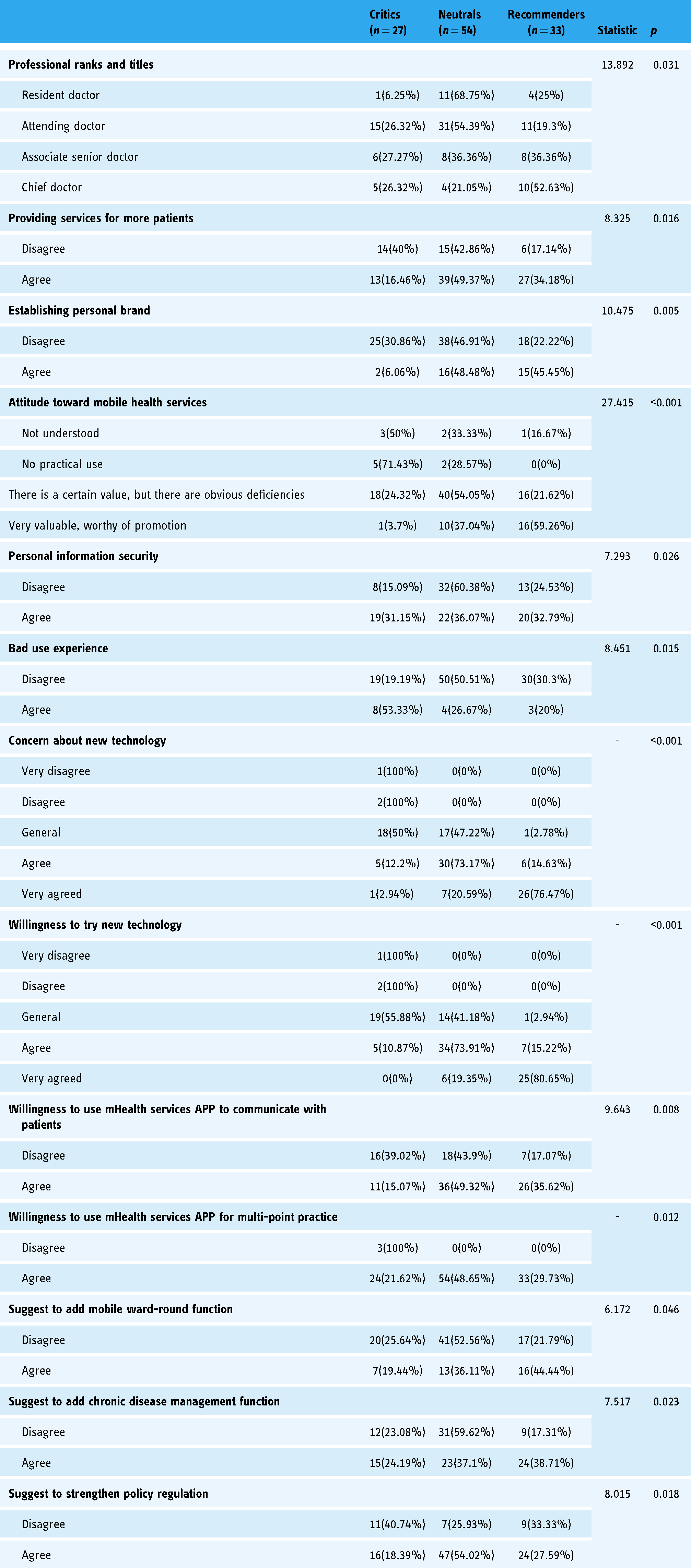
The factors with p < 0.05 in the chi-square test were analyzed by multi-factor ordered logistic regression. Multi-factor ordered logistic regression and the back-off method were used for all the factors in Table 2 and screening with the regression method revealed that the three factors of attitude toward mHealth services, concern for new technologies, and willingness to try new technologies had significant effects on doctors’ willingness to recommend (Table 3).
Multi-factor ordered logistic regression and the back-off results of doctors' recommendation willingness.

Discussion
Currently, there are few studies 36 assessing the factors influencing doctors’ willingness to recommend mHealth services. In this study, we found that doctors have a lower willingness to recommend mHealth services to patients. Doctors who hold a positive attitude towards mHealth services and are more willing to pay attention to and/or use emerging technologies have higher recommendation willingness. At the same time, we also found that in countries like China where mHealth services are still in their infancy, emphasizing the benefits of mHealth services to patients does not enhance the willingness of doctors to recommend them. On the contrary, mHealth service providers should pay more attention to the benefits of mHealth services to doctors.
We used NPS to assess doctors’ willingness to recommend mHealth services. NPS has played an important role in many industries, and in the field of health care services, some researchers have used NPS to assess the effectiveness or acceptance of a certain medical practice44–46. Exploring the role of NPS in the evaluation of patient experience47–48. As well as comparing the utility of patient satisfaction and NPS in the evaluation of health care services. 50 In the field of mHealth services, there is a study in which researchers have used NPS to assess the effectiveness and satisfaction of an app in the management of COPD patients. 51 The reason why we chose to use the NPS to assess doctors’ willingness to recommend mHealth services to their patients is, on the one hand, that it is simple and users can respond quickly, as mentioned earlier. Another important reason lies in the way it is calculated. As mentioned in the methods, NPS does not care about the average score of users’ choices, it only cares about the difference between recommenders and critics as a percentage of the total number of users who participated in the study.
The advantage of doing so is that it helps us avoid the situation where too many neutrals bring a high average score while the actual net promoter score is low. As we found in this study, all 114 doctors scored an average of 8.08 out of 10 on the question "Would you recommend mHealth to your patients?," which does not look bad and seems like a lot of doctors are willing to recommend mHealth services, but in reality, the true NPS was only 6.06%. Apparently, only a small percentage of doctors actually engage in recommending behavior, which is consistent with the findings of Jezrawi 36 et al. and Kong et al. 37 Therefore, perhaps we can find the difference between those doctors who are more willing to recommend mHealth services and those who are not, it is possible to find effective countermeasures to push doctors to recommend mHealth services to patients more often.
To explore the key factors that may have an impact on doctors’ willingness to make recommendations, we asked participating doctors 22 additional questions. The results show that three key factors influence doctors’ recommendations: doctors’ attitudes toward mHealth services, whether doctors usually pay attention to the development trend of new technologies, and whether doctors are willing to try out various new technologies.
Specifically, doctors possess a stronger willingness to recommend if they have a more positive attitude toward mHealth services. Attitude, as a positive or negative emotion held by an individual toward engaging in a specific behavior, 52 can have a positive or negative effect on behavioral intentions. Doctors’ attitudes toward mHealth services can be defined as an assessment of an individual's psychological readiness to use mHealth services. 53 We suggest that mHealth service providers can focus on screening doctors who have positive attitudes toward mHealth, that is, those who are well prepared mentally to use mHealth services, as targets for promotion, to motivate them to make more recommendations to patients.
In addition, if a doctor is usually very concerned or/and willing to try various new technologies, then there will also be a stronger willingness to recommend them. This has been confirmed by previous studies that individuals who are more willing to try new technologies have a stronger intrinsic motivation to accept them and even enjoy trying them54,55 and are also more likely to recommend that particular technology to others.56,57 In this study, those individuals with higher levels of innovation were overwhelmingly doctors under the age of 40 with intermediate or lower professional ranks. Therefore, both mHealth service providers and hospital managers who want to push doctors to recommend mHealth services more often to patients should first select doctors who are younger and also have a lower professional rank.
It is also worth noting that in China, when mHealth service providers promote their services to doctors and invite them to recommend their services more often to patients, the most commonly used reason/evidence is the benefit of mHealth services to patients. However, our findings suggest that this approach is not very effective, and doctors do not care whether patients can benefit from mHealth services when deciding whether to recommend it. This differs from the results of previous studies, in which Jezrawi 36 et al. found that most doctors believed that mHealth services were at least somewhat helpful in patient care, despite the barriers to the recommendation. We suggest that a possible explanation for this discrepancy is that mHealth services are used to improve the delivery process of healthcare services by providing support and services to healthcare providers (e.g., education, diagnostic support, or patient management) or by optimizing the way healthcare services interact with patients (e.g., appointment reminders and test result notifications). 58 That is, there are three interested parties in mHealth services, the mHealth service provider, the doctors, and the patient. Among them, doctors are both users and service providers of mHealth services. Therefore, doctors are more likely to make recommendations to patients only if they first recognize that mHealth services are valuable to them. Past studies have also confirmed that perceived usefulness is one of the most important factors influencing doctors’ acceptance of mHealth services. 59 Compared to other countries, mHealth services in developed countries in Europe and the United States started earlier and are more mature in terms of service content, stability, and value available, as may be well demonstrated by a set of comparative data. For example, as of 2012, nearly 70% of Canadian Internet users searched for medical or health-related information online, 60 a figure that had reached 55% in the United States in 2000,61,62 and 21.7% in China in 2020. 30 Thus, compared to other countries, a certain percentage of doctors in Europe and the United States have developed a recognition of the value that mHealth services can provide for themselves, so whether mHealth services will benefit patients becomes a key factor influencing doctors’ recommendations. This suggests to mHealth service providers and hospital managers that in countries like China, where mHealth is still in its infancy, it is far more valuable to emphasize the usefulness of mHealth services to doctors than to patients when encouraging doctors to recommend mHealth services to patients.

NPS distribution of participating doctors.
The perceived usefulness of mHealth services by doctors can be defined as referring to doctors’ perceptions that using a specific mobile device is superior to their current practice in an organizational setting. 63 Specifically, the results of this study showed that those doctors who perceived more the benefits of mHealth services in terms of perceived usefulness for personal branding showed a stronger willingness to recommend them. Previous studies have also shown that doctors with higher visibility in online healthcare services are chosen by more patients.64,65 Therefore, this suggests to mHealth service providers that helping doctors to enhance their personal brands through mHealth services could be a potential factor in promoting doctors’ willingness to recommend. Therefore, we suggest that mHealth service providers and hospital managers, taking into account the actual situation in their countries and the needs of doctors and patients, take appropriate optimization initiatives to help doctors enhance their personal brands. For example, in China, answering patients’ questions about diseases and popularizing medical knowledge in the form of writing blogs or online live streaming can effectively enhance patients’ recognition and trust in individual doctors, which in turn can contribute to the establishment of their personal brands.66,67 Therefore, various mHealth service providers can consider cooperating with hospitals or individual doctors to develop exclusively dedicated science channels, Q&A communities, and live events on mHealth service APPs, as well as live events through public platforms with wide audiences such as Tiktok and WeChat to enhance the exposure of doctors among patient groups and continuously strengthen their personal brands.
Through the survey, we obtained a variety of perspectives and more abundant data on the influencing factors of doctors' willingness to recommend mHealth services. In particular, as far as we know, this is the first study on this topic from regions where mHealth services are still in their infancy. We believe that the result that we found is the benefits of mHealth services to patients will not affect the doctor’s recommendation willingness and more emphasis should be placed on the benefits of mHealth services to doctors, which is particularly noteworthy.
There are some shortcomings in our study. First, this was a study from China and the sample size was 114 cases, which may limit the generalization of the findings to a larger scale. Therefore, we hope to collaborate with researchers from different countries in the future to conduct studies with broader coverage and larger sample sizes. Second, an inherent drawback of questionnaire research is the lack of interaction, which may lead to researchers not obtaining more important information. However, it has the advantage of being simple to administer, low cost, and giving important hints. Moreover, considering the impact of the current COVID-19 pandemic, conducting large-scale face-to-face interviews is almost impossible. Therefore, in future studies, we hope to conduct one-on-one interviews or focus group interviews with doctors based on the results obtained from this questionnaire study to dig deeper for more information. Finally, this study only included doctors, and whether patients are willing to recommend mHealth services to others is also a question worthy of in-depth study, and this area is still in a blank stage.
Conclusion
The outbreak of COVID-19 has led to the recognition of the value of mHealth services in improving access to healthcare services, and it has been well documented in the treatment, management, and improvement of lifestyle for various diseases. However, the user base of mHealth services is still small compared to the population with mobile devices. Given the unique nature of healthcare services, it may be possible to increase the number of users and potentially benefit more patients if doctors were more likely to recommend mHealth services to their patients. Our study shows that doctors who have positive attitudes toward mHealth services, as well as those who are younger and at a lower professional rank (who tend to be more attentive and or more willing to experiment with new things and technologies) have a higher willingness to recommend and should be a key focus group for mHealth service providers and hospital managers. In addition, it is important to note that in countries where mHealth services are still in their infancy, emphasizing to doctors the benefits of mHealth services for patients may not help increase doctors’ willingness to recommend them. Instead, the focus should be on educating doctors about the benefits of mHealth services for doctors themselves. In particular, giving doctors a sense of the value of mHealth services in enhancing their personal brands may be a potential factor in boosting their willingness to recommend them. mHealth service providers can make how to better help doctors build their personal brands as one of the key elements of their future focus.
Supplemental Material
sj-docx-1-dhj-10.1177_20552076221125976 - Supplemental material for Factors affecting doctor’s recommendation for mobile health services
Supplemental material, sj-docx-1-dhj-10.1177_20552076221125976 for Factors affecting doctor’s recommendation for mobile health services by Xiaojing Hu, Hongjun Fang and Ping Wang in Digital Health
Footnotes
Contributorship
HX and WP researched literature and conceived the study. HX and FH were involved in protocol development, gaining ethical approval, and data analysis. HX wrote the first draft of the manuscript. All authors reviewed and edited the manuscript and approved the final version of the manuscript.
Declaration of Conflicting Interests
The authors declared no potential conflicts of interest with respect to the research, authorship, and/or publication of this article.
Funding
The authors received no financial support for the research, authorship, and/or publication of this article.
Ethical approval
The ethics committee of Peking University’s first hospital confirmed that this study is not a clinical trial, so it is exempted from ethical approval.
Guarantor
WP.

Supplemental material
Supplemental material for this article is available online.
References
Supplementary Material
Please find the following supplemental material available below.
For Open Access articles published under a Creative Commons License, all supplemental material carries the same license as the article it is associated with.
For non-Open Access articles published, all supplemental material carries a non-exclusive license, and permission requests for re-use of supplemental material or any part of supplemental material shall be sent directly to the copyright owner as specified in the copyright notice associated with the article.
