



Abstract
Keywords
Introduction
Specialization within orthopedics has become commonplace, as nearly 90% of orthopedic residents pursue a fellowship post-graduation.1–3 In 2008, the Association of American Medical Colleges (AAMC) recommended an increase in medical school enrollment by 30% in order to meet the growing physician demand. 4 In response to the recommendation made by the AAMC, Salsberg et al. 1 published an assessment of the state of the orthopedic job market. The assessment found that there is an increased demand for orthopedic surgeons due to the growing population. The disparity of orthopedic surgeons is exacerbated due to the increasing demand by patients and referring providers for a specialized surgeon in cases where a specialized surgeon may not necessarily be needed. Additionally, this is compounded by a portion of fellowship-trained surgeons refusing to take care of patients outside of their area of specialization. 1
Furthermore, Morrell et al. 5 evaluated advertisements in the Journal of Bone and Joint Surgery (JBJS) during four different years from 1984 to 2009 (1984, 1994, 2004, 2009) to determine trends in the orthopedic job market. The authors found that there was an increase in advertisements seeking fellowship trained orthopedic surgeons in comparison to proceeding years. Additionally, the advertisements seeking general orthopedic surgeons decreased during the interval.
Several reasons have been proposed to explain the rising number of residents pursuing fellowship training, including to gain additional training in an area of interest, obtain a more competitive position, increase confidence in surgical skills, and to supplement what was perceived as inadequate training in certain fields during residency.5–9 Hariri et al. 10 utilized a self-administered web-based descriptive questionnaire to survey PGY 3 - 5 in collaboration with the AAOS survey research office. In total, 498 PGY 3–5 residents responded, 453 (91%) of whom planned to pursue fellowship after residency. 40 (8%) of the residents planned to complete more than one fellowship and 383 (77%) indicated that they felt competent as general orthopedic practitioners without any additional training. The authors also found that the factors most important to the applicant in choosing which fellowship to pursue were largely intellectual factors, including diversity of procedure, technically challenging procedures, and challenging diagnostic problems. 10
In 2014, Daniels et al. 11 utilized orthopedic subspecialty webpages to identify each subspecialty's match program, number of institutions participating in the match, number of positions available, number of accredited programs, and positions available outside of the match. The study was conducted in order to identify the characteristics of the subspecialty match and tendency to be ACGME accredited. The authors found that 93.1% (95/102) of sports medicine fellowships are accredited by the ACGME, which is the highest proportion of accredited programs among all orthopedic sub-specialties. Among sports medicine fellowship positions available, 97.3% (218/224) were at ACGME programs, the highest proportion of all subspecialties. 11
Data from the San Francisco Match has helped provide insight into the fluctuating trends in fellowship match rates; however, there has yet to be a study that analyzes its relationship to the job market.5, 12 Chan et al. 13 found that sports medicine had the highest ratio of fellow graduates to advertisements of orthopedic subspecialities. Because of this finding, the authors concentrate the analysis of this study on sports medicine fellowship trends and their relationship to job advertisements. The purpose of this study was to determine if trends in the number of residents applying for orthopedic sports medicine fellowship match between 2010 and 2017 correlated with the trends in the number of job advertisements in three major orthopedic journals: the JBJS, the Journal of the American Academy of Orthopaedic Surgeons (JAAOS) and the American Journal of Sports Medicine (AJSM). Using the advertisements in these journals as a surrogate for sports medicine positions available in the orthopedic job market, we hypothesized that the variation in residents applying for sports medicine fellowships would correlate with a variation in the number of jobs available.
Methods
Sports medicine job advertisements published in the print versions of JBJS, JAAOS, and AJSM between 2010 and 2017 were reviewed by one of the co-authors (Figure 3). AJSM data was unavailable prior to 2012. Any questions or discrepancies were discussed with the senior author. All advertisements seeking sports medicine surgeons and other designated subspecialties were included, while those requesting applicants for chairmen, program director, or research directors were excluded. The type of practice listed in each advertisement (hospital-employed, private practice, academic, or unknown) was recorded. The advertisement was then further categorized as a position that was available for either a fellowship-trained or a general (i.e. non-fellowship trained) orthopedic surgeon.
Advertisements were categorized as generalist if a general orthopedic surgeon was specifically requested, or it was stated that fellowship training was “not required” or “desired/preferred”. Conversely, advertisements were categorized as subspecialty if it was explicitly mentioned that a specific subspecialty was required in order for one to be hired. If an advertisement posted positions for multiple subspecialties, each was recorded separately. Positions advertised in different journals or multiple times in the same journal were counted only once. Our study does not include online advertisements in JBJS, JAAOS, and AJSM as there were very few job postings within the electronic versions. The total number of advertisements per subspecialty or general orthopedics each year was calculated. Descriptive statistics were used to analyze the data.
The orthopedics sports medicine fellowship match is completed using the San Francisco Match Program. Participating programs, applicants and matched applicant data was gathered from the San Francisco Match website.
The data gathered for the production of this manuscript was done from publicly accessible date and did not require Institutional Review Board (IRB) approval.
Results
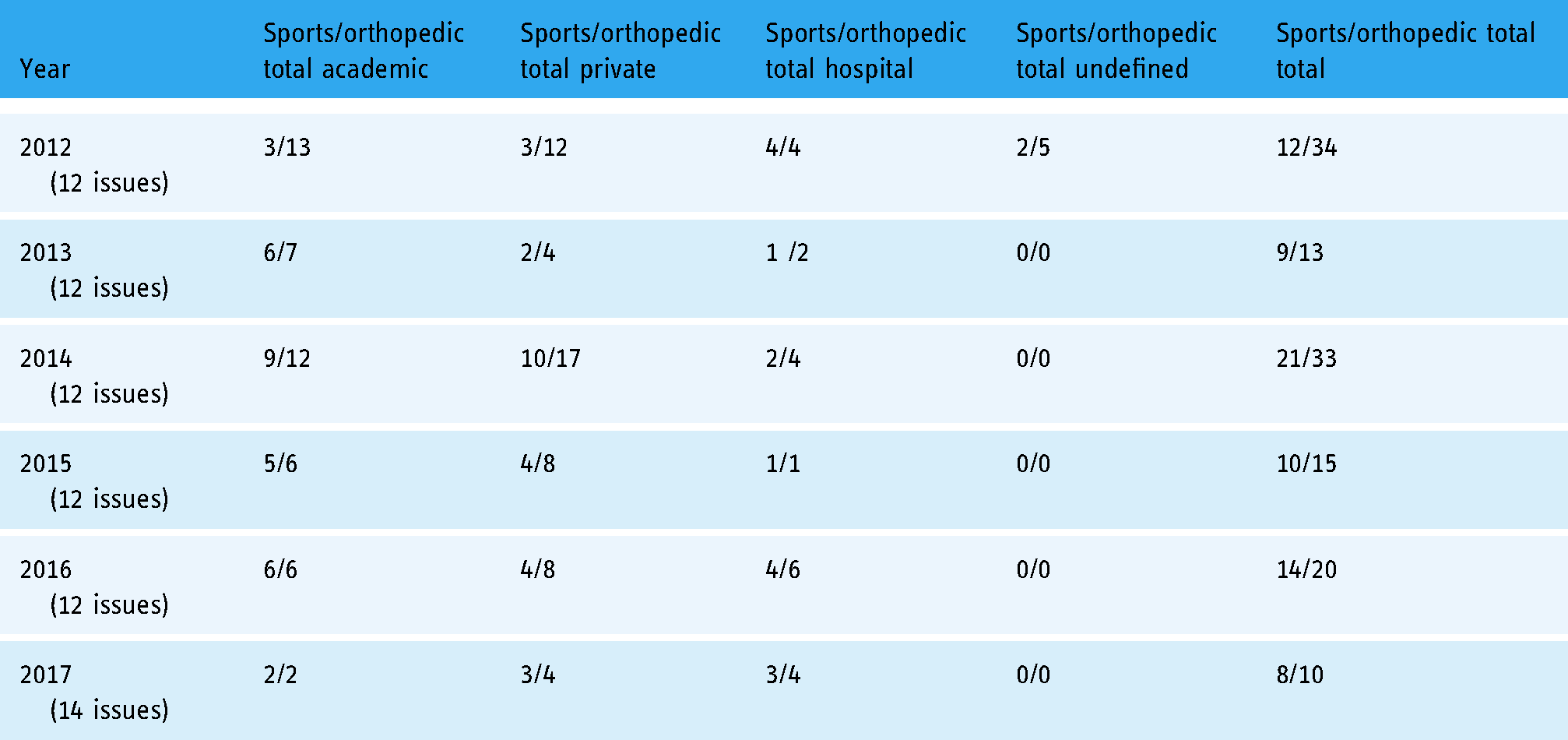
The total number of yearly sports medicine advertisements has varied from 37 to 66 between 2010 and 2017. Between 2010 and 2017, there were a total of 186 sports advertisements in JBJS, 143 in JAAOS and 74 in AJSM. However, there was a noticeable difference in the total number of advertisements year to year in AJSM from 34 in 2012 to 13 in 2013and from 33 in 2014 to 15 in 2015. While the absolute number of sports medicine job opportunities remained roughly the same for both of these years (12 in 2012 and 10 in 2015), the advertisements in AJSM have become highly concentrated with specifically sports medicine opportunities. In 2012, 35% (12/35) of the advertisements in AJSM were for sports positions, while 69% (9/13), 63% (21/33), 66% (10/15), 70% (14/20), and 57% (8/14) of advertisements within AJSM were for sports positions in the following 5 years, respectively (Table 1).
AJSM job advertisements between 2012 and 2017
A total of 1806 job advertisements were posted in JBJS between 2010 and 2017 (mean 301.0; range 170–454), 186(10.3%) of which were specifically seeking sports medicine surgeons. JBJS listed a total of 35, 36, 27, 17, 24, and 47 sports job advertisements between 2010 and 2017 (Table 2). Sports medicine advertisements in JBJS accounted for 9.6% (35/265) of postings in 2010, 10.5% (36/342) in 2013, 10.5% (36/342) in 2014, 7.8% (27/257) in 2015, 14.1% (24/170) in 2016, and 10.4% (47/454) in 2017 (Table 2).
Journal of Bone and Joint Surgery orthopedic and sports job advertisements between 2010 and 2017

In JAAOS, the average number of job advertisements between 2010 and 2017 was 161 (range 71–344) with the total number of advertisements varying over the 8-year period. There were a total of 143 sports medicine advertisements from 2010 to 2017, with a mean of 17.4 (range 7–32) advertisements per year. Sports medicine advertisements accounted for 20.7% (30/145) of all job postings in 2010, 20.2% (25/124) in 2011, 25.8% (32/124) in 2012, 9.5% (9/95) in 2013, 9.9% (7/71) in 2014, 12.8% (10/78) in 2015, 5.5% (19/344) in 2016 and 3.5% (11/314) in 2017. Overall, 8.7% (113/1295) of job advertisements in JAAOS between 2010 and 2017 were for sports medicine positions (Table 3).
Journal of the American Academy of Orthopaedic Surgeons orthopedic and sports job advertisements between 2010 and 2017

Orthopedic sports fellowship match statistics and sports/total orthopedic advertisements between 2010 and 2017
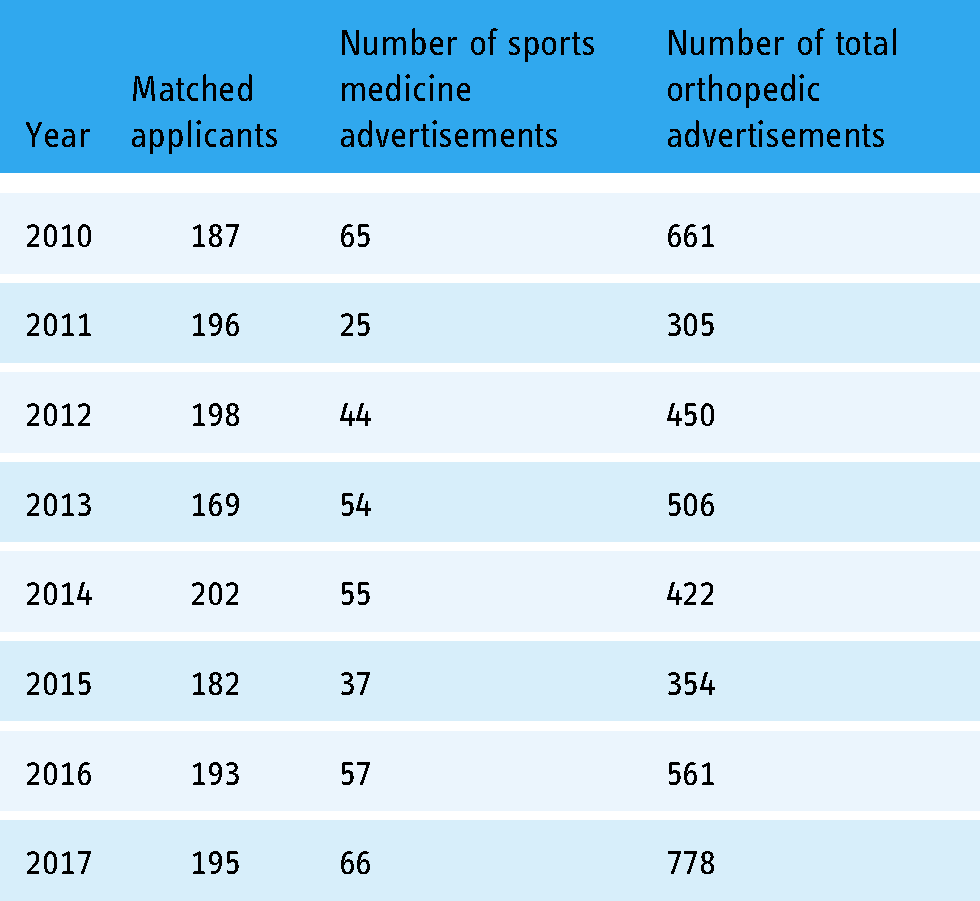
Between 2010 and 2017, the total number of yearly sports medicine advertisements has remained within the range of 37–66 per year. Although, the proportion of sports advertisements among the overall total dropping from 9.5% (65/661) in 2010 to 1.4% (66/4735) in 2017. This data was then compared to orthopedic sports medicine fellowship match data over the same time period. The number of total sports medicine applicants varied from 2010 to 2017, with a mean of 203.7 (range 178–225) applicants per year (Figure 1). The above trends indicate a relative decline in the total number of advertisements seeking sports medicine surgeons over the past several years. In addition, there is a variation in the ratio of the number of positions advertised for in comparison to the number of applicants for sports medicine fellowship positions, with the lowest ratio occurring in 2011, 9.8%, and the greatest occurring in 2017, 26.6% (Figure 1). Of note, the proportion of advertisements requiring fellowship training did increase from 76.1% in 2010 to 98.0% in 2017 (Figure 2).

Orthopedic sports fellowship match statistics and total sports medicine advertisement data between 2010 and 2017.

Proportion of total advertisements requiring fellowship training.

Advertisement flowchart.
Discussion
To the best of authors knowledge, this is the first study to investigate the association of sports medicine positions posted in orthopedic journals with the number of residents applying for sports medicine fellowships. Based on SF match data, there appears to be a small year-to-year variation in the number of applicants pursuing sports medicine fellowships, although this is not a perfectly linear relationship, nor does it show an increasing or decreasing trend. The findings of this study indicate that there is not a direct correlation between orthopedic sports job advertisements and sports medicine fellowship positions offered.
Mannava et al. 14 conducted a similar study analyzing the orthopedic job advertisements found within JBJS and Orthopaedics including the years: 1984, 1989, 1994, 2004, 2009 and 2014. The authors categorized the job advertisement as requiring a fellowship training or not. The study concluded that over the period studied the proportion of job advertisements requiring fellowship training increased from 5% in 1984 to 68% in 2014. Our study found that from 2010 to 2017 the proportion of jobs requiring fellowship training also indicated an increasing trend; from 76.1% in 2010 to 98.0% in 2017 (Figure 2). This may indicate increased demand for sub-specialty trained orthopedic surgeons.
There was a slight variation in the number of sports medicine advertisements in all three journals; however, the trends in JBJS and JAAOS were likely of larger relevance due to the higher volume of advertisements included, and the fact that AJSM was more likely to post-predominantly sports medicine positions given the makeup of its readership. Despite this finding, one must take into consideration the overall trends in the job market, as indicated by the total number of advertisements listed. Analysis of job postings for each orthopedic subspecialty revealed a general decline in the total number of listings in each journal from 2013 to 2015, but an increase in 2016 and 2017 (Table 4). This trend is similar to that seen in advertisements for sports medicine positions. However, the proportion of advertisements for each of the subspecialties in a given year compared to the total number of job postings for that year remained relatively consistent from 2010–2017. Although, sports medicine saw a decline in the proportion of sports advertisements in comparison to total advertisements which decreased from 9.8% (65/661) in 2010 to 1.4% (66/4735) in 2017. The decline in the proportion of advertisements seeking sports medicine fellowship-trained surgeons in relation to the number of sports fellowship applicants signifies either a saturation of the job market or a transition away from print advertisement as a major method of recruitment. There has been a fluctuation in the total number of advertisements and proportion of advertisements attributed to specific subspecialties from 2010 to 2017. It is reasonable to assume that the proportion of advertisements may be an indicator of the demand in the job market.
In 2012, Morrell et al. 5 analyzed JBJS publications for four years (1984, 1994, 2004, and 2009) between 1984 and 2009 for advertisements, including requirement for fellowship training. The study indicated that the proportion of advertisements requiring fellowship training was significantly more in each year's volumes in comparison to the proceeding year's. 5 In the current study, we noted a decrease in total job advertisements from 2010 to 2015 and the proportion of jobs requiring fellowship training had small variation, but was not significantly different year to year. We postulate that this is a result of the fellowship applicants meeting the demand of society, a saturation of the job market, or a sign that print advertisement is no longer an accurate descriptor of the job market. Additionally, the increase in total number of job advertisements beginning in 2016 may indicate a new trend in the job market.
In 2012, Morrell et al. 5 also indicated varying reasons for why residents pursue specific fellowship training including technical qualities, quality of life, potential job opportunities, mentorship, and income. Additionally, others have advocated for a change in resident teaching structure to provide earlier focus on sub-specialty training. 15 The fluctuations in the number of applicants for sports medicine fellowships is, therefore, likely multifactorial. While other methods to explore the job market exist, it is unclear if similar findings would be apparent upon investigation. In addition to exploring other associated factors, support for the sports fellowship applicant trend could be further substantiated through investigation of online advertisement sources.
In 2018, Mulcahey et al. 16 evaluated sports medicine fellowship match results from 2010–2017 to identify the overall match rate, number of programs filled, and number of applicants that were ranked by filled programs during this time period. The study utilized the American Orthopaedic Society for Sports Medicine match data including the number of applicants, number of matched/unmatched positions, and number of applicants matching into one of their top two positions. The authors found that the number of residents applying to sports medicine fellowships remained fairly consistent from 2010 to 2017. The study also indicated that 2013 was the only year in which there were more positions than applicants (Figure 1). 16 Our study demonstrated that in 2013, in comparison to 2012, there was a decline from 32 to 9 sports medicine advertisements in JAAOS and from 12 to 9 in AJSM.
Additionally, Roberts and Cannada write that orthopedic jobs may be found by traditional methods such as job advertisements, headhunters, search firms, job posting boards at meetings, colleagues and implant representatives. 17 The authors indicate that if a job is being formally advertised for it may be already filled or you may be “behind the curve.” Also, Laratta et al. found in a survey to AAOS member found that of the 51% who left their first job before completion of the fifth year, 31% cited the job was not as advertised. 18 These sentiment may indicate that the decreasing trend in total job advertisements from 2010 to 2015 may indicate an increasing trend in orthopedic job searches more heavily rely on alternative methods in comparison to traditional print advertisements.
There are several limitations to this study. First, is the assumption that advertisements in orthopedic journals are representative of the orthopedic job market. Since not all positions are posted in orthopedic journals, it is possible that numerous other opportunities were available, but these could not be quantified because there is not one central resource to access this information. Second, many other orthopedic journals include job advertisements, which were not evaluated in this study. Additionally, not all issues of JBJS, JAAOS and AJSM, between 2010 and 2017 could be obtained due to availability; however, the majority of issues were obtained and used for collection. Unfortunately, not all issues were readily available to the authors and/or could not be obtained. Additionally, the data comes from one region, and may not extrapolate to other regions. Collectively, inclusion of postings from these additional journals may provide a more accurate representation of the orthopedic job market. Third, many jobs are not posted in journals, rather they are spread by word of mouth or via recruitment firms. Fourth, many societies and journals including JBJS, AAOS, and the Orthopaedic Trauma Association (OTA) have job centers and listings on their respective websites. The decrease in job postings in orthopedic journals is likely a reflection of the shift towards posting positions using on-line recruiting services or orthopedic association's job centers. Based on these factors, the decline in advertisements for sports medicine surgeons across JBJS, JAAOS and AJSM may not represent the actual trend in the current orthopedic job market.
Analysis prior to the coronavirus disease 2019 pandemic was completed, as it is still unknown how orthopedics as a specialty and its relationship to job availability will change, although this would be an interesting topic to explore. Although the authors do find this to be critical information, as the job market and the trends found in this paper do signal towards the future of advertisement within the field.
Conclusion
This study demonstrated that the number of sports medicine positions advertised in orthopedic journals and sports medicine fellowship applicants and positions offered between 2010 and 2017 has seen little variation. Additionally, there has been an increase in job advertisements requiring fellowship training, which may indicate an increased demand for sub-specialty trained orthopedic surgeons. Lastly, the drop in total orthopedic advertisements in the years proceeding 2015 may serve as a harbinger for the transition to largely online content, and job postings in journals may not be the most reliable source of job opportunities, but further investigation should be done in relation to this topic.
Footnotes
Declaration of conflicting interests
The authors declared the following potential conflicts of interest with respect to the research, authorship, and/or publication of this article: Mary Mulcahey: AAOS, Board or committee member; American Orthopaedic Society for Sports medicine, Board or committee member; Arthrex, in: Paid presenter or speaker; Arthroscopy Association of North America, Board or committee member, Ruth Jackson: Orthopaedic Society, Board or committee member. Marcus Hoof, Symone Brown, and Cadence Miskimin declare no potential conflicts of interests.
Funding
The authors received no financial support for the research, authorship, and/or publication of this article.
Ethical approval
This research did not require ethics committee or IRB approval. This research did not involve human or animal subjects.
Guarantor
MAH
Authorship
All authors meet the criteria for legitimate claim to authorship.
