



Abstract
Objective
The COVID-19 pandemic has highlighted various barriers to health and the necessity of having access to digital health services. The technology industry can support addressing health barriers, promoting health equity and partnering with organizations to ensure access to digital health services for underserviced communities. The main objective of this study was to 1) identify what initiatives have been developed within the technology industry to address digital health equity; and to 2) determine whether these initiatives have been effective.
Methods
A rapid review and a grey literature scan were conducted. The academic searches were performed using four databases, including Ovid MEDLINE, Scopus, CINAHL and PsychInfo. Two reviewers screened the articles for inclusion criteria. The grey literature scan was performed through Google and Million Short. Searches of technology industry initiatives were completed through scanning technology companies listed on the New York Stock Exchange, the Toronto Stock Exchange and iShares Expanded Tech Sector – Exchange Traded Fund.
Results
Within the technology industry, 39 companies had relevant initiatives. These were identified as having one or more of the following: 1) having health-related collaborations with other companies, 2) promoting access to technology infrastructure and 3) delivering programs that supported notable inequities within the social determinants of health. Limited data are available on the effectiveness of these initiatives in reducing health inequities.
Conclusions
As technology in the delivery of health services continues to evolve, health equity initiatives must be supported through innovative strategies. Partnering with the technology industry may be one way of addressing these health equity challenges.
Keywords
Introduction
Background
The COVID-19 pandemic has highlighted a proliferation of digital health services to support health care access within the context of public health restrictions. 1 In the United States during the first two weeks of the pandemic, virtual care visits increased by 154% compared to before the pandemic. 2 Similar findings were discovered throughout the spring of 2020 in Ontario, Canada, with 70.6% of all primary care visits being virtual. 3 Although increases in virtual care use present an innovative solution to health service delivery, it is crucial to consider the risk of virtual care's influence on existing digital health inequities, also known as the digital divide. In this Canadian context, health equity is defined as removing barriers to care services to help individuals reach optimal health. 4
The digital divide is a phenomenon that encompasses a lack of access to digital resources for specific communities and groups that may be vulnerable due to factors such as location, age, health literacy and socioeconomic status.5,6 This concept has been widely studied to assess its prevalence in various communities and populations. Specifically, notable technological disparities have been associated with older adulthood, racialized communities, people who live in rural areas and people who have a lower socio-economic status.7–9 The COVID-19 pandemic has been described as widening the divide, as more groups become dependent on various technologies for health care access. 10 Due to the need for social distancing, this issue is worsened by decreased contact with individuals who can provide technological support, such as caregivers.11–13 The World Health Organization has conceptualized a global strategy to enhance digital health services within the next decade. 14 Therefore, knowing that a digital divide exists, solutions-based research is imperative to address these factors using innovative solutions.
The technology industry and the individual companies that comprise it are in a unique position to address issues that widen the digital divide through promoting access to health services, technology infrastructure and focusing on systems that impact the social determinants of health (SDH). In partnership with health systems, the expertise and strength of technology companies can be leveraged to deliver and scale integrated health solutions. This approach can foster the implementation of new tools and models of care that promote health equity. However, this is an emerging space, so understanding relevant gaps provides a framework for further research on the influence of technology initiatives on promoting health equity. This novel research provides a foundation for understanding how technology companies have addressed inequities and what future work can be done in the post-pandemic era to continue to address the digital divide.
Research questions
The research questions were as follows:
What initiatives have been developed within the technology industry to improve digital health access and promote health equity?
Objectives:
Identify what populations are targeted for health equity interventions by the technology industry. Determine whether there are specific time parameters for equity-related initiatives (e.g. internet is offered for 1 year). Identify whether the equity initiatives were formally evaluated and analyze these outcomes. Have there been any previous partnerships between health care organizations and the technology industry to enhance access to technology infrastructure, promote access to health care or address the SDH?
Objectives:
Identify the structures of these partnerships. Evaluate whether these collaborations focused on enhancing equity.
Methods
A rapid review of academic literature as per the Cochrane Rapid Reviews Methods Group was conducted, as well as a grey literature scan. 15
Search strategy
The defined levels of health equity used to guide these searches included:
Infrastructure initiatives that improve access to health services and resources, such as technological devices. Health-specific initiatives that have a direct link to technology. Innovative technology interventions that address the SDH.
6
The academic search commenced through consultation with a librarian to develop appropriate search terms and to find relevant databases. The searched databases included Ovid MEDLINE, Scopus, CINAHL and PsycINFO using applicable syntaxes for the corresponding databases.
For the grey literature scan, search engines including Google and Million Short were utilized using predefined search terms. The next step involved a manual search of the New York Stock Exchange (NYSE), the Toronto Stock Exchange (TSX) and the iShares Expanded Tech Sector – Exchange Traded Fund (ETF) to identify technology and communications companies within North America that could potentially be involved in health equity initiatives.16,17 This innovative search approach was implemented because many companies who engage in health equity initiatives do not publish their findings. Therefore, all pertinent data may not be yielded using traditional academic search methods. A scan of 368 companies was performed by examining their websites, and the search engine results to identify potential health equity initiatives. These companies were grouped and ranked based on the number of health equity initiatives they were involved in and the community reach of the outlined initiatives.
Inclusion criteria
The following inclusion criteria were outlined for articles within the academic literature review:
A focus on one or more areas of health equity, including:
Technology-specific interventions that focus on infrastructure Direct access to care initiatives Initiatives that promote positive outcomes within the SDH Results connected health equity interventions with positive health outcomes Results outlined formal evaluations of health equity initiatives Published between 2011–2021 (10-year range) All research designs and methodologies A focus on one or more areas of health equity, including:
Technology-specific interventions that focus on infrastructure Direct access to care initiatives Initiatives that promote positive outcomes within the SDH Companies were listed within the NYSE, the TSX or the iShares expanded technology sector ETF within technology and/or communications groups
The following inclusion criteria were outlined for technology companies within the grey literature scan:
Screening
Articles yielded from the predefined search terms were included in the review and screened using Covidence software. The following steps were implemented to perform the academic review:
A calibration exercise was performed by two reviewers for the title and abstract screening. Thirty citations were scanned for this exercise and an agreement of >80% was yielded from this process. Both reviewers screened 25% of the remaining citations (approximately 230 abstracts) to ensure an acceptable level of agreement. One reviewer screened the remaining citations for inclusion in the full-text screening process. The second reviewer screened all excluded citations, and 100% agreement was yielded. A second calibration exercise was performed by two reviewers for the full-text articles. Five articles were screened to assess for the inclusion criteria. An agreement of >80% was yielded from this process. The remaining full-text articles were screened by one reviewer, and data extraction was performed for the included articles.
Results
Academic literature findings: overview
A Preferred Reporting Items for Systematic Reviews and Meta-Analyses diagram can be viewed in Appendix A that summarizes the results of the rapid review. Based on the outlined inclusion criteria, only three (n = 3) articles were appropriately identified. The main reason noted for this finding is that despite the plethora of digital health equity interventions that exist, almost none of the literature included an evaluation component for the effectiveness of the interventions.
Grey literature scan findings: overview
From the 368 companies that were reviewed through the NYSE, the TSX and the ETF, 39 met the inclusion criteria outlined based on the three levels of health equity. Fifteen of the included companies were outlined as being highly involved in promoting health equity, as they either had more than one health equity initiative or their initiative(s) targeted more than one population.
Technology industry initiatives to improve digital health access
Targeted populations
The populations that were targeted for various health equity initiatives depended on the broad types of initiatives that were undertaken within the technology industry. Leaders in the technology industry engaged in specific initiatives that aimed at reducing the digital divide for various populations. Both the initiatives and the target populations are outlined in Table 1.
Technology industry initiatives to improve digital health access.
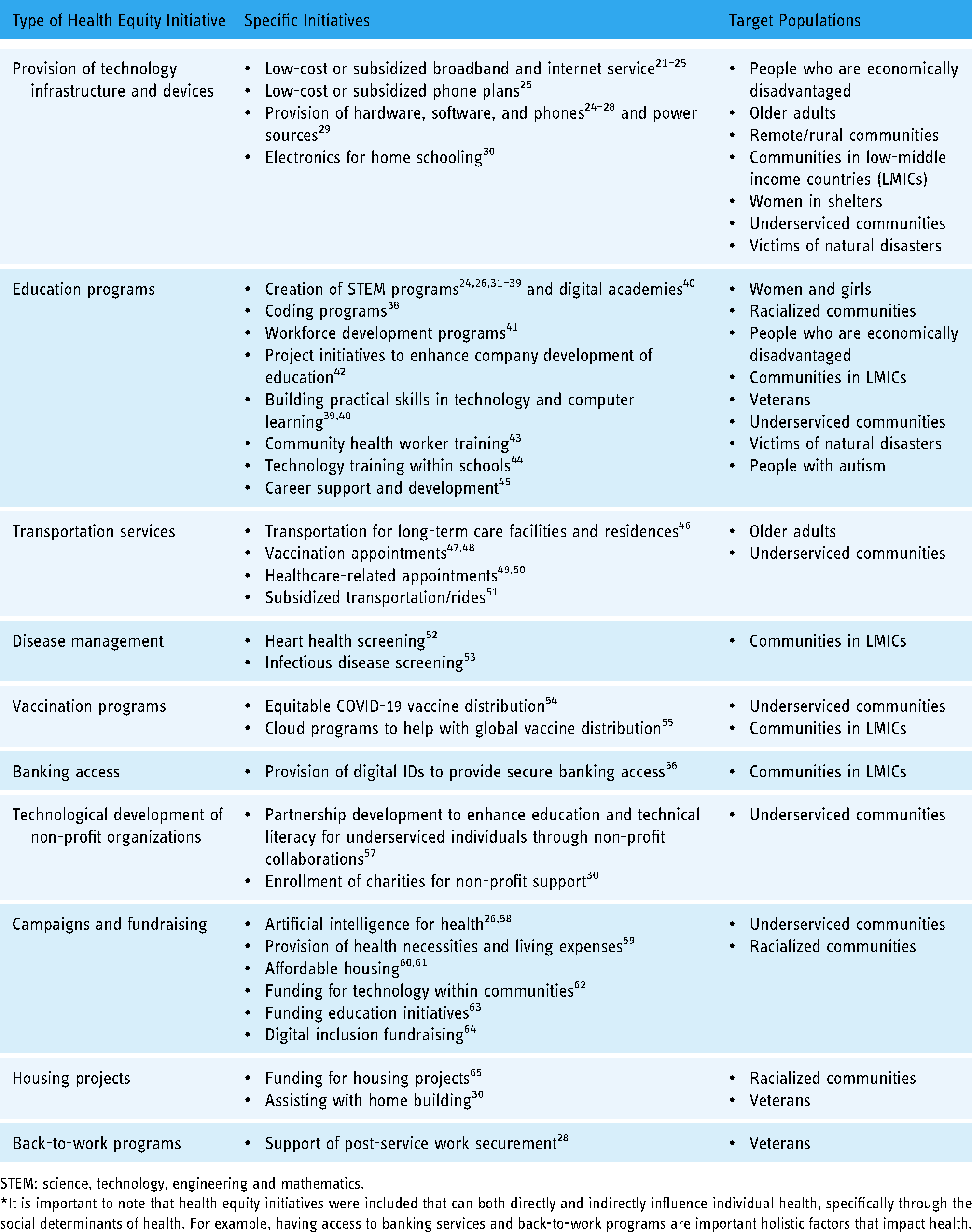
STEM: science, technology, engineering and mathematics.
*It is important to note that health equity initiatives were included that can both directly and indirectly influence individual health, specifically through the social determinants of health. For example, having access to banking services and back-to-work programs are important holistic factors that impact health.
Time parameters for interventions
From the academic review and grey literature scan, no time-specific parameters were identified for initiatives within the technology industry. However, as technology is continuously evolving, data gathered from the grey literature scan suggests that initiatives that technology companies choose to engage in will continue to advance to address issues associated with the digital divide.
Formal evaluation of interventions
From the academic literature review, one study (n = 1) addressed health equity through the application of telemedicine technology. This intervention was evaluated and found an increase in community engagement, which supports the SDH of social engagement and inclusion.6,18 The second included study (n = 1) involved the implementation of a computerized translation service to support care services for patients who were non-English speaking in a hospital setting. This intervention was evaluated as enhancing more timely access to care, supporting the SDH of health service access, as well as satisfying the health equity level of health care services.6,19 The third study (n = 1) evaluated the effectiveness of a mental health app in enhancing the management of anxiety and access to mental health services. 20 Again, the intervention supported the SDH of health service access and satisfied the health equity level of health care services. 6 From the grey literature scan, technology industry initiatives did not provide formal, research-based evaluations of their programs. However, many companies provided narratives from individuals who engaged in their initiatives to demonstrate positive impacts.
Health care partnerships to enhance access to technology infrastructure, health care access or key health determinants
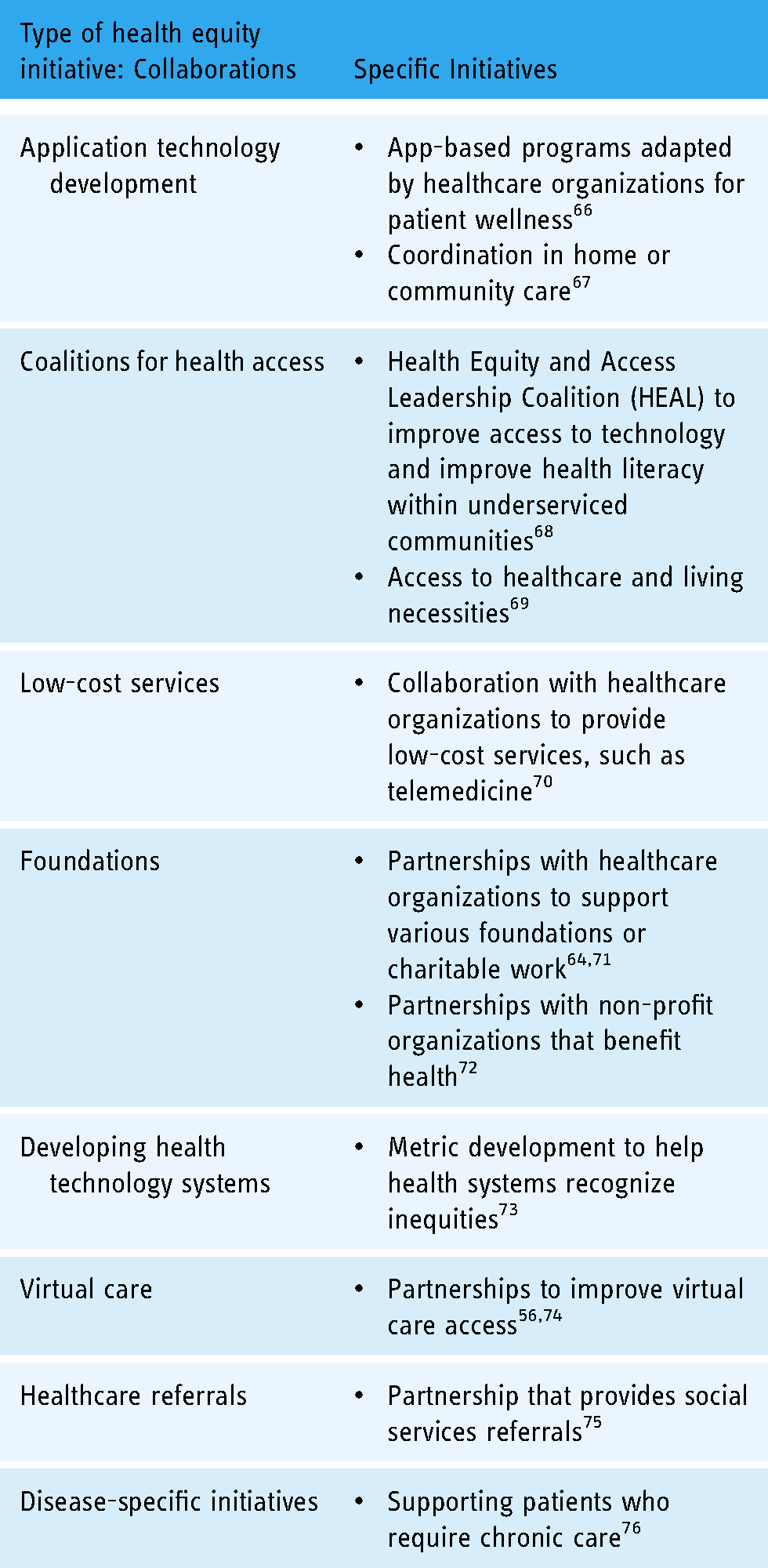
Multiple technology companies were identified as having collaborative initiatives with health-related networks, other technology companies and/or non-profit organizations to provide funding and resources to address multiple levels of health equity. As innovative, health equity strategies are difficult to initiate independently, these partnerships provide frameworks for continued collaborative work in the future. Many of these initiatives focused on various populations at both community and global levels, such as initiating social equity funds. Table 2 provides an overview of the identified initiatives within the technology industry that had a collaborative focus. These initiatives include health care and technology industry partnerships that aim to improve access to health.
Health care and technology industry partnerships to enhance access.
Discussion
Identified initiatives that have been implemented within the technology industry have ranged from upstream activities that broadly focus on areas that impact health, to more focused, community-level initiatives. Most notably, the SDH most targeted by the technology industry is education access. Education initiatives promote a preventative health care approach, by assisting to provide access to programs by populations, such as underserviced youth, who may not have been able to engage in these programs otherwise. Not surprisingly, many education programs focused on science, technology, engineering and mathematics education; these programs mostly have a science and technology focus and are predicted as being in high demand over the next few decades. 77
Some initiatives by the technology industry were particularly focused, such as providing transportation services to various populations for health-related services.47,51,75 Again, key companies that provided these services were within transportation industries, which suggests that industry leaders utilize their company services to benefit communities.
Our findings also demonstrate that there has been a vast assortment of populations targeted for health equity initiatives. One of the most common targeted populations included underserviced areas or communities; this is a broad term that can encompass a diverse number of people from a variety of communities. This finding suggests that many leaders in the technology industry focus on reducing inequities within their local communities and target various issues that are identified at local levels. Other common populations that were targeted included older adults, people who are economically disadvantaged, women and girls, veterans, racialized communities, rural communities and people who have experienced natural disasters. Industry initiatives that focused on specific groups, such as older adults, may still be community-focused or be targeted at national or global levels.
The vast number of partnerships and collaborations identified through this research demonstrates that technology initiatives that support health cannot occur independently. To successfully integrate technology and health, industry leaders must collaborate to foster innovative solutions that address health inequities. Different health equity collaborations through this research included large coalitions, virtual care delivery, foundation development, disease-specific focuses and the development of effective health technology systems.
Implications
Health system engagement with the technology industry can help to develop long-term solutions to address the digital divide. The identified partnerships and collaborations between technology industry leaders and health care organizations demonstrate key opportunities for the integration of technology and health. Technology interventions within health care systems can occur at many different levels of service, including client care, research and medicine. Collaborations between key leaders in both health care and technology industries can help strengthen community engagement and continue to promote the identification of local populations who can benefit from continued health equity initiatives.
Technology industry engagement in providing access to health technology infrastructure can also significantly reduce barriers associated with the digital divide. 78 For example, the identification of communities who can benefit from access to technological devices, such as tablets and computers for learning, was imperative during the COVID-19 pandemic. 79 Other notable examples include providing service to broadband internet and mobile phone use. 79
Policy implications that integrate both health care and technology industries should continue to focus on addressing the SDH. Despite the prominent focus on education, other industry initiatives can target other determinants, such as income and social status, structural conflict, food insecurity and social protection. 80
Limitations
Due to the vast amount of global technology companies, our grey literature scan was limited to public companies listed via the NYSE and TSX within North America. Therefore, despite these results being generalizable to North American populations, more research is needed to determine whether similar initiatives are being targeted on a global scale. Secondly, our academic rapid review results remain limited due to a lack of evaluated technology initiatives that focus on health equity. Despite there being a plethora of technology health initiatives available, many are not formally evaluated to assess their efficacy in addressing components of health equity. Future work in this space should focus on the outcomes of implementing technological interventions to address health equity so that further gaps can be recognized.
Conclusion
As technology in the delivery of health services continues to evolve, health equity initiatives must be supported through innovative strategies. Technology companies are in key positions to help supplement health equity strategies through health care access, health infrastructure support and creating programs that address the SDH. The COVID-19 pandemic has highlighted the necessity of combating the digital divide for underserviced populations, as technology and health care continue to become intertwined in the future. Further work that evaluates the effectiveness of these programs will help to recognize additional gaps to be addressed and can provide baseline data and more innovative initiatives in the future.
Footnotes
Acknowledgements
The authors would like to thank Sarah Bonato for her assistance and guidance in this research.
Contributorship
KD, GS, NB and DJ conceptualized the foundational principles for this work. A protocol was developed by KD, GS and NB to guide the methodology. KD performed the grey and academic literature searches and GS was the second reviewer for the academic rapid review. All authors were involved in data analysis procedures. KD was responsible for the writing of this manuscript with significant input and review by GS, NB, and DJ. All authors agree regarding the final content of the manuscript.
Conflict of interest
The authors have no conflicts of interest.
Ethical approval
Ethical approval was not required for this manuscript.
Funding
This work was supported by the Centre for Addiction and Mental Health (CAMH).
Informed Consent
Not applicable, because this article does not contain any studies with human or animal subjects.
Guarantor: KD.

Trial Registration
Not applicable, because this article does not contain any clinical trials.
Appendix A: PRISMA Flow Diagram