




Abstract
Objective
While colleges have implemented brief, tailored interventions for health-risk areas such as alcohol prevention, theoretically-guided digital learning offerings for weight gain prevention have lagged behind in programming and implementation. Thus, the objective was to design and usability test a weight gain prevention digital learning platform for college students with modules targeting key nutrition and physical activity behaviors.
Methods
Development occurred in iterative phases: formative research, descriptive normative data collection, prototype development, and usability testing. Formative research consisted of background work and survey administration to incoming and current freshmen. Prototype development was guided by theories of behavior change and cognitive processing, and consisted of brief assessment and feedback using written text, graphs, and videos. Iterative usability testing was conducted.
Results
Current freshmen reported eating more quick order meals per week than incoming freshman, but fewer high-fat snacks and fewer sugary beverages. Current freshmen reported more sedentary time than incoming freshmen. Based on iterative testing results, eight behavioral targets were established: breakfast, high-fat snacks, fried foods, sugary beverages, fruit/vegetables, physical activity, pizza intake, and sedentary behavior. Initial usability testers indicated the modules were easy to understand, held their attention, and were somewhat novel. Analysis of qualitative feedback revealed themes related to content, layout, structure and suggested refinements to the modules.
Conclusions
A gap exists for evidence-based obesity prevention programs targeted to adolescents as they transition into adulthood. Brief, tailored digital learning interventions show promise towards addressing key behavioral nutrition and physical activity targets among students during the transition to college.
Approximately one-third of college students have overweight or obesity. 1 Among students attending 4-year colleges, weight gain averages between 3 to 4.3 kg during the first year, with further gains in subsequent years.2,3 The transition between adolescence and young adulthood, particularly for those students beginning college, is a vulnerable time period for weight gain as it is marked by changes in environment and food availability, 4 declines in physical activity, 5 and less healthful nutrition intake. 6
College campuses are poised to launch weight gain prevention efforts given that nearly 50% of 18–19 year olds in the United States are enrolled at a postsecondary institution which support young adults during a developmental life stage primed for the establishment of lifelong health related behaviors.7,8 Yet, evidence-based weight gain prevention and treatment programming on college campuses has lagged behind interventions targeting substance use and high-risk sexual behaviors. 9 A systematic review 8 of diet, physical activity, and weight interventions in college students found significant effects in 18/29 of those with physical activity outcomes, 12/24 of those with dietary outcomes, and 4/12 of those with weight outcomes. While promising, the authors suggest that more work is needed to refine the strategies and delivery channels; characteristics of efficacious interventions were shorter-term (less than 12 weeks) and ones in which students received feedback on their behavior versus attending lectures. A gap remains regarding scalable, low-cost brief interventions targeting weight gain prevention on college campuses.
Interventions for health risk behaviors via college and university settings have been successful and serve as useful models for weight gain prevention programming. Online, interactive interventions addressing high risk health behaviors, such as tobacco, drug and alcohol use, and sexual violence have been adopted by colleges and universities.10,11 Programs that are alcohol-related include the Electronic Check-up to Go (e-CHUG) 12 and AlcoholEdu, 13 which have each been implemented by more than 1100 colleges.11,14,15 These programs are brief, provide education, and deliver immediate, personalized feedback related to alcohol-use behaviors and risk factors. Self-guided computer-delivered interventions to reduce college drinking have demonstrated beneficial results, 16 suggesting that similar programming that focuses on weight-related behaviors may offer colleges options to address an un-met need related to brief low-cost online programming to address weight gain.
Communications theories have been used to guide prevention campaigns on campuses.17–19 For example, “tailored” communication, or using a brief assessment to generate personalized messages, takes into consideration individual factors20,21 and has great potential for use in digital learning health promotion interventions.10,11 The use of tailoring in online programming has been shown to outperform non-tailored health behavior change interventions.20,22 In a meta-analytic review, interventions with tailoring on both theoretical factors, such as self-efficacy, and behavior were found to have an effect size of .092, suggesting a small but positive effect. 22 While this effect size may be small, estimates suggest that an energy gap of 100 kilocalories per day could prevent weight gain in the majority of the United States population. 23 A systematic review 24 found tailored communications effective for physical activity, fruit and vegetable consumption, fat, and other diet-related behaviors. Additionally, focusing on multiple target behaviors simultaneously was equally effective as a sole target. 25
Tailoring may enhance the personal relevance and salience of the message26,27 as well as motivation to process the message. 21 Creating these conditions such that individuals can actively process or “elaborate” on messaging is consistent with the Elaboration Likelihood Model.21,27,28 Notably, self-efficacy appears to be an important factor in physical activity messaging and online programming among college students, with recommendations for including goal setting and other theoretically driven messaging to enhance this key behavioral precursor.29,30
A number of online eating and body image interventions targeting college-aged populations have been described in the literature. Though the focus of these interventions varies significantly, covering topics such as nutrition, 31 non-dieting,32,33 eating disorders, 34 and weight regulation, 35 the short-term effects are promising in increasing fruit and vegetable consumption, reducing stress, and preventing eating disorders among college students. However, none offer tailored feedback on both physical activity and nutrition goals or address behavior change principles including self-efficacy using communication science frameworks. To explore a more individualized approach, we designed a weight gain prevention program modeled after popular alcohol prevention programs. This digital learning weight gain prevention tool utilizes a theoretically driven approach to prompt self-assessment and provide brief, personalized feedback related to eight target behaviors.
Methods
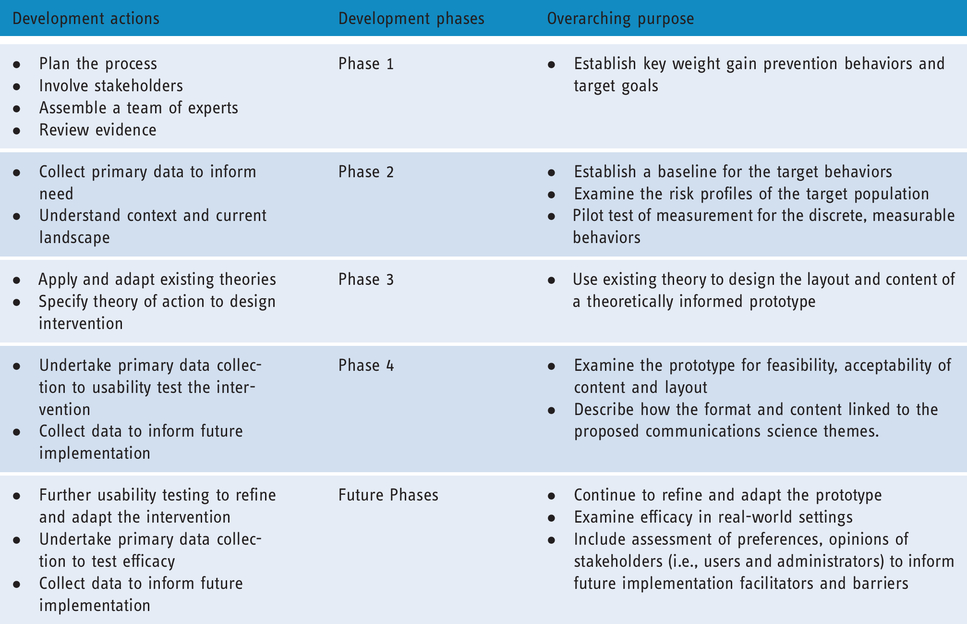
The project occurred in four iterative phases: 1) formative research to identify key weight gain prevention behaviors; 2) descriptive normative data collection on weight gain prevention behaviors among incoming and current freshmen; 3) using theory to guide prototype development; and 4) usability testing. These iterative phases followed the consensus guidelines for developing health promotion interventions (Consensus Guidelines; See Table 1). 36 The setting was a mid-sized urban private university.
Consensus guidelines for health promotion intervention development. 36
Phase 1: Formative research to identify key weight gain prevention behaviors
The study team reviewed the literature of weight related behaviors and targets. One study 37 identified 16 lifestyle, weight, and physical activity goals (e.g., eat breakfast every day). The strength of those goals were that they were concrete, which enabled ease of measurement and specific feedback. Another study 38 identified eight target behaviors (e.g., reduce sugary beverages). Based on this review, the study team initially identified six key weight-related behaviors: eating breakfast, high-fat snack consumption (HFS), fast food consumption, drinking sugar sweetened beverages (SSB), fruit and vegetable consumption (FV), and physical activity (PA).37,38 These behaviors were selected based on their relationship to weight management, as well as the ease with which they could be used for self-assessment as they are brief and easily quantifiable to provide specific feedback on future behavioral recommendations. The study team also recognized that a long list of behaviors might be overwhelming and applied the communications science techniques to minimize cognitive load by keeping messaging simple and give the user control of the order of presentation of the behaviors (See Phase 3 below).
This list was presented to University stakeholders (i.e., associate dean of students directing the student engagement and outreach center, a registered dietitian and faculty member-in-residence, a former nutrition and PA coach at the university-based fitness facility, members of a university-based food task force) and refined based on their input.
Lastly, building on input from stakeholders and content experts, we established the target goals for each behavior. The target selected for each behavior originated from current national guidelines or recommendations and evidence-based behaviors shown to promote weight maintenance in a diverse adult sample. 37 See Table 2.
Rationale for behavioral targets.

Phase 2: Descriptive data collection of weight gain prevention behaviors
Results
Demographics were as follows: Of the current freshmen (n = 103; Mage = 18.54±.61 years; MBMI = 22.73 ± 3.76 kg/m2; 82% female) 19.05% had overweight (BMI between 25.00 and 29.99 kg/m2), 6.37% had obesity (BMI ≥ 30.00 kg/m2). For incoming freshman (n = 116; Mage = 18.15±.47 years; MBMI = 23.10 ± 4.3 kg/m2; 62% female) 15.92% and 6.32% had overweight and obesity, respectively.
Independent sample t-tests were conducted to calculate mean values and examine differences between incoming and current freshmen for each of the target behaviors (see Table 3). BMI (N = 219) was 23.04 ± 4.02 kg/m2, with no statistically significant weight differences between current and incoming freshmen. For dietary behaviors, current freshmen reported eating more QOM per week than did incoming (3.26 vs. .71 meals/week), but fewer HFS (7.75 vs. 8.96 snacks/week) and fewer SSB (2.15 vs. 6.52 drinks/week) (all p’s<.001). Current freshmen reported more sedentary time (8.38 ± 4.95 hr/day) than did incoming (5.51 ± 3.47 hr/day) (p=.05). Less than half (45.9%) of the current freshmen met the physical activity guidelines (≥150 minutes per week), while the majority of incoming freshmen did (81.8%, p<.001)
Demographic and behavioral information (N = 219).

Phase 3: Prototype development and theoretical framework

Conceptual framework.

Branching logic example for tailored feedback messages.
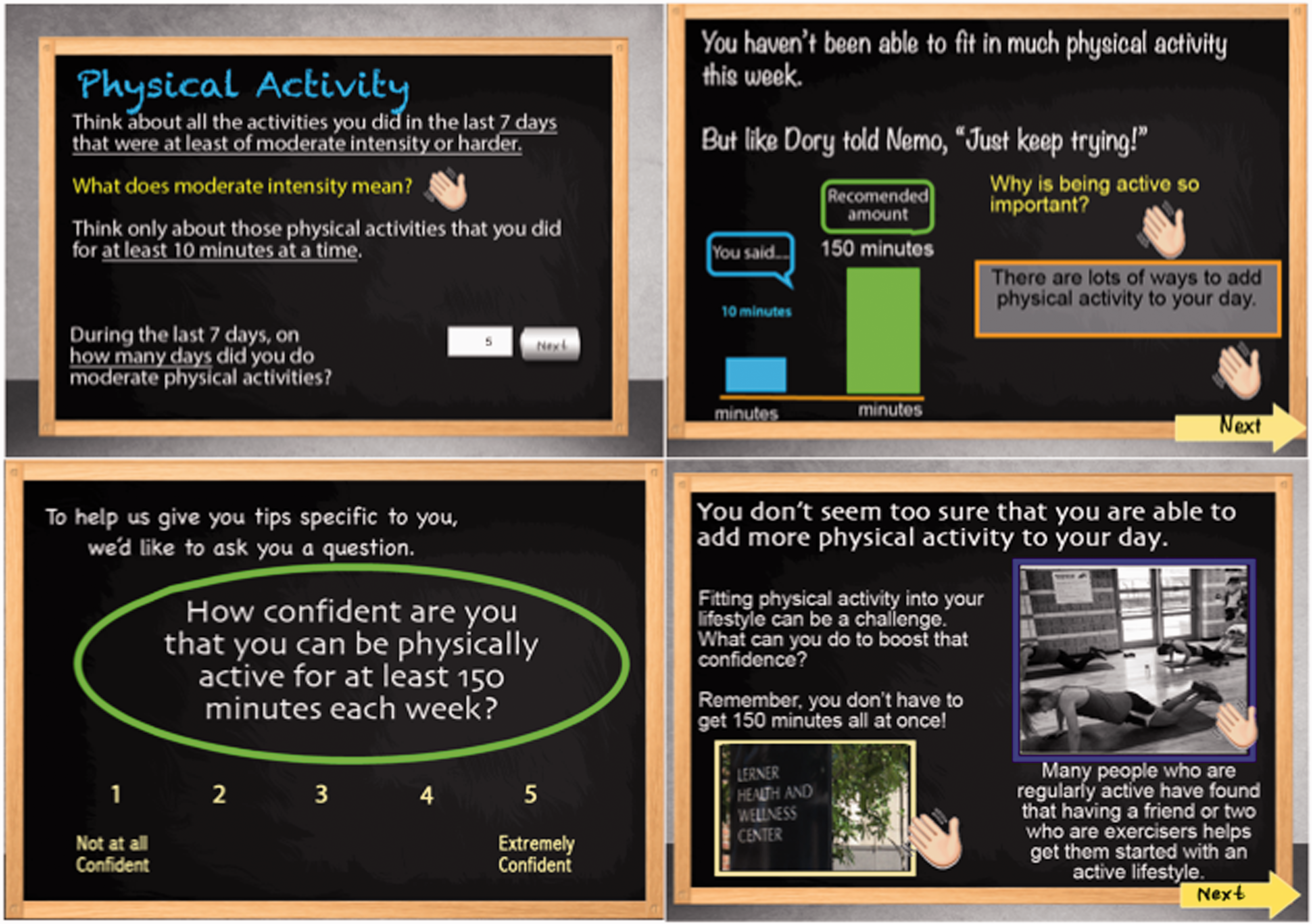
Screenshot of physical activity modules with assessment and behavioral feedback and self-efficacy feedback.
Phase 4: Usability testing
Following a brief orientation and overview of the testing purpose, participants completed a self-assessment for each module. This self-assessment included a reporting of their current behavior and perceived self-efficacy for reaching each behavioral target using a 1-5 likert scale. Both the participant’s behavior and self-efficacy were used to provide graphical and written tailored feedback. The syncronous tailored message was based on participant’s individual self-efficacy and normative behavior for reaching the target (See Figure 2 for the branching logic).
As participants viewed the modules, they were asked to verbalize their reactions and likes/dislikes related to graphics, message content, and page layout. This was recorded along with note taking by the research assistant. Following this review, participants completed a brief usability questionnaire.
Phase 4: Usability testing results
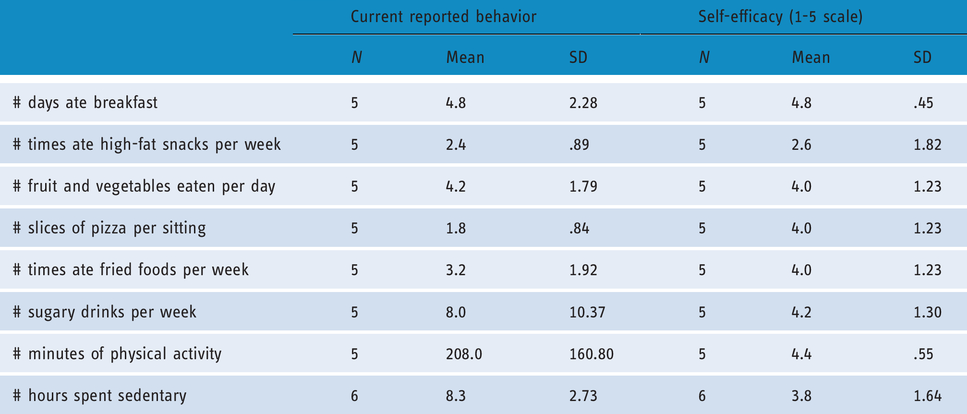
Participants (n = 21; Mage = 20.1 years; MBMI = 23.4 kg/m2; 57% female; 33.4% lowerclassmen; 66.7% upperclassmen) viewed the modules and provided feedback as noted above. Target behavior prevalence is listed in Table 4. The qualitative feedback was transcribed and categorized by two members of the study team. The following themes emerged:
Target behavior prevalence from usability testing sample.
Discussion
Targeting students as they transition to college addresses a life stage change 4 that is associated with nutrition and physical activity behaviors.5,6 Surveys of incoming and current students helped to confirm the measurable behaviors and the need for intervention. The dietary behaviors of the participants in this study underscore the need for easily accessible programming to address healthy eating behaviors. For example, participants reported consuming less than 5 servings of FV per day (3.10 incoming and 1.80 current) and consuming a significant amount of SSB per day (6.52 incoming; 2.15 current). Also, our results show that less than half of the current freshmen met the recommended amount of PA while over 80% of the incoming freshmen met current recommendations. These results indicate the potential benefits of delivering a brief self-assessment driven intervention to prevent the decline in healthy eating and PA behaviors regardless of initial weight status.
Information obtained during Phase 2 was useful for selecting the behaviors for the digital learning weight gain prevention feedback tool. By synthesizing information from literature reviews, leaders on campus, and content experts, the eight behaviors were selected as important and viable targets. Critical to this phase was the selection of target goals for each behavior, which were based on existing current national guidelines or recommendations and a weight maintenance program for adults. 37 One challenge included finding brief, measurable, and achievable targets linked to a reputable national or international organization. For example, pizza consumption and sedentary behavior were emerging as important targets, yet to date, there are few specific measurable national or international guidelines. For sedentary behavior, the target was based both on participant feedback and emerging information. Additional targets may be important for future consideration (i.e., sleep, stress) as those also can intersect with important cardiometabolic health targets79,80 and healthy eating and activity.81,82
Usability testing was helpful to understand students’ perceptions of the topics, videos, and feedback. This project was designed as a proof-of-concept to inform messaging and behavioral targets 83 and to determine necessity of further testing and implementation. Qualitative feedback from the target audience revealed eight themes. Some themes reflected the theoretical framework. For example, many students liked the order of the materials presented, minimizing cognitive load, and others liked the graphical feedback showing their behavior in comparison to the target. Self-efficacy is a key precursor for both physical activity and dietary change (SCT), 84 therefore, using one’s confidence as the basis for the tailored messages was grounded in this perspective. Future pre-post designs to assess changes in these theoretical constructs will provide further data regarding the value of using these theories in program design.
Feedback from students also informed plans for future modifications to the program (See Table 1), including simplifying wording and reducing the amount of on-screen text; adding more tips; and refining pizza, snacks, and sedentary behavior targets. Future refinements will include: change “no more than 2 slices/sitting” to “no more than 2 slices on ≤ 3 days per week” for pizza; “< 6 hours a day” to “< 6 hours a day, plus breaks” for sedentary behavior; and “no more than 2 per week” to “no more than 2 per day” for snacks. Participants also noted that only moderate-intensity activity was described in the physical activity module, and therefore vigorous activity will be covered. Students also liked the branded nature of the materials. Future versions can include the ability to provide a customizable platform with branding options for each campus including a selection of school colors and potential to incorporate static images of their mascot.
There are limitations of the current study. First, we recruited a convenience sample of students from one private university who may not be representative of students at other colleges. For example, students reported sitting between five and eight hours per day, which is lower than reported elsewhere. 59 Accounting for sedentary time may be subject to recall bias; 85 therefore, these reports of sitting time may be an under representation. Second, only students interested in research focused on preventing weight gain in college participated, which may represent a selection bias. Only a small portion of the incoming and current freshman completed the survey and most were female and white; therefore, results yielded from the formative surveys should be interpreted cautiously. Third, although helpful in generating a prototype version of the program, the software platform was limited in functionality and layout options, perhaps contributing to some of the feedback received. The usability testing was done in a controlled setting; therefore, it does not approximate what use would be like in a home or dormitory setting. The sample who completed the usability testing were similar in BMI but older. The age increase is likely related to the decision to include older students to learn from a range of undergraduates to inform the research team as to whether the program depicted an accurate and realistic reflection of the undergraduate campus culture.
Conclusions
This study involved the formative work to design a digital learning weight-gain prevention self-assessment and feedback tool targeting young adults as they transition from high school to college. Prevention programs that are brief, easy-to-use and self-paced targeting this transition period are needed, especially as students develop their own health patterns and behaviors. This study adds to the literature on low-cost online weight gain prevention programming for college students as it addresses usability of the interface, relevance to the target population and capability of delivering a self-assessment and feedback tool for weight gain prevention through a digital channel. Colleges and universities are potential avenues for helping students foster health and well-being by providing opportunities on-campus for easily accessible healthier options. 86 Mandating digital learning programming focused on tailored messaging about healthy eating and physical activity, similar to alcohol use programs required by over 500 colleges and universities, may provide a first step towards improving overall student health and well-being.
Footnotes
Acknowledgements
The authors would like to thank Jessica Rafetto, Katrina Hufnagel, and Stephanie Bono for their contributions to the data collection. The authors would also like to thank Chelsey DuBois and Jiayan Gu for their help in manuscript review and preparation.
Contributorship
MN and LP conceived of the study. SL, MM, MN and LP were involved in drafting the content and design of the study tool. SL took the lead on participant recruitment and conducted data analysis with MM. All authors contributed to, edited, and approved the final version of the manuscript.
Declaration of conflicting interests
The author(s) declared no potential conflicts of interest with respect to the research, authorship, and/or publication of this article.
Ethical approval
The ethics committee of The George Washington University Institutional Review Board approved this study.
Funding
The author(s) disclosed receipt of the following financial support for the research, authorship, and/or publication of this article: This study was funded by The George Washington University Food For Thought Research Grant.
Guarantor
MN.
Peer review
Lingling Zhang has reviewed this manuscript.
