




Abstract
While the hoarding of physical objects has been extensively explored, there is little research relating to the hoarding of digital materials. The research that has been conducted suggests that digital hoarding (DH) behaviours appear to have some similarities with physical hoarding (PH) behaviours, and can be just as psychologically distressing. This study uses the framework of the cognitive behavioural model of PH to explore DH behaviours, including possible similarities regarding emotional attachment to digital possessions, and possible links with Obsessive Compulsive Disorder (OCD) and indecisiveness. For the study, 282 participants completed an online survey which measured levels of digital and physical hoarding, compulsive acquisition, OCD, indecisiveness and mood. Strong emotional attachments to particular types of digital possessions were evident: this was especially true for photographs and videos. Significant positive relationships were found between all the variables measured. However, a regression analysis revealed that only OCD and PH scores were significant predictors of DH. DH thus appears to share some of the features of PH. Implications, limitations and future research possibilities are discussed.
Introduction
Persistent acquisition of, and reluctance to discard possessions, irrespective of perceived value, are key characteristics of Hoarding Disorder (HD)1,2 and can lead to severe cluttering of living environments with deleterious consequences including health code violations, eviction, emotional distress, social and financial impairment, reduced quality of life, severe obstruction of living space and an increase in fire and fall hazards.2–5
Hoarding of physical objects (physical hoarding, PH) shares some of the features found in obsessive compulsive disorder (OCD) and was previously seen as a symptom cluster of OCD, with hoarding and saving compulsions being observed within 15–40% of individuals with OCD.6–8 However, in response to the increasing evidence that hoarding and OCD are separate disorders,9–11 PH was classified as a distinct disorder within the DSM-5. 2
Recently, attention has turned to the digital world, with the idea that hoarding digital items may be comparable, in terms of emotional and environmental impact, to the hoarding of physical objects. The opportunity to hoard digitally is increasing due to the wide availability of digital materials (e.g. files, photographs, music, apps, etc) and the abundance of cheap storage. 12 There is evidence to suggest that we can become as strongly attached to non-physical as we do to physical possessions as they become part of our identity and our sense of self.13–16 Interviews with 35 adult video gamers, for example, revealed that participants possessed and could form emotional attachments to digital items within video games regardless of lack of legal ownership and materiality. 17
The potential emotional and psychological costs of digital hoarding (DH) to the individual are only now becoming apparent. A study by van Bennekom et al., 18 for example, shows that a male with PH behaviours extended his accumulation into the digital realm in the form of digital photography. His hobby had taken over his life with the obsessive taking, editing, categorising and copying of pictures onto various external hard drives. Though he never looked at the photographs, organising them took between 2 and 5 hours a day and had severely compromised his normal daily activities, leading to considerable stress and anxiety. The authors suggested that DH may be comparable to PH as it also involves the over-accumulation of items, leading to increased clutter and disorganisation, difficulties in discarding/deleting due to intense emotional attachments, distress and loss of normal functioning. They go on to propose that this type of hoarding should be added to screening instruments for HD. More recently, in a qualitative assessment of DH behaviours in 43 individuals, Sweeten et al. 19 found a clear overlap between physical and digital domains, with DH behaviour also reflecting excessive accumulation, difficulties with deleting, and emotional distress.
Another study, exploring possession rituals of digital consumers on Pinterest, a social image-sharing and bookmarking website, 20 indicated a high level of emotional attachment to digital possessions and evidence for hoarding of ‘pinned’ items, including a sense of private ownership of discovered items in a public forum. Users applied possession rituals (including hoarding) to the digital items (pinned digital images) and stated that they were very reluctant to delete anything: all behaviours similar to above relating to HD. Emotional attachment to digital possessions was evident within the sample: participants expressed feelings of pleasure, pride, aesthetic pleasure and value regarding their digital possessions. They also expressed a sense of attachment to these digital possessions and a perception of them as important and of high value irrespective of any actual usefulness. This research has been recently supported, in relation to HD, by Luxon et al. 21
Organisations as well as individuals are increasingly hoarding Dark Data (the information organisations store naturally through business transactions but then do nothing else with it other than store it in perpetuity). This has two main consequences: though processing power and memory capacity is rapidly increasing, slower increases in magnetic storage inhibits technological advances and computer speed 22 and although Cloud storage may mitigate this, due to the nature of such storage it may amplify environmental and economic problems. Data servers consume excessive amounts of energy. Within the USA, data servers accounted for 2% of national energy consumption, 23 and worldwide power consumption used by data centres has increased tenfold since then. 24 Such excessive energy usage causes high operational costs and carbon emissions.25,26 For Cloud storage to maintain high quality, servers must utilise numerous data centres, increasing power demands and associated costs. Consequently, individuals and corporations utilising Cloud storage (e.g. Amazon, Google, Apple, etc.) save data in multiple servers and locations. Therefore, Cloud storage creates a medium for DH while amplifying the economic and environmental consequences, as one saved digital possession is copied and becomes numerous digital possessions. Such implications highlight a need for research exploring DH and possible causes, allowing for intervention development and consequently reducing DH environmental and economic consequences.
So, DH appears to be present in the population, and this has implications for individual psychological wellbeing, and more broadly for environmental, economic and workplace effectiveness.
The cognitive behavioural model of PH27 highlights emotional attachment to – and beliefs about – possessions, vulnerability factors such as information processing styles (categorisation and decision making for example) and emotional reactions to possessions (e.g. pleasure, pride, grief, anxiety and loss) as key factors regarding the development and maintenance of hoarding behaviour.1,28–30 OCD is often comorbid with HD,7,8,31 so may also be related to DH. In order to explore this possibility, the first aim of this current study was to explore the possible extent of emotional attachment to variety of digital items. The second aim was to explore the possibility that the symptoms of DH resemble symptoms of PH and OCD. If this is the case, the third aim was to assess the possibility that factors important in the cognitive behavioural model of PH may apply to DH and thus may be helpful in future treatment.
Method
Participants
Opportunity sampling garnered 282 participants (24.2% Males, 75.8% Females, Mage = 32.84, SD = 12.97, age range: 15–70). There were no exclusion criteria. Participants with existing psychological diagnoses (12.2%) were included in the study to improve generalisability. Percentage of self-reported psychological diagnoses in the sample are as follows: Depression (5.4%), Anxiety (3.7%), Personality Disorder (1%), OCD (0.7%), Schizophrenia (0.7%), Dementia (0.4%), and Post Traumatic Stress Disorder (PTSD; 0.3%). Participants were recruited through online adverts posted on social media websites and fora. Participants were offered the chance to enter a prize draw for one of four £25 gift cards as an incentive. Ethical clearance was granted by the local ethics committee.
Questionnaires
Digital Saving Cognitions Inventory (DSCI). This was adapted from the existing Saving Cognitions Inventory (SCI), 30 which is a validated measure of compulsive hoarding. Changes included changing words relating to discarding to ‘delete’. Participants were asked to choose the digital items (‘E-mails and Texts’, ‘Documents’ or ‘Images and Videos’) that they were least likely to delete and to refer to this type of item when answering the questions. Like the SCI, the DSCI has four subscales; emotional attachment (10 items), control (3 items), responsibility (6 items) and memory (5 items). Questions are scored on a scale of 1–7, with three anchors: ‘not at all’, ‘sometimes’, ‘very much’. Examples include ‘Deleting this digital item is like throwing a part of me away’ and ‘I am responsible for the wellbeing of these digital items’. High alpha coefficients have been observed within the SCI (0.96), indicating very good to excellent internal consistency. 30 Within the current study a Cronbach’s α of 0.94 was observed for the DSCI.
Compulsive Acquisition Scale (CAS). 32 The CAS is an 18-item Likert-type scale developed to measure the extent to which individuals acquire and feel compelled to acquire possessions. The CAS contains two subscales; CAS-Buy (12 items) and CAS-Free (6 items). In addition to the CAS-Buy subscale assessing buying habits, it also assesses reasons for acquiring possessions which include frequency of inappropriate buying, compulsions to buy and emotional response to buying. 33 Examples include ‘Do you buy things you never use?’, ‘Do you pick up things that other people have discarded’ and ‘Do you feel compelled to flyers or handouts from lectures or talks?’ The CAS-Buy subscale is developed from an 11-item scale utilised in past research which displayed adequate reliability and validity. 32 The CAS-Free subscale assesses compulsive acquisition of free objects. Both subscales have displayed satisfactory reliability (α = 0.94 and 0.87, respectively). Within the current study Cronbach’s α of 0.89 and 0.86 were observed.
Hospital Anxiety and Depression Scale (HADS). 34 The HADS is a 14-item self-report questionnaire designed to indicate presence of anxious and depressive states within medical outpatient environments. The HADS contains two subscales; anxiety (7 items) and depression (7 items). The anxiety and depression items are made up of statements that are rated from 0 to 3 in severity, with 0 = statement does not coincide with how person feels or 3 = strongly coincides. Examples include ‘I feel tense or wound up’ (anxiety-item) and ‘I have lost interest in my appearance’ (depression-item). A meta-analysis 35 shows a mean Cronbach’s α of 0.83 for the Anxiety subscale and 0.82 for the depression subscale. Within the current study, Cronbach’s α values of 0.89 and 0.83 were observed for anxiety and depression subscales, respectively.
Indecisiveness Scale. 36 This is a 22-item self-report questionnaire developed from characteristics of decision-making issues (e.g. deciding takes a long time, finding it difficult to make a decision, etc.). Each item is scored on a 5-point Likert-type scale with 1 = not at all/rarely to 5 = very much/very often. Examples include ‘It is hard for me to come to a decision’ and ‘After making a decision, I can’t get it out of my mind’. It has high reliability (Cronbach’s α = 0.93)36 and in the current study an α of 0.94 was observed.
Obsessive–Compulsive Inventory Revised (OCI-R). 37 This is an 18-item self-report measure and contains six subscales consisting of 3 items each; Washing, Checking, Ordering, Obsessing, Hoarding and Neutralising. These subscales are designed to assess obsessive and compulsive behaviours and the level of associated distress felt upon doing them. Items comprise statements that describe OCD symptoms, for example ‘I have saved up so many things that they get in the way’ and ‘I wash my hands more often and longer than necessary’. Item scores are rated from 0–4 on a 5-point scale where 0 = Not At all and 4 = Extremely. The authors 37 found moderate to high test–retest reliability for total and all subscale scores. Within the current study, a Cronbach’s α of 0.91 was observed for the OCI-R.
Procedure
Participants responded by following a link to the online survey in an advertisement. This asked if they were willing to participate in a survey about mobile phone usage. The introduction to the survey itself stated that the purpose was ‘to investigate digital hoarding and factors which may play a role’. Following their agreement to participate and after providing informed consent, participants provided demographic information and completed all questionnaires in the same order.
Results
Distribution
The questionnaire data were normally distributed. Boxplot inspection revealed 15 outliers. However, histogram inspection displayed reasonably sloped tails. Outliers were within 2 standard deviations of the mean and as such were included in the analyses after the mean and 5% trimmed mean for each factor were compared and were not significantly different from each other. There were no missing data.
Emotional attachment to digital possessions
Descriptive statistics regarding DH, the emotional attachment subscale of DH and participants’ digital item chosen when completing the DCSI are displayed in Figure 1.

Mean total scores on DH scale and emotional attachment subscale related to chosen digital item.
A one-way between-groups analysis of variance was conducted to explore the impact of digital object choice (Images and Videos, E-mails and Texts, or Documents) on levels of DH. There was a significant difference in DH scores for the 3 object types (F2,233 = 30.913, p < 0.001 η2 = 0.11, a medium to large effect size). Post-hoc comparisons using Tukey’s HSD test indicated that mean DH scores for Images and Videos (M = 81.18, SD = 28.51) were significantly higher than both E-mails and Texts (M = 59.33, SD = 22.97) and Documents (M = 69.12, SD = 27.81). E-mails and Texts and Documents did not differ from each other.
A second one-way between-groups analysis of variance was conducted to explore the impact of digital object choice (Images and Videos, E-mails and Texts, or Documents) on emotional attachment to digital objects. There was a significant difference in emotional attachment scores for the three object types (F2,233 = 14.12 p < 0.001. η2 = 0.21, a large effect size). Post-hoc comparisons using Tukey’s HSD test indicated that mean emotional attachment scores for Images and Videos (M = 32.53, SD = 14.23) were significantly higher than both E-mails and Texts (M = 18.41, SD = 9.73) and Documents (M = 20.43, SD = 13.14). E-mails and Texts and Documents did not differ significantly.
Exploring PH, anxiety, depression, OCD and indecisiveness as possible factors relating to DH
The second and third aims were to examine potential links between scores of DH, PH and OCD, and explore the possibility that factors important in the cognitive behavioural model of CH may apply to DH. Pearson correlations were conducted to examine the relationship between scores on the DH scale and scores of PH, OCD, anxiety, depression and indecisiveness. All correlations were significant and effect sizes ranged from medium to strong (see Table 1).
Pearson correlations between digital hoarding and compulsive hoarding, OCD, anxiety, depression and indecisiveness.

** p < .001 (1 tailed).
Exploring CH, anxiety, depression, OCD and indecisiveness as factors relating to DH
A stepwise multiple regression was conducted to evaluate physical hoarding, OCD, anxiety, depression and indecisiveness scores as possible predictors of DH. Results are displayed in Table 2. In model 1, level of OCD was a significant predictor of level of DH scores, while all other variables were excluded. Within model 2, OCD and PH were significant predictors of DH scores while anxiety, depression and indecisiveness were excluded. In summary, the regression analysis highlighted OCD and PH as significant predictors of DH while anxiety depression and indecisiveness added little to the model. This suggests that levels of PH and OCD may predict levels of DH to a greater extent than the other factors of the cognitive behavioural model examined in the current study.
Summary of stepwise regression analysis predicting DH scores.
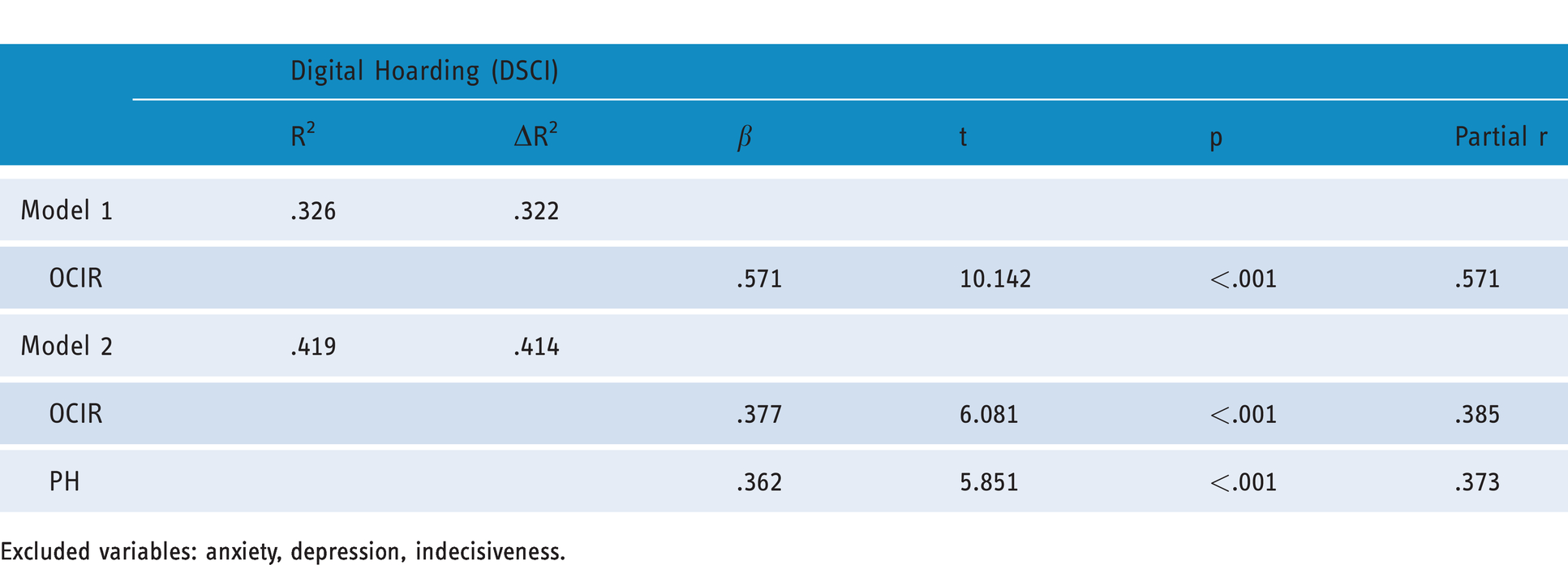
Excluded variables: anxiety, depression, indecisiveness.
As a consequence of the findings from the initial multiple regression, a further stepwise multiple regression was conducted to evaluate the subscales of OCD (checking, hoarding, mental neutralising, obsessing, ordering and washing) as possible predictors of DH. Results are displayed in Table 3. In model 1, unsurprisingly, hoarding was a significant predictor of DH scores, while all other variables were excluded. In model 2, hoarding and obsessing were significant predictors of DH scores, with all other variables being excluded. In model 3, hoarding, obsessing and ordering were significant predictors of DH scores, while checking, mental neutralising and washing were excluded. In summary, the regression analysis states that the hoarding, obsessing and ordering subscales of the OCI-R significantly predict DH while checking, mental neutralising and washing do not.
Summary of stepwise regression analysis of OCIR subscales predicting DH scores.

Excluded variables: checking, mental neutralising, washing.
Discussion
The initial aim was to explore the extent of emotional attachment to digital possessions, and explain such findings in regards to DH. We found that both emotional attachment to digital possessions and DH scores were higher in participants who chose digital images or videos, than in participants who chose documents or e-mails and texts. This is an accordance with previous studies that have reported high levels of emotional attachment to digital possessions and that such attachments are higher for certain types of digital item.17,20,38,39 Owners can form strong emotional attachments to digital possessions, though this depends on the type of the digital item in question. This suggests that DH and PH may be similar in terms of the emotional attachments made to possessions. This is a key aspect of PH.40–42
The second aim was to assess relationships between DH and PH and OCD. Results indicated that reported levels of DH related positively to both reported levels of PH and OCD. Further analysis addressing the third aim showed similarly positive relationships between DH and measures of anxiety, depression and indecisiveness, which are also found in PH.1,28,43,44 However, subsequent regression analyses indicated that PH and OCD appeared to be contributing to DH, while anxiety, depression and indecisiveness were not. This suggests that levels of hoarding of physical items and OCD, particularly the subscales of hoarding, obsessing and ordering, may be implicated in the urge to hoard digital items.
The current findings may offer a possible way forward in providing some evidence that the cognitive behavioural model of PH may be applicable to DH. Cognitive behavioural PH treatments have displayed promising outcomes, 45 with large effects and sustained outcomes observed 46 further supporting the possible clinical applications of the current findings within DH.
A limitation of the current was the fact that the DH questionnaire was developed from the SCI, which may overestimate hoarding behaviour due to the measurement of hypothesised hoarding rather than an objective measure of hoarding. 14 Research assessing compulsive hoarding behaviour has displayed social desirability bias within self-reported data, 47 so a better method of achieving an objective measure of DH would be for the participants to note the number of digital possessions they save. With the recent development of the Digital Hoarding Questionnaire 48 this is now possible: this study also reported strong links between PH characteristics and the extent of DH, and so provides support for our current findings.
Another limitation which could be addressed in future is the conflation of different types of digital items into one category. Personal selfies, holiday snaps and videos, for example, are different in emotional valence to pirated songs, software and films in terms of beliefs about a possession’s utility and sentimental value.
There is little previous research on DH, so the current study is exploratory in nature, while informed by research from the PH and OCD literature. Future research could explore other variables that may aid in the explanation of DH. Ideas about identity, self and the meaning of digital objects would be interesting to explore, as would perfectionism and procrastination28,49 and emotion regulation. 50
In sum, this paper has set out to explore possible similarities between the hoarding of physical and digital items. We found that in many ways they are similar, and that DH may become problematic for a subgroup of people. Though there may not be the issues of health, safety and fire risk that are evident in PH, there are consequences for the levels of storage required, the resources used for this, and for the levels of anxiety and mood disturbance which accompany any compulsion to collect.
Footnotes
Conflict of interests
The author(s) declared no potential conflicts of interest with respect to the research, authorship, and/or publication of this article.
Contributorship
AB and ST designed the study. AB ran the study. AB and ST analysed the data. NN assisted with data interpretation and theoretical background. All authors contributed to the writing and revision.
Ethical Approval
Institutional ethical approval was received.
Funding
The author(s) received no financial support for the research, authorship, and/or publication of this article.
Guarantor
NN
Peer review
The author elected reviewers' names to be remain as anonymous.