




Abstract
Objective
Increasing knowledge about alcohol-related harms, changing social norms, or encouraging drinking within safe unit levels often fails to change behaviour in young people. A novel intervention called ‘OneTooMany’ was developed, which targets the short-term social, and potentially, embarrassing consequences of drinking alcohol. The aim of this paper was to explore its acceptability, and to determine any features that might influence its effectiveness as a means of reducing alcohol consumption.
Methods
Participants were 23 young adults (aged 18–30) currently studying at university (n = 18) or in the first six months following graduation (n = 5). A think aloud interview approach was employed. Three main themes were identified in a deductive thematic analysis.
Results
Embarrassing experiences were a normalised part of drinking occasions, while some were actively avoided, others were celebrated. Humour served as a device to engage and interest participants, but could also diminish intervention messages. OneTooMany prompted reflections on many regrettable drinking experiences, but the participants did not see themselves as the target audience for this intervention.
Conclusions
Interventions may benefit from focusing on some of the short term, embarrassing consequences of excessive alcohol consumption. Further research is needed to ensure that reflections on past behaviour are helpful in addressing future behaviour.
Introduction
Excessive alcohol consumption is associated with a number of harmful consequences, 1 and young people in particular are negatively impacted. It appears that amongst some groups of young people in the United Kingdom (UK), alcohol consumption is falling, however, overall hospital admissions and alcohol-related illnesses such as liver disease are increasing. 2 Young people are also more likely to engage in heavy episodic drinking, which is associated with short-term harms such as accidents and injuries. 3 A recent systematic review of student drinking in the UK and Ireland found that two-thirds of students could be classified as hazardous consumers and 20% reported alcohol problems. 4
Health education programmes can sometimes fail to change student drinking behaviour. 5 6 Some findings suggest that heavier drinkers might be more critical of heath messages than lighter drinkers, 5 and that such educational interventions might be counter-productive, and lead students to maintain or increase their drinking. 7 Advice about low-risk drinking guidelines is not perceived as relevant by this group of drinkers, 8 and although social norms interventions are popular, their effectiveness has also been called into question. 9 In fact, one recent study suggested that even though some interventions can produce short-term changes in behaviour, in the longer term, alcohol consumption returns to baseline levels. 10 This evidence demonstrates that, despite various approaches to target the harms associated with young people's drinking, there is an ongoing need to explore new approaches in this population.
The Global Drug Survey (GDS) 2015, specifically explored motivations for drinking less among different groups and identified social embarrassment as a significant issue for some. 11 A study on a US college campus found a high level of acceptability for a poster campaign that targeted embarrassing situations that students might encounter when drinking. 12 Another study found that students who scored lower in embarrassability were more likely to have experienced alcohol-related problems in their daily lives than those with higher embarrassability. 13 This evidence suggests that there is a possible link between the extent to which one is prepared to lose face and the amount of alcohol consumed. Other evidence suggests that young people might be motivated to avoid being the ‘one who needs to be looked after’ during a night out, 14 and they may actively aim to stay in the ‘sweet spot’, a level of consumption where they believe they will not do anything that they may later regret. 15 Thus, a focus on maintaining control, considering the embarrassing nature of one's behaviour, and avoiding becoming a burden on friends could be explored as means of encouraging young people to drink less.
OneTooMany
Digital interventions have grown in popularity alongside the increase in Internet and smartphone use, and offer advantages in terms of cost and potential reach over face-to-face interventions. Although there are many freely available websites and phone applications that aim to encourage individuals to reduce their drinking, there is little research exploring the efficacy of, or optimal ingredients of such interventions. 16 Drawing on the GDS data and following a number of focus groups with university students, Author 4 developed an ultra-brief online self-assessment tool focusing on the short-term negative consequence of drinking, called OneTooMany. Focus-group findings suggested that participants were concerned with their social reputation, and would actively seek to avoid embarrassment. OneTooMany was designed to engage young people in a process that would allow them to reflect on their drinking in a novel and entertaining way and which could signpost interested individuals to seek further support and advice about drinking.
OneTooMany consisted of a single scrollable web page with 20 questions relating to incidents and behaviours that might occur as a result of alcohol consumption. Questions included asking whether participants have ‘lost important things (keys, phone, money, bag or clothing, etc.)’ whilst drinking, as well as asking whether participants have ‘got so drunk’ they are unable to recall what they have ‘done the night before’. Responses to these questions generated an Alcohol-Related Social Embarrassment (ARSE) score, out of a total possible score of 40. These scores were broken down into four groups, each category being given a label (e.g. Culus Major) and offering feedback on the type of drinker that score might relate to and the risks and consequences associated with it framed as motivators to reduce consumption. After reading a description associated with their score, participants were directed to sources of support concerning with reducing alcohol consumption, if they wished to do so (see http://onetoomany.co/). Using a taxonomy of behaviour-change techniques (BCT), 17 the components of OneTooMany can be described as targeting the consequences of behaviour, specifically by presenting information about social and environmental consequences (BCT 5.3) and inducing anticipated regret (BCT 5.5).
The aim of the current study was to explore the acceptability of this novel intervention with young people, and to determine any features that might influence its effectiveness as a means of reducing excessive alcohol consumption.
Method
Participants
Participants were recruited in the UK via social media, a university electronic notice board and by posters displayed around the same university's campus. The criteria for participation were that the individual was a current consumer of alcohol, and aged 18–30. We aimed to recruit both students and non-students to ensure a broad range of views were represented. Unfortunately it was challenging to recruit non-students into the study, and the employed participants were themselves recent graduates, thus the participants were a convenience sample. Recruitment of participants continued until saturation of data was reached, with a lack of new information being identified. The participants were 23 young adults aged 20–30 (12 females; M age = 22.91, SD = 2.57), 18 participants were students (11 undergraduate, 7 postgraduate), and five participants were employed in their first role since finishing university, having graduated six months prior to the study taking place. The procedure was granted approval by Oxford Brookes University Ethics committee (Study reference 150944). All participants were provided with an information sheet about the study in advance of the interview and asked to sign a consent form to indicate their agreement to take part. The information sheet explained that the purpose of the study was to provide feedback on a website designed to reduce excessive alcohol consumption in young people.
Think aloud interview
During a think aloud interview, participants are asked to talk through their thoughts whilst completing a task. This method was selected in the current study in order to find out how young people interacted with the intervention components. The think aloud interview has been used during the development of other digital interventions to determine their acceptability and feasibility.18,19 It has also been recently applied to evaluate how students engaged with another online intervention aimed at reducing alcohol misuse in students. 20 While there are a number of varieties of think aloud interview employed in the literature18,21 we used an approach that has previously been used by psychologists involved in developing digital interventions.19,22,23 In these studies, the think aloud method was used in combination with interviews; alongside being prompted to verbalise their thoughts, specific questions were used to elicit further elaboration from participants about the web pages.
In the current study, the think aloud interview was preceded by a semi-structured interview. The first main question was about general attitudes about alcohol; the second, about experiences of drinking at university; the third, about how their drinking compared with other people. These initial questions were used to set the scene for the topic of alcohol and to help the participant to feel comfortable in talking openly to the interviewer before the think aloud section. Participants were then shown the website on a laptop computer and invited to answer each of the 20 questions presented and to talk through their thoughts whilst doing so. If, during the think aloud interview, the participant stopped talking aloud, the interviewer asked them to ‘keep thinking your thoughts aloud’. If the participant remained silent at this stage, the interviewer would prompt a response, for example by asking the participant ‘what do you think about that question?’ or, ‘has this happened to you or anyone that you know?’ Participants were then asked their overall thoughts about the intervention, including who they thought it was aimed at. The final question asked what the participant would do if they were part of the interviewer's research team in order to encourage young people to cut down the amount that they drank and reduce the negative consequences of drinking. At the end of the interview they were asked if they had any other views about alcohol not previously mentioned. Interviews lasted 30–40 minutes and took place in a quiet meeting room; the interviewer sat side-on to the participant. The interviewer was a female researcher not previously known to the participants. All interviews were audio recorded and transcribed verbatim prior to analysis. Participants received a £15 voucher to thank them for their time.
Analysis
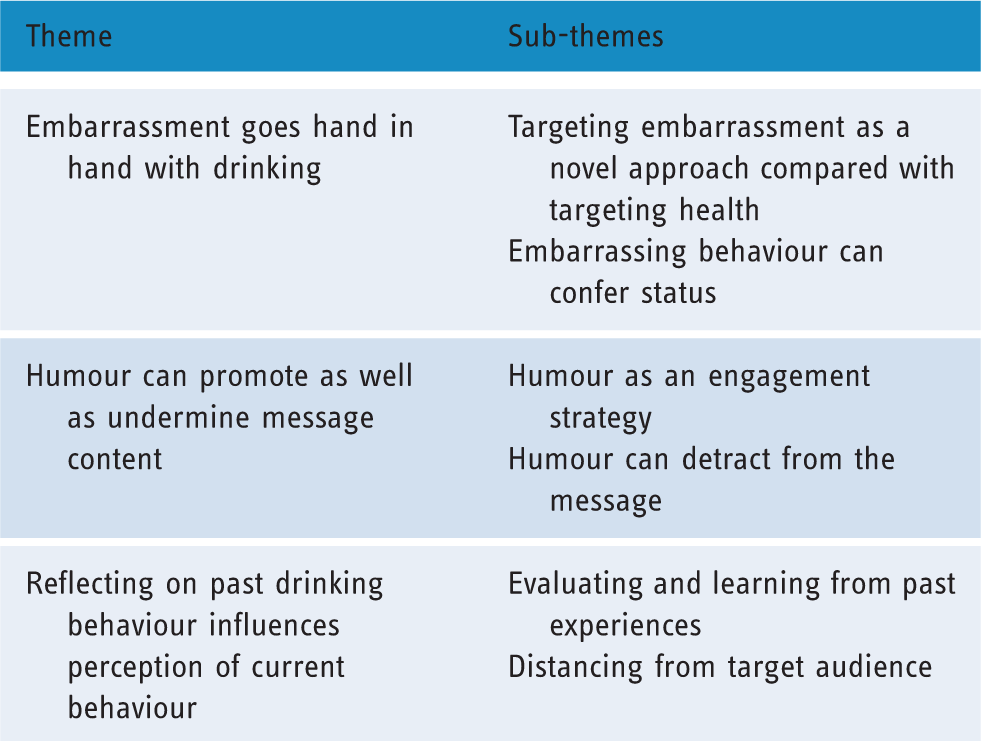
Main themes and sub-themes relating to the acceptability of OneTooMany.
Results
We identified three main themes relating to the research question within our analysis. Each theme had related sub-themes (see Table 1). Supporting quotes to evidence each theme and sub-theme are presented below. Participants' names have been replaced with pseudonyms and their ages are included, followed by UG to denote undergraduate student, PG for postgraduate and G for recent graduate.
Embarrassment goes hand in hand with drinking
The theme ‘Embarrassment goes hand in hand with drinking’ encapsulates the tricky relationship between social embarrassment and drinking. Findings suggested that embarrassing experiences were a normalised part of drinking occasions; while some were negative, and outcomes that participants would wish to avoid, some were also celebrated as shared stories in the days or weeks that followed. Participants compared the intervention content with information that they would expect to see on a website about alcohol, such as health risks, and this new focus appeared to be unexpected. Furthermore it was apparent that for these participants, embarrassment could go hand in hand with social drinking, and to a certain extent was an expected aspect of the night out. Furthermore, this embarrassment could be seen as a marker of social status/reputation.
Targeting embarrassment as a novel approach compared to targeting health
‘Collecting just the data [on units] kind of separates the person from their drinking habits, whereas I think this is much deeper’ (Becca, 22, PG).
It appeared that the feelings or the behaviours that resulted from drinking were cited as more relevant means of monitoring consumption. One reason that OneTooMany might have an advantage over interventions providing information about alcohol units or health is that participants were able to relate the information to their own lives. I think this is better [than other alcohol websites] I'm presuming because this is going to be [sic] give rise to actual stories or like incidents or anecdotes as opposed to a unit-based thing. I don't think many people have that many stories that begin with ‘hey I had 18 units last night’ (Jack, 22, PG).
Embarrassing behaviour can confer status
The one I'm thinking of, I fell in a bin and that got posted on Facebook. But that's the only time it's ever happened and you know what, rightly so, if somebody gets something golden like that on camera [Laughing] I deserve to be humiliated for that (Nikki, 21, G). ‘The embarrassing things are probably the things you remember for years to come anyway’ (Mark, 23, UG).
Taken together, this theme shows how a focus on the social consequences of drinking is likely to be more relevant to young people than a focus on health harms. It also shows that this approach needs to be cautious because there are clear short- and long-term social benefits of suffering some embarrassment whilst drinking.
Humour can promote as well as undermine message content
OneTooMany takes a light-hearted approach and provides respondents with their ARSE score, as outlined above. Findings relating to the humorous aspects of the intervention are drawn together in the theme ‘the role of humour’. It was apparent that there was a dual aspect to the jokey and light-hearted elements of the intervention. They seemed to serve as a device to engage and interest participants at the outset, and detract from serious issues arising from excessive drinking.
Humour as an engagement strategy
They were quite funny so sort of quite humorous so I did carry on with them. I was quite intrigued as to what the score was actually going to be and what the outcome was, because it's not like, it didn't feel like a test (Callum, 23, UG). I enjoyed this because it's really funny, you know. Um, it's just making a little bit of a joke out of um something that is quite serious, but as I say it it's tackling something serious in a very nice jokey and um young way (Nikki, 21, G). I think that's quite funny… because yeah you can wake up feeling like a total arse. But…yeah, I think…I like that it's something that's highlighting the negative side of that because there are there are [sic] always two sides to everything and at the time or other people may think that it's fun and it's you're being funny and it's you know all this hilarious story or all the rest of it but actually…it is embarrassing or slightly terrifying if you are so drunk that someone could've taken advantage of you. It's not just embarrassing it's actually quite dark (Tilly, 25, G).
Humour can detract from the message
You'd end up just talking about what happened in certain occasions and then everyone would be taking the mick out of each other so it wouldn't take it that seriously I wouldn't have thought … if I was to do it now with all my course mates it, it would funny [sic] whoever got the highest score (Mark, 23, UG). ‘Yeah I think it has a negative impact for maybe encouraging people to get a bad score, but then you’d get more people to actually take the survey’ (Matthew, 22, UG). I think that's definitely a different sort of attitude, it's almost like how bad are you is a good thing at that age, that's the issue. Extrovertly I’d say to my friends ‘oh, this is quite high’ and I’d be proud of it, but actually I’d be thinking um maybe that's not such a good thing inside (Samuel, 23, UG).
Reflecting on past drinking behaviour influences perception of current behaviour
Participants reported that reading through the questions was a prompt that led them to contemplate past behaviour and drinking experiences. This final main theme encapsulates both the negative stories that participants retold during the interviews, and the sense that these experiences played an important part in creating the present and future drinker identity, where past errors had resulted in learning to avoid harms. This reflection revealed a further challenge in that participants, even those who suggested they drank excessively, did not appear to see themselves as the target audience for this type of intervention.
Evaluating and learning from past experiences
‘You read the question and it instantly triggers in your mind a night out or experience that you’ve had’ (Henry, 21, PG). I think when you read it … you think to back to the nights you’ve messed up on and you kind of think ‘ah but I kind of wish I wouldn't do that’, cause I’m now rethinking the nights I’m trying to forget, if you know what I mean (Matthew, 22, UG). ‘It might make people think about their drinking um, I think perhaps just er just going through the questions is a period of self-reflection isn't it, it makes you um evaluate yourself a bit’ (Fraser, 30, UG). Even if it starts making people think about their actions, then you think ‘oh is it normal or is it not?’ and then, the ARSE score at the end … could work together to kind of make someone think ‘oh maybe I do need help’ or ‘maybe I do need to cut back on alcohol’ and then and then [sic] there's the link there that they could go to (Lucy, 21, UG).
Whilst it appeared that participants were not keen to repeat the majority, if not all, of the negative experiences they discussed, it seemed that they felt that some purpose had been served. Negative experiences were viewed as having learning outcomes that could be applied to future drinking. Tilly discussed a time that she had been separated from her friends during a night out and ended up going home with people she did not know: ‘And that it's all really terrifying looking back on it now. At the time you try and laugh it off but you don't quite realise how vulnerable you are I suppose’ (Tilly, 25, G). I've definitely had nights when I've gone way past the limit and I've ended up you know, but not in hospital or anything, but throwing everything up and it's just unpleasant. Um, but that's just, learned from your mistakes really and then you gauge how to have a good and successful night (Eva, 22, PG).
Distancing from target audience for intervention
‘I have got people in my life in comparison that are worse than me so I’m like “well I’m not them so I’m alright” ’ (Ellie, 23, G). I think it's aimed at more people that possibly have just started drinking or yeah so I don't know whenever they start drinking. But I don't know, I don't think it's going to necessarily change anyone's behaviours because people do what they do and usually people can't tell them any different (Georgia, 23, PG). ‘They’d probably rather actually speak to like a doctor or something if they're that worried about it, they wouldn't want just an online quiz to tell them how good or bad their drinking was’ (Mark 23, UG).
Discussion
The aim of this study was to explore the acceptability of OneTooMany, and to determine any features that might influence its effectiveness as a means of reducing alcohol consumption. Three main themes relating to these aims were identified during the analysis process. These themes were related to social consequences, the role of humour, and prompting reflection.
A focus on the embarrassing consequences of drinking appeared to be an acceptable means of engaging young people, in contrast to a focus on avoiding health harms or advice about low-risk drinking in terms of units. This is in line with other research that suggests these factors are not viewed as relevant to young people.6,8 It is important to acknowledge that that it is not just the drinking itself that is important when groups of friends socialise with alcohol. Drinking in this context involves a flow of fun activities around the drinking occasion and can add to the pleasure of socialising for young people. 14 Because the intervention focused on such social occasions, it appeared to relate well to the participants' experiences, leading them to recollect stories from nights out. Findings also suggested that participants were concerned with maintaining a good reputation amongst their peers. However, it appeared that being involved in an embarrassing situation might confer some status on an individual. In line with previous research, there was evidence that negative experiences were constructed as part of a good overall experience, 14 and that they may contribute to bonding among friendship groups. 25 Previous research also suggested that individuals who were less likely to feel embarrassment had higher levels of alcohol-related problems. 13
The use of humour was also an important aspect of the intervention, which could both enhance and detract from the overall message. Participants seemed to engage with the content because of the light-hearted nature of the website. Furthermore, it is possible that this could act as an entry point to more serious discussions about alcohol consumption. Some of the participants' comments revealed that, while embarrassing experiences might be valued by the friendship group, the individual may later reflect and regret them in private. Previous studies on anticipated regret appear to focus on the amount of alcohol consumed, rather than what actual consequences might be regretted. 26 Thus, the focus on social regret does appear to offer something novel here, and it would be helpful to explore this aspect quantitatively to gain an understanding of which experiences would be regretted to a greater extent than others.
Further research is also needed to explore which negative scenarios are seen as humorous and therefore sought out or valued in different friendship groups. Previous research has suggested a humorous value in stories that transgress social norms, 27 highlighting the need for careful consideration of message content. One possible means of achieving the aim of reducing alcohol consumption via a focus on embarrassment might be to highlight the importance of not becoming the person everyone else has to take care of, 14 thus reducing the chance of further funny memories being generated.
Reading through the intervention website appeared to prompt reflection on past drinking experiences among the participants. Indeed, some participants talked about occasions that they would much rather forget. This reflection might be uncomfortable, but, as suggested by other researchers, has the potential to encourage participants to think about how their drinking might have contributed and to influence future behaviour. 20 For many of the participants, there was a sense that they had learned from past experiences, and a suggestion that individuals had to undergo a certain amount of alcohol-related hardship in order to learn their limits. Perhaps because they felt they had learned from past experience, the participants appeared to distance themselves from being the target audience for the intervention. Individuals often tend to think that they drink less than average. 28 Other research suggests that when young people drink, they compare their behaviour favourably to that of other people, and therefore do not believe that they need to change. 29 Further research is needed to explore ways of encouraging young people to view their drinking in a realistic light for interventions to be appropriately targeted.
Overall, these findings have a number of implications for the further development of OneTooMany, as well as for other alcohol interventions aimed at young people. These findings suggest that targeting the socially embarrassing consequences of drinking alcohol might be an effective means of engaging with this population, and encouraging them to reflect on their behaviour. The use of scenarios that participants could relate to and the role of humour to engage them can be viewed as strengths. What is clear from these findings is that further research is needed to determine which scenarios convey the sort of social status to be actively encouraged or converted into positive narratives when considering the night out as a whole. This research should also determine the types of situations that may lead participants to reflect on the regrettable consequences of drinking alcohol. It is also apparent from other studies that some nationalities may be more concerned with the socially embarrassing consequences of drinking alcohol than others. 11 Thus, subsequent research should explore other experiences alongside embarrassment that might lead young people from the UK to reduce their drinking.
Limitations
This was a small qualitative study conducted on one university campus in the UK, and thus we make no claims for the generalizability of the findings. As disclosed on the study information sheet, participants were aware that the website was aimed at reducing excessive alcohol consumption, and that the researcher was involved in other studies with the same aim, thus they may have responded to her differently than they would have done to another individual not involved with alcohol-related research. Furthermore, detail included on the information sheet may have had an impact on the final sample, with individuals most at risk from their heavy drinking perhaps dissuaded from taking part. In this study we preceded the think aloud interview with some semi-structured questions and this timing may have influenced participants' responses to the intervention. Furthermore, as some of the scenarios were of a personal nature, it is highly possible that the participants may have felt uncomfortable discussing them with the researcher. In order to reduce researcher bias, we reviewed the transcripts and findings a number of times to ensure that we had represented the views of the participants in the study fairly, but we acknowledge that analysts not engaged directly with alcohol research may have interpreted the findings in a different way.
In summary, interventions designed to reduce risky drinking in young people may benefit from focusing on some of the short-term, embarrassing consequences of excessive alcohol consumption, rather than on reducing unit intake or health harms. Embarrassment is a common side effect of alcohol consumption, but it is apparent that it could sometimes be viewed as positive by some young people, and woven into the narrative of a night out. Using humour may be a good way to bring about engagement with alcohol interventions in a student population as long as this does not mask the behaviour-change techniques and become the sole outcome. Further research is also needed to ensure that reflections on past behaviour are helpful in addressing future behaviour, and not just chalked down to ‘experience’.
Footnotes
Acknowledgements
The authors are thankful to the participants for giving up their time. We are very grateful to Wakefield Morys-Carter for providing technical support with the website, as well as to Anna Smith and Charlie Stride for their help with transcription.
Contributorship
ED designed the study, conducted the interviews and the analysis, and drafted the manuscript. SH recruited the participants, searched for literature and contributed to the analysis. CL coded the interviews, drafted the method section and searched for literature. AW conceived the intervention and contributed to the manuscript. All authors contributed to and agreed on the final version of the manuscript.
Declaration of Conflicting Interests
AW is the founder and owner of the Global Drug Survey and developed OneTooMany.
Ethical approval
The study received ethical approval from Oxford Brookes University (study ref: 150944).
Funding
This project was funded by the Oxford Brookes University Central Research Fund.
Guarantor
ELD.
Peer review
The author has chosen for the two reviewers who peer-reviewed this article who have chosen to remain anonymous.