




Abstract
Promoting wellness within academia reduces disease frequency and enhances overall health. This study examined wellness factors among undergraduate students attending a research university (n = 85) or a small liberal arts college (n = 126). Participants were administered surveys which measured physical, emotional, social, intellectual, and occupational wellness. Significant institutional differences emerged on measures of physical and social wellness. When collapsed across academic institutions, students who were gainfully employed reported greater self-efficacy compared with unemployed students. Gender differences emerged on measures of physical and social well-being. Our findings support the need for targeted interventions that facilitate enhanced college student development and well-being.
The percentage of college students who report experiencing psychological distress, depression, and anxiety has greatly increased over the past decade (Burris et al., 2009; Eisenberg et al., 2013; Roberts and Danoff-Burg, 2010). In a recent survey (American College Health Association, 2015), 30 percent of students reported that stress and 21 percent reported that sleep difficulties negatively impacted their academic performance (e.g. lower grade or dropped courses). Furthermore, many college students regularly engage in unhealthy behaviors, placing them at risk for developing serious health problems later in life (Heller and Sarmiento, 2016; Hopper and Moninger, 2017; Scott-Sheldon et al., 2008; Tran et al., 2017; Turner and Shu, 2004). However, in a longitudinal study examining positive well-being and health outcomes, Hoyt et al. (2012) reported that positive well-being during adolescence predicted fewer risky health behaviors in young adulthood. Given the above findings, the assessment and promotion of wellness within the undergraduate student population are imperatives.
One of the overarching goals of the Healthy Campus 2020 initiative is to promote quality of life, healthy development, and positive health behaviors on college campuses (US Department of Health and Human Services, 2012). Furthermore, promoting wellness within academia reduces disease frequency and enhances both mental and physical health (Miller et al., 2008; Slavin et al., 2014). Moreover, wellness behaviors can be learned. Once internalized by the individual, holistic wellness can reduce issues related to somatization, psychoticism, and interpersonal sensitivity (Chandler et al., 2001).
This study was undertaken as an examination of wellness factors among undergraduate students attending a liberal arts or research institution. Although a variety of topics could be discussed in this context (e.g. happiness, meaning, and autonomy), we focused on several dimensions of holistic wellness (physical, emotional, social, occupational, and intellectual) as conceived by Hettler (1984). To date, studies that examine holistic wellness as a function of institutional type are scant. As the cost of higher education continues to rise, identifying factors that assist in student success and retention plays a vital role in the overall success of a given college or research university. We posit that holistic wellness contributes to student success, and the cultivation of wellness is a valuable institutional commodity.
Wellness concept
Wellness, as a concept, captures in many ways the broader definition of health. The World Health Organization (1948) redefined health to be a complete state of physical, mental, and social well-being, and not merely the absence of disease and infirmity. Shortly after, Dunn (1961) coined the phrase “high-level-wellness” to refer to a state of optimal health that included, a zest for life, sense of meaning and purpose, sense of social responsibility, developing ways to maximize an individual’s potential for well-being, and acquiring skills for adapting to the challenges of a changing environment.
Over the years, wellness has been conceptualized as a multidimensional phenomenon (Keyes, 2009; Miller and Foster, 2010; Myers et al., 2000; Myers and Sweeney, 2004). For example, Ryff (1989) posits the multidimensional model of psychological well-being, which comprises six distinct components. These include autonomy, environmental mastery, personal growth, purpose in life, positive relations with others, and self-acceptance. However, this model fails to incorporate the physical aspects of wellness and thus limiting usefulness in addressing wellness as a whole (Degges-White et al., 2003).
In this study, we used Hettler’s (1984) model of holistic wellness. This model was developed to promote wellness in university and community settings. It has been used to modify health behaviors in college students (Gieck and Olsen, 2007) and enhance prevention and treatment of diabetes (Klepac, 1996). Holistic wellness consists of six broad dimensions of health-related behaviors: Physical Wellness (e.g. diet, exercise, sleep, smoking, alcohol use, and personal hygiene), Emotional Wellness (e.g. self-identity and self-esteem), Spiritual Wellness (e.g. sense of peace and connectedness with the universe), Social Wellness (e.g. sense of community and social support), Occupational Wellness (e.g. job satisfaction), and Intellectual Wellness (e.g. creative stimulating mental activities).
According to Hettler (1984), a person who strives for holistic wellness is one who is aware of all aspects of wellness and consciously works to incorporate these elements into one’s daily life. In other words, the pursuit of wellness is a lifelong endeavor, and educational facilities are ideal settings for wellness promotion (Harrington, 2016; Miller et al., 2008). Regardless of the number of wellness dimensions, researchers agree that wellness is a multidimensional, positive, and affirming concept that has enormous practical and therapeutic benefits (e.g. Harrington, 2016; Hattie et al., 2004; Horton and Snyder, 2009; Meiselman, 2016).
Liberal arts and research institutions
Historically, small liberal arts colleges have proclaimed a distinctive mission by providing students with an educational experience which fosters intellectual openness, learning for their own sake, high-quality teaching, smaller class sizes, and frequent student–student and student–faculty interactions both in and out of the classroom (Bovillian and Murphy, 2013; Hanson et al., 2012; Pascarella et al., 2004; Seifert et al., 2008). A growing body of research in higher education suggests that students attending a small, private, liberal arts college are more likely to experience good practices in undergraduate education (e.g. effective teaching, active learning, and high academic expectations) compared to students attending other academic institutions (Hu and Kuh, 2003; Koblik and Graubard, 2000; Seifert et al., 2008). For example, liberal arts colleges were the first institutional type to implement Chickering and Gamson (1987) Good Practices in Undergraduate Teaching Model. This model identifies seven principles for good practices in undergraduate teaching (e.g. active learning, respect for diversity, student–faculty contact, and high academic expectations). Seifert et al. (2010) recently examined the degree to which first year undergraduate students attending a college (2 or 4 years) or a research university experienced these principles. For the most part, the experiences were similar, except for two principle outcomes: (1) good teaching and high-quality interaction with faculty and (2) academic challenge and high expectations. Moreover, they found that students who were less prepared for college (e.g. lower levels of parental education, academic motivation, and involvement in high school activities) tended to benefit the most from a liberal arts education. Although the findings are somewhat encouraging, this study did not assess other measures of student success such as emotional well-being.
Research universities, on the other hand, articulate a mission statement to discover, preserve, and disseminate knowledge as well as advance scientific and technological research (Jacobs and Hyman, 2010). As a result, undergraduate students are presented with a plethora of research opportunities which have been linked to increased confidence and awareness, increased cumulative grade point average, increased anticipation of a PhD, and clarification of interest in science, technology, engineering, and math (STEM) careers (Jones et al., 2010; Russell, et al., 2007; Walkington, 2015). Students and alumni surveyed at a research institution reported that working collaboratively with peers and faculty mentors engaged in research was important for developing skills and increasing their academic confidence (Levis-Fitzgerald and Denson, 2005). Similarly, Gilmore et al. (2015) recently investigated the associations between undergraduate research experiences and research skill performance, autonomy, collaboration, and motivation at the graduate school-level. They found the undergraduate research experience (e.g. design, data collection, and analyses) was associated with heightened graduate school performance in all research skills assessed. However, the examination of wellness factors as a measure of student success was not assessed.
Purpose of this study
Both research and liberal arts academic institutions are devoted to developing teachers, scholars, and other professionals capable of achieving and contributing to society-at-large. Despite these noble similarities, it is unclear how these academic institutions compare on measures of holistic wellness. Research suggests that wellness has a lifelong effect on academic, business, and individual success (Dolan et al., 2008; Gieck and Olsen, 2007; Horton and Snyder, 2009). According to Helliwell and Putnam (2004), the ultimate dependent variable is human well-being, and all other outcomes derive their importance. The primary purpose of this study was to examine differences in reported wellness in undergraduate college students attending a land grant research university or a small liberal arts college with a teaching mandate. To our knowledge, this is the first study to examine wellness within this context. Although this is a preliminary study, we expect differences to emerge between the two academic institutions.
Methods
Sample
A total of 211 undergraduate students attending a research university (n = 85) or a small, private liberal arts college (n = 126) located in the southeast participated in this study. Participants were recruited using word of mouth, and the majority of the participants were psychology majors. A total of 63 percent of the participants were female (n = 132), and the mean age was 22.4 years (standard deviation (SD) = 5.16). Of these, 87 percent identified as Caucasian, 7.1 percent as African American, 1.4 percent as Hispanic or Latino, 1 percent as Asian American, and 3.3 percent as bi-racial. The majority of the participants were upperclassmen (96%), and 57.1 percent of the participants were employed. Sample characteristics as a function of institution type are presented in Table 1.
Descriptive characteristics of participants as a function of institution type.

p < .05.
Measures
Demographic survey
We assessed all demographic variables (e.g. age, race, sex, and employment) using single items, which allowed participants to select from a variety of response options. Our wellness measures are as follows:
Physical Wellness—Health Behaviors. Diet and exercise were assessed using the modified Health Behavior Profile (Rice, 1992). This instrument consists of 14- items, and participants were asked to indicate how accurately each item describes their health habits. Responses range from 1 (never) to 5 (daily). High scores suggest that diet and exercise habits are fairly good. For this study, Cronbach’s alpha was .83.
Emotional Wellness—The Perceived Stress Scale. This scale (Cohen et al., 1983) was used to assess global non-specific stress levels during the last month. This survey comprised 14- items, of which 7 are positively formulated (e.g. In the last month, how often have you felt things are going your way?) and 7- items which are negatively formulated (e.g. In the last month, how often have you felt that you were unable to control the important things in your life?). This is a widely used instrument, and higher scores indicate greater stress levels.
Resilient coping
Coping was measured using the Brief Resilient Coping Scale (BRCS; Sinclair and Wallston, 2004). This is a four-item survey that was designed to measure an individual’s tendency to cope with stress in a positively adaptive manner. Participants were prompted to consider how well the items describe their behavior (e.g. I believe I can grow in positive ways by dealing with difficult situations) on a 5-point Likert scale ranging from 1 (does not describe you at all) to 5 (it describes you very well). Convergent validity was demonstrated on measures of personal coping resources and psychological well-being in two samples of rheumatoid arthritis patients. Cronbach’s alpha for this study met minimal standards (.70).
The Rosenberg Self-Esteem Scale. This scale (Rosenberg, 1965) assessed global feelings of self-worth or self-acceptance. This is a 10-item scale, and it is one of the most well used measures to assess self-esteem (Blascovich and Tomaka, 1991). It is rated on a 4-point scale from 1 (strongly agree) to 4 (strongly disagree). Scores lower than 15 are considered indicative of low self-esteem. This instrument reportedly has good test–retest reliability according to Fleming and Courtney (1984).
Social Wellness—Need to Belong. This scale assesses the degree to which respondents desire to be accepted by others, seek opportunities to belong to social groups, and react negatively when they are shunned, rejected, or ostracized (Leary et al., 2005). This is a 10-item scale, and participants responded on a 5-point scale ranging from 1 (strongly disagree) to 5 (strongly agree). Higher scores indicate a greater need to belong. In this study, Cronbach’s alpha was .92.
Intellectual Wellness—Self-Efficacy. The New General Self-Efficacy Scale (Chen et al., 2001) was used to measure an individual’s belief in their ability to meet task demands in a broad array of contexts. This is a short scale (eight items), and responses are based on a 5-point Likert scale where scores range from strongly disagree to strongly agree. High scores indicate higher general self-efficacy levels. According to Chen et al. (2001, 2004), the psychometric evidence for this measure is positive. Cronbach’s alpha was .88 in this study.
Occupational Wellness. For this wellness measure, participants were asked about their job status. Participants responded with yes or no to job status items such as full-time, part-time, or unemployed.
Procedure and data analyses
After obtaining informed consent, the survey package was administered during regular class time. All participants received extra credit, and this study was approved by both schools’ institutional review boards. The data were collected during the 2014–2015 academic year. All data were analyzed using SPSS version 21 (Cary, NC). To determine the differences between groups (e.g. institution type or demographic variables), analysis of variance (ANOVA) or chi-square was computed. To determine significant predictors of wellness, a standard multiple regression analysis was utilized. Effect sizes were also calculated where appropriate, and the alpha level was set at .05. Due to the poor psychometric properties for the measure of spiritual wellness, these data were not included in the current analyses.
Results
From a demographics perspective, we found no significant differences in age, F(1, 209) = .65, p > .05, or employment status, (1) = 1.45, p = .23, between the two institutions. However, significant gender, χ2(1) = 16.17, p = .000, and ethnic, χ2(1) = 7.25, p = .007, differences were found. The liberal arts group had a greater number of male and minority participants than the research institution group (see Table 1).
Table 2 presents the means and standard deviations for the study variables as a function of institution type. The one-way ANOVA revealed significant differences in reported levels of physical activity, F(1, 209) 21.37, p < .01; d = .66, overall health behaviors F(1, 209) 9.28, p < .01; d = .44, and belongingness F(1, 209) 6.42, p < 0.001; d = .36. Participants enrolled at the small liberal arts college reported higher physical activity levels and endorsed more health-related behaviors than college students attending the research institution. Moreover, students attending the research university reported a greater need to belong than their liberal arts counterparts. Collectively, the effect sizes for the analyses suggest a moderate effect.
Means and standard deviations for major variables as a function of institution type.

p < .01.
When collapsed across academic institutions, employment status as a measure of occupational wellness and gender differences were found. With regard to employment status, students who were gainfully employed reported greater self-efficacy, F(1, 209) 3.98, p = .04; d = .27, and endorsed a higher need for acceptance and belongingness than unemployed students F(1, 209) 3.74, p = .05; d = .26. However, employed college students reported less physical activity than their unemployed counterparts, F(1, 209) 4.87, p = .02; d = .30 (see Table 3). As expected, female students reported reduced physical activity levels, F(1, 209) 17.66, p = .00; d = .58, engaging in less overall health-related behaviors, F(1, 209) 9.12, p = .00; d = .42, and endorsed a greater need to belong, F(1, 209) 14.77, p = .00; d = .55, than their male counterparts (see Table 4). Collectively, the effect sizes for the analyses suggest a moderate effect.
Means and standard deviation for study variables as a function of job status (N = 211).
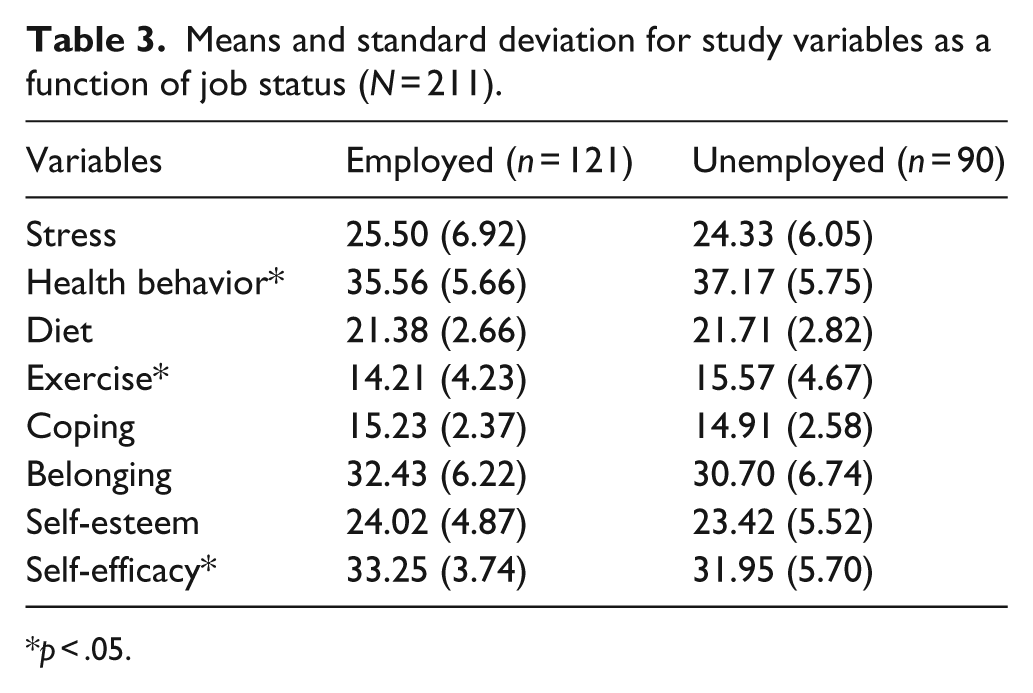
p < .05.
Means and standard deviation for study variables as a function of gender (N = 211).

p < .01.
We performed multiple regression analyses for the two wellness variables which were found to be significantly different between the two institutions. Both regression models had significant predictive powers: physical well-being, R2 = 11.8 percent, F(5, 205) = 5.49, p < .001, and social well-being, R2 = 11.7 percent, F(5, 205) = 5.42, p < .001. In predicting participants physical well-being (total score on health behavior scale), only self-esteem was a significant predictor (β = .304, p < .001), and it accounted for 12 percent of the variance. In predicting participants social well-being, only perceived stress was a significant predictor (β = .160, p = .042), and it also accounted for 12 percent of the variance in need to belong.
Discussion
In this study, we examined levels of holistic wellness between college students attending a research university and a small liberal arts college. Our results revealed few differences on measures of wellness; however, two significant differences did emerge from this cross-sectional design. First, students attending the small liberal arts college self-reported being more physically activity and subsequently, endorsed more overall health behaviors than their research university counterparts. It is plausible that these differences are due, in part, to gender effects. There were significantly more males in the liberal arts group, and the overrepresentation of females in the research group may have contributed to these differences. Research shows that physical activity levels are higher among men than women (e.g. Monin et al., 2015; National Center for Health Statistics, 2011). For example, Taliaferro et al. (2009) examined the association between physical activity and psychological well-being in college students. They found men were more likely than were women to participate in aerobic activity on a weekly basis. Indeed, when you collapse across academic institutions, males reported a significantly higher level of physical activity in this study. Furthermore, we found no significant differences between the groups (institutional type or gender) with regard to diet.
The above findings may also reflect a differential approach to stress management. Theory explaining gender-socialized behaviors has long placed instrumental traits (e.g. assertive and independent) in the men’s domain and expressive traits (e.g. dependence and care-focused) in the women’s domain (Bem, 1985; Grusec and Hastings, 2015; Shifren et al., 2003). Men may show their assertive behavior through action such as increased physical activity. However, women may demonstrate their expressive behavior through dependence on social relationships and increased belonging needs. Although instrumental and expressive trait behaviors are associated with stereotypical gender roles, some research suggests that men and women during emerging adulthood may utilize both traits when making decisions about health-related behaviors (Shifren et al., 2003). Young people identifying with the androgynous trait category may report greater physical activity than those identifying with feminine traits. Additionally, Sieverding et al. (2005) suggested that instrumental self-concept may play a role in college students’ response selections to stressors. Activity choices about management of stress in the college population are likely to be biased toward those traits most reinforced during early development.
Second, students attending the research university reported a higher reliance upon social acceptance (need to belong) compared with their liberal arts counterparts. According to Baumeister and Leary (1995), the need to belong is a fundamental human motive that reflects an individual’s subjective sense of connectedness with family, friends, and social memberships. More importantly, a high need to belong reflects a heightened motivation to be accepted by others and avoid being shunned. Again, it is plausible that this difference between the academic institutions is due, in part, to gender issues. In this study, the research group was overwhelmingly female. Indeed, when you collapse across institutional types, women endorsed a significantly higher need to belong than men. Our finding is consistent with previous research regarding gender difference with respect to belongingness or connectedness (e.g. Baumeister and Sommer, 1997; Good et al., 2012; Greenwood et al., 2013; Lee and Robbins, 2000; Townsend and McWhirter, 2005).
It is also plausible that a large research institution provides more opportunities for satisfying this fundamental need for acceptance and belonging. According to Tinto’s (1987) academic and social integration model of college student attrition, the need to belong is an important non-cognitive variable that is strongly related to academic success.
Therefore, individuals with a heightened inclusion need may be drawn to a research university as opposed to a smaller liberal arts college. Indeed, further studies are warranted to ferret out these findings. In this current investigation, we found that students who were gainfully employed reported greater self-efficacy and belongingness compared with their unemployed counterparts. Our findings are not surprising, and they are in line with previous research on the benefits of employment on well-being (Boreham et al., 2016; Dolan et al., 2008; Modini et al., 2016; Myers et al., 2000). According to Warr (1994), employment is associated with many positive benefits such as income, interpersonal contact, opportunity for control, opportunity for skill use, and valued social position, just to name a few. We also found that employed students engaged in less physical activity than their unemployed counterparts. Working, while attending college, is very demanding. Furthermore, it may be difficult to squeeze in an exercise time or a healthy meal under these time constraints. For college students, common barriers to exercise include other priorities, fatigue, no motivation, and lack of time (Ebben and Brudzynski, 2008; Greaney et al., 2009; Kulavic et al., 2013). However, Bhochhibhoya et al. (2014) found college students who reported higher levels of physical activity also scored higher on measures of emotional intelligence and mental health. Clearly, our single-item measure does not capture completely the construct of occupational wellness; further studies are warranted.
Finally, this study found self-esteem to be the best predictor of physical well-being, and perceived stress was the best predictor of social well-being. Self-esteem refers to the value we place on aspects of our self. Research shows that physical activity tends to positively influence our self-perception and consequently our self-esteem (Ahmed et al., 2017; Awick et al., 2017; Moore et al., 2011). For example, Schmalz et al. (2007) found higher physical activity early in life predicted higher self-esteem later in life in non-Hispanic girls. Likewise, a sense of belonging is a fundamental need that is often satisfied via friendships, social activities, and close relationships (Baumeister and Leary, 1995). A student’s sense of belonging is an important factor associated with academic success (Freeman et al., 2007; Good et al., 2012; Lam et al., 2015; Tinto, 1987). The college environment provides a myriad of opportunities for strengthening social ties and thereby satisfies this universal need to belong. It is not surprising that college students with a strong need to belong would seek out many of these membership opportunities (academic and/or social). Consequently, membership in too many organizations can lead to increased demands upon one’s time and energy. This increase in workload, in the absences of resources, can produce feelings of stress and burnout (Bakker et al., 2007; Schaufeli and Bakker, 2004). Future studies should examine the relationship between holistic wellness and membership in professional and social organizations among college students.
Limitations
Despite the relative strengths of this study, there are also limitations to consider. Our sampling method was nonrandom and may not be representative of colleges and universities in other parts of the country. In addition, this study was cross-sectional which eliminates cause and effect interpretations regarding the variables of interest. Moreover, our college student sample lacked diversity (e.g. ethnicity, gender, geographical region, and sexual minority). This prevented the inclusion of ethnicity and gender in intergroup analyses. For example, Spurgeon (2009) found Black males attending a historically black colleges and university (HBCU) scored significantly higher on wellness dimensions of friendship, love, sense of control, and gender identity compared to Black males attending the predominantly white institution (PWI). It is important that future studies recruit larger samples of males and minorities to examine critical differences in wellness components as a function of academic institutions. Our study did not examine wellness dimensions in students attending a community college. The inclusion of a community college group would provide a more complete examination of college student wellness. Likewise, employment status is an objective index of occupational wellness. However, this single item does not capture the construct in its entirety. Future studies should incorporate broader measures of wellness (e.g. spirituality) and correlate these self-reported measures with actual observable wellness behaviors.
Conclusion
The foundation for lifelong wellness is laid during the college years in which young adults learn to balance academic, financial, social, and health-related demands independently. The degree to which an individual can balance successfully these life challenges is a direct reflection of their level of wellness. Our findings highlight aspects of wellness which are a source of concern for both types of academic institutions. Although liberal arts colleges and research universities provide their students with wellness information via a stand-alone wellness center, classroom instructions, and/or website, the message may not be reaching the intended audience.
Footnotes
Acknowledgements
The authors would like to extend sincere thanks to Autumn Hill and Seth Green for providing technical assistance. This research study was presented at the 61st Annual Meeting of the Southeastern Psychological Association (2015) Hilton Head, South Carolina, USA.
Declaration of conflicting interests
The author(s) declared no potential conflicts of interest with respect to the research, authorship, and/or publication of this article.
Funding
The author(s) received no financial support for the research, authorship, and/or publication of this article.