




Abstract
Background:
The Kidney Research Scientist Core Education and National Training (KRESCENT) program was established to enhance kidney research capacity in Canada by providing salary support and specialized training for kidney researchers in Canada. This study is a qualitative evaluation to gain insight into participants’ experiences in the program.
Objective:
To explore participants’ perspectives of the KRESCENT program to (1) identify potential differences in perspectives between early and recent program cohorts and (2) understand perceived impact on participants’ career trajectory and professional development.
Design:
A qualitative interview study using semi-structured interviews.
Setting:
Semi-structured interviews were conducted online via Zoom.
Participants:
Individuals who have previously completed, or who are currently enrolled in the KRESCENT program.
Methods:
Participants were selected through purposive sampling, and semi-structured interviews were conducted to explore their experiences in the program. Data were analysed using thematic analysis in NVivo software.
Results:
Participants (N = 30; Mage = 41.2, SDage = 8.3, 53% Female) were interviewed, and the following emergent themes from the data were identified: (1) Navigating Expectations within KRESCENT, (2) Developing a Foundation for Success in Kidney Research, (3) Perceived Program Impact, (4) Fostering Multidisciplinary Collaboration and Diversity, (5) Considerations for Future Awardees.
Limitations:
The initial coding was conducted by a single researcher.
Conclusions:
This study highlights the long-term impact of the KRESCENT program on kidney research in Canada by exploring participants’ experiences and valued program elements beyond traditional career milestones. Findings emphasize that structured funding programs enhanced with opportunities for mentorship, networking, and skill development significantly support career advancement. These results reinforce the importance of continued investment in KRESCENT to build kidney research capacity and suggest that similar training models could benefit other health research fields.
Introduction
Chronic kidney disease (CKD) affects 850 million individuals worldwide, 1 exacerbating the burden of cardiovascular disease and diabetes, as well as contributing to global morbidity and mortality rates. In 2017, an estimated 4 million Canadians were living with CKD, and prevalence is continuing to rise. 2 Despite this, CKD can be prevented with the detection of early-stage kidney disease, allowing for timely treatment. Given the growing need for research and expertise in this area, the Kidney Research Scientist Core Education and National Training (KRESCENT) program 3 was launched in 2005 (currently in its 21st year of operation) with the goal of decreasing the burden of CKD on healthcare resources and increasing kidney research capacity in Canada. The KRESCENT program provides funding through its post-doctoral, new investigator, and allied health awards, and is distinctive in combining financial support with several mandatory training components. Notable aspects include career development sessions, problem-based modules, trainee presentations, and core lectures. To support career development, KRESCENT awardees are paired with program mentors who provide guidance and ensure that the program’s objectives are met. Through bringing together researchers from diverse career stages and backgrounds, KRESCENT fosters a multidisciplinary environment that promotes collaboration and knowledge exchange across the kidney research community. The following sections examine the program’s impact, highlighting its contributions to both individual researchers as well as the broader scientific community.
A preliminary program review in 2010 highlighted the program’s effectiveness by showcasing an increase in kidney research positions, greater success in securing grant funding, and higher rates of academic appointments among KRESCENT alumni. 4 Subsequently, a 2017 survey (N = 53) evaluating the program’s impact found that 79% of participating KRESCENT alumni received CIHR grant funding, and 76% of post-doctoral fellow awardees secured assistant professor appointments. Similarly, a bibliometric analysis showed that KRESCENT awardees had higher productivity, collaboration, and impact (average relative citations and average relative impact factor) at the post-doctoral level than non-awardees, further highlighting the program’s role in advancing kidney researchers’ careers. 5 Since then, KRESCENT’s popularity has continued to grow, becoming widely recognized as a cornerstone of kidney research training in Canada. As this program evolves, it is essential to continue to evaluate its effectiveness to ensure it meets the changing needs of participants.
Since 2010, KRESCENT has used surveys to collect participant feedback. 4 While beneficial, these may not fully capture participants’ experiences and attitudes surrounding the program. To gain a more comprehensive understanding of participant experiences with the KRESCENT program and its impact on career trajectory and outcomes, this study utilized qualitative semi-structured interviews to gather participant’s perspectives. The current study provides an in-depth evaluation of the KRESCENT program, gathering feedback on program experiences and outcomes using a qualitative descriptive design with semi-structured interviews.
Methodology
Study Design
The flexibility of the qualitative descriptive study design used here allows for the discovery of nuanced insights and themes, which can reveal areas of improvement and identify specific challenges that other research methods, like surveys, may not uncover. Semi-structured interviews allow for in-depth insights into participants’ perceptions, which may not be fully captured through quantitative methods. 6 At the same time, this approach ensures key topics are explored across interviews while allowing participants to guide the conversation and expand on experiences most relevant to them. This, in turn, allows for a more comprehensive and holistic understanding of both participants’ experiences and the program’s impact. The interview questions used in this study were co-developed with the KRESCENT team to ensure alignment with the program’s goals and to capture relevant participant experiences effectively. Thematic analysis was used to analyse the data, identifying recurring themes and patterns to provide a richer understanding of participants’ experiences. 7 Gathering this deeper understanding of participants’ experiences is crucial to suggest possible ways to refine and improve on current KRESCENT program offerings. Reporting was guided by the Consolidated Criteria for Reporting Qualitative Research (COREQ) guidelines and checklist. 8
Research Team Characteristics
The research team included an undergraduate student researcher (IP), doctoral student researcher (AC), faculty supervisor (TP), and two members of the KRESCENT Leadership Team (SH & AL). IP identified as male, and AC, JK, TP, SH, and AL identified as female. All researchers involved in data collection and analysis (IP, AC, & TP) were trained in qualitative research methodologies before study commencement, and AC, JK, and TP had previous experience conducting qualitative studies. JK, a post-doctoral researcher, contributed to manuscript preparation, and SH and AL collaborated with TP, IP, and AC to develop the initial interview questions and contributed to manuscript preparation. Notably, TP was a previous KRESCENT trainee (2011-2014), and given her areas of expertise and research foci, she was asked by the KRESCENT program leadership team to conduct this study.
Participant Recruitment and Sampling
We recruited participants from four categories based on their year of participation in the KRESCENT program: 2004-2009, 2010-2015, 2016-2021, and 2022-2024. Participants were selected using purposive sampling to ensure representation across key demographic variables within each category: award type (post-doctoral, allied health, new investigator), reported gender identity, and degree (MD, PhD). The KRESCENT program provided a list of all participants and their primary emails but was not directly involved in recruitment or contact. While TP had been casually acquainted with some individuals on the list of participants provided to the research team as a result of her participation in the KRESCENT program as a prior trainee, no recent relationship was established between the researchers and the participants, and all outreach was conducted independently by other members of the research team. This method aimed to provide a representative sample of KRESCENT awardees. Eligible participants included current or former awardees of the KRESCENT program. Once selected for inclusion in the study sample, participants were contacted by the research team via email to confirm interest in participating and were fully informed of the study’s purpose before agreeing to participate. Recruitment continued until no new themes or information emerged from the data, indicating thematic saturation, thus indicating that the sample size was sufficient to address the research question. 9
Consent to Participate
Written and verbal consent was obtained before each interview, and participants were given the opportunity to ask questions before proceeding. Participants were informed about the study’s purpose, their right to withdraw at any time without consequence, the voluntary nature of participation, limits to confidentiality, and confidentiality measures.
Data Collection
Interviews were conducted remotely via Zoom by IP. 10 Participants were asked to attend interviews in quiet settings away from non-participants. All interviews followed a semi-structured format and were video and audio recorded for transcription purposes. The interview questions were designed to target specific aspects of participants’ experience, focusing on career trajectories, experiences during the program, perceived impact on careers and academic appointments, and reflections on the program’s strengths and areas for improvement. The interview questions were extensively reviewed within the research team. The average interview duration was 32 minutes and 9 seconds. Following the interviews, the recordings were extracted from Zoom and uploaded into Echo360 11 to generate preliminary transcriptions. All transcriptions were manually reviewed and checked for formatting consistency and were corrected as needed by IP. No field notes were taken during the interviews, and participants were not consulted for further data review following the conclusion of the interviews. No repeat interviews were conducted.
Data Analysis
Transcripts were analysed using thematic analysis, selected for its flexibility and ability to provide a deep, nuanced understanding of participants’ experiences and perceptions of the KRESCENT program. 7 A hybrid deductive-inductive approach was used. The deductive framework was informed by the program’s learning objectives and evaluation priorities. This ensured that the analysis aligned with key areas of interest for the KRESCENT program. While this framework provided initial, high-level, categories for coding, the themes were generated from the participant’s responses. During coding, inductive techniques were used to identify sub-themes and ideas that extended beyond the predefined structure. This allowed for the inclusion of novel insights and experiences that were not anticipated. Data were coded in NVivo 14 12 which facilitated the organization of codes, identification of recurring patterns, and systemic comparison across participant interviews. Initial codes and themes were created inductively by IP and reviewed for consistency and refinement by the AC and TP. Themes were developed based on relevance and significance to participants’ experiences and were later discussed among the researchers to resolve discrepancies and refine interpretations.
Ethical Considerations
This study was approved by the University of Victoria Ethics Review Board (#24-0269). Each participant was assigned a unique identifier to ensure confidentiality, and all participant data was securely stored on a password-protected server, accessible only to the research team. Additionally, transcripts were generated using the University of Victoria’s Echo360 11 software, keeping recordings within the institution. After data processing, all recordings and transcripts were deleted.
Results
In this section, the derived themes are presented as main headings, with sub-themes listed within each (for further context, see also Supplemental Table 1 for a list of themes and sub-themes as well as sub-theme-relevant quotations). To contextualize and support each theme, direct quotes are included. Dates provided after each quote indicate the participant’s year range of participation in the KRESCENT program. All findings were reviewed for consistency with presented data.
Findings are based on interview data derived from 30 KRESCENT awardees (see Table 1 for participant characteristics). A total of 63 individuals were contacted via email and invited to participate. Of these, we did not have a valid email address for 10, and these individuals did not receive the invitation. Another 15 individuals received the invitation but did not respond. Five individuals interested in participating were not able to schedule an interview at a convenient time, and three of those interested were not included in the sample as thematic saturation had been reached prior to their participation. Thirty participants signed the study consent form and completed an interview. No participants who completed an interview withdrew from the study.
Participant Characteristics (n = 30).
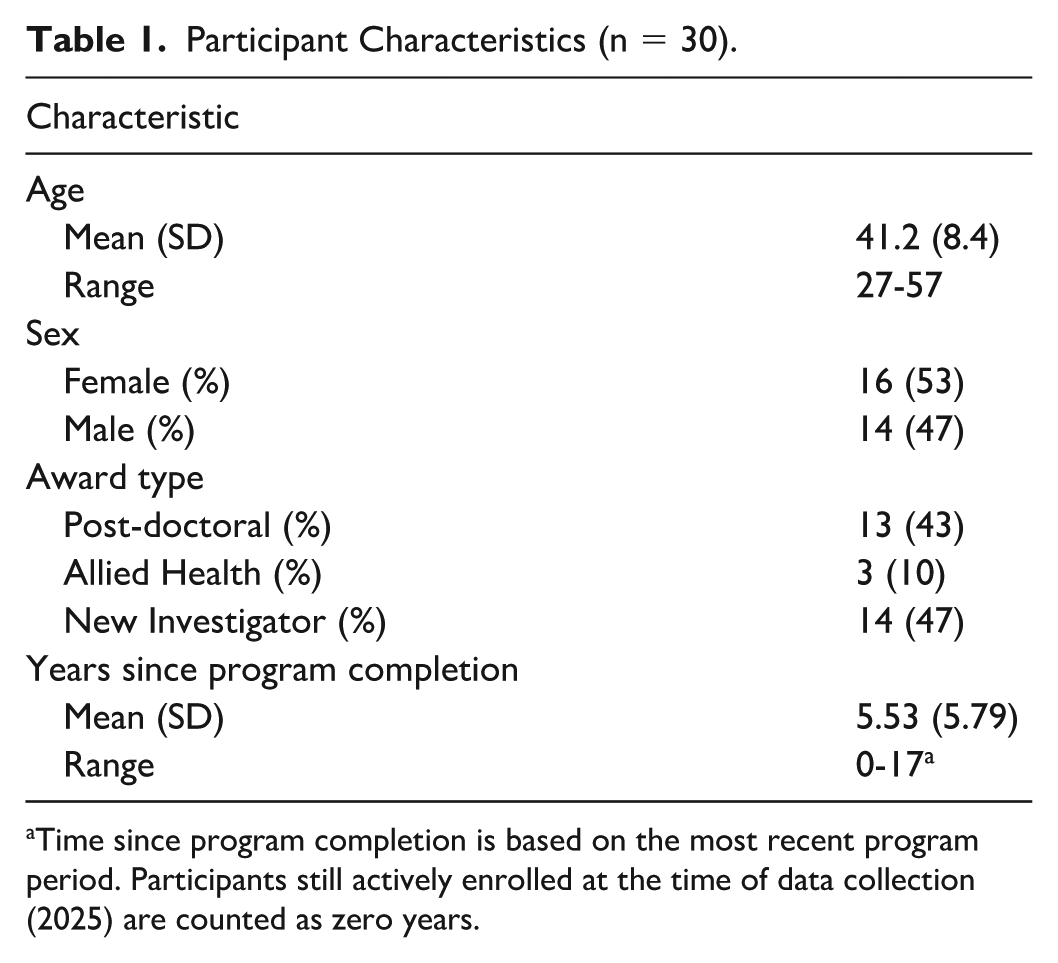
Time since program completion is based on the most recent program period. Participants still actively enrolled at the time of data collection (2025) are counted as zero years.
Theme 1: Navigating Expectations Within KRESCENT
This theme explores and compares participants’ initial expectations of KRESCENT. In the program’s early years, limited publicity may have led to uncertainty or lack of clear expectations among participants, whereas participants who joined in later years may have had clearer expectations due to increased awareness.
Financial support
As KRESCENT is a funding program, many participants applied primarily for financial support. For example, one participant expressed interest in the program “to support [their] salary and [they] thought that’s what/all KRESCENT would be” (Participant 19, who received their first award as a post-doctoral fellow between 2004 and 2009). However, as the program evolved, later awardees reported broader expectations.
Training/skill development
The program’s professional development opportunity, through its structured training and networking, became a standout feature. For instance, one participant acknowledged, “I knew there was a training component . . . but I didn’t have a sense of how intense it was or . . . to what extent it was going to contribute to [my] . . . career progression” (Participant 6—received their first award as a post-doctoral fellow between 2004 and 2009). Others expressed value in networking and joining because the program “brought together like-minded people from across Canada” (Participant 13—new investigator awardee, between 2010 and 2015, with other participants sharing similar sentiments). These reflections show KRESCENT’s benefit beyond a basic funding program.
Meeting expectations
While some expected only financial support, others were aware of training and networking opportunities. Many found the program exceeded expectations, with one participant stating that KRESCENT “promoted kidney-related research very well . . . [providing] networking, collaborations, mentorship, skill development” (Participant 22—new investigator awardee, 2004-2009). This underscores the unexpected value participants derived from KRESCENT. Similar sentiments were expressed by other participants across interviews regarding the program’s effectiveness.
Theme 2: Developing a Foundation for Success in Kidney Research
This theme explores how KRESCENT supported professional development and fostered success in kidney research. Career stage transitions, such as post-doctoral and new investigator roles, present challenges, including securing funding, obtaining academic appointments, and establishing research labs. These challenges can be daunting for early-career and established researchers alike.
Networking
Participants highlighted lasting connections formed through KRESCENT. One participant noted: “Through these collaborations and/or networks created by KRESCENT, it expanded my research focus and enabled me to collaborate or learn from others, which I couldn’t do alone” (Participant 19—post-doctoral fellow, 2004-2009). These opportunities broadened networks and research scope. Another participant emphasized the network’s longevity: “It doesn’t go anywhere. We can tap into it for life” (Participant 8—allied health awardee, 2010-2015). These relationships are crucial for collaboration, mentorship, funding, and career advancement.
Mentorship
Mentorship provides guidance, skill development, and confidence to navigate challenges. KRESCENT offered both formal mentorship from leaders and informal peer mentorship. Several participants highlighted this approach as especially valuable. As one participant noted, “The most useful part was mentorship by designated individuals, as well as people concurrently in the program or met through it” (Participant 25 - post-doctoral fellow & new investigator awardee, 2016-2021). This combination of support was seen as particularly important as it provided participants with role models and additional support beyond scheduled mentorship meetings, fostering ongoing guidance and career development.
Skill development
Transitioning into careers at varying levels requires foundational and translational skills. KRESCENT’s structured curriculum, including workshops and training, equipped participants with these critical tools. This was captured by a participant who expressed that “having those key skills, such as grant writing, how to write a manuscript, how to review a manuscript, those are very important skills that will help me in terms of launching a career but also hopefully being successful” (Participant 7—post-doctoral fellow, 2022-2024). These skills were seen as not only supporting immediate success in the program but also providing long-term career advantages.
Patient partner interactions
Over the program’s development, KRESCENT has increasingly integrated patient perspectives. One participant emphasized their value, stating: “We’re sitting there with patient partners or with people whose family member has been through a major issue with their kidneys, so they’re constantly asking questions like, ‘What is this going to do’” (Participant 29—new investigator awardee, 2022-2024). This direct engagement with patient experiences provided crucial real-world insights.
Theme 3: Perceived Program Impact
Assessing the perceived impact of the KRESCENT program is essential to understand how well it prepares early-career researchers with the skills, knowledge, and support needed for success. Participants highlighted key aspects such as program effectiveness, work-life balance insights, career advancement opportunities, and the need for increased career navigation support. Their experiences reveal the program’s strengths as well as areas for improvement.
Meeting program goals/program value and outcomes
Understanding participants’ perspectives on both the program’s effectiveness for their individual growth and its success in achieving broader goals provides valuable insights into KRESCENT’s impact. One participant reflected: “The overarching goal and framework of KRESCENT is to promote clinicians and scientists from diverse backgrounds to become . . . independent leaders in nephrology research across Canada internationally, and I think the proof is in the pudding if you look at the trainees” (Participant 25 - post-doctoral fellow & new investigator awardee, 2016-2021). This participant’s emphasis on both individual leadership growth and collective trainee outcomes, consistent with others’ reflections, suggests that KRESCENT is successfully fostering personal career advancement while strengthening the broader nephrology research community.
Career advancement and academic opportunities
KRESCENT supports career progression through training, mentorship, and networking, which are critical for securing academic positions in nephrology. This was reflected frequently, including one participant who stated: “[KRESCENT] changed my life. I wouldn’t be doing what I’m doing now without it” (Participant 8—allied health awardee, 2010-2015). Another noted: “It made me more comfortable thinking about applying for academic roles because I’d learned about application packages, hiring committee expectations, and interview processes” (Participant 6—post-doctoral fellow, 2004-2009). These reflections underscore the program’s role in shaping academic career paths.
Need for increased support and career navigation
While KRESCENT advanced many participants’ careers, some voiced the need for more guidance in long-term career navigation. One participant suggested that “another thing where KRESCENT would be helpful [is] to help people . . . go through the academic appointment and . . . help them navigate . . . through it all. . . [how to] negotiate salary or negotiate clinical time versus research time and negotiate a research budget” (Participant 30—post-doctoral fellow, 2023-2026). Another reflected that “there are many things I’ve learned over time, but it would be a great help if somebody would [have] told me those things” (Participant 17—post-doctoral fellow, 2016-2021), referring to practical aspects of career development, such as how to write application letters, reach out to potential mentors, and apply for positions or funding. This contrast highlights the program’s instrumental role while identifying opportunities for enhanced long-term support.
Theme 4: Fostering Multidisciplinary Collaboration and Diversity
This theme explores KRESCENT’s efforts to build an inclusive community by uniting participants from diverse career, ethnic, and cultural backgrounds. These diverse cohorts broaden perspectives in nephrology and encourage cross-disciplinary collaboration across the four health pillars.
Multidisciplinary collaboration
A multidisciplinary approach fosters diversity in career backgrounds and stages, aligning with KRESCENT’s goal to increase kidney research capacity. By uniting researchers with diverse skills, this model promotes comprehensive understanding, enhances knowledge translation across the four health pillars, and strengthens cross-disciplinary collaboration. Early participants identified career diversity as an area for improvement, but newer trainees now view it as a program strength. As KRESCENT nears its 21st anniversary, one participant observed that “there [are] more basic scientist[s] in . . . the program that . . . joined recently” (Participant 14—new investigator awardee, 2022-2024), highlighting the program’s expanding reach. KRESCENT’s intentional inclusivity has become a key strength, with another emphasizing “one of the key strengths of the program, I think, is that there’s an effort to be inclusive and all-encompassing” (Participant 29—new investigator awardee, 2022-2024).
Ethnic diversity
KRESCENT has taken steps to incorporate equity, diversity, and inclusion (EDI) within its program by fostering a diverse research community and acknowledging barriers that some individuals may face. As one participant noted: “KRESCENT does a very good job of identifying EDI . . . and barriers . . . both within and outside the program” (Participant 25 - post-doctoral fellow & new investigator awardee, 2016-2021). These efforts are reflected in KRESCENT’s diverse cohorts.
Ongoing barriers
While KRESCENT has made significant progress in fostering inclusivity, challenges remain in achieving full representation across academia. Participants who identified as belonging to a minority group described persisting barriers, with one sharing: “When you go . . . any place and you are a minority . . . it’s not like you feel bad, but sometimes you can feel it” (Participant 14—new investigator awardee, 2022-2024). This comment referred not to the program itself but to the broader academic environment and feeling like they are the only person of their background in the room or facing unspoken assumptions. Even within this diversity-focused program, some reported moments of isolation due to their backgrounds.
Theme 5: Considerations for Future Awardees
This theme captures advice from KRESCENT awardees to future participants. Their insights reveal the program’s strengths and challenges while helping future trainees prepare. Participants emphasized fully engaging with opportunities like networking, mentorship, and skill-building.
Taking advantage of opportunities
Networking was highlighted as invaluable. Participants urged trainees to connect with peers and mentors for guidance and long-term support. Awardees also stressed the importance of committing to the curriculum’s skill-building, with one participant advising to “take advantage of the opportunity to build those networks and to meet people and learn from others”
(Participant 1—post-doctoral fellow, 2004-2009). Another participant added: “the world of research is so hard, so . . . it’s good to have mentorship, to get networking and collaboration” (Participant 23—New Investigator, 2010-2015).
Developing a successful application
Given the program’s competitiveness, participants shared application advice. Participant 20 stressed aligning with broader research priorities: “try to see the big picture . . . what are the research priorities of the Kidney Foundation . . . and how can you help . . . compared to what is already being done.” Participant 18 emphasized focusing on growth: “Don’t worry too much about ‘what do I need to do to sort of satisfy KRESCENT,’ but think about . . . what do I need to do to enhance my own career . . . Chances are that the KRESCENT metrics are [going to] be very similar to those metrics.”
Discussion
This study aimed to better understand how the KRESCENT program has shaped participants’ careers, assess whether the program is meeting its goals, and to identify key strengths and areas for improvement. As a national initiative striving to develop kidney research capacity in Canada, the KRESCENT program plays a key role in shaping the next generation of kidney researchers, clinicians and healthcare professionals. By evaluating its impact, this study provides program administrators with insight into the strengths and limitations of the KRESCENT program, helping to validate effective components and inform future development.
We conducted semi-structured interviews with 30 participants and highlighted several key areas of focus, including expectations versus outcomes within KRESCENT, success factors in kidney research, and the importance of collaboration and diversity. Additionally, participants provided insights on the program’s impact and considerations for future awardees. Participants expressed that the KRESCENT program had a significant, positive impact in advancing their career and preparing them for a future in kidney research and related work. Skill development, networking and collaboration opportunities, mentorship, and diversity were regarded as highly impactful and important for future awardees.
Key Findings
Fostering career development
The findings from this study suggest that KRESCENT has had a significant impact on awardees’ career development in multiple ways. Participants consistently described networking, mentorship and skill development as the most important aspects of KRESCENT that helped them with their career. Many awardees with academic appointments expressed feeling that the KRESCENT program had helped them, in one way or another, with being competitive for the position or in securing the position. Individuals who did not pursue an academic position also expressed feeling that KRESCENT contributed to advancing their career and their ability to contribute to kidney research in a meaningful way, whether it was in clinical work or industry. These findings align directly with the program’s goal of fostering career development, as participants felt well-supported in their professional growth, leading to tangible career advancements.
Promoting interdisciplinary collaboration and creating a research community
Another key goal of the KRESCENT program is to strengthen the kidney research community by fostering interdisciplinary engagement and cultivating a strong sense of belonging among trainees and researchers. Consistent with this goal, participants highlighted the value of the diverse and multidisciplinary environment present in the KRESCENT program. This allowed them to interact and engage with leading researchers and emerging scientists from various backgrounds in nephrology. This level of relationship development and exchange of knowledge is unique to the program, creating opportunities and connections that may not have occurred otherwise. These relationships are fundamental to establishing a stronger sense of community outside of an individual’s area of expertise. This reflects KRESCENT’s efforts and success in achieving their goal of building a collaborative research community and promoting interdisciplinary work. It shows how the program created opportunities for participants to connect, share knowledge, and form valuable networks within the kidney research field. These efforts have had a lasting impact and fostered ongoing collaboration, strengthening the ties within the nephrology community in Canada.
Emphasizing the importance of EDI helps to create a representative and supportive research environment, which has shown to increase innovation, quality of research outcomes and innovation. 13 These participant experiences highlight that, while KRESCENT has implemented and strived towards inclusive practices, systemic inequities in academia and healthcare, more broadly, continue to affect underrepresented groups, underscoring the need for continued efforts beyond just the KRESCENT program to create more impactful change. 14
Implications
The themes identified highlight the program’s role in building and strengthening the kidney research community. Through its efforts, participants report gaining valuable knowledge and skills that not only advance their individual careers but also contribute to fostering a collaborative and supportive environment for kidney researchers and healthcare professionals, focused on kidney-related work.
There are many aspects of KRESCENT that differentiate it from other programs and awards that provide only funding for awardees. One key factor is networking and collaboration and its impact on participants. In turn, this influences nephrology research in Canada. An important aspect to effective networking and collaboration is bringing together people from different areas within nephrology and Canada. There are several ways that KRESCENT achieves this, such as bi-annual meetings, workshops, and homework exercises. Most importantly, bi-annual meetings create an in-person environment where participants can develop professional and personal relationships, both within and outside of the program. This leads to friendships that go beyond professional relationships and helps to build a sense of community. The workshops and exercises that participants complete in the curriculum also encourage collaboration. This contributes to interdisciplinary research opportunities, long-term professional relationships, and access to a research community. Overall, these factors strengthen the research network in nephrology throughout Canada, ultimately leading to more innovative research, development of clinical solutions, and improved patient outcomes.
Participants identified that mentorship was important for their development, success throughout the program, and in preparation for their future careers. Mentorship was primarily provided through assignments with the leaders of the program. Participants also expressed receiving mentorship and guidance from more experienced peers in the program, highlighting the benefits of learning from those who have established themselves in the nephrology field and have already navigated the early stages of their careers. Mentorship from those further along similar career paths was seen as invaluable for navigating early career decisions and building a foundation for long-term success, with several participants expressing a desire for more frequent and meaningful interactions with mentors to strengthen these relationships and enhance the support they receive.
Skill development was a consistent theme in participants’ experiences. When interviewed, participants highlighted how the program equipped them with critical skills for success in kidney research, including writing grants and papers, presentation skills, and gaining expertise in areas such as kidney research, lab management, and career development. Participants reported that these skills were translated directly into their careers. This indicates that participants are developing skills and feel confident applying them in the future. Not only are individuals supported in their growth, but the broader research community is strengthened by preparing awardees to take on leadership roles and successfully navigate the challenges of conducting impactful research.
Strengths and Limitations
The semi-structured approach is one of the key strengths of this study, as it allowed for a structured yet open-ended way to approach participant experiences with the KRESCENT program. The interview questions were developed in collaboration with KRESCENT, ensuring that the interviews covered key topics including career impact and program experiences. Additionally, measures were taken to balance participants on demographic information. To achieve this, we recruited a sample balanced based on year of participation, award type, and degree. This ensured that our sample was representative of KRESCENT awardees and that the feedback was gathered from different time periods within the program’s duration.
Given the nature of this study, certain limitations should be considered when interpreting the findings. One limitation of our methodology is that the initial generation of codes and preliminary themes was conducted by one researcher. Having one primary researcher analyse the data limits in-depth interaction with the data. However, inter-rater reliability checks were conducted throughout the analysis process. Initial codes were reviewed by a second researcher, and the refinement of finalized themes and sub-themes underwent a collaborative process with input from all researchers involved in the study. Nonetheless, future studies using a thematic analysis approach could address this possible limitation by involving multiple researchers in the initial coding process and conducting inter-coder agreement checks to ensure consistency in theme identification.7,15 This may help further mitigate the potential for bias emerging due to initial coding relying on a single researcher’s perspective. As the nephrology landscape and career development needs continue to evolve, periodic evaluations of the KRESCENT program are essential to ensure it continues to support awardees and adapt to emerging challenges. Timing these evaluations to reflect the program complexity and changing contexts allows for continuous improvement and sustained relevance. 16
Conclusion
Together, these findings highlight ways that the KRESCENT program has supported growth in kidney research and underscore its long-term impact on the kidney research community in Canada over the last 20 years. Previous literature examining the KRESCENT program has primarily focused on quantifiable career outcomes, such as awardees’ success in obtaining academic positions, securing grant funding, and building professional networks. These studies used surveys and bibliometric analyses to compare KRESCENT trainees with non-funded applicants to highlight the program’s effectiveness in career advancement.4,5 While past research focused on career milestones, the present study offers a more nuanced understanding of the KRESCENT program by exploring participants’ reflections on what they valued most, how they felt about their experience, how the program has changed over time, and what elements they saw as most important to their long-term success. Importantly, KRESCENT demonstrates that structured training programs, which emphasize mentorship, networking, and skill development, provide significant benefits for career advancement, in addition to offering financial support. The findings from this study highlight the effectiveness of structured research training programs like KRESCENT in fostering career development. Given these benefits, similar models could be adapted to other areas of health research to strengthen research capacity and improve health outcomes in different fields. With the burden of kidney disease in Canada growing, continued KRESCENT funding is essential to further develop and increase kidney research capacity in Canada.
Supplemental Material
sj-docx-1-cjk-10.1177_20543581261434652 – Supplemental material for Evaluating the Kidney Research Scientist Core Education and National Training (KRESCENT) Program: A 20-Year Qualitative Thematic Analysis
Supplemental material, sj-docx-1-cjk-10.1177_20543581261434652 for Evaluating the Kidney Research Scientist Core Education and National Training (KRESCENT) Program: A 20-Year Qualitative Thematic Analysis by Ian D. Petula, Alison F. Chung, Jamie E. Knight, Sunny Hartwig, Adeera Levin and Theone S. E. Paterson in Canadian Journal of Kidney Health and Disease
Footnotes

Funding
The authors disclosed receipt of the following financial support for the research, authorship, and/or publication of this article: This work was supported by the Canadian Institutes of Health Research [179724]. All of Dr. Paterson’s research is supported by her Michael Smith Health Research BC Scholar Award [SCH-2022-2664].
Declaration of Conflicting Interests
The authors declared the following potential conflicts of interest with respect to the research, authorship, and/or publication of this article: Sunny Hartwig and Adeera Levin are both members of the KRESCENT Leadership Team. Theone Paterson was a previous KRESCENT Trainee.
Data Availability Statements
Given the personal nature of interview transcripts and the likelihood that individual participants’ identities could be determined through review of these transcripts, these data are not accessible to those outside the study team.
Supplemental Material
Supplemental material for this article is available online.
References
Supplementary Material
Please find the following supplemental material available below.
For Open Access articles published under a Creative Commons License, all supplemental material carries the same license as the article it is associated with.
For non-Open Access articles published, all supplemental material carries a non-exclusive license, and permission requests for re-use of supplemental material or any part of supplemental material shall be sent directly to the copyright owner as specified in the copyright notice associated with the article.
